Tibet

Tibetan monk sets self on fire in China, dies

Chinese security officers proceed to beat and kick the monk in question, compelling hundreds of monks to protests

  • more
    • All Share Services

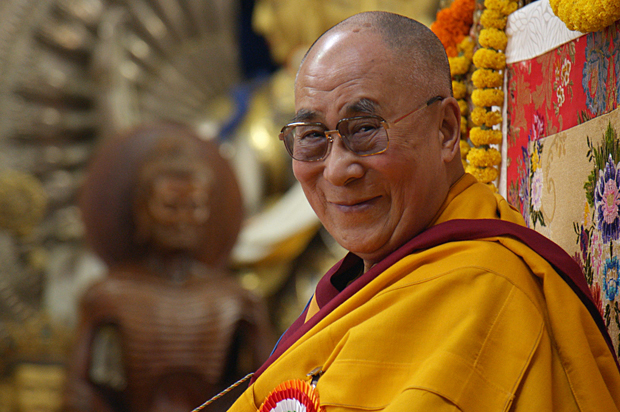
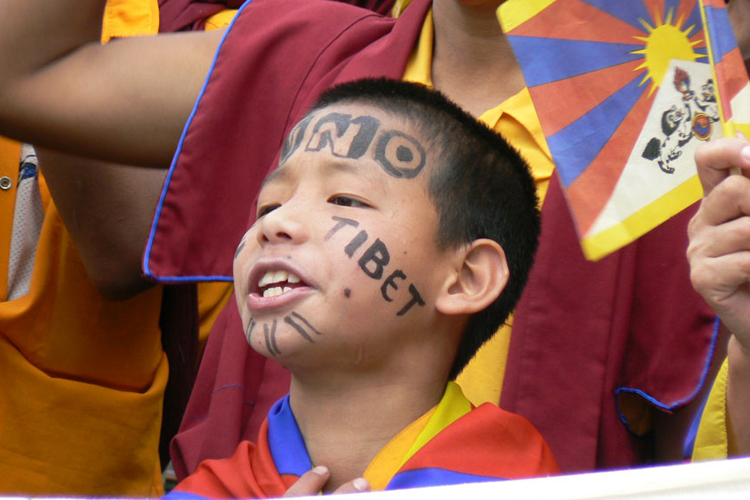
Tibetan monk sets self on fire in China, diesTwo Tibetan monks share a moment. This month marks the third anniversary of 2008's Tibetan uprising.

A Tibetan monk in western China set himself on fire in an anti-government protest, then was beaten and kicked by police, prompting hundreds of monks and others to rally, an exiled Tibetan monk said. A state news agency said the monk died Thursday.

The 21-year-old monk, Phuntsog, who like many Tibetans goes by only one name, set himself on fire Wednesday afternoon on a main street near the Kirti monastery in Aba town, in Sichuan province, said Kusho Tsering, a monk now living in Dharmsala, India.

The official Xinhua News Agency cited an unidentified county government spokesman as saying the monk died early Thursday, more than 10 hours after the self-immolation, because monks refused to let police take him to a hospital.

The exile’s account highlights simmering tensions in Tibet and Tibetan-inhabited regions in western China amid several anniversaries this month, including the March 10 anniversary of the unsuccessful revolt against China that caused the Dalai Lama to flee in 1959. Aba county has for years been the scene of large protests involving hundreds of monks and citizens.

“The monks in the Kirti monastery are always trying to find ways to protest against Chinese rule in Tibet,” Tsering, who is from the same monastery, said late Wednesday. “It’s an obvious way to show the resentment of the Tibetan people.”

Within 15 minutes of the monk’s self-immolation, police and plainclothes security officers turned up and extinguished the fire, but also beat and kicked the monk, Tsering said.

Angered by the beating, monks and Tibetan residents carried the monk back to the monastery, then marched along the main street before police intervened, said Tsering, who added he received the information from two eyewitnesses and two residents.

Tsering said he did not know Phuntsog’s condition late Wednesday. He spoke in Tibetan to The Associated Press by phone, with the help of an International Campaign for Tibet researcher in Dharmsala who translated.

Xinhua said the Aba county government spokesman blamed Phuntsog’s death on delayed treatment, saying fellow monks hid Phuntsog in the Kirti monastery until 3 a.m. before police took him to a hospital. The report did not mention any protest by monks and others.

A woman surnamed Yang from the media department of Aba County’s Communist Party said she was not aware of the case. When told that the state news agency Xinhua had reported it, she replied: “That’s impossible.”

Wednesday marked the three-year anniversary of what Tibetan activists and residents have described as a bloody crackdown by police on a large demonstration at the same Kirti monastery. It came just days after rioting that broke out in the Tibetan capital of Lhasa on March 14, 2008, which left 22 people dead and led to the most sustained Tibetan uprising against Chinese rule in decades.

China says Tibet has always been part of its territory, but many Tibetans say the Himalayan region was virtually independent for centuries and that Beijing’s tight control is draining Tibetan culture and identity.

Dalai Lama steps down as Tibetan political leader

The spiritual leaders deferral of power to the Tibetan prime minister marks an assertive mood toward autonomy

  • more
    • All Share Services

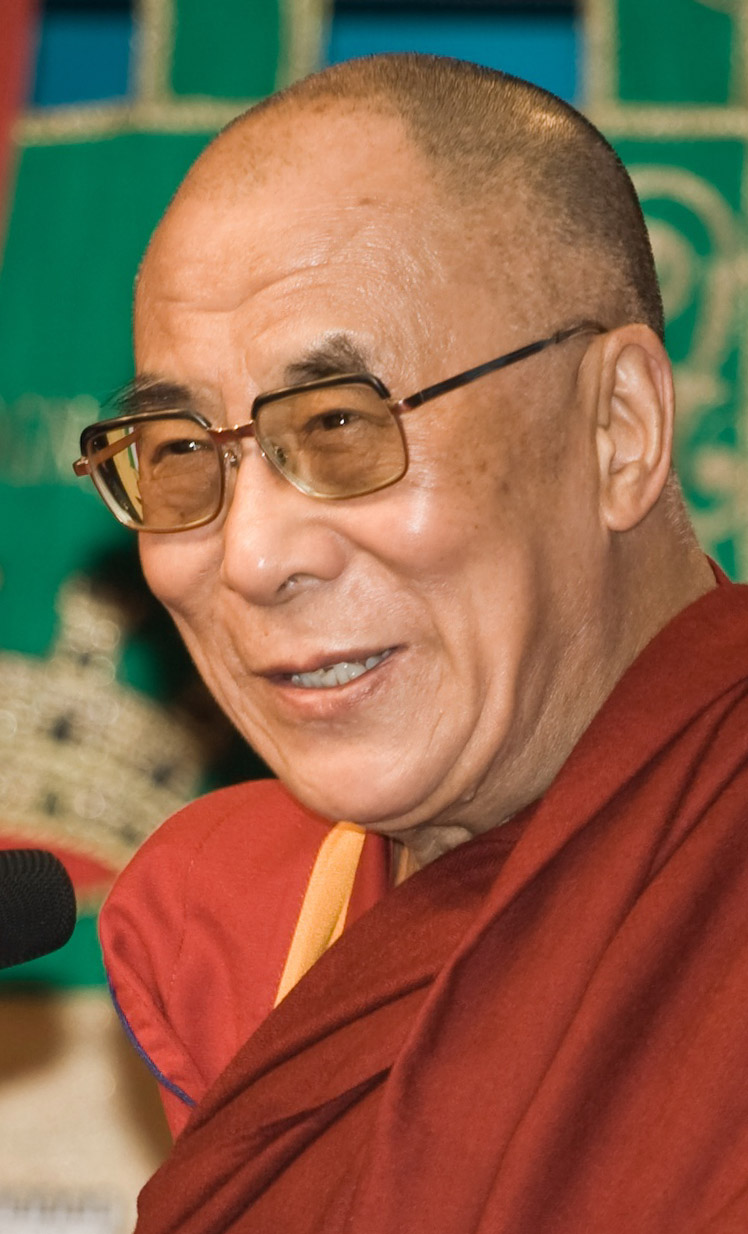
Dalai Lama steps down as Tibetan political leaderThe 14th Dalai Lama, Tenzin Gyatso in 2007(Credit: Luca Galuzzi)

The Dalai Lama said Thursday that he will give up his political role in the Tibetan government-in-exile and shift that power to an elected representative, as the 76-year-old Tibetan Buddhist spiritual leader struggles with growing worries about who will succeed him when he dies.

Speaking on the anniversary of the failed 1959 uprising against Chinese rule in his Himalayan homeland that sent him into exile, the Dalai Lama said the time had come “to devolve my formal authority to the elected leader.”

While he has long said that he wants the exile government to take on some of his powers, Thursday’s announcement appeared to mark the beginning of a countdown. The Dalai Lama said he would propose amendments to the exile constitution during the parliament’s next session, which begins March 14 in this Indian hill town where the exiles are based.

A new prime minister will be elected a few days later, and the timing indicates the Dalai Lama may want that premier to take up his political duties. Any Tibetan who has registered with the government-in-exile is allowed to cast a ballot; most of the electorate is made up of exiles.

The Dalai Lama is believed to be in fairly good health, but China’s continued heavy-handed rule over Tibet has made the succession question all important within the Tibetan community.

Beijing vilifies the Dalai Lama as a political schemer, has negotiated only fleetingly with his representatives and made clear that it intends to have the final say in naming his successor when he dies.

Not surprisingly, Thursday’s announcement was met with derision in Beijing.

Talk of retirement “are his tricks to deceive the international community,” said Chinese Foreign Ministry spokeswoman Jiang Yu, who called him “a political exile under a religious cloak now engaged in activities aimed at splitting China.”

In Dharmsala, the Dalai Lama said he had been repeatedly urged by followers to retain his political powers, which range from approving legislation to giving oaths of office, but said the community needed a leader “elected freely by the Tibetan people.”

The shift in power will “benefit Tibetans in the long run. It is not because I feel disheartened,” he said.

But the Dalai Lama’s power and influence go far beyond the exile constitution, and it was not clear what change amendments would bring.

Despite more than a half-century in exile, the Dalai Lama is still revered by most Tibetans as their traditional king and spiritual leader. Many worship him as a near deity. He is the 14th person to hold the title in a tradition stretching back 500 years, with each Dalai Lama chosen as a child by senior monks through a series of mystical signs. Each is believed to be the reincarnation of his predecessor.

The current Dalai Lama has indicated his successor would come from the exile community. Beijing, though, insists the reincarnation must be found in China’s Tibetan areas, giving the Communist authorities immense power over who is chosen.

Many observers believe there eventually will be rival Dalai Lamas — one appointed by Beijing, and one by senior monks loyal to the current Dalai Lama.

The reverence for the Dalai Lama was apparent just after his speech, when exile Prime Minister Samdhong Rinpoche met with reporters.

“Despite His Holiness’ request, the people and the government do not feel competent to lead ourselves,” he said, calling the transition “a long and difficult process.”

In the past, the parliament-in-exile has officially asked the Dalai Lama not to give up any of his powers.

Srikanth Kondapalli, a professor of Chinese studies at Jawaharlal Nehru University in New Delhi, said it was clear that succession worries were behind the announcement. The Dalai Lama, he said, wants to create a stable political system that can hold the Tibetan community together on its own.

The Dalai Lama “has been making some efforts at democratization for a long time, to forestall any anarchic situation in the aftermath of his death.”

Speaking to The Associated Press in 2010, the Dalai Lama said he and his senior advisers regularly discussed his death and its affect on the Tibetan movement.

“When I pass away, when I die, of course (there will be) a setback. Very serious setback. … But then, this younger generation will carry this on. There is no question.”

While Beijing claims Tibet has been part of Chinese territory for centuries, Tibet was a deeply isolated and feudal theocracy until 1951, when Chinese troops occupied its capital city, Lhasa.

Beijing’s rule has brought immense changes to Tibet, ranging from high-speed trains to modern universities, but Tibetans in exile say their unique culture and religion are on the verge of extinction under Chinese rule that has seen a massive influx of ethnic Han Chinese migrants.

China regards the Dalai Lama as a militant separatist intent on overthrowing Beijing’s control. The Dalai Lama insists he simply wants more autonomy for Tibet within China.

On Thursday, he once again called on Beijing to ease its rule.

“The ongoing oppression of the Tibetan people has provoked widespread, deep resentment against current official policies,” he said. “Tibetans live in constant fear and anxiety.”

Security appeared to have been ramped up Wednesday in Lhasa, with hotel staffers saying police were doing more street patrols. The anniversary of the uprising is a sensitive time in Tibet. In 2008, unrest erupted in Lhasa and other Tibetan areas when monks tried to commemorate the 1959 revolt.

——

Sullivan reported from New Delhi. Tini Tran, Isolda Morillo and Gillian Wong in Beijing contributed to this report.

Continue Reading Close

Tibet spring

Laughing Buddhas and unsustainable bottled water: Initial fractured glimpses of China

  • more
    • All Share Services

I arrived late Sunday night and it is still early Monday morning. But here are some fractured impressions:

  • A gaggle of American high-school students in line at the immigration checkpoint, laughing hysterically at each other’s mangled Mandarin.
  • The bracelet of interlinked Laughing Buddhas affixed to the dashboard of the driver who met me at Beijing International Airport.
  • Logging on the Internet successfully at my hotel, but discovering that while Gmail, The New York Times and the Wall Street Journal were all easily accessible, Twitter and Facebook were not. Social media more threatening to the censors than the high gatekeepers of Western media? (And if any of my readers has advice on how to connect to Twitter from China, please e-mail me.)
  • The bottle of “Tibet Spring” mineral water served to me on Air China. Mined from a glacier 5100 meters high in Tibet, the elegant bottle included what I assume was the brand name written in Sanskrit-based Tibetan script.

Of all these idiosyncratic observations, the “Tibet Spring” bottle provoked the strongest reaction. The fetishization of bottled water combined with the cultural appropriation of Tibet is a strange thing; a bizarre juxtaposition of consumer capitalist mastery and imperial Chinese control. I thought Fiji Water was an environmental atrocity. But here I was, staring at a slickly packaged bottle of water mined from a glacier in the Himalayas and transported by the Beijing-Lhasa railroad, one of the modern travel infrastructure marvels of the world, to a point where ultimately it could be consumed by passengers rocketing high above the Pacific. And on that bottle, a script that dates back to the earliest roots of civilization and language. The whole shebang struck me as simultaneously essentially human — a representation of everything we’ve been doing on this planet since we first started climbing down from trees and striking out across the savannah, and fundamentally unsustainable. What, I wonder, does the Dalai Lama think about Tibet Spring?

Continue Reading Close
Andrew Leonard

Andrew Leonard is a staff writer at Salon. On Twitter, @koxinga21.

Quake in western China kills 400, buries more

Earthquake near Tibet injures more than 10,000; death toll expected to rise

  • more
    • All Share Services

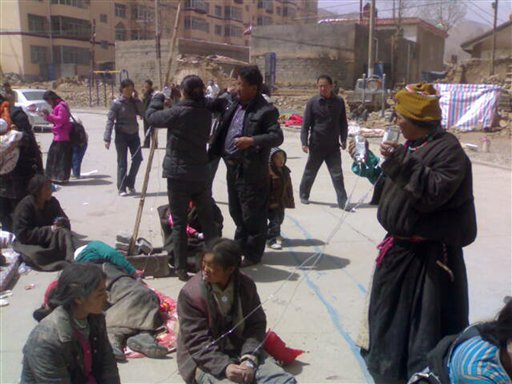
Quake in western China kills 400, buries moreIn this photo taken by a mobile phone, local people gather outside after being evacuated from buildings following an earthquake that hit the Tibetan Autonomous Prefecture of Yushu, northwest China's Qinghai province, Wednesday, April 14, 2010. A series of strong earthquakes struck China's western Qinghai province Wednesday, toppling houses, killing scores of people and burying many others in a mountainous rural area, officials and state media said. (AP Photo/Xinhua, Zhang Hongshuan) NO SALES(Credit: AP)

A series of strong earthquakes struck a mountainous Tibetan area of western China on Wednesday, killing at least 400 people and injuring more than 10,000 as houses made of mud and wood collapsed, officials said. Many more people were trapped and the toll was expected to rise.

The largest quake was recorded by the U.S. Geological Survey as magnitude 6.9. In the aftermath, panicked people, many bleeding from their wounds, flooded the streets of a Qinghai province township where most of the homes had been flattened. Students were reportedly buried inside several damaged schools.

Paramilitary police used shovels to dig through the rubble in the town, footage on state television showed. Officials said excavators were not available and with most of the roads leading to the nearest airport damaged, equipment and rescuers would have a hard time reaching the area. Hospitals were overwhelmed, many lacking even the most basic supplies, and doctors were in short supply.

Downed phone lines, strong winds and frequent aftershocks also hindered rescue efforts, said Wu Yong, commander of the local army garrison, who said the death toll “may rise further as lots of houses collapsed.”

With many people forced outside, the provincial government said it was rushing 5,000 tents and 100,000 coats and blankets to the mountainous region, at around 13,000 feet (4,000 meters) -high and where night time temperatures plunge below freezing.

Workers were racing to release water from a reservoir in the disaster area where a crack had formed after the quake to prevent a flood, according to the China Earthquake Administration.

The Wednesday quake, which struck at 7:49 a.m. local time (2349 GMT, 7:49 p.m. EDT), was centered on Yushu county, in the southern part of Qinghai, near Tibet, with a population of about 100,000, mostly herders and farmers.

The USGS recorded six temblors in less than three hours, all but one registering 5.0 or higher. The China Earthquake Networks Center measured the largest quake’s magnitude at 7.1. Qinghai averages more than five earthquakes a year of at least magnitude 5.0, according to the official Xinhua News Agency. They normally do not cause much damage in the sparsely populated province.

Residents fled as the ground shook, toppling houses made of mud and wood, as well as temples, gas stations, electric poles and the top of a Buddhist pagoda in a park, witnesses and state media said. The quake also triggered landslides, Xinhua said.

“Nearly all the houses made of mud and wood collapsed. There was so much dust in the air, we couldn’t see anything,” said Ren Yu, general manager of Yushu Hotel in Jiegu, the county’s main town. “There was a lot of panic. People were crying on the streets. Some of our staff, who were reunited with their parents, were also in tears.”

More than 100 guests of the hotel, which was relatively undamaged, were evacuated to open spaces such as public squares, Ren told The Associated Press by phone. After transporting guests to safety, hotel staff then helped in rescue efforts in other buildings, Ren said.

“We pulled out 70 people, but some of them died on the way to the hospital,” Ren said, adding other survivors were put in tents in the hotel yard while they awaited assistance.

The death toll rose to about 400 by afternoon, according to China Central Television. Emergency official Pubucairen, who goes by only one name, was quoted as saying that the number of injured has risen to more than 10,000. The official said rescuers were treating the injured at hospitals, race tracks and sports stadiums.

President Hu Jintao sent a vice premier to supervise rescue efforts and more than 5,000 soldiers, medical workers and other rescuers were mobilized, joining 700 soldiers already on the ground, Xinhua said. A message of sympathy also came from the Dalai Lama, the exiled spiritual leader of the often fervently Buddhist Tibetans who is reviled by Chinese leaders.

Yushu and its environs are among the Tibetan areas caught up in the anti-government protests that swept the region in March 2008. Tensions have simmered since, and the region has been closed to foreigners off and on.

CCTV reported that soon after the quake, troops secured banks, oil depots and caches of explosives.

Yushu was for centuries home to important Buddhist monasteries and a trading hub and gateway to central Tibet. In recent years, the government has poured investment into Yushu, opening an airport last year and building a highway to the provincial capital of Xining.

The seismically active region saw a magnitude-7.9 quake two years ago that left almost 90,000 people dead or missing in neighboring Sichuan province 400 miles (650 kilometers) away. Poor design, shoddy construction and the lax enforcement of building codes were found to be rampant.

In Jiegu, about 20 miles (30 kilometers) from the epicenter, the local fire brigade was trying to rescue 20 students stuck inside a school, Kang Zifu, head of the rescue team, told state television. It did not say what type of school it was.

Five students were killed and others trapped in a primary school, a teacher told Xinhua, saying morning classes had not yet started when the quake struck. Another official said students were buried at several primary schools.

More than 85 percent of houses had collapsed in Jiegu, which Tibetans call Gyegu, while large cracks have appeared on buildings still standing, the official Xinhua News Agency cited Zhuohuaxia, a local publicity official, as saying.

“The streets in Jiegu are thronged with panic and full of injured people, with many of them bleeding from their injuries,” said Zhuohuaxia, who goes by one name.

A monk named Luo Song from a monastery in Yushu county said his sister who worked at a local orphanage told him three children were sent to a hospital but the facilities lacked equipment.

“She said the hospitals are facing a lot of difficulty right now because there are no doctors, they have only bandages, they can’t give injections, they can’t put people on intravenous drips,” the monk said by phone while on a visit to the southern Chinese city of Shenzhen. Rural hospitals typically are not well equipped.

A local military official, Shi Huajie, told CCTV rescuers were working with limited equipment.

“The difficulty we face is that we don’t have any excavators. Many of the people have been buried and our soldiers are trying to pull them out with human labor,” Shi said. “It is very difficult to save people with our bare hands.”

——

Associated Press writer Charles Hutzler and researchers Zhao Liang and Yu Bing contributed to this report.

Continue Reading Close

“The Sun Behind the Clouds”: The Tibet film China loves to hate

Beijing went to war, oddly, over an intriguing film that explores divisions between Tibetans and the Dalai Lama

  • more
    • All Share Services

A still from "The Sun Behind the Clouds."

It isn’t literally true that there’s a new documentary about Tibet every six weeks, but it does kind of feel that way. What sets apart “The Sun Behind the Clouds,” made by the Tibetan-Indian filmmaking duo Ritu Sarin and Tenzing Sonam, is both context and content. The film includes extensive interviews with the Dalai Lama, who is less circumspect than usual about the political and moral challenges facing his “Middle Way” strategy of arguing for greater Tibetan autonomy under Chinese rule. Sarin and Sonam also lift the veil on potentially explosive divisions within the Tibetan exile community, which is torn between spiritual and cultural loyalty to the Dalai Lama and a widespread longing for true independence. (The filmmakers clearly belong to the pro-independence camp.)

This film also became the centerpiece of an altercation last year between famously prickly Chinese film authorities and the Western movie marketplace. After “The Sun Behind the Clouds” was booked at the Palm Springs International Film Festival, the Chinese government — demonstrating both intolerance and a tin ear for P.R. — pulled two much-anticipated films from the festival. For mysterious reasons, one of those Chinese movies, “City of Life and Death,” a fictional story about the notorious Rape of Nanking in 1937, was then yanked from its American theatrical premiere at New York’s Film Forum — whose programmers replaced it with the film that had caused the ruckus in the first place.

Of course, the Chinese have long been completely unwilling to discuss the Tibet question — which, when you think about it, reduces the question of what strategy the Tibetan movement should adopt to an arid philosophical point. There are reasons why the Beijing regime is so thin-skinned, as we see in “The Sun Behind the Clouds.” The explosive Tibetan uprising of early 2008 put the lie to Chinese claims that their campaign of economic development and cultural assimilation had quelled both nationalism and discontent, and it left government spokespeople, in the weeks before the Beijing Olympics, uttering the worst kinds of warmed-over Mao Zedong talking points about the “Dalai clique” and its tradition of “theocratic serfdom.”

As Sarin and Tenzing also make clear, there’s a germ of truth behind the Chinese propaganda. The Dalai Lama himself has often decried Tibet’s backward, feudal tradition — but then, he’s both a product and a symbol of that tradition. As in the Palestinian case, younger Tibetans who’ve lived their whole lives in exile are increasingly radicalized, while the Chinese continue to torture and imprison dissidents inside Tibet and the Dalai Lama’s reasonable, enlightened middle-ground position is supported by international political leaders but almost no real people. Nobody thinks this issue is going away, and the Dalai Lama has already prepared Tibetans for the likelihood that his reincarnate successor will be born outside Tibet. The Chinese seem prepared to outwait this Dalai Lama, the next one and the one after that.

“The Sun Behind the Clouds: Tibet’s Struggle for Freedom” is now playing at Film Forum in New York, with wider release to follow.

Continue Reading Close