Adam Goodheart

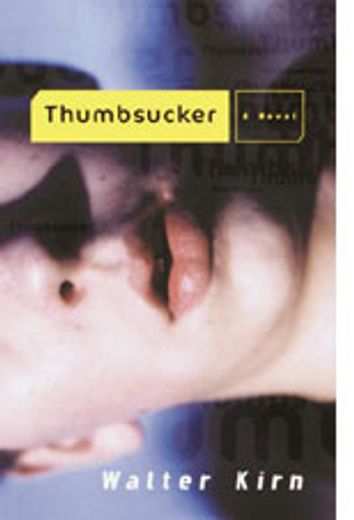
“Thumbsucker” by Walter Kirn

A sworn enemy of novelistic pain relief takes a jittery poke at American kitsch and credulousness.

  • more
    • All Share Services

Not many American writers any longer know how to mix up a nice sour cocktail the way they used to. Novels these days are more the sort of drinks you sip by the pool: heavy on the fruit juice and syrup. But in “Thumbsucker,” Walter Kirn serves a strong glassful of bitters and wry.

“Thumbsucker” might be called a coming-of-age story, but it is not, thank God, at much risk of becoming a candidate for Oprah’s Book Club. Unlike the narrators of standard-issue tales of adolescent angst and self-loathing, Kirn’s downy-cheeked hero never outgrows his awkwardness, solipsism and ingrown strangeness. Instead, he nurtures them tenderly, like exotic pets in a secret terrarium.

And Justin Cobb’s neuroses are more exotic than most. He is, as his dentist calls him, “the King Kong of oral obsessives,” a teenager who half-involuntarily still sucks his thumb. “It was the one thing I’d always done,” he explains. “Even breathing did not go back to the womb. Being part of a circle of shoulder, arm, hand, mouth, connected me to myself.” When Justin kicks this habit — if only temporarily — his fixation finds other outlets: cigarettes, alcohol, pills, the school debate team (“an experiment in concentrating on what came out of my mouth instead of what went into it”), fly-fishing.

The circularity of Justin’s thumb and mouth and arm reflects the circularity of “Thumbsucker” itself. This is a book that rejects the idea of growing up, of progress, of the transforming power of therapy and family bonding — all the old American verities. As a book critic for New York magazine, Kirn is a sworn enemy of the anodyne, and in his own fiction he puts his money where his mouth is. The Cobb family as he portrays it manages to be both sympathetic and pathetic, each member with his or her own hoard of tics and eccentricities to match Justin’s.

But Kirn’s most memorable characters are his bit players. Structurally, “Thumbsucker” is an old-fashioned episodic novel. Like “Huckleberry Finn” (an even darker and more pessimistic book), it relates a young man’s journey among a ragged job lot of charlatans and hucksters, each offering the hero his own dubious wisdom. In place of the Duke and the King, Kirn offers a sexually frustrated debate coach (“You can’t just bob and weave your way through life. Fakes get found out. At bottom, the world is fair”), a dishonest gas-station owner (“Success is like sailing: sit back and catch the wind”) and, best of all, Justin’s oily and slightly sinister dentist, Perry Lyman (“The psyche is formed in the bassinet, the stroller. A cat drops a chewed mouse inside your crib and at seventeen you’re a hand-washing fanatic”).

“Thumbsucker” is set in Minnesota in the dreariest days of the Reagan era, and its period details are perfect. (An acid-dropping, nihilistic attendant at the gas station where Justin works wears “one of those T-shirts  that show the anatomy of the human body: all the muscles, bones, and organs in their actual colors.”) And as in “Huckleberry Finn,” the book’s humor redeems its mouth-puckering sourness. The last chapters — in which the Cobb family converts to Mormonism, which Kirn portrays as a kind of exaggerated version of American kitsch and credulousness — are especially Twainian. Justin goes on a church-sponsored trip to the “Garden of Eden” (in Missouri) and considers burning the place down.

Like Justin Cobb himself, Kirn’s novel is jittery, unsettled, wired with hyperactive energy. And like all interesting adolescents, it’s capable of melancholy seriousness and manic humor, often in the very same thought.

Werewolves In Their Youth

Adam Goodheart reviews 'Werewolves in Their Youth' by Michael Chabon.

  • more
    • All Share Services

One complaint you can make about Michael Chabon is that the characters in his books always behave a bit too much like, well, characters in books. They smoke cigarettes with stylish aplomb, fall inconveniently in love, drink too much, nurse their melancholy too tenderly and too long. Their lives are a mess, but never so much that they can’t be redeemed, on the last page, by one grand moment of heroism or epiphany.

So? Books are books, after all, and reality is reality, and instead of complaining when art fails to imitate life, it’s more interesting to think about why life doesn’t more often resemble art.

Chabon’s acclaimed first novel, “The Mysteries of Pittsburgh,” inspired widespread comparisons to the work of F. Scott Fitzgerald, although they had more to do with the gorgeousness of the characters and of the prose (and of the then 24-year-old author) than with the themes. In “Werewolves in Their Youth,” Chabon’s second collection of short stories, he moves deeper into genuine Fitzgerald territory — that place where young married couples dance separately with strangers, where former football heroes stare down the dwindling time clock of youth, where the houses mock their inhabitants and every party is a disaster waiting to happen.

And like Fitzgerald’s sentences, Chabon’s can be as perfect and self-contained as plovers’ eggs. On a football hero: “He was used from long habit to thinking of his body as having a certain monetary value or as capable of being translated, mysteriously, into money, and if it were possible, he would have paid a handsome sum to purchase himself.” On a house: “It had an asymmetrical shape, a ribbon window in the living room, and a jutting flat roof and, like many modernist houses that have been long inhabited by humans, a defeated aspect, a look of having been stranded, of despairing of the world for which it had been intended but which never came to pass.”

The nine stories here are closely linked by theme: All but one are, in one way or another, about divorce. (The odd story out is a neat little experiment in pulp horror ` la Lovecraft, and its subject is completely different: a town where the women eat their menfolk, piece by piece.) The “werewolves” in the title story are two misfit 11-year-old boys whose separate fantasy worlds connect when one of them is expelled from school and the other faces the breakup of his parents’ marriage.

But a Gothic subtext runs through all the tales, and it fits surprisingly well. All the stories are also, in one way or another, about growing up — particularly about that stage of the process that occurs in one’s late 20s and 30s. For Chabon, adulthood itself is a sort of lycanthropic transformation, in which innocent bodies sprout hair and claws, innocent love becomes insatiable loathing and innocent dreams turn into frustrated ambition.

Unlike a true Gothic fantasist, though, and unlike Fitzgerald, Chabon is too fond of his characters to send them hurtling into the abyss. He always gives them one last chance to make good. In some cases (“House Hunting,” “Son of the Wolfman”), this affection makes for his loveliest stories; in others (“Green’s Book,” “Spikes”), it crosses the line into sentimentality. It also creates a certain sameness of rhythm that you wish Chabon would try harder to break. Still, without their author’s generosity of spirit and his sense of humor, these stories would lose a considerable part of their charm. And charm is an undervalued quality these days, in fiction as in life.

Continue Reading Close