Adam Shemper

The execution of Stanley Tookie Williams

Outside San Quentin prison Monday night, under the floodlights, death penalty opponents prayed, sang hymns and cursed the Terminator.

  • more
    • All Share Services

The execution of Stanley Tookie Williams

Stanley Tookie Williams was executed by lethal injection at California’s San Quentin prison early Tuesday morning. He was 51 years old.

Williams walked into the execution chamber, a semioctagonal room with a padded green gurney and flooded with pale white light. He lay down. Guards strapped him in. A guard kept a hand on Williams’ shoulder. A nurse had difficulty finding a vein in his left arm. She accidentally drew blood. It took 12 minutes to prepare the IVs. Williams held his head up. He looked at the press — 17 journalists in all. He looked at his loved ones — five of them present — and mouthed words that journalists couldn’t hear or understand.

At 12:21 a.m., the first drug, five grams of sodium pentothal to make Williams unconscious, was pumped into his arm. That was soon followed by injections of 50 cc’s of pancuronium bromide to stop his breathing and 50 cc’s of potassium chloride to stop his heart. After a few minutes, Williams’ stomach begin to spasm and contract. Soon he was not moving. The roomful of witnesses sat in silence looking at Williams’ unmoving body.

A circular flap in a heavy metal door near Williams’ body was opened by someone unseen. A piece of paper was slipped through and was unrolled by a female guard who made the final announcement. Stanley Tookie Williams was dead at 12:35 a.m. Three of his passionate supporters, including Barbara Becnel, a former Los Angeles Times reporter, cried out, “The state of California just killed an innocent man.”

Inside San Quentin’s media center, journalists finally sprung into action. Most had been here over four hours. The décor was like that of an old library, with drab purple carpeting and bright halogen lighting. A trophy case stood next to instructional videos on what to do if taken hostage. A stage with a folding table and the American flag was at the front of the room. “It looks like they do plays here,” one journalist had said earlier. “They could put on ‘Annie.’”

For most of the night, there had been apprehension and boredom. One guy sketched in a notebook. “Monday Night Football” played on a small TV. Others flipped through the press package prepared by the San Quentin press office. It opened with three pages of pictures of a young Albert Owens, followed by pictures of his dead body, lying in a pool of blood next to empty Pepsi bottles. On another page that addressed Williams’ Nobel Prize nomination, the booklet explained that over 140 nominations are submitted each year and that former nominees have included Hitler, Stalin and Mussolini.

But now journalists clutched their BlackBerrys, hoping to get the first e-mail from their colleague who witnessed the execution. They began tapping the heels of their polished shoes. A photographer took a picture of their faces lit up by their hand-held devices’ blue glow. A TV cameraman walked up and started filming.

When word broke out of the official time of death, a journalist got on his cell, “Hey, Joe, it’s me. It’s 12:35!” People ran to their camera stations.

People standing outside said prayers. They sang “We Shall Overcome,” although a girl sitting on top of a trailer said, “I don’t believe that. I’m not singin’.” A Richmond, Calif., reverend began shouting through a megaphone: “I’m tired of singin’! I’m tired of talkin’! Do somethin’! Let’s do somethin’!” He marched out to a chorus of amens, hollering and people following him. It was as if everyone decided to leave and follow the one person who was angry and ready for action.

A Native American man on the other side of the street held a large upside-down American flag with a white swastika painted in the blue field of stars. He was shouting at the “white maggots” who had defiled his land, who had oppressed and enslaved his people. He yelled at the blond news anchors below him, “You’re all immigrants. This is my land you’ve been poisoning for the last 500 years.” He lighted the flag on fire as a black woman told him he shouldn’t do that, that he should have more pride in this nation. He responded that it was time for a “true indigenous people’s revolution.” Then the white picket fence he was holding onto broke and he fell down the small embankment. Then the people he’d been arguing with lifted him up and asked him if he was OK. “Yeah,” he said. “I’m OK.”

Williams’ last chance had been clemency. But early in the afternoon on Monday, Gov. Arnold Schwarzenegger had made his decision. Williams had never apologized nor showed remorse for his victims, the governor’s statement said, so there could be no clemency.

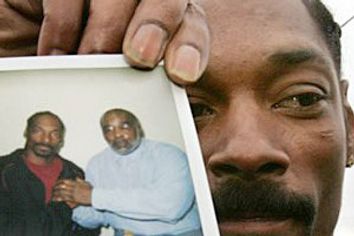
Williams had been convicted of murdering four people. He was found guilty of shooting Albert Owens during a 7-Eleven store robbery on Feb. 27, 1979, and shooting Yen-I Yang and Tsai-Shai Yang and their daughter, Yee-Chen Lin, 12 days later at a Los Angeles motel the family owned. He was sentenced to death in 1981. He maintained his innocence until the end.

One of Williams’ last visitors on Monday was 67-year-old Richmond resident Fred Davis Jackson, who had been coming to see him since 1997. Williams wore his regular blue prison uniform and was in good spirits on Monday, according to Jackson. “This time I couldn’t hug him like I wanted to. He was handcuffed; and he’s so big, it’s hard to get your arms around him.” Williams had been on suicide watch, so a guard sat in the room with him. He had refused an official last meal. But there was turkey there, according to Jackson. “He didn’t eat any, though,” he said. “And I didn’t have an appetite neither.” The warden later reported that Williams only drank water and milk.

“We said goodbye, like we always do,” Jackson said. That was at 6 p.m. It was dark out and getting colder. “I said, ‘I’ll see you later.’ We acted like nothing was going to happen. I gave him a regular goodbye because his faith is so strong. And when I said that I’d see him tomorrow, I was saying that he would be with me no matter what.” Soon after, Williams was moved and saw no more visitors.

Earlier Monday, Williams met with several friends and supporters, including the Rev. Jesse Jackson and Becnel. For 10 years, Becnel had helped Williams broker gang truces and carry his message to inner-city youth. She had helped him write a series of books for kids and teenagers. The intent of the books was to inform readers of the perils of gang life, which Williams, who co-founded the Crips gang in Los Angeles, had experienced firsthand.

In the afternoon, outside the prison’s main gate, Jackson was harangued by conservative L.A. radio shock jocks John Ziegler and John Kobylt, who were pushing microphones in his face and yelling: “Name one of the victims! Name one.” Jackson ignored them and tried to walk away. He never answered the question. “You don’t know. Answer the question. You don’t know, do you?” At one point, sheriff’s deputies stepped in and pushed the men in opposite directions.

Adjacent to the prison sits Point San Quentin Village, a town of 75 people living in quaint houses, condos and cottages nestled into the hill flush against the prison fences.

As night approached, floodlights shone down on Main Street. It looked like a movie set. Some residents had fled. The television and radio trucks were backed into their driveways, lawns and gardens. Reporters worked out of some of their houses, and NBC-TV broadcast from a balcony. Locals charged upward of $2,500 for the space — the going rate for previous executions had been $1,000. News anchors and reporters were lined up one after the other in their spotlights, and were on every 30 minutes, as if they were doing a play by play.

Actor Mike Farrell — well known for his role as B.J. Hunnicutt on “M*A*S*H” and as an advocate against the death penalty — stood before a crowd of gathering protesters and a swarm of media and spoke out against Gov. Schwarzenegger’s decision. He said Williams’ lawyers met with the governor Dec. 8, then left and they didn’t hear from him for 97 hours. “He left Stanley Williams to twist in the wind,” Farrell said. “All of us are not only disappointed but are disgusted.”

A California Highway Patrol officer told us there were possibly 4,000 people gathered. (More likely the number was closer to 2,000.) But the officer did not say that that number represented a diverse group of African-Americans, Native Americans, whites, nuns, ministers, Buddhists, Christians, Jews and members of the Nation of Islam.

The night wore on and six women — who called themselves the “Threshold Choir” — stood in a circle holding burning candles. They sang hymns and prayers. Their voices, almost whispers, were intermittently drowned out by helicopters flying overhead. Below them, people sitting on the beach looked out over the bay, which reflected the dark magenta and violet city light. No one seemed to be talking, as if they were lost in meditation and prayer. Joan Baez sang “Swing Low, Sweet Chariot.”

In the San Francisco Bay Area, people had been gathering for days in support of Williams and in protest against the death penalty. On Sunday, at an American Civil Liberties Union of Northern California ceremony in downtown San Francisco, 700 people showed up to honor Sister Helen Prejean. She received the Chief Justice Earl Warren Civil Liberties’ Award. Past winners have included Rosa Parks, Thurgood Marshall and Farrell, who was there moving through the crowd. But it was clear that Williams was on everyone’s mind.

Dorothy Ehrlich, executive director of the ACLU-NC, said, “No one should be put to death without the world watching.” Sean Penn introduced Sister Helen. They knew each other from working on “Dead Man Walking” together, the movie that starred Susan Sarandon and Penn, and depicted Sister Helen’s experience ministering to Patrick Sonnier and watching him die in the electric chair in 1984 in the state penitentiary in Angola, La. At the ceremony she posed a question to the audience: “What if we put 1,000 condemned people in a stadium and shot them?” And then answered it sharply, “The whole world could see. We have killed 1,000 people and nobody saw.”

Earlier that morning, members of the anti-capital-punishment group Death Penalty Focus met in Sausalito, Calif., for a fundraiser brunch. Executive director Lance Lindsey had helped organize it, and organization president Mike Farrell talked informally about Williams to a room of criminal attorneys, professors, business entrepreneurs, a vineyard developer, a private investigator and a psychologist. There were artists and writers. There were people with money. There were liberals who had worked in politics, fundraising and volunteering for various social causes and campaigns.

Farrell, who is tall and has watery blue eyes and white hair, said he met Williams five or six years ago. “He’s very impressive. He’s very calming, extraordinarily peaceful, given his circumstances,” Farrell said. “The transformation — from his perspective, redemption — is visible. He’s quiet. He speaks like an educated man, interestingly articulate. To use an odd word, he’s sweet.”

Farrell stood in front of a large fireplace. He had helped defend condemned inmates for more than 25 years, starting just after 1976, when the U.S. reinstated the death penalty. “We all have a finger in it,” Farrell said. “We all have a finger in the execution of Stanley Williams.” He wore a black coat and sweater, dark navy pants. “We must uphold the American principle that we all have human value, and I believe that issue starts with the death penalty.” He articulated the issues, talking of the great inequalities in the system, how poor those on death row are, the discrimination, how most death sentences are carried out in the former slave states.

“People like Stanley, people on death rows across this country, I call them ‘the invisible people,’” Farrell said, his hands speaking also, as if he were conducting. “The thinking goes that people who are invisible in our own lives can be dispensed with easily.”

He said he knew the pain of those who had lost family members. “I lost a loved one to murder, and I felt great pain, but it doesn’t mean I’m going to stoop to the lowest part of my self.”

“I spoke with a woman who lost her loved one in the Oklahoma City bombing,” he continued. “She said she didn’t want Timothy McVeigh to be executed. She said, ‘No, I want him to be skinned alive.’ She wanted him to be tortured every day for this rest of his life. Though I understand the feeling, we cannot, as a society, condone anyone acting on those feelings. Otherwise we might as well strap an inmate to a chair, and give the grieving family an ax and have them go out at them, and let there be blood on the walls.”

There was silence in the room. A woman with her legs folded beneath her on the couch looked as if she might cry.

After midnight on Monday, plenty of people were crying. Following the execution, people trickled down the dark street, and Penn was among them. We asked him how one could ultimately make an invisible person visible. “I feel the answer to your question is right here, among all these people, who came to say what’s on their mind, what’s in their hearts,” he said. And why was he there walking among them, lost in the crowd in his black jacket and faded blue jeans, an unlit cigarette in hand? “For the same reasons these people are here. I’m here to abolish the death penalty.”

Baghdad’s shame

Babies die daily of treatable diseases while their doctors search for black-market drugs, because the U.S can't fix Iraq's corrupt, crime-plagued health system.

  • more
    • All Share Services

Baghdad's shame

Babies are dying in Baghdad hospitals every day because medicine and medical supplies, lying in abundance in government warehouses only miles away, are not getting where they are needed. It is hard to believe, especially because the young resident doctors who are talking about the problem in the small, shabby common room at the Alwiya Children’s Hospital are smiling and chuckling.

For a moment their laughter stuns us into silence. A small TV flashes in the corner with a music video that zooms in and out on some big-haired Egyptian singer. A half-broken fan whirls drowsily above. The faint wailings of infants from the wards down the hall echo as if they are coming from a deep well. Finally someone speaks.

“There are so many disasters,” says Manaf Yassen, a doctor whose lab coat looks a size or two too large. “We must laugh, because it is better than crying.”

During Yassen’s shift the day before yesterday at Alwiya, two newborns died because he lacked the right supplies to treat them. One had septicemia; the other died of respiratory failure. Yassen had no luminal to treat the septicemia patient — its seizures worsened and it died. He had no ventilator machine for the child whose lungs had given out. Nor did he have any surfactant to help get oxygen into the child’s arteries. Yassen and the other doctors gathered around say at least one baby dies in the hospital every day, but they can’t estimate how many of those die because of the lack of drugs. “Many,” is all they can say, shaking their heads, smiles lingering on their lips.

Basic medicines are missing, the doctors tell us. In the case of newborns, whose immune systems are still weak, these medicines can mean life or death: Phenobarbital or luminal for seizures; immune globulin and surfactant for respiratory distress; and calcium supplements for premature infants, which the hospital has not had in stock for the last six months.

Last week was the height of diarrhea season, a common ailment during summer because of the blistering heat and lack of clean water in Iraq. It was the worst possible time to run out of ringer lactate, a fluid to revitalize severely dehydrated babies, but that’s what happened at Alwiya. Yassen and the other doctors gave the children a much less effective saline solution as a substitute, but one doctor called it “show business” to fool parents into thinking they were doing something. They’ve watched at least 100 children die of diarrhea since the war.

Children who have diarrhea are not supposed to die in hospitals, but here they do. “I have seen 20 die with my own eyes,” says another doctor, Ihsan Jassim al Douri, his eyes widening. “You ask another doctor, you get a different number.” He smiles.

Children in Baghdad hospitals are dying of highly curable ailments such as diarrhea because of Iraq’s corrupt, bureaucracy-plagued, crime-ridden healthcare system — and the failure of U.S. administrators to come up with a workable alternative more than four months after the fall of Saddam. Certainly, babies died under Saddam’s rule, though the dictator blamed U.S. sanctions for medical supply shortages, and treated scenes of dead children as photo opportunities to try to shame Americans. In post-Saddam Iraq, though, the delivery system, at least, is far worse. And just as the U.S. is being blamed for failing to plan adequately for postwar chaos on other fronts — from restoring power to keeping order — a growing chorus is outraged about the medical crisis in Baghdad.

But doctors, government agencies and relief organizations point fingers in different directions when laying blame for the troubles. Iraqi doctors say not enough medical supplies are reaching their pharmacies. American and Iraqi officials in charge of distributing those supplies insist Baghdad warehouses are full and supplies are available to those who ask, but the Saddam-era health bureaucracy, combined with a history of passivity on the part of health officials, mean hospitals aren’t getting what they need. American soldiers trying to guard the medical warehouses say that Iraqis have been pilfering the medicines to sell on the black market — and that the U.S. military can’t or won’t crack down and make sure the medicines are secure. “It’s layer after layer of bullshit that you have to get through to solve the problem,” says Army Reserve officer John Padgett, a doctor who’s helping do a needs assessment of the healthcare system. “But the public hospitals should have some recourse other than going to the black markets for their medicines — which is what they’re doing now.”

Whatever the reason, the results are disturbingly clear: Children are dying needlessly every day, and not only at Alwiya.

The Central Children’s Hospital in Baghdad is also out of luminal, the anti-seizure drug. Dr. Muhammad Hassan, the chief resident doctor, says he received boxes of it from an aid organization but the solution was tainted — yellow and cloudy instead of white. At least one baby dies here every day. Many die because there is no medicine or equipment. Premature newborns die, he says, because the electricity will go out in the city and cut off power to their incubators. Some children get renal failure and die because there are no dialysis machines. “This is the life,” he says.

At the Ibn al Hatib Hospital for infectious diseases in the town of Tuwaytha some 20 kilometers south of Baghdad, there is no anti-rabies medicine. Three months ago, says pediatrician Sa’ad Jamil, a wild dog rushed into a family’s house and bit all the children, five sisters. The doctors sent the family to Jordan to buy the drug, but it was too late to save them. One daughter died 10 days ago. “The others are at home,” Dr. Jamil says. “One by one, they are waiting for death.”

Although hospitals get some supplies from government warehouses, more come from international aid agencies such as the Red Cross and the World Health Organization. But often doctors are forced to swap drugs from other hospitals or pharmacies. Dr. Hassan at Central Hospital says he had to send families out to the black market — where prices can be 300 times more than those at public pharmacies — to find drugs. “There is no one in the Ministry of Health to get this job done so it maybe is also our problem. This is the problem of our children, so we can’t wait,” Hassan says. “If I had an empty ambulance, I would look for the drug.”

Even when medical supplies do arrive from government warehouses, they often do not work, says Yassen, the doctor at Alwiya. He leads us downstairs to the pharmacy in the next building and rips open a box containing a blood transfusion set. “This valve is the heart of the set,” he says, shaking the small, clear, plastic piece in his hand. “The valve should be closed, but it has many air leaks. It is expired.”

Because of the defective valve, air bubbles can easily get into a child’s bloodstream during the transfusion, to create fatal embolisms. Yassen says this nearly happened the night before — a child developed apnea during the transfusion and had to be resuscitated. Now the small girl is recovering under a phototherapy lamp that is barely functioning. It will happen again and again with these sets, he says.

We look the sets over. They have an expiration date of 2005. “No matter,” he says, tossing the pieces back into the box. “They are Iranian. Believe me, they are expired. They are useless. We use them even though they are useless,” he says, laughing at his own joke.

In a newly refurbished wing of the Ministry of Health building in mid-August, a U.S. advisor, Lt. Col. Charles Fisher, is giving a PowerPoint presentation at the first postwar conference of the Kimadia, the large public agency responsible for distributing medical supplies and medicine to hospitals. Facing him are 200 or so Iraqi pharmacists, Health Ministry officials and Kimadia chiefs as well as a cluster of U.S. Army officers looking for answers. In late May, Fisher took over as the coalition’s overseer for the Kimadia, which, he explains, operated as a top-down “controlled system of allocation” under Saddam Hussein, and was, by all counts, totally and utterly corrupt. Fisher is trying to make clear that he wants to create a new system, one that is “customer-driven” — where the customers, i.e. the hospitals, are “empowered” to request the drugs and supplies they need themselves.

The military leader is speaking the language of American corporate reform, and his translator has trouble finding the right words in Arabic. After a minute of awkward silence, she steps away from the podium, befuddled. A man replaces her and Fisher continues.

He scrolls through three pages worth of instructions on the large projector screen behind him, introducing his employees to customer service, American-style. He spends a while detailing how to deal with complaints. When a Kimadia official hears a complaint from a hospital or clinic that they lack a certain drug, Fisher says, he should ask the “customers” if they’ve been to the local Kimadia to request the medication. Then the official should ask the “customers” if they have a letter signed from the regional Kimadia director stating there’s a shortage.

“That’s the first step in owning where the problem is if there’s no drugs,” says Fisher. The letter from the local Kimadia, Fisher says, continuing down the long, Byzantine chain of command, will then be sent to the national Kimadia, and that will trigger a response from the import department to address the shortage of the drug in question, which will then be sent back to the local Kimadia, and so on.

But Fisher insists there is no shortage of drugs. He says even though most of the Kimadia warehouses were bombed, ransacked and burned during and after the war, he has enough supplies and medicine for the Iraqi people. After the presentation, we catch Fisher as he is leaving the podium and tell him of the things we have seen at Alwiya, which seem to contradict his claim. He says that in his experience, if hospitals don’t have sufficient drugs or supplies, the problem is that they haven’t asked for them.

“My grain of salt to your story is: There is not a shortage,” Fisher tells us. He blames the paucity of medical supplies on a “lack of empowerment” on the part of hospital workers and administrators, who he says simply don’t ask for what they need. “I’ll give them whatever they want. My job is to get that warehouse empty.” But nine out of 10 directors never ask, he says, and that’s why he wrote out the long list of instructions. Most of them never went to the Kimadia for drugs because they didn’t receive orders from the Ministry of Health to do so.

“As best as I can tell, it was such a strong command-and-control system [under Saddam Hussein] that unless I’m empowered or I have a written piece of paper, I can’t do anything,” Fisher tells us.

This could be part of the problem at Alwiya. When we try to ask the hospital director why he thinks there’s a medicine shortage, he blanches and says we need to get permission from the Ministry of Health even to speak to him. We say we have been to the Ministry of Health and no one mentioned our needing permission. “I’m sorry, you do not have an appointment scheduled with me and I have another meeting,” he says, rushing past us and out the door. “You’re going to make me late.”

But Dr. Yassen, one of the doctors at Alwiya, says the director has made requests for medicine and equipment but has received none. He says his director has given up. “He simply closes his door and sits in his room, completely isolated from the hospital,” he says.

We ask Fisher if he’s been to Alwiya. He says no, but he’ll go anywhere to get the job done. He says he is “the No. 1 answer guy in Iraq,” having personally overseen the delivery of 6,500 tons of medical supplies to local Kimadias and hospitals in 80 days. He is changing the Kimadia leadership from the national level on down, and while he may not be able to get to every single place, he is “in power to say who stays and who goes,” Fisher says. “If there is some bad actor playing a game on the supply side,” Fisher says he hasn’t seen it yet. “But if I found there was a withholding [of supplies] I tell you on the spot that person would be fired and I might even bring criminal charges. Period. Full stop.”

Col. John Black, a bald, stocky soldier in the audience at Fisher’s presentation, stands up during the question and answer session to say he has heard persistent complaints about drugs not arriving at the hospitals from the government warehouses. “I think it needs to be clearly articulated who is responsible for delivering the drugs and medical materials to the clinics and hospitals,” he insists.

“These are excellent, focused and pointed questions,” responds Fisher. “I agree with you there needs to be sound responsibility so it’s clear who will be responsible for transporting … each of you in conjunction with people in your region need to develop a solution for every clinic for every hospital where both parties are in agreement.”

Then it is break time. The conference goers spill out into the lobby, where a huge spread of catered food awaits them. When they run out of plates, some men lean over the large serving trays of rice and chicken and scoop heaps of food into their mouths with their hands. That’s where we met John Padgett, the doctor and reserve Army officer who has been visiting hospitals in Baghdad with his special ops team and doing a needs assessment. He agrees children are dying because supplies are not reaching hospitals. The irony, he says, is that the warehouses — one after the other, Home Depot-sized warehouses — are full, overflowing with medicine and supplies trucked in by the international community, and yet the hospitals don’t have what they need. Sometimes the problem is bureaucracy and sometimes it’s that the drugs are disappearing, being sold on the black market. Children with cancer are dying needlessly, he says, because cancer medicine can draw the biggest profit.

“You go looking for cancer medicine on the shelf you know has come in, where the hell is it? It’s not in the hospitals, it’s not in the warehouses, it’s in the street,” he says. Padgett’s own son had leukemia but now is in remission. The corruption makes him furious. And he says it’s more than just the end-user sitting in his office not feeling empowered. The whole system, from the warehouses on down, is a mess, Padgett says.

Walking out of the conference auditorium, we are still confused about how the Kimadia works, even after Fisher’s presentation. With its national and local branches and warehouses, the distribution system seems like a self-tangling octopus. We can only imagine how the Iraqis feel.

We thought we’d understand the system better if we visited a local warehouse, so we sought out Kimadia 13, the largest medical supply warehouse facility in all of Baghdad. The man in charge, Matt Golsteyn, a 23-year-old Army lieutenant from Orlando, Fla., gives us a tour of the warehouses. There are boxes of syringes stacked six or seven boxes high between the buildings. Parts for ambulances and elevators lie in broken crates, collecting dust. Inside we pass a row of free-standing air conditioners. “We had about 200 of those a couple of days ago,” Golsteyn says. “But they all went out. Now we have about 50. I hope they went to the hospitals, but you never know.”

He says drivers hired by hospitals come in daily with lists of requested items but they try to leave with much more. “I mean they try to run every kind of racket possible,” he says. His platoon, which has been at the complex a month, only took full control a week ago. Now they check all the outgoing items against the requisition list.

“The first three days we were on the gate, we let out three vehicles that had the proper amount of stuff. We sent back about 15. It was a common occurrence for the wrong things to leave this site.”

Many of these items — latex gloves, hearing aids, IV bags and catheters — which are normally given free to hospitals that need them, ended up in the black market.

But drivers skimming off the top was not the biggest problem at Kimadia 13, Goldsteyn says. It was the local Shiite groups who took control after the war and continued to use and exploit the medical supply complex even after the troops arrived. “The neighborhood was able to exert pressure on the managers by, pretty much, if they don’t let them have their way, they’d kill them. So the management is corrupt in the sense that they got the knife to their throat all the time. The reason why things are going out the gate all the time is because the store managers have to look the other way.”

Although Goldsteyn has fired some of the management and kicked out some workers who were extorting money from the drivers, corruption is still rife. “The administration that is running these warehouses now is the same one that was running it under Saddam. So this was and is his organization. This is going to change, but for now this is how they do it. Everyone here has dealt with some kind of corruption at one time or another. You just have to find the people you can work with.”

We hear from a soldier who requested anonymity that the large warehouse for drugs and medicines, Kimadia 1, is in a similar but worse state as Kimadia 13, the supplies and equipment facility.

“The local Shiite militia are in charge of security there and they are running it like their own little fiefdom,” says the soldier. They sell medicine that comes in the front — U.N. supplies, Red Cross supplies — to people out the back, he adds. “It’s a case of the rats guarding the cheese factory.”

What about security? we ask. Isn’t the Army protecting the warehouse? “The United States military hasn’t seen fit to do anything yet,” says the disgusted soldier. “That’s a decision that needs to come from some level above mine.”

Even when medicine makes its way from the Kimadia, there is a problem with hospital staff taking it for themselves. Dr. Mahumuad Jassihm, the director of Habibia Children’s Hospital in Sadr City, says his facility was lucky and got three months’ worth of supplies directly from the Kimadia. But the well-groomed, care-worn man says it doesn’t always mean his patients get the medicine. During a tour of the wards, we pass several mothers clutching vials of medicine, their hands resting in the folds of their black hijab. “We give the drug to the parents, and when the time comes for the injection, they call in the nurse, because we don’t trust our nurses,” Jassihm says. “What can we do?” Nurses have been known to keep the medicine and sell it on the black market, he explains. “We have a bad habit here,” the doctor says sadly.

Nada Doumani, a Red Cross spokeswoman, sits in an upstairs room of the villa compound the relief agency uses as its headquarters, in the Park al Sadoon district in Baghdad, and confirms that there is a huge problem with the system of distribution of medicine and medical supplies — but it’s one the Red Cross can’t solve.

“Kimadia went on strike for a long time. People are not getting salaries, are not feeling motivated. They have no referees, no directors appointed, no empowerment,” Doumani says, to some extent confirming Fisher’s take on the problem. Many hospitals, she says, “were so used to receiving allocations automatically that they don’t think to ask, even if there’s a shortage. It’s a structural problem.” The Red Cross, Doumani insists, is powerless to address the issue. “It has to be done by the Iraqis or by the occupying power,” she says, and suggests we talk to someone in the Ministry of Health.

So we track down Saed Ishmail Hakki, an Iraqi-American professor from Tampa, Fla., who is rumored to be on the verge of appointment as the new minister of health. We find him sitting in a Health Ministry conference room full of smiling middle-aged Iraqi men holding résumés and letters of introduction. Hakki tells them there is an employment seminar on the lower floor and they file out. Once alone, Hakki explains his grand plan: He wants to create a healthcare system on par with the United States’ within five years. That includes privatizing institutions like the Kimadia to make them more efficient. He calls the Kimadia a “billion-dollar white elephant.”

Then we tell Hakki about the problems at Alwiya and Central Hospital, and he immediately switches modes. No longer is he an anti-Kimadia, pro-capitalist visionary, but a system apparatchik denying responsibility. “I would like to see a piece of paper that requested the medicine and was turned down and I’ll give you a trip from here to wherever you want to go out of my own pocket.”

What do we tell the doctors who say their patients are dying because they can’t get needed drugs? we ask.

Hakki smiles. “Patience,” he says, hanging on the last syllable so that it sounds like air slowly leaking from a balloon. “In the Quran it says Ini allahe ma’a al sa’abareen, ‘God is with those who are patient.’ We need patience here. The Iraqis are tolerant. They are patient now because they know — otherwise you would have revolution.”

But in fact, Iraqis are losing patience. Back at Alwiya, we meet Um Aisha Senan, an angular-faced woman in a blue hijab, who holds her sick 3-month-old daughter Aisha in her arms, because the cot is too filthy. She asks Dr. Al Douri why everything is dirty. There are puddles of fetid water under the cots and the smell of feces is overpowering. “There’s no disinfectant! There’s no janitor here!” she says. The other parents in the ward crowd around her and murmur in agreement.

“The janitor should clean it but perhaps if you cleaned your area and we all did our part …” starts Al Douri.

“I am a school teacher,” Senan yells, interrupting him. “And I do my job fine, that’s why you and the cleaning staff should do yours! Look at this child!” Senan points to a boy on the cot next to hers. “It’s a simple case of diarrhea and throwing up and there isn’t any treatment and there are no drugs and he’s getting worse!”

Al Douri tries to explain that the child has a fungal infection and has been here for a week. Even though they finally have ringer lactate, the child doesn’t need it since too much fluid would cause heart failure. Senan and the others gathered around will have none of it.

After he hastily retreats from the ward, all the humor has drained from Al Douri’s round, wide-eyed face. He says parents often take it out on him when things happen beyond his control, like a lack of medicine. He’s been punched in the face before. But that’s nothing, he says, compared to what parents would do if they found what’s in his pocket. We ask him what he means, and he produces a folded-up paper. It’s a copy of last week’s Hawza, a Shiite paper that mentions him by name: “Dr. Al Douri, a Ba’ath party loyalist, doesn’t do his work at Alwiya Hospital — he shows up in his track clothes and upbraids the patients for betraying Saddam Hussein.” Al Douri says he’s no fan of the Ba’ath party — he only shares a last name with an important, well-connected family. “This article is like a death sentence,” he says. “Anyone will read this and try to kill me on the spot.” He says he is leaving the hospital tomorrow and heading north to live with his family.

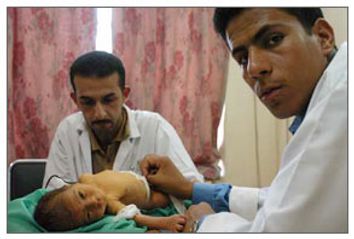
The last time we visit Alwiya, we go looking for Dr. Yassen. From an open door down a hall from us, we hear ungodly screams. Yassen is inside the room, his gloved fingers covered with blood. Below him, a newborn baby — totally yellow in color — writhes naked on a desk. Rammed into the baby’s navel is a plastic tube, part of the defective transfusion set Yassen showed us on our earlier visit. The doctor is carefully watching the valve for bubbles as he releases blood into the tube. The baby has neonatal jaundice, Yassen says, and needs another transfusion after this one. Because of the shoddy Iranian sets, it takes him three hours to do what normally takes only one. He has another four hours of this maddening work and he already looks weary.

The infant arches its tiny body in pain. With little fists clenched, it rolls its eyes back and screams again, a gurgling, animal scream. Yassen’s assistant finally puts a free finger in the baby’s mouth to calm him.

After a long while, Yassen, sweating profusely, asks if we are finished with photographs. He has been sweltering in his lab coat, which he donned when we entered the stuffy room. We ask him who is responsible for the delivery of the medical supplies and drugs. Is it the medical staff, the director, the Ministry of Health staff, the government? He shrugs.

“I don’t know where — in which joint — is the defect,” Yassen says. “But you see and I see what is the end result,” he says, waving his hands around the drab office and taking in the suffering infant. “We depend on the final result, and this is the final result.”

Continue Reading Close