Ahmed Al-haj

After bombing, somber Yemen marks National Day

SANAA, Yemen (AP) — Yemeni leaders led a somber ceremony Tuesday to mark the country’s national day, scaling back the celebrations a day after a suicide bombing killed nearly 100 soldiers during a rehearsal for a military parade.

President Abed Rabbo Mansour Hadi, along with top military commanders, government officials and foreign diplomats, took part in a small, symbolic parade held inside Sanaa’s Aviation Academy. Hadi sat behind a bulletproof glass shield with his armored car parked nearby.

Security concerns were paramount at the ceremony following Monday’s suicide attack, when a Yemeni soldier detonated a bomb hidden in his uniform during a rehearsal for a military parade for National Day, which marks the 1990 reunification of north and south Yemen. Ninety-six soldiers were killed and at least 200 wounded in what was one of the deadliest attacks in the capital in years.

Al-Qaida’s branch in Yemen claimed responsibility for the bombing, saying in an emailed statement that the suicide attack was intended to avenge a U.S.-backed offensive against al-Qaida in a swath of southern Yemen seized by the militant movement last year.

Addressing the crowd Tuesday, the chief of staff of the Yemeni military, Maj. Gen. Ahmed Ali al-Ashwal, vowed the nation would not be deterred by such attacks.

“We will not let terrorism destroy our future and dreams,” he said.

Al-Ashwal was the only official to speak at the ceremony, which was drastically scaled back because of security concerns. The parade was cut from three hours to one hour, a fly-over by fighter jets was canceled and only cadets from the police and aviation academies participated in the program.

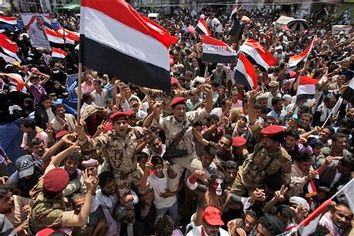
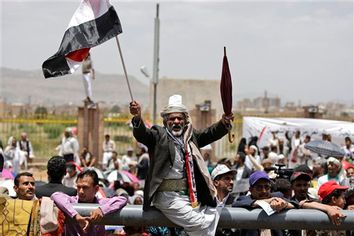
Despite their grief, Yemenis for the first time marked the National Day without their longtime ruler Ali Abdullah Saleh, who held power for nearly 30 years. Saleh was forced to step down after a yearlong uprising where hundreds of thousands of Yemenis took to the streets demanding his ouster.

Monday’s bombing deeply shocked Yemenis, and left a scene of carnage on a square in central Sanaa. Scores of bleeding soldiers sprawled on the ground as ambulances rushed to the scene. Several severed heads were on the pavement amid large pools of blood and human remains.

Military officials said the bomber belonged to the Central Security, a paramilitary force commanded by Saleh’s nephew Yahia Saleh. He detonated his explosives in the midst of the Central Security unit as it received orders to pass in front of the parade view stand where both the defense minister and the military chief of staff were sitting.

Yemen, the ancestral homeland of Osama bin Laden, was the site of the 2000 bombing of the USS Cole, which killed 17 American sailors. There have also been a spate of assaults on the U.S. Embassy in Sanaa, including a 2008 bombing that killed 10 Yemeni guards and four civilians.

After bombing, somber Yemen marks National Day

Forensic policemen collect evidence at the site of a suicide bomb attack at a parade square in Sanaa, Yemen, that killed at least 96 soldiers in one of the deadliest attacks in the city in years, Monday, May 21, 2012. The bombing appeared to be a failed assassination attempt against the Minister of Defense, Maj. Gen. Mohammed Nasser Ahmed, who arrived at the heavily secured city square to greet the assembled troops just minutes before the blast ripped through the area. (AP Photo/Hani Mohammed)(Credit: AP)

SANAA, Yemen (AP) — Yemeni leaders led a somber ceremony Tuesday to mark the country’s national day, scaling back the celebrations a day after a suicide bombing killed nearly 100 soldiers during a rehearsal for a military parade.

President Abed Rabbo Mansour Hadi, along with top military commanders, government officials and foreign diplomats, took part in a small, symbolic parade held inside Sanaa’s Aviation Academy. Hadi sat behind a bulletproof glass shield with his armored car parked nearby.

Security concerns were paramount at the ceremony following Monday’s suicide attack, when a Yemeni soldier detonated a bomb hidden in his uniform during a rehearsal for a military parade for National Day, which marks the 1990 reunification of north and south Yemen. Ninety-six soldiers were killed and at least 200 wounded in what was one of the deadliest attacks in the capital in years.

Al-Qaida’s branch in Yemen claimed responsibility for Monday’s bombing, saying in an emailed statement that the suicide attack was intended to avenge a U.S.-backed offensive against al-Qaida in a swath of southern Yemen seized by the militant movement last year.

Addressing the crowd Tuesday, the chief of staff of the Yemeni military, Maj. Gen. Ahmed Ali al-Ashwal, vowed the nation would not be deterred by such attacks.

“We will not let terrorism destroy our future and dreams,” he said.

Al-Ashwal was the only official to speak at the ceremony, which was drastically scaled back because of security concerns. The parade was cut from three hours to one hour, a fly-over by fighter jets was canceled and only cadets from the police and aviation academies participated in the program.

Despite their grief, Yemenis for the first time marked the National Day without their longtime ruler Ali Abdullah Saleh, who held power for nearly 30 years. Saleh was forced to step down after a yearlong uprising where hundreds of thousands of Yemenis took to the streets demanding his ouster.

Continue Reading Close

Yemen troops clash with al-Qaida in south; 17 dead

SANAA, Yemen (AP) — Fresh clashes between al-Qaida fighters and government forces in Yemen left 17 dead on Sunday, military officials said, as the army pushed on with an offensive to regain a key town in the county’s south that fell to the militants more than a year ago.

Officials said eight al-Qaida fighters, four soldiers and five civilian volunteers fighting alongside the military were killed since the early hours of Sunday.

The army started a two-pronged attack on the town of Jaar on Friday. It is part of a broader assault to take back Zinjibar, the provincial capital of Abyan, which has been also under al-Qaida control for more than a year.

Al-Qaida-linked fighters took advantage of Yemen’s 2011 uprising to overrun a swath of territory and several towns in the south, pushing out government forces and establishing their own rule. In recent weeks, the army has launched a concerted effort to uproot the militants from their strongholds — and is closely coordinating with a small contingent of U.S. troops who are helping guide the operations from inside Yemen.

Officials say U.S. drones have been providing information to their forces.

The military officials said Yemeni warplanes pounded targets some five kilometers (three miles) outside Jaar. Up to 70 percent of Jaar’s residents have fled the town over the past months to escape the fighting.

The officials, who spoke on condition of anonymity in line with military regulations, said the militants used suicide car bombing against military checkpoints and vehicles to hinder the army’s advance and had called for reinforcements from neighboring towns.

Yemen’s new president, Abed Rabbo Mansour Hadi, took office in February as part of a U.S.- and Saudi-backed deal aimed at ending the unrest. He has made fighting al-Qaida one of his top priorities.

The official news agency SABA said Maj. Gen. Ken Tovo, a U.S. commanding general of special operations, met Saturday with Yemen’s chief of staff Maj. Gen. Ahmed Ali al-Ashwal and discussed U.S. aid to Yemen in combating terrorism and the fight against al-Qaida.

Meanwhile Yemen’s Defense Minister Major General Mohammed Nasser Ahmed, who is directly supervising the operations in the south, paid a 24-hour visit to Saudi Arabia and returned to the Yemeni capital Sanaa Sunday.

A government official said Yemen was seeking military hardware aid from Saudi Arabia to enable it to keep up the momentum of the operations against al-Qaida. The official spoke on condition of anonymity because he was not authorized to brief the media.

Continue Reading Close

Yemen: 36 killed in fighting with al-Qaida

SANAA, Yemen (AP) — Yemeni officials say fresh clashes with al-Qaida fighters in the south have left at least 34 people dead, while a suspected U.S. drone strike has killed two militants.

The officials say the drone attack took place in the central province of Bayda, killing a Somali and a Yemeni militants.

Al-Qaida briefly ovverran parts of Bayda earlier this year.

Further south in Abyan province, fighting between Yemeni troops and al-Qaida fighters killed 12 soldiers and 22 al-Qaida militants.

The officials say the clashes took place some 10 kilometers (six miles) outside Jaar, a key town that has been under the control of militants since last year.

The officials spoke on condition of anonymity in line with military regulations.

Yemeni army pushing into al-Qaida stronghold

SANAA, Yemen (AP) — Government troops battling al-Qaida fighters in southern Yemen have made inroads into the militants’ strongholds, but the offensive on a strategic city has slowed because of concerns the extremists could launch a surprise counterattack, military officials said Thursday.

Backed by heavy artillery and warplanes, Yemeni troops have advanced into Zinjibar, the capital of Abyan province, which fell under the control of al-Qaida-linked fighters last year as the country was engulfed by political turmoil that led to the ouster of longtime leader Ali Abdullah Saleh.

If the military were to capture Zinjibar, it would deal a heavy blow to al-Qaida by depriving it of a key base and scattering its fighters to smaller towns and mountain areas of the south.

Yemeni officials said the assault on Zinjibar, which is part of the government’s broader offensive aimed at uprooting al-Qaida in the south, has slowed down in part because of poor intelligence in the city. They said army commanders were unsure whether most of the militants there have been killed, simply fled the battle or retreated for tactical reasons and were preparing a counteroffensive.

The U.S. is deeply concerned about al-Qaida’s branch in Yemen, known as al-Qaida in the Arabian Peninsula, which was behind three failed bomb plots on U.S. soil. Washington has thrown its support behind Saleh’s successor, Abed Rabbo Mansour Hadi, who has vowed to tackle the threat from al-Qaida in the country.

As part of the fight, Hadi is restructuring the military and removing Saleh’s loyalists from key posts, though there are concerns that the former leader, who stepped down in February, is still obstructing reforms and trying to retain influence through his cronies.

On Wednesday, President Barack Obama signed an executive order allowing the Treasury Department to freeze the U.S.-based assets of individuals who the White House says “threaten the peace, security and stability” of Yemen. The order was meant as a deterrent against future action and does not immediately levy any penalties against specific people or organizations.

Yemeni officials point to an ongoing power struggle between Hadi and Saleh.

In one recent example, officials say Saleh’s son Ahmed, who commands the elite Republican Guard, has sought to undermine a Hadi-appointed commander of one of the Guard’s battalions. The officials say Ahmed has been stirring up dissent within the battalion, making it impossible for the Hadi appointee to assume control.

Three foreign diplomats told The Associated Press that they have met with Ahmed to try to convince him to allow the new commander to take his post.

One diplomat warned Ahmed this week that by blocking the commander’s appointment, he is undermining the power-transition deal that his father signed and that assured him immunity from prosecution.

Washington is also directly aiding the Yemeni military in its latest offensive. U.S. troops are operating from a desert air base near the main battle zones to help coordinate assaults and airstrikes, according to Yemeni officials.

The officials said it was the most direct American involvement yet in the country’s expanding campaign against AQAP.

Also Thursday, Yemeni military officials said a suspected U.S. drone-fired missile struck two vehicles in the city of Shibam in Hadramawt province. The officials said the strike destroyed one of the vehicles, killed its three occupants who were believed to be linked to al-Qaida, and wounded two in the second car.

Yemeni warplanes, meanwhile, struck a vehicle in the town of Shaqra, killing six suspected militants, officials said.

Also in the south, the bodies of 11 Yemeni army soldiers and civilian volunteers fighting alongside the military were found after al-Qaida retreated from an area near the city of Lawder, officials said. The victims were believed to have been killed execution-style, they said.

“Most of the areas surrounding Lawder are clear of al-Qaida now,” one military official said.

All the officials spoke on condition of anonymity because they were not authorized to talk to the media.

Continue Reading Close

US helps Yemen in offensive on al-Qaida in south

FILE - In this Wednesday, Jan. 6, 2010 file photo, an anti-terrorist unit from the Central Security Forces of the Ministry of Interior trains in the Sarif area on the eastern outskirts of the capital Sana, in Yemen. Yemeni warplanes and troops backed by heavy artillery waged a four-front assault on al-Qaida militants Tuesday, trying to uproot their hold in the southern desert with the help of a team of U.S. troops at a nearby air base. (AP Photo, File)(Credit: AP)

SANAA, Yemen (AP) — Yemeni warplanes and troops backed by heavy artillery waged a four-front assault Tuesday against the strongholds of al-Qaida militants in the south, with U.S. troops for the first time helping direct the offensive from a nearby desert air base-turned-command center.

Yemeni military officials said dozens of U.S. troops were operating from al-Annad air base, about 40 miles (65 kilometers) from the main battle zones, coordinating assaults and airstrikes and providing information to Yemeni forces.

The officials said it was the most direct American involvement yet in the country’s expanding cooperation against al-Qaida’s branch in Yemen, which has been blamed for directing a string of unsuccessful bomb plots on U.S. soil from its hideouts in the impoverished country at the tip of the Arabian Peninsula. Most recently, this month it emerged that the CIA thwarted a plot to down a U.S.-bound airliner using a new, sophisticated explosive to be hidden in the bombers underwear. But the planned bomber was actually a double agent who turned the device over to the U.S. government.

The offensive is the most concerted yet aiming to uproot al-Qaida militants who since last year have held a swath of territory, including the provincial capital Zinjibar and several other towns, in the south of the country. One Yemeni military official said the Yemeni defense minister and an American general, whom he did not identify, were jointly overseeing the assault.

The Yemeni military officials, who are familiar with the workings of the army in the south, spoke on condition of anonymity to discuss the highly sensitive cooperation. The U.S. Embassy in Sanaa could not be reached for comment.

In a crescent-shaped assault on Zinjibar, Yemeni troops pushed into the center of the city, though they did not outright control it, one official said. Military helicopters flew over the city for the first time in an indication militants had lost its heavy weaponry capable of shooting down the helicopters, the official said.

The troops “can for the first time catch a glimpse of the torched government buildings” that al-Qaida’s fighters had hunkered down in during recent battles, the official said.

Al-Qaida militants seized Zinjibar, the capital of Abyan province on the Arabian Sea coast, last year while the country was mired in the political turmoil of the popular uprising against then-President Ali Abdullah Saleh. The militants also took control of several other nearby towns. Tens of thousands of residents fled the area.

Saleh finally stepped down in February under a Gulf-mediated, U.S.-backed deal.

For the past three months, the militants have carried out bloody attacks on Yemeni forces and raided weapons depots, capturing thousands of weapons, including assault rifles, machine-guns and even tanks, armored vehicles and rockets.

Yemen’s military has been largely ineffectual in uprooting the militants. The force is ill-equipped, poorly trained with weak intelligence capabilities and is riven with conflicted loyalties, since some commanders remain close to Saleh.

Saleh’s successor, Abed Rabbo Mansour Hadi, however, has vowed to make the fight against al-Qaida a priority. He moved commanders of army units, removed Saleh’s relatives in key security positions and tried to reach out tribal leaders in the troubled south to form a strong front in the face of the militant group.

Several Yemeni military officials told The Associated Press on Tuesday that unlike previous, failed offensives against al-Qaida, this time the United States was providing direct logistical support to the Yemeni forces.

Nearly 60 U.S. troops were at al-Annad base in Lahj province, neighboring Abyan, which has become a command center. “They brought their mobile houses and buildings for a long stay,” one official said. Another official said that along with coordinating the assault, U.S. personnel at the base were overseeing strikes by U.S. drone aircraft.

On Sunday, al-Qaida fighters attempted an attack on the northern gate of al-Annad air base, close to the troops’ living quarters, but were repelled. One Yemeni officer was killed in the attack, the officials said, and the Yemeni military later deployed heavy troops to protect the base.

The White House’s top counterterrorism adviser, John Brennan, met with Hadi on Sunday in the capital Sanaa, and the Yemeni leader briefed him on the army’s progress in the south, according to Hadi’s office. Defense Mohammed Nasser Ahmed described the operation as the “final decisive battle against al-Qaida.”

The Pentagon said a week ago that it had sent military trainers back to Yemen for “routine” counterterrorism cooperation with Yemeni security forces. A U.S. official said the troops are special operations forces, who work under more secretive arrangements than conventional U.S. troops and whose expertise includes training indigenous forces. The official spoke on condition of anonymity because he was not authorized to discuss the subject publicly.

Under Saleh, Washington had greatly expanded counterterrorism aid, at one point having between 100 and 150 trainers there. But the training program was suspended last year amid the revolt.

The U.S. also has a substantial naval presence near Yemen. U.S. Navy ships arrived in the area over the weekend on a routine rotation, carrying about 2,000 Marines aboard vessels including the amphibious assault ship Iwo Jima.

Al-Qaida’s branch in Yemen, known as al-Qaida in the Arabian Peninsula, was behind the failed Christmas 2009 attempt to bomb an American airliner as well as a foiled attempt the following year to mail package bombs to the U.S.

Aside from the assault on Zinjibar, warplanes were bombing al-Qaida hideouts in the nearby town of Jaar to the north. One raid hit a house, killing two militants. When residents went to inspect the site, a second raid mistakenly killed eight of them and wounded 20, Yemeni military officials. Officials say that a total number of 17 al-Qaida militants and 18 army troops were killed over the past three days.

In a third front, Yemeni forces drove militants out of the town of Hurour, west of Zinjibar.

Abdu Dail, who fled Hurour with his family on Sunday, said most residents left after the military warned them about the upcoming offensive. On Sunday, airstrikes killed at least 30 militants.

Yemeni troops backed by armed civilian volunteers and airstrikes also assaulted militant positions at Youssef Mountain on the outskirts of the town of Lawder, where residents backed by the military drove out militants last year.

Abyan Governor Abyan Gamal al-Aqil told AP that civilian volunteers had seized several positions. Ali Aide, one of the citizesn-turned-fighters, said 14 militants, six fighters and two army troops were killed.

Yemeni military officials said uprooting militants from Zinjibar would deprive the group of its only major city, leaving them scattered in desert and mountain areas. It would also push militants back away from Aden, one of the most strategically important ports in Yemen on the Arabian Sea. Officials say that al-Qaida while controlling Zinjibar, its eyes were always on Aden, to the west of Zinjibar.

Continue Reading Close

Page 1 of 16 in Ahmed Al-haj