Albert Lee

Art for Armani’s sake

New York's institutions of high culture are unashamedly selling out to high fashion.

  • more
    • All Share Services

Art for Armani's sake

It’s Fashion Week in New York — again!

The Seventh on Sixth festival of fashion may have ended a few weeks ago. But a spate of new ` la mode art exhibits already have clothing-mad Manhattanites, just off the jet from the Paris collections, a-titter about a new curatorial trend that is whipping up haute couture cattiness among art-world insiders.

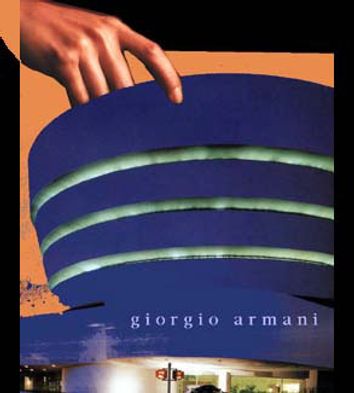
There’s the Azzedine Alaoa exhibit at the Guggenheim Soho; the Grey Gallery’s show on chic Japanese cosmetics conglomerate Shiseido; “A Century of Fashion” at the Staley Wise Gallery, with works by photographers like Richard Avedon, Louise Dahl-Wolfe and Baron de Meyer; and, most enticingly, the blockbuster Armani exhibit opening this Friday at the Guggenheim, with a “runway” exhibition space designed by theater designer Robert Wilson. The hefty, star-studded Armani exhibition catalog includes essays by Fairchild prez Patrick McCarthy and International Herald-Tribune fashion critic Suzy Menkes, an interview by Ingrid Sischy, baby photos and Armani ads, and tributes from the likes of Ricky Martin, Jodie Foster and Pat Riley. (And this is all months before the Met’s Costume Institute gala, co-chaired by Vogue editor Anna Wintour, Oscar and Annette de la Renta and Carolina Herrera.)

Not everyone is happy, however, that the Museum Mile has been transformed into one long catwalk. Some critics are accusing the institutions in question of placing themselves on the auction block, whoring themselves for money and publicity.

“These are very cynical museological decisions, determined to break down the distinctions between art and commerce,” says Hilton Kramer, art critic for the New York Observer and editor of the New Criterion. “Frankly, I don’t know any serious art critic, art historian or artist — or serious art collector, even those collectors who wear those clothes — who regard Armani’s suits as works of art.”

The New Republic’s Jed Perl has also ripped the trend, calling it “just another clever muddle of Dadaism, populism, philistinism and commercialism.”

What’s especially maddening to these art critics turned fashion scribes is the increasingly close ties between museum exhibitions and their corporate sponsors.

“It’s a dreadful development,” says Kramer. “In art circles it’s creating the impression — and I think there’s a lot of reality to the impression — that the museum is for sale, and that if you have enough money and if you’re an important enough company, you can buy the museum to promote your product.”

A month after the Armani exhibition was announced, the Guggenheim revealed the Armani company was making a three-year, $15 million commitment to the museum. (The exhibition itself is being sponsored by the celebrity-saturated InStyle magazine.) The Shiseido corporation donated half a million dollars to Grey Gallery’s owner, New York University — a sizable sum for a university. (“The Grey Gallery will show anything, if a company gives them enough money,” sniffs Kramer.) When the Metropolitan Museum of Art’s Costume Institute axed a Chanel exhibition because of designer Karl Lagerfeld’s insistent curatorial meddling, Chanel promptly canceled its planned $1.5 million donation.

Perl blames money- and fame-obsessed artists and government cutbacks for the funny money relationships. “The market-driven mentality of so many American museums dates back to the 1980s, when Warholism and Reaganomics were complementary art-world forces.”

Curiously, Lagerfeld, he of the powdered hair and ostentatious Oriental fan, agrees. Today’s exhibitions, he told Talk magazine, have “more to do with promotion and ego trips” than any legitimate interest in fashion history. Of the Costume Institute, he sneers: “They certainly weren’t afraid of being commercial. They were afraid I was taking over too much, and they wanted the check rather than me: ‘Give us the money and shut up!’”

Harold Koda, the newly appointed director of the Met’s Costume Institute and co-curator (with Germano Celant) of the Armani exhibit, dismisses his critics as “Marxist” and defends fashion as art. “Fifty years from now,” he argues, “which is going to be the signifier, the image that conveys a sense of our time?”

“If I want the work as a curator,” continues Koda, “I shouldn’t have to take it out because of [some perceived impropriety]. I mean, it’s draconian and stupid. You can’t make this simplistic argument. In Japan, corporations are the museums! Yet they’re able to do shows that are [considered] pure.”

Koda says that as long he maintains curatorial freedom he has no qualms about Armani’s ill-timed gift to the Guggenheim. “Art has always been sustained by people in power. Do we [pillory] a Medici portrait because the guy in the painting was a patron and that was self-aggrandizing? Give me a break.”

But many worry that art institutions are increasingly victim to the financial excesses and the artistic aspirations of the fashion industry. The pressure for big box-office returns and shows with mass appeal is growing, driven by the financial ambitions of modern art institutions, like the Pompidou in Paris, the Tate in London, the Museum of Modern Art and the Guggenheim, all of which are involved in aggressive expansions. So, if people aren’t interested in paying to see art, goes the philosophy, then give the people what they want. (That was one frequently cited explanation for 1998′s hugely popular but critically pilloried and BMW-subsidized “The Art of the Motorcycle” exhibition at the Guggenheim, which is sure to be cited again when the Armani exhibit opens.)

“I know a lot of junior curators are just totally horrified by this,” says Kramer, “who are saying, ‘I didn’t kill myself mastering medieval manuscripts to play second fiddle to some dress designer.’”

Even someone like Koda, a well-respected sartorial scholar who describes himself as a “boring formalist,” concedes that the art world is now a buzz-driven industry.

“Art has become so concept-driven, it’s not a bad thing anymore. Now you have artists who are manipulating art as commerce. I mean, it’s Warhol on steroids! It really has blurred the lines. When you flip through art journals, it’s difficult to tell if you’re looking at an editorial about contemporary art photography or a Gucci or Prada ad.”

When asked about how fashion is driven by money, glamour and politics — all the things that might seem antithetical to art — Koda laughs and interjects: “What, as opposed to the art world?”

The Net’s red-hot upstart

With irreverent, in-your-face shows like "Mr. Wong," webcaster Icebox.com already has Hollywood's attention.

  • more
    • All Share Services

By all rights, webcasting should be an industry whose signal has faded. Investors should be changing the channel.

Consider the evidence: Pop.com, the streaming-media site backed by DreamWorks and Steven Spielberg’s Imagine Entertainment, snapped and crackled — losing $10 million and giving 70 employees the pink slip — before it even debuted. The ambitious Pseudo.com, $35 million later, isn’t even a pseudo network. Microsoft-backed Digital Entertainment Network is now off the air. And Shockwave.com, a pioneer in the genre, is bowing out to focus on interactive games.

So why is upstart streaming-media site Icebox.com so red-hot?

The Los Angeles company’s original Web ‘toons have had more than 5.6 million “show viewings” since its launch this summer, drawing attention not only from Silicon Valley but from a more valuable source of money — Hollywood. Showtime Television has just snapped up the rights to develop Icebox’s “Starship Regulars” into a prime-time animated series; and Artisan Entertainment is looking to turn Icebox’s most popular program, “Mr. Wong,” into a direct-to-video movie. And as the firm debuts three new shows as part of its first “fall season,” it’s in talks with several studios and networks to sell television rights to three additional programs, as well as to develop a “first look” deal for its properties.

To put it simply, Icebox isn’t so much a webcaster as it is a ministudio — so it’s no wonder that its founders have elite Hollywood roots.

“We’re an incubator,” says co-founder and CEO Steve Stanford, referring to Icebox’s potential well of TV and film properties. (Stanford is a former executive at top talent agency International Creative Management, while fellow founders John Collier, Howard Gordon and Rob LeZebnik are executive producers for “King of the Hill,” “The X-Files” and “The Simpsons,” respectively.)

The company’s goal is to deliver “audience-ready” programs to networks and studios, thus eliminating the expensive costs of development. Think of it as a Kozmo.com for Hollywood development execs. It’s a clever move, yoking its business strategy to offline revenue. (The private company, which raised $15 million in financing, wouldn’t disclose how much revenue it has drawn since launching in June.)

And top writers have come on board because Icebox offers them unfettered creative freedom to produce the kinds of shows they want to make, even if the results sometimes stretch the boundaries of taste.

“Mr. Wong,” for instance, features the comic travails of a pastel yellow, hunchbacked, thickly accented Chinese manservant. The show, created by “South Park” writers Pam Brady and Kyle McCulloch, has been denounced by several Asian-American groups as racist. One recent episode had a drunken Mr. Wong urinating on the grave of Elvis Presley.

“T … t … take that, Elvis Ps … Ps … Prezzz-rey,” he moans.

In a recent guerrilla-marketing campaign, Icebox littered college campuses with fake Chinese menus for Mrwongskitchen.com. At the Web site, viewers see Mr. Wong dropping his trousers and screeching, “Suck my litchi nuts, you American bitches!” The company has even plastered posters with Mr. Wong flipping the bird near New York’s Chinatown.

“We certainly don’t encourage our writers to do things that are lowbrow,” Stanford says, but the lewd, crude frat-boy fare is aimed squarely at the 18-to-35 demographic the company aims for.

This fall, Icebox will unveil a show about a flamboyant fowl named “Queer Duck,” who pals around with his boyfriend, “Openly Gator.”

“It’s no different from “Will and Grace,” Stanford insists.

By serving as a testing ground for shows with potential to become television hits, Icebox may have discovered a solution to the biggest Web quandary — how to stay financially afloat.

After all, Stanford says, hit show “Seinfeld” is a $2 billion property. That isn’t dot-com vapor money, whose worth is tied up in the wild imaginations and speculations of investors. It’s cold, hard Hollywood cash.

Hollywood has shown an interest in Icebox because, each season, the networks lose millions to find the next “Seinfeld.” As Stanford points out, of some 100 shows that are commissioned each year, only a few dozen will actually be shot for pilots, and even fewer will actually get broadcast. NBC and Fox are each debuting six shows this fall, CBS has seven new offerings and even “not quite a network” WB is rolling out four shows — all with the hope that at least one show will be successful enough to return next year.

Meanwhile, producing an online cartoon — with no need for sets, actors, trailers or catering — is clearly a more economical proposition, and perhaps a more creative one. As Americans spend more time in front of computer screens, the potential online audience is becoming quite large. Icebox is taking particular aim at the college crowd and office slackers in their 20s and 30s — folks who tend to have fast Web connections.

Avoiding the bloated, cash-eating operations style of its predecessors, of course, is essential. So while a company like Shockwave.com dished out millions to lure names like director Tim Burton and “South Park” creators Trey Parker and Matt Stone, Icebox doesn’t pay its creative recruits a cent. Rather, it pays in stock and shares 50 percent of profits from “offline exploitation,” which includes revenues from film, TV and merchandising deals.

As Stanford puts it, “We’re trying to align the incentives of the creatives to the incentives of the deal.”

Indeed, even with dot-com cash (which isn’t so easy to come by these days), Icebox can’t match Hollywood’s prices for writers. “They all make a ton of money already,” Stanford says. “They do incredibly well in television and film. OK, let’s say we could pay them $100,000 for a project. I mean, they could go skiing on that. You know? That’s a weekend of skiing.”

Continue Reading Close

O.J. online!

Only in America: At his new AskOJ.com site, the Juice offers autographed jerseys, a lie detector test on video and other assorted horrors.

  • more
    • All Share Services

There’s simply no end to the embarrassment O.J. Simpson brings upon himself.

After shaming himself in a 20-minute shouting match with Denise Brown on Fox News Channel last month, then contradicting his attorney’s statement by saying he’d take a lie detector test only if he got paid for it, O.J. now has hooked up with Entertainment Network, the folks who brought us the popular Peeping Tom porn site VoyeurDorm.com.

Get ready for AskOJ.com, set to go live on July 27 with a chat with Simpson. For $9.95 a month, mouse potatoes can surf through O.J.’s new, “never-before-seen” evidence surrounding the case of his murdered wife, Nicole Brown Simpson, buy autographed jerseys and helmets ($75 to $400) in the “Juice Shop,” chat live with Simpson and “special guests” and, eventually, see streaming video of the Juice taking a lie detector test. The site’s developers also have approached major networks and cable channels about simulcasting the “event.”

“AskOJ.com will enable me to speak directly to the public without interference,” the maligned football star said in a statement. “The main purpose is to answer questions and to bring out facts that have been ignored. Who knows, it may also open up avenues that could lead to the discovery of the murderer or the murderers.”

So is the Juice feeling squeezed? One has to wonder whether this is a classless attempt to fill his pockets with some extra cash.

After all, the self-styled dot-com entrepreneur still owes $30 million to the families of murder victims Nicole Brown and Ron Goldman after being found liable in a 1997 wrongful death suit. To pony up the dough, Simpson has resorted to selling old football trophies.

Recently, Simpson called Fox News Channel’s “Fox News Live” and accused Denise Brown, a guest on the show, of benefiting from her sister’s death, telling her, “You made money. You’re not on welfare anymore.”

“You are a pig. You are a lowlife,” Brown retorted.

But David Marshlack, president of Entertainment Network, swears O.J. won’t be drawing a dime. Instead, he says, Simpson has promised to donate profits to charities, including the Innocence Project, which provides legal help to inmates convicted on the basis of DNA evidence.

So what does Marshlack himself make of O.J.’s infamous acquittal of double homicide?

“I watched the whole trial pretty closely, and when I met with him, I realized there’s so much stuff I never saw,” he says. “Lots of physical evidence. All I can say is, it really opened my mind.”

Marshlack, however, refuses to go into further detail, insisting on remaining neutral. “I’m nothing more than Geraldo here.”

He got the idea for AskOJ.com in early June, while tossing back a few beers in a sports bar, watching the bitter Simpson-Brown shouting match unfold on Fox.

Now the big question: Will Denise Brown be invited for an AskOJ.com chat?

“That’s a possibility,” Marshlack says.

Continue Reading Close