Alessandra Rizzo

Italy appeals court clears Knox of murder

American to be released after nearly four years in Italian prison

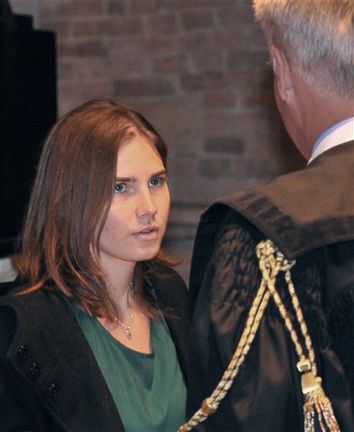
Amanda Knox talks with her lawyer Carlo Dalla Vedova upon arrival for an appeal hearing at the Perugia court, central Italy, Monday, Oct. 3, 2011. (Credit: AP Photo/Antonio Calanni)

An Italian appeals court has thrown out Amanda Knox’s murder conviction and ordered the young American freed after nearly four years in prison for the death of her British roommate.

Knox collapsed in tears after the verdict was read out Monday. Her co-defendant, Raffaele Sollecito, also was cleared of killing 21-year-old Meredith Kercher in 2007.

The Kercher family looked on grimly as the verdict was read out by the judge after 11 hours of deliberations by the eight-member jury. Outside the courthouse, some of the hundreds of observers shouted “Shame, shame!”

World urges Gadhafi to surrender, plans future

Libyan strongman's whereabouts unknown as rebels secure 95 percent of Tripoli

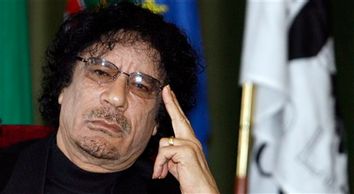
FILE -- In a Dec. 7, 2007 file photo Libyan leader Moammar Gadhafi gestures while speaking during media conference at the University of Lisbon, in Lisbon, Libyan rebels took control of most of Tripoli in a lightning advance Sunday, Aug. 21, 2011, but the leader's whereabouts were unknown and pockets of resistance remained. (AP Photo/Paulo Duarte/file) (Credit: AP)

World leaders said Monday the end is near for Moammar Gadhafi’s regime and began looking at Libya’s future without the man who has held power there for 42 years.

Leaders across Europe welcomed the rebels’ dramatic advances in the Libyan capital, Tripoli, after six months of fighting, and urged Gadhafi to surrender and avoid a bloodbath. Hundreds of Libyans living abroad celebrated in the streets, burning images of the Libyan strongman.

Though Gadhafi’s whereabouts was not known, leaders set in motion plans for Libya’s future. Britain said its frozen Libyan assets will soon be released to help the country’s rebels establish order; France announced plans for an international meeting next week; Italy has sent a team to the rebels’ base of Benghazi to help plan reconstruction and the restoration of oil and natural gas production.

“The time is up. There is no alternative to surrendering and handing himself in to justice,” Italian Foreign Minister Franco Frattini said Monday.

“His regime is falling apart and in full retreat. Gadhafi must stop fighting, without conditions,” Cameron said in London. He vowed that Britain and others would now assist Libya’s “effective transition to a free, democratic and inclusive” nation.

Cameron said British diplomats would move from Benghazi in the east to Tripoli as soon as it was safe to do so. Crucially, he announced that Britain, which has frozen about 12 billion pounds (US$20 billion) of Libyan assets, will soon release the funds.

Germany announced similar plans once the regime is out. Foreign Minister Guido Westerwelle said that just over euro7 billion ($10.1 billion) is frozen in Germany and that the money could be used to help rebuild Libya. “The Libyan people are entitled to this money,” he said.

France said the “contact group” of international powers involved in stabilizing Libya would meet next week in Paris. Foreign Minister Alain Juppe said the head of Libya’s opposition group, the National Transitional Council, would be in Paris to discuss the future now that Gadhafi’s regime is “finished.”

France and Britain, backed by the United States, have spearheaded the NATO-led air campaign that began months ago under a U.N. Security Council resolution calling for the protection of civilians.

In Brussels, the European Union vowed in a statement to “keep supporting the country in its democratic transition and economic reconstruction, based on social justice, inclusiveness and territorial integrity.” The EU has given euro150 million ($215 million) in humanitarian aid to Libya during the civil war, and in May, EU foreign affairs chief Catherine Ashton extended de-facto recognition to the rebels’ council by opening a diplomatic office in Benghazi.

But leaders also cautioned against the risk of escalating violence as a desperate Gadhafi might try to cling to power. Instead, they said, Gadhafi should face justice and turn himself in to the International Criminal Court.

“There’s a great risk that the violence will escalate,” Swedish Prime Minister Fredrik Reinfeldt told Swedish news agency TT. “It’s a very dangerous situation with various militia groups of young, angry men on the loose and armed with weapons. It would be best if the regime simply surrenders and we get a cease-fire and rid of the weapons.”

Frattini said there was no longer room for mediation, including allowing Gadhafi to go into exile or remain in Libya but relinquish power — as had been suggested at various points as diplomats sought ways to get out of what appeared to be a military stalemate.

South Africa — which has criticized the NATO bombing and led failed African Union efforts to mediate between the rebels and Gadhafi — insisted it had sent no planes to Libya to evacuate Gadhafi. It said it had received no request from him for asylum, and was involved in no efforts to extricate him.

“I’m quite amazed that there’s even an insinuation that we are facilitating evacuation of anyone,” said Foreign Minister Maite Nkoana-Mashabane. She said that “for sure, he will not ask to come here” and noted that South Africa is an International Criminal Court member — suggesting that South Africa would have to arrest Gadhafi if he arrived there.

The International Criminal Court has indicted Gadhafi on charges of crime against humanity, along with one of his sons, Seif al-Islam Gadhafi, and Libya’s intelligence chief. Seif Gadhafi has been arrested by rebel forces, while another one of Gadhafi’s sons is under house arrest.

The government of Malta, a tiny Mediterranean island close to north Africa, has also denied reports that Gadhafi is headed there.

On Sunday, U.S. President Barack Obama urged Gadhafi to accept reality and relinquish power. “The surest way for the bloodshed to end is simple: Moammar Gadhafi and his regime need to recognize that their rule has come to an end,” the president said.

Outside of the country, Libyan expatriates celebrated what they felt was already the end of the regime.

In Ankara, the Turkish capital, dozens of Libyans flocked to the embassy to celebrate the rebels’ seizing much of Tripoli. They removed the Gadhafi regime’s green flag from a mast and replaced it with the rebels’ tricolor one. They grabbed Gadhafi posters from inside the building, smashed or set them on fire as the embassy staff watched. The group, which included women and children, then proceeded to chant and dance as they waved the rebels’ flags.

A similar scene occurred in Malta, where some 200 Libyans entered the Libyan embassy on Sunday to hoist the Libyan independence flag while setting fire to pictures of Gadhafi and his green flag. The celebrations continued through the night and were still on Monday morning.

“The celebrations we currently see in Libya, and not least in the streets of Tripoli, all point in one direction: the Libyan people’s struggle for freedom has gone into the playoffs,” said Prime Minister Lars Loekke Rasmussen of Denmark, whose country took part in the NATO campaign. “It is crucial that the final phase is handled in a dignified manner and that the National Transitional Council remains united to manage the transition toward the holding of free elections.”

Associated Press writers around the world contributed to this report.

Continue Reading Close

U.S. movies headline Venice Film Festival

George Clooney's political drama "The Ides of March" will open the event on August 31

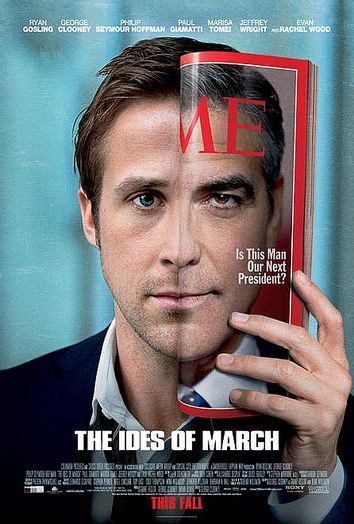
Ryan Gosling and George Clooney on the poster for "The Ides of March."

American filmmakers dominate the lineup of this year’s Venice Film Festival, where George Clooney and four others will be competing for the Golden Lion, while Madonna, Al Pacino and Steven Soderbergh will premiere their latest directorial efforts.

The strong lineup also includes Roman Polanski, presenting “Carnage,” an adaptation of the Broadway show “God of Carnage” featuring Jodie Foster, Kate Winslet and Christoph Waltz; David Cronenberg’s take on psychoanalysis in “A Dangerous Method,” featuring Keira Knightley, Viggo Mortensen and Michael Fassbender; and “Shame,” a drama by British director Steve McQueen featuring Fassbender and Carey Mulligan.

All 22 movies in competition at the world’s oldest festival are world premieres, organizers said Thursday. One of the 22 titles was kept secret and will be announced in coming weeks.

“We have looked for and strengthened a relationship with American cinema each year,” said festival director Marco Mueller. However, he stressed that the guidelines for selecting the movies were just “to take beautiful movies, movies that would make one think and dream.”

He cited Clooney’s political drama “The Ides of March” as an example of a “sharp film that takes a look at today with a critical eye.” The film about corruption and idealism in American politics, which stars Clooney, Ryan Gosling, Paul Giamatti and Philip Seymour Hoffman, will open the festival on Aug. 31.

The other American movies in competition are: the end-of-the-world film “4:44 Last Day on Earth” by Abel Ferrara; “Dark Horse” starring Mia Farrow and Christopher Walken directed by Todd Solondz of “Happiness” fame; “Killer Joe,” a black comedy by William Friedkin starring Matthew McConaughey in the title role; and the second feature film by Ami Canaan Mann, “Texas Killing Fields,” a murder drama featuring Sam Worthington and Jessica Chastain.

Chastain, who had previously starred in “The Tree of Life,” also appears in Pacino’s “Wilde Salome.”

The lineup suggests a star-studded red carpet, though Mueller would not say which stars will attend the festival.

Among the most highly-anticipated events is Madonna’s second feature film, “W.E.” The movie intercuts between the romance of a modern woman (Abbie Cornish) and the relationship of American socialite Wallis Simpson and Britain’s King Edward VIII, who abdicated the throne for love in the 1930s.

The festival runs through Sept. 10. The jury awarding the Golden Lion and other official prizes is headed by American director Darren Aronofsky.

Continue Reading Close

Silvio Berlusconi dismisses prostitution probe

Italy's prime minister calls investigation into whether he had sex with a minor "absurd"

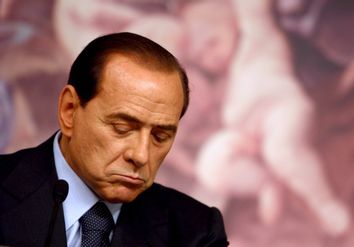
epa00714364 Outgoing Italian Premier Silvio Berlusconi reacts while speaking at a farewell press conference at Chigi Palace in Rome, Tuesday, 16 May 2006. Italy's new President Giorgio Napolitano today gave centre-left coalition leader and former European commission chief Romano Prodi a mandate to form a new centre-left government. EPA/ETTORE FERRARI(Credit: Epa)

Premier Silvio Berlusconi has dismissed an investigation into allegations he paid for sex with a teenage girl by saying prosecutors are just jealous they weren’t invited to his home for dinner.

In a statement Friday, Berlusconi called the investigations “absurd” and noted he has been investigated over 100 times, yet never convicted.

The latest probe by Milan prosecutors is looking into whether the 74-year-old premier had sex with a 17-year-old nightclub dancer nicknamed Ruby, and then used the powers of office inappropriately to try to hide the encounter.

Berlusconi’s lawyers have called the probe groundless.

THIS IS A BREAKING NEWS UPDATE. Check back soon for further information. AP’s earlier story is below.

ROME (AP) — Prosecutors are investigating whether Premier Silvio Berlusconi paid for sex with a teenage girl from Morocco and then abused his power in trying to cover up the encounters, officials said Friday.

The investigation, which Berlusconi’s lawyer called “absurd and groundless,” escalated a long history of accusations of sexual and financial impropriety aimed at the billionaire businessman, who has become Italy’s longest-serving postwar leader despite corruption trials, international gaffes and political infighting.

The latest allegations come at a moment of particular vulnerability for the blunt-speaking, high-living prime minister. Berlusconi has been politically weakened in recent months by a challenge from an-ex ally, while a law shielding him from two unrelated trials in Milan was significantly watered down Thursday by a ruling of Italy’s Constitutional Court.

Still, Italians have proven hard to shock, and Berlusconi inspires both loyalty and fierce opposition. A citizen group called Friday for his resignation but his supporters immediately dismissed the allegations as a baseless, politically-driven attack.

According to a statement by Milan prosecutors, the probe is looking into whether the 74-year-old premier had sex with a 17-year-old nightclub dancer nicknamed Ruby by the press, and then used the powers of his office inappropriately in trying to hide the encounter.

The prosecutors issued a summons Friday for Berlusconi and his lawyers to appear for questioning, the statement said. They also ordered Milan police to search the offices of various people implicated in the case, including a showgirl-turned-politician who is close to the premier.

No date was given, but the ANSA news agency said the questioning might take place next week, and that prosecutors might seek a fast-track trial.

Berlusconi’s attorneys, Nicolo Ghedini and Piero Longo, said probe represented a “very serious interference in the prime minister’s private life that has no precedent in the country’s judicial history.”

They called the case media-driven, and said the allegations “have already been refuted by all witnesses and people directly involved.”

In recent years, Berlusconi has been engulfed in a series of scandals relating to his private life, including reports of wild parties at his mansions and alleged encounters with two other prostitutes. In one case, Patrizia D’Addario, a self-described call girl, said she spent the night with Berlusconi on the night Barack Obama was elected U.S president. She later gave purported tapes of her encounter with Berlusconi to an Italian magazine.

In 2009 his second wife, Veronica Lario, announced she was divorcing him, citing Berlusconi’s purported fondness for younger women, and his presence at the birthday party of an 18-year-old model, who famously called him “Papi” (“Daddy”).

Berlusconi has made no apologies for his lifestyle, saying recently, “I love life, I love women!” In the past he denied having paid to have sex, though he also said, “I’m no saint.”

The Ruby case became public months ago when it emerged that Berlusconi had intervened to secure the release from police custody of the girl, who had been held for theft. According to unsourced press reports at the time, Berlusconi had told the police she was a relative of Egyptian President Hosni Mubarak.

When the scandal broke, Berlusconi denied any improper behavior, saying he had only intervened to help someone in need out of the goodness of his heart. He insisted he called Milan police solely to inform them that somebody available to act as the girl’s guardian was going to the police station where Ruby was being held.

The person who went to the police on Berlusconi’s behalf is Nicole Minetti, the former showgirl whose offices were searched by police. Minetti, who is also Berlusconi’s dental hygienist and an elected member of a regional assembly in Milan for the premier’s party, is also under investigation, the prosecutors said.

Ruby said in newspaper interviews months ago that she had been at the premier’s villa and that she lied about being over 18. She denied having sex with the premier.

The age of consent for sex in Italy is 14, but exploiting or aiding prostitution of minors under 18 is a crime. The girl has in the meantime turned 18.

The prosecutors are investigating whether Berlusconi called Milan police on the night of May 27-28 to secure the release of the girl because he wanted to hide the fact that he had been the girl’s client during encounters at his villa at Arcore, near Milan, between February and May, according to the statement.

Berlusconi was placed under investigation Dec. 21, the prosecutors said. They confirmed the probe Friday after Italy’s leading newspaper, Corriere della Sera, reported on it.

Many of the premier’s political allies said the latest probe was yet another attempt to hurt the premier by what they say are left-leaning magistrates.

“It’s an old script,” said Daniele Capezzone, a spokesman for Berlusconi’s party. “If someone … still believes that Silvio Berlusconi can be defeated through judicial means, once again they will be sorely disappointed.”

——

Associated Press Writer Colleen Barry in Milan contributed to this report.

Continue Reading Close

Prosecutors: Vatican bank defying laundering laws

Church tries to lift $30M seizure, says it is complying with rules; investigator says "the opposite" is happening

Italian prosecutors contest claims by the Vatican bank that it is trying to comply with international rules to fight money laundering, saying an investigation that led to the seizure of euro23 million ($30 million) from a Vatican bank account shows “exactly the opposite,” according to a court document obtained Friday by The Associated Press.

An Italian court on Wednesday rejected a Vatican request to lift the seizure, leading the Vatican to express “astonishment” at the court’s ruling and indicating the case will not be cleared up quickly, as the Vatican originally predicted.

Since the money was ordered seized last month, the Vatican and the bank’s chairman, Ettore Gotti Tedeschi, have repeatedly said the allegations resulted from a “misunderstanding” and that the Vatican bank — officially known as the Institute for Works of Religion — has been working to comply with international rules to fight money-laundering.

The strongly worded document from the prosecutors’ office said that while there is a “generic and stated will” to conform by the bank “there is no sign that the institutions of the Catholic church are moving in that direction.”

It said the prosecutor’s investigation had found “exactly the opposite.”

The document was submitted to the court as part of the prosecutors’ case against the bank.

The Vatican spokesman, the Rev. Federico Lombardi, issued a new statement Friday evening, saying Vatican bank officials “confirm their intent to follow the line of transparency” in all financial transactions and are confident in being able to provide as soon as possible all clarifications requested.

Under the investigation, financial police seized the money Sept. 21 from a Vatican bank account at the Rome branch of Credito Artigiano Spa, after the bank informed the Bank of Italy about possible violations of anti-money laundering norms. The bulk of the money, euro20 million ($26 million), was destined for JP Morgan in Frankfurt, with the remainder going to Banca del Fucino.

The prosecutors’ document suggests confirmation of Italian press reports that the probe was widening, looking into possible violations in earlier years linked to Italian corruption, in addition to the two most recent cases.

The document cites suspicious transactions involving checks drawn from a Vatican bank account at Unicredit bank in 2009, involving the use of a false name.

The prosecutors also cited a euro650,000 withdrawal from a Vatican bank account at Intesa San Paolo bank where the Vatican didn’t specify the money’s ultimate destination despite a specific request by the Italian bank.

The prosecutors called this “a deliberate failure to observe the anti-laundering laws with the aim of hiding the ownership, destination and origin of the capital.” The Italian banks have declined comment.

The Vatican bank is required to provide such information because it is considered by Italy to be a foreign bank.

Gotti and his No. 2, Paolo Cipriani, have been placed under investigation by Italian authorities. They were questioned by Rome prosecutors on Sept. 30. They have not been charged with any crime.

Italian legal experts have said the case could end up being decided by Italy’s highest court.

It is not the first time the bank has clashed with Italian authorities. The Vatican bank was famously implicated in a scandal over the collapse of the Banco Ambrosiano in the 1980s in one of Italy’s largest fraud cases.

Roberto Calvi, the head of Banco Ambrosiano, was found hanging from Blackfriars Bridge in London in 1982 in circumstances that still remain mysterious.

London investigators first ruled that Calvi committed suicide, but his family pressed for further investigation. Eventually murder charges were filed against five defendants, including a major Mafia figure, and they were tried in Rome and acquitted in 2007.

Banco Ambrosiano collapsed following the disappearance of $1.3 billion in loans the bank had made to several dummy companies in Latin America. The Vatican had provided letters of credit for the loans.

While denying any wrongdoing, the Vatican bank agreed to pay $250 million to Ambrosiano’s creditors.

The late Archbishop Paul Marcinkus, an American prelate who headed the Vatican bank at the time, was charged as an accessory to fraudulent bankruptcy in the scandal, but Italy’s Constitutional Court eventually backed the Vatican in ruling that under Vatican-Italian treaties Marcinkus had immunity from Italian prosecution. Marcinkus long asserted his innocence and died in 2006.

——

Reporter Martino Villosio in Rome contributed to this report.

Continue Reading Close

Wiretap bill spurs debate and protests in Italy

In a nation under constant surveillance, critics say the proposed law would chill important watchdog journalism

Silvio Berlusconi is sending out a message as he and his allies fall victim to a string of embarrassing phone call leaks: Stop listening.

The Italian premier is pressing a bill to limit the use of investigative wiretaps that have been the source of numerous scandals, but there is fierce opposition to curbing official eavesdropping in one of the world’s most wiretapped nations.

Magistrates warn the contentious legislation winding through parliament would damage their fight against the Mafia, terrorism and pedophilia by severely limiting powers to conduct wiretaps.

Journalists denounce provisions that would ban them from printing wiretap transcripts as a breach of freedom of information, and called a media blackout for Friday to illustrate the impact. Newspaper journalists went on strike Thursday so papers couldn’t come out the next day.

Most observers agree a problem does exist in Italy: too many wiretaps, their contents too readily made public, often in violation of privacy and without a clear connection to any relevant probes.

Wiretaps and leaked phone conversations are an important source of fodder for Italian newspapers. Some of it is salacious, as when the purported recordings of a call girl who claimed to have slept with Berlusconi dominated headlines last year for weeks.

In waging his battle against wiretaps, the scandal-plagued Berlusconi, who has been the target of several corruption probes, has cast himself as an unlikely champion of democratic values.

“We are all spied on!” the premier said recently. “Do we realize that this is not a civilized country, that this is not real democracy? … We can tolerate this no more!”

But critics also say what the premier really wants is to protect himself and his allies.

“The real objective of this bill is to prevent the reporting of judicial cases that have a high political impact, the ones that can generate, and have generated, embarrassment,” Roberto Natale, the president of the journalists union, told The Associated Press in an interview.

International organizations have added their voices to the critics, including Reporters Without Borders, which denounced the proposed the law as authoritarian.

Both magistrates and journalists have been the object of scorn by Berlusconi — the former for the numerous probes they have brought against him, the latter for publishing details of his private life. Both see the premier’s moves as an attempt to delegitimize their professions.

Italy is arguably one of the most wiretapped nations on the planet — but the estimates of how many people are being spied on electronically vary.

According Justice Minister Angelino Alfano, who drafted the bill, there are more than 100,000 authorized taps each year. That compares with 20,000 people wiretapped a year in France, 5,500 in Britain and 1,700 in the United States, Alfano said at the time the bill was presented.

Italians, it seems, have grown accustomed to getting a glimpse of the lives of their rulers, and many simply shrug off the problem, saying that those who have nothing to hide don’t care about the wiretapping.

In recent months, most wiretaps leaked to Italian newspapers have emerged from a corruption scandal in which the Italian disaster relief agency is suspected of corruption in connection with contracts for last summer’s Group of Eight summit.

Leaked conversations include a former public works official apparently discussing gay prostitutes with a Vatican choir member and a Brazilian masseuse saying her services to the disaster agency chief went no further than giving a massage.

In the past, published wiretaps have included Berlusconi discussing TV shows and actresses with an executive of the public broadcaster.

Despite these excesses, the bill remains highly controversial, even within Berlusconi’s own coalition. As a result, it has been modified several times and more changes might come when parliament takes it up again starting July 29.

As it stands, the bill would introduce significant restrictions to investigators, imposing stricter time limits and making the proof needed to win approval for a wiretap tantamount to the proof needed to win a conviction, said Armando Spataro, a leading anti-terrorist prosecutor in Milan.

Spataro said the bill amounts to “deconstructing the most important tool against any type of criminality” and called the measures “illogical” and “inconsistent.”

Officials note that investigations for terrorism and Mafia are exempt from the restrictions, but magistrates say those probes often spring from small-time crime cases and that hurting those investigations effectively hurts the fight against major crimes.

For the media, the bill would ban the publication of even a summary of any wiretap until the conclusion of preliminary investigations at the earliest — something that can require years in Italy’s slow-moving justice system.

It envisages a one month jail term for journalists and hefty fines for publishers — up to euro464,000 — who are caught in violation.

The law also bans the secret recording of conversations — a measure quickly dubbed “the D’Addario provision” after the name of the call girl, Patrizia D’Addario, who is believed to have recorded and then leaked to the media her purported conversations with Berlusconi. Secret agents and investigative journalists, however, are exempt.

Newspapers have been filled with accounts of all the stories that Italians would not have heard about if the new regulations had been in place. Gathering in Rome last week, many gagged their mouths with “post-it” style yellow stickers that have become a symbol of the protest.

If the law passes, said journalist union chief Natale — “Italian citizens would miss out on a lot of news.”

——

Barry reported from Milan.

Continue Reading Close

Page 1 of 2 in Alessandra Rizzo