“Some of y’all never been down South too much … Down there, we have a plant that grows out in the woods, in the fields, looks something like a turnip green. Everybody calls it poke salad.”
Soft white leather boots planted at his sides, Elvis Presley grinds slowly in a matching jumpsuit decorated with beaded fringe and silver buckles running down the sides. Tan and slender, he looks at once menacing and on the verge of laughter. He whips his arm into the air and the audience lets out an involuntary scream.
“Lord have mercy.”
Along with five or six other guests, I’m huddled around a faux-’50s television in the lobby of the Heartbreak Hotel in Memphis, watching Elvis perform “Polk Salad Annie” in Las Vegas, circa 1971. It’s 2 a.m. Though she has seen the footage countless times, a woman in a baby blue parka sitting beside me sighs loudly as she watches Elvis pace up and down the stage.
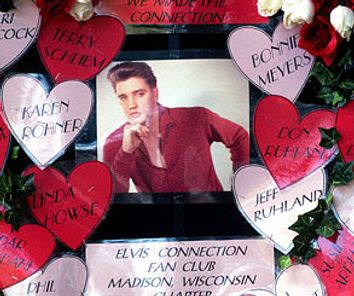
Aug. 16, 2002, marks the 25th anniversary of Elvis’ death, but I’m in Memphis in January to celebrate his 67th birthday. Both anniversaries — birth and death — are an occasion for annual fan pilgrimages. Having loved Elvis’ music ever since I can remember, I’ve spent 22 hours in a car and crossed seven states to be here. Tonight, the Heartbreak Hotel, located several hundred feet from Graceland and surrounded by fake topiary shaped like pianos and guitars, feels like the Vatican Holiday Inn.
The woman in the parka follows Elvis with her eyes, dabbing them with a balled-up Kleenex. “God,” she says to herself quietly. “Oh God.”
Day 1
In the Heartbreak Hotel cafeteria, Brenda is dreamily picking at her breakfast while “Love Me Tender” drones softly from a ceiling speaker. Brenda, in her late 30s and pretty, tells me she’s a homemaker from Texas. She says she has always felt drawn to Graceland. This is her 12th visit. “I used to bring the kids, but now my husband says, ‘What is there to do?’ But I just love being here. It seems every time I learn something new. So now I just drag along whomever I can find.”
This time Brenda brought her brother Buddy, who wears a thick mustache and a baseball cap and seems skeptical. “My cousin makes fun of me,” Brenda is saying. “‘Why can’t you e-mail me just once without mentioning Elvis?’ So now I just use the word ‘blank’ instead. And my e-mails are just full of ‘blanks.’” Buddy rolls his eyes.
I ask Brenda what she likes best about Elvis. “Oh, I don’t know,” she replies. “I just love him. I know he’s not Jesus Christ, but he was different.” Brenda says that someday she would like to move here and maybe get a job at Graceland. Nevertheless, as she looks around the tables, which are occupied by groups attired in Elvis hats, shirts and buttons, she seems a little out of place. “I know there are more diehard fans here than I,” she says almost apologetically.
Buddy snorts. “I’d hate to meet them,” he says.
At an adjacent table, a man in his early 20s is telling a rapt audience of middle-aged women about an Elvis pinball machine he bought at a garage sale for $200. When he’s not working as a telephone operator, John Daly operates the Elvis Memories Loop, an e-mail service that has more than 300 subscribers. He collects only authentic historical Elvis artifacts and displays them in his “Elvis room.” Daly exudes an air of authority and looks a bit like a young Phil Spector. Nevertheless, he has to be careful about decorating his Elvis room because he still lives with his parents.
He fills me in on some tenets of Elvis fandom: “There are two types of fans. There’s the type that come here when they’re passing through town, and then there’s us: We eat, sleep and breathe him.” And: “Serious fans don’t like to be called ‘fans,’ because it implies fanaticism.” Also: “We don’t like impersonators. They look cheap. Their outfits look nothing like the real thing, because Elvis spent a fortune on his costumes.”
The women seated around Daly are members of the If I Can Dream Elvis in Alabama Fan Club. A heavyset blonde in an Elvis sweatshirt hands me a card. It says “Sharon Parker — I Love Elvis.” Parker tells me that when she recently had knee surgery, she received hundreds of letters and cards from “Elvis friends” around the world.
I ask everyone what they like most about Elvis. “He was always there for us,” says Parker.
“He couldn’t live like us,” someone else says. “He gave up his life for us.”
A young black woman in a maid’s uniform announces that we have to leave the cafeteria because she needs to vacuum. Daly suggests that we go up to his suite to watch “Follow That Dream” on the hotel’s 24-hour Elvis channel. Before we do, Parker recites a prayer: “Thanks for the love and friendship we found through each other and Elvis Presley.”
At the Marriott on Thousand Oaks Boulevard, behind the IHOP, about 500 Elvis Presley fan club officers and their dates are packed into the hotel’s ballroom for a meal of London broil and pink champagne. They have traveled here at their own expense to attend the annual Fan Club Presidents’ Luncheon.
This year’s theme is “Follow That Dream,” the title of a 1962 comedy in which Elvis plays a Florida homesteader and sings “On Top of Old Smokey.” At the podium, Patsy Andersen, Elvis Presley Enterprises’ perky fan relations manager, is introducing Elvis’ costar in the film, Anne Helm. Also here are Gavin and Robbin Koon, identical twins who appeared in “Follow That Dream” as children. The Koons are wearing bifocals and matching crew-neck sweaters and peer glumly at the audience.
Next, Patsy introduces the Browns, a country harmony trio who toured with Elvis in the ’50s. At the podium, matriarch Maxine Brown, who looks a lot like former Texas governor Ann Richards, regales the audience with a story in which Elvis’ mother, Gladys, chides her son for “not wearing no drawers” onstage. There’s some strangled laughter, but many of the fan club officers wear expressions indicating they find the anecdote in poor taste.
Patsy announces that she has a surprise, but first, fan club officers come up to the podium to present gifts to charity in Elvis’ name. The Irish Elvis Presley Fan Club presents $1,500 to the Beaumont Hospital in Dublin. The Elvis Friendship Circle in Shreveport, La., donates 168 pounds of peanut butter to the Northwest Louisiana Food Bank. It is announced that the Elvis Heart of Gold Fan Club in Kahoka, Mo., has given six teddy bears to the Missouri Highway Patrol to “help comfort children who have been involved in accidents, domestic abuse or other traumatic situations.”
Finally it’s time for the surprise, and Patsy introduces a Disney executive named Kevin. Kevin wants to share a preview of an upcoming Disney animated feature that features seven Elvis songs, but says he must make sure no photos or video footage are leaked prior to the film’s release. “We can’t show this until all the cameras and video equipment are on the floor,” Patsy interjects playfully. “If I see any pictures on the Internet, I know where you live and I will find you and kill you.” Everyone laughs. The laughter subsides somewhat when a squad of security guards fans out across the room, checking for cameras.
Finally, the lights dim and a montage from the animated film “Lilo and Stitch” is shown on two large-screen TVs. The film concerns a young Hawaiian girl who adopts a space alien disguised as a dog. (It would be released in the spring, with impressive box office results.) When Stitch, the alien dog character, begins singing “Can’t Help Falling in Love,” the room bursts into whistles and applause. This happens every time Stitch sings an Elvis song. When the lights come up, Kevin says that thanks to “Lilo and Stitch,” a new generation will be introduced to the music of Elvis Presley. Everyone applauds.
Day 2
On Graceland’s front lawn, a photographer from Sports Illustrated is taking pictures of a tall young black man in expensive-looking sneakers. A security guard tells me the man’s name is Shane Battier and that he’s the star forward for the Memphis Grizzlies, the city’s new NBA franchise. “Do some air guitar,” the photographer instructs, and Battier strikes a ’50s greaser pose, gyrates his hips and strums the air.
Built in 1939 by Dr. and Mrs. Thomas D. Moore, Graceland still looks more like the home of an affluent physician than of a man who has sold a billion records. The Georgian colonial that Elvis bought in 1957 for $100,000 is far more modest than, for example, the homes of the rappers and heavy metal musicians profiled weekly on MTV’s “Cribs.”
Downstairs, in a rec room furnished with three TVs, a stereo console, a soda fountain and a small glass sculpture of a monkey, one of the lemon yellow walls is emblazoned with Elvis’ logo: the letters TCB, which stand for “Taking Care of Business,” wrapped around a lightning bolt. Upstairs, the Jungle Room is upholstered in floor-to-ceiling shag carpeting and decorated with faux-African recliners and an indoor waterfall. In the adjoining room, a globe-shaped bed covered in fake crimson fur has an eight-track player built into the canopy.
Most of the details, however — a football jersey, framed portraits of Elvis’ parents — are reminders that when he moved here, Elvis was a 22-year-old who never touched anything stronger than Pepsi. His favorite activities included gunning a golf cart loaded with high school friends around the property and renting out movie theaters and the local amusement park at night. Much of Graceland still looks like the home of a wealthy, unsupervised teenager.
In the backyard, a few sleepy horses graze behind a fence. There’s a small office and a smokehouse that Elvis converted into a shooting range. The old slot-car track has been replaced with the Hall of Gold, an exhibit of Elvis’ gold and platinum records, of which there are a formidable number. The racquetball courts now house an enormous glass obelisk from BMG Records, proclaiming Elvis “The Greatest Recording Artist of All Time,” as well as a collection of stage outfits from the ’70s. With their gold inlay, rhinestones and peacock feathers, they look like costumes from a kabuki production of “Grease.”
In the Meditation Garden, a crowd of visitors outfitted with headphones and digital recorders stands silently around a small fountain. They look down at gravestones inscribed with the names of the Presleys. Several months after Elvis’ death, in 1977, Vernon Presley moved his son’s body here from nearby Greenwood Cemetery, which became inundated with fans. Gladys’ grave is adorned with teddy bears. Elvis’ is heaped with flowers and cards, and a dozen more wreaths and plaques are lined up along the side of the swimming pool. There is a guitar made of lilies, a red, white and blue floral arrangement bearing an intimate inscription from a French fan and a metal-and-wood plaque nearly as tall as a man, engraved with the names of five fans from Osaka, Japan.
In 1962, when Elvis built the Meditation Garden on a solitary corner of the property, Graceland was located in a bucolic spot adjacent to the Mississippi border. The only reminder of the city was Highway 51, a two-lane road that connected Memphis and Jackson. Today, Elvis Presley Boulevard is bounded by Graceland Plaza, a sprawling strip mall that houses an assortment of antiseptic diners, souvenir shops and mini-museums devoted to Elvis’ cars, planes and personal effects. The highway takes motorists to the casinos in Tunica and the university in Oxford, and farther south, all the way to Baton Rouge and New Orleans.
The Meditation Garden hums with the sound of traffic. Standing near Elvis’ grave, a well-dressed middle-aged man begins to weep. His wife tries to console him, but he buries his face in his hands and turns away.
“No one knows why Elvis never appealed to the intellectuals,” Todd Slaughter muses. “In England, we have our share of college professors and members of the clergy, but they are in the minority. Most of our fans are blue-collar or no-collar.”
A short, jovial man with the manner of a beauty contest emcee, Slaughter is almost certainly the world’s foremost Elvis fan. As president of the Official Elvis Fan Club of Great Britain and the Commonwealth, he oversees more than 20,000 members. Moreover, he has been filmed with Elvis not once, but twice. Slaughter expounds on the intricacies of the Elvis phenomenon with the good humor and studied patience of a QVC salesman, which, in fact, he has also been. Earlier in the morning, he presided over the shaving of a casino hostess’s head, an event that raised $1,000 for the Make-A-Wish Foundation. As we speak in a hallway at the Marriott, several fans approach him for an autograph.
“Elvis penetrated the youth,” Slaughter offers, making it clear that he is not opposed to an occasional bit of ribaldry. He says that while the Elvis-oriented summer camps his fan club operates in the U.K. attract a clientele in their 20s, the majority of the members became hooked on Elvis as teenagers in the ’50s. He has been bringing British fans to Graceland for more than 30 years, and says that the experience has changed. “Back in the ’70s, the tours were very sex-driven, but most of the fans are now too old to shag.”
He greets an old acquaintance cheerfully, clapping him on the back. “How are you, you old pedophile?” he says.
When I mention an Elvis prayer meeting I heard about recently, Slaughter nods his head gravely. “The U.K., we’re not a religious nation. For us, it’s a holiday. The Americans, though, they can take it a bit over the top.”
Day 3
It’s an overcast afternoon and downtown Memphis is deserted. Even the neon signs on the newly gentrified Beale Street, once home to saloons and gambling parlors where the blues is said to have originated, can’t change the mood.
At Elvis Presley’s Memphis Restaurant, Beale Street’s grandest new establishment, Patsy is conducting an Oprah-style question-and-answer session with Anne Helm and the Browns. Patsy is blond and slim, and wears black leather slacks and a sweater with a flamingo pattern. She is questioning Bonnie Brown about her teenage romance with Elvis. Bonnie, who wears her hair in a plush silver helmet, concedes it was exciting, but demurs on the details. There are some disappointed groans among the tables.
“Can you tell us whether Elvis was a good kisser?” Patsy probes gently.
Bonnie Brown pauses to think. At a nearby table, a woman wearing a large Elvis button loses her patience. “Come on, he was out of this world,” she yells.
During the Q&A, a couple in their 60s watches the action from a table near the stage, nodding occasionally. June and Gene Koine have been coming to Graceland since 1976, when they were among the privileged few who spoke to Elvis in the Graceland driveway. June, a soft-spoken former kindergarten teacher, says her fan club is called TCEM in Ohio With TLC, which stands for “Taking Care of Elvis’ Memory in Ohio With Tender Loving Care.”
When I ask her whether she likes Elvis as a person or as an entertainer, June pauses to think. “I have my own Elvis,” she replies finally. “There’s love that goes from me to him and from him to me.”
“I love him like a brother,” Gene offers. “It’s like when you meet your girlfriend or wife for the first time, and there’s that special electricity. You just can’t explain it.”
When June had cancer surgery last year, she asked the surgeon to play Elvis’ music in the operating room. Her cancer, she says, is now in remission. Like many of the fans I’ve spoken to, June gets angry at the media for their portrayal of Elvis’ personal problems, which she says is hurtful and misinformed. “Elvis had glaucoma and arthritis,” she says by way of explaining the drugs found in Elvis’ system during the autopsy. “He chose friends who were not loyal.”
June and Gene tell me that their children like Elvis “all right,” but they are concerned about their 9-year-old grandson’s latest musical obsession. “It’s one of those rappers who is always saying bad things about the police,” June explains. “Elvis would have never done that.”
Day 4
The morning of Elvis’ birthday is unusually frigid, and a crowd of sleepy fans wrapped in scarves and mittens strolls to the Graceland gazebo to hear the Proclamation. In addition to being excited to hear Mayor Willie W. Herenton declare Jan. 8 Elvis Presley Day in Memphis, everyone is happy about being allowed to walk up to the mansion without having to take the shuttle bus. Shivering in the cold wind, the mayor quickly outlines Elvis’ contributions to Memphis and Tennessee, and everyone walks briskly to Graceland Plaza for complimentary cake and coffee at the Chrome Grille.
At a tiny Formica table wedged behind a disemboweled pink Cadillac, a young Asian man with a black pompadour and sideburns shows off the back of his leather jacket, which is airbrushed with the young Elvis’ face. Johnny “Elvis” Newinn, a college student who recently placed second in a national impersonator competition, says he first heard Elvis’ music when he was growing up in Vietnam. His father sang him the songs while accompanying himself on guitar.
Johnny’s father, Henry, is sitting beside him. “When I lived in Hanoi, Elvis was a symbol,” he recalls. “He was born with nothing, and became a millionaire.” Henry is president of the East Asian Elvis Fan Club, which is located, it turns out, in Dallas. He says that the entire student body of an elementary school in Beaumont, Texas, recently joined the club.
“Mostly minority kids,” chimes in Cynthia Presley, who in addition to being the secretary of the East Asian Elvis Fan Club, curates a traveling exhibition of her own Elvis memorabilia. Like the elementary school students from Beaumont, Cynthia Presley is not Asian. She says that she changed her name to Presley in court, and prefers the 1960s Elvis because he was the most sensual.
At a table in the center of the Chrome Grille, a man clad in black leather and rose-tinted sunglasses who looks remarkably like Elvis sits with an aloof, aristocratic bearing. When I introduce myself, his eyes suddenly fill with tears. A gray-haired woman in a white fur coat sitting beside him gently pats his arm and, in a thick German accent, says: “It’s OK, Junior, tell him.” After composing himself, Junior removes his glasses and fixes me with pale blue eyes. “My name is Elvis Presley Jr.,” he says, “and Elvis Presley was my daddy.”
The tale Junior relates falls somewhere between “Rosemary’s Baby” and “The X-Files.” Born to Elvis’ high-school sweetheart Bonnie Marie, Junior was concealed from the world for fear that the revelation would derail his young father’s career. While Elvis was kind to his illegitimate son, he was oblivious to the abuse heaped on him by Vernon Presley and Col. Tom Parker, Elvis’ longtime manager. Pausing frequently to steady his emotions, Junior speaks about being drugged by his father’s cronies as a child, held near-prisoner on an island off the coast of Florida, and later getting blacklisted as an aspiring singer by the Colonel. “People wanted Elvis to believe he was in control, but he wasn’t,” Junior says darkly.
Ursula Egger, the woman in the fur coat, says she met Vernon’s second wife, Dee, while Elvis was stationed at an Army base in Germany in the late ’50s. When Elvis was discharged, she returned to Memphis with Vernon and Dee, at whose home she babysat Dee’s three children and, she says, Junior. Stroking Junior’s arm, Ursula recalls how Elvis loved her homemade cream puffs and horsed around with his son in Graceland’s backyard.
When I wonder why he doesn’t attempt to establish paternity with a DNA test and challenge the Presley estate in court, Junior smiles ruefully. “Most of my life has been wasted,” he says. “But in my heart, I’ve forgiven my father. I don’t want to go through any of that.”
This morning, however, Junior is despondent because the Elvis Presley Enterprises publicity director has again declined to leave him a complimentary pass to Graceland, where he says he has not set foot for 16 years because he refuses to pay the cost of admission. “I will not pay them money to see my half of the house.”
He is interrupted by an elderly woman, who hands him a large eagle-shaped brooch decorated with rhinestones. “Happy birthday, Junior,” she says warmly.
“God bless you,” Junior replies, his eyes glistening with tears.
- – - – - – - – - – - -
“Do you know what the fans tell me most often?” Patsy Andersen asks me. “They say, ‘I saw Elvis perform, and I knew he was singing just to me.’ Now, you and I know that onstage, Elvis couldn’t see 5 feet past the footlights, but he made every single fan feel like there were just the two of them there.”
Patsy and I are drinking Diet Cokes, sprawled on the carpet of an empty conference room at the Marriott. She has worked at Graceland for 20 years, which is difficult to believe, because Patsy, who looks a little like Vanna White, appears to be about 35. Her job is to communicate with the officers of the 600 fan clubs around the world via daily faxes and e-mails. It is, she lets on, hugely time consuming, but the fans’ appreciation — like the hundreds of cards and letters she receives every Christmas — makes it worthwhile. “I could probably travel around the world and never have to pay for a hotel room,” Patsy says matter-of-factly.
Patsy seems to adore the fans nearly as much, and says it is sometimes difficult to balance her obligations to Elvis Presley Enterprises with her relationship with the fans, some of whom she has known since the ’70s. “Often it’s easy to forget that we are a business, and are here to make a profit.”
The questions fans ask Patsy most often concern Elvis-related tabloid stories and Elvis’ daughter Lisa Marie. She also receives frequent testimonials about the life-altering power of Elvis’ music, and describes a recent letter about a suicide attempt that was foiled by an Elvis gospel song heard in a supermarket.
Perhaps the largest wave of correspondence addressed to Graceland came in the wake of Gail Brewer-Giorgio’s 1988 bestseller, “Is Elvis Alive?” The book, which claimed that Elvis had staged his death in 1977, came packaged with a cassette containing someone who sounds like Elvis discussing the attempted assassination of President Reagan, which took place in 1981.
“What amazed me is we did not get a single letter that was angry at Elvis,” Patsy says. “Almost all of them were along the lines of ‘Your secret is safe with me’ or ‘If you want a home-cooked meal, I have an empty guest room.’ Everyone was just so happy to think that he was alive.”
Day 5
At the Marriott, the Elvis Presley G.I. Blues Dance Party is in full swing. This year the party has a patriotic theme, and the ballroom is decorated with tinsel and tiny American flags. A DJ is playing “Jailhouse Rock” while several hundred fans gyrate on a fold-up dance floor; on a video screen, an early-’60s Elvis in an army uniform is serenading co-star Juliet Prowse while riding a ski lift.
At the edge of the dance floor, a plump Japanese woman in a fuchsia sweater waves a Heineken in time to the music. She is wearing a large rectangular button that says “Elvis ’67,” with a red LED that blinks over the “i.” In broken English, Yoko, a cosmetics company employee from Tokyo, explains that she has been to Graceland “50 or 60 times,” and that this year she almost didn’t make the trip because of worries about terrorism and anthrax. When I ask why she finally decided to come, she replies: “For Ervees.”
Everyone is waving the tiny American flags because the DJ is playing Elvis’ rendition of “America the Beautiful.” The song has recently been rereleased to take advantage of the post-Sept. 11 boom in patriotic recordings, and despite the lack of radio play its climbed to No. 6 on the Billboard singles sales chart, making Elvis the only performer to reach the Top 10 55 years apart.
Over the loud music, Shantay Violette is talking about her Elvis journey. “When my father passed away, I went into a deep depression. I don’t know what I would have done without the help of my Elvis friends.” Last year, Shantay, a handsome woman who creates an impression of vigilant sobriety, founded the Always on My Mind Fan Club. These days, much of her time is devoted to publishing the bimonthly newsletter and responding to the 300 e-mails she receives every day.
Shantay says Elvis memorabilia completely covers her bedroom walls and has nearly reached the top of the room’s 30-foot cathedral ceiling. Her most prized possessions are the four scarves Elvis gave her, and a tiny bottle of water from Graceland’s pool, where, thanks to a lenient security guard, she took a dip in 1976. “I want it around me,” she says thoughtfully. “Elvis always lifts my spirit. I know I can always rely on him. It’s hard to go through a day and not have some part of Elvis touch you.”
She looks for a while at the groups of fans clustered around the dance floor. “It’s like Elvis is the tree, and then there are the branches, that are the fans,” she says. “And the tree continues to grow.”
Shantay’s daughter Lyndsey, who at 12 is the youngest member of the Always on My Mind Fan Club, has been an Elvis fan since she was 3, and says her favorite song is “Viva Las Vegas.” She says her best friend Shannon likes Elvis OK, but most kids her age don’t. “At school they sometimes make fun of me and say, ‘Elvis is dead.’ I just ignore them.”
Just then “Viva Las Vegas” begins playing, and Lyndsey screams and runs to the dance floor. Everyone dances frenetically to “Viva Las Vegas” and “The Girl of My Best Friend” and “Clambake” and “Hound Dog” and “Little Sister” and “Polk Salad Annie.” At midnight everyone sings “Happy Birthday” to Elvis — “wherever you may be,” someone calls out midverse.
Then, during “American Trilogy” — a medley of “Dixie,” “Battle Hymn of the Republic” and “All My Trials” — everyone gathers in a lopsided circle that wraps around the room and sways side to side, arms raised and hands linked, as though at a revival. As a chubby teenager with two-tone hair takes my hand, it occurs to me then that I have never been in a room with a more unlikely mix of people.
Swaying beside me is an elderly couple in pink satin TCB jackets; a red-faced, mutton-chopped semi-impersonator in a spangled jumpsuit; two men in their 30s from Scotland in matching red Versace shirts and gold chain belts who are obviously a couple; a heavyset middle-aged woman wearing an Elvis cap who unfurls a Confederate flag during the “Dixie” section; and two young Japanese women in little, chic black dresses who are singing along.
An Asian man in a leather vest with tattoos covering his forearms and a mullet is suddenly standing in the center of the circle, lip-syncing to “Battle Hymn.” He throws his head back and croons into his thumb, the other arm thrown up and back, Neil Diamond-style. No one seems to object. In fact, acceptance and love are on everyone’s face tonight in the Marriott ballroom, and fans embrace and hold each other on the dance floor.
Just as suddenly, the somber mood of “American Trilogy” melds into the power chords of “I Can Help,” a nonhit I recognize from a mid-’70s album. The room breaks into a group dance, the complexity of which I’m scarcely prepared for. By the time I catch up with the claps and turns, I begin to make out the lyrics:
“If you’ve got a problem, I don’t care what it is/ If you need a hand, I can assure you of this/ I can help …/ I’ve got two strong arms, I can help …/ If your child needs a daddy, I can help.”
Everyone is whirling around the room, and the DJ plays the song again.
- – - – - – - – - – - -
At the Heartbreak Hotel’s Jungle Room lounge, an earnest-looking young man with a jet-black cowlick is belting out “How Great Thou Art” over the prerecorded music.
After a day of sightseeing, David and Julia Steadman are sipping piña coladas. On their first visit to the U.S., they’ve come to Graceland from Birmingham, England, a trip they were planning for David’s 60th birthday. “But after David’s heart attack, I thought, We have to go now,” Julia says.
Though they booked their tickets before Sept. 11, they still came. “Terrorism didn’t stop us,” they tell me.
I ask the Steadmans whether they are having a good time. “It’s a dream,” David says. “Ever since I heard my first Elvis record as a teenager, I’ve dreamed of coming here. Look, I’m a working bloke. But when I walked into Graceland, I wept.” He looks at Julia. “And I’m proud of it.”
- – - – - – - – - – - -
At 2 a.m., there are no pedestrians or cars on Elvis Presley Boulevard, and it is cold. Hovering above a dreary strip of gas stations, Chinese restaurants and check-cashing storefronts, the lit-up Graceland looks like a UFO that’s landed on a hill. Its winding driveway is lined with blue lights, and the life-size Nativity scene on the front lawn is neon green. I stand for a while outside the wrought-iron gates, which look like notes on a staff. In a booth on the other side, a squat woman in a windbreaker watches a bank of monitors.
The brick wall that runs along the sidewalk is covered with graffiti. Periodically, the graffiti is blasted off with pressurized water, but it’s quickly replaced. In the dark, I try to read the messages, but manage to make out only one. Written in purple marker, it says: “It’s been 25 years, but our tears are still falling.”
Hiding from the heat at an East Memphis bar, I mention to a friend that I’ve come to town to interview Sam Phillips. A bearded middle-aged white man at the adjacent stool turns towards us slowly, and in a sarcastic voice says: “How original.”
It seems as though everyone in Memphis knows the story of Phillips, which, like the man himself, has become a classic of 20th century American pop culture. In 1954, in a one-room storefront studio called the Memphis Recording Service, home of a fledgling label called Sun, Phillips recorded a teenaged truck driver named Elvis Presley performing an old Arthur “Big Boy” Crudup song, “That’s Alright Mama.” The record had a feel somewhere between rhythm and country, recognizable as neither black nor white. Several days later, when deejay Dewey Phillips (no relation) played a test pressing of it on his popular “Red Hot and Blue” broadcast on station WHBQ from the Hotel Chisca, the response was instantaneous. He played the record 7 times or 12 times or 4 times in a row, depending on who’s telling the story. It didn’t matter — in two years Presley would became the best-known singer in the world. In the half-decade that followed, Phillips launched the careers of some of the greatest performers of American music: Jerry Lee Lewis, Johnny Cash, Carl Perkins, Roy Orbison, Charlie Rich and numerous others, cementing his reputation as the finest record man of his time.
But Phillips’ contribution is far broader than the legend suggests. Had he never recorded a white man, Phillips would be remembered today as one of the great pioneering producers for his work with black artists such as Howling Wolf, Bobby “Blue” Bland, B.B. King, and Rufus Thomas. And his unorthodox vision of American society didn’t stop with race — in 1955 he founded WHER, an “all girl” radio station (“One thousand beautiful watts!”) that almost single-handedly opened the field of radio to women.
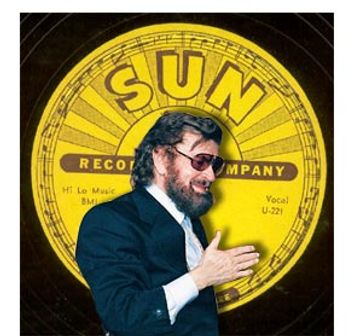
Today, Phillips lives on a nondescript residential street, and the fleet of Cadillacs and Lincolns in front of his house provides the only clue to the identity of the resident. I’m shown inside by Sally Wilbourn, who has been with Phillips since she began working as a receptionist at Sun almost 50 years ago. The man who descends a spiral staircase to greet me looks to be about 55 (he’s 78), with reddish hair and beard, dressed in a white T-shirt, tight jeans and a broad black belt studded with chrome rivets. He takes off a heavy pair of purple and gold aviators — “these are my Elvis glasses” — and fixes me with the intense pale blue eyes that Sun Records alumnus Jim Dickinson once described as “swirling pools of madness.” As we talk, Phillips speaks slowly and at length, with an evangelical flair that friends attribute to an early job at a funeral home.
Afterwards, I ask him to sign an Elvis postcard. He obliges, and also presents me with an issue of Life magazine titled “The 100 Most Important Events & People of the Past 1,000 Years.” Inside, at No. 99, sandwiched between the invention of the calendar and the Rosetta Stone, is the discovery of Elvis. Phillips smiles with a mix of irony and genuine pride. “We made it, ” he says.
Have you always wanted to be involved in music?
When I was growing up, I wanted to be a criminal defense lawyer, because I saw so many people, especially black people, railroaded. When I was a child I’d go down to the courthouse in Florence, Ala.; they’d have spring and fall Circuit Court. I’d sit on those benches because I’d love to hear the attorneys. To me, they were kind of evangelical in their approach. A lot of times it didn’t matter what the facts were — all you had to do was sway the jury. There was a lawyer in the white cases, if the [defendants] had any property or any cattle or chickens or pigs. The blacks were usually not represented by anyone. I saw both blacks and whites get sentences because they didn’t have the money to be represented like they were supposed to. I saw so many people mortgage the homes that they had farmed for generations because their child or a member of the family had gotten in trouble, and they couldn’t afford a lawyer.
But I knew I couldn’t go to college and become a lawyer — my brother Judd and I were the only support my mother had after Daddy died, and Judd had joined the Marine Corp. My mother knew I wanted to be a criminal defense lawyer, so I told her a lie: “No, I lost interest, I like radio.” My mama died thinking that was what I wanted to do. The only way to get a job back then — the war had just started — was to get a third-class radio-telephone operator’s permit from the FCC. Well, the closest place I could get that was Atlanta, and I didn’t have the bus fare to get to Atlanta. So I got on the radio by accident, because I organized a little 20-piece band for an American Legion gig. Mr. Connely, a manager of a little 250-watt station, asked me if I would announce. I got my first job on “Hymn Time,” a 30-minute gospel program.
When you started the Memphis Recording Service, in 1950, it was unheard of in the South for a white man to record black artists. You must have known it would be difficult — why didn’t you gravitate toward something more conventional, like country music or big bands?
I never heard no music I didn’t like. I was born and raised on the “Grand Ole Opry,” and I thought they were doing a great job in Nashville with country music. I loved the big bands; of course they were falling on disfavor. But they wouldn’t have been a challenge to me.
I just thought that black music should be exposed in the right forum, and somebody that purveyed it should not be ashamed of it. As a child, there was a real awakening of my spirit because I had spent so much time around black people. I saw the unbelievable talents that these people had. In Florence, white and black people picked cotton together, plowed together, did everything except quote-unquote socialize. Florence was 12 to 15 percent black, and Memphis was 35 to 40 percent black. When I decided to move there some people back home asked me, “Do you really want to go where there are so many niggers?”
How did you deal with these situations?
You almost have to transpose yourself back to those days, and to what people had to confront. I knew the way whites felt about blacks. I didn’t feel that way, yet I didn’t condemn the other people because I knew that to a degree they had no control over generation after generation of prejudice. These things I had to deal with, the social situations — I’m not a shrinking violet — but I never would have made it had I gone out and tried to challenge. I really found this out when I started Sun — how deep the resistance was. I just did my thing and tried to do it in the manner in which it would have been most effective for our causes. I say our causes because I knew it would involve mostly black people.
I looked at every distributor, every jukebox operator and every retail customer in the face. When I’d hear [a racist comment] I didn’t get into a big argument with them. I listened and learned their feelings. Just leaning on the counter, talking. We just didn’t talk about “You ought to have a different attitude …” I was going to let the product deliver itself. I didn’t need to make any damn enemies. There were enough already there.
Rufus Thomas, among others, has said that after Elvis became a star, you lost interest in the black artists that you had recorded during Sun’s early days.
When I started recording whites, I was accused of abandoning black people after getting out of them what I wanted. That I was using black people. In actuality it was totally to the contrary. I would love to have kept recording black people, period. And I continued to record some, but not as many. My thinking was that if we could record white people that felt the emotions that were so akin to black people’s emotions — this could broaden the base for the acceptance of that type of feel in music. [I felt that] this would not be achieved in any other way — maybe never or certainly not as soon as it was.
In working with the artists at Sun, what was the most crucial aspect of your job as a producer?
I had to get their confidence up. You can’t record anybody when their damn throat is in their stomach. Having worked in radio, I knew the toughest thing in the world to do is an audition. I knew what they were going through. They were so damn proud, and the toughest thing is: “Lord, I never thought I’d get this opportunity, now I can’t blow it.” Well that just makes it more difficult.
I would often take less than their capabilities would provide, and I didn’t want that, I wanted the best they could provide, I’m real selfish. But it was up to me to set the stage for them, where it looked appetizing. Even if I didn’t get what I wanted, they got to the point where they felt like they were maybe not doing it in their garage at home, but close to it. [Try to imagine] a black musician trying to play, looking at some white dude behind a window, and they’ve been kicked around all their life.
It reminds me of one time going to see a radio executive named Mr. Sudbury, an older man, and Elvis was my chauffeur. When we got there, Elvis asked Sudbury if he could use the restroom. Now you know Elvis was the most polite person in the world. And Sudbury said “Elvis, why don’t you go downstairs and use the restroom across the street at the filling station.” He wouldn’t let him use the restroom. On the way back, it was on Elvis’ mind that it was a purely personal thing. He was wondering what he had done. That’s how people like Elvis came up. I had to tell him: “I’ve known Mr. Sudbury for years, and he’s just a funny man.”
Was there an artist who you felt unable to get the best from?
Probably Charlie Rich. There was not one human being I know who was more talented than Charlie. When I met him I was just blown away by the guy. But the big difficulty I had with Charlie was that he was afraid he was not going to do the thing that would please you. If I had my way I would have spent more time with Charlie, because he needed that. Rather than just coming into the studio — I never wanted that atmosphere with any of the artists, but Charlie especially needed that. Charlie had a little old studio in his garage. He would go out there and have a couple of drinks and play. I would have given anything to have it rigged with microphones … I’m just sorry I didn’t cut some marvelous thing on him — it damn sure wasn’t his fault. I didn’t do him justice; there’s no question about that.
How did you come up with the idea for WHER?
I actually had wanted to have an all-black station, but it was blocked. However, a 250-watt daytime station became available. At that time, women weren’t in radio. So I got this wild-ass idea. Becky, my wife, and I met in a little station back in Alabama. I said, “Becky, I’ve got a wild notion that women in radio could have some appeal. But how in hell are we gonna get anybody who can compete in this market?” The people who came in to record for me [at Sun] had never seen a radio station much less a recording studio. And I thought — these girls can be taught, too.
It wasn’t all woman, it wasn’t all female, it was all girl. I don’t give a damn if they were 50 years old, they were all girls. There will not be any experience greater than that. Everybody had to work their own board, and [in the beginning] most of them didn’t know what a turntable was. These girls were up to snuff in the shortest period of time. We broke another barrier, and that is in the matter of five years there were women in radio everywhere. Every person at WHER was a girl, except I couldn’t find a girl head engineer.
“One thousand beautiful watts” was our slogan. But I never thought of it as a novelty. I really believe this little radio station transposed itself into markets all over the country. We started a second all-girl station in Lakewood, Fla.– WLIZ. I hired girls who had no experience and it became the hottest thing in that market. It was easily 75 to 100 women who got their start at these stations.
In the 1950s, you broke half a dozen national stars from a storefront studio in Memphis. Today, with the corporate takeover of radio and the prevalence of independent promotion and other pay-for-play schemes, do you think a small record company can hope to duplicate your feat?
There’s not an opportunity for the people who can do it. Payola, that is real bad, but it’s a symptom of the problem and not the problem itself. Today, the greatest form of communication in this world does not matter one iota to the record companies, the big ones. Most radio is programmed by someone who has never talked to a creative person. Even the manufacturers won’t gamble on something different.
What do you think? BMG? They don’t give a shit what you sound like, they ain’t going out knocking on doors. They ought to be beating the bushes for entrepreneurial people that are hungry who can and want and will shake the talent out of the trees. Hasn’t even entered their minds. All they want to do is build bigger studios and get more synthesizers and all this shit. I have nothing against improved sound; in fact I’m for it. But my God, let’s don’t substitute sound for soul and feel.
They think that they can get an artist and build them up. Now I believe in promotion. But deliver music that can revolutionize, whatever category it’s in. And you will only get that from hungry people, who want to do that, and do it unselfishly. I realized early, that if I had gone into what I was doing for the wrong reasons, it never would have happened for me. That is what worries me the most. If we thwart creativity in any way, we hurt the soul of the greatest thing that we will ever be exposed to, and that’s music.
Continue Reading
Close
“Put your sweet lips a little closer to the phone, oh whoa whoa,” Jerry Wexler sings into the receiver, enunciating the doo-wop embellishments that soul singer Solomon Burke grafted onto the Jim Reeves country hit. Hearing Wexler describe the early-’60s session in his unique mix of New York Jewish jive and high-flown diction is at once disarming and disconcerting. At 84, he speaks about the musicians he has known with the easy mix of affection and familiarity one might use in talking about a childhood friend or an alcoholic uncle. And while the trepidation that one might feel is quickly deflected by his charm and humor, it is difficult to reconcile Wexler’s casual magnanimity with either the fantasy of the intimidating and brilliant producer or the factual enormity of his achievement. “Solomon was beautiful, baby. He sounded just like Dean Martin.”
As a partner at Atlantic Records, and later as an independent producer, Wexler worked with Ray Charles, Joe Turner, Ruth Brown, Professor Longhair, LaVerne Baker, Ivory Joe Hunter, the Drifters, Solomon Burke, Wilson Pickett, Otis Redding, Joe Tex, Sam and Dave, Aretha Franklin, Dusty Springfield, Dr. John, Etta James, Linda Ronstadt, Donny Hathaway, Willie Nelson, Bob Dylan and many others. He did much more, however, than preside over the creation of great music. As much as any of the artists he produced, Wexler helped establish the direction of ’50s rhythm and blues and later came to define the sound of soul, a moment that for many remains the creative zenith of postwar popular music.
The key was Wexler’s belief not only in the commercial possibilities of rhythm and blues but in its potential to be art, a notion he brought with him from the world of jazz. A radical conviction in the early ’50s, it enabled black music to permeate the white mainstream almost as persuasively as the advent of rock ‘n’ roll. “Wexler was cutting records as if they were short stories,” says Jim Dickinson, the Memphis, Tenn., musician and producer. “He brought the depth of literature to a music that was basically treated as if it was primitive.”
Among modern record men, only Sam Phillips casts a longer shadow than Wexler. While Phillips pioneered an explosive combination of country and R&B by recording white Southern artists such as Elvis Presley and Jerry Lee Lewis, Wexler remained focused on his first love — jazz, the blues and their antecedents. Nevertheless, he helped develop a music that was no less audacious and racially iconoclastic. Borrowing from gospel, jazz, pop and even classical music, soul was an amalgam of the tutored and the instinctive, its history a collaboration of white and black musicians creating what Wexler calls “immaculate funk,” a music that, in the words of Atlantic arranger and producer Arif Mardin, “churned, but with precision.”
More perplexing — though equally crucial — was Wexler’s ability to imagine artists as they had not yet imagined themselves, to repeatedly capture on tape what they had only previously suspected. Unlike Phillips, the supreme talent scout, Wexler was not a discoverer of raw talent. The artists he worked with were rarely strangers to the studio, but frequently came away from the encounter with career-altering recordings, somehow more fully realized. Often they came away stars. That Wexler could help reinvent musicians as diverse as Turner, Springfield and Nelson in three separate decades is a feat that borders on the mysterious.
Getting a square look at the mystery, however, can be surprisingly difficult. Neither “Rhythm and the Blues,” Wexler’s 1993 memoir, nor conversations with the man himself provide a completely satisfying answer. Articulate to a fault, he can be by turns scintillating and opaque, hilarious and evasive. Perhaps that is not surprising, considering that Wexler has been described in various quarters as a musical innovator, a brilliant producer, a shrewd businessman, a master manipulator and a shameless carpetbagger. What everyone seems to agree on, however, is that the story of soul cannot be told without him.
Born in 1917, Gerald Wexler grew up in New York’s largely immigrant neighborhood of Washington Heights. His father, Harry, who arrived from Poland at age 19, worked as a window washer, and his withdrawn acceptance of his lot — an early-morning route with a pail and ladder — came to symbolize for Wexler the entrapment and hopelessness of his working-class family at the onset of the Depression.
It was his mother, however, who represented the fantasy of escape and transcendence. An attractive woman who had little interest in the pieties of her social station, Elsa Wexler turned heads in Washington Heights as she strolled in homemade hats and costume jewelry, a golf bag thrown over her shoulder. A committed socialist, she spent hours selling copies of the Daily Worker in Harlem. Elsa also brought home copies of Shakespeare, Molihre, Havelock Ellis and Theodore Dreiser, deciding that Gerald would be everything she was not — a Brahmin, a contributor to culture and most of all a writer, a desire that she managed to instill in her son.
In the meantime, Wexler spent his adolescence at Artie’s poolroom on the corner of 181st Street and Bennett Avenue, cutting classes and hustling three-cushion billiards. Wexler had little use for public education, and after graduating from high school in 1932, he enrolled in City College, only to drop out two semesters later. During his truant afternoons, however, he managed to acquire a more enduring passion than pool — jazz. Haunting Salvation Army depots and used-furniture stores under the els for abandoned records during the day, Wexler and his friends would spend evenings dancing to Fletcher Henderson’s band at the Savoy Ballroom.
Elsa’s final attempt to school her son entailed removing him from his dysfunctional surroundings, and in 1936 Gerald enrolled in Kansas State College of Agriculture and Applied Science as a journalism major. Kansas City gave Wexler his first taste of shouted blues and country music, but less than two years later he was back in New York, as a result of bad grades and a dismal attitude.
Back at home, economics necessitated the unthinkable, and Jerry joined his father on the window-washing circuit with his own ladder and pail. He hated washing windows, but it was his after-hours existence as a Jazz Age hipster that made the menial labor tolerable. In the evenings, Roy Eldridge, Sidney Bechet and Billie Holiday beckoned from clubs in Harlem and on 52nd Street, and Wexler remembers the period with uninhibited pleasure: “Nothing would make me happier than to share a joint with Max Kaminsky in the basement of Jimmy Ryan’s.”
His first inkling of a career in the music business must have come from a close-knit circle of jazz record collectors who met at Milt Gabler’s Commodore Music Shop. George Avakian, Bob Thiel, Alfred Lion and John Hammond were among the core members, and all would eventually be remembered as luminaries of the recording industry. “We thought — what hubris — ‘We can make these records,’” recalls Wexler.
Before his first brush with the industry, however, the newly married Wexler was drafted, and spent the World War II stationed in Florida and Texas. After his discharge he returned to Kansas to complete his degree. But in 1947, a journalism diploma in hand, Wexler found himself back in Washington Heights, living with his wife Shirley’s parents. He was 30 and in search of his first real job.
After months of rejection by the big New York papers, he found a job as a cub reporter at Billboard magazine. It was an unexpected detour into the music industry, but soon Wexler was interviewing song pluggers at Lindy’s Delicatessen, composers at the Brill Building and jukebox roughnecks and rack jobbers on 11th Avenue. It was an invaluable education and Wexler proved to be a natural. He turned Patti Page on to “The Tennessee Waltz,” which became one of pop music’s biggest pre-rock ‘n’ roll records and, more tellingly, changed the title of Billboard’s black music chart from “Race Records” to “Rhythm and Blues,” a rubric used to this day.
During his years as a reporter, Wexler grew increasingly close to Ahmet Ertegun and Herb Abramson, two fellow record collectors and jazz cognoscenti who had founded Atlantic Records, a small rhythm and blues label in New York. The three men would attend concerts, trade gossip and vacation together at Fire Island, and soon Wexler was asked to join the company. In an act of characteristic audacity, Wexler demanded to be a full partner, a request that was greeted with incredulous laughter. But a year later, when Abramson went into the Army for a two-year stint (he would leave the company by the end of the ’50s), Ertegun agreed to Wexler’s terms.
By the time Wexler came aboard in 1953, Atlantic had already scored hits with artists such as Ruth Brown, Stick McGhee and Joe Turner. It had also signed a blind singer named Ray Charles, who still sang in the polished style of Nat “King” Cole. The well-tailored and suave Ertegun, the son of a wartime Turkish ambassador, showed a predilection for the more bohemian aspects of making records, and the daily operations of the company fell to his new partner.
The job involved nearly every aspect of the process, and Wexler hired musicians, produced sessions, promoted records with distributors and disk jockeys, balanced the books and occasionally even composed ad hoc songs, since suitable material was usually at a deficit. At the time, paying off influential jockeys such as Alan Freed and Dewey Phillips was another chore that came with the territory. Wexler recalls that fear fueled his early years at Atlantic, but when the hits started coming, as they did soon and fast, the fear was partially supplanted with euphoria. As Wexler told author Peter Guralnick, “We didn’t know shit about making records, but we were having fun.”
Ostensibly motivated by wartime shellac rationing, the major labels of the time had systematically shut out black R&B musicians. The real reason had to do with simple arithmetic — in a racially segregated market, a hit record by Charles Brown or T-Bone Walker might sell 50,000 copies, while a hit by Perry Como could sell more than a million.
Atlantic was among the many independent labels that came to dominate the so-called race market, one of the small regional operations that marketed music by black musicians to black listeners — a significant crossover audience was still years away. Herman Lubinsky at Savoy, Syd Nathan at King, Art Rupe at Specialty, Lew Chudd at Imperial, the Bihari Brothers at Modern, Don Robey at Duke, Bess Berman at Apollo and Chicago’s famous Chess brothers were among the leading purveyors of rhythm and blues records.
Many of the companies were run by immigrants, often Jews, who came to the business as a result of prevalent discrimination and a willingness to cross racial boundaries in search of an opportunity. And while many were gifted talent scouts and harbored a deep appreciation for the music they recorded, for most the motivation remained primarily financial, and tales of mercenary business practices, rushed sessions and primitive facilities were not uncommon.
From the beginning, Atlantic stood in stark contrast to its competitors. Ertegun and Wexler brought to the business of R&B a professionalism and sophistication that more often characterized the recording and marketing of jazz. Extensive rehearsals, meticulous arrangements and scrupulous attention to detail distinguished the Atlantic session work. And with the arrival of Tom Dowd, the young engineer who would later double as a producer and arranger, the records with the black and red labels quickly became known for their clean, well-balanced sound.
Ertegun and Wexler also proved to be enlightened businessmen, and tirelessly cultivated a national network of disc jockeys, distributors and salesmen. The main factors that distinguished Atlantic, however, were a seriousness of purpose that everyone brought to the enterprise, and in Wexler’s admittedly self-congratulatory formulation, the qualities of “taste, intelligence and probity. If a guy came into Chess [Records] with a great tune, Leonard Chess would record him. If that guy came to Atlantic, we would buy the tune and give it to Solomon Burke.”
The approach quickly bore dividends, and during Wexler’s first two years at the label, 30 Atlantic sides landed in the R&B Top 10. Meanwhile, the creativity of the Atlantic approach increased in tandem with sales: In 1957, Mike Leiber and Jerry Stoller came to Atlantic. Already the authors of several R&B hits — they wrote “Hound Dog” for Big Mama Thornton and were collaborating on some of Elvis’ most ambitious songs — the songwriters teamed up with the Coasters to create what Stoller dubbed “playlets”: songs imbued with the density of musical theater, combining whimsical characters, narrative lyrics and bizarre sounds. “Little Egypt,” “Along Came Jones” and “Down in Mexico” injected a new strain of novelty and sophistication into R&B, and would be reprised in the ’60s with Lieber and Stoller’s work with the Drifters and Phil Spector.
Just as important as Atlantic’s commercial breakthroughs was a series of patently uncommercial attempts to unite contemporary musicians with older musical styles, a strategy Wexler would return to frequently throughout his career. For a 1956 Joe Turner session, he assembled a small ensemble of veteran jazz musicians that included legendary boogie-woogie pianist Pete Johnson. The result, “Boss of the Blues,” with Turner singing lazy Kansas City shuffles with a 1930s-style jazz combo, must have reminded Wexler of seeing Turner as a singing bartender while an undergraduate in Kansas 20 years earlier. Likewise, on an album astonishingly titled “Blues From the Gutter,” Champion Jack Dupree performed his drug-themed compositions along with interpretations of the earliest blues standards, backed by a superbly sensitive band. Both albums are paragons of authenticity and chemistry, and became career-defining sessions for the prolifically recorded bluesmen.
When Lew Chudd asked Ertegun’s brother Nesuhi to start a line of jazz LPs at Imperial, Wexler and Ertegun brought him to Atlantic to do the same, this time as a partner. The idea was obviously appealing to everyone involved, and Nesuhi soon assembled dozens of recordings by both avant-garde musicians such as Ornette Coleman, John Coltrane and Charles Mingus, as well as the more traditional Chris Connor, Mabel Mercer and Bobby Short. In addition to making the Atlantic name as talismanic in the field of jazz as it had become for fans of rhythm and blues, Nesuhi also took over the design and packaging of the albums, bringing in renowned photographers such as Lee Friedlander and Jerry Schatzberg.
However, the most groundbreaking event for Atlantic in the 1950s was a Ray Charles session that changed the direction of R&B as fundamentally as any record before or after. “I’ve Got a Woman” opened the floodgates of soul and single-handedly laid down the blueprint for a new music: The gospel base, the churchy, unrestrained vocal and the backing trumpets and reeds were all in place. Charles soon completed the formula by adding the Cookies, soon renamed the Raeletts, whose background vocals functioned as an attenuated secular choir.
The 1954 session launched a period of unparalleled creative and commercial success for Charles, and before the decade was over he would record both instrumental jazz and influential big-band sides with fully orchestrated strings. Ironically, Wexler’s remarkable intuition in the studio served him again. As he had with Lieber and Stoller, he left Charles to his own devices, for the most part, and was rewarded for his discretion. “To record Ray Charles all Ahmet and Jerry had to do was turn on the lights in the studio,” says writer Stanley Booth, “and Ray didn’t even need that.”
By the early ’60s, Atlantic’s remarkable run seemed suddenly at an end. The racial boundaries that had defined Atlantic’s mission a decade earlier had been obliterated by rock ‘n’ roll as well as Atlantic’s own crossover success, and the British invasion was on its way. More important, Ray Charles had left Atlantic for a sweeter deal at ABC, prompting much soul-searching at the 56th Street offices. Ahmet was becoming increasingly drawn to rock and pop, and Wexler was for the first time feeling stifled and bored.
Salvation arrived in the person of Solomon Burke, a soul singer of overwhelming charisma and remarkable stylistic range. Starting with “Just Out of Reach,” a country song recorded as a soul ballad, Wexler and Burke created a string of hits that carried the label financially and represented the first fully realized examples of the classic soul sound. Unusually inventive large ensemble arrangements — just listen to the tuba obbligato on “Down in the Valley” — accompanied Burke’s soulful, yet precisely controlled singing. It was the full realization of what Wexler calls his “devotion to the bel canto tradition,” and remains the epitome of the Atlantic ideal.
Simultaneously, Wexler’s attention was becoming increasingly drawn south. In 1960, when “‘Cause I Love You,” an up-tempo duet performed by Memphis singer and disc jockey Rufus Thomas and his daughter Carla became a regional hit, Wexler signed a distribution deal with Satellite, a tiny label that would soon be renamed Stax. Started by bank employee Jim Stewart and his sister Estelle Axton, who had mortgaged her home to purchase an Ampex monaural tape recorder, Stax was based in an abandoned movie palace that served as a studio, office and record store. The store, built around the theater’s popcorn counter, became a gathering place for the black and white musicians who would create the Stax sound, and included Booker T. Jones, Steve Cropper, Al Jackson and Chips Moman, the guitarist and producer who later became one of Memphis’ biggest hit makers as head of American Studio.
With its surfeit of talent, Stax gradually accumulated hits by local artists such as Rufus and Carla Thomas, William Bell and Booker T. and the MGs, the house rhythm section that had scored a surprise million seller with an instrumental B-side entitled “Green Onions.” But it was the company’s breakaway success with Macon, Ga., singer Otis Redding, who had scored five Top 20 R&B hits in 1965 alone, that got Wexler’s attention. He assigned Sam and Dave, an R&B duo he had signed in Miami, to the hot label, and soon arrived himself at the Memphis studio with another new Atlantic signatory, a singer named Wilson Pickett.
The sessions at Stax affected Wexler as profoundly as any collaboration of his career. After years of relying on arrangers and charts, Wexler was knocked out by the Southern method of improvising arrangements on the spot, based on feel rather than a preconceived structure. “I’d watch them come in in the morning,” wrote Wexler of the Stax rhythm section, “hang up their coats, grab their axes and start to play. If they didn’t have a session or a song, they’d ad-lib, developing chord and rhythm patterns until something blossomed. It was effortless, easy as breathing.” The Southern spontaneity shook Wexler out of his ennui, inspiring him to become more directly involved in the music making and sparking his most productive period.
In turn, the young Memphis musicians were certainly aware of his reputation, and impressed by Wexlers New York-accented hipsterisms and his ability to make everyone in the studio focus on the matter at hand. More important, the musical rapport proved uncanny. “He wanted to play the kind of music we wanted to play,” says Chips Moman. “The guys didn’t mind staying late to help Jerry out, because he always kept the session interesting.”
At the first Pickett session at Stax, Pickett and Steve Cropper approached Wexler with an original composition entitled “In the Midnight Hour.” Wexler objected to the rhythm track, suggesting that the beat from a recent dance hit by the Larks would improve the tune. Unable to explain what he wanted musically, Wexler started doing the jerk in front the dumbfounded band. The result became Pickett’s breakthrough smash, and in short order Sam & Dave and Don Covay charted hits recorded with the Stax sound.
Almost as soon as the productive partnership had begun, Pickett’s abrasiveness and a growing sense of confidence in the future of Stax cooled Stewart to the idea of outside production. But Wexler wasn’t about to return to the status quo in New York. “Southern recording had changed my life,” he says, “and I wanted to record that way forever.” He had been tipped that an equally talented group of musicians was working out of a small studio in Muscle Shoals, Ala., called Fame Studios, and when Fame’s Rick Hall sent him an acetate made by an orderly named Percy Sledge — “When a Man Loves a Woman” — Wexler was sold. The song went on to become the first soul record to reach No. 1 on the pop charts, and Wexler, again with Pickett in tow, headed to Alabama.
In Muscle Shoals, Wexler discovered an even more empathetic group of musicians — ironically, all were Caucasian — who enabled him to crystallize the sound that would become most closely associated with ’60s soul. The building blocks were identical to those used at Stax — a tight rhythm section, keyboards, horns and massed background vocals — but Wexler, perhaps because he felt more at ease in the new studio, was free to use them more creatively, referring to them as “lines and patterns.” In the process, he transformed Muscle Shoals from a provincial outpost to one of the South’s major recording centers, a place that would eventually attract musicians as diverse as the Rolling Stones, Etta James and Simon and Garfunkel.
The first beneficiary of Wexler’s new headquarters was again Pickett, who recorded another parcel of hits with “Mustang Sally,” “Funky Broadway” and “Land of a Thousand Dances.” But it was Aretha Franklin’s arrival that marked the high point of the Muscle Shoals experiment and Wexler’s career. Ever since hearing a 14-year-old Aretha sing “Precious Lord” on a Chess Records recording made at her father’s (the Rev. C.L. Franklin) church, Wexler was determined to sign her to Atlantic. His chance came in 1967, with Franklin languishing at Columbia, where she had spent six years enduring misguided attempts to package her as a pop singer. For her first session at Fame, Franklin brought a Ronnie Shannon song entitled “I Never Loved a Man (the Way I Love You).”
Sitting at the piano in a studio filled with white musicians — most of whom knew little or nothing about her — Franklin struck the first chord of what would become one of the most remarkable acts of self-reinvention in popular music. The musicians were thunderstruck. “I’ve never heard so much emotion come from one human being,” drummer Roger Hawkins told Wexler, and Franklin’s tenure at Atlantic marked one of the most brilliant and commercially lucrative associations between an artist and a record company.
When asked about those first pivotal sessions with Aretha Franklin, Wexler replies: “I was cutting basic R&B and blues. All I had to do was drop her into the context.” While not inaccurate, the explanation does little to explain his M.O. in the studio, and doesn’t factor in the taste, intuition and imagination that Wexler had honed over the course of 20 years and injected into the proceedings with increasing skill. “Jerry will get up in the bass player’s face, so you could smell his breath, and sing a bass part,” says Jim Dickinson. “He may not necessarily want the bass player to play what he’s singing, he just wants him to play something different.”
Nevertheless, that “context” became much sought after, and Franklin’s phenomenal success cemented Wexler’s reputation as a master of rejuvenating careers in midstream, a testament to his ability to alternately use charm, force and diplomacy in coaxing the best from an artist. When he brought British pop singer Dusty Springfield to Chips Moman’s Memphis studio to make an album in 1968, he came away with nothing but instrumentals. Intimidated and insecure, Springfield had refused to sing. It took several agonizing sessions in New York — at one Springfield reportedly hurled an ashtray at Wexler’s head — to record the vocals. The result — the definitive “Dusty in Memphis” — revealed no evidence of struggle.
In 1967, at Wexler’s prompting, the Erteguns agreed to sell Atlantic. The partners continued to run the company, but for $17.5 million, a sum that even at the time was considered ludicrously small, they handed over Atlantic and its priceless catalog to Warner Bros.-Seven Arts. The sale gave Wexler — the window washer’s son from Bennett Avenue — the security he had always craved, but laid the seeds for his eventual departure.
Meanwhile, Wexler split with Rick Hall at Muscle Shoals, just as he had several years before with Jim Stewart at Stax. Perhaps the success of Hall’s studio added to the perpetual tension between the two aggressive personalities, but as a result, Wexler found himself without a rhythm section. The split led to predictable accusations of carpetbagging and exploitation, which would resurface again when Jim Stewart discovered that he had signed over all the Stax masters to Atlantic as part of their distribution agreement. Somewhat incredibly, both Stewart and Wexler claim they were unaware of the provision. Not surprisingly, Atlantic’s corporate parent, Gulf & Western, was not particularly sympathetic to Stewart’s predicament.
After the break with Hall, in a move reminiscent of King Lear, Wexler moved to Florida, leaving his former company to be run by others and devoting himself to the full-time creation of records. He set up Atlantic South at Criteria Studios in Miami, and when the Muscle Shoals musicians cannily declined his offer to relocate, he recruited the Dixie Flyers, a band of Memphis musicians featuring Jim Dickinson on keyboards.
In Miami, the hits gradually started to slow down. Wexler continued to create superb records with new artists like Bonnie and Delaney, Tony Joe White, Doug Sahm and Donny Hathaway, while continuing to record proven stars like Aretha Franklin and Wilson Pickett. With Dr. John he created “Gumbo,” a brilliant pastiche of antique New Orleans funk, and during Atlantic’s short-lived Nashville operation, he recorded “Phases and Stages” with Willie Nelson, a musical makeover that presaged Nelson’s multiplatinum records with Columbia. Most enduringly, he conceived and produced Aretha’s “Amazing Grace,” a gospel masterpiece recorded during a church service in Los Angeles. But the forces of entropy that had caused Wexler to leave Memphis and Muscle Shoals came into play in Miami: Wexler and his wife, Shirley, divorced in 1972, and the fragmented Dixie Flyers joined Kris Kristofferson.
When Wexler returned to New York, he discovered that in his absence the Warner Bros. corporate culture had closed in on him. He was a stranger at the label, and a mid-’70s clash with Ahmet Ertegun’s protigi David Geffen served to demonstrate his alienation from the status quo. (“You’d jump in a pool of pus just to come up with a nickel in between your teeth,” screamed Wexler at a corporate luncheon as his former partners and Warner chairman Steve Ross looked on.) In 1975, after receiving little support from Ahmet, Wexler left the company he had helped build.
As it turned out, the demand for the Wexler sound was far from spent. In the ’80s he produced “Saved” for the born-again Bob Dylan, and subsequently worked with Santana, Dire Straits, Etta James and even George Michael. He also continued to pursue the revisionist concept albums he always enjoyed making. In 1982, he paired Linda Ronstadt with a small jazz ensemble for a session of jazz standards. Ronstadt decided not to release the album, but eventually recorded a similar album with the Nelson Riddle Orchestra. Willie Nelson loved Wexler’s idea of doing a Western Swing session, but Wexler’s heart attack consigned it to oblivion.
Even in his dealings with rock bands and pop idols, Wexler has remained true to the authentic vernacular sounds he has loved since childhood. Even as the music business that left him behind moves toward ever-greater corporate consolidation, Wexler remains an uncomfortable reminder of an individual’s — and an organization’s — ability to champion the most vulnerable and profound expressions of our culture, and in the process reconfigure the society around it. Along with Sam Phillips, he remains the epitome of that potential. “A lot of contemporary production tries to homogenize the music,” says Jim Dickinson. “They take away the element that’s alien. Jerry Wexler always turned that element up.”
As for the mysterious profession of record production, its infuriatingly subjective workings may remain locked in the grooves of the records and in the minds of the participants. Phillips, who has been known to indulge in instructive obfuscation and plain old hubris, sums it up thus: “Producing? I don’t know anything about producing records. But if you want to make some rock ‘n’ roll music, I can reach down and pull it out of your asshole.”
Dickinson recalls Wexler once telling him: “You never know who’s really going to produce the session. It could be the guy who brings the coffee.” “For a long time, I didn’t understand what that meant,” says Dickinson. “Producers whom I’ve worked with seemed to not do much of anything. I realized later that production is all in how you go about doing nothing.”
Speaking from his home in Long Island, where he lives with his wife, novelist Jean Arnold, Wexler seems simultaneously content and restless. As if chastened by past indiscretions, he is diplomatic and incommunicative on the subject of the music industry he once led. Instead he prefers to talk about the music he’s perpetually discovering and rediscovering — Kay Starr, Bob Wills, Dan Penn, the new Dr. John. He professes impatience with listening to his own records: “I know them so well.” But one suspects that for Wexler, playback pales in comparison with the moment of creation, the hours in the studio that still elicit his most animated responses.
“Jerry is a deeply spiritual guy,” says Stanley Booth, “but his religion is making music.” For Wexler, memories of recording Solomon Burke do seem to elicit far more joy than the notion of an afterlife, a subject on which Wexler remains doggedly pessimistic. “I’m so damn atheistic that I know there will be nothing to enjoy afterwards. Even if you’ve made an impact on world culture, you’re gone, baby.”
Continue Reading
Close
“My aim in everything I write is to disappear into the world I’m writing about,” says Peter Guralnick. More often than not, that world has been one of rural juke joints and dance halls, “brush arbor” revivals, fish fries and old primitive recording studios — the sites of the music that is often reverently and sometimes condescendingly referred to as “vernacular.” As an undergraduate in the early ’60s, Guralnick turned in a paper about Roman poet Catullus and bluesman Robert Johnson, and ever since he has written about blues, country, rockabilly and soul with the sweep and depth of a cultural historian and the boundless enthusiasm of a longtime fan.
His “Feel Like Going Home” (1971), “Lost Highway” (1979) and “Sweet Soul Music” (1986) — a trilogy of books that have acquired something of a cult following since they were originally released — are collections of revealing, remarkably affectionate portraits of musicians that, taken together, read like an atlas of Guralnick’s own musical journeys and discoveries.
Invariably, they offer a trenchant look at the Faustian bargains of commercial success, seen through the eyes of both established stars such as James Brown and Ernest Tubb and relatively overlooked musicians such as Stoney Edwards and Johnny Shines. Surprisingly, their perspectives on their vocation are often equally ambivalent. Reading these books today, one also cannot help marveling at the evocation of a long-lost regional culture that appeared to be slipping away even as Guralnick chronicled it; years later it can seem like a mirage.
In 1994, Gurlanick’s “Last Train to Memphis: The Rise of Elvis Presley” was released to nearly universal acclaim, and became the definitive Presley biography virtually overnight. The novelistic account of Presley’s early years almost single-handedly reclaimed one of the culture’s prodigal heroes: The book renewed interest in Presley and replaced the accumulated clichis and speculation with a portrait of a conscious, deliberate artist with a uniquely democratic vision of popular music.
His book “Careless Love: The Unmaking of Elvis Presley,” released in 1999, completed the increasingly sorrowful story with characteristic empathy and detail.
Throughout his career, Guralnick has retained the missionary ardor that characterized his early writing on the blues; he has worked as an executive producer on recordings by, among others, Charlie Rich and Sleepy LaBeef, has written two documentaries about Elvis and has produced an ocean of liner notes. On June 18 — Father’s Day, appropriately — A&E will premiere “Sam Phillips: The Man Who Invented Rock ‘n’ Roll,” a documentary about the legendary producer and Sun Records founder directed by Morgan Neville, a project that Guralnick calls “my first real film collaboration.”
As we speak during a rare break between research trips for his upcoming biography of soul singer Sam Cooke, I ask him about the origins of “Last Train to Memphis” — in the midst of a mini-industry of Elvis books and the kitsch that had engulfed Presley’s reputation, the book must have seemed like an unlikely contender for the success it ultimately achieved.
“I didn’t believe there was an audience for it,” admits Guralnick. “I thought that the interest in Elvis was saturated and that the bias against him was too pronounced. His fans turned out to be a true silent majority.”
I ask him about the inspiration for the book.
“I was driving down McLemore Avenue in Memphis with my friend Rose Clayton, a native Memphian,” Guralnick recalls. “She pointed at this boarded-up drugstore, where she said Elvis’ cousin used to work, and talked about how Elvis would sit at the counter and just drum his fingers on the countertop, and then she said, ‘Poor baby.’ And I just had this revelation of a real kid, with acne, with enthusiasm, with this omnivorous interest in music.
“Right around that time Gregg Geller, who started the Elvis reissue program at RCA, asked me to do the liner notes for the Sun Sessions,” Guralnick continues, “and I interviewed Sam Phillips and [songwriter] Stan Kessler again. All of a sudden we were talking about a real person working in the studio, not the grand theory behind it all but what actually happened. Finally, I became involved with a documentary about Elvis, and in working on it gathered the interviews that Elvis had given in 1955 and 1956. Again, I came to realize that this was not the mythic Elvis, there’s a real Elvis here — this is Elvis speaking for himself. In writing about him, I always tried very hard to strip away the layers.”
One of the frequently cited dead-ends in Presley research has been Elvis’ manager of 22 years, the late Col. Tom Parker, who maintained a long-standing silence on the subject of his most famous client.
“I never thought I’d get a chance to meet him,” says Guralnick. So when it was announced that the Colonel would speak at Presley’s birthday celebration in January 1988, he flew to Memphis “solely to be in the same room with the Colonel, to absorb his aura.” When Phillips, who sat with Guralnick at the event, decided to take the opportunity to speak with the Colonel for the first time in more than 30 years, Guralnick tagged along and obtained an introduction that led to a cryptic encounter with Elvis’ notorious manager.
“Colonel Parker and I had begun a correspondence, and his letters always opened with ‘Friend Peter,’ which was his customary form of address. About a year and a half after we met, I received an invitation to his 80th birthday party in Las Vegas. Of course I attended, and when it was time to leave I thanked the Colonel and said goodbye. He was sitting in a high-backed chair with a giant stuffed elephant behind him and was wearing a Stetson hat. He looked straight at me, took my hand and said, ‘Peter, I put you on the list.’ I wasn’t sure whether he was saying what I thought he was saying, so I thanked him again for inviting me. He held onto my arm and repeated: ‘Peter, I put you on the list.’ And he was right. He did put me on the list. Without having spoken to anyone at the party about the book I was writing, I met many people that evening whom I subsequently wrote to, for whom I was validated by the Colonel’s invitation. I still don’t know why he did it.”
In his earliest writing, Guralnick approached Elvis as primarily a blues singer and was somewhat dismissive of much of his work from the ’60s and ’70s. “My tendency was to write off everything that I wasn’t already sold on,” he admits when I ask about how his conception of Elvis had changed during the time he spent on Presley’s two-volume biography.
“I went into the project with many prejudices. I originally came to Elvis in the reverse way — through the blues and not the other way around, and I had a vested interest in Elvis being the pure blues singer that I thought I had discovered in songs like ‘Mystery Train’ and ‘Good Rocking Tonight.’
“In writing the biography, however, I started to listen more to Elvis’ ballads — especially the Don Robertson and Doc Pomus-Mort Shuman ‘late night’ ballads from the early ’60s. Songs like ‘That’s Someone You Never Forget’ or ‘I Need Somebody to Lean On’ from ‘Viva Las Vegas,’ which I didn’t even know existed, astonished me. They were so moving.
“I also discovered a multiplicity of influences that I never suspected — whether it was the gospel quartet music of the Statesmen and the Blackwood Brothers, which was at the heart of everything Elvis did, or something like Teresa Brewer or Frankie Lane, which was music that I had never listened to. I came to see the songs he recorded after his return from the Army as an expansion of his ambition, a very conscious attempt to broaden his musical talent. To a lesser extent, I came to see the Las Vegas years in the same way.”
In the final chapters of “Careless Love,” which chronicle Presley’s decline, a strange matter-of-factness creeps into the writing, almost as if Guralnick couldn’t maintain his usual enthusiasm for his subject. “It required a considerable level of discipline to stay out of the picture,” he says. “I rewrote the last 150 pages of the book more often than anything I’ve ever written. I tried to cut away everything that was extraneous. I felt that at a certain point, you just had a sense of this inexorable fall, and I didn’t want to repeat ‘and then he did this destructive thing again.’ I wanted to evoke the pathos of what was happening.”
Guralnick points to the Leadbelly, Big Bill Broonzy and Howling Wolf LPs he first heard as a teenager as the genesis for his lifelong obsession with the blues. In the late 1950s, black music was an unpopular preoccupation for a Jewish kid growing up in Boston. Guralnick remembers seeing blues legend Bukka White, attired in a tuxedo, perform to an audience of fewer than 15 at Boston’s Huntington Avenue YMCA. Later, as his tastes expanded to encompass soul, Guralnick worked as “the worst usher in the world” at concerts at the old Donnely Theater: “I tried to absolutely avoid showing anybody to their seat. You could end up in disputes which I felt I lacked the expertise to adjudicate.”
In the mid-’60s, the appearance of small magazines and tabloids that catered to younger readers and published the first serious writing about rock — Crawdaddy, the Boston Phoenix, Rolling Stone — provided Guralnick with his first opportunity to share his musical discoveries with others.
“Getting paid was a big surprise,” he laughs, and for years his profiles of blues, soul and country musicians appeared in pages dedicated almost exclusively to rock articles and reviews. “I felt sometimes I stuck out like a sore thumb,” Guralnick says. “I would be in Crawdaddy writing about Robert Pete Williams and here [alongside it] would be an article about Jefferson Airplane and Moby Grape.”
The differences between Guralnick and his colleagues were often more than thematic. Celebrated contemporaries like Lester Bangs, Nick Tosches and Richard Meltzer wrote about music in a self-referential, often expletive-riddled style that was a corollary to the new journalism of Norman Mailer and Tom Wolfe, and varied almost diametrically from Guralnick’s self-effacing approach.
“I was looking for a clean, colloquial style that treated the subject with dignity and respect,” he says, “but that wasn’t condescending. Sometimes I used myself as a foil to bring out the atmosphere around a musician, but it never occurred to me that I was or that I should be the subject.”
Guralnick has become close friends with some of the musicians he has written about, and I ask whether the role of the interviewer came naturally to him. “I don’t think you could have found anyone less outgoing or more consumed with self-consciousness,” he says.
“When I first met Jerry Lee Lewis I was so intimidated I took my Jerry Lee Lewis Fan Club membership card out of my wallet and showed it to him. On another level, what made these relationships difficult is that I’ve always wanted to understand and empathize, but I also felt a responsibility to report the truth as I saw it.
“When I first spoke to Charlie Rich at the Vapors in Memphis, I had never met anyone I liked more on first acquaintance. What he told me that night, however, was a story of guilt and alcoholism and crippling self-consciousness and feeling unsuited to the life he led. When it came to writing the piece, I wanted to be empathetic but felt obligated to portray him honestly.
“As I wrote it I thought, ‘This is terrible: Here’s a guy I really like and he’ll never want to talk to me again.’ As it turned out, when the book with the essay about Charlie finally came out, I got a call from the secretary at [my publisher] Outerbridge and Dienstfrey, who told me that Charlie had called and ordered around 30 copies of the book to give to everyone in his family. He told her he liked the book because it was the truth; it wasn’t flattering but it was the truth.
“I have never written on assignment,” says Guralnick, and there can be no doubt that the impetus for his close-up portraits of musicians stems from a deep affinity for their work. But the very quality that gives his writing its intensity is also what separates it from most consumer-oriented music journalism.
In reviewing “Careless Love,” a critic praised Guralnick’s reluctance to judge his characters while castigating him for “being too easy on the Colonel.” I mention this to Guralnick, wondering whether a work motivated by affection can also be critical.
“When I started there was no such thing as a rock critic, and I never would have chosen that path,” he replies. “I consider what I do writing, not music writing or criticism per se. But I think of Edmund Wilson or George Orwell celebrating writers who they admired and trying to point the reader towards a similar admiration — that’s the kind of criticism that I value most.
“I don’t think you have to get up on a soapbox and shout out your opinions to announce them. They are implicit in your writing. What you put in and what you leave out are tantamount to a critical point of view. I think there are a good many critical perspectives on the music expressed in the Elvis biography, for example, but they may be passed over by people who are only going to recognize A plus or D as the grades of criticism.”
As we speak, Guralnick is getting ready for a 4 a.m. flight to Florida, where he will conduct another round of interviews for the Sam Cooke book, a project he says he has wanted to do for years. “I love doing it; I’ve loved doing it from the beginning,” he says of his work, and one is inclined to believe him. He continues to write fiction and is the author of “10 or 12″ novels. When I ask about new music he remains sanguine, advising me “not to cling to the old forms” and professing enthusiasm for the records of Alvin Youngblood Hart, Steve Earle and Nick Lowe.
“I only had two ambitions in my life,” Guralnick says. “One was to be a writer and the other was to play baseball. One of my biggest regrets is that I never played on the baseball team at Columbia. In my fantasy life, I would watch every pitcher on TV and say, ‘I could hit that guy.’”
I suggest that had things gone differently in 1968, he could have faced the St. Louis Cardinals’ Bob Gibson in the World Series.
“He was a personal hero of mine,” Guralnick says a little sadly. “But I never thought I could hit Bob Gibson.”
Continue Reading
Close