Alison Motluk

“Of Moths and Men” by Judith Hooper

It was a world-famous example of evolution in action, and it was rigged. How the case of the peppered moth proved that "scientific fact" sometimes isn't either.

Almost everyone is familiar with the magnificent story of the peppered moth. In the second half of the 19th century, lepidopterists in Britain began noticing that a dark version of a well-known pale speckled moth, Biston betularia, started appearing in great numbers in the industrialized regions. The more polluted the area, the more they seemed to thrive. Soon, they outnumbered their pale cousins, and Darwinists, eager for a real-life example of evolution at work, suggested the color change might be due to “natural selection.”

Darwin was already in the grave by the time someone first made the connection in 1896. The great man himself had never witnessed a clear-cut case of natural selection and had not expected to. But those who carried the flame were beside themselves with excitement.

The coloring on the typical form of the moth looked a lot like lichen, so on trees in rural areas they could be camouflaged from their predators. But in industrialized areas — so polluted that the lichen died off — this coloring was no longer an asset. Here, where tree trunks were dark with soot, mutant darker forms of the moth had the upper hand, and they survived and multiplied. So the argument went.

But a hypothesis is one thing and real evidence is another. It wasn’t until 1953 that Bernard Kettlewell, an amateur lepidopterist (and erstwhile medical doctor) hired by the Oxford School of Ecological Genetics, set off to test that idea in the field. For a few successive summers, he camped out near industrialized Birmingham or in pastoral Dorset. By releasing marked moths — both dark and light — then counting how many live ones he could lure back, he aimed to show that the dark moths fared better in polluted areas and light ones in pristine areas and that the reason was selective predation.

This is indeed what he “found.” He reported that twice as many darks as lights survived near Birmingham and three times as many lights as darks survived in Dorset. It was marvelous news for evolutionists. The findings were hailed as “Darwin’s missing evidence,” evolution’s “prize horse” and “evolution in action.” The story of the peppered moth became a staple in biology texts and science museums everywhere.

It was almost too good to be true — and, well, it was, as Judith Hooper explores in her new book, “Of Moths and Men: The Untold Story of Science and the Peppered Moth.” She isn’t the first to conclude this, as she readily admits. The first attack on Kettlewell’s methods dates back to 1969, she says, when Ted Sargent at the University of Massachusetts at Amherst pointed out that moths don’t actually choose to rest on colors that match their own. Other exposés appeared everywhere from the New Scientist (1987) to Whole Earth magazine (1999). An entire book on the peppered moth research and its shortcomings, by evolutionary biologist Michael Majerus, came out in 1998. This all does rather raise the question of why a new book was needed, and certainly makes the words “untold story” in the title a tad disingenuous.

Hooper does try to delve into the nitty-gritty of how it all went wrong. She interviewed extensively for the book, read the correspondence between the major players, even did some independent sleuthing. For instance, during Kettlewell’s first summer testing of the peppered moth hypothesis, he wrote to his boss, the formidable professor E.B “Henry” Ford, bemoaning his low recapture rates. Ford replied, innocuously enough, “I do not doubt that the results will be very well worth while.” Oddly, the very next day they suddenly were. After six days of catching only two or three moths per day, Kettlewell suddenly started netting 23 and 34. After asking pointed questions about what could have accounted for this dramatic reversal of fortune — and checking for herself that no significant weather changes happened during that time — Hooper speculates that he might have fudged the numbers.

Hooper is a competent writer, and occasionally she has a nice bite. She enjoys taking the piss out of Darwinists like Ronald Fisher, a mathematician, whose “severe myopia doomed him to lenses the thickness of coke-bottles … It didn’t seem to have occurred to him that in the state of nature, lacking optometrists, he might not have been the fittest of the lot.” Sadly, though, most of the book’s pithy comments come straight from the mouths or pens of others, and are nestled cautiously inside quotation marks, undigested by the author.

Her decision to tell the story chronologically also has some pitfalls. She wants to keep her readers in suspense, so she describes the experiments without pointing out where they were going awry. Consequently, important details often aren’t adequately underscored. For instance, in Dorset, Kettlewell rejigged his procedure partway through and ignored a few days’ data, a big scientific no-no. All decent scientists will immediately see the problems with his work, and wonder why Hooper doesn’t comment on them, while lay readers only find out about the mistakes many pages after they learned the salient details of the experiments in question.

In fact, the list of Kettlewell’s scientific shortcomings is fairly long, and it’s almost all left until Part 3, which doesn’t start until Page 241. For example, he wasn’t “blind” to what he was measuring; that is, he alone decided how dark to score a moth while at the same time knowing the result he wanted to get. Also, he placed many more moths per tree than would be the case in the wild, leading his critics to charge that he simply constructed a bird feeder; in other words, he failed to prove that birds were selectively eating the most visible moths. Somehow the most egregious of all was that photo — impressed on the memories of all young biology students — with two moths side by side on a tree, one nearly invisible because of crypsis, and the other totally obvious. Well, it was a setup. Worse, peppered moths don’t even rest openly on tree trunks that way.

Hooper tells the story right from the beginning — from Darwin’s voyage on the HMS Beagle to present-day critics of Kettlewell’s science. And it is a story well worth reading. But she fails to critically examine many of the important issues this sorry saga brings to light. How did all these flaws pass peer review? Why was this study accepted as gospel before it was replicated? Why did so few people go back and read the original papers before passing the story on?

Clearly, there was a lot at stake. The idea that the fittest survive became more than just a scientific theory — it had huge social implications as well. Many of the experts whose duty it was to cast a critical eye over the work seemed to want so badly for it to be true that they overlooked its glaring deficiencies. But in the case of the moths, only ideology was at stake. What happens when big money enters the picture, and billions of dollars hang on a result? The brave new fields of biotechnology and genomics rush to mind. Hooper quotes researchers saying this sort of thing couldn’t happen today. But reading this cautionary tale makes you wonder not whether it will, but where and when.

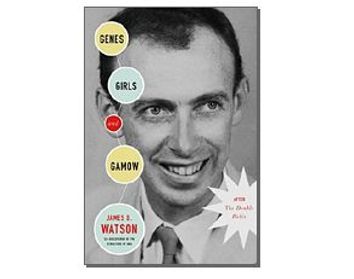
“Genes, Girls and Gamow” by James D. Watson

A brilliant biologist's embarrassing new memoir reveals that even with a Nobel prize-worthy discovery under his belt, a 24-year-old geek finds it hard to get laid.

There are some memoirs that real friends would stop you from writing. They would take you aside and say, Jim, when you and I look back we find this all very amusing, but do you really want to bare it to the world? All the rebukes from uninterested women, your sexual frustration, the silly little practical jokes? Surely you’ve grown up some since then. And do you really think the world would be interested?

I can’t speak for the whole of the world, but my guess is no.

James Watson’s new book, “Genes, Girls and Gamow: After the Double Helix,” is, as the title forebodes, about nothing much of anything. Dredged up from old letters, it is a diary-like recounting of the mundane details of his life from April 1953 to March 1968, including detailed descriptions of trinkets he buys his parents in airports and what kinds of houses his friends live in.

This story begins immediately after one of the most important scientific discoveries of the century — for which Watson was to share the Nobel prize — the discovery of the structure of DNA. Watson wrote a bestseller, “The Double Helix,” about that pursuit way back in 1968. And now he wants us all to have the chance to know what life was like for a young American scientist following such a major accomplishment at the tender age of 24.

The big surprise is how much time he spends thinking about how to get laid (or groped, or whatever the ’50s equivalent was). Well, that’s interesting: Even a groundbreaking scientific discovery can’t get sex off a young geek’s mind. Nor apparently does it help him attract women — or rather, “girls.”

Reader, you may think that, when in the first chapter Watson obsesses about one Sheila Griffiths, “a good-looking English girl,” he’s introducing you to someone who’s going to play some kind of role in this story. But no, you’re going to hear about every female he takes even the slightest fancy to: women he meets on an Atlantic crossing, secretaries he ogles in diners, women he considers asking out but doesn’t.

Sheila lasts but a few pages. Then it’s Christa Mayr, the 17-year-old daughter of a Harvard ornithologist. Well, OK, he can’t really keep his eyes off her younger sister, Susie, either, but the crush he had on that one back when she was 13 is at least subsiding. There’s Rachel and Margot and Mariette and Linda (who had a “glamorous blonde personality”). Sadly, throughout much of the book, most of the women he covets go out of their way to avoid him. Some of his only successes involve bribery: “Both Leslie Orgel and Jane Rich opted at the last minute to join me, tempted by my offer to pay for the gas that would transport them.”

Even academic institutions are viewed in light of their female pickings. Caltech is “girlless.” And Watson desperately wants a job at Harvard: “A faculty position there could give me not only a chemical colleague focused on DNA but also the opportunity to be near Christa and, if not her, the many girls whose faces caught my eye as I walked about Harvard Yard.”

All of this could be discounted as the harmless banter of a horny youth if it weren’t for Watson’s now notorious disregard for chrystallographer Rosalind Franklin, whose work contributed in a major way to the discovery of the double helix. In his earlier book, Watson’s chauvinism and disdain are clear: “Though her features were strong, she was not unattractive and might have been quite stunning had she taken even a mild interest in clothes. This she did not. There was never lipstick to contrast with her straight black hair, while at the age of thirty-one her dresses showed all the imagination of English blue-stocking adolescents … There was no denying she had a good brain. If she could only keep her emotions under control.”

Watson says in his preface that he’s trying to capture the spirit of his youth and to avoid being reflective. He succeeds. This is very raw stuff: daily life trivia, snapshots of his friends and letters to and fro. But it strikes me that this material belongs in a dusty old box in an archive somewhere, not in a book. It needs to be digested at some point, probably by an arm’s-length historian, and, frankly, much of it needs to be left out entirely.

It’s not that Watson can’t write; he puts his words together nicely enough. But he doesn’t seem to be able to tell a story. And without a narrative, reading it feels very much like being trapped in an old folks’ home with Uncle James and his box of mementos as he hoots about his randy boyhood.

The science bits are a bit disappointing too, as Watson makes little attempt to make them understandable to the layperson. He seems to think that if he puts a chatty paragraph on either side, he can get away with impenetrable gibberish like: “Initially I got over-excited when its high negative birefringence implied bases oriented strongly perpendicular to the putative helical axis.”

Watson knows readers can get lost, he’s just not always clear on where. “Girls, Genes and Gamow” includes no glossary of scientific terms such as “birefringence” and “helical axis,” but Watson kindly provides us with a compendium of 91 names that reads a lot like a Who’s Who of the century’s scientific bigwigs. All these names are dropped, copiously, throughout the book, most of them without much introduction.

One such is George Gamow, a Russian theoretical physicist who becomes interested in biology. I’m still not sure why Gamow won a place in the title, but he does provide Watson with a convenient segue into his own little pranks. Gamow, Watson tells us, was a big-time practical joker — for instance, he once persuaded a handful of European physicists to write to the editor of Naturwissenshaften, a prestigious German scientific journal, to say that a paper they’d published had been a hoax. It wasn’t, but Gamow and Watson and their pals got a good knee-slap out of it. Watson relishes the telling of his own capers — getting a genuine hoax paper published in Nature, for instance, and sending out false invitations to make-believe parties.

There were plenty of people annoyed (or worse) by Watson’s game playing. No doubt some of them hoped that some day they’d have the last laugh. And I can’t help but wonder if one of them suggested he write this book.

Continue Reading Close

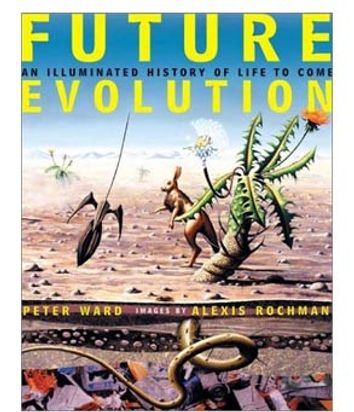
“Future Evolution” by Peter Ward

A scientist and an artist team up to portray a future of square tomatoes, kangaroo rats and universally brown-skinned humans who don't need food.

Before you crack this book open, close your eyes and let your imagination roam into the eons to come. Maybe pets will have evolved to do housework. Maybe real food will no longer exist. Maybe humans will have developed a handy fertility switch, to be flicked on only when we want babies. A title like “Future Evolution: An Illuminated History of Life to Come” inspires fanciful musings, no?

Well, this book isn’t anything like that.

Peter Ward, a geology professor at the University of Washington in Seattle, is not really a details man. Even in the chapter dealing with the future evolution of humans — and let’s face it, that’s what we shallow laypeople are interested in — there’s little to really set your heart aflutter. He speculates vaguely that the races may merge, yielding “a universal brown-skinned future.” That’s nice. And that we may be genetically engineering our offspring. Well, yes. The one really intriguing suggestion he raises is that we should somehow manage to stop eating and become solar-powered, but he expends a mere paragraph on the idea.

Despite what its title may imply, this book is concerned more with the process of evolution than with its specific results. Almost half the book is taken up with evolution’s historical record, and the other half is basically a framework for how it will carry on.

But Ward’s Big Idea is a fascinating one. (Good thing, too, as this isn’t the first book he’s written on the topic.) Unlike the doomsayers out there, he doesn’t think there’s another mass extinction looming. Rather, he’s convinced it’s well underway, and that the worst is already over. Most of the big mammals that are going to die off already have. Among those no longer with us are the mastodons, the mammoths, the saber-toothed tiger, the giant short-faced bear. “It is visible in the rear-view mirror, a roadkill already turned into geologic litter — bones not yet even petrified — the end of the Age of Megamammals,” he writes.

History has taught us that mass extinctions like these — especially of large beasts — usually give rise to exciting new species. The Permo-Triassic extinction 250 million years ago lost mammal-like reptiles and gained dinosaurs. The Cretaceous-Tertiary extinction 65 million years ago extinguished the dinosaurs, making way for mammals. But if you’re eagerly awaiting the new exotica, you might be disappointed. Ward thinks that most of the new species to spring from this round of death have already sprung. They are mostly farm animals, transgenic plants and drug-resistant bacteria.

And while human beings had a hand in the demise of the megamammals, and even in determining which among the new species would survive, we aren’t going to die out in some kind of earthly tit-for-tat. Indeed, Ward describes us humans as “functionally extinction-proof.” We’re smart, for one thing, and adaptable. Chances are, says Ward, humans will be around to see planet Earth through to its end.

A particular pleasure of the book is the futuristic artwork that accompanies the text. In glowing color, we are presented with everything from square tomatoes to kangaroo-like rats. Artist Alexis Rockman adds this delightful dimension to the book.

Ward, for his part, is a very capable writer. His words are well chosen and carefully polished. Occasionally he’s downright eloquent, as here, on the impact of cities:

“Our plane lifted from the lushly verdant Yucatan on a luminous day, and we flew over a starkly visible Mexico. The flight was not very long, and a vista of mountains and forests passed far beneath us. Eventually I spotted a distant mountain, larger than the others, and as we approached I was filled with wonder. Never had I seen a mountain like this before, perfectly dome-shaped, brown in color, impossibly tall, a vision that enlarged and degenerated into implausibility. Our pilot headed straight toward the summit of this great mount, and just as we were about to crash into it, I realized what it was: the air over Mexico City, a mountain of pollution covering the huge sprawl below.”

Ward’s early chapters, highlighting the two above-mentioned extinctions as well as the current one, are authoritative and clear. However, when he strays from his areas of expertise, as when writing on the future shape of man, I found it harder to trust him. He relies too heavily on single sources to flavor his predictions, and too often those single sources are writers of outdated popular science books.

Ward gets in a muddle on the issue of intelligence, for instance. First he struggles a bit to define it, then decides it’s irrelevant to do so. He summarizes two theories on how human intelligence evolved in a paragraph each. Then, borrowing heavily from a book called “The Gene Bomb,” published in 1996 — so, probably written around 1994, years before some of the biggest leaps in human genetics — he raises the possibility that we could get dumber and more mentally unstable. Ward doesn’t exactly buy the idea that we’ll be less intelligent, but he nevertheless reiterates the suggestion by the author, David Comings, that we are unwittingly passing on the genes for behavioral and mental disorders.

According to Ward, Comings makes that stale old argument that people with behavioral and mental disorders get pregnant earlier and more often, thus sullying the gene pool — a sort of “unnatural” selection — while “intelligent” people go to university and breed less. Comings apparently suggests that the former is true of people with attention deficit hyperactivity disorder (ADHD). But do people with ADHD really reproduce more and at a younger age? How many studies have been done on that question since the disorder was first recognized and included in the DSM, the bible of mental disorders, in 1980? And are people with ADHD really less intelligent, or do they just perform less well on standard intelligence tests because of their inability to concentrate?

These are but a few examples of factoids I would have liked to see referenced. But, alas, there are no footnotes. Has genetic engineering of plant species really yielded “spectacular dividends in terms of crop yield”? Exactly which “further work” has found that “depression, addiction, and impulsive, compulsive, oppositional and cognitive disorders” may be “coded on only a few genes”? How can I be confident in what Ward is saying if he doesn’t tell me where the learned ideas come from?

In a way, I have to admire Ward. He builds most of his case on the science as he knows it. He is well aware that a lot of readers are clamoring for a sensationalist life-after-man story. He even includes a charming anecdote of how the BBC asked him to be a scientific advisor for a television series on the future of evolution — with one catch. The future of evolution, they had decided, would not include humans. Needless to say, he politely declined.

Ward’s book is fun, insightful, educational and bold. Sadly, for me, there was just a tad too much Evolution, and not enough Life to Come.

Continue Reading Close

“Blue Cats and Chartreuse Kittens” by Patricia Lynne Duffy

For people with synesthesia, letters, words and numbers have their own colors, and you can smell the shape of milk

The letter “S” is red: “Sand,” “sea” and “sky” are all red words. “Rain” is shiny black. “Mist” is green. “Lust” is a sad dull yellow.

Bizarre? Certainly. But not nearly as uncommon as you might think. This condition of mixing up sensations — known as “synesthesia” — affects about one person in 2,000. Most people just intermingle colors with letters, numbers and days of the week. But others experience colored pain or can tell when the cream has gone sour by sniffing its “shape.”

Synesthesia is enjoying something of a renaissance. A hundred years ago, it was all the rage. Artists and composers were thrilled by the creative possibilities, and scientists were trying to untangle its cause. The composer Aleksandr Scriabin believed musical keys had inherent colors; he composed a few pieces calling for a colored organ. The writers Charles Baudelaire, Arthur Rimbaud and Joris Karl Huysmans all dabbled in the cross-sensory, though whether they were genuine synesthetes is unclear. Vladimir Nabokov was definitely one, and apparently so were his mother, wife and son.

After a long hiatus, artists are once again painting it, composers playing it and writers writing about it. In the past decade, at least four popular books have been dedicated to the topic. The most recent, “Blue Cats and Chartreuse Kittens,” by Patricia Duffy, is — importantly — the first to be written by someone who actually has the condition.

Synesthesia isn’t easy to fathom. People who don’t have it have a hard time understanding — let alone explaining — what it’s like. Duffy gives us an insider’s view.

Most synesthetes, for instance, don’t realize that there’s anything unusual about the way they think. The numeral 9 just happens to be, say, silver. Or trumpets just always sound blue. They simply take it for granted — and assume everyone else realizes it too. Then one day, they let slip, and their world changes forever.

Not unusually, Duffy made it all the way to age 16 before that happened. On that memorable day, she was talking with her father in the kitchen about how she’d had trouble as a kid learning to write the letter R. “I realized that to make an R all I had to do was first write a P and then draw a line down from its loop,” she recalls saying to him. “And I was so surprised that I could turn a yellow letter into an orange letter just by adding a line.” Father was intrigued.

Almost all synesthetes will say their mixed sensations have been there for as long as they can remember and they have always been the same. The color is an essential element, not decoration, Duffy stresses. “To me, a red O seems as peculiar and wrong as the notion of a triangular O,” she writes. “An O is circular! And it is white!”

Hear, hear. An O is indeed white. But that is one of the few colored letters that we synesthetes can agree on. Duffy describes her yellow P and orange R. Nothing could be more ludicrous: In my world, P is pale blue and R is black.

One of the pleasures of “Blue Cats” is that Duffy lavishes time on details that a lot of her nonsynesthete predecessors failed to properly appreciate. She doesn’t just mention that letters have colors, she analyzes how those colors blend and mutate when they find themselves side by side in a word. She explores the way many synesthetes organize the world spatially. Numbers, for instance, are often fixed in space on what she calls a “number trail.” Years, months and days of the week all have not only colors but shapes and patterns as well — a very particularly tilted loop, for instance, or an endless roller coaster. Through interviews with others with various forms of the condition — painters, a photographer, a composer, a mathematician — Duffy examines the phenomenon of synesthesia thoroughly and lucidly.

She also had the good sense to convince her publisher to fork over for some color photographs, something other authors on the topic haven’t bothered to do. Some of the illustrations — the comparisons of colored alphabets, the colored equation, the depictions of time — are indispensable in understanding what must seem to many to be truly alien concepts.

Duffy is a bit coy about what she thinks lies at the root of synesthesia. Most of her explanations are posed very tentatively as questions, such as “Do synesthetes generally have the capacity to sink more easily into, for lack of a better term, a state of ‘creative reverie’?” or, for you regular folks, “What would happen if … unattended mental processes were attended to?” She stops just short of saying it, but I can feel her longing to belt out: My god, we’re a creative bunch, and so in touch with our inner selves too!

This reliance on a sort of mystical explanation is disappointing, especially when the condition really is a fascinating scientific puzzle. How is it that perfectly healthy and otherwise neurologically normal people can experience color when there is no real color there to be perceived? What happens in such a brain to make the visual areas switch on when something is merely heard, not seen? Are these people born this way, or does something happen early on in their lives that make them distinct? Is it genetic? Are we all a little bit synesthetic?

Duffy can’t be faulted for not having the answers, because there really aren’t any yet. But there are some interesting propositions. She touches so very lightly on these important issues that I almost wish she’d steered clear of the science altogether. Where it does appear, it jars with her otherwise conversational style, as though she transcribed it undigested from tape-recorded sessions with experts.

It’s not as if there wasn’t space for a fuller explanation of what’s possibly going on in synesthetes’ heads. Even with the assistance of generous margins, numerous lengthy italicized quotations and page-numbered photographic plates, the book seems to struggle to reach full length. There is too much padding in the form of unrelated research (such as, out of the blue, a comprehensive listing of Howard Gardner’s “multiple intelligences”), irrelevant musings and personal history.

On this last point, perhaps I can call her editor to account. In her acknowledgements at the end, Duffy thanks him for encouraging her to think more about her relationship with her father. It’s uncharitable of me to say so, but I felt there was rather too much about her father. There were a few too many sentimental tributes, a bit too much family minutiae. Do I need to know exactly which inspirational notes he had fixed to his workroom wall?

As a synesthete myself, I know this book’s description of synesthesia is accurate and true. It tells the real story. Many of Duffy’s readers may be skeptics, though, who question the very existence of the condition, who think it might be fabricated or even some mild mental illness. For this reason, it is especially important that the book be accurate on other levels as well. Sadly, it is peppered with niggling little errors, the kind that undermine your confidence if you’re already having a hard time taking it seriously. A few names are chronically misspelled (Eraldo Paulesu, for one, who did one of the first brain scans of the condition, and, OK, I admit it, my own), foreign words mistransliterated, even the color-coding of the Prague metro lines is slightly off. An earlier oft-cited book is repeatedly given the wrong title, an important article mentioned in the text goes unreferenced, while another that is referenced offers up the publisher’s name in lieu of the journal’s. Are there no copy editors? Are there no fact checkers? What happened to the “keen ability to recall … people’s names, correct spellings of words, even phone numbers” that Duffy celebrates in this very book?

Despite these minor deficiencies, however, the book is a fun and worthwhile read. Whether you’re a nonsynesthete amused by colored words and shapely smells or a synesthete annoyed with the notion of “cat” being a blue word (when it’s clearly brown), either way you’ll shake your head and marvel.

Continue Reading Close
www.salon.com/writer/alison_motluk/index.html