Alissa Novoselick

The school gardener strikes back

Caitlin Flanagan is throwing bombs at garden-based education. To this teacher, they're all duds

  • more
    • All Share Services

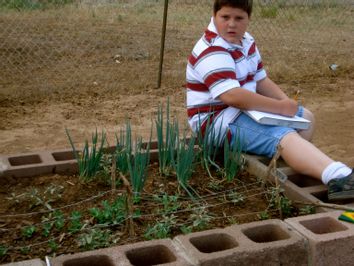
The school gardener strikes backA student in Novoselick's school garden

Last month, Alissa Novoselick wrote a wonderful story for Salon about starting a school garden in rural Camp Verde, Ariz. So when Caitlin Flanagan wrote her sneering attack on Alice Waters, the Edible Schoolyard, and school gardening in general, Alissa chose to respond. Also read Andrew Leonard’s response here.

When I read Caitlin Flanagan’s “Cultivating Failure” in the Atlantic, my heart broke. Then, like most grievers do, I got angry. Throughout her drawn-out, misinformed piece, Flanagan says that school gardens destroy standardized test scores, promote apathy for education, and are …  racist? Please. Flanagan slashes at the tenets of strong educational tactics and makes me wonder if her “I-live-right-by-Compton credentials” (yeah, us white people all know someone from the hood somewhere) really have any validity at all. School gardens do exactly the opposite of what she states: They create excitement, create learning opportunities, and create a sense of community in classrooms where that is hardly ever seen.

Flanagan writes that gardening, of all things, is robbing our students of “reading important books or learning higher math … that have lifted uncounted generations of human beings out of the desperate daily scrabble to wrest sustenance from the dirt.” Not underpaid teachers, or lack of technology, or homeless students, or incompetent instruction? Funny, she doesn’t seem to think any of those very real factors are very important, but says that gardens distract from “true” learning — “leaving the Emerson and Euclid to the professionals over at the schoolhouse.” She then dismisses the education that happens around gardening: “Students’ grades quickly improved … which makes sense given that a recipe is much easier to write than a coherent paragraph on The Crucible.”

WRONG.

In the garden I started last year with my 6th grade students, Emerson and his good buddy Thoreau tagged along wherever we went. You see, good educators don’t leave the gurus behind when creating something exciting for the students; they include them. As the superintendent of my Camp Verde Unified School District, Dan Brown, told me this morning, “The best teachers use Bloom’s Taxonomy through project-based curriculum. That forces students to create something of their own.”

The application of the real world is the most powerful tool in our educator toolbox, and what better way to understand a philosophy about cultivating land than to do it? As we read pages of “Walden” and planted our seeds, quotes from Thoreau such as “I chose to live deliberately, to front only the essential facts of life, and see if I could not learn what it had to teach, and not, when I came to die, discover that I had not lived,” carried much more weight with action. And guess what? We even wrote paragraphs about it.

Gardening can be included as the best pedagogy. I fostered great relationships with students based on active learning and parental involvement, and they raised their writing scores on the standardized AIMS (Arizona Instrument for Measuring Standards). We went from 64 percent meeting the requirement to 85 percent meeting the requirement … while we were “wasting our time” in the garden.

Flanagan never asked a student.

She never quoted a teacher.

Her quotes come from charter school administrators who have had extremely good luck with traditional English/math curricula. But she certainly does not know what my world is like in rural Camp Verde, Ariz., where this sort of education would be inappropriate and dull.

So when Flanagan argues that it is much more important to get a kid to read Shakespeare than play in the dirt, I say … why not do it at the same time? And why not include the student’s parents and community members who have many different ethnicities to help us learn about each other?

She says because it’s racist: “Does the immigrant farm worker dream that his child will learn to enjoy manual labor, or that his child will be freed from it? What is the goal of an education, of what we once called ‘book learning’?”

When your elementary-school child is forced to pick up his or her toys after recess, you are going to claim that because your child is a “privileged American” he or she should not be taught the values of simple tidiness? When your child has the opportunity to attend a field trip to the zoo to see the lions after studying the climate and culture of Africa you are going to say, “You’re not going. Read another book”? And frankly, what about the farmers who enjoy their life as it is and truly do not need to know the entirety of “Hamlet” to have a good life and make a good living? She dismisses physical work, under the guise of respecting students’ upward mobility, but it also hints darkly at her views of the people in those fields.

In my garden, I saw the Hispanic immigrant farmer teach the children (black, white, Hispanic, and Native American) about the tactics he used on the farm. I watched his daughter’s eyes light up with admiration for the man that tucks her into bed each night. Students taught one another the medicinal properties of Native American plants. I’d say this cultivated not only math, science and historical and literary awareness, but cultivated community — something which needs to be fostered above all of the disciplines. Students did not think of themselves as the “new child farm laborers,” as Flanagan suggests, but begged to take part in the gardening, to touch the dirt, to help things grow.

“Some educational decisions must be explicitly hands-on,” science teacher Matt Malloy told me. “Real-world application is where learning is synthesized and it’s unfortunate that professors who do not know what the real (educational) world is like are writing curriculum and making grand assumptions.” This assumption — that a garden can cultivate failure — is an idea that needs to be squashed.

I was so angry after reading “Cultivating Failure,” that I assigned my 11th grade students a writing exercise on this question: “Is interactive learning important? Why or why not?” After 10 minutes of frantic scribbling, I heard about the necessity of things like our school garden in my students’ own voices.

“The balance of all disciplines,” Michael wrote, “is essential to gain knowledge. I learn just as much working in Auto-Mechanics as I do in Pre-Calculus. I want to do a hands-on job so it is more meaningful to me.” So when Flanagan asks facetiously, “why not make them build the buses that will take them to and from school?” Ha. They want to. 

Growing more than food in a desert garden

For one teacher and her 6th grade students in rural Arizona, playing in the dirt means making a community

  • more
    • All Share Services

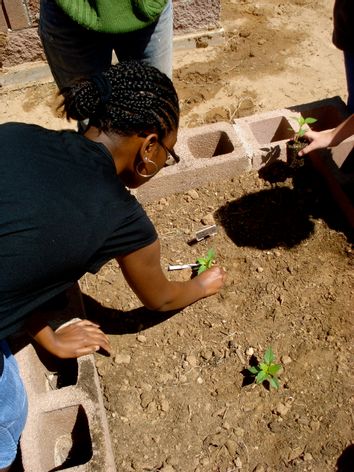
Growing more than food in a desert gardenA student in Alissa J. Novoselick's class

There are great organizations planting gardens in urban schools — Alice Waters’ Edible Schoolyard is the most famous example — but we asked a young middle school teacher about a grass-roots effort planting one in rural Arizona, inspired by the book “Seedfolks.” This is her report.

There is something about 6th graders and dirt that just makes sense. They can’t resist it; can’t wait to move it and pile it and throw it in each other’s faces. But when you’re a 6th grader in the desert, “outside” is a different kind of beast. As I watched my students in rural Arizona pull cactus needles out of their rear ends and kick up dust, I thought about the uses of this barren land we call home — and we don’t use much.

Moving from a big Michigan city to this tiny Arizona town called Camp Verde, I found that the word “barren” could be used to describe almost everything — the landscape, the bookshelves that lined my English classroom, the extreme apathy for education and the rare semblances of togetherness between the Hispanic, Native, white and black students. At school board meetings, all I heard was “We need to form a sense of community,” and “Our community needs a stronger identity.” Camp Verde is a dot on a map — but what is it?

I tried to figure this question out with my 6th graders. We made lists of things our community is and isn’t, what it needs and doesn’t. The one thing that reappeared, over and over, was food. From the tamales that Hispanic students share with each other to the local fry bread stand a Native American family runs, the unique things we eat were the dominant traits that defined us. We talked about how important, culturally and practically, food is to family and we talked about how being poor means having few resources for fresh produce. So, with community and food swirling in my head, my students and I planted a garden.

We dug up the weeds, trekked manure from neighbors’ farms, and $40 later, planted a plethora of local plants outside of our three-school, K-12 complex. As we measured distances and plopped seeds into the prepared earth, the squeals of excitement at the sight of a slug or the misfire of the garden hose triggered a smile on my face that had not been so fierce in some time. We researched the plants, planned for their use in the cafeteria, created a classroom-composting bin, and most important, talked about the compelling diversity of the place we lived.

The day we planted, I saw something I had not seen in Camp Verde, ever: Parents, who rarely seemed invested in their childrens’ education, showed up with rakes and trowels. A college professor called and asked if he could help. A woman who ran a greenhouse donated bags of compost on the spot. The community began flocking to the garden site. I asked one student what she was learning and she replied, “Nature is more than what God created. It is a part of life.” I was stunned. The Native American parents that showed up began impromptu lessons about the history of the agave plants, and another 6th grade teacher taught a lesson about water conservation in the desert. Inside the garden, inside the decrepit fence, racial tensions eroded and the true meaning of community blossomed.

It was likewise inside the classroom. When one student, Sharli, talked about the chilies her family grows on their farm, a Hispanic student look stunned and said, “Really? You eat chilies?” The connections and compassion came from all over, reappearing daily. At the end of the unit, students brought in dishes from their cultures and we learned about every family and what is “normal” for them to eat for dinner. Students found similarities and loved the differences. When I admitted that I had never been introduced to tamales before, students loved sharing them with me. It was a binding experience that paved the way for new friendships and discussions.

We sat in our garden, weeks later, and all wrote about the growth we could taste and touch with our fingertips. Students talked about how they wanted to keep this going forever. With impending budget cuts, teachers working with half the lights on, and another year of ancient textbooks, the funding to put in a functional (and environmentally friendly) watering system was just not plausible.

But we keep plugging. We keep toiling in our small piece of desert land where things still grow. My dream as an educator is to give our community what we deserve — the right of healthy, local, community-driven food. While we’ve created something that students will hopefully remember and cherish, we still have much more work to do. We have funds to raise. We have people to convince. But, when the school board asks me, “What can we do to create community?” I’ll tell them the answer: food.


Alissa J. Novoselick 

Continue Reading Close