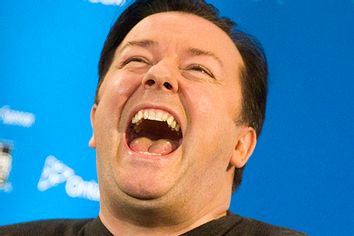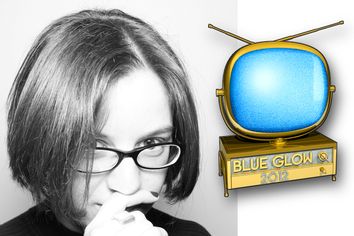
In the lead-up to Sunday’s Golden Globe Awards, all eyes are on the return of host Ricky Gervais — specifically about the snark that earned him a career-enhancing dose of notoriety when he took some swings at his fellow celebrities at the same ceremony last year.
Gervais is in the New York Times Magazine, where David Itzkoff explains his comedic swings from kind impulses to mean-spirited rawness. In Vulture, Willa Paskin worries that all the focus on Gervais’ edge is leading him to buy his own hype, obscuring the fact that he’s very much a part of the club he got credit for lampooning. NBC’s own ad campaign features Gervais talking about how controversial it is for him to be back. In as much as the 2012 Globes are must-see television, it’s supposed to be because of the man riffing at the podium, rather than the artists who will deliver grateful speeches from it.
All of this may cast the Hollywood Foreign Press Association, the force behind the Globes, in Gervais’ svelter-than-in-the-past shadow. But given past experience and ongoing challenges to the group’s credibility, the smartest place for the association to stand may be out of the direct spotlight.
First, asking Gervais back makes the HFPA look confident and self-aware rather than prickly and insecure. At the ceremony last year, Gervais didn’t exempt his hosts from his barbs, lampooning the Globes for nominating the luxe-but-lukewarm “The Tourist.” “I haven’t even seen ‘The Tourist.’ Who has? It must be good because it’s nominated, so shut up,” he joked. “I’d like to quash this ridiculous rumor going round that the only reason it was nominated was so the Hollywood Foreign Press could hang out with Johnny Depp and Angelina Jolie. That is rubbish. That is not the only reason. They also accepted bribes.”
At the time, members of the HFPA were angry enough for someone to go to the gossip columns and complain that Gervais wouldn’t just be banned from hosting the show again — his projects would be blacklisted, too. But punishing Gervais for something everyone has long assumed is true doesn’t dispel that belief. Especially not after the association fell all over itself to lock in George Clooney’s attendance this year, nominating him not just for his performance in “The Descendants,” but for directing and adapting the decidedly mediocre political drama “Ides of March.” It’s easier to defuse allegations by laughing them off than by trying to quash an embarrassing truth your host shared with 17 million people.
Having a sense of humor over its attempts to reel in a little talent would put the HFPA and its audience on the same footing going into the event. There’s nothing wrong with serving up entertainment with a healthy side of cheese. Or with acknowledging that the Academy Awards will always hold pride of place — and refusing to let that prevent you from having fun. There’s ample middle ground for someone to claim in between taking yourself deadly seriously and drenching your guests in literal slime, like the Nickelodeon Kids’ Choice Awards.
And Gervais is more likely to provide an entertaining show than the results of the awards ceremony itself. The Globes play a role in the horse race on the way to the Oscars, but the nominations this year make for a singularly unexciting set of contests. In some categories, it’s difficult to care which already-anointed actor will walk off with this year’s trophy. When it comes to the best actor award, Clooney, Leonardo DiCaprio (nominated for the underwhelming “J. Edgar”) and Brad Pitt’s careers will all continue on their merry way without a statuette, and Michael Fassbender and Ryan Gosling are on trajectories steep enough that a loss wouldn’t slow their rise. In others, snubs like “Breaking Bad” in the best drama category mean the wins will inevitably be hollow. Victory comes cheaper if you don’t claim it over your true competitors.
The best the Golden Globes can ever hope to achieve is second place in the hierarchy of awards shows. And that’s where Gervais comes in. But in collaboration with Gervais or a host like him, the HFPA — whether it intends to or not — is producing an awards show that combines our contradictory attitudes toward celebrities. First we get them in the room, and then we cut them down to size.
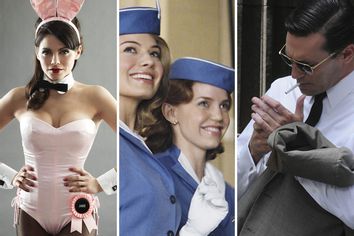
The fifth season of “Mad Men” may have been delayed until 2012 by contentious negotiations between AMC and series creator Matthew Weiner, but fans desperate for their fixes of fashion, Old Fashioneds and nascent feminism have three new shows set in the late 1950s and early 1960s to tide them over.
This week, NBC’s “The Playboy Club” and ABC’s “Pan Am” join “The Hour,” a stylish look at a British TV news show that premiered in August on BBC America. It’s easy to suggest that these shows are trying to capitalize on “Mad Men’s” popularity — which has spawned everything from paper dolls to a Banana Republic clothing line — and it’s certainly true. But it’s more accurate to say that “Mad Men” tapped a vein of gender trouble that no one expected ran so deep. The clothes and the cocktails may be appealing, but they’re a way of setting us up to revisit a moment when women were starting to remake the world, and to take on the knotty questions of where the fight for women’s equality got derailed. The success of “Mad Men’s” imitators will depend on whether they give viewers substance to go with that style, or whether they build a series of arid, period theme parks.
That’s not to say that our stylistic fantasies of an earlier age can’t be valuable. There’s something refreshing about the late ’50s and early ’60s standard of beauty, an era when Marilyn Monroe, the world’s sexiest woman, fluctuated between a size 8 and a size 12. On “Mad Men,” the sexiest woman, Christina Hendricks’ Joan Holloway, is also the biggest, clad in costumes that emphasize her curves. Romola Garai, the tough and sensuous female star of “The Hour,” refuses to diet and has spoken repeatedly about food as a source of joy rather than anxiety. They may not have succeeded in permanently shifting the fashion world — Hendricks still has trouble finding dresses for premieres and events — but they are a powerful counterpoint to a world where a deviation from a sample size sparks pregnancy rumors and female news anchors confess to eating Cheerios as if they’re binging on candy.
But if shows set in the 1960s usefully debunk the idea that women need to starve themselves to be stylish, they also let us indulge in less healthy fantasies. Don Draper may turn himself into an anti-tobacco crusader as a strategic move and Bel Rowley may be shut out of smoke-filled rooms on account of her gender. But “Pan Am’s” stewardesses still serve martinis on orchid-adorned trays, and “The Playboy Club’s” waitresses still shill steaks for the menu’s standard buck-and-a-half price. When you’re fretting over the assassination of the president or the rearrangement of society’s hierarchies of race and class, who has time to fret over cholesterol or cirrhosis? In an uncertain world, who doesn’t need a tipple, or in the case of Peggy Olson, to smoke some marijuana?
But even if we don’t want to go back to work in sex-segregated offices (and clubs and planes), there is something appealing about an era where, in the battle of the sexes, it was easy to pick out bad guys, and single out bad behavior. It’s impossible to miss the sexism in advertising executives’ treatment of Joan and Peggy; in the doubts that dog Bel as she sets out to make “The Hour” a vital and challenging news show; in the leers of young men who think themselves sexually sophisticated simply by perusing a Playboy Club menu; in a world that seems so stifling that escaping into a Pan Am-issue girdle feels like freedom.
And while there may be no perfect solution to the sexism these characters face at home and at work, we at least see the characters learning lessons that we’ll benefit from a generation later. The Playboy bunnies may get a little bit further than the Joan Holloways of the world by packaging their sex appeal for sale beyond a market of only one man. But as “The Playboy Club” makes clear, the freedom not to marry every man you shook your bunny tail at did not mean freedom from sexual harassment. There’s no question that trailblazers like Bel and Peggy opened up new professions and responsibilities for women, but we know now, from persistent pay gaps and underrepresentation of women in powerful positions, that their victories were the first salvos in a battle that is far from won. And the “Pan Am” stewardesses won their freedom of mobility by conforming rigidly to a corporate standard of beauty.
What’s both depressing and powerfully nostalgic about these shows is not necessarily that sexism was so virulent — though that’s certainly upsetting — but that we failed to capitalize on the nascent momentum that all of these shows explore. Some of those failures, like the inability to pass the Equal Rights Amendment, are a testament to the persistence of sexism in American society. And some of them are the result of fighting with ghosts. Should women and men be represented exactly equally in all industries? Are we really going to tell women that it’s wrong to take time out of the workforce to raise their children? Shows like “Mad Men,” “The Hour,” “The Playboy Club” and “Pan Am” resonate with us not because we want to return to the bad old days, but because we wish we had a clearer path toward a better future.
Continue Reading
Close
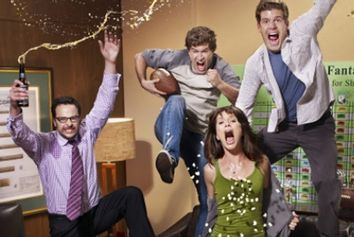
Three rounds into my fantasy football draft last week, my co-manager and I were cruising. We’d snagged Kansas City Chiefs running back Jamaal Charles, Atlanta Falcons wide receiver Roddy White and Pittsburgh Steelers wide receiver Mike Wallace, in that order, when we made a critical error. Under time pressure, we failed to double-check that we had the right player highlighted in Yahoo’s fantasy system and accidentally took Carolina Panthers quarterback Derek Anderson. The deep boneheadedness of wasting a fourth-round pick on a quarterback I wouldn’t have even considered as a backup was a new kind of agony for this fantasy newbie. In an effort to move beyond narrow, team-based rooting — and an experiment in guy culture — I decided to kick in $50 and help run a team, and to take FX’s fantasy-football sitcom “The League” as my guide.
“The League,” which debuted in 2009 and returns for a third season on Oct. 6, is ostensibly about the way fantasy football ties together a group of friends, but it’s also a minor gem about how men regulate their behavior around women, and around each other. When I first started watching the show, part of the fascination was the chance to observe a phenomenon that I’ll never be able to see myself: what a tight-knit group of guys acts like when there are no women in the room — rape jokes, smack talk and slightly creepy innuendoes about their wives. It’s not that in the absence of women, the main characters are free to indulge their inner sexists. These men — dorky, divorced and overmatched by their hot wives — after all, are our heroes. It’s that they have space where they can say wildly inappropriate things without anyone believing they mean it.
It’s interesting to see the characters come up against their limits. In the second season, Ruxin (Nick Kroll) convinces his friends to let his wife’s cousin Rafi join the league — only for all of them to get uncomfortable when, among other things, he gets a little too casual with the rape talk. Similarly, the league’s championship trophy is named for Shiva, the valedictorian in the men’s graduating class who’s outgrown her nerdy high school identity to become a beautiful doctor. When Andre, one of the league members, begins dating her after she moves back to town, he gets skittish when his friends make jokes about their memories of Shiva and their attempts to harass her. Once one of your recently divorced friends starts faking prostate trouble to make an unnecessary appointment with your urologist girlfriend, well, suddenly the joke isn’t funny anymore. Of course, when Andre starts bragging about bedding Shiva to sound like one of the guys, he pays for it with a dumping and a severe case of bruised testicles.
Even more than the question of how men behave when women are safely outside their circle is what happens when the characters in “The League” come into contact with women who can compete with them on a level playing field. There’s the stripper in Las Vegas who, overhearing the league members’ pre-draft speculation, dismissively tells them that “[San Diego Chargers quarterback] Philip Rivers isn’t going before the third in any of my mock drafts … I won my league last year.” Then she lets them hire her for draft consultations.
And there’s Jenny — who is married to Kevin, the league’s commissioner — who demands to be let into the league as an equal player after years of helping her husband coach his team. (When her insistence on starting Peyton Manning costs Kevin a playoff game, she even suffers the consequence of the usual bet and walks naked down an alley.) “I have all this knowledge! I need to use it!” Jenny tells him. “Give it to me!” Kevin resists, hoping he can get her to commit to staying usefully on the sidelines. But Jenny’s not dissuaded, explaining that she’s sick of watching Kevin waste her insights. “I love my wife but I don’t want her in the league,” Kevin grumbles to his friends. “This is my thing.” But after Rafi’s kicked out, Kevin and the guys let her in — and she proves to be a fierce competitor. As they negotiate sex as rival managers (“I don’t want to talk smack while I”m about to enter you,” Kevin complains), trade waiver priorities and family chores, and figure out how Jenny fits into beer-and-bull sessions, they’re not just adjusting to her role as the league’s first female member — they’re figuring out their marriage.
I don’t have a marriage to be improved by fantasy football, and my co-manager and I have been drinking beer and arguing about sports together for years. I didn’t have to fight for my right to fret over how Peyton Manning’s metastasizing neck problems are going to impact Colts receiver Pierre Garcon’s performance this year. But I’ve already learned one lesson about manhood and football from playing with the boys: Don’t let anyone else draft for you without confirming your picks first. And the season doesn’t even start until 8:30 p.m.
Continue Reading
Close
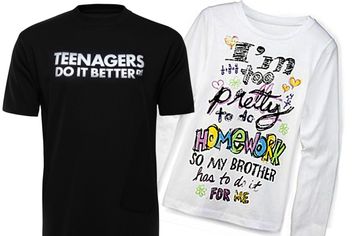
JCPenney became the latest retailer to make itself the target of protests this week when it offered a T-shirt, aimed at preteen and teenage girls, emblazoned with the words “I’m too pretty to do homework so my brother does it for me.” As has happened with similar offerings over the last decade, protests fell swiftly into shape. A Change.org petition denouncing the shirt garnered thousands of signatures, bloggers like those at Gawker Media’s Jezebel turned the tacky offering into a national story, and inevitably, JCPenney announced that it was pulling the shirt from its back-to-school collection.
Besides the fact that the slogan doesn’t really make much sense — not that we want girls to use their looks instead of their heads, but shouldn’t they woo peers and not siblings? — the predictable flap illustrates a larger truth. If you’re trying to make money by getting people to plaster ridiculous sayings across their chests, it’s better to go surreal or silly than stereotypical.
Why do supposedly ironic T-shirts touch so many sincere cultural buttons? After all, a shirt that asks passersby “Who Wants a Mustache Ride?” — to name one novelty tee on the market — might be crude. But it’s hard to believe that anyone would don it in the expectation that it’s an effective sexual solicitation. Similarly, it would be pretty depressing if someone wore a shirt that said “I Drink Beer Like It’s My Job,” also widely available, and meant it. Nevertheless, it doesn’t take a high-level humorist to tell that it’s a joke. “All the Cool Kids Go to Rehab” might not be terribly funny, given the way the celebrity industry treats addiction and rehabilitation as recurring and sometimes trivial parts of the news cycle. But it’s more depressing than offensive, an attempt to glamorize hitting rock bottom, and not a particularly effective one at that.
But retailers go wrong when they treat stereotypes and social issues as if they’re distant enough to be the subject of casual humor. In August, American Apparel began selling a shirt that proclaims “Teenagers Do It Better.” It simply reminded many people that Dov Charney, the company’s CEO, has faced sexual harassment charges from many young women.
Abercrombie & Fitch found itself in trouble in 2002 when it started selling a T-shirt advertising a “Wong Brothers Laundry Service — Two Wongs Can Make It White.” It wasn’t just that that the top played into the idea that laundries are an exclusively Asian industry — which might have been enough to invite protest — but it also implied an inequality between white customers and the people of color from whom they buy services they wouldn’t perform themselves. Similarly, if less perniciously, the chain sold an “It’s all relative in West Virginia” shirt in 2004 that prompted protests from the state’s governor on the grounds that it reinforced stereotypes of the region as a place full of casual incest.
Another chain that’s found itself repeatedly in the hot seat for its T-shirts – perhaps intentionally to cement its edginess — is Urban Outfitters. In 2003, the company found itself under fire from the Anti-Defamation League for selling a top emblazoned with the slogan “Everyone Loves a Jewish Girl,” with dollar signs surrounding the words. Worn by actual Jewish girls, the shirt could have been self-aware and funny, but the association of Judaism with the perception of avarice is still a stereotype that provokes anxiety. Last year, the company pulled back a T-shirt with the slogan “Eat Less” — the words were taken as an uncomfortable promotion of unhealthy approaches to eating. In that case, the debate was particularly fraught because Urban Outfitters introduced its shirt shortly after gossip blogger Perez Hilton started selling (and then withdrew) a T-shirt with the words “Nothing Tastes ss Good as Skinny Feels.” Kate Moss popularized the line in a 2009 interview and it has since become associated with websites that advocate radical weight-loss measures.
It would be wonderful to think we live in a world where the idea that a girl or a woman would prioritize her body over her brain is so ludicrous that it could never be taken seriously. But when the message that women ought to embrace that hierarchy of values is delivered so relentlessly and through so many channels, JCPenney should have realized that its supposedly clever slogan was too on the nose to be worn on anybody’s body as a joke.
Continue Reading
Close