Amanda Terkel

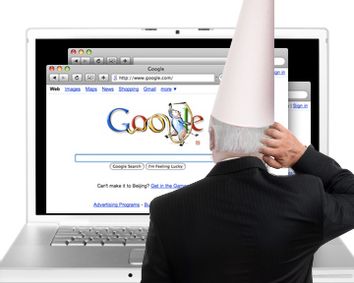
John McCain, Internet dunce

Why the Arizona senator, who can barely Google, is not the chief that an increasingly technological world requires.

  • more
    • All Share Services

John McCain, Internet dunce

John McCain spends a lot of time talking about Iraq. He also likes talking about terrorism. But one issue he rarely touches upon is technology. In fact, under the “Issues” section of his campaign Web site, technology isn’t even an option. He has people like former Hewlett-Packard chairman and CEO Carly Fiorina and former eBay president and CEO Meg Whitman advising him. But the campaign usually deploys them to talk about economic issues like tax cuts and gas prices.

Most of the tech talk surrounding McCain has so far focused on his self-admitted computer ignorance. “I’m an illiterate who has to rely on my wife for all of the assistance that I can get,” McCain said in an interview with Yahoo/Politico earlier this year. Last month, McCain admitted that he has “never felt the particular need to e-mail.”

Tech has put the McCain campaign on the defensive about whether a president needs to be actively engaged in the Internet to lead an increasingly wired country. At the tech-savvy Personal Democracy Forum conference in June, Mark Soohoo, McCain’s deputy e-campaign director, drew snickers when he desperately insisted, “You don’t necessarily have to use a computer to understand how it shapes the country … John McCain is aware of the Internet.”

It has also brought up the unsavory topic of McCain’s age, with people wondering if his lack of technology skills is simply part of the “generational gap” between him and younger voters. But even in his own demographic — white, college-educated men over 65 — McCain is an outlier. According to new data from the Pew Internet & American Life Project, approximately three-quarters of this group use the Internet. “Basically, John is a technological troglodyte, and proud of it,” said former Federal Communications Commission chairman and Obama supporter Reed Hundt.

One area being overlooked, however, is the need for progress on America’s technological infrastructure.

The United States currently sticks out globally for having no national broadband policy — a plan to give every American access to affordable high-speed Internet connections. Roughly half of the country’s households still lack broadband connections, and the United States continues to fall behind. “Broadband will soon be an indispensable communication technology affecting the way we learn, the way we work, and the way we communicate,” Charles Benton, chairman and CEO of the Benton Foundation, wrote in June. “However, at the dawn of this Digital Age, those who could benefit the most from this economically empowering technology are also those most likely to be left without access because of where they live or how much money they make.”

Science and technology certainly haven’t been priorities under the Bush administration. A 2005 report by the National Academy of Sciences concluded, “The scientific and technical building blocks of our economic leadership are eroding at a time when many other nations are gathering strength.” McCain has given little indication that he intends to be much different, and that has some tech experts worried.

“What concerns me is that [McCain] will do as George Bush did, which is to make technology an issue related to how he raises money to run the government or to fund campaigns, and not as an independent issue that is important to grow America,” said Stanford University professor and Internet expert Lawrence Lessig. “Technology for the Bush administration is a total non-issue, even though that was the thing that drove most growth in 1992 to 2003. And the reason I think he’d be led to that is because [he's] a guy who doesn’t understand anything about technology in the first place.”

McCain has not released a tech platform, although he may do so this week. On this front, he lags behind Barack Obama, who unveiled his last year. Mark Lloyd, vice president of strategic initiatives at the Leadership Conference on Civil Rights, pointed to the fact that some of McCain’s top advisors also advised Bush. “I think that the people who determine his tech policies, like [former FCC chairman] Michael Powell and a few others who were his top advisors, will talk, as Bush has talked about, getting advanced telecommunications services to all Americans,” said Lloyd. “But mainly their model is to allow the industry to determine what all this means, which is the danger.”

These worries aren’t unfounded. McCain has a long record of blocking progress on tech issues. He has served as a member of the Senate Committee on Commerce, Science and Transportation since coming to the Senate in 1987, and as chairman from 1997 to 2001, and again from 2003 to 2005. He oversaw the committee at a crucial point in history: the explosion of the Internet economy.

During McCain’s tenure, the committee oversaw the implementation of the 1996 Telecommunications Act, the first major overhaul of U.S. telecom law in nearly 62 years. McCain had to choose whether to be pro-competition or pro-big business. In most instances, he chose the latter route, by opposing increased Internet access for schools and libraries, backing large mergers to benefit the telecom industry and supporting a virtual system of haves and have-nots.

Lloyd said the Senate Commerce Committee during this time devoted “far too little oversight to the good things in the 1996 Telecommunications Act.” Those included “making sure there were equal opportunities to participate in the industry afforded to women and minorities and small businesses.” He added, “There was a rush to essentially allow industry players to get into each other’s businesses and consolidate in the industry.”

McCain’s long history in the Senate has one main theme: Government can do no good in telecom policy. “McCain is a pure free-market ideologue,” said Mark Cooper, director of research at the Consumer Federation of America. “Their [Bush and McCain] belief is that government should just get out of the way and let the private sector do it. Clearly, in the financial markets, the private sector has done a horrible job.”

Other media experts have characterized McCain’s Commerce Committee tenure as a lost opportunity to make progress on telecommunications policy. “The thing that stands out for his entire tenure is that he has never had a priority, and has never had, to my knowledge, any accomplishment of any kind at all,” said Hundt.

McCain has said that closing the digital divide — the gap between people with access to digital technology and those without — is one of his top tech priorities. Speaking to the Consumer Federation of America in 2001, he said it was “our greatest challenge in the 21st century.” It may therefore be surprising to learn that McCain was one of the most vocal opponents of Education Rate (E-Rate), a program designed to provide discounts to schools and libraries to connect to the Internet.

E-rate, established as part of the Telecommunications Act of 1996, may have gotten off to a shaky start, but many tech experts agree that it has been a success. According to the Benton Foundation, nearly $19 billion in discounts have been provided to schools and libraries, and more than 90 percent of classrooms in rural, high-minority and low-income school districts now have Internet connections.

McCain opposed E-Rate in the late ’90s, concerned about the impact it might have on the telecom industry. He mostly cited concerns about government waste and “inflated” costs. Groups such as the American Library Association were so outraged that they encouraged their members to contact obstinate senators, including McCain.

Over the next few years, McCain shifted his views on the program. He instead focused on making schools and libraries set up a filtering system to keep children away from undesirable sites — a requirement opposed by libraries, school boards, civil libertarians, technology interests and even some conservatives.

“The prevention lies not in censoring what goes into the Internet,” said McCain of his Internet School Filtering Act in 1998, “but rather in filtering what comes out of it onto the computers our children use outside the home.” McCain’s position was so strict that even former Sen. Rick Santorum, a hard-line conservative, proposed a more moderate compromise bill.

In a 2000 Republican presidential debate, McCain had the gall to take credit for wiring schools, despite his opposition to E-Rate: “We took a major step forward when we decided to wire every school and library in America to the Internet. That’s a good program.”

Not only did McCain oppose E-Rate, but he fought tooth and nail against the entire Telecommunications Act of 1996. The bill wasn’t perfect, and has had a mixed record. As Lloyd noted, “Part of the concern was that there had been, frankly, too little debate about the act before the public, and that the broadcasters were getting extraordinary benefits without sufficient return to the public for what they were doing.”

McCain was one of just five senators to vote against the bill, arguing that it was too regulatory. In fact, a common theme of McCain’s views on tech policy is the belief that law can rarely be used to benefit telecommunications. Government intervention, for the most part, is bad. “Unless there is a clear-cut, unequivocal restraint of competition, the government should stay out of it,” McCain said in 2007. “These things will sort themselves out.”

At a 1999 Senate Commerce Committee hearing, McCain criticized the Telecommunications Act, arguing that it encouraged large mergers. “By redrawing the ownership and competition rules that govern the industry, it has created incentives, both intended and unintended, for companies to merge.” But McCain did little to stop them.

“McCain was encouraging the notion of competition, but really did very little to limit consolidation,” said Lloyd. Hundt added that McCain has “never successfully opposed any merger.” At a Federalist Society debate in June, Hundt also challenged Powell, a McCain supporter, to name one merger the senator has opposed since 1986. Frustrated, Powell replied, “Well, I’m not going to attempt to do that. I think it’s a cheeky argument.”

In 2003, McCain also voted against a bill that would have tightened media ownership rules — and, in theory, fostered more diverse voices — and introduced a bill limiting the FCC’s ability to regulate telecommunications takeovers. As Bloomberg’s Christopher Stern wrote recently, “McCain sees the Internet mainly as a business and trusts market forces to foster innovation for society’s benefit.”

(After trying to talk to several McCain campaign advisors, Salon was told to contact his Senate office for a response. McCain’s Senate office did not respond to repeated inquiries.)

More recently, McCain has sided with the telecom industry in the network neutrality debate. In 2006, consumer advocates supported legislation by Rep. Ed Markey, D-Mass., that would have prevented broadband providers from creating a pay-for-play system. Telephone networks already operate on neutrality principles. Calls go through equally as well whether someone is calling her grandmother or Steve Jobs. But without net neutrality, say its advocates, the Internet would operate on a different model. Sites willing to pay large sums of money would be faster to access, generating more revenue for telecoms.

The CEOs of some of the world’s most innovative technology companies — including Google and Yahoo! — wrote the House Energy Committee in 2006, worried that the “longstanding openness of the Internet” was being threatened. (Ironically, Whitman, who was then heading eBay, also signed the letter.) They urged the committee to adopt net neutrality rules that were “both meaningful and readily enforceable.” Michael Arrington of TechCrunch, a popular technology blog that endorsed both McCain and Obama in the primaries, called net neutrality “probably the most important issue in Silicon Valley.”

McCain sided against competition and opposed Markey’s legislation. In 2007, he argued, “When you control the pipe you should be able to get profit from your investment.”

McCain has boasted that he has “never done any favors for anybody — lobbyist or special interest group — that’s a clear, 24-year record.”

But the record isn’t so clear. McCain’s chairmanship of the Senate Commerce Committee has been good for large corporations, and they have rewarded him handsomely. In 2000, Washington Internet Daily, a trade site, reported that McCain was the “[c]lear leader in fund-raising from high-tech companies.” Over those past two years, McCain collected $1.2 million from communications and electronics companies, including nearly $700,000 from phone companies and telecom infrastructure firms.

In 1998 and 1999, McCain wrote at least 15 letters to the FCC, urging members to take action on issues that had potentially major consequences for his campaign donors. For example, McCain wrote two letters in April and May 1999, asking the commission to make a decision on a $62 billion pending merger between telephone companies Ameritech and SBC Communications. The merger went through later that year. A few weeks before the April letter, Richard Notebaert, then head of Ameritech, co-hosted a fundraiser for McCain. He took in approximately $50,000. Just before the May letter, SBC and Ameritech officials contributed or solicited about $120,000 in donations for McCain’s campaign.

At the time of the merger, SBC was a client of Davis, Manafort and Freedman, a firm run by McCain’s campaign manager Rick Davis. (Davis is now serving as McCain’s 2008 campaign manager.)

The current campaign cycle is also shaping up to be lucrative. U.S. Telecom Association president and CEO Walter B. McCormick Jr., Sprint CEO Daniel R. Hesse, and Verizon chairman and CEO Ivan G. Seidenberg have each raised between $50,000 and $100,000 for McCain’s campaign. AT&T executive vice president for federal relations Timothy McKone has raised at least $500,000.

McCain has steadfastly resisted using the federal government’s power to ensure America’s technological advancement. But that approach will not work as other countries begin to outpace the United States.

When McCain took over his second tenure of the Senate Commerce Committee, the United States ranked fourth in broadband penetration, according to the Organization for Economic Co-operation and Development. In 2007, two years after he had given up that position, the United States had dropped to 15th in the world. The rest of the developed world, which chose to be pro-competition, is now racing ahead of the United States.

Americans don’t expect the next president to be Twitterer-in-chief, but he will need to lead an increasingly technologically savvy nation and ensure that the benefits of advanced telecommunications reach as many people as possible. “Government doesn’t need to manage the technological developments,” Hundt said at the June Federalist Society debate. “But it ought to establish a rule of law where entrepreneurs can raise money and enter these markets.”

Closing the digital divide and developing an equitable broadband strategy will be a significant challenge. Cooper of the Consumer Federation of America said McCain won’t be up to the task. “Nobody believes if McCain gets into office he’s going to fix federal communications policy,” he said. “He doesn’t have any credibility when it comes to [initiating] a government act. Obviously, he’s trading on the capital he built up when he was the straight-talk express. But that capital is dissipating very quickly.”

Karl Rove’s sly deal with Fox

The GOP mastermind is billed as a top campaign analyst for the cable news network. But he has his fingerprints all over John McCain's White House bid.

  • more
    • All Share Services

Karl Rove's sly deal with Fox

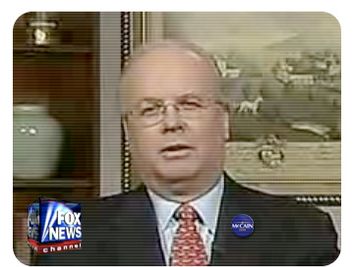
It has now been more than three months since Karl Rove first appeared on television as a Fox News political analyst on Feb 5. In no fewer than 57 appearances, he has increasingly been welcomed into the Fox News fraternity, even joking that the “Hannity & Colmes” show should be renamed the “Colmes & Rove” show. After departing from a Bush administration in political tatters last August, he has reemerged to hold forth at length on the 2008 presidential race. And he may have plenty of seasoned political wisdom to offer Fox’s audience. Rove, however, is playing a strategic role that he and the network refuse to reveal to viewers.

Fox News hosts routinely introduce Rove as a “former senior advisor to President Bush,” “the architect,” a “political wizard” and a “famed political consultant.” But never has he been introduced as he should be — as an informal advisor and maxed-out donor to John McCain’s presidential campaign.

To political news junkies, a disclosure of Rove’s relationship to the McCain campaign may seem unnecessary. But whether the public simply assumes that Rove supports McCain isn’t the point. The “most influential pundit” in America, as Fox likes to trumpet, should have to play by the same rules as other high-profile political analysts. For example, Paul Begala and James Carville are regularly identified as supporters of Hillary Clinton when they appear on CNN. But Rove has been able to act as an independent observer while criticizing Clinton and Barack Obama, McCain’s likely general election opponent.

There is nothing shocking about Rove’s attacking Democrats, of course. And his operating with a duplicitous air of independence probably isn’t going to make or break Fox’s claim to “fair and balanced” coverage. But will the greater public catch on?

In a May 7 Washington Post online chat with Karl Rove, the news organization correctly introduced the pundit as an “informal advisor to the McCain campaign.” The Post’s media reporter, Howard Kurtz, has also endorsed disclosing that Rove is a “maxed-out donor” to McCain.

And with good reason. On Feb. 7, two days after Rove first appeared on Fox News as a contributor, he donated $2,300, the maximum legal amount, to McCain’s campaign. According to the New York Times, Rove’s donation was part of a symbolic effort by Bush’s allies “to unify the Republican Party behind its presumptive nominee.”

The next day, reporters from Fox News asked McCain if he would accept advice from Rove. McCain responded enthusiastically: “He has a very good, great political mind and any information or advice and counsel he could give us I would be glad to have.”

A month later, after Rove had made 14 appearances on Fox News, Politico reported that soon after donating to McCain’s campaign, Rove “had a private conversation with the senator.” A top McCain advisor also told the paper that Rove and Bush-Cheney ’04 campaign manager Ken Mehlman were “informally advising the campaign.”

Rove has denied that he is an informal advisor, telling Kurtz that “he merely has ‘chitchat’ with friends in the campaign.” He offered a similar line during a recent Washington Post online chat, telling a questioner that he is “not certain” that he qualifies as an advisor to McCain but still has “friends at the campaign who occasionally ask [him] for reactions.”

“I hardly think Fox News viewers would be surprised to learn that Karl Rove is helping the Republican presidential candidate,” Begala told Salon. “Still, I believe full disclosure is best.”

There’s no evidence that Rove has a formal role with the McCain campaign. However, it is hard to deny that he has an active, if informal relationship.

For example, the consulting firm he currently heads has been disseminating 2008 electoral map projections to influential media outlets and party operatives. In late March, McCain media advisor Mark McKinnon participated in a public conversation about the campaign with former Bush strategist Matthew Dowd. During the talk, McKinnon displayed maps analyzing the states and their electoral votes; the maps bore the header “Karl Rove & Co.” At the end of April, the Washington Times reported that such maps were compiled weekly by Karl Rove & Co., based on the latest state polls. In addition to McKinnon and the Washington Times, the maps have made their way into the hands of Fox News’ own Chris Wallace. (Just yesterday, Rove’s firm put out a new round of maps making a case in Hillary Clinton’s favor.)

There are other ways in which Rove appears to have influenced McCain’s campaign. At the beginning of April, McCain embarked on a biography tour to introduce himself to the public. According to the Atlantic’s Marc Ambinder, the tour may have been Rove’s idea. In an April 4 blog post, Ambinder noted that Rove had laid out the idea for such a tour during a Feb. 20 appearance at the University of Pennsylvania. Suggesting that McCain “should take a biographical tour to the places in the country that have made him who he is,” Rove proceeded to list the very locations that McCain would eventually visit in April. (Although, as Ambinder pointed out, McCain actually spoke in Prescott, Ariz., rather than Rove’s suggested Sedona, Ariz.).

Rove has also admitted to meeting with Sen. McCain recently. On April 22, while doing on-air coverage of the Pennsylvania primary for Fox News, Rove let slip that he “saw Senator McCain recently at a private gathering” where the general election campaign was discussed.

Rove’s reluctance to directly admit a relationship with the McCain campaign may be out of concern for staying on the right side of election laws. Aside from all informal advising, he may also be coordinating the efforts of independent political groups and former Bush donors in an attempt to rekindle the type of Swift Boat Veterans for Truth strategy that many analysts believe helped sink John Kerry’s campaign in 2004. Rove has one of the most expansive rolodexes in Washington, which he’s been putting to use for the 2008 election: According to the National Journal’s Peter Stone, Rove has been calling up old friends like Texas oilman T. Boone Pickens and casino mogul Sheldon Adelson, and convincing them to spend millions of dollars on outside right-wing groups, known as 527 and 501(c)(4) entities. An unnamed GOP consultant who “has met with Rove a few times this year” told Stone that “Karl is up to his eyeballs in this.” The Washington Post has also reported that Rove is working with outside groups who aim “to influence the outcome in November.”

According to Federal Election Commission rules, coordination between a 527 group and a presidential campaign — such as discussing the content or timing of political ads — is illegal (if difficult to prove).

Fox News is not the only media outlet that has failed to disclose Rove’s ties to McCain. Whenever Rove writes for the hardcore conservative Op-Ed pages of the Wall Street Journal, the paper identifies him only as “the former senior adviser and deputy chief of staff to President George W. Bush,” even though he has usually written about the Democratic presidential candidates. Similarly, Newsweek, where Rove is a contributor, simply calls him a “former senior adviser for President Bush.”

CNN’s treatment of Begala and Carville offers a sound model for Fox News. Both Begala and Carville have donated to Clinton’s presidential campaign and remain close friends and trusted confidants of the Clintons. Like Rove, neither is formally advising the Clinton campaign, although Carville sent out a fundraising e-mail in 2007.

“I have no role in her campaign, save as a donor and voter,” confirmed Begala.

CNN executives initially resisted identifying their commentators’ political ties, for which the network drew fire. “Would it kill CNN to disclose that James Carville is a partisan Clinton supporter when talking about the presidential race?” wrote DailyKos founder Markos Moulitsas.

Eventually, however, the network did some soul-searching and realized that its critics were right. While Begala and Carville were not on Clinton’s payroll, they were “on the Hillary bandwagon, and that should be disclosed as much as we can,” CNN president Jonathan Klein said. “I wasn’t comfortable with it myself as I watched it.” CNN now regularly identifies Begala and Carville as Clinton supporters and typically pairs them with an Obama supporter in conversation.

Fox almost never puts another talking head in with Rove, generally hosting him as a solo guest.

In 2004, it was Republicans who were raising conflict-of-interest complaints. “It seems highly irregular that CNN would tolerate two employees’ openly working and advising and appearing on behalf of the John Kerry for President campaign,” Steve Schmidt, then a spokesman for President Bush’s reelection effort, said of Begala and Carville, according to the New York Times. (At the time, the two CNN commentators were serving as unpaid advisors to John Kerry’s campaign.)

Schmidt is now working for McCain’s campaign. Not surprisingly, he has not voiced any complaints about Rove’s arrangement with Fox News.

Another conservative indignant over Begala and Carville’s dual roles in 2004 was Fox’s opinion maker Bill O’Reilly. According to MSNBC’s Dan Abrams, O’Reilly complained then that their arrangement was the “collapse of CNN’s ethical standards.” Furthermore, O’Reilly claimed, if he had “signed on with Bush-Cheney 2004,” then “the media mob would have stormed the Fox castle.”

Since Super Tuesday, Rove has appeared on “The O’Reilly Factor” 13 times. Not once has O’Reilly revealed his guest’s relationship to the McCain campaign.

Despite Rove’s undisclosed dual role, media critics have been quick to praise his performance as a Fox News analyst. Ten days after Rove’s first appearance on the network, Slate’s Troy Patterson announced that on-air, Rove offers “clarity, concision, humility, good humor, good posture and dispassionate analysis.” In March, after Rove had made 15 appearances on Fox, the New York Times’ David Carr said the pundit is “one of the best things on television right now.” Carr called him “graceful, careful and generous,” adding that he is unlike “the real Karl Rove.”

But it may just be the real Karl Rove dressed up for broadcast. Take, for instance, his frequently misleading recitation of Obama’s reaction to controversial statements by his former pastor, the Rev. Jeremiah Wright.

On March 13, ABC News published a 2003 video of Rev. Wright saying “God damn America” during a sermon. The network reported that earlier in the month — before these comments had been revealed — Obama had said, “I don’t think my church is actually particularly controversial.”

On at least five occasions, however, according to a Lexis-Nexis search, Rove has altered Obama’s comment about his church to make it seem as though the senator was commenting specifically in response to Wright’s comments as publicized by ABC. For instance, on the April 25 edition of “America’s Election HQ” on Fox, Rove claimed that “on the 13th of March, [Obama] came out and said, ‘There’s nothing particularly controversial in Reverend Wright’s statements.’”

Rove’s distortion here is subtle, but in making it, he is able to imply that at one point Obama explicitly endorsed Wright’s comments. In fact, Obama has said he was not present when the comments were made, and both denounced and rejected them once they became public.

Repeated attempts by Salon to contact a Fox News spokesperson about why the network refuses to identify Rove’s ties to the McCain campaign brought no response. Inquiries to Rove directly also went unanswered.

Rove’s conflict of interest is problematic now, but will become increasingly so in the general election. He will be commenting on McCain and his Democratic opponent, whom Rove will be working to help defeat. Still, the network has given no indication that it intends to start disclosing Rove’s ties to the public at that time.

Continue Reading Close