Amy O'Connor

Better loving through chemistry

Why do guys sulk after a fight with their girlfriends instead of talking the problem to death? It's the hormone, stupid!

  • more
    • All Share Services

Better loving through chemistry

Psychologists think they have an explanation — finally — for why men withdraw into solitary silence in response to stress or anger. The latest theory zeros in on oxytocin, a hormone previously thought to do little more than trigger milk flow in pregnant women. The new research is considered a breakthrough in our understanding of human stress.

But it also marks a broader shift in psychology, away from social explanations for human behavior. Burned by their postmillennial status as “soft” scientists unable to prescribe antidepressants, psychologists are turning from their field’s humanistic roots and toward biochemical and genetic research. The unwillingness of insurance companies to pay for unlimited psychotherapy is also spurring the change.

“Neural ailments, chemical imbalances and the legitimate and illegitimate use of drugs is occupying the time of more psychologists,” says Ronald B. Evans, Ph.D., professor of psychology at East Carolina University in North Carolina. “We are leaving the field as a social science.”

Until the oxytocin study, most evolutionary and cognitive psychology focused on sexual behavior. MIT’s Steven Pinker, for example, defended President Clinton’s philandering by explaining that he, like all males, is cognitively hard-wired to impregnate as many females as possible, thus ensuring species survival. David Buss, author of “The Evolution of Desire,” cites genetic evidence for the male impulse to pair with younger, more fertile women, while women seek older males because of their greater earning power. The oxytocin hypothesis of women as nurturing caregivers and men as emotionless warriors suggests that evolutionary theorists are moving beyond a carnal focus to find chemical bases for all behavior, from why men pout to why even employed women take on all the child care.

This is distressing to anyone who believes that human behavior is governed by something higher, more mysterious, more and peculiarly human, than genes and hormones. Without social explanations, or even a social context into which to fit their findings, evolutionary psychologists promote friction between the sexes. Even more troubling, their research proposes no hope of change.

The study, published last month in the journal Psychological Review, argues that women’s higher levels of oxytocin, a mood regulator released by the pituitary gland, causes them to seek social interaction to relieve stress. This newly coined “tend and befriend” response evolved, they say, from female primates genetically coded to protect their young. To this day it contrasts with the solitary, wound-licking behavior familiar to anyone who has ever shared a home or office with a man.

Low levels of oxytocin, according to the study, explains why my boyfriend spends hours in his “music room” strumming the guitar when we have a fight, forgoing food and even the bathroom with his torturous pouting. I, on the other hand, will make a round robin of phone calls to my girlfriends, seeking an ear, advice, anything to break the isolation. Because oxytocin operates synergistically with other sex hormones, his behavior is supported by testosterone, while mine is supported by estrogen. Theoretically, when my estrogen levels dip after menopause, we’ll both spend more time sulking and our phone bills will be lower.

“We began this study in 1998 with the hypothesis that men and women responded differently to stress,” says Laura Cousino Klein, a professor of bio-behavioral health at Pennsylvania State University and one of the study’s authors. “That was quite controversial.” It was previously assumed that everyone displayed a “fight or flight” response to any kind of stress, from a nasty day at the office to being held up at gunpoint.

Women have traditionally been left out of human stress studies because researchers assumed that menstrual mood swings would muck up any results. But since 1995, when the federal government mandated broad representation of both sexes in research grants — and made more money available for research on women — psychologists have shifted their focus. The oxytocin study, one of the largest of stress, examined thousands of studies on male and female humans, apes and rats — even deer and moles.

“There will now be a surge of new research in this field,” says Brian Lewis, an assistant professor of psychology at Syracuse University who specializes in stress.

It’s important to keep in mind that hormones are subtle and poorly understood. “I must reiterate the almighty fact that a hormone does not cause a behavior,” says Natalie Angier, author of “Women: An Intimate Biography.” “Nor does the ability to behave in an aggressive or dominant fashion require a hormonal substrate. If hormones do anything, they raise the likelihood that, all other things being equal, a given behavior will occur.”

The work of Kerstin Uvnas-Moberg, one of the world’s foremost experts on oxytocin, suggests that some of the current research is probably right on target: It does calm people down. Mothers release oxytocin when their babies nurse, and massage and intercourse — usually stressless events — raise everyone’s levels.

But Klein and her colleagues may be leaping far beyond the scope of any biological explanation. For example, isn’t it possible that men learn stoicism from their fathers? That women are more likely to ask for directions when lost because their odds of being injured by a stranger are greater? And then there’s child care, which the researchers bizarrely assign to oxytocin, according to their interpretation of events.

For example: “When the typical father in the study came home after a stressful day at work, he responded to stress by wanting to be left alone, enjoying peace and quiet away from the stress of the office; when office-related stress was particularly acute, a typical response would be to react harshly or create conflict with his wife or children,” says Shelley Taylor, the study’s principal investigator at the University of California at Los Angeles. “When the typical mother in the study came home from work bearing stress, she was more likely to cope with her bad day by focusing her attention on nurturing her children.” Tell that to Arlie Hochschild, the University of California at Berkeley sociologist whose book “Second Shift” painstakingly documented gender inequality in child care — how even women with full time jobs almost always get saddled with the housework and babysitting.

The oxytocin theory also assumes that tending and nurturing are always “healthy” responses to stress. But for every distant father, there’s a meddling, smothering mom just as likely to send her offspring into therapy someday — or maybe oxytocin shots! My stressed mother force-fed us oatmeal in the morning, and tracked our after-school whereabouts obsessively. By contrast, my father’s laissez-faire style seemed a blessing.

As recently as three years ago, when biobehavioral explanations for sexual behavior were just coming into vogue, a group of male psychologists presented research at the American Psychological Association’s annual meeting. Ronald Levant, an expert on male aggression and author of 1997′s “Men and Sex: New Psychological Perspectives,” had examined the male tendency to be passive-aggressive, emotionally isolated and compartmentalized. Though their hypotheses sounded similar to the oxytocin investigation, they didn’t talk about hormones, evolution and genes. Instead, they blamed macho socializing and a culture that rewards male stoicism. Their solution: eons of therapy to help men tap into their feelings and empathize more with the nurturing females around them. Levant and his colleagues, with their traditional psychotherapeutic emphasis on personal growth without chemicals, disdain what Evans predicts will be the field’s emerging biochemical establishment.

Indeed, Klein seems to understate the benefits of talk therapy to help men manage stress. When I asked her to discuss the psychotherapeutic applications of her work, she said simply that therapy can be used to teach everyone better coping methods.

I couldn’t help asking: Does she have trouble divvying up childcare with her husband? She demurred, allowing only that she was slightly more likely to discuss work problems with other female colleagues. (In contrast, Ronald Levant uses himself as an example of a “man who behaved like a dog” until he was liberated by therapy.) But when asked if she would like to see men offered oxytocin supplements — hormones in a pill like menopausal women get, and like “real” doctors can prescribe, Klein brightened.

“I would love to see that day.”

Blame it on Gisele

A Brazilian runway Amazon turns New York into Sco Paulo's sister city.

  • more
    • All Share Services

Blame it on Gisele

It’s 10 p.m. on a blistering night in Manhattan. Churrascaria Plataforma, a new Brazilian restaurant in Midtown, is overbooked. The hostess sends a quartet of Gucci- and Prada-clad new media executives to the swarming bar for caipirinhas, Brazil’s potent national drink, as tuxedoed waiters glide from table to table brandishing skewered meat — chicken hearts, pork, flank steak — slicing it high in front of slap-happy American patrons. Brazilians know the rules — have a nibble at the salad bar, then turn the two-toned coin on your table to green. The meat keeps coming until the waiters see red. New Yorkers “don’t know when to quit,” sighs the hostess; they squat at the table for hours, then waddle out the door in agony.

Management has the same problem at Rio de Janeiro, a nearby restaurant, and Soho’s Riodizio, two of the city’s 25 Brazilian restaurants (there are many more Latin-themed eateries), eight of which have opened in the last 18 months. Their appeal — all the rotisserie-roasted animal flesh you can stuff in your face for about $30 — isn’t limited to gluttons, Latins or those on the high-protein Atkins diet, however. David Rosengarten, co-host of the Food Network’s “In Food Today” and a former restaurant reviewer for Gourmet, can land a table anywhere in town. On his nights off, he hits Churrascaria Plataforma. “All things Latin are very hot right now, and Brazil is the fresh face on the block.” he says. “It’s a culinary cross between mucho and macho.”

“The caipirinha,” he adds, sipping the margarita-like lime, booze and sugar concoction, “is the drink of the decade. It’s made with a distillate called cachaca, from sugar cane, and the quality of the high is dizzying. One gets you buzzed off your can. After four, I’m hearing bossanova music, seeing palm trees sway and wishing I were dancing the samba with Carmen Miranda on the beach.”

Restaurants and cocktails aren’t the only Brazilian imports hitting Manhattan like a tsunami this summer. For the legions who can’t afford a summer on Long Island, Brazilian dancing, food and drink is an escape, a way of thumbing ones nose at the Bobos (Bourgeois Bohemians) who flee the city each summer. What man would rather hang out at the Della Femina bar in East Hampton with horsey socialites when he could be dancing to Astrud Gilberto with a dark-eyed beauty at Via Brasil? And what woman would rather adopt the last decade’s pale, crouched-waif look when she could be at Rio Chic, an instant billboard for fun, sun and surf (never mind that she shares a grim studio two blocks from Macy’s and works 24/7 at a dot-com).

Sizzling Brazilian models, fashion designers and salons are influencing New York women to adopt the sultrier country’s carefree, sensual aesthetic with revealing clothing and loose, cascading hair. Boobs, butts and pierced brown skin are back. Extreme waxing is de rigueur (Brazilians prefer their bikinis and their sandals thonged). Clothes are jewel-toned, sequined or light leather. Forget SPF, face makeup and your Fire Island time share. Less Rio than Sco Paulo — Brazil’s Los Angeles and New York counterparts — the mood is gritty, nocturnal and utterly urban.

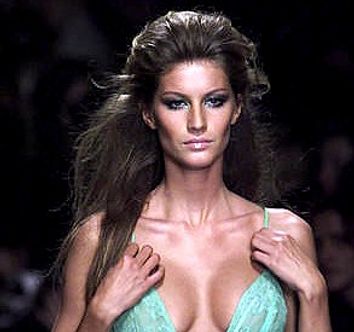
The Brazilian invasion began last winter during the New York and London fashion weeks. Twenty-year-old Gisele Bundchen emerged as the season’s “It” girl, and she shows no sign of disappearing. Gisele, who is always referred to by her first name, is a Rapunzel-haired Sco Paulo-born Amazon with a feral face and a body that makes men and women cry, though for different reasons. She epitomizes the fashion industry’s current obsession with the girls of Rio, Sco Paulo and — judging from a recent issue of Vogue — Ipanema. Her fcompatriots, Fernanda Tavares, Caroline Ribeiro and Fabiane Nunes, are also making a splash. All boast bronzed, sand-dusted skin and vaguely exotic (though not “too ethnic”) faces.

Gisele, the current ruling face and body in the modeling world, commanded $7,000 a day to strut the runway last fall. She also boosted the career of designer Fause Haten, a fellow Brazilian, by romping free-of-charge in his pearl and sequin-embroidered pants and dresses, which are now selling out at Bergdorf’s. Sco Paulo-based Alexandre Herchcovitch wowed the London fashion press; now his creations hang in the toniest shops in Europe, Japan and New York. “Ipanema Girl,” a line of sexy, strappy footwear, is one of Bloomingdale’s bestsellers this season.

Though it remains to be seen if the Brazilian look will last through the fall, Ribeiro and Tavares have both landed contracts with Ralph Lauren and Gucci, and Gisele graced the summer 2000 swimsuit issue covers of Vogue, Harper’s Bazaar, Elle and W. Her status as the model of the moment was cemented last spring when the New York gossip pages caught her smooching Leonardo DiCaprio at Moomba. The late 1990s saw “the English girls, the Israeli girls and the Russian girls,” says Marilyn Gaulthier, who owns the New York modeling agency Marilyn. “Now it’s the Brazilian girls.” Brazilian places seem to have similar allure; this spring, Harper’s Bazaar, Vogue, Jane, Cosmopolitan and Elle set sexy multipage fashion shoots in Sco Paulo, Copacabana Beach, Sugarloaf Mountain and downtown Rio de Janeiro.

New York women who covet Brazilian women’s “effortless” touch-me
sexiness are learning that less is more, at least when it comes to clothes,
makeup and body hair. The four Brazilian sisters who run the J. Sisters
International Salon can’t keep up with the demand for their signature
Brazilian bikini wax. The $50 procedure leaves nothing but a thin landing
strip of hair, hidden by the floss-thin bikinis favored by Latin sunbathers. “I
estimate that 40 percent of the female population in New York between the
ages of 20 and 30 has a Brazilian wax,” says Anne Breza, beauty director of
Self magazine. Fans include Gwyneth Paltrow, model Naomi Campbell and
Linda Wells, editor in chief of Allure, whose explicit editorial on the pleasures
of Brazilian bikini waxes may be her career’s most memorable contribution.

At lunch at the Condi Nast cafeteria, young fashionistas concede Brazilian
beauty isn’t as effortless as it looks. The wax is “more painful than childbirth,
embarrassing and expensive,” says an editorial assistant at Vogue. Breza
adds that Brazilian women are oblivious to the fact that “the sun can kill
you.” Which is why Sarah Nicholas, a pastry chef in Tribeca, spends $60 a
month having self-tanner professionally applied to her legs and arms at the
Elizabeth Arden salon. “Even if I never get to the beach, I want to look like I
live there,” she says.

São Paulo-born Denis DeSilva, who owns Devachan Salon in Soho,
credits Gisele for his booming summer business; the “natural” look requires
upkeep that can cost hundreds of dollars a month. “Brazilian women don’t
care about makeup, but they are obsessed with their hair. It must be long
until they turn 40, then they can go to shoulder length. They don’t blow-dry
it, so there can’t be any split ends. It is also very fashionable to have bright
highlights.” Brazilian women are also meticulous about twice-weekly
manicures and pedicures, which can run up to $200 a month.

Despite the models’ perfect bodies (Gisele’s legs are skyscraper-high, her
stomach is concave and many wonder how non-silicone breasts can be that
perky), DeSilva insists that Brazilian men appreciate women in every shape
and size, as long as they show plenty of flesh. (In the local parlance, an ideal
figure is “guitar-shaped”; Americans seem to prefer the Pez-dispenser
model.) “When I go to the beaches in New York, I see so many huge bikinis,”
he says with a frown. “If American women could learn to be more free they
would be happier.”

Real Brazilian women, by the way, are fed up with those who try to adopt
their look — not to mention with men who see them as eroticized, brainless
objects, according to Rosaria, a makeup artist from the Rio de Janeiro
suburbs. (She did, however, affirm that she never has and never would cut
more than an inch off her lustrous hair. Below the waist, she was wearing
two 24-inch leather flaps stitched together with leather lacing. She called
them pants.)

Spencer, a commodities trader who lives near New York
University, is also fed up with uptight, high-maintenance New York women.
He worships Brazilian women’s strutting, unself-conscious sexuality. He
wishes he could leave the city and spend the rest of his life on the beach. He
says he and his friends used to talk about getting married and settling down
back home on Long Island to raise a family. Now a common fantasy among
his friends: “Retiring early, moving to Rio de Janeiro and finding a nice girl.”

Continue Reading Close