Andreas Lorenz

Tiananmen silence turns 20

Two decades after the massacre in Beijing, the event remains a taboo in China.

  • more
    • All Share Services

Tiananmen silence turns 20On June 4, 1989, Chinese tanks rolled into Tiananmen Square in the heart of Beijing to break up pro-democracy demonstrations which had been going for months. Untold numbers of demonstrators lost their lives.

Two decades after the Tiananmen Square massacre in Beijing, the event remains a taboo in China. The former pro-democracy activists are scattered around the world and hope that the truth will one day emerge as to what happened on that fateful June 4.

When the blood had been washed from the asphalt and the hopes of a more equitable China had dissipated, Han Dongfang got on his bicycle and rode out of the city. It was June 4, 1989, the Sunday when the Chinese Communist Party cleared protesters from Beijing’s Tiananmen Square and, according to the official figure, shot 319 of them. Other sources cite up to 3,000 dead.

The 25-year-old railroad electrician had dedicated himself to a special mission. “I wanted to ride around the country to talk to workers and farmers,” says Han. About a month earlier, his friends had announced, on Tiananmen Square, that they had selected him as the spokesman of their independent trade union.

Ten days later, somewhere in Hebei province, he saw his photograph on television — as an “agitator and counterrevolutionary,” being sought by the authorities. Han was shocked, but he reminded himself of the promise he had made to the leaders of the Beijing Workers’ Autonomous Union before being appointed their leader. “If the time comes for me to go to prison, I will not wait for them to catch me, but will turn myself in.” Han rode his bicycle back to Beijing, where he reported to police headquarters — and was sent to prison for the next 22 months.

For almost seven weeks in the spring of 1989, students occupied Tiananmen Square, where they demonstrated on behalf of their own, independent organizations and against corrupt party officials. What began as a harmless protest movement developed into a revolt against those in power — until the aging party members surrounding Communist Party patriarch Deng Xiaoping remembered something former Chinese leader Mao Zedong once wrote: “Political power grows out of the barrel of a gun.” Communist Party General Secretary Zhao Ziyang, a man who could have become China’s Gorbachev and who strongly opposed the use of military force, was first set straight and then placed under house arrest.

“Impetus for reform”

The protests “were not a threat to our political system,” Zhao said in retrospect, before his death in 2005, after spending 16 years under house arrest. He even believed that the protests were useful, and that they may have given “impetus for reform in China, even to political change.”

Zhao’s memoir, titled “Prisoner of the State,” recorded secretly on 30 tapes and smuggled out of the country, has now been published posthumously in the United States and Hong Kong. It offers a rare glimpse into the inner workings of China’s ruling Communist Party. Zhao was in his home not far from Tiananmen Square when the blood bath unfolded. He wrote: “On the night of June 3, as I was sitting in the courtyard with my family, I heard heavy gunfire. A tragedy that would shock the world had not been prevented, and now it was happening.”

What happened on Tiananmen Square has been seared into the world’s collective memory, complete with the unforgettable images of Beijing’s brutal settling of scores with defenseless regime critics. When the tanks rolled into the city from the west, the protesters were already exhausted by the heat and by a hunger strike. A few fire hoses would have been enough to drive them from the square.

China has become a different country since then. The Communist Party has granted its subjects previously unheard-of economic and personal freedoms. But a taboo still hangs over the date of June 4. No one has been held accountable for the massacre. The official history books mention the date, if at all, in connection with an “incident.” Many young people don’t even know what happened in the heart of Beijing in 1989, because both their parents and their teachers say nothing about the massacre.

Human rights activists in Hong Kong estimate that about 30 people remain in prison as “ringleaders” and “hooligans.” Of the remaining key players scattered around the world, many have withdrawn into private life and some have become religious.

Teahouses and repair shops

Railroad electrician Han Dongfang, who lives in Hong Kong today, contracted tuberculosis in prison and lost a lung. He was eventually allowed to travel to the United States for treatment, after American union leaders rallied behind his cause. He is no longer willing to talk about his time in prison. “That chapter of my life is over,” he says.

Han, a man with delicate features and dressed casually but elegantly, speaks English well. He is sitting in an office on Jervois Street in Sheung Wan, a lively neighborhood of teahouses, repair shops and narrow stores. Barred from returning to Beijing, Han works for his country from Hong Kong. His China Labour Bulletin reports on conditions in factories, on construction sites and in mines in the People’s Republic. He hosts a program on Radio Free Asia, talks on the telephone to trade unionists in China about their rights, and secures legal representation.

The former revolutionary has become a man dedicated to small steps. “There is no point in trying to fly when you have no wings,” he says. He has abandoned the idea of establishing an independent labor union in China. “My dream is a system that enables workers and employers to negotiate with one another. Independent unions would then develop automatically.”

Were the students’ sacrifices worth it? “In 1989, I had never heard of strikes,” says Han. “They are commonplace today. It was the beginning, and we must continue.”

Wu’er Kaixi, 41, was also part of the 1989 protest movement. A member of the Uighur minority, he was studying to become a teacher at the time. After the death of the popular former party leader Hu Yaobang in mid-April 1989, Wu’er and other students formed the Beijing Autonomous Students’ Union.

A month late

It was an extraordinarily daring step at the time. After a hunger strike, and still wearing hospital clothes, he appeared in the Great Hall of the People, where Premier Li Peng was meeting with angry students. When the premier apologized for being late, Wu’er rudely interrupted him, saying: “You are not just five minutes late, but an entire month.” He now lives in Taiwan, where he and his Taiwanese wife have two children. Wu’er, who now holds a Taiwanese passport, has become more heavyset and wears his hair shorter today.

Even after 20 years, the Communist Party is still punishing him for having humiliated one of its senior officials on live camera. Wu’er’s parents are still not permitted to leave China today. They have never seen their grandchildren, except in photos, and their only communication with them is the occasional phone call via the Internet. Wu’er himself, despite having attended an American university, never truly gained a foothold professionally, although he now works for a U.S. investment company.

 ‘We want the truth’

Shortly before the deployment of troops on June 4, says Wu’er, one of Deng Xiaoping’s sons sent him a message to warn him that the protests would end in bloodshed. “I asked him: ‘What can you offer us if we withdraw from Tiananmen Square?’” He had no response.

Nevertheless, he tried to convince his fellow students to clear the square, but was unsuccessful. After the massacre, Wu’er fled to the south, where a network of dissidents and businesspeople smuggled him by boat to Hong Kong. From there, he traveled to the United States.

Wu’er plans to meet with former activists in Washington on the eve of the 20th anniversary of the Tiananmen Square massacre this week. He has never abandoned his dream of bringing about political reforms in China. He says: “One cannot live in exile without hope.”

Meanwhile in Beijing, former philosophy professor Ding Zilin tries to keep the memory of the massacre alive. Despite her gray hair, she moves with agility and elegance. The 72-year-old is the most prominent of the “mothers of Tiananmen.” Even today, she fights to hold back the tears when she talks about the events.

“Lived like a real man”

Ding, who lives in the northwest of the Chinese capital, is still permitted to receive visitors but is not always allowed to leave her apartment. She seems exhausted and is worried about her husband, who is ill. “On Oct. 26 of last year, the police suddenly raided our apartment. After that my husband had a heart attack and was in a coma for two days.” An oil painting of her son Jiang Jielian hangs on the wall. He was a 17-year-old student when he died. A photo depicts him holding a sign in his hand that reads: “You will fall, and we will remain.” A wooden urn containing his ashes stands beneath the photo. The father carved the characters on the urn, which read: “In these short 17 years, you lived like a real man.”

On the evening of June 3, Jiang Jielian and few friends had ridden their bicycles to Tiananmen Square. Diplomats, journalists, police officers and professors had already joined the student movement by then, and it could no longer be characterized as a rebellion of youthful troublemakers, as the Communist Party continues to insist today.

Ding was still a committed party member at the time. But on June 4, when party officials refused to release the names of the victims and the circumstances of their deaths, she and her husband turned their backs on the Communist Party. “We want the truth. We want compensation. We want those responsible to be put on trial,” she says. She has published three books, has meticulously documented the lives of many victims and, together with other mothers, has submitted petitions again and again to the party leadership.

“China’s role in the world has become stronger in recent years,” says Ding. Unfortunately, she adds, the government must now pay far less attention to criticism from abroad, especially since the patriotic education campaign begun in 1989 is now bearing fruit. Today’s students, says Ding, declare their solidarity with the Communist Party when, as was recently the case during the Olympic Games, foreign criticism becomes particularly vocal. She is disappointed by the new generation. “They are self-involved and materialistic. They boycott Japanese goods, but they line up in front of the U.S. Consulate to obtain visas for America.”

Intelligence agents loiter in front of her building. One of them, who videotapes visitors, is young and bears a slight resemblance to Ding’s son. Perhaps he would have been among those standing on Tiananmen Square 20 years ago.

Translated from the German by Christopher Sultan.


This article has been provided by Der Spiegel through a special arrangement with Salon. For more from Europe’s most-read newsmagazine, visit Spiegel Online or subscribe to the daily newsletter.

Inside Myanmar’s violent crackdown

Eyewitness accounts from the uprising led by Buddhist monks, and how the junta silenced the city after days of bloodshed.

  • more
    • All Share Services

It is Friday afternoon in Yangon, the former Burmese capital, and the city of 5 million broods silently under heavy rain clouds. The last clashes between demonstrators and soldiers happened in the morning. In Okkalapa, a slum neighborhood on the city’s eastern outskirts, citizens blocked the path of troops as they attempted to storm yet another Buddhist monastery.

The ruling junta’s security forces are attempting to seal off as many monasteries and temples as possible with barricades and barbed wire to prevent the monks from sparking further demonstrations. The strategy has already succeeded around Burma’s national symbol, the Shwedagon, a giant golden pagoda in downtown Yangon. It shimmers in the soft dawn rays of the tropical sun, silent and completely devoid of people. In the areas surrounding the Shwedagon, where the pagoda rises on a hill surrounded by a tangle of markets and monasteries, barricades block the access roads to Burma’s holiest site. Elite government troops are now positioned behind those barricades.

Curious passersby find themselves facing the soldiers’ Kalashnikov automatic rifles. “Just keep going, for heaven’s sake, and don’t look them in the eye,” one local resident urges. “They shoot without warning.” The soldiers have their steel helmets pulled down deep over their faces, and are all wearing orange-red scarves tied around their shirt collars.

Convoys of four or five trucks at a time constantly patrol the temple district. Young recruits sit on the truck beds, pointing their rifles at people on the streets whenever they feel threatened.

The situation is similar at the Sule Pagoda about two kilometers away, in Yangon’s decaying business district, where heavy iron gates now block the doors to the temple complex’s prayer and congregation rooms.

Soldiers from the government’s elite 77th Brigade — its toughest fighters — are positioned under the trees lining some of the city’s boulevards. A tense calm lasts until 3 p.m., but then the students arrive. Some are wearing the longyi, the traditional sarong worn by men in Burma, and simple rubber sandals, while others wear frayed jeans and sneakers. Buddhist monks, in their red and saffron-yellow robes — who have hitherto dominated the images of the resistance against the military government — are nowhere to be seen.

Yangon still reveals the architectural vestiges of the British Empire in neighborhoods like the one surrounding the Sule Pagoda. Five-story apartment buildings are built of red brick, and yet the plaster is crumbling from their façades, the asphalt on the streets is in need of repair, and heaps of garbage are piled up in the side streets. The shops sell video recorders, television sets and cheap knickknacks, all made in China. The local residents, who are comparatively well-off, stand on their balconies applauding the students.

The students have prepared their strategies well. They appear in groups of 200 demonstrators at a time, advancing toward Anawrahta Street, a bustling commercial strip, where they occupy several intersections at the same time. Then they confront the security forces in their defensive positions around the Sule Pagoda.

A student leader calls out: “Give us freedom! We want democracy!” Residents shout: “Soldiers, don’t shoot at the people!” But the soldiers shoot nonetheless.

The first shots whip through the humid afternoon air around 4 p.m. and the students quickly scatter. They run into the next street, which is named after Aung San, one of Burma’s national heroes and the father of opposition leader Aung San Suu Kyi. Soon they block the next intersection on Aung San Street. A few demonstrators redirect traffic, keeping the street clear to provide the crowd with an escape route from the soldiers’ bullets. The leaders chant, once again: “Give us democracy!” The crowd responds with the same chorus as before: “Soldiers, don’t shoot at the people!” And the soldiers shoot again.

The cycle continues until nightfall. “Now we will come back every day,” says one of the leaders, “unless they shoot us all.”


These eyewitness accounts from Yangon describe the most recent chapter in a struggle that began as a clash between two powers that couldn’t be more asymmetrical: thousands of monks in their colorful robes, walking barefoot or in rubber sandals, armed with the rice bowls they use to beg for alms, facing off against soldiers armed with automatic weapons and tear gas, and police officers wielding clubs and riot shields.

It is a struggle for power in a country full of pagodas and rich in natural resources, one that has been ruled by a succession of military regimes for the last 45 years. The generals have shown few scruples in using deadly force against their own people, a population that has somehow managed to intimidate them at the same time. Two years ago, the ruling junta moved the country’s capital to Naypyidaw, a remote location in the jungle 189 miles north of Yangon, where they believed themselves safe against uprisings.

But now the generals no longer trust even their own regular soldiers. Instead, they are bringing in elite troops who were stationed on the country’s borders to subdue the rebellious monks with beatings and bloodshed. Since these special forces arrived in Yangon, the direct threat to the regime appears to be over, at least temporarily. After surrounding key monasteries in Yangon and the central Burmese city of Mandalay on Thursday, the government declared the areas off limits the next day. Hundreds of monks had already been arrested by then. Eyewitnesses report seeing the soldiers beat some of the monks and drag them from their temples, leaving behind pools of blood in the monks’ ransacked quarters. All remaining monks were placed under house arrest.

“We will fight until we have achieved democracy,” representatives of the All Burma Monks Alliance, an organization established in September, announced. Despite their initial defeat, the Buddhist monks remain resolute.

This week, however, there were no signs of further protests in Yangon. Thousands of heavily armed soldiers patrolled the streets, stopping young men on foot and in cars, searching for cameras that could be used to get photographs and footage to the international media. Barbed wire barricades blocked off Shwedagon Pagoda, with soldiers stationed at the four entrances.

Witnesses in Mandalay told the Associated Press that security forces had arrested dozens of students who had staged a street protest on Sunday. The Democratic Voice of Burma, a Norway-based opposition news organization, estimated that 138 had been killed in the violence and around 6,000 detained.

Burma is a deeply Buddhist country where more than 600,000 monks and tens of thousands of nuns live in monasteries and temples. Every morning they walk from house to house, barefoot and carrying empty rice bowls, begging for alms.

The regime’s thugs made their biggest mistake at the beginning of the protests, on Sept. 5. In an effort to prevent the protests from spreading, they began beating a group of demonstrating monks in the central Burmese city of Pakokku. Shots were fired, and the police arrested the monks, tore off their robes and threw them in jail.

The All Burma Monks Alliance, a previously unknown group, made its voice heard only a few days later, demanding an apology from the police and the release of their fellow monks. What began as a small protest soon spread like wildfire.

Besides the country’s 400,000-strong military, the clergy is the only well-organized force in the country. At first tens of thousands of monks took to the streets in Mandalay, chanting Buddhist sutras and carrying statues of the Buddha and religious pennants. The demonstrations soon shut down the city of Sittwe in western Burma and later the surrounding Rakhine state.

By the time the protests reached Yangon, the Saffron Revolution had turned into a massive protest against Burma’s grim and repressive military junta. By this stage, the monks had expanded on their initial demands of reversing hikes in fuel prices and releasing political prisoners — they began calling for a national dialogue with the opposition pro-democracy movement.

Local residents who lined the monks’ protest routes are accustomed to seeing the clergy play a role in shaping Burmese politics. In the days of the monarchy, in the 19th century, they performed a mediating function between the government and the people, taking up positions on both sides. They would typically defend the king when he reached decisions they saw as necessary but unpopular, such as tax increases, but they would obstruct him if they felt that he was abusing his power. Buddhist monks have consistently been a powerful force in the Burmese state.

But the generals refused to give in. On the day before the bloodbaths began, Religious Affairs Minister Thura Myint Maung knelt before the monks’ leaders and lowered his head to the ground, a gesture of respect for the clergy. But then he declared war on the monks, making it clear that the regime would show no mercy.

Ironically, the monks were not the ones who had begun the protests. Dissidents from an underground group known as the 88 Generation Students, led by men like Ko Ko Gyi, 45, and Min Ko Naing, 44, were behind the initial demonstrations.

As students they led mass protests in 1988 against the military regime, which, with its “Burmese Way to Socialism,” had driven the Southeast Asian country into international isolation and economic chaos since 1962. The generals quashed protest marches on Sept. 18, 1988, in a massacre that claimed at least 3,000 lives, then robbed the opposition leader and later winner of the Nobel Peace Prize Aung San Suu Kyi and her National League for Democracy (NLD) of their election victory. The student leaders were thrown into prison. “It was 16 years of hell,” Gyi said last summer in Yangon. And yet the military never managed to break the two men’s will.

After being released from prison last year, the dissidents established the 88 Generation Students as an informal network and began organizing events such as peaceful prayer meetings in Yangon’s Shwedagon Pagoda and readings and gatherings in other cities.

When the junta raised gasoline prices by 100 percent without warning on Aug. 15, it became a rallying cry for the opposition. Four days later, veterans of the 1988 student protests took to the streets once again in various cities and towns throughout the country, often alone or in groups of only two or three people. Most were arrested immediately. But the Burmese people soon followed suit.

“It was the straw that broke the camel’s back,” says Bertil Lintner, a Swedish expert on Asia and Burma. “The people simply have nothing left to lose. They are hungry, and they have been bled dry.” What makes their hatred of the regime even stronger is constant talk of the junta living in the lap of luxury, squandering public revenue on weapons and senseless prestige projects.

The monks and the pro-democracy activists had long coordinated their activities behind the scenes. The monks would stage the protests while the people would form human chains.

By Saturday, Sept. 15, the military leaders must have realized how serious the situation had become for them. Monks were marching along University Avenue in Yangon. There, in a house with a view of Inya Lake, opposition leader Aung San Suu Kyi, 62, has been under house arrest for more than 11 years.

Suu Kyi had returned to Burma from abroad in 1988, and as the daughter of national hero Aung San, she was soon at the head of the protest movement. In 1990, Suu Kyi led the National League for Democracy in free elections, winning more than 80 percent of the vote. But the junta, which had ordered the massacre in the streets of Yangon in 1988, declared the results invalid.

As the demonstrators marched toward Suu Kyi’s house two weeks ago, it set off a panic in the new jungle capital, Naypyidaw. Would the monks liberate the Nobel Prize winner? On Sunday the junta’s leader, Than Shwe, ordered his family to pack their bags, and early in the week they took a charter flight to Bangkok. That was when the regime began the “extreme action” it had earlier threatened.

The regime brought in its elite troops from the borders. When the troops arrived in Yangon on Tuesday, the government imposed a curfew on the city. Any remaining hopes that the soldiers would shy away from shooting at monks were quickly dashed. On Wednesday, after initial warning shots were fired over the heads of the demonstrators, government troops began shooting directly into the crowds. The dead and injured included a foreign victim, Japanese photographer Kenji Nagai, who was executed by a soldier as he lay on the ground.

The regime launched a propaganda campaign against the protesters at the same time. In an attack on the NLD, the government-run New Light of Myanmar wrote: “Saboteurs from inside and outside the nation and some foreign radio stations, who are jealous of national peace and development, have been making instigative acts through lies to cause internal instability and civil commotion.” The media was quickly filled with the regime’s appeals to the Burmese: “We favor stability,” “We favor peace,” “We oppose unrest and violence.” The government-controlled press was, of course, quick to place blame abroad for the unrest, writing that the BBC and the Voice of America are broadcasting “a sky-full of lies.”

On Thursday afternoon, soldiers combed the Traders Hotel in downtown Yangon for foreign journalists who had sneaked into the country on tourist visas. Telephone lines to other countries were cut off and Internet connections shut down. As night fell over Yangon on Friday and the students ended their protests, the generals seemed to have won the first round.

Nevertheless, the junta is still a long way from winning the fight. “They are extremely hunkered down, delusional, paranoid and probably afraid at the moment about what could possibly happen,” David Mathieson, an expert on Burma with the U.S.-based group Human Rights Watch, told the New York Times.

The country’s military leaders would presumably prefer to persist in their isolation. They have denied an entry visa several times to Ibrahim Gambari, the United Nations special envoy to Burma, in the past, and this time around they were no more willing to let him into the country. It wasn’t until Thursday night that they finally agreed to meet with the U.N. representative.

Since arriving in the country on Saturday, Gambari has been allowed to meet with Suu Kyi, with whom he had a one-hour talk on Sunday, and has also been given an appointment to meet with junta leader Than Shwe on Tuesday. Gambari had originally hoped to meet Than Shwe on Monday, but the regime postponed the meeting, sending Gambari on a government-sponsored trip to the north of the country instead.

The junta’s decision to let Gambari enter the country came in response to collective international outrage, at least among Western nations, over the junta’s attempts to violently suppress the Saffron Revolution. German Chancellor Angela Merkel condemned the government’s use of soldiers, and British Prime Minister Gordon Brown called for tougher sanctions. The United States imposed visa bans on Burmese leaders and froze foreign assets of senior junta members, as far as it could. But little more than a delicate clearing of the throat was heard from Burma’s neighbor to the north, rising global power China.

“We hope that all parties in the Myanmar issue will maintain restraint and appropriately handle the problems that have currently arisen,” Chinese Foreign Ministry spokeswoman Jiang Yu breathed into the microphone, as if Burma had just experienced a minor marital quarrel.

But Beijing’s actions in New York were not nearly as soft-spoken. Last week the Chinese ambassador to the U.N. voted against a proposed Security Council resolution condemning Burma. “We are not supporting the Burmese military, but rather stability,” said a foreign policy advisor to the Communist Party and Burma expert in Beijing, seeking to downplay the embarrassing vote.

China has benefited for many years from the leaden calm that has prevailed in Burma. When the West slapped economic sanctions on Yangon after the 1988 massacre, the Chinese jumped in to fill the void. Relations have blossomed ever since. More than a million immigrants from throughout the People’s Republic have already settled, more or less legally, in Burma.

For the Chinese, Burma is a land of rich prizes, including oil and natural gas, natural resources, and timber. China mines nickel, copper and coal in Burma. According to the nonprofit organization Earthrights International, at least 14 Chinese companies are building hydroelectric power plants in the country. Trade between the two nations approached $1.5 billion last year. Beijing’s state-owned energy groups plan to exploit oil and gas fields off the Burmese coast and have already signed agreements with the junta. Another project in the works calls for the construction of 1,480 miles of oil and gas pipelines from Burma’s western Rakhine state all the way to Kunming, the capital of China’s southern Yunnan province.

Economic ties are already so close that the Chinese yuan is treated as legal tender, in addition to the Burmese currency, the kyat, in the northern border regions. Sections of the old royal capital Mandalay, with their Chinese shops, apartment buildings and shopping centers, could already be mistaken for neighborhoods in a Chinese city. Close to one-third of Mandalay’s residents are believed to be Chinese.

China is also providing Burma’s generals with weapons and materiel. The Burmese have already purchased about $2 billion worth of helicopters, aircraft, artillery guns, warships and tanks from their northern neighbor.

But by generously supporting the Burmese junta, the Chinese risk provoking the anger of the international community. With the Olympics less than a year away, it is not in Beijing’s interest to appear as the protector of an inhumane regime, one whose atrocities are all too reminiscent of the brutal suppression of its own student uprising in Tiananmen Square in 1989. “It’s a problem for us,” officials in Beijing quietly admit.

To head off a potential conflict, the Chinese government facilitated a secret meeting in June between U.S. diplomats and representatives of the junta in Beijing, where the Americans hoped to convince the Burmese to release opposition leader Aung San Suu Kyi. Chinese officials also invited opposition groups to take part in informal talks.

But by the end of last week, Chinese diplomats were not convinced that the monks’ uprising could cause the junta to fall from power. If it does, Beijing said, it “hopes for a smooth transition.” If the generals are driven out after all, said the Communist Party’s foreign policy advisor in Beijing, “we will have no trouble in coming to terms with the lady.”

Of course, this would come at a cost to the Chinese. “If the lady comes to power, the international economic sanctions will be lifted,” the advisor said. “And then we will no longer be without competition in Burma.”


This article has been provided by Der Spiegel through a special arrangement with Salon. For more from Europe’s most-read newsmagazine, please visit Spiegel Online or subscribe to the daily newsletter.

Continue Reading Close

China’s boom and doom

China now produces tons of cheap clothes, electronics and raw materials -- and dizzying amounts of pollution beginning to taint the globe.

  • more
    • All Share Services

China's boom and doom

The cloud of dirt was hard to make out from the ground, but from six miles up, the scientists could see the gigantic mass of ozone, dust and soot with the naked eye. In a specially outfitted aircraft taking off from Munich airport, they surveyed the brownish haze stretching from Germany all the way to the Mediterranean Sea.

These kinds of clouds float above Europe for most of the year, and they’ve traveled far to get there. By analyzing the makeup of particles in this cloud, European scientists were able to identify its origin. “There was a whole bunch from China in there,” says Andreas Stohl, 38, of the Norwegian Institute for Air Research.

Some 7,500 miles to the west, Steven Cliff is slowly winding his way up Mount Tamalpais near San Francisco in his RV. The 36-year-old researcher has installed a complex instrument to measure the air that crosses the Pacific from Asia and reaches the West Coast.

Days like this are ideal for taking these measurements. San Francisco is shrouded in cool fog, but on top of the mountain there’s warm sunshine. Indeed, these are ideal conditions for surveying air currents untainted by local influences. But Cliff is alarmed by his instrument’s readings — soot particles have colored the device’s filter “blacker than we’ve ever seen it,” he says.

Back in a lab at the University of California at Davis, Cliff and his colleagues analyze the origins of the air pollution with the help of x-rays. According to their chemical signature, most have come from coal-fired Chinese power plants, Chinese smelters and chemical factories, and from the tailpipes of countless Chinese diesel-powered cars and trucks.

On the other side of the Pacific, in Yokohama, Japan, climate change researcher Hajime Akimoto places three photos of the Earth next to each other. They show in red where concentrations of nitrogen dioxide are especially high. The picture from 1996 shows the area between Beijing and Shanghai as a loose group of reddish spots, but one from 2005 completely covers that part of China in bright red.

Winds are blowing ever-greater amounts of pollution from China into Japan, leading many Japanese to complain about irritated eyes and throats. Last year, for the first time, two cities issued official warnings about the health dangers caused by Japan’s neighbor across the sea.

China has become a global environmental problem. Initially, it was only the economists who were shocked by how the country was changing the world with its cheap clothes, televisions and washing machines. But now climate researchers are concerned about another Chinese export — the pollution it is spreading across the planet. The massive nation is already the world’s second-biggest producer of greenhouse gases after the United States.

And particularly in North America and Europe, awe over China’s booming economy and its ability to produce cheap goods for the entire world is now often giving way to a critical question: Can the planet handle China’s growing damage to the environment?

China’s economy is booming — with an annual growth rate of more than 10 percent. But the more the country’s population of 1.3 billion strives to raise itself out of poverty with a mostly antiquated industrial base — and the cheaper the Chinese goods the world’s consumers buy — the higher the price the world will pay for China’s economic miracle.

The Chinese are no longer simply destroying their own environment. Just as trade is global these days, so too is the threat against nature.

The connection isn’t always apparent at first glance. For example, what does the spreading desert of Inner Mongolia — a massive autonomous region in northern China — have to do with the comfy cashmere sweaters that shoppers are snapping up for next to nothing in cities from Berlin to Boston? For years, Chinese herders in the region let millions of goats graze until the grass was gone, roots and all. Then the soil simply blew away and the desert began to expand at an alarming rate. Since the early 1980s, China’s grasslands have shrunk each year by some 15,000 square kilometers — an area the size of Connecticut.

And now in the midst of a deadly drought, the sand dunes move ever closer to the small village Chaogetu Hure. Inch by inch, seemingly unstoppable, the dunes claim everything in their path, as if they want to bury the government’s costly efforts to plant trees, build fences, corral goats and resettle local inhabitants.

Abbot Lao Didarjie is being forced to watch the walls of the house opposite his Zhao Huasi temple slowly disappear under the sand. Out of fear for the house of worship, he’s raised an alarm with six different authorities. “The temple was built by the sixth Dalai Lama in the 17th century,” says the religious leader. “It should be saved for the coming generations.”

Only a few miles away, on the edge of Luanjingtan, the farmer Xu Changqin inspects a few meager green stalks of wheat. The local peasants worked hard to plant their fields, but last May a sandstorm covered them over. “The grassland is getting smaller. The fertile grounds are disappearing,” says Xu, explaining how growing numbers of people are moving away to seek more hospitable places to live.

The fine sand from the farmer’s homeland blows all the way to California and Europe. It’s mixed in with ash and other dangerous particles from industries in China’s Inner Mongolia region, which is home to countless factories, chemical works and power plants.

Along the Huang (Yellow) River in the city of Shizuishan, in the Ningxia region adjacent to Inner Mongolia, the extent of the pollution becomes obvious. Swaths of gray-black clouds blot out the sun to make the perfect setting for a Hollywood film about the end of the world. Two power plants belch ash into an artificial lake separated from the nearby river only by a thin dam. The wind blows the ash upward to start it on its journey around the globe.

But it’s not just sand, smog and ash that China is spewing into the atmosphere. The country’s factories and power plants already emit more sulfur dioxide (SO2) and carbon dioxide (CO2) than Europe, even though the booming Chinese economy manages only a fraction of the per capita gross domestic product that the old industrialized nations do. Between 2000 and 2005, China’s SO2 emissions grew to 26 million tons. In just a few years the country will surpass the United States to become the world’s biggest carbon dioxide producer. China already accounts for more than 15 percent of total global CO2 emissions.

Independent U.S. energy expert James Brock can see the smog-filled sky from his office in Beijing. “Currently each Chinese person uses just one-fifth of the energy that an American does,” he says. But when China reaches a Western standard of living, each person in the country will use three times what he or she does now. Even done efficiently, that will amount to five tons of coal each year. Presently, only very few Chinese can afford that standard of living. But what effect on the environment will there be if the Communist Party makes good on its promise to spread as much “modest prosperity” to as many citizens as possible by 2020? Can nature withstand the strain when the number of families with washing machines, driers, air conditioners and cars rises from 100 million to a half billion?

Chinese factories are already producing three times as many air conditioning units as they did five years ago. And although few people drive cars in China compared to industrialized countries, in Beijing alone the number of vehicles is growing by a thousand each day. In order to feed its appetite for energy, China is building coal-fired power plants as fast as it can. Every seven to 10 days a new plant begins spewing smoke into the sky. The amount by which China increased its power production last year alone is greater than Britain’s entire capacity.

Coal heavily pollutes the air, but China’s leaders see little alternative to a dirty resource that is available in ample quantities around the country. Some 69 percent of all Chinese power plants are run on coal. China used 2.1 billion tons of it in 2004 — more than the United States, the European Union and Japan combined. Even if the Chinese economy continues to grow only 7 percent annually, its coal usage would double to 4 million tons within 10 years.

Slowly, politicians and scientists are recognizing the path of destruction caused by China’s industrial revolution. Yet China has a long tradition of abusing nature. Revolutionary leader Mao Zedong spoke of “dominating nature” and during the Great Leap Forward (1958-59) ordered the construction of numerous factories. In an attempt to overtake Britain as an industrial power, the Chinese were instructed to build mini blast furnaces across the entire land. The absurd project failed, but the environmental destruction is still visible. To heat the steel furnaces, China chopped down an estimated 10 percent of its forests.

The country opened itself to the world in the late 1970s, and its bizarre mixture of communism and capitalism has since produced growth rates that Western politicians can only dream of. But China was simultaneously turned into one massive, poison-producing factory.

The country is home to 16 of the world’s 20 dirtiest cities. The inhabitants of every third metropolis are forced to breathe polluted air, causing the death of an estimated 400,000 Chinese each year. Half of China’s 696 cities and counties suffer from acid rain. Two-thirds of its major rivers and lakes are cesspools, and more than 340 million people do not have access to clean drinking water. The Yangtze River, once China’s proud artery of life, is biologically dead for long stretches. Many other rivers flow with blackened water, and along their banks are the notorious “cancer villages,” where many people die early.

It’s now begun to dawn on Beijing’s politicians what China’s economy is doing to China’s ecology. Experts like Pan Yue, the deputy minister of the State Environmental Protection Administration (SEPA), are already fearful that environmental pollution will destroy the impressive economic growth of recent years. SO2 emissions cause $65 billion worth of damage each year, and the World Bank estimates environmental pollution already shaves 8 to 12 percent off China’s gross national product.

“China has gone through an industrialization in the past 20 years that many developing countries needed 100 years to complete. That’s why the country now has to deal with environmental problems that would also take 100 years to solve in many Western nations,” Pan says.

Chinese Premier Wen Jiabao has also distanced himself from the country’s rape of the environment by promoting “sustainable growth,” which includes an ambitious nuclear program. At least 20 nuclear power plants are to be built by 2020 — but the communist leadership doesn’t say where the radioactive waste will end up. Beijing also wants at least 10 percent of the country’s energy needs to be covered by renewable sources such as solar, wind and hydro. Photovoltaic facilities have already been erected in thousands of villages, and giant wind parks dot China’s eastern coast.

Beijing also actively participates in the international emissions trade and provides foreign environmental polluters with opportunities to buy their way out of their obligations by financing somewhat clean chemical plants. The Chinese government plans to spend around $125 billion on sewage treatment facilities and new water pipes over the next five years.

But such impressive-sounding announcements, measured against the scope and speed of China’s environmental destruction, fall far short of what’s needed. And despite any good intentions, the Communist Party members make no secret that their most important goals remain those that will ensure their continuing power: raising the living standard of China’s citizens and eliminating the massive gap between rich and poor, as well as East and West.

China’s leaders are certainly pushing for tougher laws to allow for stricter punishments for criminal officials and unscrupulous factory managers. But the misery is partially caused by the country’s authoritarian system, which allows for neither an independent judiciary nor democratic supervision. SEPA’s 167,000 employees aren’t empowered enough to clamp down on polluters in every single province, especially if there’s an influential employer there. And often local officials simply consider impressive growth rates more important for their career than a clean environment.

Of 661 Chinese cities, 278 did not have a sewage treatment plant at the end of 2005. But wealthy polluters can often pay any fines with petty cash. Many recently built power plants shouldn’t even exist. Roughly half of them are illegal — many simply on technical grounds, but others because of corrupt or negligent officials who ignore environmental rules. Instead of falling as they should, emissions in 17 provinces have risen.

These grim facts aren’t kept secret, as some government officials apparently still believe that they have the situation under control. SEPA official Li Xinmin claims it remains unproven that pollution from Chinese power plants reaches other countries. “That’s a false, irresponsible argument,” Li says.

Climate expert Liu Deshun, from Beijing’s Tsinghua University, seemingly has a reassuring statistic or sensible Communist Party decree for almost any pressing environmental problem. But he avoids the key question: How much is China contributing to global warming, and what is the government doing to try to stop it?

Liu wears a small green cap and an oversize pair of sunglasses. “We are a developing country,” he says. “We aren’t yet in the position to take on international obligations.” Beijing has signed the Kyoto Protocol — which aims to reduce CO2 emissions worldwide by 2012 — but as a developing nation, China is not obligated to make cuts. Still, the professor claims Beijing’s leaders have made an important contribution to efforts to protect the environment: The country’s strict population control policies have ensured that 300 million fewer people live on the planet and use its limited resources.

When a chemical plant exploded in the northeastern Jilin province in November 2005, the industrial city Harbin had to cut water supplies for four days to prevent its 9 million inhabitants from being poisoned. But that didn’t keep the catastrophe from spreading, as a thick benzene film traveled from the Songhua River into the Amur River, where it slowly dissipated in Russia’s Far East.

Alexei Makinov, saw the disaster in the making. “It wasn’t just a problem since the accident,” says the 54-year-old Russian geologist and head of the hydrology lab of the Russian Academy of Sciences in the Far East in Khabarovsk. “The river has been stinking since 1997.” The scientist’s desk is covered with tables and statistics, and his glass-fronted cabinet is crammed full of papers. All of it is environmental data on the Amur.

But it’s easy to see with the naked eye just how much damage the river has suffered. The Sungari — as the Songhua River is known in Russia — carries tons of poisonous sludge hundreds of miles downstream to the Amur. When fishers cut a hole in the river ice during the winter, a horrible odor is released. Makinov thinks the smell is from dying plant life and tells of residents complaining of infections, rashes and diarrhea.

The ailing Amur River has become the most important patient of 65-year-old doctor Vladena Rybakova as the end of her career nears. “The river began to stink of phenol,” she says. “And at first we thought it was a natural phenomenon.” But soon Rybakova and her colleagues found the actual cause over the Chinese border. Whereas 65 million people live on the Chinese side of the Amur, there are only 4 million on the Russian side. Since the Chinese authorities offered the Russian scientists no information on what their factories were producing and what poisons they might be releasing into the waters, the Russians began investigating on their own in the early 1990s. After Rybakova fed lab rats fish from the river and then dissected them, she discovered that “their livers decomposed before you could start cutting.”

The road to Sikachi-Alyan leads past barracks and massive radar equipment. It is home to the ethnic Nanai minority, which has always lived from fishing. During Soviet times there was a fishing collective here, but now the village of wooden houses has fallen into bitter poverty. These days no one will buy what the locals catch.

“For the past 12 years, the fish have smelled like chemicals,” says village leader Nina Druzhinina, a thin woman with a towering hairdo. “At first we thought it was Russian plants letting untreated water into the river. But now we know most of the filth comes from China.”

In order to secure their future, the Chinese also intend to dominate the Mekong River, which is known as the Lancang in China. In Yunnan province there are two major dams holding back the waters of Southeast Asia’s longest river without regard for China’s neighbors. Six further dams are planned. At the construction site of the Xiaowan Dam, an army of workers is transforming the once green gorges into a barren Martian landscape. Xiaowan will be one of the world’s biggest hydroelectric plants — almost as huge as the controversial Three Gorges Dam on the Yangtze River.

Farther southward, the Mekong flows through fertile rice paddies and cornfields. Here and there, bamboo groves crowd the banks. But the lives of millions people who depend on the river’s natural rhythms have been disrupted. The Chinese now have a dam in place and they flood the Mekong as they please — when, for example, the water is too low and the Chinese need a big ship to enter the Thai river harbor of Chiang Saen.

In Cambodia, where river fish are one of the most important sources of food, the size of the catch is shrinking — especially in the important Tonle Sap lake and river system. But even down south in the Mekong Delta the river has become unpredictable, according to residents. Sometimes floods wash away houses, and at other times there’s not enough water for the rice paddies.

Suthep Teowtrakul, district head of the small Thai town Chiang Khong, observes the river every day. He wears a yellow polo shirt sporting the words “I Love the King” and has four Buddha figures in his office. But neither his monarch nor the bodhisattva can help him counter the Chinese effects on the Mekong. “My motto is: Leave the river alone,” he says, while admitting that’s unlikely to happen, “because the Chinese think the Mekong belongs to them.” Just like the fields they destroy or the air they pollute.

At a recent United Nations conference on climate change in Nairobi, the Chinese demanded that developing nations not be forced to make cuts in greenhouse gases. Only after pushing through this condition — from which China has the most to gain — did the Chinese delegates vote to work toward a follow-up agreement to the Kyoto Protocol.

China is a big country, a future superpower. Its leaders, accountable only to themselves, don’t care for economic or environmental advice. They set their own path.

But each year, each month, almost every week, China experiences some sort of major environmental catastrophe. The mess spreads across the land, in its waterways and the air. And far too often, the rest of the world gets sprinkled with some of it too.

Translated from the German by Christopher Sultan

- – - – - – - – - –

This article has been provided by Der Spiegel through a special arrangement with Salon. For more from Europe’s most-read newsmagazine, visit Spiegel Online at http://www.spiegel.de/international or subscribe to the daily Newsletter.

Continue Reading Close

License to spill

China's lack of environmental protections means disasters like last week's Songhua River spill will keep happening -- and keep being covered up.

  • more
    • All Share Services

On Friendship Street in the northeast Chinese city of Harbin, hundreds of people carrying white canisters, red buckets, plastic bowls and cooking pots wait for a tanker truck. They have been waiting here in the bitter cold since early morning — though the water delivery isn’t scheduled until 11 a.m. Two police officers and three women from the neighborhood committee keep an eye on the crowd. Their job is to ensure that the water is fairly distributed when it arrives — at about five liters per person.

Other Harbin residents have lined in front of the Century Buddha Restaurant on Yilan Street. Twice a day, for an hour and a half at a time, the owner dispenses free water from his private well. Meanwhile, customers at a local supermarket make off with entire pallets of sparkling water and juice. “We are now frugal with water,” says a woman in a red woolen cap. “First we use it to clean vegetables, then to wash our hands, and finally to flush the toilet.”

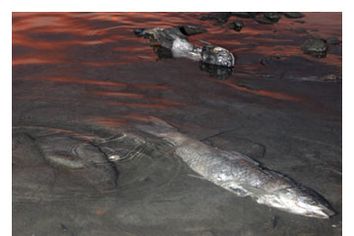
The water emergency in Harbin, an industrial city of 3.8 million, comes on the heels of an environmental catastrophe with as yet unforeseeable consequences. About 100 tons of toxic chemicals have been floating down the Songhua River ever since an explosion in Jilin, located 400 kilometers (248 miles) upstream from Harbin, released highly toxic benzene compounds. At least five people were killed and dozens injured in the Nov. 13 accident in Chemical Factory 101, and the slick, slowly traveling downriver toward Russia, threatens the drinking-water supply for more than 10 million people between the northeast Chinese city of Harbin and Khabarovsk in Siberia.

True to form, the Chinese Communist Party attempted to twist the disaster into a propaganda victory, sending convoys of water trucks decorated with red banners (“Love the people — deliver water”) from other cities and ordering soldiers to drill for new wells. But try as it might, the People’s Republic cannot obscure the sheer magnitude of this environmental catastrophe. Never before has a city as large as Harbin had to shut off the taps to avoid poisoning its residents.

Even if water began flowing once again to the city’s residents on Tuesday, the horrific environmental catastrophe reveals the flipside of the socialist economic miracle. Secretiveness and sluggish crisis management highlight the price the Chinese are paying for their boom. And even as Westerners envy the half-communist, half-capitalist country for its impressive growth figures and endless backyard market, China is no longer merely the world’s factory. It is also the world’s toxic waste dump.

China’s rise as a global power, achieved with high economic growth rates, is reminiscent of the conditions in the era of early capitalism. Everything that drives production is good, and everything that slows it down — safety technology, for example, that prevents industrial accidents from leading to massive factory explosions — is harmful. The result is exploding tanks, burning factories, collapsing mine pits and all manner of toxic leaks. According to official statistics, 350 Chinese die each day in industrial accidents, but the unofficial figure is likely to be much higher. “Occupational safety is a serious problem, because the number of accidents and deaths remains high,” said Wang Dexue, deputy director of the State Office of Occupational Safety, commenting on the horrifying figures from the country’s manufacturing industries.

Adding to the problems are economic reforms that have made many businessmen greedy. China’s laissez-faire brand of socialism doesn’t prevent executives from spending their money on cars and villas instead of investing it in worker safety and environmental protection. Although the government is constantly vowing to monitor manufacturers more closely, local officials and party leaders are often in bed with the captains of industry in China. This Mafia-like alliance between the politically and economically ambitious is known as “local protectionism.”

Chen Bangzhu, an environmental expert on Beijing’s Parliamentary Council, says he recognizes an “irrational development” in his country. In an interview earlier this year, Pan Yue, the deputy minister of the government environmental agency, SEPA, predicted a bitter end to the economic miracle. “This boom will soon come to an end,” he said in an interview with Der Spiegel, “because the environment isn’t cooperating anymore.” The negative consequences of the boom are devastating. Five of the world’s 10 most polluted cities are in China. More than two-thirds of all Chinese rivers and lakes are turning into sewers — even before the recent accident, the Songhua River was hardly a model of cleanliness — and more than 360 million people have no access to clean drinking water. A toxic soup splashes through the country’s waterways, while people living along the banks die from cancer at above-average rates. Nowadays, the then 72-year-old former party chairman Mao Zedong’s legendary swimming outing in the Yangtze River in 1966 would no longer be seen as evidence of his strength, but more as a suicide attempt.

The Chinese capital itself is suffocating in its own filth and pollution. On many days of the year, Beijing is covered by a dome of pollution made up of the exhaust gases from more than 2 million cars, as well as the dust from construction sites and cement plants. “The government doesn’t want to talk about it before the 2008 Olympic Games, but the level of exhaust gases in Beijing’s air is dangerously high,” warns a high-ranking government official. Satellite measurements have revealed that Beijing is covered by a blanket of nitrogen dioxide of previously unheard-of proportions.

And there is no improvement in sight. To meet its rapidly growing demand for energy, the government is building coal power plants, with more than 500 planned for the next few years. Although China has its fair share of windmills and Beijing promotes renewable energies, well over two-thirds of the country’s electricity requirements are met by burning coal.

The People’s Republic, which could soon surpass the United States as the world’s largest producer of greenhouse gases, has lost its ecological balance and is paying a heavy price as a result. About 400,000 people die prematurely each year because of the polluted air they breathe. Experts estimate the annual loss at 8 to 15 percent of the gross domestic product — or up to $250 billion — a figure that does not include the costs of treating cancer, skin conditions and bronchitis.

The Chinese leadership has become increasingly concerned about the possibility that environmental damage could jeopardize China’s industrial ascent. After the Harbin incident, even Prime Minister Wen Jiabao admitted that the environmental situation is “bleak” and called for “sustainable growth.” But many other party leaders see this kind of talk as nothing but Western social nonsense. They prefer to follow the lead of Mao, who summed up his take on the environment in 1958 when he said, “Make the high mountain bow its head; make the river yield its way.” Today’s comrades, profiting handsomely from industrial growth, believe it is cheaper to clean up in the distant future than to invest in protecting the environment today.

Besides, the system promotes environmental dramas such as the one playing out in Harbin now. The careers of party functionaries are tied to economic success figures, not to fresh air and clean water. “The only thing that counts, when it comes to keeping their jobs or getting a promotion, is what they’re doing to increase the gross domestic product,” says Sze Pang-cheung of Greenpeace China in Hong Kong. Chinese courts, says Sze, are notorious for disallowing environmental suits or failing to execute sentences against polluters. Besides, it is usually cheaper for factories to pay fines than to install filters or treatment systems.

Whenever catastrophes do occur, the Communist Party responds using the same old Stalinist approach. In Harbin, as with the SARS crisis two years ago, authorities initially tried to conceal or at least downplay the true scope of the disaster. At first, the managers of the Jilin PetroChemical Co. claimed that the accident posed no danger whatsoever to the Songhua River. State-owned television followed suit and announced that the “accident caused no serious environmental damage.” And when the Harbin city administration announced its plans to shut off the water supply, it first offered the transparent excuse that the pipes needed “maintenance work.” No one believed that the city’s entire system of pipes was shut down for maintenance at -100C (140F), and the icy city was soon filled with rumors of terrorist attacks or a predicted earthquake. Anyone with money fled the city by train or air. Those who stayed cleared the shelves in the food sections of places like Wal-Mart and Metro. The Beijing youth newspaper called the P.R. gaffe “unjustifiable lies.”

Bit by bit — and fully 10 days after environmental officials had detected the toxic spill — the government began revealing the facts. “They should have told us the truth from the very beginning,” complains Zhao, a retiree doing his morning calisthenics in a blue winter coat and blue cap. Once again, he says, the poorest are the worst off. “I must now depend on expensive bottled water. And if I fall ill because of the poisons in the Songhua River, I’ll have to pay the medical bills myself.”

Translated from the German by Christopher Sultan.

- – - – - – - – - – - – - –

This article has been provided by Der Spiegel through a special arrangement with Salon. For more from Europe’s most-read newsmagazine, visit Spiegel Online at http://www.spiegel.de/international or subscribe to the daily newsletter.

Continue Reading Close