Andrew Brown

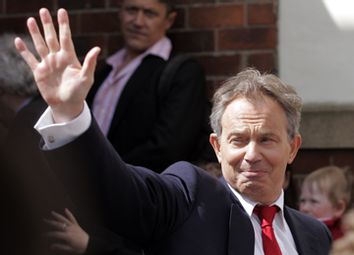
Tony Blair becomes Margaret Thatcher

Thanks to George W. Bush, the man who was supposed to reinvent the Labor Party leaves office with more friends in America than in the U.K.

  • more
    • All Share Services

Tony Blair becomes Margaret Thatcher

Tony Blair does not depart as hated as Margaret Thatcher was when she left 10 Downing St. It’s not clear whether this is a measure of his success or of his failure. But the two prime ministers are profoundly linked. Both of them confronted Britain with necessary, uncomfortable truths about our diminished status in the world. And without her, Blair could never have amassed the enormous majority of his first election, even though she had been gone from office for six years.

At this distance the huge wave of popular revulsion toward the memory of the Thatcher government and all its works seems as unreal as the Diana hysteria, but election night in 1997 had an atmosphere of national vindication that I can only otherwise remember from global sporting events. “Were You Still Up for Portillo?” was the title of one book on the election, referring to the question people asked one another the next morning about the symbolic defeat of one of the most loathed and Thatcherite Conservative ministers.

For the first six or seven years of Blair’s governments, it was literally unthinkable to elect the main opposition party, as the Tories continued to rip themselves apart in the aftermath of defeat. Now Blair has helped revive the Tories as a viable opposition, just as surely as Thatcher once helped reanimate Labor. He will also be emulating her in her post-government career. Both Thatcher and Blair believed Britain’s fortunes lay in becoming a junior partner in the American empire. Having lost his job and squandered his reputation by hewing too closely to the imperial schemes of President Bush, Blair, like Thatcher, will most likely soon be earning much of his living on the other side of Atlantic.

Prior to the debacle in Iraq, for a long time, we trusted Tony Blair. The only segments of the population to regard him as wholly untrustworthy were tiny minorities: traditionalist Tories, outraged by his dealings in Northern Ireland and his ban on fox-hunting; journalists, who had to deal with the arrogant mendacity of his staff; and the small group around the chancellor (or finance minister), Gordon Brown, the man now most likely to take Blair’s place as prime minister when he steps down on June 27. This is a pity because the chancellor was also his closest colleague.

The two men had been friends as well until 1994, when they decided — as Brown believed — that Blair would have a clear run for the leadership of the party, in exchange for a commitment to step down and let Brown have his turn. But the moment for hand-over kept getting postponed as Blair found more to do in the world, and might have been postponed indefinitely had it not been for Iraq.

Along with personal tensions caused by simple ambition, there were profound differences in their attitudes to the Labor Party. Brown was a true tribal loyalist who knew the party well and cared for it. Blair disdained the old party. He was first elected almost as a third-party candidate who would be neither Conservative nor Labor. Instead, he represented something he and his acolytes called “New Labor” — a party, it was understood, that had nothing much in common with the one that Thatcher had defeated. Brown believed in New Labor, of course. He was one of its inventors. But he did not despise old Labor as Blair did, and it did not despise him.

But both men are devout Christians, something deeply unfashionable in Britain, and something that has been concealed, so far as possible, from the electorate. One of the most damaging questions ever asked of Blair in a television interview is whether he had prayed with President Bush — to have answered “yes” would have made him look like a dangerous loony in the eyes of most of the electorate.

Both men, too, shared the belief that America, and the American model of globalization, were the unavoidable future. This may be the greatest casualty of Blair’s time in office, though it’s not at all clear what can replace it, either. To look at Blair’s relationship to America is also, I think, to understand precisely how he continued Thatcher’s attack on the traditional British state.

Until Thatcher, the British Isles were governed by a recognizably imperial system. The empire had gone, but the sort of people who had run it were still running Britain. This is of course the class that Blair belongs to. Under the old British class system money was important, but military prowess, or imperial service, mattered just as much. Traces of this still linger: The fact that Prince Harry is being sent to serve as a junior officer in Iraq is the most vivid illustration of the way in which position in British society is still validated by military prowess.

On the other hand, the British army has not been a serious instrument of national policy since Suez, the defining foreign policy disaster for the postwar generation. The Suez invasion in 1956 established that Britain (and France) could not fight a war without American support even in a country that had been part of our own colonial backyard.

If power in the new, post-imperial Britain did not grow from the barrel of a gun, then it could only arise from money. This was Thatcher’s great insight. She turned on the traditional civil service, believing that business was always more efficient. Blair and Brown carried on her tradition of privatization and the gutting of the civil service. “Special advisors” and P.R. people fanned out across Whitehall to ensure that power would be concentrated in political hands; the traditional administrative caste was sidelined. Shortly before the outbreak of the Iraq war, I interviewed Douglas Hurd, who had been Thatcher’s foreign secretary, and indeed a failed candidate for the leader of the Conservative Party, who lost because he was seen as too posh. He was certainly part of the old establishment, and he was horrified by the thought of the war, and said so. So were people like him throughout Whitehall and in the upper reaches of the army. All of that institutional wisdom was discarded by Blair because, like Thatcher, he had concluded that the only empire that made sense in the modern world was the American one.

“Get up the arse of the White House and stay there,” he instructed an ambassador newly sent out to Washington.

This turned out to be a monumental misjudgment, as we know, but it is one that almost anyone might have made who could have been elected in this country. To look coolly at our own powerlessness produces a kind of despair that any British electorate will reject. Much better to suppose that we are in some ways participants in the American political process and have a share in American power.

In many ways, any British prime minister now is a tributary king, of the sort that we used to install in India and, before us, the Romans had on the fringes of their empire. The British army and air force use American weapons. Our navy has American nuclear missiles, and the fingers on their buttons are American. No British politician believes he or she could be elected without the support of the Murdoch press, owned by an American. But what’s a barbarian king to do when the emperor is mad?

Blair’s enthusiasm for the Iraq war may have come about because he believed in the power of the British army as a force for good in the world, but in a post-Suez, post-Falklands war, this power was entirely dependent on American goodwill. Before the invasion of Iraq he had already fought two and a half wars — the Kosovo campaign, a peacekeeping intervention in Sierra Leone and the “Desert Fox” bombing campaign against Saddam Hussein.

Whether he actually believed the lies his own government told about the danger posed by Saddam Hussein is impossible at this distance for anyone to tell. Probably he himself could not answer the question. In the manner of great salesmen everywhere, he appears entirely to believe whatever he is saying as he says it. But in any case, he had no choice. Given that he knew the Americans were determined to invade, with or without British support, he seems to have believed that allowing them to be defeated on their own, and retreat into a snarling Weimar-ish despair, was the worst possible outcome. If the war had been won, Britain would have been on the winning side.

Perhaps no other prime minister, confronted with those choices, could have chosen differently. Britain is now too small and insignificant to make its way except as part of a larger political union. If you do not believe in the European Union — and the British people don’t — then the only larger body available is the American empire. On the other hand, the empire doesn’t care for us at all. No British prime minister except Thatcher and Winston Churchill can have been so much admired in America. Yet it is impossible to think of a single issue on which Blair has changed American policy.

Out of office, Tony Blair is likely to reinvent himself, or at least to confirm some things that we in Britain had long assumed. An Episcopalian, or Anglican, married to a Roman Catholic, he has been a Catholic in all but name for years now. He has long attended a Catholic church with his family. Persistent and very well sourced reports say that he will be formally received into the church soon after he steps down, and that the only thing to have held him back so far was the thought of the impact such a conversion would have in Northern Ireland.

And now he also goes off to his expected American reward. First, perhaps, he’ll make a quick fortune on the U.S. lecture circuit, and then maybe he’ll take a useful but not too demanding job in the service of the liberal wing of American foreign policy. Just like Margaret Thatcher, he will always be better regarded abroad than at home; just like her, it may turn out that his lasting domestic legacy was to make the opposition party electable.

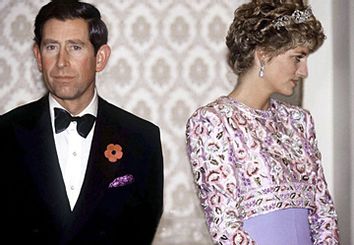
Diana’s last days

The rumors swirling around Princess Diana's death were nonsense. But after her celebrity, the royal family, and England, will never be the same.

  • more
    • All Share Services

Diana's last days

The release Thursday of the Stevens report makes clear that there was nothing tragic or sinister about Princess Diana’s death nine years ago. Despite the rumors that surfaced in the press earlier this week, it has been officially denied that Diana was ever the target of an American intelligence agency investigation. The night of her fatal crash, her chauffeur was drunk; Diana wasn’t wearing a seat belt; she and her beau, Dodi Al Fayed, were trying to escape from paparazzi. Even the attention of the paparazzi was to some extent self-inflicted. Diana sought fame, as of course did Al Fayed, in a way that other members of the royal family just do not.

Unlike Diana, the first member of the royal family to behave like a modern celebrity was despised by almost everyone in England. After Edward VIII, formerly the Duke of Windsor, abdicated in 1936 to marry American divorcée Wallis Simpson, his private secretary, Tommy Lascelles, judged him harshly. “He had, in my opinion and in my experience, no comprehension of the ordinary axioms of rational, or ethical, behavior,” said Lascelles. “Fundamental ideas of duty, dignity and self-sacrifice had no meaning for him, and so isolated was he in the world of his own desires that I do not think he ever felt affection — absolute, objective affection — for any living being, not excluding the members of his own family.”

Of course, Lascelles would never have said anything like that in public: It is a minor but entirely characteristic detail about the British Establishment that he was known to everyone who knew him as “Tommy” Lascelles, while his baptismal name was “Alan.” Even your true name was to be kept from the vulgar gaze.

But what is fascinating is that in the 60 years between Edward VIII’s abdication and Diana’s heyday as a global star, those very character traits came to represent Diana’s superiority to the rest of the royal family. It was precisely her lack of self-control and her helplessness in the face of her own desires that were meant to constitute her humanity.

Although Dodi’s father has been all around the studios Thursday to promote his view that there was a conspiracy to kill his son, he is now regarded as a rather ridiculous figure whose overactive imagination was no doubt also responsible for some of the recent speculation about spies and CIA investigations. Only the Daily Express, a paper owned by a man who made his fortune in pornography, still pretends to take Al Fayed’s story seriously. In one of the running jokes of British journalism, the Express has been running Diana stories on the front page almost every Monday for the past two years. But believing in the conspiracy against Diana is now the British equivalent of seeing Elvis in a parking lot. By putting 843 pages of his report up on the Internet, Lord Stevens hopes to crush all speculation under a mountain of evidence.

The contrast with Edward VIII could not be starker. There was a real, determined conspiracy to push him from the throne and from the country. None of it got into the papers until decades later, if at all, simply because it was ruthlessly successful. Lascelles recorded in his memoirs that “when, in December, the storm broke, [Edward VIII] went one evening to see his mother at Marlborough House; she asked him to reflect on the effect his proposed action would have on his family, on the Throne, and on the British Empire. His only answer was: ‘Can’t you understand that nothing matters — nothing — except her happiness and mine?’”

The British Establishment united against Edward VIII and Wallis Simpson, and drove them from the country for the rest of their lives. In Diana’s case, they failed absolutely to win the struggle for popular esteem. In part, this is because most of modern Britain is much less prejudiced against foreigners than in the ’30s, when one of the objections to Mrs. Simpson was that she was “an American with a voice like a buzz saw.” What public opinion then would have made of a princess who took as her lovers a Pakistani doctor and the son of an Egyptian businessman does not bear thinking about.

The transition from princess to celebrity is also a loss of function. The constitutional powers of a monarch may have been limited even in 1936 — in fact, as events were to show, Edward VIII was wholly powerless against a determined political class — but that did not mean that the job was not an important or useful one. The figurehead does not steer a boat, but does help to hold it together. The Establishment that expelled Edward VIII as its figurehead required someone like his brother, George VI, to express its common purpose, which was the survival of the British Empire and Commonwealth — something that in 1936 still governed abut a quarter of the globe.

The Establishment that fought Diana no longer even governs England and Wales. The empire has gone, the United Kingdom feels insecure and the country has largely lost its independence. Our foreign policy is completely subservient to Washington, our administrative law largely determined by the European Union.

The result is that none of the traditional virtues — or vices — of the governing classes are rewarded. Men like Lascelles, and even Edward VIII, were treated with astonishing coldness and brutality by both their parents and their elite schools. Prince Charles was sent to a similar place in Scotland, where cold baths were a prominent feature of the daily routine; I myself went to an extremely expensive school where frost formed on the inside of the dormitory windows in winter. The reward for the survivors of this kind of regime was mastery over much of the world but also the habit of treating their own emotions as servants who could be dismissed like any others.

Without the payoff, the bargain made no sense at all. And after Diana’s death their self-control and refusal to show emotion in public came to look less than human, rather than the summit of human behavior. The natives laughed and poked fun, the tradition of the stiff upper lip seemed risible. Now the queen’s accent gets mocked all over the country.

Of course this is really just a change of masks. Prime Minister Tony Blair, emoting about the “People’s Princess,” was no more sincere than the queen pretending that she had not been hurt by the whole thing. But behind that change of mask lies the much deeper, and quite irreversible, transformation of the country from a sort of Rome to a sort of Italy.

Continue Reading Close

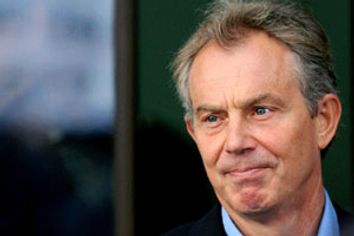
Labor’s love lost

How Britons came to hate Tony Blair and America, and why the next prime minister will pay the price.

  • more
    • All Share Services

Labor's love lost

In any disintegrating relationship there are moments of very loud, raw silence. Things have been said that can never be taken back, but their consequences can’t be taken in either. Just so, the calm in the United Kingdom’s Labor Party this week, after it became clear that Tony Blair is finished. It is still overwhelmingly probable that his successor will be the chancellor of the exchequer, Gordon Brown, but the exposure of the party’s internal hatreds has made it much less likely that Brown will win when he stands for election as prime minister on his own.

This is unfair. As the man in charge of the economy for the past 10 years, Brown can argue that all the real successes of the Blair government were his, and all the failures Blair’s. But Blair had the success that really mattered: He got elected. And Iraq, his one great failure, will probably sweep Brown away just as it has destroyed Blair, because it has brought out an extraordinary resentment of America here. Whoever is in power will be tied to the American wars in Iraq and Afghanistan, and they will be the victims of this growing antipathy when the election comes.

Until the invasion of Iraq, the people who hated Blair were mostly outside the Labor Party. He never had a majority of the voters behind him — even in his greatest triumph, in 1997, he won a huge majority of 197 seats in Parliament with only 43 percent of the popular vote — but the only people who actively hated him were traditionalists, whether on the left or the right. The hatred of the traditionalist Labor voter was precious to Blair. You might argue — and I think his circle believed — that what made him electable after 18 years of Tory rule was that he was known to be despised by everyone who believed in paleo-Laborite socialism and thought Thatcherism should be rolled back.

The hatred of traditionalist Tories — the sort of people, in fact, with whom he had gone to school — he could ignore. He trampled over tradition of every sort, castrating the House of Lords, abolishing — with 48 hours’ notice — the office of the lord chancellor, who had been head of the judiciary for at least a thousand years, banning fox hunting, and in general continuing Thatcher’s contempt for the professions and the civil service.

But none of this mattered until the invasion of Iraq. The invasion was opposed by the left, of course, who had always hated Blair. But it also alienated large sections of the Tory Party and brought anti-Americanism from the fringes of British politics into the center.

Anti-Americanism had always existed among the groups that hated Blair anyway. Though it wasn’t much of a political force before Iraq, the left’s hostility to American imperialism hardly needs rehashing. The old right, meanwhile, took the view that if anyone had to run an English-speaking empire, it should be the English.

Now there is something thin and horrible in the burgeoning hatred of America that reminds me of the itching resentment that Ulster Protestants harbor toward England. In both cases, it stems from the difficult realization that we are part of someone else’s empire, whether or not it is benevolent.

Up until 2003, it probably would have seemed incredible to most British voters that we were part of someone else’s empire. The Iraq war, and the lies that were told to get us into it, have made it clear that we are — and have delivered a prolonged and almost unendurable humiliation for which Blair will always be blamed and for which Bush will always be hated. In a poll before the 2004 American election that asked Britons whether they preferred Bush or Kerry as president, only 16 percent chose Bush. After the election, the Labor tabloid Daily Mirror ran the headline “How can 59,054,087 people be so DUMB?”

As soon as the Conservative Party elected as its leader David Cameron, a man too young to be tainted with Thatcherism, Blair’s days were numbered. Cameron wrote much of the very pro-American Conservative manifesto at the last election and must therefore take some responsibility for the failure of the Conservatives to capitalize on Blair’s unpopularity. But since then he has navigated shrewdly to put Blair between himself and Bush. On the anniversary of 9/11 he delivered a speech that was widely considered to be a repudiation of neoconservatism. Of course, this doesn’t actually mean distancing himself from Washington — how many neocons will be found there in 2008? — but it does show clearly what must be done to get yourself elected in Britain today. That Thatcher was at the same moment in Washington offering her support to Bush won’t have harmed Cameron at all.

Cameron seems to share some of Blair’s chameleon qualities. Like Blair, he appears to be an authoritarian who cares nothing for tradition — someone right-wing, perhaps, but not in the least conservative. He doesn’t appear to have Blair’s breathtaking gift of sincerity, which allows Blair to believe whatever he’s saying, no matter what he’s saying. Cameron, like Gordon Brown, seems to know when he is telling lies.

Or at least we think we know that Gordon Brown knows when he is telling lies. The next prime minister — the man who will probably be prime minister by Christmas — remains a mystery. He is powerful, secretive, famously bad at appearing human. Blairites hate him, and his acolytes hate them back. He believes that Blair promised him an early, orderly succession way back in 1994 and that this promise has been repeatedly broken.

Last week, as Labor teetered on the edge of civil war, Charles Clarke, who was sacked by Blair as home secretary in the spring, denounced Brown in two conservative newspapers as someone who “lacks confidence. He is nervous.” This goes back to an old Blairite complaint that Brown is a vicious, cowardly control freak. No one in the Conservative Party could possibly loathe Brown as much as his enemies in the Labor Party do. He is still almost certain to win any election among Labor members once Blair has gone. But the longer Blair stays, the more bitter and damaging that election will be. At the moment the smart money is suggesting a succession in the spring. I am not so sure. If the Labor MPs panic and conclude that they have more to fear from Blair’s staying in power than from a bloody coup, he will be gone more quickly than that, and it will not be tidy.

The Conservatives were rendered unelectable for a full decade by their seething, rancorous hatred of Europe, which was Thatcher’s legacy and which drove the party into a civil war. Labor may choose to destroy itself over the question of anti-Americanism. The joke is that in both cases, all that is at stake are gestures. What else can we do with our economy but trade with Europe? What else can we do with our army but fight as American mercenaries? Perhaps Blair’s real failure was not that he offered his services to the White House, but that he never charged enough.

Continue Reading Close

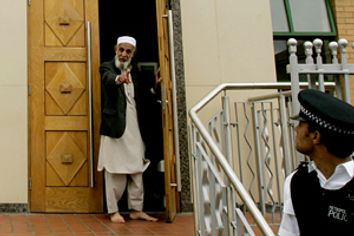
What America doesn’t understand

Homegrown U.K. terror is a growing threat, multicultural "tolerance" can't combat it, and the war in Iraq will only make it worse.

  • more
    • All Share Services

What America doesn't understand

The most shocking fact about the foiled U.K. bomb plot may not be obvious to an American reader: The bombings were planned in High Wycombe, a suburban town that is a byword for middle English dullness and uneventful safety. When poet James Fenton wanted to refuse an invitation to go traveling in the Amazon with explorer Redmond O’Hanlon, he replied, “I wouldn’t go with you to High Wycombe!”

That’s not all Americans don’t seem to understand about the crisis we find ourselves in now. In the immediate aftermath of 9/11 I wrote a piece for Salon about the lessons Britain had learned in 50 years of struggle against terrorist movements, from the Stern gang to the Irish Republican Army. Don’t torture people, I wrote; don’t shoot the young men who throw stones. Remember that wars go on for longer than seems remotely possible when you start them, and that the really dangerous enemies are not the young men trying to kill you today, but their unborn children, should they grow up to hate you, too. These were not startling or new reflections over here. They were, however, alien to the way that most Americans seem to think of terrorism. (A day or two later, I found myself on a radio show in Oregon, where a caller asked whether it was now OK to shoot or at least intern green activists because the people trying to stop logging were like terrorists.)

Five years later, the gap in understanding between Britain and America has widened. The American angle on the airplane bomb plot has been that Muslim terrorists were trying to attack American flights; here, what’s interesting and frightening is that British Muslims were planning to attack flights out of British airports. In the five years since 2001 both the British left and right have had to come to terms with unpleasant truths.

As far as can be told, every single one of the suspects arrested here was born here. One was a white convert, known until a year ago by the strikingly un-Muslim name of Don Stewart-Whyte. We are not dealing here with something wholly foreign. The discovery of the plot comes less than a week after a poll for a reputable television program suggested that between a quarter and one-third of young British Muslims say they understand the motives of the suicide bombers who struck London in July 2005; about the same proportion would be happy to live under sharia law. Given a Muslim population of about 1.6 million, this translates to something between 100,000 and 200,000 people who could be described as terrorist sympathizers.

Now, from an American perspective, that can seem incredibly dangerous. When Jack Straw, the British foreign secretary, was sacked earlier this year, it was widely assumed that this was because he had said that it would be “nuts” to start a war with Iran. This is undoubtedly the majority view here, but it is offensive to the Bush government, which may be planning just such a thing and certainly believes that the threat of war is essential to its credibility. But a much more worrying theory has been floated by Irwin Stelzer, an economist who is regarded as Rupert Murdoch’s ambassador here, who claimed in a recent column that Straw was sacked only after Condoleezza Rice visited his home district in northwest England and discovered that 20 percent of the voters there are Muslim. Straw, Stelzer alleged, was found to be compromised by his own constituency. This, if true, is an odd way to demonstrate your commitment to spreading democracy among your allies.

Of course, the presence of a large disaffected and angry bloc of Muslim voters who believe that British foreign policy is immoral and misguided creates a problem. The fact that our army in Iraq will almost certainly have to retreat, defeated, makes the problem worse. It looks as if the army in Afghanistan is fighting a much harder war than some politicians foresaw; it’s also clear that America will have to pull back from Iraq, and the British army is hardly going to stay there on its own.

One may not like the fact that the invasion of Iraq has made homegrown British terrorism more likely. But it is a fact, acknowledged by almost everyone except Prime Minster Tony Blair. The trouble is that a defeat in Iraq will make the invaders seem both weaker and more immoral. This is a dangerous position to be in.

The right in Britain has had to come to terms with this, and the result has been a clear split between the Atlanticist and traditionalist wings, or what you might call the Republicans and the conservatives. The Republican, or neocon, press used to be the Murdoch papers and the Daily Telegraph, when it was owned by Conrad Black. But since Black was forced to sell the Telegraph and charged with the theft of hundreds of millions of dollars from his shareholders, the Telegraph has been much less reliably neocon, though it remains pro-American. Meanwhile, the most influential conservative paper, the Daily Mail, has taken a much more nationalist line and is now firmly opposed to the war in Iraq and ambivalent about Israel’s war with Lebanon. Within the Conservative Party there has been a bitter little struggle over whether to describe the Israeli bombing of Lebanon as “disproportionate.” When the shadow foreign secretary, William Hague, did so, he was furiously attacked by a former party treasurer, Lord Kalms. But Hague, and his boss David Cameron, seem to have calculated that in this instance all the votes are to the left of Blair.

Yet at the same time as the war has made elements of the right move left, or at least eastward, widening the Atlantic, there has been an equally bitter debate on the left about the principles of multiculturalism. The argument here is that the British political classes are quite right to listen to Muslims, but that they are listening to the wrong ones. It was originally, and still most clearly, put by French sociologist and expert on Islam Gilles Keppel, who coined the term “Londonistan” to describe the policy of the British security services in giving sanctuary to all sorts of unsavory Islamists on condition that they only plot against foreign governments. This largely unspoken bargain was not kept. The Islamists preached a global jihad, which, it turned out, included Britain and America in its targets. The most prominent of these agitators, among them Abu Hamza and Abu Qatada, have all been jailed or exiled since 2001. However, their influence remains, and will take decades to extirpate.

But Keppel argues, from a leftist, secularist point of view, that the more general policy of multiculturalism may fail because it is a hangover from the British Empire. He told a BBC radio program earlier this year that “the British in the Raj — in the former Indian empire — dealt differently with Muslims, with Sikhs and with Hindus. It was in a way a matter with them as with other empires of divide and rule; and that is something which led ultimately to partition of Pakistan and Indian and Bangladesh in 1947.”

There is a bitter irony here, in that the dispute over Kashmir, arising from that partition, is still a live issue among many British Muslims, since about half of them are of Pakistani descent.

The point of Keppel’s argument is that once you start dealing with people as members of communities, rather than equal citizens, you need to find leaders to represent these communities; and these leaders then become a privileged caste, whose members have an interest in keeping their communities unintegrated. The French, in this sense, have a much more American policy toward immigration than the British do. This may explain why 46 percent of French Muslims claim to feel Muslim first and French second, whereas 83 percent of British Muslims regard themselves as more Muslim than British.

In particular, Keppel identifies the dominant leadership of British Islam as “not so much interested in promoting the wellbeing of their flock as in promoting their own interest and their own role in society as people who have to be dealt with by authorities and who will negotiate.”

His analysis has been taken forward by Martin Bright, political editor of the left-wing New Statesman, who in a recent pamphlet and television program has argued that the government is taking its advice from a particular politicized strain of Islam, descended from the Muslim Brotherhood, and ignoring the wider, apolitical grouping of Muslims who really couldn’t care much about foreign policy anywhere and are perfectly happy to live in a secular state.

There is no doubt that some of the younger leaders of British Islam are clever and able politicians who would make their way under any political system. The question is whether we have the best political system to align their self-interest with that of the wider community. We will find out. It’s too late to change. The British establishment has always worked by co-opting and corrupting rebels. Sir Iqbal Sacranie, the knighted leader of the Muslim Council of Britain, who got his start in national politics agitating against “The Satanic Verses,” is not much different in that respect from Ramsay Macdonald, the first Labor prime minister, who ended up splitting his party when he went into coalition with the Conservatives.

Macdonald is excoriated to this day as a traitor. There is always a danger that the leaders who will talk to us are not those who can deliver the sentiment on the streets. There seems to be no religious or political leadership that can represent the true extremists, though, clearly, the police are talking to some of them, otherwise we would not have had the information that allowed for the discovery of this plot.

Then again, when High Wycombe turns out to contain a bomb factory, the one thing that’s certain is that nobody really understands what’s going on, nor how it will end.

Continue Reading Close

Is it OK to shoot a suspected terrorist in the head?

Britons debate a post-9/11 police policy that led to the killing of an innocent man.

  • more
    • All Share Services

Is it OK to shoot a suspected terrorist in the head?

When London’s Metropolitan police force announced that it had fatally shot a suspected suicide bomber at the Stockwell tube station on July 22, 15 days after the terrorist attacks that killed 53 people in the city and one day after four more suicide bombers failed to detonate themselves and escaped without killing anyone, the overwhelming reaction of the city’s residents, it’s safe to say, was joy and relief. But within 24 hours it became apparent to police commissioner Sir Ian Blair that police had killed an innocent man, a Brazilian electrician named Jean Charles de Menezes. Until the shooting of de Menezes, few British citizens were aware that there are now, under a policy instituted in 2001 by the Association of Chief Police Officers and Lord John Stevens, the former police commissioner, hundreds of armed plainclothes policemen on the streets of London who are permitted to shoot dead, without any warning, anyone whom they suspect to be a suicide bomber.

In the immediate aftermath of the shooting, a series of police leaks established the false story that de Menezes had been acting suspiciously, even if he was the victim of mistaken identity. But the disinformation did not come just from police briefings. Civilian eyewitnesses to the shooting told journalists he had been wearing a heavy jacket and had run when challenged, details that now are in question.

Then Blair’s predecessor, Stevens, wrote a column in Rupert Murdoch’s Sunday tabloid, the News of the World, in which he explained — with what seems extraordinary relish — that policemen are now trained to shoot suspected suicide bombers repeatedly in the head, following Israeli advice sought after 9/11. Anything less might leave them capable of detonating their devices.

Stevens wrote: “We are living in unique times of unique evil, at war with an enemy of unspeakable brutality, and I have no doubt that now, more than ever, the principle is right despite the chance, tragically, of error … It would be a huge mistake for anyone to even consider rescinding it.”

The traditional principle that Britain’s police should be unarmed, and usually are, is one that all parties pay lip service to and most voters seem to support. The total Met force of 31,000 has only about 2,000 officers allowed to carry firearms (with 440 of these further trained as specialists). So the implications of the police policy as described by Stevens took some time to sink in. But the incident has raised questions about the future of British civil liberties, exposing fault lines not simply between left and right, or police and public, but within the police force itself.

The assumption on which the policy rests is that the police’s suspicions will always be justified; and at moments of crisis, this is what everyone wants to believe.

The normally scrupulous Daily Telegraph reported that “the officers had become concerned that their target was carrying a bomb not in a rucksack or holdall — he was carrying neither — but beneath the bulky, dark jacket he was wearing despite the warm weather … The man, of Asian appearance and in his 20s, walked into Stockwell Tube station and went to buy a ticket. At about 10am, a senior officer gave the order for his armed men to challenge the suspect.

“Instead of giving himself up, the man panicked, vaulted the ticket barrier and sprinted down the escalator to a platform where a train was already waiting with its carriage doors open. Several armed officers were in pursuit and, according to witnesses, the suspect stumbled as he tried to get into one of the carriages. By the time he half-ran, half-fell onto the train, three officers, at least one of them holding a low-velocity pistol, pounced on him, shooting him five times in the head.”

It was not until three weeks later that a leak of documents from the investigation into the killing established that almost every detail of this account was false. De Menezes was not “of Asian appearance” — nor, incidentally, was the man the police were really hunting, a Somali. The senior officer involved “who gave his men orders” was a woman. De Menezes did not run through the station but paused to pick up a free newspaper, and used his season ticket to pass through the turnstiles normally. He did not run until the train came in. He did not fall over until a police officer grabbed him and held his arms, immobilizing him. At this point another police officer shot him in the head — not five, but seven times. Some of these details are still contested, but a photograph of his body shows quite clearly what may be the most important fact: He was not wearing a heavy top that might have suggested or concealed a bomb, but a pale-blue denim jacket.

By the time these details emerged the four presumed suicide bombers had all been caught and arrested, without a shot’s being fired. No one seriously believes Britain has seen its last bomb, but the next ones won’t come for a while. So while the fear is over, for the moment, the leaked documents have produced a furious debate on all aspects of the police’s tactics.

Although the debate contains elements of a left-right split, it has more to with a struggle over the soul of the police force and thus of the future of Britain’s struggle against terrorism. The right-wing press carried a number of articles suggesting that it was absurd to criticize policemen who shot anyone they thought was a terrorist. The Daily Express, owned by a man who made his fortune in porn, and which has carried, since the bombings, a Union Jack and “Britain defiant” on its masthead, ran the front-page headline: “It Was Just a Tragic Mistake: Why the Police Should NEVER Face Murder Charges Over Shot Brazilian.” Murdoch’s Sun ran an eloquent column by its star columnist defending “the poor bloody infantry” and asking what would have been said had de Menezes really been a suicide bomber and not been shot.

But the most interesting reaction came from the most influential right-wing paper in the country, the Daily Mail, which has demanded the resignation of commissioner Blair, rather than the policemen who actually shot de Menezes. The Mail hates Blair, whom it considers too liberal and “politically correct.” An Oxford graduate who worries about logos and symbolism, Blair has tried to stamp out racism in the police force. The Mail, with a largely suburban readership, is prone to campaigns against London policemen: Its previous target was Brian Paddick, the most senior openly gay policeman in the capital, who was in charge of Brixton when he ordered his force to concentrate on hard drugs, not on cannabis.

All this resonates with a macho and conservative subculture within the force, and there is no doubt that some policemen have spread leaks against Blair. He has made his own position more difficult by his overconfidence and one dreadful stroke of bad luck: Interviewed on the radio on July 7, the day of the London bombings, he said that British anti-terrorist policing was the envy of the world. Within three hours of his comments, the first round of bombs had gone off and killed 53 people.

He has been attacked from the left for allowing the officers who actually shot de Menezes to go on vacation immediately after the incident. But it looks as if the government has decided to back him, partly for the reasons that the Daily Mail is trying to destroy him. He is committed to reforming the police and to making them acceptable to the communities from which they must draw their informants. These reforms, along with controlling the armed police squads, are absolutely essential for a proper anti-terrorist campaign. (Blair estimates that about a fifth of his men are opposed to his reforms.)

Most crimes are not solved, as they are in many novels, by detecting criminals from the evidence they leave. On the contrary, the police know pretty well who the serious criminals are on their patch. Their job is to find evidence that will tie known criminals to particular crimes, normally by using intelligence. This is why police need consent, or at least legitimacy, from the communities they police. If no one will talk to them, no crimes will get solved and no criminals convicted.

But it’s not just a matter of the police being trusted. The police must also be feared as more powerful than criminals; otherwise their guarantees of safety to witnesses can’t be believed. But fear on its own won’t do, which is what right-wing critics never understand. Nor do some policemen.

There have been worrying signs for some time that the members of the London police’s elite firearms branch believe they should never be punished for shooting someone they suspect to be a terrorist. Last autumn, over a hundred of them went on unofficial strike after two of their colleagues were charged with murder for shooting in the street Harry Stanley, a Scottish carpenter who had been carrying a chair leg in a plastic bag. An anonymous caller had identified him as an Irishman carrying a shotgun.

There is no offense, in British law, of being drunk while in charge of a chair leg. Even if there were, the law is clear. The police are not allowed to shoot anyone unless they honestly and reasonably believe that it is the only way to save other lives (including their own). A dogged five-year campaign by Stanley’s family, represented by the law firm of Cherie Blair, the prime minister’s wife, led to a trial for murder of the two policemen who shot him. They were acquitted after persuading the jury that they had made an honest mistake. They have now been rearrested following a further investigation: Forensic evidence suggests they shot him from behind, so he couldn’t have been brandishing the chair leg at them.

Meanwhile, an investigation has been launched into the leaks from the independent investigation into de Menezes’ death. There is still controversy over the closed-circuit TV (CCTV) footage of the tube station, which would clear up a great deal of the story. Some police sources have claimed that the cameras were empty or malfunctioning. Others, in apparent leaks from the investigative team, have said this is nonsense. The whole story may not emerge until the investigation is complete, in about six months’ time.

But whatever happens in the case of Jean Charles de Menezes, the policy of shooting without warning has been for the moment discredited and may be abandoned. It depends too much on intelligence’s being infallible, and it never is. Even high technology doesn’t seem to have helped here. Although the police had excellent CCTV images of the bombers they were hunting when they shot de Menezes, the officer whose job it was to identify suspects leaving the block of flats they were watching failed to confirm de Menezes’ identity because he was, at the crucial moment, taking a leak.

Continue Reading Close

A political bombshell for Blair

Now that terror has struck London, will the British blame their leader?

  • more
    • All Share Services

A political bombshell for Blair

The bombs exploded while the morning newspapers here in Britain were frothing in jingoistic delight that London had won the bid to host the Olympic games, and with the agenda for the G8 summit apparently set by Tony Blair. Terrorism or war was off the news radar. But at the same time, the attacks weren’t unexpected. Ever since 9/11, the police have been warning that it will happen here, not that it might. The government has been saying the same thing, in private as well as in public for years; and there was a full-scale rehearsal of a chemical attack on a tube station in September 2003.

These bombs were not, thank god, poisonous. But it is already clear from the reaction of the police and the transport authorities, from the first stories about the cause of the explosions — a “power surge” was blamed, to prevent panic — to the little touches like ferrying the wounded to hospitals in commandeered double-decker buses, that they had prepared and rehearsed in detail for an atrocity. We are unlikely to hear of all the measures taken. But it looks as if the police, the emergency services, and the transport authorities were all less shocked than Tony Blair, whose ghastly statement as he left the G8 summit in Gleneagles, Scotland, for London completely lacked his usual fluency. Where normally he skips lightly from cliché to cliché, there were terrible pauses between each one, which seemed to extend for hours.

So it would be natural to assume that the chief political victim of these bombs will be Mr. Blair. His own party believes that he personally dragged us into the American invasion of Iraq. No one doubts that these bombs are a sort of retaliation for that. The war was extraordinarily unpopular, and the only thing that has diminished its unpopularity since then has been the fact that whoever else was getting killed in Iraq, it wasn’t often British soldiers. The fact that the bombs went off while President Bush was here will send a very clear message about whom in particular the bombers object to. Very few people here believe they hate us for our freedoms. We think they hate us because our armies are in their countries.

This means that no one who had been previously a doubter about the war is going to rally round the prime minister. It doesn’t seem to the British particularly unnatural and horrifying that terrorists are trying to kill us, in the way that it seems to strike Americans. Those of us who believe that the Iraq war was a monstrous folly and a crime believed it before the election here in May, and what happened today will not make the war look wiser or more winnable.

On the other hand, the fact that the bombs have been so long expected means that few of the war’s supporters will change their mind either. Since everyone had factored into their calculations and their arguments the likelihood of an atrocity in London, the most likely political effect will be to persuade both sides that they were right all along. At this very moment, the Daily Telegraph, which was the neocons’ mouthpiece here when it was owned by Conrad Black, will be preparing an editorial to say that this atrocity proves how right we were to invade Iraq, and how wrong it would be to retreat.

Nonetheless, the discussions on the war and on the reasons for Islamic terrorism here are carried on in ways that seem unthinkable in the U.S. — and the political consequences of the bomb can’t be understood without some sense of the un-Americanness of British politics, and even of British conservatism.

As it happens, I was at a party thrown by a Telegraph editorial writer on Tuesday, in a flat where Winston Churchill once had lived, to launch a book on evangelical Christianity. This sounds like the sort of event that Bushite Republicans would understand as proper British conservatism; indeed, my friend is the only wholehearted believer in the war that I know, and we have had to agree not to mention it, lest our friendship rupture. I don’t think he knows anybody outside the editorial writers’ room at the Telegraph who would share his enthusiasm. And when you looked at the details of the party, it became apparent how unlike American right-wing Christianity the British sort is.

For a start, my friend is gay, as are the couple who had lent him Winston Churchill’s old flat. The party had a memory of heterosexual exuberance in the shape of two great-grandsons of H.G. Wells, through his liaison with Rebecca West, but this was not the British establishment that either Wells or Churchill would have recognized. This is a city where even the ideological conservatives can pride themselves on their lack of military virtue, their tolerance, their exuberance, and on the diversity around them. Selling the war as a crusade won’t do, even though it is Blair’s instinct, since he wants everything he does to be part of a moral struggle.

The non-ideological conservatives have never been enthusiasts for the war. The Downing Street memos have made it obvious to everyone how much the institutional conservatism of the civil service was outraged by the Bush approach to Iraq. Such people might be dismissed as ineffectual liberals, but the most influential Conservative paper, the Daily Mail, a tabloid that sells 2 and a half million copies, could never be called either liberal or ineffective. It is violently anti-foreigner and devoted pages to abusing Jacques Chirac on the morning of the bomb, because he had insulted British food. But it also regards Americans as foreign, and has been notably skeptical about the war.

The Mail, and perhaps the Murdoch press as well, will probably conclude that this is all the fault of foreigners, asylum-seekers, and similar shifty types. In the dog-grooming parlor where my teenage daughter is working this summer, they all read Rupert Murdoch’s Sun, and they all knew at once that the bombs were what happens “when you let the Ahmeds in.” If it turns out that the bombers were native British Muslims, this sentiment will be heard more widely.

Such a rise in racial and religious tension must be one of the things that Tony Blair is most afraid of. But he, too, has little choice. He too must believe that the bomb shows he was right all along. His broad strategy has always been clear. First, and whatever happens, Britain’s position in the world depends on its standing as an American client state, which must be maintained at all costs. As his chief of staff, Jonathan Powell, a very intelligent man, told a British ambassador setting off to Washington, “You must get up the arse of the White House and stay there.”

Blair’s not going to back off from that. The last thing that he can do at this point is to make noises about withdrawing troops from Iraq, or from Afghanistan, against Bush’s wishes. But he must also press on with his domestic policy for managing the consequences of the war, which contains a couple of laws repulsive to principled liberals and instinctive conservatives. The first is the introduction of compulsory I.D. cards. These threaten to be extremely expensive, and have no obvious utility against terrorism. But the government must claim that today’s atrocities prove the need for I.D. cards. The second is a law banning incitement to religious hatred. We already have, and have had for decades, a law banning acts and speech that tend to incite racial hatred. This covers the Jews, but not Muslims. Banning incitement to religious hatred looks like a straightforward piece of pandering to Muslim sensibilities, though in fact the law is so widely drawn that it also covers attacks on atheists and agnostics. Practically every comedian and liberal in the country has campaigned against the proposed law. But to draw back from it now would be impossible.

In the aftermath of the bombing, all the right and usual noises will be made about the terrorists not defeating us, and not destroying our way of life. This isn’t just the right thing to say: It is very largely true. The committee charged with preparing for these attacks was called the “resilience committee,” and London has proved very resilient today. I really don’t believe that the terrorists will defeat us or that these bombs will destroy the British way of life. But one of the terrible things about war is that neither side has to win. The British are determined that we will not be defeated. We are very much less certain that the terrorists can be. How long will it be before the government warns us against the next attack?

Continue Reading Close

Page 1 of 3 in Andrew Brown