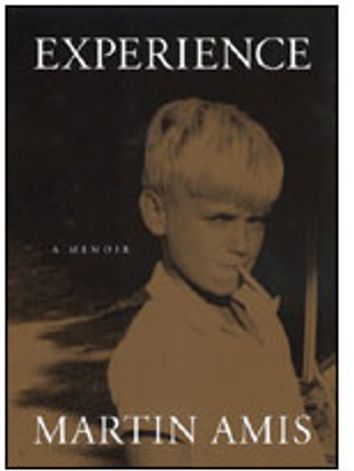
Martin Amis has been known as the bad boy of British letters for so long that it’s easy to forget that last year he entered his sixth decade. At a pre-grandfatherly 51, he is that rare, endangered creature: a writer who makes headlines. And now the man who has been called “the best American writer England has ever produced” and “the Mick Jagger of literature” once again finds himself the subject of speculation and scrutiny: For the past month or so, the British press has been abuzz about the nearly simultaneous publication of “The Letters of Kingsley Amis” by Martin’s famous father (author of “Lucky Jim” and the Booker Prize-winning “The Old Devils”) and Martin’s own much-anticipated memoir, “Experience.”
Why the hubbub, the headlines of “Daddy Dearest”? Sir Kingsley’s voluminous letters, written mostly to his close friend, poet Philip Larkin, touch upon several facets of his life (including intimate details of his first marriage, to Martin’s mother), but what really cranked up interest was his unpaternal treatment of his novelist son. “Little shit,” the elder Amis writes in reference to Martin’s prodigious earnings for 1978. He disapproves of his son’s postmodernist excesses and thinks him too heavily influenced by Vladimir Nabokov, who “fucked up a lot of fools here, including … my little Martin.” He also offers some jabs at Martin’s politics: “Gone all lefty,” he carps in 1986, after his son has declared his support for the anti-nuclear movement. “He’s bright but a fucking fool.”
Until now the son has remained relatively quiet on the subject of his father — hence this latest wave of Martin mania. Hence, too, his desire to “speak, for once, without artifice,” as he proclaims early on in “Experience” — and not only about his father but about the tumble of events and imbroglios he was at the center of in the mid-’90s: his leaving his wife and children; his decision to part with his longtime agent, Pat Kavanagh, and the abrupt end of his friendship with Kavanagh’s husband, novelist Julian Barnes; his huge advance for his novel “The Information” and the $30,000 portion of it he laid out on reportedly cosmetic dental work; and his discovery that his cousin, Lucy Partington, who disappeared in 1973, was a victim of Frederick West, Britain’s most notorious serial killer. Finally, there was the death of his father in 1995. “The theme is clear,” Amis says of the period: “partings, sunderings, severances.”
In “Experience,” he reflects upon all these dramas, but the book isn’t the tabloid tell-all the British press seemed to be hoping for. Rather, it’s a balanced, haunting work of memory and memorial, a surprisingly gentle meditation on fathers and sons, mortality, the loss of innocence, divorce, friendship, love — what Amis calls “the main events,” those “ordinary miracles and ordinary disasters” that shape you and define you and remain forever in your blood and being. No doubt critics will hail this intensely private evocation of a very public life as the arrival of a kinder Martin Amis. (We learn, for instance, that His Nastiness cries at the movies.) Still, there are passages in which Amis definitely seeks to set the record straight.
On his father’s criticisms of him: “A fucking fool, in his lexicon, meant someone just about bright enough to know better.” On his famous midlife crisis: “Like many people who have not yet turned forty, I used to give the Mid-Life Crisis little credit and no respect: it was the preserve of various dunces and weaklings.” And, of course, the teeth: He devotes many pages to his lifelong dental woes, which, he insists, were far from merely cosmetic. He painstakingly describes the pain and trauma of dental surgery and of, as he puts it, losing his face — he even casts his lot with his fellow literary tooth sufferers, Nabokov and Joyce — but unfortunately he pleads his case too hard and returns to it too often.
Structurally, Amis spends two-thirds of the book jump-cutting between various eras and episodes of his life, from his adolescence to his relationship with Saul Bellow to a reunion with a teenage daughter he didn’t know he had. But it’s his father who haunts these pages most, and the last third of “Experience” focuses almost exclusively — and touchingly, compellingly — on his father, especially his last days. “I always knew I would have to commemorate him,” Amis explains. “He was a writer and I am a writer; it feels like a duty to describe our case — a literary curiosity which is also just another instance of father and son.”
Quoting extensively, Martin demonstrates that he’s a savvy and dedicated reader of Kingsley’s writing. The reverse, however, could not be said: Kingsley stated publicly (on TV, in fact) that he “couldn’t get on” with Martin’s second novel, “Dead Babies,” and he didn’t even read “London Fields,” which was dedicated to him and which many consider his son’s greatest achievement. Yes, Martin dishes out the occasional dig — at his father’s anti-Semitism, at his misogyny, at his less successful writings — but what finally emerges is a multidimensional, loving portrait of a man whom many regarded as the top comic novelist of his generation, yet who was afraid to be alone in his house after dark. Part fascinating literary memoir, part raw catharsis, “Experience” also represents a universal phenomenon: a son’s attempt to understand his father and to make sense of his death.
Amis’ nine novels and two short-story collections have been praised for their verbal virtuosity and their stylistic wonder, but criticized for their lack of soul and of humanity. “Experience” displays the familiar virtuosity and the wonderful style, but this time there’s no faulting the humanity or the soul. Call it the full Martin.
Something about conspiracies seems peculiarly modern, or rather postmodern. Facts elude verification; the search for the truth — and sometimes you have to wonder if it really is out there — can recede into little more than a vague nostalgia for a gentler, simpler time before the proliferation of conspiracy-themed Web sites devoted to everything from the death of Princess Diana to elaborate lies about fluoridation.
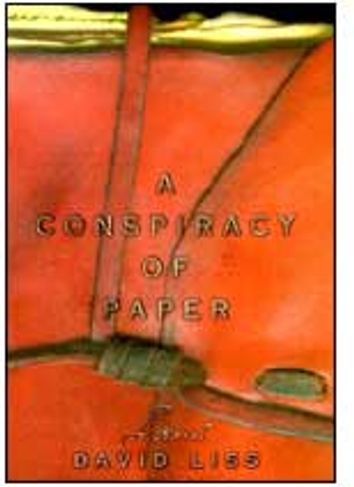
But of course the orchestrated collective scheme dates back at least as far as Rome. Conspiracy historians cite the Crusades as one early instance of fears erupting over the possibility of a cabal seeking to manipulate its way into power. The notion gained currency again in the wake of the French Revolution, whose opponents portrayed their enemies as seeking to rule the world by devious means. Seventy years before that, another revolution of sorts was occurring in London, and it’s here that David Liss situates the conspiracy that fuels his debut novel, “A Conspiracy of Paper.”
“The era was one of exuberance as well as turmoil, doom and possibility,” Liss writes. “It was a fine time for a man whose livelihood depended on crime and confusion.” Early 18th century England (the novel takes place in 1719) was also a time when a new kind of financial order began to flourish, based on stock speculation and credit (as opposed to the established mineral-based economy), which would eventually become the dominant model for the entire industrialized world. Liss conjures a web of deceit involving a series of murders that lead the novel’s narrator, Benjamin Weaver (his estranged father, a notorious “stock-jobber,” is one of the murder victims), to the murky machinations of the Bank of England and the South Seas Company. “These financial institutions are committed to divesting our money of value and replacing it with promises of value,” lectures Weaver’s pal and confidant, Elias. “For when they control the promise of value, they control all wealth itself.”
It sounds like a great basis for a novel — and it is. Liss creates a colorful cast, including a real-life figure, Jonathan Wild, the Al Capone of his time, as well as a multifaceted, likable protagonist in Weaver, who is a lapsed Jew, a former pugilist and highwayman and now a “protector, guardian, bailiff, constable-for-hire and thief-taker.” (Think of him as a precursor to the modern private detective, a Marlowe in tights.) Unfortunately, however, the novel gets bogged down in formula, explanation and tedious this-is-what-it-all-means conversations between Weaver and Elias, and it never fully lives up to the promise of its premise. Despite the seemingly vast scope, “A Conspiracy of Paper” soon turns into a fairly straightforward mystery offering little surprise and innovation. Worse, the conspiracy at the heart of the book — which has to do with forged stock certificates — ultimately isn’t all that compelling.
Liss, who is writing his dissertation at Columbia University on how the 18th century British novel shaped the modern idea of personal finance, certainly knows his subject matter, and he does a good job of evoking the seething metropolis. But with the exception of his portrayal of Jewish life there, it’s nothing we haven’t seen before — lots of taverns and coffeehouses, dank and dangerous streets, bawdy barmaids and wenches, the appalling conditions of London’s infamous Newgate prison, the predictable penchant of those on the lower rungs of society to drop their H’s when they speak.
The book is being marketed as a historical thriller along the lines of “The Name of the Rose” and, more recently, “An Instance of the Fingerpost.” But Liss, like most novelists who turn to the past for material, doesn’t merely employ history for history’s sake. “A Conspiracy of Paper” is also intended as a commentary on our own age — on the volatility of online day trading and overvalued tech stocks and, beyond that, the rampant ambiguity of the contemporary world, which provides such fertile ground for conspiracies. Weaver’s musings apply just as much to early 21st century America as they do to London circa 1719: “There were too many connections, too many avenues of villainy. Too many men had too much power and knowledge, but none could be made to answer for their crimes because they hid themselves in endless mazes of deceit and fiction.”
The present-day conspiracy theorist couldn’t have put it any better. It’s just too bad that the plot at the center of “A Conspiracy of Paper” probably wouldn’t elicit even a blink from Scully and Mulder.
Continue Reading
Close
With the possible exceptions of Nicholson Baker and David Foster Wallace, no contemporary American author makes such prodigious use of the Nabokovian digression as Donald Antrim. These parenthetical asides, which either disturb or delight depending on a reader’s willingness to follow an author down a labyrinth of language and excess, can certainly distract from the narrative at hand. But for Antrim, the aside is the novel: He takes to heart John Hawkes’ still radical 1965 dictum that “the true enemies of the novel” are “plot, character, setting and theme.”
Like Antrim’s first two novels, “Elect Mr. Robinson for a Better World” and “The Hundred Brothers” (the latter a PEN/Faulkner Award finalist), his latest, “The Verificationist,” is an audaciously imagined work of whimsy and wonder. And yes, it’s brimming with his patented digressions, including meditations on everything from pancakes to adultery to Revolutionary War battle tactics; there’s even a deconstruction of the freckles and moles on the back of a waitress’s neck, a pattern that happens to resemble a Bruegel painting. (Don’t ask.) Although it’s easy enough to isolate Antrim’s influences — he shares Vladimir Nabokov’s wickedness and his revelry in wordplay, Thomas Pynchon’s antic comedy, Donald Barthelme’s sense of the surreal — he nonetheless manages to create, with each new novel, a fictional universe that’s wholly, truly his own.
|
|
The premise (if you can call it that) of “The Verificationist” involves a biannual gathering of psychotherapists dedicated to “the seemingly everlasting task of reconciling classical metapsychology to our particular branch of Self/Other Friction Theory,” as Tom, the novel’s narrator, explains. As his Krakower Institute colleagues arrive at the Pancake House & Bar and place their orders, Tom decides a little levity is in order. But just as he’s about to instigate a food fight with a group of child psychologists, he finds himself in the metamorphosing embrace of the group’s leader, the paternal Bernhardt — a manly hug (“sordid, oddly lovely, threateningly intimate”) that puts Leo Buscaglia to shame and, what’s more, causes Tom to ascend toward the restaurant’s ceiling, where the majority of the novel takes place.
More accurately, the novel takes place in Tom’s deliciously imbalanced mind while he apparently undergoes a nervous breakdown. During the course of the evening (“The Hundred Brothers” also encompasses a single night), Tom’s out-of-body experience provides him with a lucid vantage point from which to examine his life, his profession, his colleagues, his marriage, his mortality, his manhood. “Perched high with feet hanging and my head rising upward to float closer and closer to the ceiling and lights,” Tom describes the sensation, “I felt, for a short while, as if I were becoming what every normal child most truly is: an inventor of reality.”
As strange as this all sounds (how many books have a levitating narrator who regresses to “a classically pre-oedipal position, in order to reorganize psychosexual reality and survive trauma”?), Antrim turns “The Verificationist” into yet another tour de force, demonstrating again what makes his voice so compelling and unique. Few writers can match his madcap burlesques, and even fewer can equal his dizzying high-wire prose. But along with the yuks and the verbal theatrics, Antrim infuses the novel with a surprising sadness, satirizing psychoanalytic jargon one moment and delving into Tom’s existential crises the next. It’s a virtuoso performance: funny, playful, melancholic, outrageous, over the top (perhaps, at times, too over the top).
Antrim is an acquired taste. He writes a kind of fiction that’s bound to polarize and provoke, and his unconventional style and disdain for realism will no doubt turn some readers off. There’s an underlying darkness, a sinister edge to his work. His narrators are unlikable, hyperintelligent, Humbert Humbertish men who struggle to understand their tenuous place in the world and eventually endure a kind of reckoning of the soul. Whether it’s the postapocalyptic suburbia of “Elect Mr. Robinson,” the raucous family gathering of “The Hundred Brothers” or the pancake-house hallucinations of “The Verificationist,” Antrim seeks to shatter the veneer of contentedness and normality surrounding our day-to-day lives. An act as simple as choosing the paint color of the empty room that Tom and his wife have yet to fill with a child isn’t so simple; rather, “it is loaded to capacity with marital sorrows and the profoundest mysteries of destiny, accident, and the overall purpose and meaning of life.”
“The Verificationist” goes further than Antrim’s previous novels: It’s more brazen, more shot through with the raw ache of relationships and the nakedness of emotional experience, with the tragedy of our inability to connect. “I feel the dread of love,” Tom confides. And it’s Antrim’s achievement that we feel Tom’s pain, even though he happens to be floating five feet in the air.
Continue Reading
Close
The novelist hasn’t always been kind to Los Angeles. Whether it’s the existential noir of Raymond Chandler, the psychological and cultural dread of Joan Didion or the hallucinatory dystopias of Steve Erickson, there’s something inevitably damaged about the portrayal of the city of lapsed angels — that “bright, guilty place,” as Orson Welles once put it.
Welles’ spot-on description certainly rings true to the Los Angeles that lurks at the heart of Rachel Resnick’s “Go West Young F*cked-Up Chick,” a promising yet frustratingly uneven first novel that chronicles one woman’s trip down the neon rabbit hole of L.A. “Hard to believe this is the town that spins out all our dreams,” quips Rebecca Roth, the novel’s picaresque young heroine, who heads west after the suicide of her mother and immediately goes about staking her claim in la-la land, mucking her way through the detritus of Southern California, wanting (of course) to make films and take the town by storm. “I was exultant,” she states not long after her arrival. “Even breathed the thick poison. Liked the way it filled the throat.”
But before she can become the artist she longs to be, Rebecca must first endure a series of low-level jobs in the entertainment industry (transcribing celebrity interviews for “Entertainment Tonight,” working production on B movies) and navigate the vertiginous waters of love and loss (there’s Isaac, there’s Giorgio, there’s Slim), as well as confront the consuming memory of her mother. The chapter titles provide a general sense of how Rebecca’s helter-skelter and somewhat predictable script plays out: “My First Abortion,” “On Not Becoming an Actress,” “Things She Learned in Therapy.” Throughout, Resnick counters Rebecca’s technicolor odyssey with fragmented glimpses of L.A. life — ` la Robert Altman’s “Short Cuts” — ranging from cow-killing Satanists and a suicidal socialite to a man who claims to be the son of Gene Autry.
Other than the occasional over-the-top rhapsodizing about Los Angeles, Resnick handles the material with an impressive deftness, and her vibrant prose glimmers with the intensity of that omnipresent SoCal sun. Nevertheless, her talents as a writer can’t overcome the book’s fatal shortcoming: its structure. Told in brief vignettes (most in first person but some in third), the novel unfolds in a nonlinear, collage-like fashion, jumping back and forth among several periods in Rebecca’s life. Perhaps the intent was to replicate the cinematic jump cut or mirror the manic energy of L.A., or both. The result, however, is a disjointed debut that reads more like a series of semi-related episodes than like an organic, fully realized novel.
Without an underlying narrative anchor, “Go West Young F*cked-Up Chick” ends abruptly and unsatisfactorily. What we get is Rebecca’s belated attempt at summation, at epilogue: “And yet … I am still here in the town that throbs with celluloid and videotape. Something keeps me … For all the city’s smog, its choppers, sirens, gunshots, snarled traffic and ego-tripping monsters, there is comfort here. Apocalyptic authenticity.” But after 250 pages, the reader expects more from Rebecca, regardless of how long she’s lived in L.A. and no matter how f*cked up she might be.
Continue Reading
Close
You have to wonder if Stewart O’Nan had the Clint Eastwood spaghetti westerns in mind when he decided to set his harrowing and masterful new novel, “A Prayer for the Dying,” in Friendship, Wis., a sleepy post-Civil War hamlet that undergoes a reckoning of Old Testament proportions. It’s a safe bet that bad things are bound to happen in a town called Friendship — very bad things.
And O’Nan holds nothing back. The disasters mount, and after the climactic fury of the closing pages the reader is left breathless and overwhelmed at just how much misery one author can dream up. To his credit, however, O’Nan not only crafts a mesmerizing tale of Gothic terror and tragedy; he also anchors the novel with a resilient humanity and an urgent, eerie beauty.
Like Camus’ “The Plague,” “A Prayer for the Dying” is part horror story, part biblical fable, part meditation on the human capacity to endure. But where Camus opted for a good old-fashioned pestilence, bubonic plague, O’Nan employs a more mundane diphtheria outbreak as the catalyst for Friendship’s chilling descent. As the number of cases escalates and the body count rises, a belated quarantine is imposed. And as if that weren’t enough, a raging wildfire forces an evacuation; ultimately the flames engulf Friendship and the surrounding countryside, “the sky violent and backlit, shimmering like some artist’s version of hell.”
Just how much can one town take — or rather, how much seemingly random suffering can we withstand yet still be able to make a Kierkegaardian leap of faith and accede to the authority of a higher power? That’s the spiritual dilemma O’Nan puts to the reader and to his Job-like protagonist, Jacob Hansen, a Civil War veteran who serves as Friendship’s sheriff, minister and undertaker. Although Jacob stoically continues his professional duties (caring for the dead, enforcing the quarantine), at home he succumbs to the madness breeding around him: He goes a little Stephen King and takes to dressing up and speaking to the rotting corpses of his baby daughter and his wife. Here, as in the rest of the novel, O’Nan describes the horror with a skillful balance of menace and restraint, countering the gruesomeness of his subject with the rapture of his language and the conviction with which he inhabits Jacob’s consciousness. (Imagine a less wordy Faulkner or Cormac McCarthy.)
The author of four previous novels, including “The Speed Queen” and “The Names of the Dead,” and one of the writers on Granta’s 1996 list of the best young American novelists, O’Nan here solidifies his reputation as a writer of versatility and depth. Apart from a few minor errant steps — the questionable use of the second person, an underdeveloped subplot involving a religious colony — “A Prayer for the Dying” shudders hauntingly toward its unsettling and inevitable (and satisfying) end. “Lately it seems there are mysteries everywhere,” Jacob muses, “as if you’ve only just opened your eyes.” And it’s the mystery of faith, O’Nan suggests, that is the greatest mystery of all.
Continue Reading
Close