Angela Charlton
Sarkozy fighting for his future, likely to lose
FILE - In this April 28, 2012 file photo, France's President and candidate for re-election in 2012, Nicolas Sarkozy, gestures as he delivers a speech during a campaign meeting in Cournon-d'Auvergne, central France. The dynamic French leader made his mark on the world arena but let down voters at home, and may well be out of a job within days. Not a single poll throughout the campaign has predicted that Sarkozy will win re-election. (AP Photo / Michel Euler, File)(Credit: AP) PARIS (AP) — President Nicolas Sarkozy is the underdog, and he knows it. Not a single poll has predicted he will win re-election on Sunday, and leading figures in his government are already lining up new jobs.
In televised interviews, Sarkozy’s on the defensive and paints himself as a victim. At campaign rallies, he’s boxer-like, punching the air, torso soaked with sweat within minutes of taking the podium. He relishes the combat, but after he leaves the stage, his face drains of color, his features lined with fatigue.
The dynamic French leader made his mark on the world arena but let down voters at home, and may well be out of a job within days.
Always the fighter, Sarkozy could confound pollsters and pull off a victory. At a sunny Paris rally in front of the Eiffel Tower on Tuesday, he looked more like the triumphant Sarkozy of the 2007 campaign.
But his challenger in Sunday’s runoff vote, Socialist Francois Hollande, is sounding increasingly confident, and his campaign rallies already feel like victory parties.
Even as the field of challengers has shifted throughout the campaign, Sarkozy has never climbed above second place in the polls.
In a surprising admission for the 57-year-old career politician, Sarkozy has acknowledged that he’s thinking about possible defeat and says he would quit politics if he loses.
“I will fight with all my strength to win your confidence, to protect and lead you and build a strong France, but if that is not your choice I will bow out. That’s the way it is, and I will have had a great life in politics,” Sarkozy said on RMC radio. “I’ll do something else. I don’t know what.”
It’s not over yet. Sarkozy scored 27 percent of the vote in the first round of presidential elections April 22, to Hollande’s 28 percent.
Sarkozy may pick up more support from voters who handed far right candidate Marine Le Pen a surprisingly strong third place.
And Sarkozy may get a last-minute boost from the final televised debate of the campaign on Wednesday night. Sarkozy has a sharp tongue and strong verbal sparring skills, while the jovial Hollande has been flustered in some recent appearances.
But millions of French voters are determined to prevent Sarkozy from winning a second term, and polls predict Hollande could win by as much as a 12-percent margin.
Sarkozy came into office in 2007 promising dramatic changes to France to better compete with emerging economies like China. After an initial wave of labor reforms, Sarkozy’s presidency was hit with the world financial meltdown, Europe’s debt crisis and France’s worst recession since World War II.
His momentum appeared to fizzle, and he became seen as too friendly with CEOs while France faces near-10 percent unemployment and sluggish economic prospects.
“Without workers, there would be no bosses,” said Christine Delorme, a 57-year-old factory worker marching Tuesday at a leftist May Day rally in Toulouse, one of many union-led marches around France. “I’m here to say no to Sarkozy, the president of the rich. We don’t want that anymore.”
Sarkozy entered this presidential campaign on the back foot, and met obstacle after obstacle.
Reports surfaced that Libya’s Gadhafi regime offered to finance Sarkozy’s 2007 campaign. Critics compared Sarkozy to France’s Nazi occupiers. Former International Monetary Fund chief Dominique Strauss-Kahn suggested his political career was destroyed by Sarkozy’s cronies.
Sarkozy enjoyed a boost after his confident handling of the manhunt for a gunman who killed Jewish schoolchildren and paratroopers in March.
But he spent much of his campaign time denying, dismissing or denouncing criticism lobbed his way. He says the media is lined up against him and regularly accuses his critics of lying.
“What’s troubling in all this is the evasion, it’s the hypocrisy, it’s the lies,” he said, again, Monday.
His campaign team and aides officially refuse to talk about a plan B. But two of his aides have taken new jobs in recent weeks, along with three senior figures in leading government ministries. Some are staying in public service in less political roles, others are taking research or academic jobs.
Satirical puppet show “Les Guignols de l’info” has already made its election prediction: Its episode on Sunday showed first lady Carla Bruni-Sarkozy, an Italian heiress and former supermodel, packing a suitcase for Switzerland, to avoid the 75-percent tax on very high incomes that Hollande has promised to impose.
___
Johanna Decorse in Toulouse contributed to this report.
It’s all about emotion in French presidential race
French Socialist Party candidate for the presidential election Francois Hollande (Credit: AP Photo/Bob Edme) PARIS (AP) — Like Barack Obama, Nicolas Sarkozy swept to power on a wave of hope for change. Sarkozy’s wave crashed on the global financial crisis and his own failings. On Sunday, the French leader faces a tough fight against nine challengers in presidential elections awash in fear and anger.
This has been a race of negative emotion and nostalgia for a more protected past: One of the world’s top tourist destinations and biggest economies, France is feeling down about its debts, its immigrants, its stagnant paychecks, and above all its future.
Continue Reading CloseEuropean court can’t rule on World War II massacre
A monument to some 22,000 Polish officiers and intellectuals, prisoners
of war, killed in 1940 by the Soviet secret police in the forest of Katyn and at other places, on then-Soviet territory, in the Old Town in Warsaw, Poland, on Monday, April 16, 2012 . Relatives of some of the victims have complained to the European Court of Human Rights that Russia discontinued an investigation into the killings without finding those responsible and without explaining the decision.The court said
Monday it could not rule on the complaint because Russia failed to
priovide the relevant documents. That promplted the relatives to say thet Russia was placing itself above internaitonla laws. (AP Photo/Czarek Sokolowski)(Credit: Czarek Sokolowski) PARIS (AP) — The European Court of Human Rights said Monday it cannot rule on whether or not Russia properly investigated a World War II massacre of thousands of Polish officers because it has not received vital documents from Moscow to properly judge the case.
The court also said it considers the massacre in the Katyn forest a “war crime,” but that it cannot force Russia to further investigate. Poland considers it a war crime, but Moscow has refused to apply the term.
The court found Russia in violation of the European Convention for Human Rights for refusing to share investigation documents, and said that Russia’s response to most attempts by victims’ relatives to find out the truth about what happened had amounted to “inhuman treatment.”
Continue Reading CloseHarvey Weinstein: French Film’s Golden Age Is Now
U.S film producer and movie studio chairman Harvey Weinstein during an interview with the Associated Press in Paris, Wednesday, March 7, 2012, the same day as Weinstein received, Chevalier of the Legion of Honor by French President Nicolas Sarkozy. (AP Photo/Remy de la Mauviniere)(Credit: AP) PARIS (AP) — Harvey Weinstein says “The Artist” is just the beginning.
“France is about to have a golden age of cinema,” said the Hollywood titan, who produced the French-born silent film that captured the world’s attention and five Academy Awards, including best picture.
Weinstein told The Associated Press on Wednesday that his optimism is driven in part by a French law cracking down on the Internet piracy that has strangled the U.S. movie and music industries.
The expansive New Yorker was feeling particularly well-disposed to France after a Paris party celebrating “The Artist” this week and getting the esteemed Legion of Honor award from French President Nicolas Sarkozy on Wednesday.
Continue Reading CloseShort-selling banned in 4 European countries
France, Italy, Spain and Belgium disallow the practice in an effort to calm markets
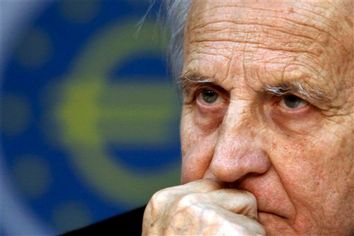
President of the European Central Bank Jean-Claude Trichet listens to a journalist's question during a news conference after a council meeting in Frankfurt, central Germany, Thursday, Aug. 4, 2011. The European Central Bank decided to keep the main interest rate unchanged at 1.5 percent. (AP Photo/dapd, Mario Vedder)(Credit: AP) France, Italy, Spain and Belgium are banning short-selling on select stocks amid efforts to calm market turmoil that has sent bank shares gyrating wildly and aggravated worries about Europe’s huge debts.
The European Union’s markets supervisor, the ESMA, announced the move late Thursday night after boosting surveillance of stormy markets earlier in the day. The move capped two days of whipsaw trading that saw French banks’ market value fall and rise by billions of euros.
In a short sale, a trader hopes to make a profit by betting on the decline in the price of a share. The practice has been blamed for contributing to market volatility.
Continue Reading CloseSarkozy lashes at U.S., defends Libya campaign
The French leader said Friday that France and Britain are carrying most of the burden
French President Nicolas Sarkozy speaks during a media conference after an EU summit in Brussels on Friday, June 24, 2011. The European Union said it would help Greece access billions of euros in EU development funds in an attempt to boost the country's struggling economy and sweeten unpopular austerity measures ahead of a tight parliamentary vote. (AP Photo/Michel Spingler)(Credit: AP) French President Nicolas Sarkozy derided the low U.S. profile in the international campaign in Libya, saying Friday that France and Britain are carrying most of the burden and will stay until Libyan leader Moammar Gadhafi leaves.
While other European leaders pushed Friday for some kind of political solution in Libya, the French leader strongly defended the NATO-led military operation — and NATO itself. He refuted comments by U.S. Defense Minister Robert Gates that the alliance’s future could be in doubt because of European reluctance to exercise military might.
Continue Reading ClosePage 1 of 3 in Angela Charlton