Ann Nichols

The dilemma of a cook who finally lost weight

I'm eating better after struggling to lose 30 pounds. Can I still serve fatty foods at my job -- and should I?

It is the consummate, diet-related cliché: “You can stop drinking, or smoking, but you can’t just stop eating.” You can, of course, stop eating; Gandhi used that strategy to magnificent effect. As a method of reaching a healthy weight, however, it’s frowned upon. What you have to do to lose weight is not to stop eating, but to stop eating the way you used to eat. I’m doing it, and it’s working, but it complicates the hell out of my life as a cook.

I’ve struggled with weight all my life, losing and regaining the same 30+ pounds several times. I established a pathetic pattern worthy of a medieval tapestry: the large woman stops eating (anything, carbs, second helpings and fast food), exercises (incorrectly, so intensely that she gets shin splints, until she abhors the sight of her Nikes) and becomes smaller. She buys tinier clothes, and basks in the admiration of all of the people who want to know her “secret.” She gets busy, stressed, cocky and inattentive and starts to eat like she used to, she becomes larger again, and in the final tableau she is folding her smaller clothes and putting them in bags to donate to Goodwill, and then pulling the larger versions from the back of the closet where she saved them for the inevitable.

This time, I used health and moderation as my guides. With the help of my beloved iPhone I make sure I eat the recommended daily servings from all groups (the artist formerly known as the Food Pyramid is now The Plate) and that my grains are whole, my dairy is low in fat, and at least half of my daily protein comes from a non-animal source. Using another app, I enter everything I eat, and it gives me not only a kind of profile of where I’m on and off the nutritional mark, but also a grade. Being the competitive person that I am, I am willing to do almost anything to make the disembodied Calorie Count God give me an “A.” If I enter butter and my grade drops to a “B,” I put olive oil on my bread instead, and receive an “A” and a star on my chart. Finally, there is a pedometer app that makes me want to park farther and take the stairs just to see the gratifying jump in steps taken. My phone and I have lost a lot of weight in just over 30 days without shin splints or a diet so restricted that I can’t eat among normal folk. This is good.

The sticky thing is work, where I am paid to cook fairly standard, American fare for a diverse group at a church. Although I read vegetarian cookbooks in bed at night, and my husband and I are planning a hydroponic vegetable garden so that fresh produce is available in the dead of a Michigan winter, I am not running a health food restaurant. My impulse is to share, to reform, to turn all white flour to wheat and all heavy recipes lighter. I’m not interested in the weight of anyone I feed; I simply burn with the passion of the zealous convert. At home I can easily balance my own eating habits with those of my husband and son — they eat burgers, I eat a Boca Burger. I make white wheat bread, I add butter and cheese to their noodles after taking my serving, and all of their various snacks are still in the house. To their credit, my boys are both good about trying the lentil-cheddar loaf, or the kale chips (once), and I see small and gratifying changes in their preferences and consciousness.

At work, I wrestle with the increasing disconnect between my own strong convictions about healthy eating, and my actual job. I believe that “all foods fit,” and that life without the occasional French fry, Alfredo or bacon would not be worth the living. I am still, after all, a devoted foodie. Mostly, though, I think we run better on healthy stuff. I thought about it last week in my work kitchen as I whipped bowl after bowl of heavy cream for an icebox cake. I had just eaten a modest dinner of grilled chicken, quinoa, salad and melon, and I was making artery-clogging death in a hotel pan for my “customers.” The dinner I served at work the next night was grilled brats, coleslaw and icebox cake. It was well-received and apparently delicious, but I ate none of it. A single sausage lowered my daily grade to a “B,” and one can only imagine the effect of adding coleslaw dressing and a mound of real whipped cream. I felt odd, sitting down at one of the long tables of diners to eat my leftover salmon, red peppers and sunflower seeds, but I wasn’t ready to give up the degree of control that has gotten me to this good place.

It’s been my bitter experience that it’s those “I can just have a little bit” moments that reverse the positive trajectory and send me plummeting into a morass of Oreos and self-loathing. But I can’t cook things without tasting them. I had to make sure the whipped cream had just enough powdered sugar, and that the slaw dressing was not too vinegar-sour. I will have to try biscuits for flakiness, cookies for dryness, mashed potatoes for butteriness and sauces for balance. Good cooks taste and adjust, taste and adjust. I am relatively safe for the rest of the summer since most of what I serve is grilled meat and fresh produce, but I am shaky about the fall and winter when the grill is retired, and I plan menus to please everyone from small children to octogenarians on cold, Midwestern nights. Will I tweak the menus, skewing then toward Cooking Light versions of classics and two kinds of veggies? Will people complain? Am I good enough to make the changes so smoothly that they can’t even tell? If I make their old favorites, how will I taste as I cook? Will I have to keep a “bite log” and enter every spoonful of soup, and every square inch of pie in my Calorie Count app? Even if I burn it all off in a brisk walk, how can I justify the addition of full-fat dairy and white flour to my pristine rotation of Greek yogurt and spinach?

If I had an unlimited budget I could plan meals for work around a lean protein deliciously napped with a chimichurri, or a balsamic reduction. Instead, I have a budget that calls for an abundance of cheap, filling pasta, rice or potatoes with small amounts of meat. It is also difficult for a lone cook to serve anything of the “fast, easy, fresh” variety to 100 diners at one time. There can be no stir-fries or sautés; whatever is for dinner has to be prepared in quantity, all at once. It will also become increasingly difficult (and expensive) to source really good, fresh vegetables as we move into fall and winter. At home I might slice a Hubbard squash, embrace it with a little sesame oil and grill it like steak; during my grill-less winter at work that is not an option. I know how to make soup from root vegetables, mashed parsnips, and carrot soufflé, but I am imagining the disappointed faces of small children and the disapprobation of my favorite geriatric gentlemen when they hear that they are having vegetable soup and wheat rolls instead of my beloved (heavy) cream of tomato soup and sweet, white yeast rolls. It is my job to feed them, to show them hospitality and love that fills a plate or a bowl. It may be my personal conviction that it is more loving to reduce their fat and sodium intake, but working at a church does not make me God.

I will make it work. I look with hope at the many slender celebrity chefs in the world, and tell myself that they can prepare highly caloric feasts seven nights a week, taste as needed, and remain camera-ready. I will probably look for lighter versions of the macaroni and cheese, the cream of tomato soup and the chicken and dumplings, and make sure that there are always two “clean” vegetables on the side. I may take the dramatic step of offering a bowl of fresh fruit alongside the chocolate peanut butter cupcakes and pineapple upside down cake. I love my job, and I love wearing pants that are a size smaller. I will make it work.

My “Top Chef” dreams go splat

I thought I was a culinary hotshot when I took a job cooking for a large church. Then I got my own dose of reality

As of today, I have had my job cooking at a large Protestant church for five months. I had imagined it as a kind of “Top Chef: Church.” In reality it tends to be more like a combination of “Upstairs, Downstairs” and some kind of circus in which animals are replaced with small children and the high-wire is represented by gigantic pots of boiling soup. I still love it, I still look forward to going in, but there is very little preparation of truffle-scented foam.

When I took this job, I was at a point in my life as a home cook that allowed me to watch “Top Chef,” “Hell’s Kitchen” and “Iron Chef” with a certain smug and informed confidence. It was, for me, like watching a sport that I could actually play.

“He’s going to go for a sous vide!” I would announce to my spectacularly uninterested family.

“Those scallops are overcooked — I can tell from here!”

I knew the secrets of roux that didn’t taste raw and flour-y, how to poach tender and flavorful chicken, and — my equivalent of the Hail Mary pass — how to make croissants, doughnuts and bagels from scratch. I could party with a spice rack like nobody’s business and present a finished product that spoke of Mumbai, Phuket or Puglia. In the same way that I had lived my childhood years as Dorothy Gale, Jo March and Anne Shirley, I was hitting middle age as Fantasy Chef, in the mold of Anthony Bourdain. Not French and effete, my secret self had tattoos, a pierced nose, Batali-bright cooking shoes, a foul mouth and a favorite late-night watering hole that served marrow and tripe soup.

As it turns out, I have not lulled so much as a single snail to eternal rest in a bath of garlic butter. There is no sous vide machine in the church basement, nor is there much call for truffle oil, Hawaiian sea salt, lemongrass or chutney. I cook for families, and not the kind of families that live in Manhattan and take their precocious children out for dim sum on Sundays. I am cooking for children who eat nothing “mixed” or otherwise arcane, for elderly folk who can’t tolerate spice like they used to, and everyone in the middle. I have a tight budget. I am, despite my fantasies, completely untrained, and I sometimes make awful mistakes based on a combination of optimism and ignorance. To wit: The scalloped potatoes that failed to “gel” and turned into potato soup, the grilled cheese for 100 people on the griddle that ranged from “torched” to “touchable” in the space of a square inch, and the broccoli cheddar soup that doomed four pots to spend eternity wearing an immobile scrim of vulcanized dairy products.

I am learning, all the time, but it is clear that the work I do is not like that of a restaurant chef working on a line and searing pan after pan of perfect quail breasts; it is far closer to catering or cooking for a school, hospital or all-you-can-eat establishment. Quantities are big, food has to be able to endure the steam table, and the lack of individual choice for diners means hitting the “happy medium” every time. I am not Anthony Bourdain; I am Chris Farley in a hairnet. I work with volunteers who are concerned that I will trigger the apocalypse by putting salad dressing on the table in its original containers, and I cook for funerals, cake auctions, parenting classes and women’s club teas. I know who likes Earl Grey, and which kids don’t eat any vegetables.

Last week there was a line-dancing class for senior citizens, which required me to hear “Boot Scootin’ Boogie” approximately 62 times, and a tornado warning that brought a parade of sleep-pinked babies from the second floor preschool into my basement to ride out the storm. Yesterday, my kitchen was the hub of a voting precinct and I spent the day dodging volunteers who wandered in to get a snack, or to chat with me despite those white cords hanging out of  my ears, and the fact that I was juggling 350-degree pans the size of Rhode Island. It is a circus of humanity, leaving me with a head full of dancing, white-haired ladies in matching sweat suits and ironically detached poll challengers wiping Frito dust on their tweed jackets.

There is no swearing (well, not much), no tattoo, no piercings and no after-hours drinking in this cooking life. There are spectacular failures, retorts bitten back, and the odd, impotent rage when things don’t go according to plan. I’m thinking that’s all stuff that every working person deals with at one time or another. On the other hand, the time-worn, broad and generous hand of fate, I get to put on a show at least once a week, create something from nothing, get a round of applause, and come home rich with stories, experiences and satisfaction. If I were really on “Top Chef,” I would have been instructed to “pack my knives and go” the first time the scalloped potatoes left the kitchen in soup bowls. In my kitchen, the glass may be full of Church Lady Punch instead of Malbec, but it is always, always half-full.

Continue Reading Close

A field guide to grocery store shoppers

From the OCD, the Tribes and the Hostiles, how to spot the wildlife in the miles and miles of aisles

A woman shopping in a grocery store

Every Saturday morning, even if Mercury is retrograde, we go to the grocery store. In this part of the world there is no such thing as Whole Foods, and the nearest Trader Joe’s is an hour away. We shop at Meijer’s Thrifty Acres, a Michigan-based operation that sells everything from food to auto parts. There is no artisanal cheese, lobster ravioli, free-range chicken, Tofurkey or cheap house reds; this is a Midwestern store with Midwestern values. (Like no Tofurkey). It has been a fixture throughout my life (aside from a brief relationship with Star Markets in Boston), and is at once sprawling, overwhelming and as familiar as home.

In the aisles of Meijer’s, I have seen the gamut of human types and behaviors; it is a fine microcosm of my community and of humanity as a whole (or, sometimes, as a “hole”). Everyone is trying to get something accomplished; some have a rigid plan, and others wander in a cloud of uncertainty. Some shop alone, others with an entourage of friends and/or family members. There are folks who beam their rays of love as they push their carts through the dog food aisle, and folks whose hostility and malevolence are palpable. As sociological research goes, a Saturday morning at Meijer’s is a bonanza.

Because we live near a large university, and many students live off campus and own (nicer) cars (than we have), shopping at or after 12:00 means that they will be found around every corner. At the beginning of the school year they come with their parents, collecting unwieldy piles of mops, storage containers and institution-size packages of ramen and Frosted Flakes. Mothers advocate buying vegetables and Clorox spray; fathers look mutinous and flee to the hardware section. The students are clearly counting the minutes until their parents have emptied their wallets and their SUVs and returned to the suburban comforts of home. Later in the year, clusters of roommates may be found in the soup aisle, blocking all legitimate traffic as they hold earnest debates about whether they really prefer chicken noodle soup or tomato. Sometimes, on the day of a home football game, a rangy herd of young men in sweats and backwards hats will lumber in to buy vodka and Cheetos, leaving behind them a trail of f-bombs guaranteed to shock all grandmas, mothers and other sensitive humans.

There are also parents with numbers of small children best suited to a TLC series, pushing low plastic carts with built-in DVD players projecting a continuous and jangling loop of animated chaos. Often, two children share the seat inside the cart, one trailing a foot in such a way as to exert maximum drag, and both whining about who put their sucker on the other’s snow pants. An infant will be perched in a car seat on the cart’s handle, and at least one other child will run alongside the cart nagging for eye-level cereals and dropping behind periodically so that the frantic parent has to choose between abandoning the other three to make a reconnaissance mission, or standing by the cart and yelling, “David? David?!” until the prodigal son returns with the sample of cholesterol-free turkey sausage he has cadged. I have, at various times, retrieved projectile bottles, pacifiers and baby socks from the floor and returned them to grateful and demoralized mothers and fathers; I only wish we could also send them on a spa vacation with their offspring left in the care of Supernanny.

The aforementioned Parent of a Thousand Toddlers is a varietal of the Tribe, a phenomenon in which it appears that not only every family member, but everyone living within a mile of one’s home, is brought to the grocery store. These bands often include people my age, their parents, their children, their grandchildren and mysterious duplicates at several age levels who could be siblings, cousins, parole officers or hitchhikers. These tribes take up most of the space in an aisle, and there is usually a large group clustered around the cart as if it were a wet bar, with satellites heading off to grab the actual groceries. Often, the majority of the group is not only un-animated, but appears possibly to have become zombies, while the remaining human in the group frantically gathers food before her own flesh is consumed. I have no idea why people shop this way; it is a rule in my own (small) family that no one talks to me while I am shopping, because I am Following My List and Counting the Total at all times. When I see someone I know (because there is no socially acceptable way to clue them in on the “don’t talk to me” rule) I surreptitiously write down my current total so that I will be able to resume after they have moved on.

My least favorite variety of shopper is the Hostile. For whatever reason, maybe a bad day or a bad life, these people view all other shoppers as potential combatants, and are not only willing but anxious to take visible umbrage. These are the people fluent in what my father calls “dragon breath,” the disgusted exhalation meant to be heard and understood by those who have gotten on the breather’s Last Nerve. Transgressions known to offend the Hostile include, but are not limited to, having a crying baby, being slow in the U-checkout, and accidental cart bumping. I have personally had the misfortune of tapping my cart accidentally against the cart of a Hostile while rounding a corner. After I said “excuse me” in my most winning way, I received the roll of an eye, the breath of dragons, and the dramatic departure featuring muttering about how “some people just think they rule the world” in a voice intended to be audible. Clearly there is some kind of pathology at work, but it just seems so much easier to smile and say “no worries” than to engage in major and protracted huffery. People do, after all, forgive those who cheat on them and injure them in accidents; what’s the big deal about miscalculating turning radius at the intersection of International Foods and Cereal?

As long as I live here, which will probably be as long as I live, I will be at Meijer’s every Saturday, following my OCD route with my OCD list. I will tell the undergraduates the difference between salted and unsalted butter when they ask, Rob will reach things from high shelves for me and my fellow dwarfs and midgets, and we will both smile sympathetically at frazzled young parents. Even if I have to listen to the Chipmunks singing “The Christmas Song,” followed by “Jingle Bell Rock,” I will strive to be a benevolent force in the aisles of Meijer’s. As for you, Hostiles of the world: All I am saying, is give peace a chance.

Continue Reading Close

The hypocrisy of the green-living bullies

Activists are guilt-tripping me about my food choices -- but the fact is, I'm just too poor to do what they say

Young woman shouting at another woman through a megaphone(Credit: Mateusz Zagorski)

A version of this post initially appeared on Ann Nichols’ Open Salon blog.

As a lefty/crunchy granola/pop-culture influenced foodie type, I am well aware that “green is the word.” I read Michael Pollan, Russ Parsons and Barbara Kingsolver. I watch the network entirely devoted to all things green, from Ed Begley Jr. installing solar panels and a rain barrel to Emeril teaching the clueless how to cook entire meals using only the vegetable section of Whole Foods. I’ve seen “Food, Inc.” and “King Corn.” I recycle, I repurpose, I always try to buy local, I shop at the farmers market, I covet the Prius, I make my own non-toxic cleaning products, and I just started composting. I am a (good) home cook, and prepare meals from scratch seven nights out of seven. Conceptually I am in. Way, way in.

Here’s the thing, though. It is very, very expensive to be green. The only eco-friendly things that I do that actually save money are making my own cleaning products, using cloth rags and napkins instead of buying paper, and using energy-efficient light bulbs. It may be TMI, but I will tell you that money is very tight around here these days, as it is for many people. I have a grocery budget, it is fixed, and I have, for years, been using the weapons of sales circulars, meticulous list, menu planning and creative cooking to make the money stretch to feed a big carnivore and a growing boy.

We don’t have a Whole Foods in these parts, but I hear from my more urban friends that there is a high price to be paid for all of that fresh, organic wonderfulness. I know firsthand that the small selection of organic produce available at our grocery store, the local health food store and the food co-op is much more expensive than “regular” produce at my grocery store, and that I pay farmers at the market at least 10 percent more per item than I would pay at said grocery.

During the growing season here, as cash flow allows, I buy all of my weekly produce at the farmers market. I love everything about it, from the contact with the farmers to the knowledge that my family is supporting local agriculture. (Plus, the food tastes better.) When cash flow doesn’t allow (and in the eight or nine months during which there is no local produce), I buy my eggplants, zucchini, onions and peppers at the large grocery store where I buy everything else. Because we live in farm country, much of what I purchase at the grocery store in the summer is locally grown. I still feel guilty.

I continue to feel guilty when I do not buy the line of grass-fed beef or free-range chicken sold at our grocery store because it is TWICE AS MUCH as the chemical-fed, tortured, ill-used animal protein I feed my family. I would, left to my own devices, solve that problem by being a vegetarian (I used to be). Neither my husband nor my son is willing to give up meat, and I am forever playing chicken (no pun intended) to see how small a quantity of animal protein I can put in our meals before they notice and complain. We have at least one meatless meal a week, usually two. What I cannot do is spend $7 a pound on chicken instead of $3.69, thus diverting dollars that are needed to buy other things.

The nervous tic near my right eye starts to twitch when I read statements by food pundits about how we are not used to paying what food is really worth, and we have become used to a McDonald’s and Walmart pricing system that makes us shocked at the prices of food that is produced in ways that are humane and earth-friendly. It’s undoubtedly true, but the reality is that I am a person working to balance a tight budget and a perpetually starving, adolescent son. My first duty is to provide abundant, healthy food for my child. If, to quote the Barenaked Ladies, “I had a million dollars,” I would be all over the grass-fed beef, the locally grown produce and the hormone-free milk. Until then, I buy what I can afford. And feel guilty.

The point of this rant, I guess, is that it is very easy to preach about the value of the grass-fed, the solar, the phosphate-free and the organic when you are in a position to afford it all — or willing to decide for yourself that you can live without cars, meat or a washing machine. My mother has wisely reminded me that much of the preaching is not directed at me; I already know and understand ecological “best practices,” and implement them as often as possible. The fact that I feel guilty when I make the choices I have to make is really my own issue.

What about the people who have less money than I do, though? What about the people who buy food from the dollar menu at McDonald’s because they lack the time and skills to spend the same amount on a roasting chicken, new potatoes and fresh aspragaus? What about the people who might save money if they drove a Prius, or installed solar panels, but who lack the funds? Is “being green” realistically the province only of the well-heeled and the folks whose lifestyles allow them to leave the grid completely? Maybe, until such time as the economic playing field is equalled a bit, there should be less bully pulpit and more compassion and assistance. I don’t honestly know whether that leveling is the role of government, the market, or both.

It will be a beautiful day when green choices are similar in cost to less green choices. I am deadly, earnest serious that I would be proud and happy to live in such a world. Until then, I can live without affluent and/or single-minded greenazis looking down their noses at those of us who still shop at regular grocery stores, drive gas-burning vehicles and commit various other sins against the environment as if we were intentionally throttling Mother Nature with our bare (chemically tainted) hands. I’m betting that my IQ and social consciousness are a good match for the best of them; all they have that I don’t is enough money to make payments on a Prius and spend $7 on organic dishwasher soap.

Continue Reading Close

Some love for the Waffle House

After driving by them for years, I finally stopped in, and the world became a better place

A version of this story originally appeared on Sprezzatura.

Waffle House is the unofficial flower of the Southern Interstate. Driving back north from the Gulf Coast on I-65, their yellow signs blossom in hamlets from Alabama to Kentucky. I’ve taken this route for years now, but my mother has thwarted every one of my romantic urges to pull in for a waffle, to meet locals and chitchat with a folksy waitress holding a coffeepot. Finally, this year, somewhere near Franklin, Tenn., I convinced her to give it a try.

On the way in, we were stopped by a gravel-voiced, sun-damaged woman in a Gatlinburg sweat shirt with silk-screened horses. “Where are y’all headed?” she asked, taking a drag off her cigarette. I told her we were on our way home to Michigan. “Must be snow there,” she said, “we’re out looking for snow.” We live with shovels and kitty litter in our trunks from October to April, so the idea of “looking for snow” was highly amusing, but there had been a rare blizzard across the deep South the day before, and apparently Ms. Gaitlinburg and her crew were really driving around looking for snow. We wished her safe travels, and found ourselves a booth.

The Waffle House menu is pretty straightforward except for the “World Famous Hash Browns 7 Different Ways” including “scattered, smothered, covered, chunked, topped, diced & peppered.” No mention is made of Doc, Happy, Sleepy, Dopey, Grumpy, Sneezy or Bashful. I decided to have waffles, since I was at a Waffle House, and to try the Famous Hash Browns in restrained fashion: scattered, smothered (with onions) and covered (with cheese).

As we waited for our food, I watched a young man named Esco working behind the counter. It was a tiny place, really, and Esco, with a thick drawl and the looks of a young Colin Farrell, was flirting with a carload of college girls wearing pajama pants and sweat shirts, on their way to Florida for spring break. “You don’t talk much,” he observed, speaking to the prettiest of them.

“I do when I have something to say,” she replied, smiling and fiddling with her fork. As his co-workers teased him about his sudden diligence about keeping the counter clean and the register area tidy, I wondered how often this happened to Esco, that he spent 45 minutes or an hour waiting on someone who captured his imagination and made his heart beat a little faster, only to have them get back on the Interstate on their way to someplace he wasn’t invited.

While watching this drama, I received my food, along with a cup of coffee. I am happy to report that the waffle was delicious — flavorful, crisp outside, fluffy inside and improved by the application of maple syrup. The hash browns were also very good — the potatoes were real; I watched them cooking on the griddle along with the onions. They involved not a little Processed American Cheese Food, which made for a lovely, mellow blanket for the potatoes and onions.

We finished and headed out to the car, dreaming of the day when I can order the hash browns all seven ways, only to discover the four college travelers lying on the ground with their heads under the front end of their car. I asked if they needed help, and they said that they had been involved in a minor accident and didn’t think there were any big problems except that a “thingie” was loose, and they weren’t quite sure what it was. Although my son knew what it was, and started to tell them, I gave him a stern look and did a “lock your mouth and throw away the key” pantomime. I saw a chance, in the untethered, unfocused course of a road trip, to leave the world a little better than I had found it.

“You know,” I said to the prettiest one, the one who only spoke when she had something to say, “I bet Esco could help you with this.” As we drove away, I could see our hero, rag in hand, crawling under the front bumper of the blue Chevy Malibu as the girls watched.

Continue Reading Close

Matzoh brei: French toast Passover style

As I child, I envied the kids who shunned leavened bread. But now I can share my recipe for sweet scrambled matzoh

A version of this story first appeared on Sprezzatura.

During Passover, Jews eat only unleavened bread to symbolize the fact that they had to flee Egypt before their bread could rise, and so the staple and symbol of the holiday is matzoh, the flat, cracker-like squares that blossom in the grocery store aisle alongside the gefilte fish and macaroons. Well, and the bubble gum; I did see a package of bubble gum the other day that indicated that it was “kosher and suitable for consumption at Passover.”

I love matzoh, and was always secretly jealous of my friend Ruthie Rome, who brought sandwiches on matzoh to school during Passover – peanut butter and jelly on matzoh, tuna salad on matzoh, egg salad on matzoh. It made her special and interesting, and implied a certain religious depth that was lacking in my own laissez-faire spiritual life. (I was also jealous of kids who got to leave school on Ash Wednesday and come back after lunch with smudges on their foreheads). I asked my mother if I could take sandwiches on matzoh in my lunch, since I was half Jewish and we did, actually, celebrate Passover in Ohio with her family. She shrugged and said that I could do that if I wanted to, but that it was really not particularly meaningful to eat matzohs only in public when I was showing off, if I then came home and ate regular bread and butter after school. Never give a sucker an even break.

We did have matzoh in our house before Passover, though, and we all ate them buttered or plain. At my grandmother’s house they were graced with her chopped liver, which was to die for. (Literally. Pounds of rendered chicken fat went into every Tupperware container of chopped liver). There was also the Matzoh Brei, which my grandmother made for her “boys’ who were a businessman and a surgeon. There was also plenty for her grandchildren, further proof that, despite our resolutely atheist father, we were among The Chosen People.

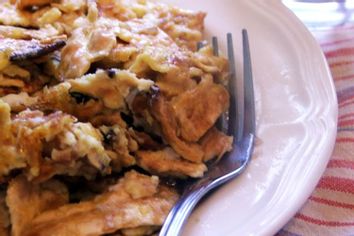
Matzoh Brei really is French Toast made with matzoh. There are people who make it fancy, or savoury, or flat like a frittata, and they are all doing it wrong. This is not really a matter to be discussed. You can be pretty loose about quanities, and you may substitute pan spray for butter if you really feel that you must, but I draw the line at adding onions, substituting egg beaters, or omitting the maple syrup. If you’re going to do that kind of stuff, you’re on your own.

Matzoh Brei for One (Starving) or Two (Not So Much)

2 eggs, beaten lightly
About 1 tablespoon milk
2 full sheets matzoh (preferrably egg matzoh), broken into pieces about the size of a matchbook, or smaller
Butter
Maple syrup

  1. Place matzoh pieces in shallow bowl
  2. Mix milk into eggs and pour over matzoh pieces; stir to coat. Allow to soak at least 30 minutes. [Note: a quicker alternative is to pour boiling water over the matzoh, place it in a towel and wring it out before placing it briefly in the milk and egg mixture. I find this messy and exhausting].
  3. In a sautee or frying pan, melt butter over medium heat
  4. When butter is melted and covers bottom of pan, add matzoh and egg mixture and stir gently, as you would scrambled eggs
  5. When all egg is cooked and nothing looks wet, slide mixture onto a plate (or two), top with syrup and enjoy.
Continue Reading Close

Page 1 of 2 in Ann Nichols