Anna Holmes

Why won’t this man blink?

Rapid blinking suggests nervousness or deceitfulness. So what does it mean when someone -- like Gen. Wesley Clark -- rarely bats an eye?

  • more
    • All Share Services

Why won't this man blink?

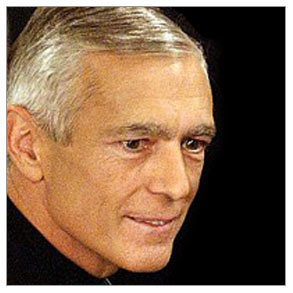
As everyone now knows, Democratic presidential candidate Gen. Wesley Clark is a retired Army general who served as the supreme allied commander during the U.S. military operation in Kosovo. But when I tell you that Clark doesn’t blink, I don’t mean that he doesn’t blink in the face of adversity (although for a war hero and big-shot military man, that certainly seems true). I mean that he literally doesn’t bat an eyelash, or does so very infrequently.

According to researchers, the average adult human blinks between 15 and 20 times a minute. That’s once every three to four seconds. But, according to my rough calculations, Clark blinks between two and four times a minute, once every 15 to 30 seconds. This may not seem startling in writing, but in action, it can be truly extraordinary, as can be seen in this clip available from Clark’s own Web site.

It’s so noticeable that the Clark campaign has even prepared a spin for it. “Gen. Clark is aware [that he blinks infrequently] and that’s just him,” says Bill Buck, Clark’s national press secretary, adding after a beat: “Basically, I’d say that the American people can rest assured that as president, Wes Clark, when facing down terrorists, will not blink.”

But blinking, it turns out, is a serious, strange business. Serious because it enables the gift of sight by helping to lubricate and clear our corneas. Strange because, like breathing, everyone does it but no one really thinks about it (unless, of course, you happen to be watching Malcolm McDowell get the eye-speculum torture in “A Clockwork Orange”). And most studies on the subject tend to focus on those who blink a lot and on what that means (very roughly, it tends to suggest someone is nervous or behaving in a deceptive manner). What it means when someone blinks infrequently does not appear to have been extensively studied.

But Clark’s unfluttered mien has been extensively noticed. “The guy never blinks. It’s as if he has no soul,” wrote one critic on the far-right Free Republic site. “His character is stellar … [and] he never blinks, which is admirable. I never blink either,” wrote a blogger (and Clark supporter) last month. The news media has pointed it out, albeit to a minor degree. “He rarely blinks his eyes,” wrote the New Yorker’s Peter J. Boyer in a profile of the general last fall. “He stands firmly in place, rocking back and forth on his toes and heels, and rarely blinks,” said Joanna Weiss of the Boston Globe. Even one of the general’s former West Point classmates, Gen. Robert Scales Jr., was quoted in the New York Times as saying of Clark: “He never blinks. I don’t think he has tear ducts.”

David B. Givens, an anthropologist and the director of the Center for Nonverbal Studies in Spokane, Wash., says that although it is common knowledge that people under stress blink faster, he knows of no studies done about low blinking rates. And, he adds, the fact that Clark blinks so infrequently in particularly high-pressure situations (like TV interviews) goes against the conventional wisdom. A 1996 paper published by Boston College psychology professor Joseph J. Tecce stated that the average blink rate for someone speaking on television goes up to twice the relaxed rate, up to 31-50 blinks a minute. “It’s pretty amazing because for a person giving a speech, a low blink rate is unusual,” Givens said. “It just shows that Clark’s autonomic nervous system is operating on a lower level. It’s not abnormal, per se, just not on the bell curve.”

It’s also very hypnotic, because once you begin to notice that Clark doesn’t blink, you not only can’t stopnoticing, but you also try to play along with him. Givens says this sort of imitation, called ixopraxism, is common in primates. Marc Schoen — a psychologist at UCLA’s David Geffen School of Medicine and a researcher in and instructor of hypnosis — said that the fascination with Clark is understandable. “I’ve never watched Gen. Clark speak, but if someone is sort of just gaping, looking straight ahead, it could definitely have a trancing effect on the people looking at him,” he said. “It also shows that Clark may have an amazing ability to focus and not be bothered by external distractions.”

Christopher Carter, a well-known mentalist and stage hypnotist, told me that the mesmerizing effect of a stare is both seductive and threatening, that it can be likened to the interaction between a predator and its prey. “Being stared at is a very intimate act, and whether someone taught Clark to not blink or he knows it instinctively, he certainly could have a lot of control over other people’s behavior,” Carter said, laughing. “Although eye contact has fallen out of favor with hypnotists, you’ll find that the eyes play a big role in the folklore of hypnosis. Svengali, after all, was a hypnotist, and he was often depicted with lightning bolts coming out of his eyes.”

The idea that Clark’s slow blinking could be a learned behavior was both fascinating and disturbing, so I called up Col. Thomas Kolditz of the U.S. Military Academy at West Point, from which Clark graduated in 1966. Kolditz, a social psychologist and the head of West Point’s department of behavioral sciences and leadership, made it clear to me that he knows nothing about Clark’s specific experience at West Point and that nothing in the school curriculum focuses on blinking. He did say, however, that the customs and traditions at the academy reinforce the importance of eye contact between persons, and that cadets regularly practice public speaking in everything from English to mathematics classes. “It could be that [Clark] has practiced [not blinking] somewhat,” said Kolditz with a laugh. “But it could also come down to something as simple as his tear ducts.”

Tear ducts may, in fact, have something to do with it. Dr. Joseph Kubacki, chairman of the ophthalmology department at the Temple University School of Medicine, told me that blink rates vary according to one’s level of concentration (the higher the concentration, the lower the rate), the thickness of one’s tears (the thicker the tears, the fewer the blinks, for the most part), and age (babies and young children blink a lot less than adults). “Maybe [Clark] has always been that way,” Kubacki told me. “The only disease I know of in which people blink infrequently is Parkinson’s, but that’s due to a lack of motor skills.” I giggled nervously and Kubacki backtracked a bit. “Don’t quote me as saying that I think Clark has Parkinson’s, OK?”

Clark’s low blink rate probably doesn’t augur a descent into debilitation, but it does serve as a sort of double-edged sword; he can come across as intensely focused and calm but also robotic, more reptilian than mammalian. It can seem creepy, because, as Givens explains, primates express emotion and an arousal of the nervous system by blinking more. “My husband was just commenting on Clark’s unusualness,” wrote a woman on John Kerry’s official Web site last week. “Clark never blinks. It creeps [my husband] out.” Kurt F., a 44-year-old Virginia architect who posted a comment about Clark’s blinking on his blog last fall, told me that he remembers feeling vaguely uncomfortable whenever Clark appeared television but he couldn’t put his finger on exactly why. “Then last fall, Chris Matthews mentioned something about Clark’s not blinking on ‘Hardball,’” he said. “And I thought, ‘My god, that’s it!’”

There’s no doubt that right-wing pundits and opinion makers would be more than happy to use such statements as ammunition against Clark (“Hardball” guest Don Imus called him a “psycho” just a few moments before Chris Matthews commented on his not blinking). But conservatives have a lot to answer for when it comes to the blink rates of their own candidates. If, as asserted, a high blink rate signals deception or stress, then the Republicans have done a lot to seem mistrustful and manic. During the fall 2000 presidential debate, for example, the Hartford Courant’s Susan Campbell counted the number of times Al Gore and George W. Bush blinked. Bush won (or, rather, lost), with a final tally of 2,867 to Gore’s 1,808. In 1996, Bob Dole entered the annals of presidential-debate blinking history when, after being questioned about the nation’s economy, he hit a blink rate of 163 a minute. And Richard Nixon’s blink rate increased markedly during the Watergate hearings and press conferences.

But although Clark’s low blink rate commands attention, it can also blind some culture watchers to the content of his message, which does not necessarily bode well for his campaign. “You can’t hear what he’s saying anymore because you’re just watching his eyes and waiting for him to blink,” said Kurt F., the blogger architect in Virginia. “It’s like visual noise.” Joyce Newman, a well-known media coach in New York, says that she’s had clients who blinked too much, but never the opposite. And however much of a liability not blinking could be, she said, she would never coach a client to blink more. “Then they’d be focusing on their blinking and not the conversation. You can’t change a behavior like that,” she explained.

Cashing in on cord blood

Private companies are charging thousands of dollars to collect newborns' stem cells.

  • more
    • All Share Services

Cashing in on cord blood

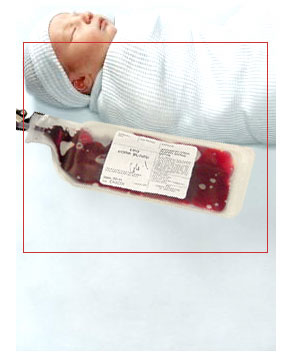
“[It has] a perfect marketing plan, a product you can’t not buy, assuming you can afford it and you find out about it in time.” So wrote Josh Goldfein, a New York lawyer and writer, in the New York Times Magazine this past July. Goldfein wasn’t referencing TiVo or the Segway scooter, but the fairly new and rapidly growing industry of private cord blood banks, which profess to offer a sort of biological insurance for the newly born via a deceptively simple idea: store the blood from your baby’s umbilical cord (rich with stem cells) and you may have the material you need to cure his or her future diseases. And although Goldfein is admittedly unimpressed by the pressures these private companies put on expectant parents — “I think [these companies'] entire marketing strategy is based on fear,” he says — in the end, he did bank his newborn son’s blood.

With 4 million births in the U.S. each year, cord-blood banking is becoming a big business, with dozens of private banks in the U.S. alone, and more on the way. ViaCord, one of the country’s largest private cord-blood banks, sends brochures to Ob/Gyn offices around the country, and takes out expensive glossy advertisements in magazines like Fit Pregnancy. So does competitor Cord Blood Registry (CBR), which has also run television spots on new-mommy-friendly shows such as TLC’ s “A Baby Story.” CBR even advertises the fact that well-known pediatrician Dr. Robert Sears has stored his children’s cord blood with the company, and last month, it hired celebrity reporter and TV personality Leeza Gibbons as its new spokesperson.

All this fancy advertising is indicative of a fancy price, of course. The cost of the initial processing of cord-blood can run up to $1,500, and that’s not all: with an added fee of approximately $90 per year for storage, just 10 years’ worth of maintaining a baby’s cord blood can add another $1,000 to the bill. But out of optimism, paranoia or a sense of duty, thousands of anxious parents-to-be are forking over their cash to such privately owned and run cord-blood banks. And it’s the steep cost — coupled with the very remote probability that the cord blood will ever be used by the family that banks it — that has some critics shaking their heads.

The American Academy of Pediatrics, for one, released a statement in 1999 that cast a dubious light on the for-profit industry. Given the current technology (which does not support a particularly wide range of uses for cord blood), the academy wrote: “… private storage of cord blood as ‘biological insurance’ is unwise.” The American College of Obstetricians and Gynecologists’ position, outlined in 1997, stated that although cord blood transplants “seem very encouraging,” “until there is a fuller understanding of all of these issues, we must proceed with considerable circumspection. Parents should not be sold this service without a realistic assessment of their likely return on their investment.”

“It’s about people’s tolerance for risk,” says Goldfein. “It’s insurance. It’s preparing yourself for the risk of a bad thing happening. I think the biggest question mark about the whole [industry] is that a lot of the medical benefits you can derive from cord blood don’t yet exist, and you’re taking a leap of faith that the cells you save now will be useful in the future.”

But what are those medical benefits, actually? First off, it’s important to clarify exactly what cord blood is, which is the blood that is found in a baby’s umbilical cord and placenta after the cord is cut following birth. That blood is full of stem cells, which are essentially the building blocks of a body’s blood and immune systems, and researchers have used such stem cells to regenerate these systems in sick patients. Indeed, some people have been successfully treated with stem cells for a myriad of conditions, including leukemia, genetic metabolic diseases, immune deficiency diseases and blood disorders such as sickle cell anemia. Some researchers are hopeful that technology will advance to the point where cord-blood stem cells will be able to treat all sorts of different types of cancers, as well as diseases like Alzheimer’s and diabetes. Maybe one day, stem cells will even be used to grow new organs.

But that hasn’t happened yet, and there’s no assurance that it ever will. “Currently, cord blood transplants are performed on patients who have a blood cancer or genetic disorder where the patient hasn’t responded to traditional therapies,” says Dr. Liana Harvath, deputy director of the National Heart, Lung and Blood Institute’s division of blood diseases and resources. “And it’s extraordinarily rare that a cord blood transplant would occur in which a newborn’s cord blood is given back to the same donor.”

This is because the very blood that was saved could be the same blood that caused the disease in the first place. “Most of the kids who need transplants that could involve the use of cord blood will have a genetic disease in which you couldn’t use their own blood because the kids might just get the same disease [all over again],” explains Dr. Cladd Stevens, medical director of the cord blood program at the New York Blood Center, the largest public cord-blood storage center in the country. “Take an instance in which a child develops leukemia later in life. There is good evidence that these kids have the leukemic cell in their blood at birth.”

Rather than paying thousands of dollars to store cord blood for a child who will probably never use it, Stevens and other public-health advocates recommend that new parents donate their child’s cord blood to a public bank, where it can be used by anyone who needs it (much like a bone marrow donor program). The New York Blood Center, for one, has collected cord blood from almost 22,000 babies since 1993 and has given cord blood to more than 1,400 patients around the world. But the problem that the public banks encounter is their accessibility to potential donors, who must be geographically close to the banks they want to donate to. “We’ve gotten calls from mothers saying they want to donate their child’s cord blood but there’s not a program near their hospital,” says Harvath. “Not all regions of the country have public banks yet.”

This was the problem for Christine D’Amico, 38, a life transition coach and author of “The Pregnant Woman’s Companion.” D’Amico and her husband wanted to donate their second child’s cord blood to a public registry three years ago but were dismayed to find there was not one close enough to their San Diego home. So with their third child, born a month ago, they chose a private bank. “My opinion is that donating [to a public bank] is probably better because someone can get access to it immediately and use it,” says D’Amico. “And the private banks are expensive. But I also thought, who knows what amazing things doctors will be able to do in the next 20 years with this really valuable body fluid, and wouldn’t we be pissed off at ourselves if we didn’t take advantage of it?”

Expectant parents who are considering cord blood banking and don’t know whether to chose a public or private bank should take into account their finances, their family medical history, and whether or not a public cord blood bank is nearby. If you are considering a private bank, Dr. Harvath advises asking company representatives how many units of cord blood in their bank have been successfully used in transplantation (of 50,000 units at CBR, for example, 27 have been used in transplantation, although no figure is available as to the success of those procedures). She also recommends asking whether a bank has been accredited by a professional organization such as the American Association of Blood Banks. “My message has always been for consumers to be aware and weigh the facts,” she says. “It’s like any other kind of emerging technology.”

Fran Verter, a NASA employee who lives in Maryland and is the co-creator of the Web site ParentsGuideCordblood.com, became interested in cord blood after her daughter Shai developed leukemia (Shai died in 1997 at the age of 4 and a half despite a bone marrow transplant). It was her daughter’s diagnosis — and Verter’s need to educate herself about leukemia and its possible treatments — that introduced her to what she calls the “complex subject” of cord blood. Shocked that there were so few resources available to parents who wanted to educate themselves about cord blood — Verter says that even her doctors knew little about it — she began to research it herself, and the idea for a Web site soon followed.

Verter’s site does not preach the value of private banks over public, or vice versa, although she’s a front-row witness to the mutual skepticism that private and public banks have toward each other. “The private banks exaggerate a lot in their literature, making it sound as if you can use a baby’s cord blood in case the baby gets cancer, which really isn’t true,” she says. “And the public banks like to emphasize the unlikelihood that cord blood will be used from the child from which it was harvested. There’s a certain amount of propaganda on both sides.”

With no federal regulations on private cord blood banks, and so little unbiased information available to the public, it’s up to doctors to wade through the hype and help expectant parents make informed decisions. Dr. Gary Goldberg, an obstetrician/gynecologist at New York Presbyterian Hospital Cornell Medical Center, says he is a “big advocate” of cord blood banking, and usually broaches the topic with his patients at around the 32-week mark (the same time he brings up finding a pediatrician). “The information we have suggests that the potential for the use of cord blood in correcting problems like diabetes and Parkinson’s and spinal cord injuries is only going to grow. The research is still in its infancy but it’s really exciting.”

Goldberg displays brochures from private cord blood banks in his waiting room. As for some companies’ marketing tactics and high costs, he is sanguine. “I think in a capitalistic society it’s unavoidable,” he says. “I think that these companies call in the spin doctors and make themselves and their products sound like the best thing since scrambled eggs. [With regard to cost], the way I describe it to my patients is that the two leading companies are the most expensive because they have to fund their research. My concern about [the smaller and cheaper] companies is, will they be around in the long term and if not, what will happen to the blood that they had?”

Some new mothers have extremely personal — and pressing — reasons for paying the high costs associated with private banks like CBR and ViaCord. Take Amie Gbelawoe, 27, an actress in Los Angeles, who gave birth to a daughter, Luna, in early May, and banked her daughter’s cord blood with one of the large private banks. “I first learned about cord-blood banking through reading pamphlets in my doctor’s office and there was no doubt in my mind: I was absolutely going to do it,” says Gbelawoe. “It seemed like an amazing opportunity, and I’d rather be safe than sorry.” Gbelawoe decided to store Luna’s cord blood because her husband Ramsey suffers from sickle-cell anemia. Although their daughter only carries the sickle-cell trait, theoretically, her blood could be used to help treat her father’s disease someday.

Few dispute that, given new and emerging technologies, cord blood is a potentially life-saving resource for families like the Gbelawoes. Dr. Stevens of the New York Blood Center says that she thinks that cord blood has a big future. But she and others express concern that some cord blood companies are diverting potential public donations to their own private freezers, where the blood will be of no use to the public and of unlikely use to the depositor.

“The major part of [these companies'] business is speculation,” says Stevens. “They have big campaigns, and of course they play on people’s emotions: ‘There’s a one-time chance to do this.’ It has a pretty strong emotional appeal. But what if a family finds that they need their cord blood but the bank can’t find it? Or what if the bag of blood broke? Or what if the unit of blood is too small for a transplant? In my mind, it’s kind of a crazy business.”

Sara Brown, 31, a public-school teacher in the San Francisco Bay Area who is expecting her first child in December, was turned off by the aggressive marketing tactics used by the private banks. “I saw an ad in a baby magazine that made it sound like you’d be a fool or a bad parent if you didn’t do this. It just seems like these companies are taking advantage of people in a vulnerable position. I have faith that science will have other treatments and cures for the sort of diseases that cord blood could possibly be useful for.”

Although some professionals and parents suspect that companies like ViaCord and CBR are simply preying on the fears and anxieties of expectant parents, the companies themselves are, of course, inclined to disagree. “Unfortunately, you have to address the subject of health even before a baby is born,” says Stephen Grant, vice president of communications and cofounder of CBR, which currently stores about 50,000 samples. “Twenty-eight percent of our customers are healthcare professionals [themselves]. It may not be a necessary [procedure], but that doesn’t mean it isn’t wise or prudent.”

Wise or not, the cord-blood banking industry has yet to be regulated by the FDA, which considers cord blood use experimental. “This is a whole new field and it’s taken a long time for the FDA to figure out what measures they need to assess in terms of quality,” says Dr. Stevens of the New York Blood Center. The FDA hopes to start regulating cord blood banks next year, and there is a bill (HR2852) pending in Congress that, if passed, would create a national network of public cord blood banks. “If it passes, it will change the landscape,” says Fran Verter. “It would make public banking a lot more accessible. Right now the public banks have about 58,000 donations and this legislation proposes to create an inventory of 150,000. I have my fingers and my toes crossed.”

Continue Reading Close

In grossness and in health

Psycho-dermatology, female gorillas, and why women love to pick their boyfriends' zits.

  • more
    • All Share Services

“One of the signs that a female gorilla is in love is that she can be seen picking nits off her male companion.” So said “Sex and the City’s” Carrie Bradshaw in a recent episode of the hit HBO series. Although these words of wisdom — written by SATC staff writers Julie Rottenberg and Elisa Zuritsky — were being used as a metaphor for overly critical women, they nonetheless touched on an issue I’ve been wondering about for a while. Namely, why exactly women love to pick at their partners. And I mean picking, in the literal — not metaphorical — sense. As in: skin, hair and nails. As in: popping, squeezing, sloughing, scraping, trimming. No one admits to it (unless, well, pressed) but almost everyone does it.

Julia M., a 25-year-old architectural designer in southern Connecticut (who, like most of the women interviewed for this article, asked that her full name not be used) has been involved in a serious relationship with her computer-programmer boyfriend, Dave, 23, for the past two years, a union that includes cooking, cats, and lots of picking. Although Julia also directs her picking behaviors at her own skin (particularly her face), she finds going after her boyfriend’s blemishes, facial hair and yes, even toenails, supremely satisfying. “It’s difficult to explain, but picking at Dave and removing his blackheads or ingrown hairs makes me feel like I’ve done something useful … something good.” Other women concur. “It’s like you’re fixing something, getting some sort of closure,” says Gail (not her real name), 32, a fiction writer living with her boyfriend Peter in Brooklyn. Adds Rebecca D., 32, the general manager of an upscale sex-toy retailer in the Pacific Northwest: “I feel that by squeezing his blemishes I’m eradicating some sort of fault, cleaning him up, fixing him and making him more perfect.”

To the uninitiated (and even many of the initiated themselves), inclinations such as Julia’s, Gail’s and Rebecca’s might sound like grotesque, obsessive fetishes, but such behavior is in reality perfectly normal, say cultural anthropologists and primate specialists. Helen Fisher, author of the bestselling “Anatomy of Love: Mating, Marriage, and Why We Stray” explains that, among hunter-gatherer societies, the brains and physiques of females are simply better at the fine motor-coordination necessary for good grooming (and other skills such as berry-picking and textile-making). “In primate societies, females groom more than males: their children, their relatives and individuals that they are going to copulate with,” she says. “And they’ll do it for hours.” Fisher speculates that, in addition to promoting cleanliness, grooming serves as a way for women to connect to a man and keep him, because touch involves increased levels of oxytocin, a hormone long associated with attachment (it goes into overdrive after a woman gives birth, for example, the better to bond with her baby).

Dr. Robin Dunbar, a professor of evolutionary psychology at the University of Liverpool and the author of “Grooming, Gossip, and the Evolution of Language,” says that the chief manner in which primates regulate their relationships with one another is through grooming, whereas we more evolved humans rely on verbal and written language. “Relationships are negotiations and we use many devious ways and wiles to get close to members of the opposite sex,” he laughs. “At the end of the day, grooming and language are part and parcel of the armory we have to facilitate and build relationships.” Language, he says, is “a very inefficient mechanism in terms of making the social wheel go ’round. Grooming is a much more powerful way of conveying a sort of emotional state; nothing you can say verbally can compare with what you say through touch.”

What exactly, though, are we trying to “say” when we engage in blemish picking and hair pulling of others? Experts in the fields of psychiatry and psychology (who refer to such behavior as “psychogenic” or “neurotic excoriation”) differ on this issue. “At the most superficial level, all of us have a fantasy that if we pick these things off, we are improving ourselves and others,” says one prominent Philadelphia-based dermatologist/psychoanalyst who asked not to be named. “And I think it’s part of the care-taking aspect of women’s personalities: It’s like how people are fussy about putting their children in nice clothes; picking at others to make them blemish-free is a sort of narcissistic extension of the self.” This same doctor also wonders whether there isn’t some sort of ritualistic/purification element at play, and hints at issues of sadomasochism. Just as obsessive-compulsives engage in rituals such as hand washing in order to master their anxiety, picking may be a “rather soothing thing in a frenetic life.” In addition, she adds, “Although there are no studies behind this sort of behavior that I’m aware of, I do wonder if these sorts of pickers aren’t just transferring the pleasure of picking at themselves to some other person in a sort of sadistic fondling.”

Dr. Fred Penzel, a psychologist and expert on dermatological obsessive-compulsive disorders such as trichotillomania (compulsive hair-pulling), laughs off psychoanalytic theories and the experts who espouse them. “The field of psycho-dermatology has gone nowhere,” he scoffs. “It’s just a bunch of people trying to come up with psycho-sexual interpretations of why people do this sort of stuff. It’s all symbolism with them, like interpreting poems and literature. In psychology we sort of look at the whole picture, both behavioral and biological, and believe that these compulsive behaviors are neurobiological and maybe even genetic.” One theory that Penzel is pushing lately is that people use certain grooming behaviors as means to calm themselves during times of stress or anxiety or to provide focus while feeling bored or sedentary. Although these behaviors are most often self-directed, they are sometimes also performed on other people, even animals and objects. “Of course I’ve had patients who mention that they pick at their spouses. I also know people who pull threads out of clothing and furniture, or whiskers and fur out of their pets,” says Penzel. He adds that there is scant research on such other-directed groomers. “People don’t talk about these sorts of things.”

What is known, even without reams of research, is that imperfections and blemishes on the skin are highly fascinating. Dunbar, the evolutionary psychologist, says that most primate species are “absolutely enthralled by” blemishes, moles, and other flaws on the skin. Dr. Frans de Waal, a primatologist with Emory University’s Yerkes Primate Center, likens a primate’s desire to pick at the skin as just as instinctual as his appetite for food and sex. “If I have a scab on my hand, for example, I have to keep it out of the reach of the chimps because they will start smacking their lips and focusing their attention on it because they want to get at it,” he says. Our human counterparts can get just as excited, he adds. “I’ve heard of women talk about [picking at others] as an almost orgasmic experience,” he says. Indeed, one woman writing in New York-based Vice magazine’s January 2002 issue (in an article titled the “ABC’s of Guilty Pleasures”) explained that she had to promise sexual favors to her boyfriend in order to get access to his blemished back, then went on to say that the practice of squeezing his blemishes was “one step lower than an orgasm.”

The, ahem, symbolism of pressing out sebaceous material from a pore in the skin is hard to ignore. “If a woman is squeezing something and there’s material coming out of the skin, surely a sexual similarity is in play,” says the dermatologist/psychoanalyst from Philadelphia. “There is an undeniable buildup of tension and undoubtedly an orgasmic component to the release. I’ve even had nurses who admit they really ‘get off’ on removing blackheads.” Pimple-squeezing can even get in the way of actual sex, says Julia M. “I will say that Dave and I have had to stop having sex before because I’ve become so obsessed with getting a pimple,” she confesses. “We’ll be in the midst of foreplay and I’ll see something on his face and become fixated. I can’t stop looking, and I can’t think about anything else.” One magazine-writing colleague of mine, Nanette (not her real name), 32, admits that with one ex-boyfriend, she was more interested in picking at his back than in having sex with him. “I jumped on his back with a certain zeal and enthusiasm that I can’t say I had with regards to sex.” (She still misses the pimples, although she’s now involved with a blemish-free boyfriend). As Dr. Brad Katchen, a dermatologist and founder of the hip Manhattan spa SkinCareLab delicately put it, “Perhaps there’s a playful sort of gratification in the extraction … the mechanical process of release is kind of just, you know, fun.” So fun, in fact, that some pickers have become professionals in the process. Nina Gromov, 52, an aesthetician for the Le Boe Day Spa in Coral Gables, Fla., admits that she got into the business of blemishes because of her love of “extractions.” “Ah, yes, I love picking and I’ve always loved it,” she says excitedly. “My grandmother had a lot of blackheads and hairs and I just loved to pick on her skin and back. It was my dream to become an aesthetician and work with skin, and I love what I’m doing.” Gromov adds that most of her friends in the skin care business have been passionately picking at others since childhood.

If, unlike the picking enthusiasts quoted above, you’re not turned on by blackheads and whiteheads, you’re not alone. Many friends, colleagues, and acquaintances who heard about this story reacted with swift and damning derision, peppering my e-mail inbox with comments like “Gross!”, “SICKO!” and “I am totally revolted.” (“This must be a joke,” wrote one ex-porn star I correspond with sometimes. “Oh my god!” e-mailed an editor. “You is nasty,” complained an art director, who then contradicted herself by adding, “Don’t forget peeling sunburned skin … it’s just as fun!”). Even the women who knew what I was “getting at,” so to speak, expressed a sense of shame with regard to picking and pulling (the word “guilty” popped up time and time again). “Being quoted about this grosses me out for some reason,” said a 31-year-old New York law student. “Please change my identity to protect my insanity,” said another, who went on to describe in excruciating detail just how she takes a Tweezerman to her hirsute honey’s shoulders and back.

Although they couldn’t articulate exactly from where their sense of shame stems, pickers had plenty to say about why they do what they do, and the majority alluded to the intimacy of the act. “Dave is the first guy I’ve trusted enough to reveal what I consider to be a gross compulsion,” says Julia M. “I certainly felt the desire to do it on other men, but I didn’t because I didn’t know them well enough. And the fact that I can do it to Dave and he won’t reject me, that he accepts that I do it, makes me feel really loved.” It’s as much about loving as being loved, say other women. “When you’re in love, nothing about the other person’s body is gross, including their blemishes,” says Gail, the fiction writer. “They are kind of an extension of yourself.” Jackie, a 35-year-old health care marketer on Long Island, says that the picking of her partner (now husband) began within the first year of the relationship while the couple cuddled and stroked one another (she came across an ingrown hair in his beard). “Paul was my first, very serious close relationship,” she says. “And I haven’t picked at anyone else, except my mother, when I was young.”

As one expert intimated, such intimacy involves a certain amount of manhandling and possessiveness. Gail says that she enjoys her live-in boyfriend’s submissiveness with regard to her picking, which she usually initiates in bed. “I’ll tell him to turn one way or another, and he’ll comply and even keep on reading while I pick,” she giggles. “I feel kind of proprietary towards him, like ‘this is my person, and I get to pick at him!’” Some guys even — gasp! — enjoy the once-overs. “My ex used to [pick] all the time,” says a 30-something acquaintance named Philip, a technology consultant in New York. “Most of the time, I thought it was hilarious, and I actually appreciated it because she was really good at it. My skin has certainly gone downhill since we broke up.” Biore-Strip-aficionado John Halcyon Styn, 32, a Web developer from Southern California, says that blemish-picking is evidence of a significant stage of intimacy in a relationship. “Skin blemishes are in the same family of horrific, embarrassing things, like peeing with the door open, that you can only go through with an intimate partner,” he says, adding that although he loves it when a girlfriend picks at him, “it’s nowhere near as satisfying as getting at it yourself.”

Continue Reading Close

Girls in heat

The third season of HBO's "Sex and the City" is going for the groin as well as the brain.

  • more
    • All Share Services

Girls in heat

On May 25, David Letterman welcomed actress Sarah Jessica Parker onto the set of his zany late-night talk show with a warm, lingering embrace and sweet nothings whispered in her ear. A few minutes into their interview, a Ferris Bueller-like smirk crossed his face. Apparently Letterman had in his possession the promo for the new season of “Sex and the City,” Parker’s hit HBO series and, judging by the way he squirmed in his seat, he was also extremely taken with it. (Luckily, he has a desk to sit behind.)

“Sex and the City” first aired on HBO in 1998, a creation of “Melrose Place’s” Darren Star based on Candace Bushnell’s New York Observer column of the same name. The show quickly attracted a cult following of “Arli$$” haters and “Larry Sanders Show” leftovers. During its second season, however, the show became a full-fledged phenomenon among young, professional females: Women began explicating dialogue and plot lines over cocktails; they planned “Sex and the City” viewing parties; often, they so identified with the show’s depiction of single-girl life they went as far as to cast one another in the show’s lead roles (“I’m Miranda and you’re Charlotte!”). Last year, the show was nominated for two Emmys and won two Golden Globes, one for best comedy series, further heightening its profile. And last week, TV Guide not only did a cover story on the show, but offered readers a choice of four “Sex and the City” collector’s covers from which to choose, calling the show “a bona fide smash” and “pop culture touchstone.”

But back to Letterman. The promo he so snickered over depicts Parker as an oiled-up, sexed-up, glamour goddess sashaying down a traffic island in Times Square wearing nothing but a gold bikini. Certainly, with her lithe, curvaceous figure and perfected pout, Parker is quite the looker. But more intriguing than her good-girl-gone-raunchy romp was Letterman’s schoolboy-with-stag-film reaction, which underscored the fact that the show’s producers, not content with merely capturing America’s eyes and ears, have been going like gangbusters for its groins. In Manhattan, billboards advertising the series show Parker clad in a tight black dress emblazoned with the image of a very white, very large, very … vertical Empire State Building.

The sexual saturation seems to be rubbing off on cast and crew as well. A few months ago, a member of the directing crew made a pass at a reporter visiting the set for a magazine story on Parker. “I’m sure there are a hundred tales to be told from that set,” laughs the reporter. “It’s coed. There are young beautiful men and women everywhere.”

Along those lines, last week we caught actor John Corbett canoodling and clinking beer bottles with actress/model Bridget Moynihan at a Chelsea watering hole. (Moynihan plays Mr. Big’s new wife, Natasha; Corbett plays an object of Carrie’s affection beginning in Episode 5.) Corbett was so inspired, it seemed, by his portrayal of the amorous Aidan, that he pulled down his jeans in front of this reporter to prove that he wasn’t wearing underwear, adding that he was having the time of his life on the set. Ah, yes, summer in the city.

The June 4 premiere, titled “Where There’s Smoke,” exploded like a flame in an oil drum. In it, the slutty Samantha (played by Kim Cattrall) busts a move with a brawny firefighter who, true to he-man form, throws her up against the back of a fire engine and takes her standing up. The aforementioned scene, which could have been lifted straight from some late-night Cinemax softcore booty ball, elicited gasps and giggles from viewers. Days after the episode aired, women were still congregating by water coolers and in stairwells, sniggering with delight.

“The show is definitely more crass and has become more of a fantasy than it was,” says ex-sex columnist Amy Sohn. author of “Run, Catch, Kiss.” “The truth of the matter is, when I sit down with my female friends we talk about how we feel, and the tenor of the conversations is not that X-rated. So to women it’s alluring because we would like to think we’re as salty as the women on the show are. And at the same time it functions as a fantasy for men because men are really easily aroused when women talk dirty.”

Blame it on the show’s creators, who have written the Kim Cattrall character of Samantha Jones as the brazen hussy to end all brazen hussies. “I don’t think a guy has ever gotten me that wet,” Samantha gushes to the girls after the aforementioned fireman fling. “And let me tell you about his cock!” In fact, if episodes 1 and 2 are any indication, this is the season Cattrall, 43, will finally shrug off the monkey that was “Mannequin.” Her role not only demands precise comic timing and sharp delivery, but nerves and buns of steel as well (she seems to disrobe in every episode).

“Kim is absolutely amazing. She just purrs in that role,” says Degen Pener, entertainment editor for Details magazine and an avid fan. “She likes to get it and she likes to get it a lot. And she’s not apologetic about it.” Cattrall is such a knockout — in talent and titillation — that the show’s producers may have a Christine Baranski/Cybill Shepherd situation on their hands if she continues to upstage Parker.

But forget the great one-liners and you’ve still got a show that consistently raps the upper registers of the raunch radar, if only because of the peculiar predicaments it presents. Take, for instance, anal sex. Or what to do when your lover’s penis is too big (smoke a joint and pray for the best). Or the best way to respond when your charming and attentive new boyfriend wants to take a shower with you … and get peed on. As the show’s creators seem well aware, cross-dressing and blowup dolls are passi, too 20th century. Real men nowadays want it all: the beautiful woman, the successful career, the golden shower.

“I think the show is strongest, and appeals most to women, when the show’s writers pinpoint things that haven’t really been talked about before,” says Sohn, who points out how gleeful she felt when Carrie discovered that her ex’s new wife couldn’t spell. “In the same way ‘Seinfeld’ tapped into the self-centeredness of people, ‘Sex and the City’ taps into certain things women care about and focus on. And viewers feel cool that they ‘get it.’”

“They go after a lot of topics many people would never touch with a 10-foot pole,” says Pener. “And I hear people talking about it constantly. People stay home to watch, or tape it and pass around tapes. I think for better or worse we’re coming out of an era when people were really worried and scared of sex. And the show is a positive force in terms of opening up certain subjects and making them easier to talk about.” He laughs. “I mean, I can’t imagine that we’re going to see any fisting on the show. But, hey, maybe I missed that episode.”

Fisting or no fisting, “Sex and the City” is adept at pushing TV’s limits, serving up a degree of nudity usually reserved for Spice Channel writhings. Although Cattrall and Cynthia Nixon are the only two leads to bare their bods (Parker and Kristin Davis, who plays Charlotte, have a no-nudity clause in their contracts), the show’s producers have relied on an apparently endless supply of young New York actresses eager to show their birthday suits — the season’s third episode features no fewer than five fully frontally nude women. In fact, the nude-and-silent female seems such a “Sex and the City” staple that at times the show resembles scenes from Stanley Kubrick’s “Eyes Wide Shut,” without the masks and incense.

But where’s the beef? After two seasons of female flashing and risqué behavior, some viewers have begun to wonder where the wood is. Sure, boy butts have made appearances (in fact, Corbett says he’ll be baring his in a future episode), but they’re no big deal: Mel Gibson’s been flashing his forever. How can a show about women and sex, particularly one about their fascination with and need for men, not show a single shaft?

“American television is the most prudish in the world,” sighs sex and relationship therapist Mira Kirshenbaum, author of “Women & Love” and another “Sex and the City” devotee. “But in this country, a naked woman shown frontally is art. A naked man frontally is porno.” True, but this is not TV, this is HBO, the channel known for its “Real Sex” series, the channel that last year produced and aired a documentary all about penises called “Private Dicks.” (Full disclosure: This reporter worked on the film.) So, again, we ask, where’s the beef? “That’s a very good question,” says one HBO executive, who asked not to be named. “We’ve aired ‘Boogie Nights’ countless times, including the Marky Mark money shot, so you’d think there’d be an occasional dick in ‘Sex and the City,’ if only in the episodes that are focused on them. But you only see penises in arty French films, and we don’t air arty French films.”

“The penis is like the Wizard of Oz,” explains “Private Dicks” producer/director Meema Spadola. “It’s like, ‘Do not look at the great and terrible Oz!’ Like the Wizard, the penis can never measure up to the image we have in our minds.”

Spadola, who also directed a documentary called “Breasts” for the cable channel, says HBO “totally supported” the nudity in “Private Dicks,” but that “in reality, documentaries are treated very differently from fiction. We’re allowed to be a little bit more risqué. But I hope the producers of ‘Sex and the City’ will step on up.”

“They might as well,” adds Sohn, “after doing those ads with Sarah Jessica wearing that dress. She looks like she’s getting fucked by the Empire State Building!”

We can’t imagine HBO has plans to pair Parker with a live New York skyscraper, but, in addition to her multi-episode romance with Corbett, there will be a romance blossoming between characters played by Davis and Kyle MacLachlan (himself no stranger to unusual erotic encounters on-screen).

Reports also claim a pregnancy for one of the characters is scheduled for later this season, as well as a wedding, and Chris Noth’s Mr. Big will make a return appearance. And even though this Sunday’s “Boy, Girl, Boy, Girl” episode features a female-on-female kiss, things may calm down a bit — emphasis on the “bit.”

“As the season progresses you can expect to see episodes more focused on relationships,” says a recently departed member of the production team. “But the raciness won’t go away. I mean, Samantha will still have a nude scene in almost every episode.”

Continue Reading Close

The masculine mystique

A new book takes a look at what makes a man sexy and stylish, but its theories about masculinity are less compelling than its photos of men in many guises.

  • more
    • All Share Services

The masculine mystique

The panel at the Art Directors Club on 29th Street in Manhattan was just getting into an interesting discussion about fashion and status when the impatient, standing-room-only audience started getting antsy, downing drinks and conversing loudly. The fashionable crowd had assembled for a party to celebrate the release of “Material Man” — a collection of essays on “Masculinity, Sexuality and Style” — and the exhibition accompanying it (which closed Saturday). But the sound system lacked clarity, and the discussion seemed unfocused, ranging from topics like tattooing and male jewelry to Brooks Brothers and ambivalence toward fashion. By the time the book’s editor, Giannio Malossi, took the stage, the din in the room was too much to bear, and the panel quickly broke up.

Lack of clarity and purpose can do that to a crowd — and to a book. Supposedly a rumination on the influence of style on masculinity and sexuality, the book is less about its text than its photographs, despite the large number of essays from academics such as Valerie Steele and Alain Weill. It is these photographs — including those of individuals from a smiling William Jefferson Clinton and Rudy Giuliani (in drag) to Lou Ferrigno and Evel Knievel — that, at times, make “Material Man” so compelling. Unfortunately, the book’s producers got a little carried away and, instead of sticking with one theme, went after three of them, making the book about as easy to read as having (or hearing) a coherent discussion amid a liquored-up crowd at a book party.

Masculinity

“Material Man” is undeniably male, from the cover image of a man’s suited torso in shades of blue and orange — a “masculine” color combination associated with industry and sport — to the book’s ending, a full-page photograph of Sean Connery as James Bond in “Goldfinger.” There are, of course, the requisite photos of guns and urinals, of motorcycles and facial hair and groins. And there are the not-so-expected images, like the series of black-and-white photographs of Mexican wrestlers or the colorful (and phallic) designs for razors, cars and power drills.

The masculinity on display is interesting, but, as explored in the text, it’s nothing new. The book offers no real investigation into issues of class, age or race. (There are only three black men in the entire book — Muhammad Ali and two naked African tribesmen.) The sort of pretentious, say-nothing philosophizing that informs the first few essays in the book finds its nadir in the essay “There Is a Savage in the Future of Man,” by Italian psychoanalyst Claudio Rise.

Rise posits that post-World War II culture has produced a kind of sissy man, a male emasculated by modern society and commerce. (Corporations represent “the figure of the Great Mother” and tend to “break the emotional and symbolic unity of men.”) The modern male Rise decries is a male unable to create “new forms,” “new actions” or “crazy ideas,” a male suffocated by society, which (like a woman, he intimates) has as its prime goal “the maintenance of the individual and the satisfaction of his or her needs.” Rise throws around terms like “female receptivity” (negative) and “gift of phallic force” (positive) like some kind of 1950s Freudian freak, and the whole essay is completely insulting, both to women and to the book.

Luckily, Rise’s essay is followedt by industrial designer Anna Lombardi’s hilarious “Sex Objects: Portrait of a Real Man.” This brief but ballsy bit of sarcasm deftly skewers both the lowbrow idea that masculinity is a commodity that can be purchased (that a Ferrari will make you a real man) and the highbrow psychobabble that accompanies such objectification (that a Ferrari is an extension of your penis). It is just her sort of humor, insight and accessibility that much of “Material Man” is lacking.

Sexuality

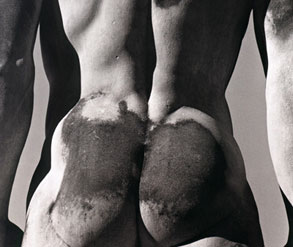
When it comes to sex, “Material Man” doesn’t truly give it up for its readers. (Yes, we know Mel Gibson is “sexy,” and so was Robert Mitchum.) In fact, the most exciting part of the book, sexually, is the strange eroticism in “Men of Marble,” a suite of photographs of male sculptures by Roberto Schezen.

Shot at close and compelling angles, these images are overtly erotic and filled with more life and light than any of the Armani models or publicity stills of old movie kings that appear on preceding pages. The opening shot, in fact, almost took my breath away: a close-up of the naked backside of a stone male, his ass muscles clenched and at the ready, his back widening at the shoulders, the stone itself darkened in places to suggest that — were he animate — he had just arisen from resting naked on his back in wet sand.

Schezen’s photos concentrate on the lower belly, that soft space framed (and often upstaged) by penises and rippling racks of abdominal muscles. And what a sexy space it is, feminine in its curves, masculine in its musculature. Michelangelo knew just how to sculpt it; Schezen knows just how to shoot it.

Besides “Men of Marble,” however, the book has little to offer when it comes to sexuality. Certainly, the photo of Lenny Kravitz in a pool is sexy, but it’s sexy with a capital “S”: styled sexy, self-aware sexy, tattooed and pierced and bare-chested “rock star” sexy. There are lots of bare chests in “Material Man,” and penises, of course, but the chests are attached to runway models and the penises are all small and nonthreatening, or ugly, or attached to ugly men. And what about homosexuality? The book hardly touches on it, although gay male culture has always strongly informed straight male culture and style. The lack of exploration into male sexuality — straight and gay — makes “Material Man” seem like the kind of superficial coffee-table book your typical Fortune 500 homophobe will feel comfortable displaying on his yacht this summer.

Style

So this is what it comes down to: “Material Man” is not a book about masculinity or sexuality but a book about style and the media. To be fair, this is precisely where it succeeds — from the images of crew cuts, Tim Burton’s “Batman” and military uniforms to Alix Sharkey’s hilarious and informative essay, “New Media, New Men” (about the rise of saucy men’s magazines like Maxim and FHM).

For style it’s worth a look. (After all, “Material Man” is the creation of an Italian fashion research center, Pitti Immagine.) But for anything real about masculinity or male sexuality, you’re better off plowing through the latest Susan Faludi or Camille Paglia. Because although the fashion industry sells it in spades, fashion itself has rarely been about sex — real sex — and it has rarely been about masculinity. “Material Man” is a sobering reminder that superficiality still reigns when it comes to style.

Continue Reading Close

How nosy political reporters measure up

After they revealed the presidential candidates' SAT scores, we hit them up for their own.

  • more
    • All Share Services

Future presidential wannabes have a brand new worry, thanks to snooping reporters this season determined to find out exactly which bubbles the candidates penciled in while young and miserable and not thinking much about how it would reflect their intelligence and self-worth in the future.

It started in November, after Yale University students acquired and threatened to publish alumnus George W. Bush’s SAT scores. Employing what now seems like quaint discretion, they chickened out. So the New Yorker printed them in Talk of the Town (Bush’s verbal: 566; Bush’s math: 640 ). A few months later, Slate revealed Bill Bradley’s verbal SAT score (485). Then, just last month, two Washington Post reporters released loads of academic information about Al Gore, concluding that the vice president “was often an underachiever” (verbal: 625; math: 730).

When asked what he thought of all this, the New Yorker’s political correspondent, Joe Klein, said he adamantly opposes publishing the scores. “I’m against these types of things coming out,” he raged. “I think it’s an invasion of privacy, I think it’s none of our business, and I think these scores are a leading indicator of zip. Zero. I would much rather have a president who screwed around, did serious drugs and learned a lot from it than someone who had 800 boards.”

He sighed.

“First it was drugs, then sex, now it’s grades,” he continued. “What’s next? Cholesterol levels? The Puritanism of the press in the ’90s just amazes me.[Publishing these scores] is a new low for American journalism.”

Well, then, we’ve gone even lower. But if turnabout is fair play, why not call the reporters who originally wrote these stories and ask what their scores were? After all, we reasoned, shouldn’t we know who’s disseminating news in this, the Information Age? Who’s to say Maureen Dowd or Robert D. McFadden are academically qualified to feed us the ideas we ingest every day? We commenced.

Geoff Kabaservice, Slate

When I finally connected with Kabaservice, a lecturer in the history department at Yale University, we talked about this business of publishing academic records, and we touched on issues of class, race and opportunity. A nice conversation, sure, but eventually, it came time to drop the bomb. He took it well.

“I did well on the SAT, as I suspect most people did who write about these things,” he responded cryptically. “But the thing that is funny about this is that there is no benefit in communicating my SAT scores.”

Right, right. So … what did he get? He laughed. “If you have to know, I got a perfect score on the GRE and did almost as well on the SAT.”

Jane Mayer, the New Yorker
It was Mayer who wrote the story accompanying George W. Bush’s academic transcript. She was pleasant, and defended her decision to publish Bush’s record. “My own personal feeling is that to become president of the United States, there’s no reason to keep anything secret. A person’s health, academic, business and political records … I find all of that to be part of the larger picture about who someone is. I think the more information the better.”

Speaking of that, what were her scores?

“I don’t remember the exact numbers,” said the Yale graduate (1977 Phi Beta Kappa). “My English score was in the 700s and my math in the 600s. I did well on them. But I went to school in England so the SATs weren’t such a big deal for me. I wasn’t surrounded by SAT mania. I was the only person going to an American college. I just went up to London for the day to take the test.”

Alexandra Robbins, the New Yorker

Mayer then put me on the phone with her co-writer on the piece, who is also a Yale Phi Beta Kappa (’98). Robbins refused to tell me her scores. “I’ve always hated that emphasis on SAT scores and I’ve never told anybody what mine were. That’s why I’m not telling you. It puts people in a hierarchy.”

But isn’t that what she did when she published Bush’s academic transcript? “Well, yes, I think we started that whole monster,” she laughed.

“But I think that George W.’s educational experience is relevant for two reasons. First: He himself has pushed education as one of his most important campaign issues but if he didn’t care about his own education, as his transcript suggests, then what does that say about the sincerity of his platform?”

“Two,” she continued, “the fact that George W. went to Yale has been used endlessly to defend him when people charge that he’s a witless, empty suit. But if he didn’t get into Yale on merit and was indifferent once he got there, then using the defense that he was an Ivy Leaguer is essentially baseless.”

Well, I cooed to Robbins, trying again, you’re obviously an intelligent woman. Certainly you scored well on your SATs, so you have nothing to be ashamed of. Wouldn’t you please give me your scores? Please? Pretty please? She laughed but wouldn’t budge.

Ellen Nakashima, the Washington Post
Things got worse when I called Nakashima, the Post reporter who — with David Maraniss — dug up and published Al Gore’s grades from his days at high school and Harvard University. Nakashima had been away from her office on vacation and hadn’t returned my initial call. This time, she answered on the first ring, and I reintroduced myself. She muttered something in recognition and I explained my mission.

“I’m not sure I can talk to you,” she said. “We’re actually quite busy right now. We’re desperately trying to finish a manuscript for a publisher.”

I paused. “Well, maybe you can answer just one of my questions. It’ll only take a minute.” She was silent.

“I’d like to know what your SAT scores were,” I continued. “I’ve asked the other reporters and plan to include their responses in my story.” I was hoping Nakashima would get the joke and play along.

She didn’t seem amused. “I really must confess,” she sighed. “I really can’t remember.”

“Hmm,” I said, surprised. “But you must have some idea.”

“I’m serious,” she insisted. “I just can’t remember. But … what are the other reporters giving you? Are their scores high?”

“Pretty high,” I said, slowly. I suddenly got the strange feeling I was back in high school on the day scores were released, and everyone tried to conceal their own results until they knew they wouldn’t be embarrassed.

“I can’t remember,” she insisted. “It was, it was — I don’t remember for sure, but it was somewhere between 1280 and 1350, I think. I have some vague recollection of that.”

“Great,” I said, impressed. “Where’d you go to school?”

“I’m not able to help you right now,” she said suddenly. “I have to go.”

Later, I received a voice mail message. It was Nakashima, and she didn’t sound pleased. She requested I call her back. I did.

She lit into me. “I don’t give you permission to use my SAT scores,” she said angrily. “I don’t want those published.”

I explained that she’d never said she was speaking off the record. Those are the rules. No “off the record,” no dice. Didn’t she know this? She demanded to be given my editor’s name and hung up on me. An hour and a half later, she called me again.

“Anna, this is Ellen,” she said. She sounded much nicer this time. “I called back because I wanted to tell you that I felt like I was caught off guard before.” The tables, officially, had been turned

She continued: “I don’t know what you’re doing with this, but go ahead and use [the scores].” She sounded contrite. She even tried to joke with me about her scores: “It’s not like I’m running for president or vice president.”

David Maraniss, the Washington Post
After I spent more than a week trying to track down Maraniss, who co-wrote the story with Nakashima, he followed up with an e-mail that dodged the specifics, but was otherwise admirably candid:

“Anna. I was out of town for a while. Understand you talked to Ellen and she thought the gist of your questions was about our SATs and grades. I can tell you that I was a horrible student, dropped out of college and had SATs that made me seem destined for life as a bum on the streets.”

Continue Reading Close

Page 1 of 2 in Anna Holmes