Art Levine

Photo finish in Arizona

Democrats have a shot at a Senate seat and several House races, but a new voter I.D. law could keep many of their supporters from voting.

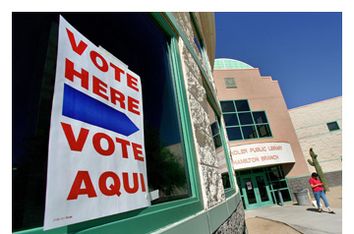
On Tuesday, Democrats stand an outside chance of picking up several House seats and a Senate seat in the once beet-red state of Arizona. Democrat Harry Mitchell is in striking distance of Rep. J.D. Hayworth in the 5th House District, and challenger Jim Pederson has closed within single digits of incumbent Republican Sen. Jon Kyl. But the prospects for Pederson, Mitchell and Democrats in general would be much better had the U.S. Supreme Court not recently upheld the state’s new voter I.D. law.

Republicans nationwide have been proposing and passing various laws that require would-be voters to produce photo identification on Election Day. The nominal intent of the laws is to discourage fraudulent voting. In the absence of any real evidence of such fraud, however, the more likely effect of the laws is to disenfranchise members of Democratic-skewing groups — blacks, Latinos, the poor and college students. Arizona passed its tough photo I.D. law by direct voter referendum in November 2004.

While lower courts in other states have tossed out similar laws, the Supreme Court’s decision was its first direct ruling on a photo I.D. law. The court upheld the law on procedural grounds, and pointedly did not rule on its merits, but the decision was still a boost to the largely Republican proponents of voter I.D. laws across the country. The decision takes on added importance since the House of Representatives split along party lines in late September to pass an immigrant-bashing “Election Integrity” bill that would bar would-be voters nationwide if they can’t produce a passport or other proof of citizenship at the polls.

On the ground in Arizona on Tuesday, the voter I.D. law means election officials may now shoo away or discourage enough Democrats to make a difference in any of several close races. Maricopa County alone, which encompasses Phoenix and has a population close to 4 million, has more than 1,100 precincts. If only a dozen voters are rejected or leave in frustration in each precinct, it could mean a difference of more than 13,000 votes. Democrat Janet Napolitano won the governor’s race in 2002 by less than 13,000 votes. And last week, a state court ruled that nonpartisan poll watchers would not be permitted into the polling places to count the number of people turned away. “If anyone is interested in using voter suppression to win an election,” says Linda Brown, director of Arizona Advocacy Network, a voting rights group, “Arizona is the place to do it.”

Arizona’s I.D. law is one of the most restrictive in the country. In order to register to vote, Arizonans must produce a state driver’s license or a state-issued photo I.D. More than half a million potential voters in the state do not have either. Would-be voters can only prove citizenship to receive one of the I.D.s and register to vote using a very narrow range of official documents.

At the polling place on Election Day, a voter must again produce a photo I.D. or other documentation with a current address in order to be permitted to vote. A voter who can’t produce the proper I.D. is supposed to receive what the state calls “a conditional provisional ballot.” But for that provisional ballot to count, the voter is required to return to the same polling place later that day or to a county’s election offices within five business days with the correct I.D. In some of the state’s sparsely settled and sprawling counties, voters would have to make a 200-mile round trip to visit an election office.

Arizona officials already have an idea of what to expect on Tuesday. The arguments over the law and its effects ceased being hypothetical on Sept. 12, when the state held a primary election. Observers agree that there were problems, especially with poll-worker training, but whether those problems were serious depends on whom you ask.

Joe Kanefield, election director for Arizona Secretary of State Jan Brewer, a Republican, thought Sept. 12 went smoothly. “The new I.D. law was a tremendous success. The vast majority of people had no problem with the new requirements. When you have 10,000-plus poll workers, you’re going to have isolated human mistakes. It’s a rush to judgment to say they weren’t properly educated about procedures.”

Yet at a briefing for county and municipal workers in Maricopa County in October, the county election department’s federal compliance officer, Tammy Patrick, expressed concerns about the “awful” foul-ups during the primary, according to observer Linda Brown. Patrick denies using the word “awful,” but she concedes, “The [election] board workers faced a lot of challenges in this election. They had to learn the basics in a two-hour training,” especially difficult because first-timers replaced many of the 7,000 often elderly poll workers who quit before the primary because of the complex touch-screen computers and I.D. rules. “Did they all retain the information?” she asks rhetorically. “Absolutely not.” Maricopa County disallowed 73 percent of its conditional ballots.

Individual voters provide plenty of anecdotal evidence of just how stringent the new law can be, and how poorly trained some poll workers are. Dr. Michael Lopez, a Tucson anesthesiologist, thought he had enough I.D.s to qualify to vote when he showed up at 6:45 a.m. at the polling place before rushing off to assist in an operation at a local hospital. He not only had a valid driver’s license and his voter registration card, he even had his hospital photo I.D. draped around his neck. He still wasn’t allowed to vote, however — the address on his voter registration card matched the address in the voter registration book, but the address on his driver’s license did not. “Do you doubt this is me?” he asked, staring at his name in the book, irritation mounting. “No, but the law requires verification of your address,” a poll worker told him. Without the correct address on his driver’s license, the law required him to produce two forms of non-photo I.D. with a current address before he could vote.

“I don’t have time for this,” Lopez said. “I have to go to the hospital.” Before he left, none of the poll workers, supposedly trained for two hours in the complexities of the new voter I.D. rules, offered him the opportunity to cast a provisional ballot. Their failure to do so was a violation of federal and state election laws.

Lopez vowed to return before the polls closed, but never got the chance. “If I was there with all these forms of I.D.,” he asks now, “what’s going to happen to underprivileged people who don’t have driver’s licenses or to people who are more transient?”

In the battle over I.D.s, most attention has focused on the possible disenfranchisement of traditionally Democratic voting blocs that are represented in the tens of millions nationwide — the poor, the elderly, blacks and Hispanics. Within Arizona, it is the supposed concern about preventing electoral fraud by undocumented Mexican aliens that drove the GOP push for Proposition 200, the voter I.D. law, in 2004. But 5 percent of Arizonans are part of a non-white voting bloc that is both Democratic-leaning and undeniably native-born, and that is uniquely susceptible to disenfranchisement via I.D. requirements.

More than 250,000 Native Americans live in Arizona. As Leonard Gorman, an official of the Navajos, the biggest Arizona tribe, reported at a hearing in August, many Native Americans in the rural Southwest have no driver’s licenses, utility bills or birth certificates. No one disputes their citizenship, yet they would not qualify to vote under what is now Supreme Court-approved Arizona law. “This is very burdensome to the elders,” said Gorman.

Sure enough, on Sept. 12 an elderly Navajo woman from rural Chilchinbeto was barred by a poll worker from casting any ballot — even a provisional one — in the September primary. Agnes Laughter, who speaks only Navajo, lacked the proper I.D. “From just this one example, it is obvious that the ID requirement creates an undue burden on our citizens who are attempting to participate in the democratic process,” one Navajo official, Speaker Lawrence Morgan, told the Gallup (New Mexico) Independent.

But the Republicans say there is another measure of success for voter I.D. laws. They claim that it increases voter registration. As Rep. Vernon Ehlers, R-Mich., chairman of the House Administration Committee, argued on the House floor, “The fact is people are encouraged to vote when they believe their vote will count and know that vote will not be canceled out by an illegal vote.” GOP officials, including Ehlers and Arizona Secretary of State Jan Brewer, claim that Arizona has increased voter registration 15 percent since Proposition 200 took effect in 2005.

In fact, even before the primary there was already numeric evidence that the I.D. law actually depresses voter registration. A preliminary county-by-county analysis of the drop-off in registered voters between the 2004 election and the 2006 primary by John Brakey, co-founder of Arizona Citizens for Election Reform, shows a net decline of 110,000 voters, or 4 percent. This reduction took place even though Arizona is the second-fastest-growing state in the country, adding as many as 200,000 residents yearly, and its number of registered voters should’ve increased markedly. “If you calculate the population growth,” claims Brakey, “the real possible impact is 250,000 to 300,000 people missing from the state voter rolls.” By comparison, Nevada, the one state that’s growing marginally faster than Arizona, saw its voter registration rolls shoot up 20 percent during the same period. Nevada doesn’t have a voter I.D. law.

Who are the people who aren’t registering to vote? Perhaps the most overlooked impact of rigid voter I.D. laws, as in Arizona and Indiana, is the effect on college students. A 2005 study of driver’s license possession in Wisconsin, for instance, found that 98 percent of those college students living in dormitories didn’t have a driver’s license with their current address. The result is unsurprising given how many times the average student changes addresses while attending college, but it makes voting in voter I.D. states very difficult.

In Arizona, students can’t register to vote unless they provide an Arizona-approved birth certificate and multiple proofs of their current address. In-state students who are already registered to vote in one Arizona county must provide proof of U.S. citizenship if they want to reregister in another county. At Arizona State University in Tempe, with its 63,000 students living on and off campus, voter registration has essentially evaporated. Allowing for the difference in intensity between presidential and midterm elections, the falloff is still stunning. From 5,000 voters registered in six weeks before the 2004 presidential race, the ASU Young Democrats’ post-Proposition 200 registration drive has produced little more than 200 new voters in a year and a half. According to Joaquin Rios, 20-year-old president of the local Young Democrats chapter, the problem is the I.D. requirement. “I’ve encountered hundreds of students,” he reports, “and I don’t know a single one who has decided to get a state I.D.”

Even if an Arizona college student is determined to vote, overcoming all the obstacles is still a bureaucratic nightmare that could deter all but the most fervent political activist. For instance, Christopher Gustafson, the 19-year-old Texan who is president of the student senate at ASU, was eager to register to vote in his new home. But when he went down to the Arizona Department of Motor Vehicles with a state-certified birth certificate that his mother had mailed to him from Texas, he still didn’t qualify to vote. He was told he only had a “short-form” birth certificate, and needed a “long-form” birth certificate that included his father’s birthplace. The Arizona DMV wouldn’t accept the short version even when combined with his Texas driver’s license.

“Is this because of Proposition 200?” Gustafson asked a supervisor.

“No, it’s because of 9/11,” the supervisor replied.

Ultimately, after spending a total of $42 and getting the long-form birth certificate mailed to him, Gustafson was finally granted the Arizona driver’s license that permitted him to register to vote. He is well aware that other would-be voters may not have the necessary funds or perseverance. And he doesn’t think many of his fellow students will get a chance to vote. If they bother to show up, he predicts, “They’re going to be turned away, and they won’t come back.”

Alarmed at what may happen on Tuesday, voting activists in Arizona have been trying to recruit volunteers to monitor the polls and alert people to the 1-866-OUR-VOTE help line. The Democratic Party and an “Election Protection” coalition of nonprofit groups affiliated with People for the American Way hope to field a few hundred election monitors in Democratic-leaning precincts in Tucson, Phoenix and other areas. Other advocacy groups are trying to sign up monitors by promoting “Poll Workers for Democracy.”

But a court decision on Nov. 1 said those nonpartisan volunteers won’t actually have access to polling places to monitor voters being turned away. Instead, it will be up to state and local officials to do so. According to activist Linda Brown, “The counties have a vested interest in demonstrating that there are no problems with the law.”

Poll observers may not be able to stop disenfranchisement, but they can bear witness, and counter any unwarranted spin. Brown’s group will try to do its watching outside the polling places. “If things are perceived as going smoothly,” Linda Brown points out, “and no one has monitored the number of people who were turned away or couldn’t vote, supporters of the I.D. laws will say that opponents were crying wolf. Then the story will be spun that the voter I.D. law works, it doesn’t disenfranchise anybody.”

Meanwhile, next door in New Mexico, there are already signs that the Arizona experiment has the potential to spread. Over the past five years in this closely divided purple state, the Democratic-controlled Legislature has managed to quash or gut most of the photo I.D. provisions proposed by the Republican minority. But using the public relations approach that worked so well in Arizona, where the GOP went straight to the public with Proposition 200 and won by raising the specter of electoral fraud, New Mexico Republicans seem to have convinced the public that photo I.D.s are a necessity. Polls indicate a strong majority in favor of the requirement. Local Democratic politicians, in turn, have decided that it is a winning issue. On Tuesday, New Mexico voters have a choice of a Republican and a Democrat for secretary of state. Both of them support voter I.D.

Salon’s shameful six

There was Florida in 2000 and Ohio in 2004. Here are the six states where vote suppression could cost voters their voice -- and Democrats the election -- in 2006.

Eva Steele has a son in the military who is supposed to be fighting for freedom in Iraq, but sitting in a wheelchair in her room in a Mesa, Ariz., assisted-living facility, she wonders why it’s so hard for her to realize a basic freedom back here in America: the right to vote.

Arriving in Arizona in January from Kansas City, weakened by four heart attacks and degenerative disk disease, Steele, 57, discovered that without a birth certificate she can’t register to vote. Under a draconian new Arizona law that supposedly targets illegal immigrants, she needs proof of citizenship and a state-issued driver’s license or photo I.D. to register. But her van and purse were stolen in the first few weeks after she moved to Mesa, and with her disability checks going to rent and medicine, she can’t afford the $15 needed to get her birth certificate from Missouri. Her wheelchair makes it hard for her to navigate the bus routes or the bureaucratic maze required to argue with state bureaucrats. She’s unable to overcome the hurdles thrown in her way — and in the way of as many as 500,000 other Arizona residents — by the state’s Republican politicians.

“I think everybody should have the right to vote, no matter if you’ve got two nickels or you’re a millionaire,” Steele says. “I think it’s a shame you have to jump through so many hoops to prove that you’re the person who you say you are.”

But Steele’s plight has gotten relatively little notice from pundits and progressive activists confidently predicting a sweeping Democratic victory in November. Opinion polls show that a majority of the public wants a Democratic Congress, but whether potential voters — black and Latino voters in particular — will be able to make their voices heard on Election Day is not assured. Across the country, they will have to contend with Republican-sponsored schemes to limit voting. In a series of laws passed since the 2004 elections, Republican legislators and officials have come up with measures to suppress the turnout of traditional Democratic voting blocs. This fall the favored GOP techniques are new photo I.D. laws, the criminalizing of voter registration drives, and database purges that have disqualified up to 40 percent of newly registered voters from voting in such jurisdictions as Los Angeles County.

“States that are hostile to voting rights have — intentionally or unintentionally — created laws or regulations that prevent people from registering, staying on the rolls, or casting a ballot that counts,” observes Michael Slater, the election administration specialist for Project Vote, a leading voter registration and voting rights group. And with roughly a quarter of the country’s election districts having adopted new voting equipment in the past two years alone, there’s a growing prospect that ill-informed election officials, balky machines and restrictive new voting rules could produce a “perfect storm” of fiascos in states such as Ohio, Florida, Arizona and others that have a legacy of voting rights restrictions or chaotic elections. “People with malicious intent can gum up the works and cause an Election Day meltdown,” Steele says.

There is rarely hard proof of the Republicans’ real agenda. One of the few public declarations of their intent came in 2004, when then state Rep. John Pappageorge of Michigan, who’s now running for a state Senate seat, was quoted by the Detroit Free Press: “If we do not suppress the Detroit [read: black ] vote, we’re going to have a tough time in this election cycle.”

For the 2006 elections, with the control of the House and the Senate in the balance, Salon has selected six states with the most serious potential for vote suppression and the greatest potential for affecting the outcome of key races. In nearly every case, the voter-suppression techniques have been implemented since 2004 by Republican legislators or officials; only one state has a Democratic secretary of state, and only one has a Democratic-controlled legislature. The shameful six are:

ARIZONA
Thanks to a legacy that includes denying Native Americans the right to vote until 1948 and decades more of scheming to block minority voters (the state still has to submit its voting regulations to the Justice Department for approval), there’s a good reason that voting reformers view the state’s latest “voting integrity” weapon with skepticism. The sweeping, Republican-backed Proposition 200, passed by voters in 2004 and enacted last year, was designed to bar illegal immigrants from accessing state services and voting. It makes Arizona the only state in the country to require proof of citizenship for voter registration.

Despite right-wing fear-mongering, hordes of unwashed illegal immigrants aren’t lining up at polling places to vote. In Arizona, out of 2.6 million registered voters, a handful of legal resident noncitizens who responded to voting registration drives have been charged with crimes in the last year or so. But, according to the Arizona ACLU, there hasn’t been a single case in state history of an illegal immigrant charged with falsely voting.

Yet spokesmen for Arizona secretary of state Janice Brewer, a Republican, praise her for minimizing fraud while “single-handedly” working to increase voter registration. Privately, though, she may hold more disturbing views. A former Republican candidate for the state Legislature, Thom Von Hapsburg of Phoenix, told Salon that he was shocked at a fundraiser when Brewer told him she doesn’t want “the wrong kind of people voting.” Deputy secretary of state Kevin Tyne flatly denies she holds such views, contending, “I think her record in this area speaks for itself.”

“I don’t care what they say to deny it, the function of this statute is to discourage people from voting,” says Joe Sparks, the veteran voting rights attorney who serves as counsel to the Intertribal Council of Arizona. “It’s not about protecting our borders; it’s about keeping minorities from voting,” including Hispanics as well as Indians born without state-certified birth certificates. In fact, the law asks Native Americans who lack other I.D. to produce a Bureau of Indian Affairs card number or a “tribal treaty card number” — cards and numbers that don’t exist. No tribe in Arizona has them, says Sparks.

But, as Eva Steele’s experience shows, you don’t have to be a Native American to be denied the vote in Arizona: More than 500,000 registered voters and eligible but unregistered voters lack state-issued photo I.D.s. In the first weeks of the new law, about 70 percent of new voter-registration applicants were rejected in Maricopa County, site of Phoenix, although the rejection rate has been reduced to a still sizable 17 percent this year. Linda Brown of the Arizona Advocacy Network, a statewide progressive coalition, says, “With these I.D. and citizenship proof requirements, we’ve sealed the fate of the least among us: the elderly, the poor and the disabled, people who are already disenfranchised.”

Key races: Republican Sen. Jon Kyl is vulnerable, as are two incumbent GOP representatives.

INDIANA
In the movie “Hoosiers,” a plucky team of Indiana underdogs overcomes long odds to achieve victory on the basketball court. But in the real world of politics, Indiana citizens face even more daunting obstacles to win the right to vote, and too often, they fail. Whether it’s thousands of voters purged from county registration rolls this year without due process or new and arcane photo I.D. rules that can trip up even the most dedicated voter, state and county GOP election officials are seemingly seeking to discourage voter participation — perhaps because three of the most competitive U.S. House races this year are in Indiana.

“I think this is all part of a nationwide effort of the Republican Party to suppress votes, because that’s the only way for them to stay in power,” says William Groth, an attorney filing a lawsuit challenging the voter I.D. law on behalf of the Indiana Democratic Party, a case now on appeal. Between 8 percent and 23 percent of all registered voters in the state may lack the proper photo I.D., so the added costs — comparable to a poll tax — and obstacles of the I.D. law are going to make low-income and minority voters far less likely to vote, according to research by political science professor Margie Hershey of Indiana University.

But some determined Hoosiers won’t give up trying to vote. Take the never-ending bureaucratic maze Theresa Clemente, a 79-year-old Fort Wayne resident born in Massachusetts, has been forced to navigate. An Indiana resident for 15 years, she’d never had a driver’s license when she moved to the state to live near her son. So when she learned that the state required a state-issued photo I.D. to vote, her husband drove her down to the delay-plagued Bureau of Motor Vehicles to get a photo I.D. On her first visit, she brought her Social Security card, her voter registration card, two bills and a credit card, but that wasn’t good enough. She had to return three more times, with BMV drones telling her successively she needed a copy of her birth certificate, then a $28 state-certified birth certificate from Massachusetts, and finally a marriage certificate because her birth certificate listed only her maiden name — although all her various I.D.s carried the married name she has used for 53 years. “I was so angry, it worsened my blood pressure,” she recalls.

“My experiences in attempting to obtain a photo I.D. card from the BMV have been humiliating, time-consuming and extremely frustrating,” she concludes. In truth, that’s the whole point of the law, but how many other Indiana citizens will be willing to jump through so many hoops? Yet Paul Okeson, Indiana’s Republican deputy secretary of state, insists, “This law strikes the right balance between voting integrity and access.”

The May primary provided a foretaste of what millions of Indiana voters can expect in November who don’t have the exact photo I.D. Even a Republican election official, Jackie Rowan of DeKalb County, was upset because she had to turn away veterans whose Veterans Administration photo medical cards didn’t qualify as photo I.D. “They all accused us of not wanting them to vote,” she said, and they declined to use provisional ballots instead. Only 15 percent of such ballots were counted in the last major election.

Key races: Incumbent Republican representatives Chris Chocola, John Hostetler and Mike Sodrel are all within striking distance of their Democratic challengers.

OHIO
The secretary of state, Kenneth Blackwell, now the Republican candidate for governor, is using some new vote-suppressing tricks and, this time, he’s got a sweeping if confusing law, HB 3, to back him up. A coalition of voting-rights groups filed suit last month to overturn the law as unconstitutional.

Infamous for such schemes as initially demanding that all voter registration applications be submitted on 80 lb. stock paper, Blackwell also presided over what most investigators regard as the worst election meltdown of 2004. While the allegation that Blackwell helped “steal” the election from John Kerry is debatable, the view that he intentionally suppressed voting by Democratic-leaning groups is less controversial. That the Ohio election was a mess is almost universally acknowledged, although not by Blackwell’s office. His spokesman, James Lee, says, “The critics were wrong then, and they’re wrong now.”

This time around, the law that took effect in May allows the state to pursue felony prosecutions of workers for voter registration groups who turn in registration cards past a 10-day deadline. They face up to 12 months in prison and a $2,500 fine; late returns on less than 50 forms merit a misdemeanor prosecution. At first, Blackwell implied that the workers couldn’t even send in the forms by mail. Each registration worker also has to return the forms personally to the local elections board, which prevents voter registration groups from combining and checking large numbers of forms. “It’s made registration far more difficult,” says Teresa James, Project Vote’s election administration coordinator. In fact, Ohio ACORN, the Project Vote-allied group that focuses on low-income neighborhoods, suspended virtually all voter registration activities for two months. Now it’s gathering less than 20 percent of the 7,000 registration applicants it signed up monthly before the law was implemented.

Even if people do manage to register, most Ohio election boards don’t know that voters are entitled to vote using regular ballots even if their driver’s licenses list old addresses. It’s a confusion created by a series of misleading or opaque directives from Blackwell.

“I think we could very well have a meltdown in November because of these confusing election rules and poll workers not knowing what to do with the new electronic machines,” observes Peg Rosenfield, the Ohio League of Women Voters election specialist. That’s already been shown by the voting crack-up in Cuyahoga County, home of Cleveland, where the sudden switch to electronic machines in May led workers to lose 70 memory cards from touch-screen terminals and a six-day delay in counting 15,000 absentee ballots.

Key races: Democrats could take the governor’s mansion and unseat Sen. Mike DeWine and four House incumbents.

CALIFORNIA
Back in 2002, the federal government mandated that states create consolidated statewide voter registration lists, a mandate that became effective Jan. 1, 2006. The law required that states attempt to match the applicant’s Social Security or driver’s license info with the database, but spelled no consequences for the would-be voter if the data didn’t match. California is among a handful of states that have been using those comparisons to bar voters from the rolls.

Earlier this year Conny McCormack, the Los Angeles County registrar (and a Democrat), went public with her concerns that 43 percent of all new registered voters in her huge county were being disqualified — but only after Republican secretary of state Bruce McPherson didnt respond to her private complaints. “Why does anybody need to be dumped over files that don’t match?” she asks — a view shared by a federal court in Washington state that last week blocked that state from enforcing a similar policy. Following negative publicity and pressure from advocacy groups, McPherson has loosened the matching requirements and may eventually drop them, but 11 percent of L.A. County’s newly registered voters have been disqualified so far in 2006 — and it will get worse in November. A spokesperson for McPherson denies any implication of voter suppression. “We’re always looking for ways to improve the process and ensure voter accessibility.”

In addition, despite its reputation as a progressive, well-run state, some of California’s election officials have been remarkably negligent in providing fair opportunities to register or ensuring secure elections with the new electronic machines. “I’m concerned that we’re turning away one generation of potential voters after another,” says Kathay Feng, the executive director of California Common Cause.

Perhaps the best-known controversy involves allegations of shoddy security for voting machines in the June 6 San Diego special election to replace convicted Rep. Duke Cunningham, an election run by Republican county officials and won by Republican Brian Bilbray. A lawsuit seeking to invalidate the results and demand a recount was filed last month on behalf of voters.

A main target is the legal but questionable practice of allowing poll workers to take home the voting machines for weeks before an election in what critics deride as “sleepovers.” You don’t have to be a conspiracy theorist to be troubled by authoritative reports by researchers about how easily these machines can be hacked — and the lack of even minimal security precautions in the training provided to San Diego’s poll workers. Patty Newton, an assistant precinct inspector in charge of equipment, told Salon how she had just four hours of training with no security instructions — and then was surprised by the news that she’d be taking two machines home with her. “I left them in the car overnight and took them out of the Jeep onto the floor of the garage,” she recalls. “We live in a semirural area and we never lock doors.” She also apparently wasn’t subjected to a background check: “All you need is a pulse to be a poll worker.”

Mikel Haas, the Republican San Diego County registrar of voters, insists he fully follows all state security procedures. “We’re not giving the machines out like lollipops,” he says. “It would be ridiculous not to address security as part of the training.”

Key races: Despite his recent tack to the center, Gov. Arnold Schwarzenegger remains vulnerable in his reelection bid, as do three Republican House incumbents.

FLORIDA
Will the fiasco-prone Sunshine State be the next … Florida? That’s the question that has haunted observers of Florida’s election system since the debacle of 2000. Six years later, Florida is still Florida, only more so. Florida still has a Republican governor, Legislature, and secretary of state, and still doesn’t have voter-verified paper trails for its vulnerable voting machines. Hundreds of thousands of voters remain at serious risk of being robbed of the vote.

This year, however, it also has a package of new voting rules, like restrictions on voter registration campaigns. The fines for violations are now so stiff that they forced the League of Women Voters to suspend its voter drives in the state for the first time in nearly 70 years. Each misplaced blank registration form means a potential penalty of $5,000. Just 16 misplaced blank forms, even if destroyed by a hurricane, could cost the Florida League $80,000 — its entire annual state budget.

Another codicil in the new state voting law essentially endorses the thuggery of 2000. It permits roving bands of political partisans — the same sort of goons who banged on the glass doors at the Miami election board six years ago to halt the recount — to descend on inner-city precincts to challenge any voter’s right to cast a vote on Election Day. The challenged voter will then be forced to use what reformers call a “placebo ballot” — a provisional ballot that makes the voter feel like he voted, except the vote will count only if he comes back later to offer written proof that he was entitled to vote. “The use of challenges is likely to disenfranchise a lot of people,” observes Lida Rodriquez-Taseff, the chair of the Miami-Dade Election Reform Coalition.

Key races: Five Republican House seats are in play.

MISSOURI
The Show Me state has an unsavory and very recent history of suppressing black votes. As governor 20 years ago, John Ashcroft tolerated different standards for voter registration in white Republican St. Louis County and the black and Democratic city of St. Louis. Last week, progressive groups mounted a legal challenge to the Republican Legislature’s latest attempt to thwart black voters, a rigid voter I.D. law that takes effect Aug. 28.

Missouri secretary of state Robin Carnahan, a Democrat, has expressed public disapproval of the law but will enforce it. She reports that 200,000 voters lack the necessary photo I.D. and could be disenfranchised. Recent elections have been close, and the black urban voters most likely to be purged are crucial to Democratic hopes. John Hickey, the executive director of the Missouri Progressive Vote Coalition, says that Republicans are promoting “mass disenfranchisement” because African-American voters turned out in large numbers in 2004 and are expected to turn out again this fall because Republican Gov. Matt Blunt cut 100,000 people from Medicaid. “Let’s say an 83-year-old woman in a wheelchair is kicked off Medicaid,” he says. “Guess what, you don’t have a driver’s license and can’t vote: Tough luck, Grandma.”

Hickey says the law is also known as the Jim Talent Protection Act, because the Republican U.S. senator is in a close election battle and last time won by only 20,000 votes. As Hickey explains, “If you knock off 200,000 people who wouldn’t vote for you anyway, you can win.”

Key races: His opposition to stem-cell research has made Sen. Jim Talent one of the GOP’s more endangered incumbents.

What is anybody doing about all of this?
The Democratic National Committee and nonpartisan voting rights organizations, including Common Cause, have launched an assortment of initiatives to increase voter participation and challenge onerous laws in court. When the Democratic National Committee announced its expanded voter protection program last week, chairman Howard Dean said, “For Republicans, nothing is more important than their partisan interests, not even the American people’s most cherished right to vote and have that vote counted.”

True enough, perhaps, but outside of filing lawsuits and telling some voters about their rights, it’s not at all clear whether progressives are going to offer enough practical help so that the victims of legalized Republican vote-robbing, people like Eva Steele stuck in her room in Mesa, Ariz., can actually have their votes count.

Continue Reading Close

The education of Alice

Are white supremacists and anti-Semites using the Net to recruit upscale followers?

Is the Internet somehow to blame — again? The murderous racist rampage by Benjamin Nathaniel Smith last weekend has reopened the question of the role of the Internet in promoting hate — and even hate crimes — among impressionable youths.

News reports note that Smith — who killed two and injured nine before killing himself during a three-day, two-state shooting spree — was a former member of a white supremacist group that calls itself the World Church of the Creator. The group, which has more than 40 chapters across the country, has built up its membership online, advocating a racial holy war. Its leader, 27-year-old Matt Hale, runs the group from his parents’ home in East Peoria, Ill.

According to such monitoring groups as Hatewatch and the Southern Poverty Law Center, the loose-knit organization is among the fastest-growing hate groups in the country, with several hundred active members and thousands more who pay electronic visits to the “church” and its dozens of affiliated Web sites.

There’s no evidence directly linking Hale’s group to Smith’s shooting spree, but critics argue that while its violent anti-Semitic and racist rhetoric is protected by the First Amendment, the World Church of the Creator not only promotes hate but incites violence.

Web sites like the one run by the World Church of the Creator — usually found at www.creator.org, it has not been accessible during the reporting of this story — appear to be shaping a new, upscale cadre of white supremacists extending even to tony New England prep schools.

As Don Black, the ex-con and computer whiz who runs the white supremacist Stormfront.org site (which was also inaccessible during the reporting of this story), told USA Weekend on March 28: “We’re not trailer-trash people with bad teeth or high school dropouts. We are not illiterate, unsophisticated people.” (Black declined to answer e-mail and phone requests for a Salon Technology interview.)

“What the Net does for the [supremacist] movement is amplify its propaganda and recruiting reach,” says Mark Potok, the editor of the Southern Poverty Law Center’s Intelligence Watch. “It’s the perfect venue for recruiting middle-class and upper-middle-class young people. They’re looking for those kids to build a political movement and a revolution.”

For those kids and young adults drawn to these Web sites — and the people who run them — the Internet can offer new vistas of hate. But Web surfers aren’t turned into hate-mongers overnight.

There was no instant conversion for 16-year-old Alice (not her actual name). She says she grew up in an affluent household; both her parents graduated from Harvard. Today she attends a ritzy Northeastern prep school. But this curious teenager has a worldview that is likely to be radically different from that of many of her classmates.

“I got interested in white heritage, and started searching out sites on the Internet,” says Alice, whom I met through a Stormfront mailing list and then interviewed by phone. “From there, I found any number of sites that provided me with solid information about why blacks are inferior. These Web sites led me in directions I couldn’t have found otherwise.”

Alice speaks analytically and unemotionally on these subjects, seemingly unaware that they might be objectionable to her listener — yet she’s also careful to keep her views hidden from friends and family. She clearly recalls how she arrived at this point in her life: It began four years ago as normal teenage rebellion, when she challenged her parents’ views on affirmative action (she was sent to her room for arguing with them). She began wondering about the attention devoted to black history in school, and turned to the Internet to learn more about white history.

Now this college-bound young woman is a regular visitor to anti-Semitic and racist Web sites and discussion forums. Alice points to more than a dozen sites she visits that feature white-power or “white heritage” information, along with private and secure chat rooms for regular users to contact each other.

Some sites use “white power” rock music and high-end designs to pull in Web-savvy kids. For younger children, there are sites that use basic games as a lure — the World Church of the Creator’s “Kids Page” invites kids under age 12 to play word games and crossword puzzles that push the white heritage perspective. Another World Church-related page caters to teenagers, using the slogan “Spread Creativity on the Web!” to promote tenets like “The inferior mud races are our deadly enemies, and the most dangerous of all is the Jewish race. It is our immediate objective to relentlessly expand the White Race, and keep shrinking our enemies.”

“I find these sites extremely valid,” Alice says of sites that, for instance, compare blacks to monkeys (on a Web page called “Whites & Blacks: 100 Facts and One Lie”) or contend that Jews control the world. She regularly visits Stormfront — with its slogan “White Pride World Wide” — which features direct or indirect links to some of the more extreme sites on the Net, featuring neo-Nazis, skinheads, bomb-makers and assorted Christian-identity type groups that offer a potent brew of racism, anti-Semitism and skewed Christian fundamentalism.

“I now feel free to think,” she says, “and my ideology and thoughts are slowly changing. I’m getting more and more information.” But her descent into extremism, one Web link at a time, has been conducted in secret from her friends, classmates, parents and teachers. “I live in an area where these ideas are unacceptable,” she says. “You can’t go to the library to take out ‘The Turner Diaries,’” she says, referring to the racist novel that inspired Oklahoma City bomber Timothy McVeigh.

But she can find “The Turner Diaries” and similar extremist literature — along with instructions on building bombs — on the
Web. Recently, she’s been flirting with the notion that the Holocaust never happened, after viewing a number of sites that purport to include “evidence” that almost none of the atrocities perpetrated by the Nazis ever occurred.

Alice puts her white supremacist discoveries simply: “I think it’s important that white people reclaim our world.”

- – - – - – - – - – - – - – - – - – - – -

Today, according to Rabbi Abraham Cooper, associate dean of the Simon Wiesenthal Center, over 1,400 Web sites spread racist propaganda, promote violence or offer how-to pointers on everything from guns to bomb-making. Once, hate groups were limited to poorly printed flyers and small ads to promote their cause, but now they have a potential worldwide audience. “We’re seeing this stuff in the mainstream of our culture,” says Cooper. “For racists and bigots, this is a gift they couldn’t have invented.”

The Web can not only bring people into an extremist orbit but offer them moral support and encouragement as well.

“It’s empowering,” says the SPLC’s Mark Potok. “Instead of isolated pissed-off people who could only shake their firsts at the sky, they can turn on their computer and find eight different listservs with messages for them. They now feel like they’re in a movement.”

But while the Net may make it easier for groups of all persuasions to spread their word, online free-speech advocates argue that the Net itself can hardly be blamed for educating people in the ways of racism or violence. “Historically, there’s been bigotry and hate; it’s not an Internet problem, per se, but it shines a big light on it,” says Tara Lemmey, executive director of the Electronic Frontier Foundation. Ultimately, Lemmey says, “more discourse makes a society better” — but she does advocate that parents monitor their kids’ Web time.

Of course, Internet filtering software, like the Anti-Defamation League’s HateFilter, which blocks hate sites, can help parents keep their kids away from racism when they’re surfing from home. But, just as laws and rules don’t keep kids away from porn, alcohol or anything else they’re curious about, such measures won’t necessarily stop kids from discovering white supremacy or anti-Semitism. As Alice puts it, going online is a personal matter; she usually surfs in the privacy of her bedroom or when her parents aren’t around.

Some anti-hate activists want Internet service providers to stop selling Web page space to hate groups or bigots — in the same way that newspapers refuse ads for hardcore porn — but concede that isn’t likely to happen. In fact, a number of businesses, like WhitePower88.com, have sprung up specifically to host white supremacist sites.

That will keep providing the Alices of the world with what they’re looking for on the Web. “What I have found reading these sites,” she says, “led me in directions I couldn’t have found otherwise.”

Continue Reading Close

Miami's vice

Crack cocaine is almost dead in many cities, but immigrants, suburbanites and teenagers have kept it alive in South Florida.

Remember crack? The highly addictive rocks of cocaine laid waste to cities across the nation throughout the 1980s, spurring violent turf wars, ruining lives and destroying families. Now, roughly 10 years after the epidemic was at its worst, news headlines across the country are proclaiming the death of crack.

“Crack is going away and probably isn’t coming back,” proclaimed Richard Rosenfield, a professor of criminology at the University of St. Louis, in the St. Louis Post-Dispatch last November. Recent features in the New York Times and elsewhere have also heralded society’s victory over the scourge of the 1980s.

The good news, unfortunately, has not reached several big cities where the problem has not gone away. One of them is Miami, the nation’s fourth-poorest city, where crack is spreading into new suburban communities, among immigrants, and is taking hold with a new, younger generation of drug users.

In fact, crack is again on the rise among some teenage drug users nationwide, according to recent federal reports. The positive testing rate for cocaine among juvenile arrestees has increased by about 40 percent or more in such cities as Phoenix, San Antonio and Miami, and, according to the latest National Household Survey on Drug Abuse, there’s been an upswing in first-time users of cocaine, largely teens. In San Antonio, for instance, the percentage of teen arrestees who test positive for cocaine use jumped 70 percent between 1995 and 1998 — to 28.9 percent. In Miami, 26 percent of arrested youths ages 15 to 20 (and charged as adults) test positive for cocaine, a jump of nearly 40 percent since 1995. And, for about two-thirds of the criminal suspects, the cocaine in their systems is crack.

It seems as though the biggest shift has not been in the statistics, but in the media spin about those numbers. In analyzing crack’s legacy, for instance, the New York Times reported in February “the number of crack users began falling not long after surveys began counting them.” Later in the same article, it pointed to the 1997 National Household Survey, which found that “600,000 had smoked cracked within a month, unchanged since 1988.” So which is it — down sharply or unchanged? The confusion most likely is the fault of the study, which depends on voluntary admissions of illegal drug use to total strangers, not to mention finding a valid sample of crack addicts to interview. Good luck: It’s a sampling technique that might have some reliability in American suburbs, but hardly in the inner cities.

The real picture, experts contend, is more nuanced than the media’s trend stories indicate. The casual use of cocaine has declined and there’s a downturn in total crack and cocaine use in many cities, but a hardcore group of crack addicts remain. And in several cities, use among young offenders — and others — is rising. One of the main reasons for the death-of-crack stories is doubtless plummeting crime rates in America’s largest cities. In New York, the plunging crime rate is a much-touted success story. Even in Miami, the number of murders last year fell below 100 for the first time in 20 years, and the violent crime rates have generally been falling since 1991, about the time total crack use began a gradual decline from its late 1980s peak. Indeed, a 1997 National Institute of Justice report found a strong link between homicide and crack cocaine usage rates.

But just because crime rates are down doesn’t mean crack has gone away. Forty-five percent of all males arrested in Miami have cocaine in their systems, according to the U.S. Department of Justice’s Arrestee Drug Abuse Monitoring Program (ADAM), with, again, roughly two-thirds of them crack users. The Greater Miami area’s cocaine-based emergency room admissions are three times the national average, and more than half of all of Miami-Dade County’s rehab patients are seeking treatment for cocaine addiction.

Clearly, in Miami, the rumors of crack’s death have been greatly exaggerated.

Part of Miami’s problem stems from a growing popularity of crack among the area’s teenagers. In most cities, crack is a problem for a dwindling group of older, long-term users. But in Miami and surrounding towns, a small but increasing number of youngsters are trying such novelties as “geek joints” — a mix of marijuana and crack.

Crack and youth are a particularly volatile combination. The typical user’s notion that he won’t become hooked is only exacerbated by the youthful illusion of invincibility. Joseph, now 17, began dealing drugs in his early teens, and he saw crack’s effects.

“I’ve seen the people starting out looking nice, then they’re out on the streets begging for it,” he says. Joseph himself realized he was hooked after he faced a one-year prison term for auto theft. Suddenly, treatment looked like a good option.

He’s been clean for six months, and has been offered a full scholarship to a local cooking school. “I still have urges,” he confides, “but I stay away from the people I used to hang out with.”

Josh, 16, is another caught up in the city’s crack reemergence. He was only 4 years old at the worst of the crack epidemic of the 1980s, and as a budding juvenile delinquent in the 1990s, “never paid attention to crack.” That changed when a friend’s uncle, straight out of prison, introduced him to the drug when Josh was 13.

Josh was primed for a new high. Fueled by crack, his petty crimes turned into a crime spree that included stealing cars and breaking into houses. “I was stealing for the drugs,” he says. It wasn’t until he faced a stiff prison sentence for 25 separate crimes that he took the last-chance option of drug treatment.

That was six months ago, and now Josh is clean for the first time in years. He’s even allowed a few visits to his father’s home in the Keys, where he carefully avoids old hangouts and habits. “I’m tired of the same thing, always getting into trouble,” he says.

Jim Hall, director of the Up Front drug information center in Miami, estimates that anywhere from 3 to 5 percent of all adolescents in Miami-Dade now use crack, up three-fold in the past five years. Most striking, it is spreading out of the inner city and taking hold among young white and Hispanic suburbanites.

In short, while crack may have vanished from the media’s radar, the problem has not gone away. “Local cocaine abuse still outranks other illicit drug problems,” Hall wrote in a recent report co-authored by Dr. Michael Whitman.

The reasons for the persistence of the crack problem in Miami continue to confound local experts, but there’s little doubt about its harsh effects. In East Little Havana, a 2.5-square-mile area populated mainly by low income Hispanic immigrants, Officer Fred D’Agostino and his partner, the lanky and hyper-alert Jose DeHombre, are driving their blue and white patrol car past the run-down homes and little knots of people watching them warily from the street corners. The officers are part of a neighborhood policing program that responds to ongoing citizen complaints about drug dealing. They don’t limit themselves to making arrests. D’Agostino and DeHombre also seek to involve local kids in police-sponsored athletic activities to keep them out of trouble.

But their main weapon is enforcement. Last year, the pair made 70 crack-related arrests in just one month. One dealer was arrested three times in eight days. In February, their squad launched a three-month “Operation Hellraiser,” targeted at drug dealing and prostitution. The team made 210 crack-related felony arrests, including 100 busts of small-time dealers. But that has barely put a dent in the city’s continuing crack problem.

“I’ve been in this for 11 years, and in my view, it’s never gone away,” said D’Agostino, a compact man with close-cropped salt-and-pepper hair. “Treatment has failed and jail has failed,” he said, and he is still on the streets every day arresting people buying and selling rock cocaine.

“I wish the system would catch up with them. They’re out [of jail] before we go back out in the streets.”

It seems a paradox that while crack continues to rage, Miami’s violent crime rate is the lowest it’s been since 1984 — with a few striking exceptions. In the black ghetto of Liberty City, a wave of shootings and 20 homicides linked to a drug war prompted a massive police crackdown in January. After a sophisticated, 15-month investigation by federal and local law enforcement, 26 members of the “John Doe” and “Cloud Nine” gangs were indicted on a string of charges that included murder, drug dealing and money laundering.

Turf wars aren’t nearly as major a problem in East Little Havana. “There’s so many buyers and sellers, everyone’s got a piece of the pie,” DeHombre notes bleakly.

In fact, the settling of turf wars, with some notable exceptions like the Liberty City case, seems to be one of the driving forces in the decrease of crack-related crime. During the 1980s, bloody feuds over territory filled the nation’s emergency rooms — and morgues — with victims. But now, in Miami, it appears the era of the “cocaine cowboys” and crack killers is over.

Miami was marked by bloody disputes and drug-related violence throughout the 1980s. In the first half of the decade, flamboyant drug traffickers — the “cocaine cowboys” — with a penchant for million-dollar homes and the murder of rivals carved up the area for the Colombian cocaine cartels. By the mid-1980s, the new, dangerously cheap smoked form of cocaine, crack, swept through the Miami ghettos, leading to crazed crimes by addicts and street gangs mowing down competitors. Murders — often linked to drugs — finally began declining in 1989.

Still, questions remain. Why do some cities seem to have crack problems under control while others do not? There is no simple answer — only informed speculation — on why some urban areas are faring better than others. One factor in Miami might be the city’s stubbornly high unemployment and poverty rate — almost one-third of the city’s residents live below the poverty line. Some surprising places, such as Omaha, are finding themselves grappling with disturbing rates of crack use, rising to 25 percent among male suspects and 35 percent of females in the Nebraska city. To Jim Hall, one possible answer lies in business expansion. “The dealers learned it’s a great, big wonderful country out there, and they’re taking on new markets,” he said.

The sharpest declines are on the East Coast and in the bigger West Coast cities, where positive cocaine rates among arrestees once went as high as 80 percent or more. In Philadelphia, cocaine use has dropped to 44.5 percent among male arrestees from 60 percent in the early 1990s, though that figure is still disturbingly high. The youthful offender cocaine rate in 1997 was just 11 percent.

The main yardstick for measuring these changes is the Justice Department’s ADAM program, and its director, Jack Riley, contends, “In the larger cities where the epidemic hit first, there’s a generational learning effect,” he said, adding that youngsters who see the impact of crack on their elders have usually avoided repeating their mistakes.

But that hasn’t worked for one particular group of offenders. “There’s a noticeable lack of decline in cocaine use among young Hispanics,” Riley says. “What you could be seeing is that they weren’t around in those communities when crack was first there.” Indeed, some of the sharpest rises in teen crack use are in communities with a strong influx of Hispanics (although ADAM doesn’t offer ethnic breakdowns for teen use in Miami and most cities). In Miami in 1995, 19 percent of arrested teens charged as adults tested positive for cocaine.

But Hispanics don’t seem to be the primary users of cocaine, even in Miami, with a majority Hispanic population. Among arrestees who tested positive for cocaine, the biggest users in Miami have been blacks (52 percent), followed by Hispanics (29 percent) and whites (19 percent), a pattern that’s roughly consistent with the ethnic make-up of all Miami arrestees. Some national studies have shown that most crack users are white, even if most of the arrests take place in black urban areas.

In the case of Miami, another contributing factor to the city’s sustained level of cocaine users is its proximity to cocaine-producing South American countries. “Our geography has made us still the key importation center for many of the organized trafficking groups,” Hall said. In the last 10 years, there’s been a growth of new Caribbean groups involved in cocaine traffic: Jamaicans, Haitians, Puerto Ricans, Dominicans, Bahamians. Many have links to major Columbia drug operations — most of the cocaine still originates there, Hall says — but they blend into this community with its rich range of ethnic groups. “For many of these groups, Miami is still the U.S. base of operations. Cocaine is still headquartered in Miami.”

These new smaller trafficking groups with close family and ethnic ties here are harder to infiltrate. “Crockett and Tubbs would find it harder today,” he said, referring to the fictional heroes of “Miami Vice.” “Cocaine remains a major industry, and we’re affected by its fallout.”

These groups, he points out, “aren’t really stepping on each other. It’s coordinated: There’s money to be made by everyone.”

Whatever the cause of crack’s persistence, to Jim Gilliland, dealing with addicts every day for 16 years at the Village, a local drug treatment center, none of the high-minded demographic theories ring true. “Once you’re addicted, you’re looking for the ultimate high,” he says. “You don’t care what it’s done to anybody else.”

Continue Reading Close

Viva “Buena Vista Social Club”

In spite of volatile Cuban-American exile politics, Wim Wenders' documentary 'Buena Vista Social Club' wins over Miami

A little over a week ago, the aging Cuban musicians from the
Buena Vista Social Club played in the heart of notoriously anti-Castro Miami, and, this time, there were no firebombs, no protests, no violent attacks on the audience.

They played a lilting and sensuously rhythmic music from the old Havana of
the 1940s and 1950s, and the mostly Cuban-American audience greeted these
players with robust applause, affection and a fond nostalgic remembrance of
their lost Cuba.

Of course, the musicians were only there on a movie screen in the
U.S. premiere of Wim Wenders’ lovely new documentary, “Buena Vista Social Club,” inspired by the Grammy-winning, Ry Cooder-produced album of the same name. Indeed, when a
few of the musicians showed up last year to play in person for a music industry
conference in Miami Beach, hundreds of protesters chanted outside and the
convention center hall was cleared briefly because of a bomb threat. Still, the
warm response to Wenders’ stirring film represents progress of sorts for a
community still shaped by the feverish right-wing exile politics that have
turned Miami into the nation’s most repressive city for artistic free
expression. Cuban-born Raquel Vallejo, a member of the Miami Beach Cultural
Council, went to last year’s bomb-threatened concert and also attended the
Wenders screening at the Miami Film Festival. “Isn’t it ironic,” she told a
friend, “that a lot of the people clapping tonight were [probably] the same
people involved in the protests outside the convention hall?”

The screening was held in a refurbished movie palace, the Gusman
Center for the Performing Arts, that less than three years ago was the site of an ugly near-riot
protesting the appearance of Cuban jazz pianist Gonzalo Rubalcaba. Hundreds
screamed epithets at those daring to hear him, then some spat on incoming
audience members or allegedly attacked them with Cuban flags.

Although such protesters are often dismissed as a fringe element, they’re
bolstered by the shameful silence of the area’s political leaders who
generally won’t condemn even the most violent protests — including the
firebombing of a restaurant that planned to feature a Cuban singer — as well
as by a rabid local Spanish-language radio industry that foments anti-Castro extremism and
refuses to play any Cuban music.

In the last few years, though, the climate has softened, pulled
along by the seductive, irresistible lure of both newer and older forms of
Cuban music. A younger generation of Cuban-Americans is eager to rediscover
its roots and seeks out the music without fear. “There’s a tremendous
difference in the politics of freedom of expression in this community since
the Rubalcaba incident,” says John De Leon, the president of the local branch
of the ACLU. A few Cuban artists have played in clubs without incident in the
more tolerant city of Miami Beach, there’s a popular music club in Miami’s
Little Havana called Cafe Nostalgia and, on this Friday night at Gusman,
Wenders is the audience’s tour guide to the glories of son music from
pre-revolutionary Cuba. In addition to all the demographic and political
shifts, there’s an underlying reason for the growing acceptance: “There’s
something magical about the music,” observes De Leon.

The film celebrates the musicians’ performance
on the world stage and offers a portrait of their
life back in an impoverished Cuba. It artfully mixes footage of their
triumphant concert appearances in Amsterdam and Carnegie Hall last year with
musician interviews and shots of a new recording session for crooner Ibrahim
Ferrer’s solo album. The film and the Ferrer album (which includes some of the
Buena Vista players) will be released nationally in early June.

Ferrer is the tender heart of the movie. He is a soft-spoken 72-year-old who had been a singer with the legendary Benny Moré band in the
1950s, but who was shining shoes at the time Cooder’s team rediscovered him
for the Buena Vista album. As he says in the film, he was literally
plucked off the street while taking a walk, shoe polish still on him, and
brought into the studio to sing that same day.

Wenders’ dazzling camera swirls around Ferrer and the accompanying
musicians — including a laid-back Cooder on slide guitar — as he pours his
feelings into love ballads. One of the movie’s high-points is a duet on a
sinuous bolero, “Silencio,” that begins in the studio with Ferrer and a proud
69-year-old Omara Portuondo singing directly to each other from opposite
microphones, then cuts to them finishing the song in the Amsterdam concert,
Portuondo overwhelmed by the song’s emotion and the ovation they
receive. She bends her head as tears fall, and Ferrer gently hugs her and
brushes the tears away.

Back in Cuba, we see the run-down home of Ferrer and his
younger wife as he mentions how life is better for him now. He refrains,
though, from
explicitly discussing the Castro government’s impact on conditions in Cuba;
indeed, there are very few political references in the film — except for,
say, a shot
of a sign proclaiming something like “The Revolution Is Forever” — and,
surprisingly, the crowd at Gusman didn’t boo or hiss them. But for
musicians such as Ferrer, their real faith is not in politics, but in
music. And, for Ferrer, there’s yet another inspiration: He is also a
fervent believer in the saints of the Afro-Cuban Santeria religion
whom he enshrines with daily flowers and candles in his home. He carries a
good-luck totem with the carved head of St. Lazarus, or Babalu-aye, with him
wherever he travels.

After being ignored for years in his own country, it’s touching to
see an awestruck Ferrer wandering along Broadway, and then soaking
up the audience’s love for him and his music at Carnegie Hall. At the
concert’s end, a Cuban flag is brought up to the Carnegie stage, and the
tumultuous cheering on the screen, a powerful mix of longing and pride and
musical ecstasy, was echoed by waves of applause from the Cuban-Americans in
the Miami theater.

Emotions ran so high in Gusman that there was
scattered crying
throughout the crowd. Latin music critic Judy Cantor of the weekly Miami New
Times noted later that the woman next to her sobbed, “It’s so beautiful –
and so sad,” referring to the country’s deterioration. Cantor also said that
for older exiles, “One of the big reasons it’s OK to listen is that it’s
pre-revolutionary music, not the music of today’s Cuba.” But even that isn’t good enough for some anti-Castroites, explained
60-year-old, Cuban-born Ophelia Martín Hudson, although she
enjoyed the film: “The wound is still there. It’s like asking Jews during the
Holocaust to listen to German music.”

Even in Miami, though, the film overpowered that sort of lingering
resentment. As Nat Chediak, the film festival director, remarked contentedly
afterward while puffing on a (non-Cuban) cigar, “The film succeeds because
music transcends politics.”

Continue Reading Close

Scandal's silver lining

Washington lobbyists profit from upheaval.

While Washington pundits have been decrying the effect of the impeachment crisis on the business of governing, all the chaos and congressional head-rolling has been very good for at least one business: lobbying.

The turmoil in Washington — marked by a frenzy of revolving door departures and arrivals among lobbyists and congressional staffers — is perhaps best illustrated by the quick career turnaround of John Feehery, currently new speaker Rep. Dennis Hastert’s press secretary. At the end of October, he left his post as Republican Whip Tom “The Hammer” DeLay’s communications director, joined Policy Impact Communications (co-founded by Ed Gillespie, former policy director for majority leader Dick Armey, and ex-GOP chairman Haley Barbour) as a lobbyist and media strategist. Then, in mid-January, Feehery signed up again with his fellow Illinois Republican, Denny Hastert. “They still want me to give back their pager,” he jokes of his old firm.

While he asserts that he hasn’t been lobbied by his former colleagues at Policy Impact Communications — yet — the well-connected firm is widely expected by Washington insiders to have especially good access in the year ahead. “I will always return their phone calls,” Feehery admits. They should do well, Feehery argues, because Barbour and Gillespie are “well respected.” That should come as good news to the firm’s clients, including Visa and the American Hospital Association. As Feehery pointed out when he was still employed there, “One of the marketing tools we have is our close ties to the leadership.”

Similar claims are being made all over Washington these days. In a subtle look-at-me dance among lobbyists and the press, certain names keep cropping up in the on-the-record and background talks as being close to Dennis Hastert and especially the new power in the House, DeLay. There’s Bruce Gates of Washington Counsel; Mike Johnson of the APCO Associates public relations and lobbying firm; Dan Mattoon, the vice-president of Congressional Affairs for Bell South; Jack Abramoff and Bill Jarrell of Preston-Gates.

But part of their jockeying includes a humble downplaying of their new importance. As Bruce Gates, who became close to DeLay in their early battles for sweeping government deregulation, says, “The paparazzi aren’t showing up at my office door; I’m not having trouble getting to my car at night.” But he concedes there’s an upside: more press interest in him and, he adds, “My relationship with the Republican leadership team has been appreciated and acknowledged for a while.” Long-term clients such as General Electric and Merrill Lynch & Co. are among those who appreciate it.

For lobbyists such as Gates, DeLay’s growing influence has made such strong relationships even more valuable than usual in Washington. In part, that’s because DeLay and his hard-line Republican allies have been accused by critics of trying to freeze out Democratic-tinged lobbyists and businesses, earning a K Street reputation as bully-boys. They’ve taken extraordinary steps — including circulating a list of lobbying firms’ partisan spending and hiring patterns — designed to pressure lobbying firms and other big business representatives to hire more Republicans, give more money and work harder on behalf of the pro-business Republican legislative agenda. (The House GOP’s top business-related goals: lower taxes, limited HMO reform and deregulation.) “If you want to stay in the room, you’ve got to help,” says one lobbyist close to DeLay’s team. DeLay, in fact, has now become the main House Republican liaison to the business community.

Last year, DeLay and other Republicans unsuccessfully sought to pressure the Electronic Industries Alliance against hiring former Oklahoma Democratic Rep. Dave McCurdy as its president. It stirred lobbyists’ anger at the heavy-handed tactics, but, says one high-ranking Republican leadership aide, “We don’t trust these representatives. Democrats run the organizations and Republicans are caddies.”

Thus, Republican lobbyists with long-standing ties to the leadership have a special advantage now. As the House Republican staffer points out, “It’s a good business decision [for them]. You want to sit across the table and look at the person with a sense of trust and know that they’re not going to stab you in the back.” One firm he praises: Preston-Gates.

The Republican lobbyists at the fifth-ranked firm of Preston-Gates, particularly Bill Jarrell and Jack Abramoff, are so proud of their strong ties that they even have their own internal software program, “ConData,” to measure and track them. In today’s topsy-turvy world of congressional leadership and staff, you can’t tell the players without a program. (That kind of computer power-tool befits a firm that represents Microsoft and was co-founded by Bill Gates’ father, Bill Gates Sr., who is now retired.)

Jarrell, the tall, amiable former deputy chief of staff for DeLay, looks up some congressional names, points to the screen and says, “We’re stronger now.” On an access scale of 1 to 10, he estimates, Preston-Gates rated a 7 under Gingrich. “We were pretty close to Newt,” he admits. But his and others’ ties to DeLay are even better. “We’re about a 9 now,” Jarrell says. Even so, although Preston-Gates gave about 60 percent of its $194,000 individual and PAC donations to Republicans (according to an analysis by the Conservative Leadership Political Action Committee), it makes sure to have a fair share of Democratic lobbyists, too.

The firm, which pulled in $9.5 million in lobbying fees last year and represents more than 100 clients ranging from Pitney Bowes to the Choctaw Indians, has also reaped a bonanza of recent inside-the-Beltway publicity. It’s all neatly packaged by the firm with highlighted quotes, almost like a smash Broadway show: “A heavy-hitting policy firm — Legal Times” and “A D.C. lobbying giant — Roll Call.”

“We’re in a great position,” says Jarrell, who has been fielding a blizzard of calls from reporters, clients and Hill staffers, as well as from some lobbyists he hasn’t heard from in quite a while. “They were reminding me,” he recalls wryly, “of how close they are to the leadership” — hoping that he’d plug them to reporters, too.

Still, Jarrell and other well-connected lobbyists don’t want to appear unseemly as they quietly — or not so quietly — win new attention from the press and current (or potential) clients. “We’re not running around advertising our friendships,” says Abramoff, a veteran conservative Republican Party activist, a multimillion-dollar fund-raiser and, incidentally, a close personal friend of Tom DeLay. “We don’t trade on it with anyone. But it’s helpful.” All the buzz about his firm, he adds exuberantly, is paying off: “We have a lot more people calling to give us business. It’s great!”

Of course, the turmoil has had some casualties. Take, for instance, the momentary brush with inside-the-Beltway fame of an obscure lobbyist named Jay Stone, who happened to be a good friend of Rep. Bob Livingston of Louisiana, who was supposed to become the next speaker of the House before being derailed by yet another Washington sex scandal in mid-December. Back in early December, Stone had his brief, shining moment in the sun, winning attention in Business Week and National Journal and among the players on the Washington influence scene. It all seems so long ago now.

Other hot-wired firms and lobbyists have reaped benefits from the congressional upheavals unleashed by the scandals in Washington. One recalls meeting with a regular client who added extra monthly payments to his lucrative retainer, telling him, “I don’t know if we’d give it to you if Newt was still there.” The client’s company decided to trim its payments to another lobbying firm that had been hired, in part, to secure more access to Gingrich. “It frees up money for us,” the grateful lobbyist observes.

So much for the tragic legacy of impeachment and scandal in Washington.

Continue Reading Close

Page 1 of 2 in Art Levine

www.salon.com/writer/art_levine/index.html