AUDREY McAVOY
Navy study: Sonar, blasts might hurt more sea life
John Van Dame, right, U.S. Pacific Fleet senior environmental planner, and Roy Sokolowski, a U.S. Pacific Fleet sonar modeling expert, speak in Honolulu on Thursday, May 10, 2012 about the Navy's new environmental impact statement for training and testing in Hawaii and California waters. The U.S. Navy says its training and testing using sonar and explosives could potentially hurt more dolphins and whales in Hawaii and California waters than previously thought. (AP Photo/Audrey McAvoy)(Credit: AP) HONOLULU (AP) — The U.S. Navy may hurt more dolphins and whales by using sonar and explosives in Hawaii and California under a more thorough analysis that reflects new research and covers naval activities in a wider area than previous studies.
The Navy estimates its use of explosives and sonar may unintentionally cause more than 1,600 instances of hearing loss or other injury to marine mammals each year, according to a draft environmental impact statement that covers training and testing planned from 2014 to 2019. The Navy calculates the explosives could potentially kill more than 200 marine mammals a year.
A notice about the study is due to appear Friday in the Federal Register.
The old Navy analysis — covering 2009-2013 — estimated the service might unintentionally cause injury or death to about 100 marine mammals in Hawaii and California, although no deaths have been reported.
The larger numbers are partially the result of the Navy’s use of new research on marine mammal behavior and updated computer models that predict how sonar affects animals.
The Navy also expanded the scope of its study to include things like in-port sonar testing — something sailors have long done but wasn’t analyzed in the Navy’s last environmental impact statement. The analysis covers training and testing in waters between Hawaii and California for the first time as well.
“Each time around, each time we swing through this process, we get better, we take a harder look, we become more inclusive,” said John Van Name, senior environmental planner at the U.S. Pacific Fleet.
The Navy isn’t saying it will injure whales and dolphins as it trains sailors and tests equipment. It’s telling the public and environmental regulators that its actions have the potential to harm or otherwise prompt a reaction in the animals.
The Navy takes a variety of measures to prevent harm to the animals, including turning off sonar when marine mammals are spotted nearby. It says the actual numbers of injured animals would be lower as a result.
The Navy must provide the information to the National Marine Fisheries Service to earn a permit for its activities. If it didn’t do so and was later found to have harmed marine mammals, it would be found in violation of federal environmental law and have to stop its training and testing.
Zak Smith, staff attorney at the Natural Resources Defense Council, said he’s encouraged the Navy reduced the threshold for the level of sonar it found to affect beaked whales — a species that appears to be particularly sensitive to the noise.
The Navy said it changed the threshold because research has shown beaked whales move away and otherwise react when exposed to a lower level of sound than earlier studies indicated.
“My first glance shows there’s positive steps,” Smith said after he took a quick look at the 1,800-page document. But he said he would have to look at the details before giving his full assessment.
The Navy uses sonar to track enemy submarines, torpedoes, mines and other potential threats underwater. Sonar operators send pulses of sound through the ocean and then listen for echoes from objects hit by the sound waves.
Scientists say the sound may disrupt the feeding patterns of marine mammals. The sound may also startle some species of whales, causing them to surface rapidly.
The Navy will be holding public meetings on the study in Hawaii during the week of June 11 and in Southern California on June 20.
____
Online:
Hawaii and Southern California Training and Testing Study Area: www.hstteis.com
Navy says sonar, blasts may hurt more sea life
HONOLULU (AP) — The U.S. Navy says its use of sonar and explosives could potentially hurt more dolphins and whales in Hawaii and California waters than previously thought.
The new research and more thorough analysis are part of an environmental impact statement covering Navy training and testing planned for 2014 and 2019.
The Navy estimates its use of explosives and sonar may unintentionally cause more than 1,600 instances of hearing loss or other injury to marine mammals in one year.
It calculates its use of explosives may inadvertently cause more than 200 marine mammal deaths a year.
The old analysis — covering 2009 through 2013 — estimated the service might unintentionally injure or kill about 100 marine mammals.
The Navy’s estimate includes in-port sonar testing for the first time.
China, India To Jump Forward With Hawaii Telescope
In this artist rendition provided by TMT, the Thirty Meter Telescope is seen. China and India have signed on to be partners for a project to build the Thirty Meter Telescope, which will be the world's largest when it's finished in 2018, at the summit of Mauna Kea volcano in Hawaii. It's the first time either nation has joined a major telescope involved in research on the frontiers of astronomy. The TMT observatory will be so powerful it will allow scientists to see some 13 billion light years away and get a glimpse into the early years of the universe. (AP Photo/Thirty Meter Telescope)(Credit: AP) HONOLULU (AP) — China and India are signing on as partners in a telescope that will be the world’s largest when it’s built at the summit of Hawaii’s Mauna Kea volcano in 2018.
Their participation in the Thirty Meter Telescope will catapult the two nations to the forefront of astronomy research. It’s the first time either nation has participated in such an advance telescoped anywhere.
As partners, China and India will pay a share of the construction cost, which is expected to top $1 billion. They will have a share of the observation time.
Shude Mao, an astrophysics professor at the National Astronomical Observatories of China, says China has lagged behind in observational astronomy, but the country has ambitious science goals and wants to catch up as fast as it can.
A group of California and Canadian universities founded the telescope project.
China, India To Jump Forward With Hawaii Telescope
In this artist rendition provided by TMT, the Thirty Meter Telescope is seen. China and India have signed on to be partners for a project to build the Thirty Meter Telescope, which will be the world's largest when it's finished in 2018, at the summit of Mauna Kea volcano in Hawaii. It's the first time either nation has joined a major telescope involved in research on the frontiers of astronomy. The TMT observatory will be so powerful it will allow scientists to see some 13 billion light years away and get a glimpse into the early years of the universe. (AP Photo/Thirty Meter Telescope)(Credit: AP) HONOLULU (AP) — China and India are signing on as partners in a telescope that will be the world’s largest when it’s built at the summit of Hawaii’s Mauna Kea volcano in 2018.
Their participation in the Thirty Meter Telescope will catapult the two nations to the forefront of astronomy research. It’s the first time either nation has participated in such an advance telescoped anywhere.
As partners, China and India will pay a share of the construction cost, which is expected to top $1 billion. They will have a share of the observation time.
Shude Mao, an astrophysics professor at the National Astronomical Observatories of China, says China has lagged behind in observational astronomy, but the country has ambitious science goals and wants to catch up as fast as it can.
A group of California and Canadian universities founded the telescope project.
Tsunami warning center cancels alert for Hawaii
Expert: "We dodged a bullet"
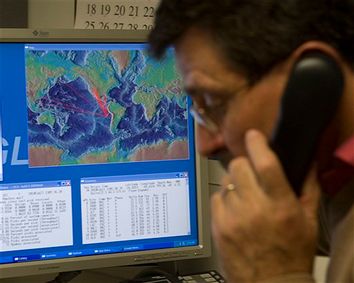
With a computer graphic showing the possible path of tsunami waves from an earthquake in Chile, Dr. Charles McCreery speaks on the phone at the Pacific Tsunami Warning Center, Saturday, Feb. 27, 2010 in Ewa Beach, Hawaii. The State of Hawaii is under a tsunami warning after an 8.8 magnitude earthquake rattled Chile today. (AP Photo/Marco Garcia)(Credit: AP) Update: The Pacific Tsunami Warning Center has canceled its tsunami warning for Hawaii, with the state apparently escaping the roiling waves unscathed.
Gov. Linda Lingle says no damage has been reported in any county. Tidal surges were observed Saturday along the coasts but did not roar ashore. She’s calling it “a great day now that it’s over.”
****************
A tsunami triggered by the Chilean earthquake sent a surge of water ashore in Hawaii, California and islands in the South Pacific on Saturday as the waves continued onto Alaska and parts of Asia.
Continue Reading Close