Barbara O'Dair

Beyond Bridget Jones

These four new novels by and about women (and one not-so-new one) may be riding the chick-lit publishing craze. But they're also good enough to bust that dismissive genre label wide open.

  • more
    • All Share Services

Is there a bigger buzz-kill in chick lit than babies? I mean, mewling infants, soiled diapers, endless nights at home: Miranda was never the same again. Nevertheless, motherhood is an endless source of fascination and provocation in a new crop of women-driven books, several of which might qualify as chick lit simply for their vivid depictions of privileged lives, story lines that combine finding oneself with getting the guy, and characters that aren’t asked to do much in the way of introspection. Even the insular ladies of these titles are outer-directed; in this, they provide enough action to satisfy the most intense need for feminine theatrics. At their best they do what so-called chick lit can do: open a window onto women’s lives and propel uniquely female concerns to center stage.

In these titles, we get glimpses of a posh set of Greenwich-style grandmothers, narcissistic neuroscientists, a professional woman with two husbands, and the mother of a teenage monster who holds herself (and is held) partially responsible for his horrific acts. The getting, having and grappling with children might end up making chick lit, as it is narrowly defined, defunct. It might also push out the boundaries of the category, which, despite its brash and dismissive appellation (see also “chick flick”), could grow to include new and interesting material such as found in the following works. Wouldn’t that be ironic: If the fluffiest of current genres spawned the latest in Big Ideas?

“Our Kind: A Novel in Stories”
By Kate Walbert
208 pages
Simon & Schuster
Order from Powells.com

Before we get carried away, Kate Walbert’s third book would never be mistaken for chick lit in any world, though “Our Kind” is a literary hen party of sorts. Her “novel in stories” twines together select tales from the lives of a group of older women, with names like Canoe, Bambi, Viv and Esther, in gorgeous but taut lyrical prose. While Woolfian in spirit (the author deliberately drops a few references to Virginia Woolf throughout), the book’s sharp, canny social observations are rather more Austenian. But though her characters are finely drawn, they are hard to distinguish from each other by design, as they’re ingeniously referred to in the first person plural throughout: “We laughed; we couldn’t help it”; “Some of us bit our fingernails.”

It’s a device that’s both inclusive and exclusive. Walbert’s vision is that these upper-crust Connecticut ladies are of a piece, a type, a “kind,” one or two of whom may have attended Smith or Mount Holyoke yet ultimately dropped academia for marriage. They’ve stuck together as adults through childbearing and divorce, martinis and cigarettes, country club memberships, and vacations but never known much about each other’s inner lives. She beautifully limns their world: “We were once rich, or close enough. Our husbands had good jobs, buying and selling. We left them some years ago in a thundering of hooves, our long faces uncompromised by apology. They would remarry, mostly, younger girls or women not our type. We couldn’t have cared less. We kept the house and the pool, occasionally a court. We drew together.”

They’re bored, so bored they don’t even think to ask, Is this all there is? But children begin to fill a void, for a little while. “After their conceptions we’ve felt our world expanding, bursting out of its previous condition … With babies we feel oddly contained, rightfully nailed into form. No longer loose boards, a leaky vessel listing in the doldrums with a wildly spinning compass, we head straight into the wind, sails unfurled and bleached white as the diapers soaking in our bathtubs. If nothing else they give us something to do.”

“No Ordinary Matter”
By Jenny McPhee
272 pages
Free Press
Order from Powells.com

Jenny McPhee’s modern young women are not caught in the same dilemma, yet they, too, struggle to find their footing with or without men or children. In “No Ordinary Matter,” two sisters, Lillian, a beautiful neurosurgeon, and Veronica, a soap opera and musical comedy writer, hire a private investigator to probe the circumstances of their father’s death 25 years earlier, ultimately unearthing startling family facts. Along the way, a series of coincidences occur: For one, Alex Drake, the handsome new actor on Veronica’s show, has unknowingly impregnated Lillian in a one-night stand, which Lillian orchestrated to conceive a child.

Supposedly random occurrences such as this one are McPhee’s specialty, and she layers her plot lines with scientific inquiry, often pitting the factual world against the more malleable constructs of psychology and choice. Of Lillian for instance, McPhee writes, “Abandonment, jealousy, anger, and resentment were all feelings she usually absorbed and deflected with the ease and precision of a superconducting magnet.”

The sisters meet regularly at a pastry shop, each one often dressed to the nines and spouting breezy repartee that passes for sisterly confidences. “When she had told Lillian about the breakup, her sister had said very little more than ‘Perhaps there is a God.’ ‘Should I call him?’ Veronica had asked. ‘Cold turkey, it’s the only way’ … ‘I think we have to stop meeting in this place,’ Lillian said. ‘I mean, the art is just so consistently bad, I’m reduced to reassessing your ex-boyfriend’s talent.’”

The novel’s angle on parenthood is complex — the ending truly illustrates this point, but there are plenty of other examples. Their mother is absentee, off raising farm animals in New Zealand, their father’s death is shrouded in mystery, and Lillian eschews partnership in raising a child. “A few months earlier Lillian had announced to Veronica that she had decided to have a baby. She was thirty-five … there was no man she was particularly interested in and certainly no one she wanted to share the experience with … She would just have to rely on Margaret Mead’s dictum: Fatherhood was a social invention.”

For McPhee, it would seem, the world is a fascinating machine with intricate parts that somehow fit together: Broadway, television, brain chemistry, academia, motherhood, family, feminism, beauty, jealousy, love, sex and work — and that’s what she models her novel on. It’s a heady mix, and an ambitious undertaking. She has wit and patience with her sometimes exasperating characters, and a demonstrated skill as ringmaster to her intricate plot circles and the ideas that make them swirl.

“What to Keep”
By Rachel Cline
304 pages
Random House
Order from Powells.com

Rachel Cline’s “What to Keep” is another novel about parental neglect and a daughter coming to terms with her own responsibilities to herself and others, an appraisal, naturally, that includes her own version of motherhood. The book is divided into thirds, taking place when the narrator is 12, 26 and 36. Denny Roman is a precocious, lonely girl whose neuroscientist parents, Charles and Lily, are distant and preoccupied: “No one identifies their six-year-old girl’s willfulness as ‘passion’ but Charles and Lily did recognize in Denny an emotional immediacy that was genuine, relentless and entirely new to both of them.”

When Lily has a car accident on the day of Denny’s debut as an actress in a middle-school play, Lily wanders their town, a suburb of Columbus, Ohio, in a muddle, forgetting her engagements and even her identity. “The thing that Lily has never been able to see around the sides of is being a mother. Even while working sixty hours a week, even when Denny was asleep, even when she and Denny were always together and their relationship made perfect sense to her, the role of mother did not. Even more than a doctor, even more than a wife, a mother is an ‘other,’ whose existence always seems incomplete — and maybe that’s why, in Lily’s state of burgeoning concussion, it is the first thing she lets go.”

Cline’s eminently readable, tender tale mixes empathy and quiet humor, adolescent yearning and adult understanding. Returning to Ohio from Los Angeles to clean out her room as her mother prepares to move to New York for a research job, Denny expects revelation. “As they pull into the driveway, Denny waits for the feeling of home to wash over her. As she opens the car door, she draws a deep breath of the still, hot air. She smells lawn cuttings, dying barbecues, exhaust. Nothing happens. The way the eleventh stair creaks doesn’t do it, either. Nor does the smell of the freshly laundered pillowcase on her childhood bed. No wonder she is not a Method actor.”

In the last section, when Denny has relocated to Manhattan herself and taken up playwriting, this wry 36-year-old has the opportunity to become a mother, via the potential adoption of the 12-year-old African-American son of her recently deceased friend. That a kind of Prince Charming (a blue-eyed former Brat Packer turned director) appears in the final scene is a testament to the power of chick lit, though the fact that he’s a divorced father with his own adolescent to contend with assures us that another story is just beginning.

“We Need to Talk About Kevin”
By Lionel Shriver
416 pages
Perennial
Order from Powells.com

Then there’s the mother of all recent above-chick-lit novels, last year’s “We Need to Talk About Kevin,” by Lionel Shriver, just released in paperback. Eva Khatchadourian’s son is the teenage killer — by crossbow — of seven students, a teacher and a janitor in his high school. Deep maternal ambivalence predated Kevin’s conception and continued throughout his childhood. “What possessed us? We were so happy! Why, then, did we take the stake of all we had and place it all on this outrageous gamble of having a child?”

This story is the most extreme, of course, in this lot of over-the-top plots. Of course, Shriver could have illustrated the fear of motherhood without resorting to the Columbine reference. But what this conceit does is allow the author to explore her topic to its core, as she has created as unsympathetic a portrait as possible of the boy — and his mother, the former travel company owner and Manhattan-dwelling sophisticate, whose sharp clothes and smart dinner parties and monthly treks to one continent or another have been curtailed by the care and feeding of her firstborn.

The epistolary method Shriver uses, letters to Eva’s absent husband, strains belief, yet ultimately that’s not what trips us up. It’s Eva’s relentless negativity that becomes boring and repetitive in the first half of the book, the endless recounting of her loss of svelteness, her loss of freedom. What was hailed as feminist comes across as vain and selfish — yes, that’s right, the very hallmarks of chickdom. Could Eva Khatchadourian be chick lit’s very own patron saint? During her pregnancy, Eva racked her brain “for what in all this — the diapers, the sleepless nights, the rides to soccer practice — I was meant to be looking forward to.”

She goes further. “Casting my eye down Fifth Avenue as my belly swelled, I would register with incredulity: Every one of these people came from a woman’s cunt … I once turned heads with a short skirt. Ever notice how many films portray pregnancy as infestation, as colonization by stealth? … Any woman whose teeth have rotted, whose bones have thinned, whose skin has stretched, knows the humbling price of a nine-month freeloader … My face was younger but, I thought, dumber looking.”

This strikes me as more than maternal ambivalence. I would, in fact, call this misogyny, at least self-hatred, and if you think it understandable in light of the senseless slaughter carried out by this woman’s son, we are nonetheless stuck with this unsympathetic narrator for another 350 pages.

Still. There is undeniable excitement in saying the unsayable, in voicing the unpopular, and it mounts as this book goes on. While not always eloquent, Shriver’s dive into the icy waters of the human heart is bracing. “I couldn’t bear the subtle distrust that was building between us when your experience of our son did not square with mine. I have sometimes entertained the retroactive delusion that even in his crib Kevin was learning to divide and conquer, scheming to present such contrasting temperaments that we were bound to be set at odds. Kevin’s features were unusually sharp for a baby, while my own still displayed that rounded Marlo Thomas credulity, as if he had leeched my very shrewdness in utero.”

Whatever you believe about nature vs. nurture and the components that aggregate to create the young killers of the Columbine sort, Shriver’s horrific tale mesmerizes when it doesn’t cauterize.

“Confessions of a Bigamist”
By Kate Lehrer
288 pages
Shaye Areheart Books
Order from Powells.com

For those who prefer less bloodshed with their beach reading, try bigamy. Not since Anaïs Nin treated us to her diaries has a tale of female double marriage been so rollicking as Kate Lehrer’s “Confessions of a Bigamist.” New Yorker Michelle Banyon, an attractive, 40-something efficiency consultant with a burgeoning career, takes a business trip to Texas and meets bird doctor Wilson Collins, is seduced, crowned “Mickey,” installed in his Victorian farmhouse alongside his skeptical cook, and eventually married.

All this while remaining betrothed to Steve, a fancy international lawyer who remains oblivious to her merrymaking as he closes business deals in Asia. She works to keep two households homey, two men happy, and her career happening. “The transition from a conventional and slightly repressed wife and single-minded career woman to a lust-driven adulteress was dramatic enough, but returning to New York all but undid me.”

While occasionally silly and simple — Michelle doesn’t suffer nearly enough, or get caught by nearly enough people for a woman in her public position — the story has its charms, if only because there is no moral to it, and Michelle gets to keep all her balls in play. “There are so many ways to live a life,” she muses at the end. “The way I live wouldn’t appeal to everyone, but I am more content than an outlaw like me deserves to be.” Spoken like a woman who has turned the word “chick” on its ear.

“Why are movies bad and how do women get dead?”

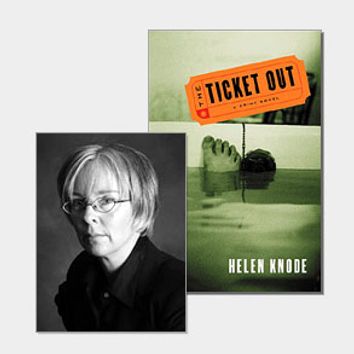
Film critic-turned-crime writer Helen Knode on her first novel, the soul-crushing deadness of Hollywood, the greatness of "Titanic" and her relationship with husband James Ellroy.

  • more
    • All Share Services

I met Helen Knode in 1989 at the L.A. Weekly, when she was in the middle of her six-year run as the paper’s leading contrarian film critic. I had just come to town from New York and an editing job at the Village Voice, and was pretty much on my own. Helen and I became fast friends. We shared a love of feminist discourse and enjoyed healthy disagreements over Indian food: While Helen, a Calgary cowgirl, studied early matriarchies, I barely tolerated the notion of “goddess” unless applied to Madonna. She didn’t tolerate Madonna. Nevertheless, when my Los Angeles stay was cut short and I returned to New York, we resolved to stay in touch. In 1991, Helen married crime writer James Ellroy and quit the Weekly. Relocated to Connecticut, she was back in my sphere. But after four years, the couple made for Kansas, where Helen had graduated from college years before; it was there that she set herself up to write her first novel.

Eight years later, Knode, now 45, talks about that novel, “The Ticket Out,” and the “media-addled, frustrated career woman” who drives her unique crime story. After disillusioned film critic Ann Whitehead finds a dead woman in her bathtub, she embarks on a journey to discover more about the woman and hooks up with the main detective whose job it is to solve the crime. Along the way, she unearths and becomes embroiled in a larger scheme that unites old Hollywood decadence with the corruption of contemporary L.A. Written with wiseacre wit and stylish yet clean storytelling, “The Ticket Out” is an engaging romp with plenty of ideas jostling for place among the many characters and plot points. From a temporary house on the Monterey Peninsula of Northern California, minutes from the new house being readied for her and Ellroy, Knode reports that the book was “a crushing intellectual and completely wrenching emotional labor.”

Give me the basic plotline of “The Ticket Out.”

It’s a police procedural, a homicide investigation. Ann, my heroine, an amateur, finds a dead body in her bathtub. She’s fascinated not with the crime so much but the life: Who is this woman? And she runs up against the LAPD detective who is investigating the crime, and gets involved in his investigation too.

Greta is the dead woman and Doug is the detective. So describe the subsidiary plotlines.

There is the Oedipal plotline, which involves Ann Whitehead’s father and sister, and their presence in L.A. There is the fact that the dead woman has written a script that is missing, and the script is the story of a real unsolved murder — real as in an actually historically true, unsolved murder of a woman named Georgette Bauerdorf who was murdered in October 1944 in West Hollywood. The crime has never been solved.

What are the central themes of the book?

Hollywood, and the women in Hollywood. There’s a running argument about the state of movies and of film criticism and of Hollywood. Everybody Ann talks to has some role in Hollywood, whether it’s fringe or central. And there’s also the running theme of Hollywood’s past. I use Metro-Goldwyn-Mayer, the greatest studio ever from the classic era of Hollywood, as a symbol of Hollywood’s greatness. There’s lots of stuff about Louis Mayer and Irving Thalberg and the MGM lot, which is now owned by Sony.

And there’s a lot of stuff about women. Women in various roles in the movie industry, in front of the camera, behind the camera — the women who never made it, the women who slept their way to the bottom.

And you might also say that there is a subplot and a theme about police and authority.

Yes. Absolutely. Thank you for noticing that.

And concurrently about violence.

Violence against women. Violence in general. The breakdown of authority. Specifically male authority. I’m always looking to shock, and I thought the most shocking thing I could do was try to put myself in the place of the LAPD. Because I really do believe that we live in a time of an authority crisis. And the police are blamed for things that aren’t their fault, exactly. They’re subject to the same crisis of authority as everybody else, even though they’re supposed to be authority. And so I have a lot of male “authority figures” who are weak or stupid. The father, of course, being the ultimate authority figure. All these different kinds of authority and power centers, and they’ve all just collapsed.

The ultimate irony is that you have your heroine fall in love with a cop.

Well, no, no. Did I say she was in love? Did I say that?

You did not.

[Laughs.] She slept with him. That’s all. That’s all that’s happened so far. One of the questions I started the book with was: What produces a hard-boiled woman? When men are hard-boiled, they’re hard-boiled for specific reasons. A woman gets hard-boiled because of sexual trauma, because of abuse in the past, because … she’s like Scarlett O’Hara. She looks at the world, it’s a man’s world, and she grows a shell. So this was my version of doing a hard-boiled woman. Without it being a completely unanalyzed hard-boiled woman.

What was the initial spark for “The Ticket Out”?

I had started writing a column for the L.A. Weekly called “Weird Sister.” It was a creative leap for me, because it wasn’t reviewing movies. I could write about whatever I wanted to write about. Then I met James [Ellroy], whose work I did not know when I met him, and he was telling all the unhappy journalists who talked to him to write a novel. One thing led to another and I was suddenly married and moving to Connecticut. I was going to continue the column but I realized it wasn’t enough.

I should also mention that when I was a columnist I wanted James to take me around and show me Black Dahlia sites. I’d never heard of the case [a notorious Los Angeles murder from 1947], but I read his book ["The Black Dahlia," 1987] and was so impressed by the way he treated Elizabeth Short [the murder victim] that I started thinking about violence against women differently. Because the normal feminist discourse on violence is that we are the objects of violence, we are the victims of violence.

Right. And of course most murder victims in crime books seem to be women.

Yes. So what does that mean for the women who are living, who have managed not to be killed? What is it like not to be the object of violence but the subject of violence? And I find that in many mystery novels and crime novels written by women, they act like it’s the same thing for a woman to find a woman killed as it is for a man to find a woman killed. But for me, any woman who finds a woman who has been murdered, it’s got to throw you back on yourself: Why is she dead while I’m alive? So I went into the novel with these two questions in my mind: Why are movies bad and how do women get dead? And it somehow ends up being the same answer. [Laughs.] I don’t know what the answer is but I’m sure it’s connected. [Laughs.]

Why Hollywood?

Well, I was there. I obviously consider it important for a certain period of my life. When I first started at the job I really just thought I was hotter than shit. Even though the L.A. Weekly is definitely fringe, and never aspired to be part of the industry. But you’re close to that energy, and you feel it all the time and it’s pumping a little into your veins. It’s a kid thing — to take your energy from something like that.

I finally realized after two or three years that there was some profound philosophical bankruptcy in what I was watching. I myself became unhappy and started to feel empty, started to feel like this wasn’t giving me its energy anymore, and wasn’t reflecting what I believed. Not just on the women front. You know, you can criticize the movies for being sexist, for sure. But just in terms of a degraded view of human possibilities, of human behavior.

So to feel that kind of loss and disappointment you must have had very high hopes for the movies to begin with.

That were completely neurotic. [Laughs.] I mean, why do people look for meaning outside of themselves? It isn’t there. I had a tremendous amount of psychic energy invested in movies: Movie history and sexy movies and art movies. Movies are stupid. They’re not reflecting anything in particular, except for maybe the end of civilization. [Laughs.]

Is the nasty old mogul Joel Silverman in your book really based on [late MCA head] Lew Wasserman? One of your reviewers suggested you had to wait to publish your book until Wasserman died, as if he might have sued you for defamation of character. Does that have any basis in reality?

Absolutely none. Lew Wasserman was at one time the most powerful person in Hollywood and continued to be a presence up until his death.

And did in fact ruin movies.

He didn’t ruin them. He didn’t care about them. That’s the whole thing. What people don’t really understand is Hollywood is run by a lot of people who don’t care about movies. They’re just making money. And they use that money, like Mike Ovitz, to buy beautiful art collections. [Laughs.] But no, I mean, Joel Silverman is just a type.

Where did Greta come from?

She came from my meeting with [film director] Kathryn Bigelow. But she’s not Bigelow. I’m a big fan of Bigelow’s. I interviewed her for “Blue Steel.” That was in ’89, years before I started this book. I think that what Bigelow wants, which is to be a female director of action, is strictly speaking impossible, given Hollywood’s gender categories. My heroine is driven crazy by this contradiction. She wants to be Steven Spielberg, she wants to make widescreen adventure movies. Her existential position in Hollywood just fascinated me. How could she do the things she wanted to do? I have felt it myself. It’s not just Kathryn Bigelow, it’s women who just want to do what they want to do. And there’s some reason that the world won’t let them. At that time, you know, Bigelow had not made “K-19: The Widowmaker.”

Let’s talk about “Thelma and Louise” for a moment.

“Thelma and Louise,” which I think is a watershed, is the tragic view of the condition of women. You just drive off a cliff and you’re dead. Because you’ve been cornered and there is no hope. You cannot be free. You can drive somewhere and not have a history. You can drive somewhere and start new. Just like the myth of the Wild West. There’s a frontier where you can be free. And for women there is no such place. Because wherever you go, you are a vagina. Wherever you go on this planet you are a vagina. And that’s what happens, that’s the dynamic. That’s what starts “Thelma and Louise.” Thelma and Louise decide they want to take a vacation from their thankless husbands and boyfriends. So they jump in their car, they’re going away for a weekend. The first thing that happens is they go to a bar for some fun and someone gets raped. Or it’s attempted. And so someone gets shot. And they’re on the run.

I know the movie took a lot of flack for being anti-feminist and anti-woman, that women with guns are just as bad as men with guns. But the dynamic, the thing that’s motivating the violence, is purely female. I was very moved by that movie, and I wanted to go on in that vein. What does it mean for a woman to be free?

Has anybody come close to making a movie that touches on that issue since then?

I don’t think people have even tried. What’s come out of “Thelma and Louise” is this whole kicking-feet genre, like “Charlie’s Angels” and “Crouching Tiger, Hidden Dragon” and “Lara Croft: Tomb Raider” and all the chick-flick stuff. These movies have skipped over the problem of freedom. I have not seen anything like “Thelma and Louise,” because it’s not explicit. It’s talking about its problem in genre language. It’s not directly saying what it’s saying.

What was the last good movie you saw?

“Harry Potter and the Sorcerer’s Stone.” [Laughs.] I’d rather watch 15 Harry Potter movies than “The Hours.”

Tell me about “The Hours.”

I think the basic premise of “The Hours” is that modernism is responsible for AIDS. [Laughs] It’s a chain of unhappy women leading to a guy who throws himself out the window, all with the link of “Mrs. Dalloway.” Virginia Woolf walking into the river leads to him throwing himself out the window. Any movie that opens with a woman walking into a stream with rocks in her pocket is not my kind of movie. And it all seems to be this morass of psychological opacity and sexual ambiguity and unhappiness. It’s the most morose movie I’ve seen in a long time. Nobody knows anything, everything is lost, everything is despair, everything is unhappiness and water’s rushing over your head.

Not that there’s not tragedy in life. But if I’m going to watch a tragedy I’ll watch David Lean, you know. I’ll watch “Doctor Zhivago” if I want to cry. At least that’s a clean cry.

What about “Adaptation”?

I didn’t hate it, but again it’s one of those movies that seems to say that there are only two options for human consciousness. Either completely paralyzed self-consciousness, which is not even the same as self-awareness, or your other option is bloody, low-chakra, base, animal unconsciousness, which is adultery, betrayal, drug addiction, death in the swamp, shotguns and crocodiles and car crashes, and all that. There are other forms of consciousness. There’s the spiritual dimension that’s completely missing.

Who are your favorite directors?

I don’t have any anymore.

What do you think about Martin Scorsese?

“Gangs of New York” was like being in a Hieronymus Bosch painting. In a room with no windows or doors or air. Because there’s no tension in a movie with extreme violence. There’s no suspense. There is literally nothing that your mind is asking itself, because the only solution to every problem is violence. Your mind is so tired but you’re getting a sort of psychic workout because it is like having electrodes stuck on your body and you’re getting these physical reactions. But it’s not engaging your mind.

So what are you loving?

I am obsessed with romance and men and women and the female principle and the male principle and how in this day and age, romance seems to have turned into something like pathology. Nobody believes in it, and yet people are falling in love all the time. And so my favorite movies are romantic movies. I’m a big fan of “Moulin Rouge.” That’s a movie I would defend. I think Baz Luhrmann is a romantic searching for a contemporary language for romance. And that’s why it’s so gothic, that movie, because we don’t have a natural language for romance.

So I don’t have a director anymore. It’s more subject matter and view of the world. I have my pantheon of romantic movies, my female transformation plots, which I love, like “The Princess Diaries,” “Miss Congeniality,” “Now, Voyager.” Then, you know, my pure romantic movies that are always exalting even if they’re tragic, like “Doctor Zhivago,” “Ryan’s Daughter,” “Brief Encounter” and “Bridge on the River Kwai,” “Titanic.” I’m a big fan of “Titanic.” I think Jim Cameron is our great poet of the doomed heterosexual couple, for which “Titanic” is the ultimate metaphor. [Laughs.]

Ayn Rand wrote an essay called “The Romantic Manifesto.” It’s the most influential essay, for me, on aesthetics. She makes a difference between naturalism and the romantic. She defines the romantic as the recognition that human beings have a will and they have the capacity to make their own happiness. She contrasts that to naturalism, which has basically triumphed in our cultural world, in which everything is formless, you can’t know anything, you can’t make your own destiny, you are just prey to all these forces that you can’t control. There is no such thing as human will.

I can look at “The Hours,” or, say, “Far From Heaven” — you’re looking at people who can’t seem to be happy, they can’t seem to exert themselves, they can’t even seem to say happiness is possible and they will actively work towards it. I’m not a pessimist. So I don’t believe everything is darkness and shit and then you die.

Do you think that that’s the worldview of classic noir, what you just said?

Absolutely. That we’re the prey of these corrupt institutions. They can’t be understood, they can’t be combated. Essentially, it’s just darkness.

Darkness with no hope?

With no hope. And your exaltation is the dark exaltation of flushing your life down the toilet for a woman. And Lord knows they wrote some sexy stuff and made some sexy movies. But I am an optimist and I believe in hope and I believe pessimism is both cause and effect when your worldview is naturalistic.

Why did you use the noir genre then?

I wanted the hard-boiled voice. But I call it “feminist noire,” with an “E” on the end.

Why is the last word of the book “Doug”?

Because I have embraced my nature as a romantic. Because the most shocking thing you can be nowadays is a romantic. And that’s an ambiguous ending, I hope you admit. And she starts the book dreaming about a gun and ends it on a man’s name, after we’ve had a long soliloquy about why she doesn’t love anyone and can’t.

It’s a message of hope.

It’s the lead-in to the sequel.

Continue Reading Close

A conversation with Robert Christgau

The self-styled dean of American rock criticism talks about rock's past, its future and why he hit Ellen Willis in the face with a piece of pie.

  • more
    • All Share Services

A conversation with Robert Christgau

For 35 years, Robert Christgau has written about pop music, first for Esquire in its new journalism salad days and then, for fully 29 of the past 31 years, at the Village Voice, where he still holds a senior editor title. Over that time he has tracked, with unmatched energy and unflagging interest, the course of our culture’s most protean art form.

It’s also our most youthful art form; yet, at 59, Christgau still maintains a sympathetic ear for the music’s newest sounds, even as he’s matured into a sophisticated appreciation of world pop on a scale few American writers can claim.

His work is unmistakable: At Christgau’s best, he’s fiercely analytical, dispensing dense sentences that twist in on themselves and (sometimes) the reader, rife with allusions both academic and street and displaying both a ready conversance with theory and a scathing contempt for puffery.

He has lived in a book-strewn flat in New York’s East Village for decades. He married Carola Dibbell in 1974; they have a daughter, Nina, now 15. Over the years Christgau has maintained combative friendships with critics like Ellen Willis, Greil Marcus and Dave Marsh, and mentored a generation or two of young critics, notably Ann Powers, now a staff critic for the New York Times.

The 28th edition of the Voice’s Pazz & Jop Critics’ Poll was published in March. A lineup of nearly 600 critics voted Outkast’s “Stankonia” the album of the year. Created and still overseen by Christgau, the poll incorporates the views of ever-new generations of younger critics and can lay claim to having rarely missed talent when it first appeared, making it arguably the most comprehensive and respectable award operation in any medium.

Christgau continues to write a column, “Rock&Roll&,” for the Voice and pens a monthly “Consumer Guide” of capsule record reviews. He has three recent books: “Grown Up All Wrong,” a collection of his recent Voice essays; “Christgau’s Consumer Guide: Albums of the ’90s,” the third assemblage of the Consumer Guide capsules; and “Any Old Way You Choose It,” a reissue of his first, 1973 anthology of his earliest work.

We spoke to Christgau recently in New York.

- – - – - – - – - – - -

How do you feel about the notion of a rock canon?

I’ve been accused of being a canonizer myself and I’m pleased to say that that’s now a complete absurdity.

Do you think you worked out of that way of thinking?

I think that the culture simply passed me by. Canonization is institutional. The Rock and Roll Hall of Fame is a canonizing institution. Jann Wenner has worked to make Rolling Stone the keeper of the canon since 1970. I don’t like that, because he uses institutional power and he uses economic power to enforce those standards. Similarly, when MTV does one of its incredibly stupid historical rundowns — which it does four times a year of some dumb shit or other — it’s using its institutional and economic power to enforce a canon. I just express my tastes. But I think that there was a time in, say, the ’70s when my tastes were so in keeping with the conventional critical wisdom that I was a kind of a canon keeper.

Kind of an anti-canon canonizer?

I was and I wasn’t. For the critics I wasn’t. Maybe for the industry I was ’cause I always liked punk. But critics never had any problems with the Sex Pistols and the Clash; it was just the industry that did.

None of your books has presented your work in a canonizing way. Maybe specific essays do.

Somebody may well ask me to write a canonizing record book.

And would you?

If the money were right, I wouldn’t hesitate to do it. But even then, Dr. Dre and Radiohead would not be in that book. Now Radiohead is the most important rock band in the world by acclamation. Bull fucking shit, you know. They suck. And whether I’ll be vindicated or not I don’t know.

What’s the next thing after the teen boom?

I never prophesy. I’ve been saying hip-hop, hip-hop, hip-hop, hip-hop for a long time, and now I’ll say hip-hop, hip-hop, hip-hop, hip-hop. I don’t see any signs that it’s slowing down. And obviously other stuff is going to go on. You know what I mean: The trend is no trend — that’s the trend. The trend is the proliferation of outlets, genres, audiences. That’s clearly the case and it makes perfect sense structurally in terms of the economy and the way the society is structured.

You’re not a doomsayer about audience fragmentation?

No, I’m not. But I also don’t think it’s a good thing that we’ve lost what’s called the monoculture. I grew up with the monoculture. I don’t think it’s such a bad idea that people learn the same history in school. I think it tends to ground people and give them something to respond to and react against. But on the other hand, if 25 years ago you had said, “Oh, there’ll be 50 different radio stations that’ll all play different kinds of music and there’ll be thousands of different songs on the radio,” people would have said, “Oh really? That sounds great.” Now they say, “Oh, it’s the end of the world.” Well, it’s one or the other. Maybe it’s neither.

You know, information overload is a phrase I’ve been using in my criticism for a long time. Change seems disturbing, threatening, fucking irritating, an affront to one’s very existence. But it’s not a good idea to base a career on it. I’m very anti-nostalgia and I’m very anti-golden age.

So what is the rap that a 58-year-old white man likes these days?

I tend to have very East Coast tastes. I’m slow on the uptake about things. I didn’t understand that the first Wu Tang album was great when I first heard it. And now I’m curious — I was listening all morning to the fourth Outkast album, and I suspect that there was more on those first two albums than I heard at the time. I have to go back and listen. It takes me a while to understand, because I’m not in that world at all and I have to get it solely as music. I have no cultural connection at all to it. And I usually have to read a lot about it and have it explained to me.

I’ve been pretty quick on the uptake about most things. And then there are things I don’t like or get. Metal — I don’t think metal’s as bad as I hear it as being. And were I a different person, I could probably write differently about dance music, especially the most recent phase of it, since 1989 or so. But I’m not that person and I believe the only person who can write well about that music has to spend a lot of time in clubs and do a certain amount of drugs, neither of which I’m ready to do. And then there are other things too. I don’t get salsa.

It’s not always so easy for lots of people to maintain such a high level of interest in the subject matter for so long either. How do you do that?

It’s my gift.

You’ve never lost it?

Every once in a while there’s a day or two when I say, “Gee, electric guitars, what an ugly sound.” But I’m a very enthusiastic person. For sure I’m an excitable, fun-loving person. I enjoy life.

Do you think you’re intimidating?

I’m told I’m intimidating, so I guess I am.

And do you like that?

No.

Has it ever worked for you?

I assume it has. But I don’t think that’s the way to relate to people. I’m not one for small talk. I don’t have many regrets about being that way. There are times when it really seems inappropriate to me, and I try not to do it, or I wish I hadn’t done it later. But as a general approach, no, I think it’s fine.

How would you assess your character?

Honest, abrasive, hardworking, fun-loving. And a peculiar mixture of pretentious and unpretentious.

It’s interesting that you didn’t mention being a talent scout and mentor, because so many people credit you with not just giving them their start but shaping them.

I love being an editor, but I haven’t been an editor in a full-time way for 15 years. I became a rather good writing teacher until I decided that no one could pay me enough for the time that it takes to be a good writing teacher. Give me [tenure], I’ll go back to it. Make me an adjunct, forget about it. I love teaching writing. And it was a great pleasure to find writers.

Do you think the Voice has lost its relevance?

No. Has it lost its monopoly? Yes. Its formula has been fucked with, adjusted, so that we have Time Out, we have the New York Press — which are two sub-Voices, both of which have their own functions and their own audiences. We don’t control the playing field anymore. But I don’t think that’s unhealthy.

I’m proud to work for a newspaper of the left. I’m a leftist. And fuck everybody at the Nation who thinks that we’re not really leftists.

What’s the most dread question that you can imagine me asking?

It would have to do with talking seriously about what I think of the work of people who I like more than their work.

Who are the younger writers you like now?

What do you mean by “younger”? ‘Cause the younger writers are all past 30 now. There’s a whole bunch of people under 30, and I have more trouble sorting those people out. There are a lot of people who I’m not even aware of, and I think because there isn’t anybody really guiding them in a lot of ways, there’s a lot of shitty work being done.

You ask me to name who I’m proud to have worked with as an editor? I’d say Greg Tate, Nelson George, Tom Carson, Stanley Crouch. Both Chuck Eddy and Ann Powers were people who I got jump-started because I noticed them and gave them a passing shot. And I’m very pleased about that.

So who are your five favorite rock critics?

Most of them are over 40; the exception is Ann Powers. Greil Marcus, Lester Bangs, Greg Tate and Jon Pareles. Is that a self-interested list? Yeah, but on the other hand, why did I go to those people to begin with? Because I thought they were smart. I like Jon because what he manages to do in that daily context is pretty remarkable. I think he’s as good a writer about the music of rock as there is.

Was Lester Bangs a good friend?

He wasn’t a good friend. He was a good friend of my sister, Georgia, he was a good friend of Greil, who is one of my closest friends. He ate dinner at my house. We had a good professional relationship based on a lot of respect on my side and to a lesser extent on his. He had bad feelings about me sometimes. I said something to him once about Flaubert and the Ivy League that he never understood. I used to complain about people who talked about literature as if it went back to “Naked Lunch” — and Lester was certainly in that category.

I’d come to realize that my education had prepared me in a certain way, that it had given me a context out of which to work. Not that it made me better than him, which I think is what he thought I was saying. What I would say is that having a good general education helps you to write criticism because you understand the consensus narrative about culture — “consensus narrative” is a term my wife and I have been kicking around. You know, you understand what the conventional wisdom is about culture and then you can work against that.

Do you want to say a little bit about Greil?

Greil has been one of my closest friends since we started corresponding before we even met, in early ’68, I think. I’m very unlike him in a lot of respects. He’s a much classier guy than I am. There was a period of the better part of a year when he wouldn’t talk to me because of what I said about Public Enemy. He felt I was defending their anti-Semitism. We didn’t have the same position on it. He’s a very loyal friend. It’s of value for both of us.

How would you compare your approach to music and writing?

We started out two peas in a pod and now I think we’re completely different. He has a much broader cultural range than I do. He’s a much better educated person than I am, both autodidactic and in terms of his academic background. He cares about the fine arts in a way I do not. And his knowledge of politics is much more detailed than mine. On the other hand, I think that my appetite for music far exceeds his, and I think specifically that he hasn’t had much feeling for black popular music since soul took a nosedive. That’s almost 30 years ago. It’s not that he pays no attention to it at all, but it definitely hasn’t moved him the way it’s moved me. He’s not moved by George Clinton the way I am. He knows George Clinton is great, I’m sure, but he doesn’t care about him like I do. And I think that’s very important. I like rock — it’s meant a lot to me. But hip-hop is the music I think is strongest these days. And you know what? I have no connection to speak of with the hip-hop community. I’m sure that most of the people don’t care at all what I think. But the music is there; it’s there to be enjoyed.

How did you meet Ellen Willis?

Ellen was my first serious girlfriend after college, well after college. I had a long dry spell. I’d actually gone to junior high school with her and later ran into her. I was asked to write a story about the Free University for Commentary, the other magazine that called me up. She was working for Fact, Ralph Ginzburg’s magazine. And she was at the free university trying to meet guys. I was in love with her soon enough. She didn’t really know that much about pop but she understood it, I would say, inside of 15 minutes. We started developing this theory of pop together — which we were going to write a book about, only we broke up first.

How long were you together?

From January of ’66 till September of ’69. They were interesting years.

Why did you break up?

She wanted to sleep with somebody else and I didn’t want her to. We really felt the opposite way about some things. A lot of sparks flew and we’re both really articulate and smart-talked to each other all the time.

So what about the rumor that you and Ellen were at a dinner party after you’d broken up and you threw a piece of pie at her?

Greil Marcus was sitting right next to her, and he’s still my friend. That’s one of the reasons I threw the pie at her, actually.

How is that?

‘Cause I wanted to be with Greil — that was the reason I was out there.

And she was monopolizing him?

In terms of my irrational motivation, that was certainly part of it.

Did it hit her?

Right in the face.

Did anybody ask you to leave?

No. It wasn’t a dinner party, it was a big Grunt Records/Jefferson Airplane junket. There were hundreds of people in the room. It was at Winterland, I think.

Have you ever done anything like that again?

Probably, but I don’t think I’m going to labor to remember it. When Carola met me, she was impressed by how often I got into confrontations with people on the street.

She was impressed by that.

Yeah. It happened probably three or four times the first year or two I knew her.

Were you trying to impress her?

No. And I don’t do it anymore.

To what do you credit that?

Carola. She calmed me down. I’m not really a street-fighting man.

You’re the marrying kind.

I am. And Carola had decided she was ready after a couple of years. We wanted to have kids together.

I know you’ve personally brought women into the business of rock crit. The field has been male dominated, however; that’s a common perception.

I certainly know women who feel that way who I think got exactly what they deserved and I’m not going to name those names. I don’t have a very p.c. view of this. I think that as in rock itself, there are certain — I want to say prerogatives of discourse but that’s not the right phrase — certain usages (that’s a word I often fall back on) that require a certain kind of forcefulness that I don’t think women are as well equipped for as men.

Why?

I would say socialization till proven otherwise, but maybe that’s not the case. It’s an aggressiveness, I think, more than anything else. I teach Strunk and White when I teach college writing. Strunk and White — that book ["The Elements of Style"] was originally written for ruling class white men at Cornell in 1920. I explain that to my students. I point out to them all the class biases in the text, and then I say, “You should learn how to do this, because this is how the enemy controls you when it’s the enemy.” I believe that you have to learn to master those tools. I think a certain number of women critics decline them, and it’s to their detriment.

What about women in rock, or “women in rock”?

The best rock band going now is Sleater-Kinney, a women-in-rock band if ever there was one. One of the things about rock ‘n’ roll, and its excitement, is that it’s about youth, and discovering your power. It’s about growing up. It’s about forming yourself in public. For many, many white guys, that drama doesn’t seem to have many nooks and crannies anymore. But for women it’s got plenty. And the reason that there were so many great female artists in the ’90s is simply that they had emotional expanses out there that they had to explore and utilize and exploit that guys didn’t have. It is definitely not a good time for that sort of thing right now. So far there are no women coming along — whether they are pop stars, à la Britney [Spears] and Christina [Aguilera], or whether they’re the likes of Aimee Mann, who seems to me to conform to an aesthetic of gentility that has always been the opposite of rock. There are always holdovers and residuals, but as an idea, I would assume it has not played out.

What has to happen?

For one thing, it’s got to happen big. Hip-hop is really what’s going on in pop music these days. And women have a foothold. But for the most part they’re very ancillary and they tend to be members of crews being tossed bones. It’s got to get better than this. It seems like the big women in that world then become R&B singers, like Mary J. Blige.

There is something very masculine and hard about the main thing one likes about rock ‘n’ roll. And one of the things you’re saying to women is, “Don’t be so fuckin’ girly — come out and do this.” And maybe that’s an unfair imposition. Maybe it’s not right for a guy to make that demand. But it’s nevertheless the demand I guess I’m making.

So you’re not saying that women can’t handle an ax the way —

I certainly don’t believe there’s any biological reason. There are probably biological things that women can’t do, but playing guitar isn’t one of them.

When did you know that you wanted to write about rock?

It wasn’t there for anyone to know it was to be done.

How did it occur to you?

I had been a big rock ‘n’ roll fan in the ’50s. I had a friend who subscribed to [Billboard competitor] Cash Box. I kept the Top 40, I bought a lot of singles, I did all that stuff. I went off to Dartmouth at 16. It wasn’t a terribly good time for music and the radio up there sucked. And so there was jazz and folk music. I got into folk music, Joan Baez happened, I got out of folk music. I had always liked jazz too, and I really got deeply into jazz. And I was dimly aware of what was going on in rock ‘n’ roll.

After college I took this filing job, and WABC radio was on every night. The painter Bob Stanley, who was a mentor to me after I graduated, was my boss. We would talk about the songs — early Motown, girl groups, all that stuff was great.

How did you start to write?

I went to Dartmouth thinking I’d be a lawyer. It lasted two weeks. I discovered literature, which had really never been presented to me as such, even though I was a really good English student and won the creative writing award in my high school.

I’d always loved to read. I wanted to write fiction. I spent two years trying to do it in my spare time and I was terrible at it. I’m not good at making up stories. At the same time, I was getting interested in pop. And I was interested in sports and sports writing. I discovered A.J. Liebling when I read an essay called “Ahab and Nemesis” in his book “The Sweet Science.” It’s one of the great essays of the 20th century. And I said to myself, well, I’m not doing too well with these short stories. If I could write one thing that’s as good as that in my life, I’d be happy.

And I don’t think I have. But I’m close enough.

So I began to think about journalism, about reporting. I didn’t want to be a critic, but that’s what happened.

Why didn’t you want to be a critic?

Because it wasn’t creative — although people told me I should be a critic, that it was something I had a gift for. ‘Cause I certainly had a lot of opinions. One of the things you need to be a critic is not only opinions but to think that they’re important.

I went to work for the Newark Star-Ledger at a suburban feature service. I did the police beat and found I wasn’t good at that either because you have to hang out with the policemen. I’m not somebody who likes to sit in bars and talk to people. I like to sit at home and read. I’m not a schmoozer. And good reporters tend to be schmoozers. I admire it greatly, but I don’t have it.

Somebody had died in Clifton, N.J., on a macrobiotic diet. I went to New York magazine [with the story] and Tom Wolfe was actually there with [editor in chief] Clay Felker. I’d been a copy boy there for a few months so I had some notion of what I was doing. They gave me the assignment on spec, I worked my ass off, I gave it back to them in two weeks. And it was an award-winning piece. Esquire called me up. By the end of the second year [there], [editor] Harold Hayes was telling me that he had heard rock was dead and could I please write a piece saying it wasn’t true.

I wrote this piece about how rock ‘n’ roll wasn’t actually dying and why it wasn’t going to. And they didn’t print it. And then they let me take it over to the Village Voice and I asked if I could write there.

What do your parents do?

My father is a fireman who at the age of 34 got a scholarship to NYU, and went at night while working two or three jobs. He used to work an 80-hour week all the time — and go to college. My mother is a housewife. She became a school secretary a little after I went to college and basically ran whatever school she was in. She’s not bossy but she’s very smart.

What were you like as a child?

I come from a very religious background. My parents came from churchgoing families and they moved to Flushing [in Queens, N.Y.] and ended up in this extremely theologically conservative church, which was full of nice people, most of whom were displaced Southern Baptists. And they became born-again Christians and pillars of the First Presbyterian Church of Flushing. Still are.

I lost my faith when I was 15. I was a very thoughtful kid. I took the biblical teachings very seriously; I thought about what they meant. The idea of predestination, for instance, fascinated me. The idea of God’s omniscience fascinated me. I thought about it a lot. The ideas of the church really stimulated me.

So you were more intellectually drawn than emotionally?

I guess so. It’s not uncommon for kids in those churches to wonder if they’re really saved, and I did. I grew up in the belief that I had eternal life. I was the second member of my family to go to college. I took philosophy, which everybody told me not to take ’cause it was too hard. But that was the kind of thing I was interested in, ideas. And boy, it put me in a funk that lasted for years. I became an existentialist. I worried about death all the time. I was depressed for years.

And you think it was triggered by this philosophy course?

Yeah. Having grown up in the certainty of the faith and then having to learn to live without it. It was a struggle. But I think in the end, having grown up with that faith has been very good for me, just like being a first-born son has been very good for me. I have a lot of confidence that I think comes from my childhood training.

You must make some connections between that early faith and your more secular passion.

I think it informs everything I do. And it was very hard on me sexually; I resented it for that reason for years, ’cause I didn’t know what to do about sex. I didn’t lose my virginity till the summer before my senior year, because I felt it was wrong in some way. Once I realized what I’d gone through and how much time I’d wasted, I was very mad about it.

So as the first-born son in a religious family, you had a lot of pressure to be a leader and an upstanding son, carry on —

I don’t think I was pushed. But I was taught to compete. My father was a very competitive guy. He would play cards with me, and play to win. And, you know, that made for somewhat problematic relations in some respects, but once again, I think it was good for me. I tried to do it with my own daughter — it didn’t work at all. Then I tried to not win and that didn’t work either. My father was very athletic, and although I’m not a great athlete, I always played sports. I know there’s a lot of that in me. I’m a good competitor.

How has having a child, specifically your daughter, changed your criticism or affected your taste?

I don’t think it’s affected my taste very much at all. Except I probably would not have gotten into the Backstreet Boys without her. And I’m very glad I did ’cause there are things the Backstreet Boys have done that I think are really great. And I can write about teen pop with sympathy. Plus, Nina’s very musical — she has an enormous amount of specific insight to provide, as well as info.

She likes to share it with you?

We talk about music a lot. She has great ears.

Why does music mean so much?

I began this having a very political and sociological view of it, and I still do. But when you immerse yourself in music over a long period of time, the notion that arts have formal properties that transcend their apparent meaning becomes irresistible. You know, what is it about music? There are ideologues who believe that music is what makes us human.

There’s a musicologist named Christopher Small, who I wrote a piece about recently, who makes that argument pretty strongly. I resist that sort of generalization because I think it’s always a little dangerous to take what it is that you care about and make it the test of what’s human. That’s led to a lot of bad things in the world. But it seems to be a pretty deep thing that people really like. And I don’t believe that the reasons they like it have been very well understood. Small’s idea, by the way, is that rather than its being about time, which is the usual fallback position that people have, it’s about relationship. The notion that it’s about time is a very Western European idea. I must say I find [Small's idea] a completely compelling formulation, ’cause I’ve always thought the time idea was a little suspect.

So he says it’s about the relationship of things to each other?

To anything. At every level.

It’s very bodily related.

Yes it is. But many people believe it’s about sex. I haven’t believed that for a long time.

No, that’s too narrow.

Right, much too narrow.

What do you need to be a good critic?

A critic’s job is not to like everything that’s good at precisely the right moment. If you could do that, my guess is that you’d be kind of a boring critic, ’cause there has to be some idiosyncrasy and weirdness in there. That’s part of what’s fun about it. Or fun about reading good criticism.

Kids ask me, “How do you write a good record review?” I always say, “The first thing is to know what you like and the second thing is to know why you like it.” The temptation is to like what you should like — not what you do like. You have to resist that temptation. And then once you know what you like, another temptation is to come up with an interesting reason for liking it that may not actually be the reason you like it. That’s not a good way to write criticism.

It’s a discipline. You have to learn how to do it. You have to know when you’re actually feeling pleasure, and then you have to be honest with yourself and look into yourself until you figure out why it is exactly that you like it. And you know the Consumer Guide, which is what I’m best known for, there’s still people out there who believe I just dash the shit off.

Is there any place that you wish you had had a career instead of the Voice?

The one place I would always have liked to have worked and I’ve now come to understand that it will never happen — and I’m probably much better off for it — would be the New Yorker. Who wouldn’t? They pay real good and they let you do what you want. That’s always what I wanted. But it’s obviously not a match.

What I’m most pleased about is that I’m a professional writer and I get to say something that closely approximates what I might actually want to say. I’m very sensitive to language. My style is forbidding — I understand that. I know my sentences are too long and that sometimes the references are too obscure. I’m not always happy about it but it seems to be my style. I have a lot of craft. And I’m good at imparting it to other people, at showing people how to think about stuff.

What about these designations for you, such as the dean of rock criticism?

I made that one up myself. I mean, I try to be jokey about it. Maybe in the early ’70s there actually was some sort of weird truth to it. I said it at a party for the Fifth Dimension in either 1970 or ’71. I was a little drunk and I was introduced to somebody and they said, “Who are you?” And I said, “Oh, I’m the dean of American rock critics.” I thought it was funny, so I stuck with it. There are people who don’t think it’s funny at all; they think it’s awful — a lot of people. I bet Russ Smith [editor of the New York Press] thinks about it every night.

MTV, yea or nay?

I hate it. I mean, there was a brief moment … But it has nothing to do with music. That’s why I hate it. For a while it provided an alternative distribution network, and another set of values by which music could be disseminated. But even in the earliest times there were too many conventional notions of beauty impinging on [it].

What about radio?

I don’t listen to the radio. But that’s a professional peculiarity. Unlike Nina, I can’t listen to two things at once. I spend all my time listening to music, so how am I going to play the radio? I think that’s too bad. First of all, it connects you to the culture at large, the musical culture at large. And the second thing is that it surprises you. There are songs that actually reveal themselves to you in that kind of saturation. A song like that which broke through to me anyway was Cher’s “Believe” — which I think is an absolutely great song. It’s a song that I know about from the radio, from Nina playing it. [The Backstreet Boys'] “I Want It That Way,” which I now regard as one of the great pop songs of the history of rock ‘n’ roll, basically got through to me that way.

You mentioned music, journalism and criticism as being the tripartite focus of what you do. What about historian?

I won a Guggenheim in ’87 to study the history of popular music for a book that I have thus far not written, I’m sorry to say. I have a great command of the history of popular music. But I don’t regard myself as a historian.

Why?

I’ve never taken a history course in my life.

But you make the point in your introduction to your recent collection, “Grown Up All Wrong,” that this book can function as a history, as if the music can be used as a prism.

It’s a reporter’s, or critic’s, diary more than it is anything else. And it seems to me that “Any Old Way You Choose It” functions as halfway between a specimen and an analysis. It’s not either. “Grown Up All Wrong” is a much better written and more authoritative book. I think that my writing has improved enormously since I got to the Voice. The primary reason for that, if there has to be one, is my wife. Carola cares about language. That was really my passion, and Carola got me back into it. So I’m interested in language. I’m interested in what they used to call diction when I was studying poetry. I don’t think the term is current anymore.

There’s a sentence from Thomas Browne’s “Urne-Burial” that I encountered as an undergraduate which uses, in a piece of very formal discourse, the verb “to piss.” To piss on their graves. Well, it’s a sentence I still show my students. I like mixing levels of discourse. I’m very interested in slang and the colloquial. I understand that that means that my writing may not stand the test of time. So fucking be it. Because I don’t believe that that’s what you sit down to do. You sit down to write as well as you can right now and then just see what happens to it.

What records do you go back to over and over again to make you feel better, like comfort food, a Beatles or a “Let It Bleed”?

There is no single record that I go back to that way. The fact of the matter is that there isn’t any one Beatles record that I feel that way about. “The Beatles’ Second Album,” I guess, is the one I like which I still only own on vinyl, which makes it less convenient to use. For the most part, records are not really comfort food. There are too many records in my life for me to go back to any one of them. As I say in the introduction to the book, my favorite record is “Mysterioso” by Thelonious Monk. It’s not a pop record. Is that comfort food? Even now, not exactly. Even after 45 years of absorbing bebop I don’t believe that Monk’s chords are exactly comforting. It’s more about reaccessing a certain style of surprise than it is about being comfortable.

Do you have a top five artists of all time?

Louis Armstrong, Thelonious Monk, Chuck Berry, the Beatles and the New York Dolls. Those are the ones that mean the most to me. The reason the Dolls are in there is that there ought to be something that was a skyrocket that didn’t prove to last. And for me they were a life-changing band. Al Green and George Clinton would probably be my next two. If there were a woman, it would probably be Billie Holiday. The artists that have meant most to me in the last 10 years are probably Pavement and Sonic Youth. Sonic Youth, of course, once called for my death.

Did that endear them even further?

No, it didn’t. I hated it. At first it was in “Kill Yr. Idols,” where they actually did call for my death.

That’s scary.

Yes, because there are nuts out there, you know. Then there was the Flexi-single and someone suggested they call it “I Killed Christgau With My Big Fucking Dick.” Which I then listed as in my top 10 singles only at Carola’s suggestion. I called it “I Killed Christgau With My Big Fucking Dick and Now It Don’t Work No More.”

Do you agree that magazines and journalism in general have changed so significantly in the last 20 to 30 years that they may no longer be the best forums for the kind of critical opinion that you care about?

I don’t think it’s quite as bleak as that. I’m very lucky to be at the Voice, although there are constraints that didn’t used to be there, and I don’t like those constraints. I think one of the best pieces I’ve ever written was a piece for the Voice about Woodstock ’94. It’s 8,000 words long and probably wouldn’t run in the current Voice. But there are many other places where it’s possible to do good, serious work at some length, starting with the New Yorker, Harper’s and the Atlantic. None of which happen to be right for me, but it would be silly to act as if no good work was done there.

What do you want to do next, besides your weekly journalism?

I’ve been asked to write a long essay on minstrelsy for Transition magazine. Really long. When am I going to find the time to do it? I’m working on it. I know a lot about minstrelsy. Blacking up is an old story in American culture. Blacking up is the source of all American popular culture. The minstrel show is the source of American popular culture. There is no other source. It’s the source.

And yes, I would like to do some version of the book I got the Guggenheim to write.

Which was what exactly?

Well, it was proposed as a history of popular music.

International?

Yes. That was part of the idea. ‘Cause nobody ever writes — there are histories of popular music that are about individual nations.

How far back would you go?

Ancient Greece. The idea would be to do it all in one book. If I can do the 20th century in 3,500 words [in "Let's Get Busy in Hawaiian," Village Voice, January 2000] … My plan now would be to do it as two volumes, one before World War II and then another one afterward.

You are a historian, really.

If I write it, yeah, well then I’ll be a historian. Just keeping up is very, very time-consuming and engrossing.

I don’t think anybody is as thorough as you are.

I listen to more and I listen to it more times. My entire life is constructed around those facts. I’m not always so sure that’s right, and I think it has its drawbacks, critically. As I say in the introduction to the latest Consumer Guide, the great problem in my life is that once I give a record an A, I’m not sure I’m ever going to hear it again.

Is there ever a time when music is not on?

Yeah, yeah, there are — but it’s to be polite. Carola is incredibly tolerant. And you should be here when Nina’s here because Nina has my habits; only Nina does literally listen to two or sometimes three different pieces of music at the same time. She has her radio on, she has the television on and she has her earphones on listening to her CD player. That I don’t understand. I have great respect for her ears, but sometimes I wish she’d turn it down a little.

“Turn down that music!”

No. Because it’s making it hard for me to hear my music.

Continue Reading Close