Baruch Kimmerling

The two catastrophes

Israelis and Palestinians have both been marked by inconceivable tragedy. For both sides, understanding the other's memories is the first step toward moving beyond the past.

  • more
    • All Share Services

The two catastrophes

In the post-Arafat era, Israelis and Palestinians are struggling once again to find a way to peace. But until each side honestly tries to understand and empathize with the other’s catastrophe, it is likely to be a dialogue of the deaf.

One of the most courageous statements ever to come from the pen of a Jewish-Israeli intellectual was made by philosopher and historian Yehuda Elkana more than a decade ago. In an article titled “In Praise of Forgetting,” Elkana called upon Israel’s political, cultural and educational elite to “forget the Holocaust.” “I do not envision today,” wrote Elkana, “a more important political and educational task for the leaders of this nation than to mobilize on behalf of life, to devote themselves to building our future and not to occupy themselves from sunrise to sunset with the symbols, the ceremonies, and the ‘lessons’ of the Holocaust. It is incumbent upon them to uproot the domination of historical ‘remembrance’ on our lives.”

Elkana’s declaration received extremely vehement emotional responses. Not only was his recommendation vigorously rejected, but since it was made Israeli society has sunk even deeper into Holocaust rituals.

To be sure, it is questionable whether it is even possible to suppress or forget such a memory. It is also questionable whether it is morally acceptable for Israelis, not only as Jews but also as human beings, to forget, let alone actively erase, the memory of this terrible catastrophe, one of the greatest crimes ever perpetrated. And it can be further asked if it is possible to reconstruct a “Holocaust-free” memory, or at least one where the Holocaust is peripheral.

I do not have the answers to these questions. But Elkana was not demanding that the Holocaust vanish from individual or collective memory. His anger was directed against the manipulative use of the Holocaust by almost all those occupied with it, and the over-orientation of Israeli and diaspora Jews toward the past at the expense of the present and the future.

Jews in general and Israeli Jews in particular draw two contradictory lessons from the Holocaust. One lesson is ethnocentric: Not only is it “incumbent upon us to be strong so as not to be led like sheep to the slaughter,” but after what the Gentiles did to us, we also have moral sanction to do almost anything to the Gentiles. This is the attitude that seems to have infuriated Elkana. The other, contradictory lesson is universalist: A people that survived the Holocaust not only has a firm obligation to be ultra-sensitive to all suffering and injustice, but also must itself behave in a humane fashion towards all Others, even at the cost of certain material or political damage.

I lived for many years in a Jerusalem suburb called Mevasseret Zion. This is a new and developing, primarily upper-middle-class Ashkenazi neighborhood. In its previous incarnation it was a failing settlement erected in 1956 and inhabited by “Moroccans” (Jews who emigrated from Morocco to Israel) until developers and contractors came and transformed it into Mevasseret. Within this settlement, a new-immigrants absorption center was established that today serves mainly “Ethiopians.” This absorption center arouses fear in some of the new residents of Mevasseret and the envy of young couples descended from the veteran residents.

One of the significant considerations in my choosing Mevasseret Zion was ideological: I did not want to live across the Green Line, Israel’s internationally recognized pre-1967 border. I did not want to be a “settler.” However, the truth is that I was a settler nonetheless.

Soon after our arrival Palestinian laborers from the villages and the refugee camps in the area came to work in our house and in the surroundings. They did not call the place Mevasseret. For them, even today, the place has remained Qalunya — its original Arab name. This was not the first time that I had encountered Palestinians from all social classes — from simple day workers to colleagues, professors in universities — who sat with me to tell their family’s stories, from where and to where they were expelled or fled in 1948 and what happened to each family member in great, often obsessive, detail.

I will confess, more than once I was tempted to pull out a counter-narrative — to tell my tale and that of my family, of what happened to us in “our” Holocaust. My reasons were mixed. On one hand, I wanted to demonstrate empathy, to say to my partner how much I understood him or her since I too was not a stranger to catastrophe and to being a refugee. On the other hand, my instinct was to present narrative versus opposite narrative, catastrophe versus opposite catastrophe, in order to “balance” the situation and to reach a certain “equilibrium of catastrophes.” In the case of Qalunya there might have been even more than that: a certain justification of my personal presence in the place. But in most cases I overcame the impulse and refrained from telling my story.

I refrained from telling a counter-narrative because I felt that al-Naqba, the Palestinian catastrophe of 1948, is incommensurable with the Holocaust, except at one point. Both events left collective and personal traumas on the two nations, and they are living in the shadow of these traumas until today. It is impossible to understand either culture and its behavior without understanding the centrality of these events in their identity and their memory. Thus, I was very happy to read a few years ago an article in this spirit by Edward Said on the Holocaust, an article that was written with Said’s characteristic intellectual courage.

In 1948, the Jews carried out ethnic cleansing. Most of the Arab inhabitants of the territory upon which the Israeli state was constituted were brutally uprooted from their homes, often accompanied by incidents of massacre, rape and looting. As a result of this, the Palestinian collectivity collapsed as a social and political entity and became largely a refugee-camp people and a people of exiles. Nevertheless, even a brutal ethnic cleansing and expulsion cannot be compared with the systematic genocide of the Holocaust. It was a crime unprecedented in scope, a crime against all humanity, and was intended to create in the end a world order in which a group that was constructed as one “race” would rule over all the other “races.”

From a third perspective, the introduction of the Holocaust into the discourse and the conflict between us and the Palestinians is insufferable because the Palestinians are not an “involved party” to the Holocaust, except in the way that all humanity is involved in it. Not so the Naqba, which was directly caused as part of the founding story of the Jewish nation-state.

However, the story is even more complex. The place where I live is apparently identified with the biblical city Motza, and it is in fact located next to present-day Motza, another middle-class suburb of Jewish Jerusalem. The emperor Vespasian turned it into a Roman soldier colony named Colonia Amosa, which became a Byzantine settlement called Koloneia, a name that the Arab conquerors adopted almost unchanged when they conquered the land in the 7th century.

I found all of this information on the place I live in a volume written by the veteran Palestinian historian Walid Khalidi. This volume serves as a sort of memorial to the Arab settlements and neighborhoods that were and are no more, following the 1948 war and the colonization of the land by the Jews.

From this book I also learned that before 1948 about 900 Arabs lived in Qalunya, in 156 houses. Tourists and pilgrims described it as a rich village with relatively fancy homes compared to other Arab villages. It had citrus groves and a travelers’ inn, the last resting-place before Jerusalem. The village was attacked and conquered by Haganah forces as part of Operation Nachshon, on April 11, 1948. The Israeli historian Benny Morris writes that the Jewish forces remained there for two days to ensure the total destruction of the village, most of whose residents had apparently fled on April 9, following reports of the massacre at the nearby village of Deir Yassin.

Some Jews point to their biblical roots in the Holy Land as giving them a greater right to live there than the Palestinians. But to make that argument one has to go back 2,000 years in time. And in that case why should not the Palestinians go back a mere 57 years? The Zionist demand to restore the situation that allegedly existed 2,000 years ago supports the Palestinian demand that the situation be restored to what it was only a generation ago. This whole strange game of “who preceded whom” is an absurdity.

Actually, the story of the place I live is an allegory of what happened in this entire land before I emigrated to it. Between 700,000 and 800,000 Arabs were uprooted from close to 400 Arab settlements. Most of these settlements were wiped off the face of the earth. A few were resettled by Jewish immigrants and their names Hebraicized. A small number of their inhabitants were killed in battle, or died of starvation and illness. The lion’s share of them became refugees and were dispersed throughout the entire region and the world. Some became “internal refugees,” meaning those who fled or were driven out of their permanent homes; despite remaining within the boundaries of the state of Israel, they were not permitted to return to their homes. Their property as “present absentees” was confiscated and nationalized.

This ethnic cleansing that was carried out in 1948 should be seen in its historical context, which means that the Jewish perspective must be taken into account. It is inarguable that the results of the war were a great catastrophe for Palestinian society and caused indescribable human suffering for generations, suffering that continues today. But it is necessary to recognize that these results were not predestined. There was a reasonable possibility at that point in time that the Jewish immigrant-settler society would collapse and be destroyed. Both sides regarded the situation as a zero-sum war following which only one of the two communities would survive politically. That at least was the subjective and honest feeling among the Jews, who had just begun to absorb the results of the Holocaust and its meaning. The possibility of another Holocaust in Palestine terrified the Jews, and their military doctrine and activities stood in the shadow of this trauma.

The connection between the Jewish Holocaust and the Arab catastrophe exists also in Palestinian historiography, but the context and its meaning is different. The Palestinian complaint on this is familiar and clear. Not Muslims or Arabs but the Christian West, Europeans and Americans, perpetrated a terrible crime against the Jewish people. Some carried out the extermination; others closed their eyes and did nothing to prevent it. After they committed their crimes against the Jews, they washed their hands of responsibility and made the Arab-Oriental people pay the price by helping to dispossess them of their land, thus compounding one crime with another. It is no wonder, therefore, that many Palestinians and other Arabs feel deep resentment towards the West — a resentment perhaps especially strong among the most “Westernized” of the Arabs.

The trauma of the expulsion and the dispersion, a tragedy perceived as both personal and national, has shaped the Palestinian experience more than any other event. As with the Holocaust, the harnessing of the Naqba for the purpose of building a collective Palestinian identity involved constructive and creative principles alongside destructive and obsessive ones — such as the cult of individual martyrdom that surrounds suicide bombers. Palestinian literature and poetry also reflect this obsession with memory and a founding loss. The poet Fadwa Tuqan wrote, “In 1948 my father died and Palestine was lost … these events gave me the ability to write the nationalist poetry that my father always wanted me to write.” A collection of the poet Mahmoud Darwish’s poems is titled “Unfortunately, It Was Paradise.” A popular culture expressed in songs and ballads, poetry and prose, revolves around three central topics: the memory of the Lost Garden from which the Palestinians were expelled; the bitter lamentation over the present, the desire for revenge and restoration; and the description of the future victorious return to the field, the vineyard, the house, the settlement and the homeland.

The further the Palestinians were from Palestine geographically and politically, and the less contact they had with Jews and with Israel, the more intense these mythic principles grew in their consciousness, together with hatred and the aspiration for revenge. Those who were in close, often intimate — sometimes too intimate — contact with the concrete “Zionist entity” (mainly the Arabs citizens of the Jewish state) learned to recognize us well, our language, our mores, and the variety and multivocality within us and our culture. The same is true of the relations between Israelis and the laborers and prisoners from the occupied territories following the 1967 war.

Thus, on the one hand, Palestinians have resented Israel and the injustice and hardship that were and are their lot. On the other hand, the Jewish state has inspired among some Palestinians a mixture of appreciation and jealousy of its material and even spiritual culture, and its military power. These Palestinians recognize both the ugly and the attractive faces of Israel. Certainly they recognize Israelis far better than we recognize and value them.

Over time, it has penetrated the Palestinian consciousness that Israel is an inalterable fact of life. Therefore it is preferable to find some modus vivendi with it, even to come to terms with its existence and to arrive at a tolerable arrangement with it. The recognition that an arrangement like this is preferable to the perpetuation of the Palestinian suffering and its bequeathal from generation to generation has been a real revolution in Palestinian political thinking. Thus recently, some of their intellectuals, like our intellectuals of the 1930s, have even begun to dream of a bi-national state.

Despite the last four violent years of the Al-Aqsa intifada, a growing portion of the Palestinians, particularly those who live in the territories conquered by Israel in 1967, are prepared, for lack of choice, to relinquish the dream of Greater Palestine. Despite the injustice in this concession, they are willing to relinquish their family property and part of their national assets, on condition that they get a state and that their own and their people’s lives improve.

In exchange, the Palestinians ask simply that even if we do not return the lands and homes that were usurped in 1948, at least we will recognize their catastrophe and their suffering, and that our society and state were founded and built upon the ruins of the Arab society and culture.

The Palestinians do not even expect that we ask for their forgiveness — just that we recognize the historical facts. In the political and practical realm, they are entitled to expect that we will take direct responsibility as a society and as a state for the rehabilitation of the Palestinian refugee society that we have created. Also, they have every right to demand that we will not force upon them a “subcontractor” regime, like Arafat’s Palestinian Authority, that violates all their human and civil rights.

Simply recognizing the Palestinian narrative, their collective memory, and their suffering — a narrative Israel is part of, just as the Palestinians are part of the Israeli story — is necessary for the maturation of Israeli society itself. Strength is not only military. Our true strength will emerge when we are able to look self-critically in the mirror — and when we understand that the more that Palestinian society and people are rehabilitated, the better it will be for us as well, as Jews and as human beings. If the past, with all its burdens, cannot be forgotten either by us or by the Palestinians, at least we must strive to create a common and empathetic narrative of the past, where each of us recognizes the suffering of the other. That open path of memory, trod by both peoples, would bring greater security to Israel, in the long run, than any wall.

This piece was adapted from a keynote speech given at the annual conference of the Israeli Anthropological Association in 1999. It is dedicated to the memory of Edward Said, the bravest intellectual I have ever known.

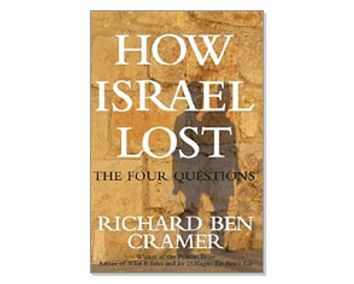
“How Israel Lost” by Richard Ben Cramer

This startling new book asks brave, naive and absolutely necessary questions. They must be answered if Israel is to save itself from destruction.

  • more
    • All Share Services

Richard Ben Cramer is an enormously able storyteller who displays great moral sensitivity and personal bravery. He was, no doubt, very much aware of the fact that his new book would not make him very popular among the Jewish readership of Los Angeles, and even less so in New York, which constitute the major markets for this book. The book is a passionate love letter to Israel, albeit one written by a disillusioned, distant and bitter lover. “How Israel Lost” is a very important book because, beyond the emotions and the rich mosaic of small anecdotes, Cramer detects and diagnoses, with high precision, the potentially lethal maladies afflicting Israeli society.

In 1979, while a correspondent for the Philadelphia Inquirer, Cramer won a Pulitzer Prize for his coverage of the Middle East, including the peace deal with Egypt and the Israeli invasion of Lebanon. He is also author of the bestseller “What It Takes: The Way to the White House,” a classic work on Washingtonian inside politics. His well-researched biographies of Ted Williams, Bob Dole and Joe DiMaggio were enthusiastically received and won him a reputation as a serious journalist and writer.

Raised as a “zionist” (he now avoids writing the word with a capital letter) on the slogan of “a land without a people for a people without a land,” Cramer was shocked to learn, during his first visit to the “Holy Land,” just how false that slogan was. He was not too deeply concerned by this realization at the time, though. This was, after all, the period when Anwar Sadat made his historic visit to Jerusalem, when the newly elected ultra-nationalist Menachem Begin made a deal that returned every inch of Sinai’s land to Egypt and even guaranteed “full autonomy” to the Palestinians within five years. It took Cramer years to realize that Begin had made that deal in the hope of being rewarded with full and eternal control over Greater Israel — including the West Bank and Gaza.

The lessons that Cramer learned regarding the cynical interest-based politics behind Israeli peace negotiations inform “How Israel Lost.” This book is divided into four chapters, each of which poses a different question — an obvious reference to the “four questions” asked at Passover: Why do we (Americans) care about Israel? Why don’t the Palestinians have a state? What is a Jewish state? Why is there no peace?

The first question — Why do we care about Israel? — would have been sharpened if Cramer had acknowledged that the Bush administration’s unconditional political, economic and military support for Israel is, in fact, a new phenomenon, and one that could disappear just as quickly as it has emerged. Cramer does not acknowledge this fact, and his answer seems extremely superficial. He suggests that American support for Israel derives from the fact that the Americans have traditionally felt that they were like the Israelis, and warns: “Somewhere along the line, we got the feeling, ‘they aren’t like us.’ Or maybe we don’t want to be like them. And this is just one of the ways — one big one — how Israel lost.” In the light of the invasion of Iraq and the Abu Ghraib scandal, perhaps both statements are correct. Nonetheless, they cannot really be thought of as having a deterministic explanatory power. The truth is that no one yet has come up with a truly satisfactory answer to this question, which calls out for deeper research. This is the weakest part of Cramer’s thesis and it is not supported by any provided evidence based on the American scene.

The three additional questions Cramer poses can be thought of as one single big question. They are mostly focused around Cramer’s correct assertion that 37 years of occupation and subjugation of millions of Palestinians and the colonization of their land have fundamentally corrupted, militarized and brutalized Israeli society, as well as the occupied people. The conflict, argues Cramer, is the only reason that, regardless of which party or coalition is in power in Israel, a military junta controls the political, economic and most of the cultural spheres within a supposedly democratic country. The reserve generals and colonels of this junta (whether they consider themselves “rightists” or “leftists”) fill almost every important position in Israel. The perpetuation of the conflict, which is good for every kind of business directly or indirectly connected with the permanent condition of warfare, is thus in their vested interests. Cramer provides ample evidence to prove and illustrate this thesis.

Cramer’s other main point is that the occupation is responsible for what he denounces as the splintering of the Israeli polity into a series of self-interested groups. The idealism, friendliness and humanism that characterized the Israel he once knew have been replaced by coarseness, increasing violence and an I’ve-got-mine-Jack attitude. Cramer is correct that the occupation is responsible for many of the pathologies that affect Israeli society, but I would take issue with him on what those pathologies are.

Cramer buys the idea that the demise of “Israelization,” the failure of the American-style “melting pot,” is the biggest crisis facing Israel. I see that failure as in fact a sign of blessed progress toward a multicultural and individualistic society, and away from the quasi-fascist collectivism (what is good for the state is good for the individual), exacerbated by the Jewish-Arab conflict, that has characterized Israel for most of its history. Moreover, the corruption of the occupation is only partially responsible for this trend.

One of the most important things that Cramer does is debunk, yet again, the apparently indestructible myth of the so-called “generous offer” made by Prime Minister Ehud Barak at Camp David, which has been cited ad nauseam ever since as evidence that the Palestinians have no interest in peace. As Cramer notes, what Barak offered Arafat was a minuscule country divided into three enclaves lacking territorial contiguity by offering an exchange of the lands of three major settlement blocs characterized by sandy and unusable land. This, after the Palestinians had already given up their claim to more than 78 percent of the land of historical Palestine.

The situation on the Palestinian end of the story is, according to Cramer’s analysis and description, both similar and different. After he learned, following the first intifada, that it is impossible to oppress a people, Yitzhak Rabin initiated a deal with Fatah leader Yasser Arafat that was based on a terribly wrong assumption. The assumption was that imported Palestinian militias from Tunisia could serve as subcontractors to ensure Israel’s internal security (“without High Court and human rights organizations’ interventions,” as Rabin explained). The Israelis, like many colonial powers, preferred to rule indirectly.

The Palestinians, for their part, instead of having a prosperous sovereign state (they are probably the most educated and skilled Arab society per capita in the world), found themselves to be doubly oppressed. On the one hand, they found themselves still ruled by the Israelis, who continued to build settlements and wield ultimate power over Palestinian jobs, freedom of movement, water and land; on the other hand they encountered an even crueler oppression by the despotic tyranny of the “Tunisians” headed by Arafat and his Mafia-like security services. As Cramer vividly shows, Arafat and his lieutenants maintain the loyalty of the people by personally granting bribes and benefits (many have made a good fortune in this way) and using brutal force and torture.

Cramer correctly notes that the Israeli-Palestinian issue is not essentially a religious conflict but a political one. He accurately notes that the Palestinians are not a particularly religious group (they include Sunni Muslims, various Christian denominations and other smaller groups). However, the religious dimension of the conflict has begun to loom larger, as impossible and inhumane living conditions have pushed many Palestinians into embracing Islamist movements, turning the occupied territories into a huge factory for suicide bombers (or “martyrs,” in their terminology). The Islamic movements, through their image of purity, their devoted work for community welfare and their charity activities, have easily captured the support and loyalty of the Palestinian constituency, especially after Israeli military actions wrecked the Palestinian Authority’s power, prestige and legitimacy. Now, rule over the Palestinians is conveniently (for Israel) divided between Fatah, Hamas and Israel.

Cramer characterizes the second intifada as a “phony war.” Indeed, thousands of innocent civilians and non-civilians from both sides have been murdered or have sacrificed themselves (sometimes Cramer touchingly provides names, faces, ages and short life-stories for the victims). Nonetheless, as he points out, the corrupt present political and economic establishments have profited greatly from the situation. In fact, their only raison d’être is the continuation of the killings. Sharon could decide to kill or expel Arafat. He does not do so because Arafat is his insurance policy: The folly of the Palestinian leader ensures his own political survival. Sharon serves the same role for Arafat: Palestinians overlook their leader’s gross incompetence every time the Israelis lash out. Sharon’s investment in the status quo is revealed by the fact that every time Hamas has proposed a truce in suicide attacks, the Israeli military has promptly responded with a “targeted killing” of one of their leaders or activists, thus once again inflaming the cycle of violence and mutual slaughter.

Cramer has enormous admiration, empathy and sympathy for ordinary Jews and Arabs and their cultures, both of whom he sees as victims of their evil and corrupt leaderships and establishments. He argues that Israeli Jews, mainly the secular ones — many of them descendants of the socialist founding fathers of the Jewish state and of the early pioneers — are oppressed both by the old-boy junta generals and by zealous rabbis who have transformed secular Israel into a semi-theocratic state.

The author of this review is an atheist Israeli Jew who has fought an uncompromising struggle over the past 40 years or so for the separation of state and synagogue. Having said this, however, I find Cramer’s description of the Israeli Orthodox and national religious rabbis (today it is difficult to find any differences between them) to be highly stereotypical and repugnant. Cramer portrays Orthodox rabbis as greedy and ridiculous, as in a story about a hotel restaurant which goes to absurd degrees to get around its violation of a kosher dietary law. Even if this portrait has some roots in Israeli daily life, it is so exaggerated it resembles an anti-Semitic screed — surely not Cramer’s intention.

In fact, religion plays a more profound role in Israeli civic life and Israeli self-definition than Cramer realizes. It’s true that Israel was envisioned and created by secular socialists and liberals. At the same time, the Zionist movement was essentially a religious-messianic one. This is why it aroused the antagonism of European Jewish Orthodoxy prior to the Holocaust and World War II. It was not incidental that the founders of the state chose the Holy Land, nor is it by chance that the major symbols of the state were selectively borrowed from the Jewish religion. The Bible was always perceived by both Jews — even the atheist ones — and many non-Jews as the “Charter” of the Jewish people, justifying their claims over a land which was already populated by a native people.

The roots of Israeli submissiveness to religion and toward the “representatives of the god on the earth” — rabbis and religious clerks — should thus be seen as reflecting the quest for legitimacy of a settler-immigrant society in a region where they were not welcomed by the local population. Herein also lies a partial answer to the mystery of the extraordinary influence of the settler minority, which far exceeds their actual numbers.

As for the question of how to end the occupation, according to Cramer the solution is simple. He argues that “any Jew who isn’t an Israeli and not on psychotropic drugs, could solve this Peace-for-Israel thing in about ten minutes of focused thought. Give back the land to the Palestinians. All of it [the West Bank, the Gaza Strip and East Jerusalem]. And since Palestinians are already living in their own country, they should have equal rights, a fact so laughably obvious — the only nation that can’t see this is Israel.”

Cramer is right about the solution, but wrong to say that Israelis don’t recognize it. In fact, opinion polls indicate that approximately 35 percent of Jewish Israelis support the so-called “Geneva Accord” issued recently and built on the same principles as suggested by Cramer. This level of support for such a “radical” peace plan was almost unthinkable several years ago. Today, even every child in Israel knows that if ever it will be possible to reach an agreement, these would be its contours.

What is the cause of this dramatic trend as well as of the surprising “disengagement” suggestion of Prime Minister Sharon, including the uprooting of all the settlements in the Gaza Strip and some isolated settlements in the northern West Bank? No doubt it is the so-called “demographic threat”: the fact that Palestinians will eventually outnumber Jews, forcing the Jewish state to choose between democracy and its Jewish identity. Some calculate that by 2020, a total of 15 million people will live on the land of historic Palestine, with Jews comprising a minority of 6.5 million. Moreover, even in Israel itself, within 20 years, the Jewish population will be reduced from its current 80 percent majority to a projected majority of barely 65 percent. Israeli fear of this has led to proposals that Israeli areas densely populated with Arabs be transferred to the Palestinian state in exchange for Jewish settlement blocs.

Two deep-rooted existential anxieties exist within Jewish Israeli political culture. The first is the physical annihilation of the state, an issue that is frequently used, abused and emotionally manipulated by many Israeli politicians and intellectuals. The second is the loss of the fragile Jewish demographic majority on which the supremacy and identity of the state rest. In fact, the loss of that demographic majority could be a prelude to the physical elimination of the Jewish state. Thus, the annexationist camp has found itself in an impossible situation: The patriotic imperative of holding onto the sacred land is contradicted by the patriotic imperative of ensuring a massive Jewish majority on the land.

Other settler societies “solved” the problem of the indigenous population by annihilating the natives (e.g., North America, Australia, New Zealand) or intermarrying with them (South and Central America), while others completely collapsed (Algeria, Zambia and, perhaps, South Africa). Israel’s problem is so intractable because none of these or other options, including repartition of the territory or binationalism, are either acceptable to it or viable.

The final question that must be addressed is the right of return of the Palestinian refugees. There is no doubt that, as Cramer suggests, Israel should recognize its moral responsibility at least for not accepting the refugees back home after the 1948 war. The Geneva draft, supposedly accepted even by Arafat (perhaps too late), presumes that most of the refugees should return to the Palestinian state and rehabilitate there, after having been compensated for their lost properties. A very limited number would be allowed to return into Israel. This may not be as difficult for Palestinians to accept as it may appear: Khalil Shikaki, a controversial pollster, found that only 10 percent of Palestinian refugees were in fact even interested in exercising their right of return (as Cramer notes, for his trouble he had his office smashed up by thugs associated with Arafat’s corrupt political machine). Nonetheless, even if all the trends outlined above take off, the solution to this complex situation may not be quite as simple as Cramer suggests.

Since 1967, Israel has regarded the occupied territory of the whole of Palestine and the Syrian Golan Heights as an open frontier for Jewish settlement and colonization. Both the rights of the indigenous inhabitants and international law were blatantly ignored. This was a gradual and incremental, two-dimensional and mutually complementary process. One dimension was the establishment of irreversible and accomplished facts on the ground, like settlements and the transfer of Jewish residents to them; at the same time, Israel prevented the development of local Palestinian institutions, infrastructures and leadership. (Those institutions and authorities that were created during the short period of the implementation of the Oslo Accords were a major deviation from the general trend, and were destroyed after Rabin’s assassination.) It must be mentioned that even the Oslo Accords were hardly welcomed by the majority of the Jewish population, and that Rabin’s government was based on a parliamentary minority.

The second dimension was the psychological-cognitive one. The fact of occupation and rule over a territory and its population was absorbed into the Israeli consciousness and became part of its identity. Today most Israelis have grown up under the present reality or immigrated into it (more than 1 million from the former Soviet lands, Ethiopia and even from the U.S.) and cannot imagine life within the narrow pre-1967 war borders. Moreover, “peace” is an abstract and incomprehensible notion, while land is a tangible asset. If Israeli casualties caused by wars and Palestinian terror, or resistance movements (depending on one’s values), were regarded in the past as a painful national calamity, they were slowly routinized and perceived as an inevitable cost of Israel’s existence. In the past, governments that failed to prevent war or protect the personal safety of their citizens were voted out. Today, casualties only empower governments — a situation that reflects a high level of national cohesion on this issue. It’s true, as pointed out above, that many Israelis say they are prepared to give back land for peace, but their words remain untested.

Cramer’s impressionistic book, with all its charming naiveté, lack of historical depth and some imprecision and exaggeration, is a very important work, both for American Jews and non-Jews. It is my hope that it will create a more open and critical debate regarding American policy and relations toward Israel (and perhaps even towards the entire Middle East), replacing the current orthodoxy of reflexive, blind defense of any wrongdoing by the Jewish state merely because it is Jewish.

Cramer is completely correct in his intuition that Israel is behaving today like a suicidal nation. Unlike Europe, the United States has not yet come to reject Israel’s behavior as unacceptable. Nonetheless, such a time will surely come, probably as a part of an increasing general awareness that the American responses to 9/11, including George W. Bush’s blank-check acquiescence in all of Sharon’s schemes, were evil, wrong and counterproductive. When the time comes that Americans realize, in the words of Cramer, that “we, the Americans, don’t want to be like them,” and Israel is forced to stand alone and choose its course, we will witness Israel’s finest or worst historical moment.

Continue Reading Close