Ben Adler

Does Rudy Giuliani know how to take a hint?

He wants us to believe he might jump in the presidential race -- four years after his epically disastrous campaign

  • more
    • All Share Services

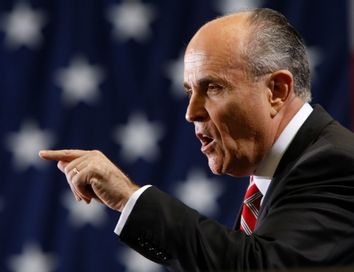
Does Rudy Giuliani know how to take a hint?Then Republican presidential hopeful, former New York City Mayor Rudy Giuliani, speaking at a campaign rally in Clearwater, Fla., Monday, Jan. 28, 2008.

On Sunday night, Rep. Peter King, R-N.Y., floated a Rudy Giuliani trial balloon, claiming to reporters that the former New York mayor has been quietly lining up donors and is seriously considering another presidential campaign. Byron York of the Washington Examiner, who is well-sourced among Beltway Republicans, reported on the possibility with surprising credulity, noting that Giuliani placed third in the most recent New Hampshire poll.

Polls this early are, as York should know, total hogwash. It’s a contest based on name recognition, long before most voters have started to pay attention. That’s why Giuliani led the Republican field in national polls throughout 2007, with Fred Thompson in second. Both candidates crashed and burned dramatically in the early primaries and were gone before Super Tuesday. There were four main reasons Giuliani’s campaign failed last time, and none of them have been ameliorated since:

His political record is too socially liberal. This is a guy who started his mayoral campaign in 1989 running to Ed Koch’s left and compared himself to liberal lion Fiorello La Guardia (whom he called New York’s greatest mayor). Although he shifted right when David Dinkins got the Democrats’ mayoral nomination, Giuliani remained pro-choice and pro-gay rights: He even once bunked with a gay couple and famously dressed in drag. Giuliani endorsed Mario Cuomo for governor in 1994. He was a New York Republican, not the sort who can play in South Carolina. His stance on abortion — Giuliani gave up on his brief attempt to pretend he is anti-abortion rights when it was revealed that he had donated to Planned Parenthood, the GOP’s new ACORN — would be a major sticking point. Elite national Republicans like King and York don’t actually care about abortion — see the sections in “Game Change” on how McCain advisors had no objection to putting Joe Lieberman on his ticket — but actual Republicans do. That’s why McCain reluctantly concluded that he couldn’t choose Lieberman. A pro-choice Republican nominee would either trigger significant defections from the religious right to a third-party candidate or simply prompt many of those voters to stay home next November.

He wasn’t terribly popular or successful as mayor. National Republicans may not know this, and New York Republicans like Peter King may have conveniently forgotten, but Giuliani’s political career was over before Sept. 11, 2001. His abrasive manner and controversial policies had resulted in lousy approval ratings. He was trailing carpetbagger Hillary Clinton in the 2000 Senate race before he dropped out. His vulnerabilities have never been seriously exploited by an opponent, but don’t think Mitt Romney would hesitate to unload on him in a close race, especially now that we’re four years further past Giuliani’s post 9/11 beatification.

Speaking of vulnerabilities, Giuliani has nasty skeletons in his closet, even by the standards of a Republican politician. He has been twice divorced: His first wife was his second cousin, and he  dumped his second wife for his quirky mistress, Judith Nathan, at a press conference before informing his wife in person. During the last campaign Ben Smith of Politico reported that Giuliani improperly used police escorts to take Nathan to trysts in the Hamptons. To be fair, Giuliani’s pecadillos pale in comparison to those of Bernard Kerik, a Giuliani crony who started as his driver and was ultimately promoted to chief of the NYPD. When Giuliani recommended Kerik to be secretary of Homeland Security after the 2004 election, a bevy of embarrassing revelations ensued, from his affair with publish Judith Regan in apartments near ground zero that were paid for by taxpayers and intended for rescue workers, to accepting favors from contractors with alleged mafia links.

He also has no message. Giuliani events in New Hampshire in 2008 were depressing affairs. Small crowds, silently bored to death by Giuliani droning on about the importance of lowering the corporate income tax and the various taxes he cut as mayor. It seemed that Giuliani figured he had the national security hawk vote lined up and needed to focus on fiscal conservatives (since he surely could not count on social conservatives). But his only line that drew applause was a throwaway at the end when he would mention the need to “stay on offense” against Islamist terrorism.

But that brings us to the point that Giuliani’s one major selling point — that he happened to be mayor of New York on 9/11 — has been surpassed by events since the last election. President Obama just killed Osama bin Laden, so Giuliani can hardly claim that he would be more committed to taking out al-Qaida. The Iraq war, which Giuliani vociferously supported, is viewed by everyone who doesn’t work for Fox News as a failure. Even the war in Afghanistan is increasingly unpopular. Meanwhile, the news out of the Middle East is of the Arab Spring, which gives us hope that the region will accommodate itself to modernity and democracy rather than being a fount of anger and frustration looking for a target. Giuliani’s dour and militaristic view of Middle Eastern affairs seems especially out of step with the times.

Mostly, Americans are just worried about the economy, and Giuliani already proved last time that he can’t win the nomination with an economic policy focus. Giuliani is unlikely to run, and if he does, he is virtually certain not to win the nomination. The discussion of a Giuliani candidacy is evidence of nothing so much as the desperation of Republicans who want an alternative to their current uninspiring field. But they should take heart: Michele Bachmann might still run.

The bigger Clarence Thomas scandal

His ethical blindness is alarming, but it's also common on the Supreme Court -- and there's no way to stop it

  • more
    • All Share Services

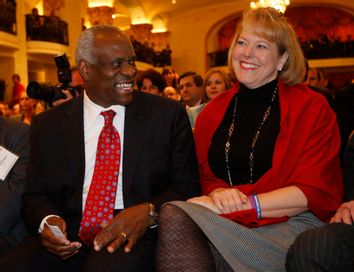
The bigger Clarence Thomas scandalFILE - In this Nov. 15, 2007, photo, Supreme Court Justice Clarence Thomas, left, sits with his wife Virginia Thomas, as he is introduced at the Federalist Society in Washington, where he spoke about his new book and took questions from the audience. Virginia Thomas is asking Anita Hill to apologize for accusing the justice of sexually harassing her, 19 years after Thomas' confirmation hearing spawned a national debate about harassment in the workplace.(AP Photo/Charles Dharapak)(Credit: Associated Press)

It’s been a rough few months for Justice Clarence Thomas and his wife, Ginny.

First, in October, Ginny left a bizarre, early morning phone message for Anita Hill asking her to apologize for the sexual harassment accusations she leveled at Thomas 20 years ago. Then, in January, the good government group Common Cause revealed that Thomas claimed “none” for “spousal noninvestment income” on a disclosure form during years where his wife pulled in six figures working for two conservative organizations, the Heritage Foundation and Liberty Central. Having a wife who worked for a group that opposed healthcare reform raised the question of whether Thomas should recuse himself in future cases on the law’s constitutionality. (74 House Democrats think so and they sent Thomas a letter saying as much).

Now Common Cause has just revealed that Thomas took an all expenses paid trip in 2008 to Palm Springs for four days to make a speech with money that he says came from a conservative legal group but that may have actually come from the controversial company Koch Industries. In 2010 the Supreme Court overturned limitations on corporate political spending in Citizens United v. FEC. The Koches — staunch fiscal conservatives who own an energy conglomerate — have run wild with that new freedom, so Common Cause argues that Thomas should have disqualified himself from ruling in Citizens United. (If Thomas had recused himself the 5-4 decision would have been tied 4-4 and the lower court ruling upholding the spending limits would have stood.)

Experts on legal ethics don’t all agree on whether Thomas should have recused himself in Citizens United and whether he will be honor bound to do so for healthcare reform. But they are unanimous in their condemnation of Thomas’ dishonest filings on his disclosure forms. “Since it went on for six years [2003-2007 and 2009] it’s especially troublesome,” says Stephen Gillers, a prominent expert on legal ethics at NYU law school. “It’s impossible to claim it’s an oversight.”

It would be comforting to think that Thomas’ shady behavior was an anomaly, but it’s actually just the most egregious example of trends that have made Supreme Court justices seem more like hypocritical and partisan politicians than disinterested jurists. If left unchecked, the court will seriously damage its public image.

The problem has two roots: changing social norms and lax ethical rules governing the Supremes. The former is beyond the scope of our government but the latter isn’t, and Congress should act.

Supreme Court justices work in a weird, gray area, with virtually none of the ethical or legal impositions that most similarly powerful people are subjected to. The Code of Judicial Conduct that governs the behavior of federal district and appeals court judges does not apply to the Supreme Court. If it did there would be a bunch of regulations on justices, such as a rule against speaking at fundraisers for advocacy groups, which they are currently free from. The Supreme Court says it follows the principles of the code, but there is currently no way to force it to.

The only binding rules for justices are the laws governing conflict of interest. And even they have no enforcement mechanism: If a justice decides not to recuse himself, the aggrieved party is out of luck because there is nowhere to appeal.

Just ask the Sierra Club, which in 2004 filed a motion asking Justice Antonin Scalia to recuse himself from hearing their effort to make Dick Cheney reveal the members of his secret energy task force. Scalia had just been on a hunting trip with Cheney, and the case had the potential to embarrass Cheney just before the 2004 election, but Scalia refused to recuse himself. Short of impeachment, which is incredibly rare, there is no way to discipline a justice who does not follow the law on recusal, which says that a judge should recuse if his or her “impartiality might reasonably be questioned.” Many experts, such as Gillers, think Scalia should have recused himself in the energy task force case, but — in violation of the principle that no one can be his own judge — Scalia got to decide that he thinks he’s perfectly impartial, thank you very much. And that was that.

With no penalty for breaking the law, it is more likely to happen. “There is no effective deterrent,” says Jonathan Turley, a constitutional law expert at George Washington University’s law school. “You have a significant violation by [Thomas] and virtually no accountability.”

Public disapproval is one way to impose accountability, but that seems to not exert the pull it once did. Whereas justices were once wary of speaking out on controversial matters, they have become more comfortable speaking their mind, even on matters before the Court, and often in front of partisan audiences. Just the day before the first revelations about Thomas broke, Turley published an Op-Ed in the Washington Post lamenting this trend of “celebrity justices,” and criticizing Scalia for recently speaking at the congressional Tea Party Caucus’ Conservative Constitutional Seminars. “It allows justices to merge their role in cases with the broader political debate, robbing the Court of the appearance of neutrality,” says Turley. (Case in point: Earlier this month Thomas, speaking at a Florida college, vociferously defended the Court’s decision in Citizens United and attacked specific newspapers whose editorial boards disagreed with the ruling.)

Other experts caution that engaging with and educating the public on constitutional law is a good role for justices to play. But there is widespread agreement that without any rules placed on speaking engagements, questionable situations like Thomas’ free trip will arise.

So, if justices were following the Code of Judicial Conduct, would Thomas have broken the rules? Some would argue that being reimbursed for travel is not the same as accepting a speaking fee, which would clearly be forbidden. Critics like Common Cause counter that four free days in an expensive resort town is a form of payment. And what about ruling on healthcare reform in light of his wife’s work? That would depend on how much of Ginny’s work is focused on that law and how she might benefit from him overturning it.

It’s hard to figure out the answer to those questions when you don’t have access to all the relevant information. That’s part of the problem with our current system. “Justices aren’t required to disclose as much as they should be,” says Bill Yeomans, a former Department of Justice official who teaches at American University’s law school.

These problems are not limited to conservative jurists. In December, the Senate removed Thomas Porteous, a district judge in Louisiana appointed by Bill Clinton, for a number of ethics violations. Some of Porteous’ actions that led to his impeachment included filling out forms during his confirmation process and personal bankruptcy proceedings with false information — an awfully similar transgression to Thomas’. Will Congress uphold the same principles where Thomas is concerned?

There’s some reason to be optimistic. This past week, Sen. Chuck Grassley, the ranking Republican on the Judiciary Committee, introduced a bill to create an inspector general for the judiciary who would have authority over the Supreme Court. That — combined with a law that would impose the important elements of the Code of Judicial Conduct on the Supreme Court and create a mechanism to enforce it — could help save the Court from itself.

Ben Adler covers politics and national affairs for Newsweek and The Daily Beast. He previously worked for Politico and his writing has also appeared in The Atlantic, Columbia Journalism Review, The Nation, The American Prospect and The Washington Monthly among other publications.

Continue Reading Close