Beth Arnold

“Everything matters to everybody”

French provocateur Bernard-Henri L

  • more
    • All Share Services

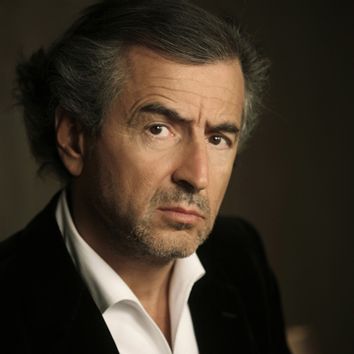
Since he began his career 35 years ago, self-described leftist, philosopher and journalist Bernard-Henri Lévy has never been caught without a cause or opinion. He has flamboyantly articulated these in more than 30 books (including the much discussed “American Vertigo”), countless television appearances, articles and even films that he’s written, produced, directed and/or narrated. Lévy is a kind of intellectual Robin Hood, going where there is totalitarianism and/or war. He has been a passionate advocate of Bosnia, smuggled himself into Darfur to report on the Sudanese genocide and followed the perilous trail of Wall Street Journal reporter Daniel Pearl into Pakistan to write the New York Times bestseller “Who Killed Daniel Pearl?”

Lévy is a showman — his narcissism is legendary — which adds fuel to the fire of his critics, who accuse him of lacking original ideas. Known in France as BHL, Lévy is his own wildly successful brand. He wears the mantle of polarizing intellectual quite happily along with made-to-measure clothing from French house Charvet, which also made shirts for JFK and Marcel Proust. He was recently quoted in the New York Times’ T Magazine men’s fall fashion supplement saying he had no interest in his bespoke apparel or even talking about it — though he had clearly agreed to this fashion profile, which was set in Bosnia, where he was screening two documentaries he had shot there and attending a children’s festival partly financed by his family foundation.

At home in France, Lévy is treated as something of a god (which is not lost on him), known for his good looks and family wealth as much as for his intellectual output. It doesn’t hurt his glamorous profile that he is married to provocative actress and singer Arielle Dombasle, who is sometimes uncharitably compared to a Barbie doll. The couple share an apartment with a chic address on the Left Bank, a house in the South of France and a Marrakech palace.

Lévy’s latest literary publicity blitz coincides with the publication of his newest book, “Left in Dark Times: A Stand Against the New Barbarism.” When Levy wrote “Barbarism With a Human Face” 31 years ago, his sworn enemy — the barbarism he spoke of — was Marxism. In the new book, the author has focused on his own intellectual autobiography, examining his ideological and political history and identity. He believes a segment of his political family (the left) is being led astray and he rakes his extended kin over the coals for becoming too tolerant — especially on issues like Islamic radicalism — and letting their anti-imperialistic attitudes and loathing of America cloud their vision and damage their democratic values. He is unusual in French terms, because he’s pro-American when a lot of Europeans think the U.S. behaves like it owns the world. Lévy has a fondness and understanding of American culture. He gets us, and attempted to prove it in “American Vertigo,” his report on the state of the USA.

Lévy answers the door to his Paris apartment himself, a tall, lanky man wearing his signature white shirt, unbuttoned almost to the navel, underneath a sleek suit. In his large, blond-wood-paneled office, there is an enormous metal sculpture of a man’s head with a panel opening half of it. Inside, the figure is empty — the complete opposite of the man who owns him.

The subtitle of your new book is “A Stand Against the New Barbarism.” Can you explain what you mean by that?

What I mean by the new barbarism is great ideas having bad effects. Great ideals turning out to be the stem cell of big crimes, big injustices, unfairnesses, brutality and so on. The barbarism 30 years ago when I wrote “Barbarism With a Human Face” was Marxism, which pretended to be a fight in favor of justice, social equality, freedom, eradication of slavery, and which was exactly the contrary. And you have today a new barbarism in the case of these women and men who pretend to fight in favor of tolerance, in favor of anti-imperialism, in favor of anti-colonialism, and actually plead for slavery of the women, massive violation of human rights. Or when they don’t plead for that, they tolerate them, refuse to denounce them.

You have a new mechanism today … for example, where in the name of anti-Americanism the crimes in Darfur are not denounced. The crimes in Bosnia were accepted. And so many wars in Africa or elsewhere are just forgotten.

Are there specific kinds of people you’re talking about?

Those, for example, who pretend to be anti-mondialist … I don’t know if you have this in America? Anti-mondialists fight against globalization. Anti-globalization … They are the dark side of the left of today.

Now, in my family, which is the left progressive camp — in this family, I observe that there is a tendency which can reach the same results … the same blindness of the right. The same indifference to the real suffering of the real people, and so on and so on.

So you are saying that you believe the left can end up committing the same sins as the right? Because I think in the United States we have been fighting for tolerance in so many ways — tolerance for gays, civil rights …

These battles, of course, you fought. I fought … And it is won. It is achieved. Barack Obama being a candidate for the presidency and maybe — I hope — elected means that the fight is won, more or less. Frankly a country where racism is sued in front of lawyers, a country where the women won the power of preventing discrimination and so on, this is great. This is a huge cultural revolution, which America led.

But in the name of tolerance there can be also some crimes — not committed but veiled … For example, those who tell us that we have to be tolerant of the radical Islamist movements. Those who tell us that being tolerant means trying to understand their reasons and their justifications. Those who tell us that, about women, to veil the face of a woman is just a customary habit, which we Westerners are not allowed to judge according to the standard of human rights. This is a very bad thing.

This idea that every habit should be respected, every custom should be accepted because it belongs to a whole and that if we take a piece, we break the whole — this is one of the counter-effects of tolerance. And you have in America a lot of people who said, why should you ask the Indian people to resign the pattern of the castes that belong to their culture? Why should you oblige this or that tribe, people in Africa, to resign the excision of the clitoris of the little girl? It belongs to their culture …


You framed the new book around your telling Nicolas Sarkozy that you would not support or vote for him for president. Even though you two had been friends for 25 years, you told him in a phone call that you’d never voted for the right, and you had no intention of changing that. What is your relationship with Sarkozy now?

I don’t know. I did not see him again since the book … He does not believe in ideas, so he does not understand somebody who was a sort of buddy — I would not say a friend but a buddy — not to vote in favor of him. He still did not understand, I think, so he interprets these sorts of stories in terms of betrayal, fidelity. I don’t believe in that. The only fidelity you have to have is to ideas, truth, and there are some circumstances when an intellectual has a duty of infidelity — if he’s a friend, and if you are against his ideas.

What does it mean to be a leftist? Does it mean to be faithful to a family, whatever the family does? Whatever the family says? I don’t think so. There is a duty of unfaithfulness also to the family in question — to the left when the left is embodied by Noam Chomsky, or when it is embodied by Naomi Klein.

Would you define for an American audience what you mean by a leftist? I’d like to try and get at what the difference is between someone on the left in Europe and the U.S.

In the two countries, I think it is the same definition: to have freedom and equality, the two dreams of freedom and equality walking at the same pace. To refuse to choose between the two. This is written in the motto of the French Republic, as you know, “Liberté, égalité, fraternité.” And it is also written in the DNA of the best of America. The real dream of equality, which fed the battle, for example, for the civil rights, Martin Luther King and so on, and the battle for individual freedom. Those who ask to choose between the two — if you have freedom you do not have equality, if you have equality, you do not have freedom — for me, they are not leftist. This is a good definition of the left.

If there were three main differences between the left and the right, right now, what would you say they are?

To believe or not to believe that equality and freedom can be combined, as I told you, is one difference. [Another is] to believe or not to believe in politics. A classical rightist or leftist-rightist does not believe in politics; he believes in the invisible hand of the market in one case, of history in the other case — the invisible hand being able, herself and alone, to promote the change and the reform and so on. For me, a leftist is somebody who believes a democracy has to be built with time, patience, real meaning and so on.

And the third difference for me is not to choose the victims. When you are a rightist, you decide, for example, that you have some privileged blood baths, some privileged wars of which you take care and others of which you don’t take care. You also have some people in the so-called left who [do that] — for example … Kosovo. You had a racist, neo-Fascist dictator [there], Milošević. You had a civil population guilty of nothing, which was displaced, raped, killed and so on. And you had some people who, because America was against Milošević, decided to be in favor of Milošević and against the American intervention to stop the thing, and so on and so on. This is the false left.

In this book, you write, “Since the French Revolution, the word ‘revolution,’ the pure signifier, was, in France at least, the most serious political dividing line. The Left wanted it; the Right feared it.” What is the state of revolution in the world right now?

It depends on what you mean by revolution. If you mean by revolution the dream which was on the top of the clock when I was 20 years old [in the 1960s], I hope this dream is over — the dream of rebeginning the human gender. To remake it. To remold it completely … This was the old way of being a revolutionary.

Now, if you mean by revolution changing the world in favor of the have-nots, of the less gifted, and so on — if you mean by revolution, more and more democracy and liberal democracy and not to choose between liberty, freedom and equality, this is still going on. Not enough. I hope it will be more.

I think that if Obama is elected, it will be a revolution in the United States.

In a way, you can understand it like this. I am in favor of that myself. I hope, if I could pray I would pray, for Obama being elected.

Why do Europeans love Obama?

I don’t know. I can’t tell you why. I don’t love him, by the way. I wish him to be elected. It’s not a question of love or hate … This is not the best way to make politics.

Why Obama should be chosen, in my opinion: No.  1, because it would mean really the end — and the complete victory of the battle begun in the ’60s. No. 2, because it will mean the end of a new American evil, which is the dividing, the Balkanization of American society. This is another counter-effect of a great idea, which was tolerance. You so much tolerate that you tolerate the American society to be in separate bubbles having their own peculiarities, and so on. Obama as president will mean all these bubbles submitted to a real ideal of citizenship. This is his message. McCain will not be able to do this. If McCain is elected, I can tell you the Iranians will close themselves in the Iranian identity. The Arabs will coldly, freezingly imprison themselves in the Muslim identity. The African-Americans will believe that the American society is more and more built against them. You will have an increase of the Balkanization.

And No. 3, you have another ideal in the America of today, which I call the competition of victims. Competition of memories. If you are in favor of the Jews, you cannot be in favor of the blacks. If you remember the suffering of slavery, you cannot remember too much the suffering of the Holocaust, and so on and so on. The human heart has not space enough for all the sufferings. This is what some people say. Obama says the contrary. It will mean the end of this stupid topic, which is competition of victimhood.

If McCain is elected, then how will the world react?

The only way America can get out of the current crisis is a minimum of welfare state, of a Rooseveltian New Deal. It will not be tax cuts and so on … So America will react badly. The world will react also badly. McCain may not be a bad guy, but he will mean — his victory will mean — the revenge, freezing, frightened, shy, rear-guard America. Rear guard. Not vanguard. Not victorious. Not optimist America.

A lot of Americans do not understand why it even matters what the rest of the world thinks about who the American president is.

Because you are the most important, the most powerful country in the world. But don’t be too narcissistic, you Americans. Everything matters to everybody. The next president of Iran matters to everybody. Who is president matters to everybody. Who presides over one of the most little states in the world, which is Israel, matters to everybody. The entire world matters. Even more little — Gaza. Hamas or not Hamas? Everybody has the eyes on that. So it is a principle, a rule in this time of globalization: Everything matters to everybody.


Vive la Obama diff

Why the French love Barack Obama -- even if he'd rather not be seen with them in public.

  • more
    • All Share Services

Vive la Obama diff

The building is not far from the Place Vendôme and the Opéra Garnier and is closer still to the Bibliothèque Nationale. For those in the know, this area, the 2nd arrondissement, is where Napoleon Bonaparte once lived, where the Americans Robert Livingston and James Monroe signed the Louisiana Purchase into being, and where Wolfgang Amadeus Mozart debuted his “Magic Flute.” This quartier is where the “Jewish question” was decided during the German occupation, and where Alexandre Dumas’ three musketeers rode and fought their way into myth and history. This is the very heart of Paris.

On Wednesday, a good-looking young man wearing jeans and a Barack Obama/France T-shirt waves his visitor into a chic, but not fussy, light-filled conference room. With its sofas, its simple black chairs filed around an elegantly rustic table, the room could double as a gracious salon in someone’s home — someone who’s a hard-core Barack Obama supporter, that is. Obama posters are tacked to the wall, and others lie on the big table. An Obama banner is unfurled around one of the fireplaces, and two flags are draped on a chair — one American, the other French.

Twenty-two-year-old Samuel Solvit is the kind of guy you’d like your daughter to date — smart, ambitious and clean-cut. He studies economics at ESCE (Ecole Supérieure de Commerce Extérieur), but his vocation these days is Barack Obama. While Obama’s candidacy has engaged the imagination and hopes of the French in general, Solvit started the Comité français de soutien à Barack Obama (French Support Committee for Barack Obama) in January 2008. His growing organization has 3,500 members so far, and its glittering honorary committee includes such celebrities as Axel Poniatowski, a member of Parliament; Bertrand Delanoë, the mayor of Paris; fashion designer Sonia Rykiel; Pierre Bergé, the co-founder of Yves Saint-Laurent; the journalist and filmmaker Frédéric Mitterrand; former Prime Minister Edith Cresson; and the writer and philosopher Bernard-Henri Lévy.

“I’m not an American … It’s your election first,” Solvit says. “But I am a world citizen, and what you do will affect us … If we see that the U.S. is changing, it’s good for all of us.” Solvit also believes it’s a Republican thing to say that foreign support is bad. “Everything is moving. He [Obama] is a symbol of this new evolution.”

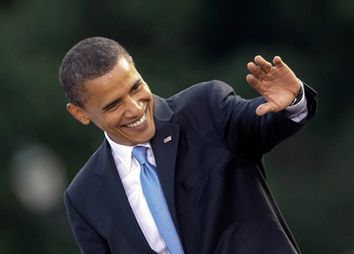
Obama’s Thursday speech in Berlin could be counted as a triumph. In a city chosen because Germany is Europe’s economic heavyweight, and because Berlin is a living symbol of once-divided nation coming together, 200,000 turned out for Obama’s evocation of JFK. But it is also interesting that Obama will not visit that other European capital, Paris, until Friday, at the end of the weekly news cycle, and then only for a brief meeting with French President Nicolas Sarkozy. A massive throng of cheering French people might have been an image more useful to McCain than the Obama campaign, given the way being “too French” was wielded as a cudgel against the previous Democrat to run for president. Because if anything, the crowds in Paris might have been larger than those in Berlin. In the July 23 Gallup Poll, Obama beat McCain as the preferred U.S. presidential candidate in Britain, France and Germany by lopsided margins. The highest numbers were in France — a stunning 64 to 4 percent.

What is it about Obama that turns French heads? Some of the answers are idealistic. “People now feel that in America it’s remarkable because of this ability to change,” Solvit says. “From the time years ago that a black man could be lynched and now a black man could be president.”

Obama backer Bernard-Henri Levy is effusive. “We French have the confused feeling that he is the living resurrection of the two greatest heroes, in our eyes, of modern America: Martin Luther King and John Kennedy. Yes, the reembodiment, in a single person, of King and JFK, that’s how we perceive Obama.

From their culture-straddling perspective, Americans in Paris have a slightly different view of the French crush on Obama. Crystal Fleming, a 26-year-old Ph.D. candidate in sociology at Harvard University who is currently a traveling scholar at L’Institut d’Etudes Politiques at Paris, is often called upon to speak to the French media about Obama. “The French love him,” she says, “for the same reasons that people around the world love him. There’s such a level of disappointment and disgust with American policies and political arrogance. It didn’t begin with the last administration, but it skyrocketed then.”

But Fleming, an African-American who is studying how the history of the transatlantic slave trade is commemorated in France and the United States, has also noticed that the French affection for Obama helps them feel good about their own society. “They also see in him some of the aspects of their color-blind myths. The French esteem themselves as a color-blind society. They are, constitutionally, which is daily contradicted in racism and discrimination in France. But, regardless, they see him [Obama] as someone who wants to overcome communitaurisme” — which basically refers to identity politics, the mobilization of minorities, and the fracturing of society along group lines — “and to build bridges between groups and move beyond ethnic divisions. They like this.”

Fleming finds it ironic that Western Europe tends to love Obama. “He’s someone who they alternately refer to as a black or métis [mixed-raced] politician, but they don’t know what to do with their own minorities.”

Other instances of French projection onto Obama are less problematic. Retired Time journalist Don Morrison, who has lived in Paris the past few years, and in 2007 penned a controversial cover story for Time’s European edition called “The Death of French Culture,” thinks that for the French, comparisons between Kennedy and Obama go deeper than mere style. “More than perhaps any other country, France likes its politicians to be smart. Not just street-smart but book-smart. You can’t get to high office here without having written a few books. And not just earnest tomes on public policy. French politicians crank out biographies, histories and books of poetry. A French literary magazine the other day asked me what I thought of a French presidential candidate’s comments about a recent historical novel. Only in France do presidential candidates consider themselves literary critics.”

“I think,” Morrison says, “that’s why the French love Obama. He comes across as somebody who has written a few good books and, more than McCain and certainly more than Bush, isn’t afraid to be thought of as somebody who reads … This is a country that takes culture seriously. [Obama] appears to the French to be somebody who values intelligence, education and culture. That makes him one of those idealized Americans that the French have always treasured, the ones who share the Enlightenment values that France did much to invent.”

Americans in Paris recognize, however, that their countrymen back home may not share the attitudes of their French neighbors. American Parisian John Morris, 91, was the photo editor for Life magazine and Robert Capa’s editor on D-Day. Morris has lived in Paris for 25 years. For the past year and a half, he’s been actively involved in the Obama campaign. An Obama MeetUp group that now numbers almost 400 people — mostly Americans, but also French and other nationalities — meets monthly in Morris’ apartment. “If the election were held here,” Morris said, “Obama would win hands down. [But] the average Frenchman is more knowledgeable about the world than the average American. It’s sad.”

The irony is that in these days of intense globalization, when the world is becoming a smaller and smaller place, Americans are in some ways becoming more insulated. Foreign news is becoming less interesting to them. As Richard Pérez-Peña reported earlier this week in the New York Times, a study by the Pew Research Center shows that almost two-thirds of American newspapers publish less foreign news than they did just three years ago, nearly as many print less national news, and despite new demands on newsrooms like blogs and video, most of them have smaller news staffs.

Yet at least one very important impression from the outside world is getting through. According to another Pew Research Center report, more Americans now say that the United States is less respected in the world than it has been in the past, and a growing proportion views this as a major problem for the country. More than 7 in 10 Americans (71 percent) say that the United States is less respected by other countries these days, up from 65 percent in August 2006.

For the first time since Pew began asking this question in 2004, a majority of Americans now see the loss of international respect for the United States as a major problem. The percentage of Americans saying the loss of international respect is a major problem has risen from 43 percent in 2005 to 48 percent in 2006 and 56 percent currently.

Perhaps that will partially relieve any trepidation in the Obama campaign about too many Paris photo ops, or of Obama being “too popular” in Europe. It is certainly good news for Americans who live abroad and who long to see America’s reputation restored.

And whether or not Obama reaches the White House, his very candidacy is good news for those who want to improve America’s image in Europe. As Obama’s brief stopover in Paris approached, Solvit was feeling excited that he would be one of the privileged few to see his hero in the flesh. He had received an invitation to attend Obama’s Friday evening joint press conference with President Sarkozy. “In France, everyone, of all ages, are for Obama,” Solvit says. “Elite or non-elite, black or white, politically interested or not, people of all different backgrounds. For young people, it’s a new way of speaking of world involvement and politics. It’s a new American dream.”

“You American people, it’s your future,” he says. “But it’s also our future.”

Continue Reading Close

The truth about “The Diving Bell and the Butterfly”

Family and friends of Jean-Dominique Bauby speak out about how Julian Schnabel's Oscar-nominated film honors and defames Bauby's real story.

  • more
    • All Share Services

The truth about

The quietly stunning film of Jean-Dominique Bauby’s phenomenal memoir, “The Diving Bell and the Butterfly,” is nominated for four Oscars this year. They include directing by Julian Schnabel — an honor he won for the film at the Cannes Film Festival and Golden Globes — and best adapted screenplay by Ronald Harwood, who won an Oscar in 2002 for his adaptation “The Pianist.” “The Diving Bell and the Butterfly” is also nominated for cinematography and editing, and has won numerous awards in film festivals across the world.

There is every reason for the film’s success. It recounts the remarkable life of Bauby, the debonair editor of French Elle magazine who in 1995 suffered a massive stroke. He slipped into a coma that lasted 20 days and awoke to find himself paralyzed from head to toe. He was diagnosed with a rare neurological disorder called locked-in syndrome.

A prisoner inside his useless body, Bauby, 43, could think and reason, smell and hear (though not well). With the only part of his body that he could move — his left eye — he could see and later learn to express himself. His speech therapist and later his friends would read him an alphabet, and Bauby would blink at the letter he wanted. He formed words, phrases and sentences, and ultimately, over the course of two months, working with ghostwriter Claude Mendibil, who took down word for word what he said, he completed his memoir.

The evocative title comes from Bauby’s notion that while his body was submerged and weighted down — impossible to move — his imagination and memory were still free and as light as a butterfly’s wings: “My cocoon becomes less oppressive, and my mind takes flight like a butterfly. There is so much to do. You can wander off in space or in time, set out for Tierra del Fuego or for King Midas’s court.” A few days after the book was published to rave reviews in March 1997, Bauby died of an infection.

Released last spring, the film is a visual knockout. Schnabel draws on Bauby’s fantasies to blast moviegoers with a kaleidoscope of dreamy images — some subtle, some banging loud — and an array of captivating music and sounds. The wonderful script takes the point of view of Bauby himself. The fourth wall between the audience and film has fallen away and the audience experiences the world through his eyes.

The film is said to be “based on a true story,” which, of course, is from Bauby’s book. The problem is that mixing his factually accurate journey through locked-in syndrome with a personal life that has been fictionalized for film has affected real people who were intensely involved in Bauby’s life before and after his accident. Now some of his closest friends feel the movie may forever obscure the truth of his life. They fear this collision between art and reality has created a revisionist history that is accepted by filmgoers around the world, and that this is what will remain in the collective cultural memory. For the first time, they are speaking publicly about it. As one of Bauby’s friends says, “There’s the Real Story. The Film. And the New Real Story.”

The Real Story

When books are made into screenplays, dramatic action takes first seat to writerly fluff or facts. In this case, there are minor differences between the book and the film that don’t change the meaning or spirit of Bauby’s life and text. He had two children instead of three. Sylvie de la Rochefoucauld, Bauby’s partner of 10 years and mother of their two kids, Théo and Céleste, says Schnabel liked all three child actors and couldn’t make a decision of whom to cast. He called her and asked if it was OK to use them all, and she said yes.

In the movie, Bauby feels guilty when his friend “Roussin” (Jean-Paul K in the book) comes to see him. Roussin was captured and held hostage in Beirut, Lebanon, after Bauby had given up his airline seat to him. Jean-Paul K was captured but it wasn’t when Bauby gave him his seat. If Jean-Paul K did come to see him, Bauby didn’t write about it. What Bauby says in the book is that he felt guilty for never having seen Jean-Paul K after his release. The movie captures his guilt by dramatically inserting the character into Bauby’s hospital life. And in the last section of the film, Bauby is driving through the boulevards of Paris and green countryside to de la Rochefoucauld’s house to pick up his son. In real life, a chauffeur was driving him. Which is more cinematic?

But the biggest difference between Bauby’s book and the film is the story of the women in his life. The movie shows Bauby, known to his friends as Jean-Do, as an invalid babe magnet and the women surrounding him as vying for his attention. Bauby doesn’t write about this or anything like it in his book, although friends describe him as having been very charming with a great sense of humor — quick and sometimes biting. He was a bon vivant and engaging. One friend portrayed him as having power in his silence once he became ill.

The major difference between book and film is that the mother of Bauby’s children — this is how he refers to her in the film as he points out that they were never married — pays him saintly visits day after day, despite the fact he doesn’t love her, and the girlfriend he is in love with never shows up at the hospital at all. In the most devastating scene of the movie, Bauby’s girlfriend tells him on the phone that she can’t come visit him because she cannot bear to see him like that. He painfully spells out his response to the mother of his children so that she can interpret it to his girlfriend. Bauby’s touching reply is that each day he waits for her. At that point, his wounded former partner slams the phone down, and the audience withers with the pain of her rejection.

In real life, this scene never happened. His girlfriend, Florence, was at the hospital day after day spending time with him. (De la Rochefoucauld was at that point his ex.) In the book, de la Rochefoucauld is only mentioned in one bittersweet chapter in which she brings the children to the hospital to celebrate Father’s Day for the first time, and they experience a wonderful day on the beach together.

Florence is mentioned several times, including an indelible memory of her on the day of his accident: “I pressed my forehead against the windowpane to gauge the temperature outside. Florence softly stroked the nape of my neck. Our farewells were brief, our lips scarcely brushing together. I am already running down stairs that smell of floor-polish. It will be the last of the smells of my past.”

Bauby also writes: “And here I had no problem identifying the watchers on either side of the bed: they were members of the personal bodyguard that spontaneously sprang up around me immediately after the disaster.” They include Florence; Bernard Chapuis, a writer and his best friend; Anne-Marie Périer, his boss at Elle, and her husband, Michel Sardou; and Patrick McClellan, his cousin.

With affection, he writes about the rest of his close gang: his other best friend, photographer Brice Agnelli; and his old buddy, editor Vincent Lalu, with whom he had worked as an accomplished journalist for many years before editing Elle. Florence, Chapuis, McClellan and Agnelli drove the 300 kilometers to the hospital at least once or twice a week. These were the frontline troupers throughout the ordeal.

As for the women in the hospital who were important, Chapuis says there were three: 1) Bauby’s speech therapist, Sandrine Fichou (called Henriette in the film), who set up the communication code, which became his silent voice. He called Sandrine his guardian angel in his book. 2) Mendibil, who transcribed the book, which is dedicated to her and his children. 3) Florence.

The Film

In France, a publisher owns book and film rights. But just as in the U.S., after the advance is paid back, the author receives a percentage of the royalties. When Bauby died, his children, Théo and Céleste, were the inheritors of their father’s rights and royalties, and, naturally, Sylvie de la Rochefoucauld acted as her minor children’s representative in their business matters. De la Rochefoucauld is a successful businesswoman and a fierce mother. She has her own public relations company and formerly ran television chain Canal +’s Jimmy channel. She is chic, sophisticated and fluent in English.

The publisher, Editions Robert Laffont, sold the rights of “The Diving Bell and the Butterfly” first to Steven Spielberg and Dreamworks, and one of Hollywood’s most successful screenwriters, Ron Bass, wrote the first script. Bass won an Academy Award for best original screenplay for “Rain Man” in 1988 and has also written other emotional and visual stunners such as “The Joy Luck Club” and “Snow Falling on Cedars.”

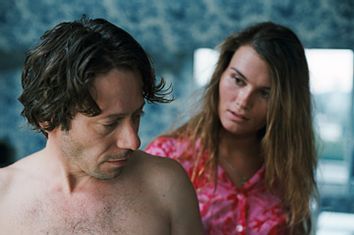
But as often happens in the movie business, the project stalled and switched companies — to Universal and then to Pathé, who finally made the movie with producer Kathleen Kennedy. Kennedy, who has produced such movies as “Munich,” “Seabiscuit” and “The Sixth Sense,” asked Harwood to write another script, and it was his screenplay that Schnabel read and directed. Johnny Depp had been attached to play Bauby early on but couldn’t proceed because of “Pirates of the Caribbean,” and, happily for all involved, French actor Mathieu Amalric was brought in.

Because de la Rochefoucauld was the mother of Bauby’s two kids, the publisher extended her the courtesy of being involved with the film. She was contacted to speak with Bass about his script, and she was put in touch with Kennedy. The two women became friends. “Kathleen Kennedy is the godmother of the movie,” de la Rochefoucauld says.

Editions Robert Laffont and de la Rochefoucauld had a good relationship, and the publisher looked upon “The Diving Bell and the Butterfly” as an extraordinary publishing adventure. Everyone involved made money and benefited. Then, just as the movie was finally about to be filmed, de la Rochefoucauld (again, representing Théo and Céleste) brought a lawsuit against the publisher, which was shocking to them. Simply put, the point was to question the rights of the book and the film, increasing the royalties for the Bauby children.

The first judgment was in de la Rochefoucauld’s favor. The case went to appeal, and the parties are working on an agreement on the court’s demand. One notion of French law that doesn’t exist in the U.S. is the ownership of “droit moral” or moral right. This is an intellectual right of an artist to protect his work. When an artist dies, the “droit moral” goes to his heirs unless he appoints someone else. For example, a John Huston movie was colorized in the U.S., and the movie is shown this way in the States despite the opposition of the Huston heirs who are trying to honor their father’s artistic wishes. But in France, where the Huston heirs argued their father didn’t want his film to be in color, the colorized film can’t be shown because of droit moral.

Being the mother of the Bauby children, de la Rochefoucauld also represented their droit moral. In this capacity, she could make sure the movie adaptation protected her children in the way that she saw fit. “She [de la Rochefoucauld] was very much involved in the screenplays,” one person close to the situation told me. “She could have opposed this or that version of the screenplays because of the children.”

Changes are made when books are adapted to film, and some make the transition better than others. This is the screenwriting business as usual. Harwood, whose credits include “The Dresser” and “Being Julia,” is a master adapter and playwright. He says the book and de la Rochefoucauld were his main sources. Incredibly, his screenplay was greenlighted on the first draft. “I took what she [de la Rochefoucauld] told me as gospel,” Harwood says. “I don’t believe in research. You have to tell a story in a movie. Sometimes the facts disturb all that. I was asked to adapt, and that was what I decided to do.”

Harwood says he became friends with de la Rochefoucauld, and she’d given him a dinner party in Paris. He also had an interview with Bauby’s transcriber, Mendibil. “All the women were so good-looking,” he says. “All fell in love with him. They found him deeply attractive. I used the things I thought were valuable.”

To de la Rochefoucauld, the film hits all the right notes, especially the portrayal of Bauby by Amalric. “Everything with Mathieu is right,” she says. “The entire movie is right. We couldn’t dream the movie would be so beautiful.” “For me, the movie was amazing,” Théo says. “It was like a flashback for me, the way Mathieu looked and acted like my dad.”

Bauby’s circle of friends agree that Amalric did an amazing job of portraying Bauby and his condition. “I think Julian Schnabel got it,” says Véronique Blandin, director of the Association of Locked-In Syndrome, which Bauby founded in the last month of his life. “It gives the right feeling of the locked-in syndrome people and problems in their communication. We can really recognize the book.” The problems begin for Blandin and others where Bauby’s private life is concerned. “I don’t agree with the personal story,” says Blandin, who now works with Bauby’s friends in the association. “It’s not the truth.”

The New Real Story

In the new real story, the mother of Bauby’s children took charge at the hospital, even if she is portrayed as jealous. She keeps coming back time and time again to support the man she loves even if he doesn’t love her. In reality, say Bauby’s friends, his girlfriend Florence was the one who came day after day and carried out his wishes. Bauby died in her arms. Sylvie de la Rochefoucauld was in the U.S. with her new boyfriend, rock journalist Philippe Manoeuvre, when Bauby passed away.

“The mother of the children was there every time — not the truth,” says Blandin. “Florence didn’t want to be in the movie. The mother of the children is there. OK. But it is really nasty in the way she [Florence] is presented as not brave, and she refused to come [to the hospital]. It’s so incredible to put this in front of the whole world. You just want to make your life. Ten years later you are attacked like that.” Florence declined to comment. In fact, to protect her privacy, she requested that her name not even be used in this article.

But Bauby’s friends have decided to break their silence. They say they have never spoken publicly about the film before because it was hard enough to live through his illness and death the first time. Bringing it all up again is painful. “Brice, Florence and I had to cling to each other,” says Chapuis. “Otherwise, we would have died.” The friends were bonded in their sense of loss and protection of Bauby. Then once they realized what was happening in the film, they wanted to protect Florence. They also kept quiet because of Théo and Céleste. But now they want to set the record straight. “It [the movie] is not the story of my friend,” Agnelli says. “It is a story for Hollywood.”

Schnabel knew the role that Florence and Bauby’s friends played in Bauby’s life and hospitalization. Chapuis, Florence and others met with him and various actors, including Amalaric, to help them get the feel for Bauby. In the end, they felt burned, though not necessarily by the actors. Bauby’s friend Lalu says that in the middle of filming, Chapuis saw the script and realized it was inaccurate. Lalu chose not to see the film. “I know it’s a great movie,” he says. “I make a big difference between the work of the director and the storyboard.”

The straw that broke the camel’s back for Bauby’s friends and colleagues was a recent article in the London Daily Mail in which de la Rochefoucauld is quoted as saying: “I was at his [Bauby's] bedside day after day. I never abandoned him. I was never aware of Jean-Do’s girlfriend visiting him in the hospital.” De la Rochefoucauld denies she said this.

Chapuis, who is godfather to Théo, says he thought de la Rochefoucauld came to the hospital three or four times; Agnelli says the same. “The situation was difficult,” says Chapuis. “Jean-Do had left her, and he was ill. When she says Florence never went, it’s stupid. To have the revenge like that, well …” De la Rochefoucauld is very specific about her visits. “I was at Berck [the hospital] every Tuesday for one year and a half,” she says, “plus weekends with the kids every three weeks except during the school holidays.”

Of Bauby’s friends, she says, “They were pissed off that I didn’t ask their permission. They’re reproaching me for having done that movie. It is very hard for me because I was sure I was doing the right thing. They [the filmmakers] did the adaptation they wanted to do. They made the movie they wanted to make.”

Théo says he was asked to be a grown-up when he was 11 years old, when his father died, and being his father’s son has been a burden to him at times. He appreciates his mother’s portrayal in the film. “I don’t have anything against her [Florence],” Théo says. “I respect my dad fell in love with her. [The thing was,] all my dad’s friends kept sticking to that girl. [I liked] the way Julian showed my mom strong and getting over my dad. She [his mother] will always be the love of my father’s life.”

“Not so,” says Agnelli, godfather to Théo’s sister, Céleste. “The love of his life was the kids — not the mother.”

Bauby’s speech therapist, Fichou, didn’t return my phone calls for this article. But Marie-Josee Croze, who played her in the movie, was quoted in CanMag.com as saying that Fichou “didn’t like the script … She said, ‘No, it wasn’t like that in real life. I remember Jean-Do never said that he wanted to die. She was against lots of stuff in the script.”

Bauby’s transcriber Mendibil says the whole experience with Bauby affected Fichou deeply, and that she was afraid of the film. For Mendibil herself, “Julian Schnabel understood the essential of the story and the relationship between Jean-Do and me,” she says. Mendibil was also there for the telephone calls to Bauby’s father, and says they’re accurately depicted, although Mendibil was not with Bauby when he was dying, as the movie suggests.

Schnabel filmed in the real places where Bauby spent his life, but French Elle didn’t let him film in its offices. In May, the magazine didn’t cover the release of the film. Instead, editor Valérie Toranian wrote an homage for her old mentor and friend, which included this paragraph: “At your side, Florence, always Florence, your companion journalist at Elle, present, vigilant, courageous, this woman that you loved and who loved you until the end, until the last lullaby, your last breath.”

Toranian also drew attention to the Association of Locked-In Syndrome, founded by Bauby, which in the film is only mentioned in a brief credit at the end. Blandin says that de la Rochefoucauld has never contacted nor contributed to the association. Since Théo has gotten older, he has attended one of the association’s meetings, which greatly pleased them. Florence has helped the association since its inception and continues to do so.

In France, directors — not producers — get final cut. In a Guardian interview, Schnabel says that he was terrified of death his whole life. “I made this movie, and I’m not scared to die,” he says. But in exorcising his demons, he has conjured new ones for Bauby’s closest circle of friends.

In the end, “The Diving Bell and the Butterfly” is a beautiful film, deserving of the awards it has won and may win Sunday night. Does it matter that a revisionist history — the New Real Story — has replaced the truth and affected the real people involved?

Agnelli saw the film at the Cannes Film Festival, and after it was over a woman beside him said, “Oh, the poor wife!” This is the common reaction. “No,” he said, “you don’t understand. That’s not what really happened.” And he explained.

Continue Reading Close