Bill Sasser

Strained by war, U.S. Army promotes unqualified soldiers

A Salon investigation reveals that a shortage of skilled sergeants has led to dubious promotions for inexperienced soldiers -- even jeopardizing some operations in Iraq.

  • more
    • All Share Services

Strained by war, U.S. Army promotes unqualified soldiers

America’s military commitment in Iraq and Afghanistan is certain to remain a key issue in the presidential race — and soon that could include renewed focus on a “stretched thin” U.S. Army. According to a Salon investigation, the Army is facing a troubling shortage of qualified sergeants, the noncommissioned officers considered to be the backbone of training and combat operations. In fact, a new Army policy intended to boost this critical leadership corps of NCOs has prompted a wave of promotions for apparently unqualified soldiers — and even jeopardized some combat operations in Iraq.

In essence, an Army policy implemented in 2005 and expanded this year lowered the bar for enlisted soldiers with the rank of E-4 to gain the rank of sergeant, or E-5, by diminishing the vetting process. According to more than a half dozen current and former Army sergeants interviewed by Salon, the policy has produced sergeants who are not ready to lead. In some cases, soldiers were promoted even after being denied advancement by their own unit commanders. While awarding a promotion once required effort on the part of a commander, those interviewed say, the Army’s current policy actually requires effort to prevent a promotion, and has had negative consequences on the battlefield.

A sergeant interviewed recently at Ft. Hood for this article recounted how he watched his commander feed the promotion papers for one E-4 through a shredder shortly before their unit deployed to Iraq in 2006. After two months in the field, that solider and another E-4 who had also been passed over for promotion were automatically promoted to sergeant anyway, despite their commander’s earlier judgment. Problems soon arose during a combat patrol involving “action on contact,” an encounter with the enemy in which fire is exchanged. “These two NCOs were immature and not ready as far as leading other soldiers, and there were some ‘oh shit’ moments,” said the sergeant, who asked not to be identified and declined to provide specific details about the combat incident because of security restrictions. “We had to have a powwow and pull back on what was going on. Fortunately, no casualties occurred.”

The newly promoted E-5s, he said, also had problems with calling in reports from the field — which, in a combat scenario, could involve such life and death decisions as requesting suppressive fire or determining if an area is safe for medical helicopters to land. “We had to spend a lot of time counseling and mentoring these new E5s in the field,” he said. “They have their sergeant rank and they still have a lot to learn.”

Sgt. Colin Sesek, a medic in the 82nd Airborne Division who returned from a 15-month deployment to Iraq in November 2007, said automatic promotions affected both the morale and effectiveness of medical units in which he served and in combat units he observed. “There was an E-4 in my platoon who was very disorganized and didn’t care about anyone else — he always delegated down the line, even when it was his job to do,” said Sesek. “I’m trying to think of the civilian equivalent of how to describe him — ‘shit bag’ is what we called him. He had been in the Army for a while and boom, he got paper boarded” — a term referring to the Army’s expedited promotions process. “When I heard he got promoted I said, yep, that’s the only way he would have gotten it.”

Sesek said the promotion had wider effects within his unit, as other platoon leaders followed this example and began promoting their own E4s without hesitation. “In infantry platoons, too, I saw people get promoted who shouldn’t have been. The squad leaders told me, ‘Well, if that screwup in that platoon got promoted, then we’ll promote ours too.’”

After six years of war, with multiple tours of duty commonplace, the Army continues struggling to retain and recruit quality soldiers. After failing to meet its recruitment goals in 2005, the Army undertook measures to boost its numbers, with some success. That included stop-loss orders (compulsory postponement of retirements), bonuses of up to $50,000 for re-enlisting, and the loosening of standards on criminal backgrounds, education and age. It also began automatically promoting enlisted personnel with the rank of E-4 to sergeant, or E-5 in the Army’s hierarchy of service ranks, based on a soldier’s time in service, while waiving a requirement that candidates for E-5 appear before a promotions board.

Under the current policy, after 48 months of service E-4s serving in military specialties with shortages are automatically placed on a promotions list. Although a soldier’s name can be removed by his or her commander, each month that soldier’s name is placed back on the list. This was termed “automatic list integration” by the Army (or what the soldiers call “paper boarding”). This April, the policy was expanded to include promotions to staff sergeant, or E-6.

Sgt. Selena Coppa, a communications specialist in the 105th Military Intelligence Battalion, said she has noted a marked lowering of standards for E-4s being promoted to sergeant. “The doctrine now is that you just need to be trainable, and people who are not competent and not good leadership material are being promoted,” said Coppa, who has expressed her concerns through unit performance surveys and spoken directly to her superiors. “A sergeant major told me, ‘Yes, you’re right, but there’s nothing I can do about it.’”

Lt. Col. Anne Edgecomb, head of the Army’s media relations division for personnel at the Department of Defense, explained in an interview with Salon that the Army was short 1,549 sergeants, mostly in combat occupations, when the policy was implemented in February 2005. It has reduced the number of NCO occupational specialties with shortages by 74 percent since then, according to Edgecomb. She added that in many cases promotions are awarded to E-4s who, due to manpower shortages, are already doing the work of E-5s. “The policy does not change Army standards for promotion,” said Edgecomb. “Commanders have the responsibility to stop a potential promotion when they determine a soldier is not trained or is in some way unqualified in accordance with standards.”

Perhaps no part of the U.S. military has carried as heavy a burden in Iraq as Army sergeants, who directly train, mentor, discipline and lead boots-on-the-ground soldiers. After years of war, many of the Army’s most experienced sergeants have retired, left the service, transferred to noncombat posts, or are recovering from battlefield injuries.

“Army NCOs lead on a very personal level and are the backbone of how the U.S. Army is run,” says Lt. Col. Gian Gentile, a former commander in the 4th Infantry Division who teaches military history at West Point. “In combat specialties such as armor and infantry, doing two to three tours is having an effect on NCOs. They have been through a lot and it puts tremendous stress on them and their families.”

The current promotion policy is causing some doubts and bitterness among veteran NCOs. “If these guys don’t work for it and you give it to them, we’re not making leaders, we’re making stripe wearers,” says Staff Sgt. Charles Bunyard, a senior scout in the 1st Cavalry Division at Ft. Hood who commands a unit of Bradley fighting vehicles.

Bunyard has over 15 years of service in the Army, including two deployments to Iraq, where he survived nearly a dozen IED blasts, was grazed in the head by a sniper’s bullet and broke a leg in three places in a training accident. Sent home last year from Diyala province after suffering a dislocated shoulder and a severe concussion in an IED attack, he was diagnosed with post-traumatic stress disorder and traumatic brain injury. But after five months of recuperation, he was cleared by Army doctors to return to duty and has volunteered for a third combat tour.

At Ft. Hood, Bunyard is spending 16-hour days training his squad of new recruits for their first deployment later this year. Married and the father of five children, several months ago he stopped going to his scheduled doctor and therapy appointments, which he says interfered with his duties. “I have a large responsibility to these guys, and when I’m gone I’m cheating them out of leadership and ways to learn better,” said Bunyard, who still has memory problems and sometimes speaks with a slur as a result of his brain injury.

While the Army needs thousands of new NCOs to replenish the existing ranks, thousands more are also needed as the force expands. The Army plans to add 65,000 soldiers to its ranks by 2010, as declared by President Bush in his State of the Union Address in January 2007.

Quality and morale issues notwithstanding, official figures from the Defense Department on re-enlistment show that the Army has exceeded its retention goals for the past three years. But the planned expansion will only increase the Army’s need for NCOs and junior officers, who have also been leaving the military in waves. A shortage of qualified NCOs is tied to a shortage of junior officers, as many of the latter choose not to re-enlist, says Gentile. “The Army has holes in its officer corps as well, and enlisted soldiers who would have become NCOs — the cream of the crop — are going to Officer Candidate School rather than becoming sergeants,” he explained. According to Gentile, who served two combat tours in Iraq, it’s now not uncommon to see 26-year-olds with seven years of service who are sergeants first class in charge of a platoon of 30 soldiers. Before the war, he says, achieving that rank would have taken twice as long.

Some military experts doubt the force’s capability at present, particularly if it is needed to perform on a third war front. Two former undersecretaries of defense for personnel question the ability of the all-volunteer Army to meet its manpower needs in coming years. “Our volunteer Army was not set up to fight a long war,” says Lawrence Korb, who served in that role in the Reagan administration. “The idea was that an active Army would fight when needed and the National Guard and Reserve were on standby as a ready reserve. They’ve all been in constant rotation for over five years, and we no longer have a reserve. What we’re doing is mortgaging the future of our Army.” Edward Dorn, who served in the Clinton administration, sees trouble on the horizon. “I think an increase of 65,000 by 2010 is out of reach with a volunteer force, unless you have a very significant downturn in the economy,” he said.

Not all E-4s are eager for automatic promotions to sergeant, according to Bandon Neely, who served in a military police battalion at Ft. Hood before leaving the service May 2005. When the policy began in 2005, the Army also had begun to impose stop-loss orders to prevent sergeants from leaving the service, “so a lot of E-4s did not want it,” Neely said. “Guys were being put up for promotion who refused to take it.”

Patrick Campbell, a sergeant in the District of Columbia’s National Guard who was recently awarded an automatic promotion, said he has seen both the benefits and drawbacks of the policy. Campbell, who served as a combat medic in Iraq in 2004 to 2005, said battlefield experience quickly turned new sergeants into competent leaders. “Being in combat forces you to learn fast — your life depends on it,” he said. “At the same time, leadership training is needed but it’s being delayed because of the pressure of deployments. If you promote people without training, what does it mean to be a sergeant?”

John Hagedorn, a sergeant who served in 2007 as a forward observer in the 82nd Airborne Division assigned to an artillery unit in Tikrit, said the high rate of NCO promotions disrupted the chain of command in the platoons to which he was attached. Out of 70 personnel in three platoons, only five soldiers returned without having been promoted to sergeant, he said.

“The artillery soldiers I was assigned to would normally be operating 105-mm Howitzer canons, but most of them had no idea how to fire one,” said Hagedon, 23, who served 15 months in Iraq under stop-loss orders and left the Army after his return in 2007. “The guys who were promoted to E-5 would normally be the crew chief in charge of one of these guns, and when they came home they were thrust into the position where they were untrained in their mission. They would be transferred to other posts and would get somewhere else and not know how to use the gun.”

Sgt. Hagedon’s experience points to a problem documented by an internal Pentagon report co-authored this year by Lt. Col. Gentile. The report, which raises concerns that the Army’s current focus on counterinsurgency has weakened its ability to fight conventional wars, cites among other statistics that 90 percent of Army artillery units are unqualified to fire their weapons accurately — the lowest rating in history.

In Iraq, Sgt. Hagedon said, “All those promotions lessened the significance of being in a position of leadership. It brought junior leaders down to Joe Private level and stole thunder from the older NCOs, who didn’t like seeing all these young guys getting promoted so fast.”

Hagedon said consideration of leadership potential played no part in the promotion process, as the new policy created pressure on senior sergeants to promote, regardless of performance. “If all the other E4s are getting promoted, it will look bad if you don’t promote your guy,” he said. “And if everyone else is getting it, they don’t want to cut an E4 out of the pay raise you get — $200 a month.”

The result in the platoons he observed was a breakdown in the chain of command, which followed the soldiers home: “There was really no difference between the enlisted guys and the junior leadership [in Iraq]. They’re hanging out together, being buddies, not like back in the U.S. where the NCOs are constantly correcting soldiers of a lesser rank. Then you come home to a training environment like Ft. Bragg and it’s a problem. You can’t be hanging out drinking beer with the enlisted guys one night and chewing their ass out the next morning. You end up showing favoritism.”

Such concerns may be exacerbating morale problems caused by multiple deployments. In Hagedon’s own platoon of forward observers from the 82nd Airborne, only two out of 12 sergeants chose to remain in the Army when their enlistment ended.

Sgt. Major Tom Gills, chief of Army enlisted promotions, says that the current policy has returned promotion rates to what the Army had prior to the end of the Cold War. “Over the years, individual units had adopted their own standards that were higher than official standards,” he said. “A lower and lower percentage of soldiers were going before promotion boards. Through the 1980s, 25 percent of soldiers were going up for promotion, while until recently only 5 percent were coming up for promotion.”

But Andrew Bacevich, a retired Army colonel who served in Vietnam and now teaches U.S. military history and foreign policy at Boston University, said soldiers in the all-volunteer Army will continue to be overtaxed, even with the planned expansion. The strength and morale of noncommissioned officers, he said, has always been a critical measure of the Army. “When the Army began to fall apart during Vietnam one of the red flags was the deterioration of the NCO corps,” said Bacevich. “Experienced NCOs began leaving in large numbers, and the Army tried to make up for it with ‘shake and bake NCOs’ — enlisted men who went through a 90-day school. It didn’t work very well and it didn’t stop the erosion.”

Bacevich, whose son, 1st Lt. Andrew J. Bacevich, served in the 1st Cavalry Division and was killed in Iraq in 2007, added, “We don’t have an Army that is large enough to continue with this sustained rate of deployment, particularly if some other conflict arises elsewhere. The best solution I see is to lessen our commitments abroad.”

Texans turn against Bush’s war

Disillusionment with Iraq is smoldering even in the heart of Bush country, where military families have paid a heavy price.

  • more
    • All Share Services

Texans turn against Bush's war

As George W. Bush approaches his final year in office saddled with an unpopular war, the shifting winds of public opinion have reached even the wide open spaces of Bush country. More and more Texans appear disillusioned with the war in Iraq and with the man who was once their widely popular governor, though some can still seem reluctant to talk about it.

“The truth is, folks in Texas are hurting,” says Big Bo Kern, standing behind the counter at the Luckenbach General Store, a fixture of this small but well-known Texas crossroads. “They probably won’t tell you that, because we supported Bush and stood up for him. Back in the day you couldn’t swing a dead cat around here without hitting one of those ‘W’ stickers. But feelings around here started to change about a year ago, when guys started going back to Iraq for their third deployment.”

The town of Luckenbach, founded in 1849 and made famous a generation ago by the hit song from “Waylon and Willie,” still hosts live cowboy bands on weekends and can seem timeless. But over the past couple of years, autographed photos of Willie Nelson and Jerry Jeff Walker tacked to the walls of the general store have been joined by snapshots of young servicemen in Iraq, holding up their Luckenbach T-shirts. “We get young guys coming through here, on leave or on their way back to Fort Hood for their next deployment, so I give them a hat or a T-shirt and ask them to send me a photo back,” says Kern, 45, an Army veteran originally from the nearby town of Sisterdale. “We also get soldiers from Brooke Army Medical Center in San Antonio. The hospital takes them out on trips sometimes. They come in and most of them are horribly burned, some missing arms or legs. I give them a T-shirt or a hat,” Kern says. “It breaks your heart to see them.”

Texas has paid a price for the wars in Iraq and Afghanistan. More Texans than people from any other state have served in those wars. From September 2001 through July 2007, 171,335 active-duty service members and 23,906 National Guard troops and reservists from Texas have been deployed with Operations Iraqi Freedom and Enduring Freedom, according to data provided to Salon by the Department of Defense. (The numbers account for every tour of duty served by every soldier.) As of July 31, Texans represented 35,015 active-duty service members and 2,649 Reserve troops in Iraq and Afghanistan, accounting for more than 14 percent of total forces stationed in those countries. (Approximately 264,000 Americans were stationed in Iraq and Afghanistan as of July 31, according to the Defense Department figures.) As of Sept. 17, 378 Texans have been killed in Iraq and Afghanistan and more than 2,200 wounded. Only California has seen a greater total number of deaths, with 447 service members killed.

Many Texans have deployed from Fort Hood, the Army’s largest base with more than 44,000 personnel. Sprawling across hundreds of square miles of Texas Hill Country between Austin and Waco, Fort Hood is home to the 1st Cavalry Division and the 4th Infantry Division, which have been in constant rotation to Iraq since the 2003 invasion. At a benefit concert in nearby Killeen on a recent Thursday night, Marissa Sousa, a 29-year-old Iraq war veteran, staffed a table for the advocacy group Iraq and Afghanistan Veterans of America, offering brochures on veterans’ health issues such as post-traumatic stress disorder.

“I see some of these guys and I know they’re back from Iraq,” says Sousa, who retired as a staff sergeant from a unit based at Fort Hood, and whose fiancé is currently stationed with the 1st Cavalry Division in Baghdad. “They start circling my table and I can see they want to talk to someone, but it’s difficult to do. Morale is down. A lot of them are only going back again for their buddies, not for patriotism or their president. They’re doing it because they have to, and because they would feel guilty about staying behind.”

Speaking freely around Fort Hood about the war is difficult, Sousa says, because “Texans are very patriotic and very proud of their state. For a lot of people around here, Bush is like the president of Texas, and supporting the soldiers means supporting Bush.”

But elsewhere in Texas Bush has become a figure that former supporters say they no longer recognize. “I was very enthusiastic for Bush when he first ran, embarrassingly so looking back now,” says Paul Burka, executive editor of Texas Monthly magazine. A political independent who has covered Texas politics for 30 years, Burka twice voted for Bush for president. “Early on his approval rating in Texas was around 80 percent, and he did well with Democrats as well as Republicans and independents. Now there’s widespread disappointment he hasn’t led the country in the same way he led Texas. To a lot of us he doesn’t look like the same person he was as governor. I would say it’s been an enormous disappointment.”

Burka’s sentiments bring to mind a public renunciation in Austin last April by Matthew Dowd, a Texas native and once a Democratic pollster who helped Bush win both presidential elections. After leaving Washington, Dowd, in an interview with the New York Times, was critical of Bush’s leadership and called for a withdrawal from Iraq.

Iraq is the No. 1 issue on the minds of Texans, according to a recent Lyceum poll sponsored by the University of Texas. (The poll asked open-ended questions about statewide issues of concern, but did not track positive or negative opinion on the war.) Yet, a poll in July by Survey USA found that Bush’s approval rating in his home state stood at 41 percent, with 57 percent disapproving, significantly better than Bush’s national numbers. (A national poll by Newsweek in July, for example, found Bush’s approval rating at 26 percent, with 65 percent disapproving.)

Indeed, it can be difficult to pinpoint where people’s feelings about the war, and the president, collide and diverge. “Support for Bush was always less about his stated political beliefs than the idea that he was their guy, a native son,” says James Henson, a University of Texas public policy professor who helped direct the Lyceum poll. “I used to ask Democrats who voted for him why, and they’d say, ‘He’s from Texas.’ There’s a strong sense of cultural identity here — a cliché about Texas that has a lot of truth to it. But finding people now who say they voted for Bush, at least in Austin, is like trying to find people who voted for Nixon in his 1972 landslide a few years after the fact,” Henson says. “No one wants to talk about it,” he adds. “The criticism here is much more muted than in the rest of the country.”

Geoffrey Wawro, a professor of military history at the University of North Texas in Denton, says he has seen no waning of support for Bush, or the war, at least in the Dallas area. “You see Bush stickers all over here,” says Wawro. “This is a very Republican place, and people support the war because they support their president, and vice versa.”

But Perry Jeffries, 46, a former first sergeant who served with the 1-10 Cavalry Regiment of the 4th Infantry Division during Operation Iraqi Freedom in 2003, says he sees a growing divide around Fort Hood between support for the war and support for Bush. “Many, many people here are connected in some way to deployed soldiers, and no matter what they may feel they want to support the troops,” says Jeffries, a native of Waco who retired from the Army in 2004 and is also a member of Iraq and Afghanistan Veterans of America. “But if you feel people out about what they think individually, it’s far from a consensus,” he says.

As a member of a Fort Hood honor guard, Jeffries has attended the funerals of 20 service members from Texas killed in the war. “Most of the women I work with, who all have husbands who have been deployed, are done with this war — they don’t think their husbands should have to go back again for something that to them looks dumb now. The soldiers signed up to do a job, and they’re going to do what they’re ordered, but you’ll see guys now who come back on leave or on rotation and you know they don’t want to go back.”

Jeffries now manages volunteer recruitment for a private contractor that operates a blood donor program in Fort Hood that supplies military hospitals in Iraq and Afghanistan. When he began his civilian job, Jeffries began driving his pickup truck on post with a bumper sticker reading “George Bush: American Errorist.” He says he was surprised by the response he got. “I only had one person to tell me that I should take it off, but dozens of people asked me, ‘You haven’t gotten in trouble for that?’” People were concerned his truck might be vandalized, Jeffries says, but “they didn’t have a problem with the message.”

Yet, while recruitment has lagged elsewhere in the nation, the Army continues to surpass its recruiting goals in Texas. By September, the Texas Army National Guard had already met its enlistment goal of 3,300 recruits for 2007, signing up 4,195 new members, according to Lt. Col. Ron McLaurin, the recruiting and retention commander of the Texas Guard. The total number of its soldiers, or “end strength,” has reached 18,765 (accounting for both new-enlistee and retention numbers), surpassing the 2007 goal by more than 1,100 soldiers. To date, Texas has sent more Guard soldiers to Iraq per capita than any other state.

“Texas has a long military history, and it’s part of the culture here to support it,” says Wawro.

Burka, the Texas Monthly editor, sizes up Bush’s standing in Texas in other ways. He points to the recent controversy at Southern Methodist University in Dallas, where faculty members signed a letter of protest against locating a Bush presidential library on campus, and the closing of most of the Bush gift shops in Crawford, Texas, where even activist mother Cindy Sheehan has left town. “The elite opinion makers here were really taken aback when [Bush] seemed to completely ignore the advice [on the war] of James Baker, who is very respected in this state,” adds Burka.

Then there are the photographs of Texas service members, the latest casualties in Iraq, that show up regularly in the morning papers. Recently it was Cpl. Thomas L. Hilbert, of Venus, Texas, a small town 30 miles south of Dallas. Hilbert, 20, and two other soldiers serving with the 9th Cavalry Regiment based at Fort Bliss, near El Paso, died after their vehicle was hit by an improvised explosive device on Sept. 6. Hilbert’s sister, BillieJo Alexander, told the El Paso Times that her brother had already reserved a hotel room in Las Vegas to celebrate his 21st birthday with his family in January. “We were very close,” she said. “He wanted to make something of himself, something he could be proud of.” His parents, Tom and Theresa Hilbert, said they wanted their son remembered as a soldier and a hero who loved the Army. He had planned to reenlist, they said.

In April, Lt. Phillip Neel’s photograph appeared in the Austin American-Statesman. A West Pointer who graduated from Fredericksburg High School in 1998 and was stationed at Fort Hood with the 1st Cavalry Division, Neel, 27, was killed in a grenade attack in Iraq’s Diyala province on Easter Sunday. A month before, he had come home to the Hill Country on a two-week leave. His obituary in the Statesman hinted at the trepidation many soldiers have felt about returning to Iraq, saying that Neel “had prayed for his enemies and cried at the dinner table for the souls of his soldiers” on his last night before returning to duty.

In an interview with Salon, Neel’s sister, Kelly Foster, deflected any questions about the Neel family’s opinions of the war. “He felt like something might happen when he went back this time, but he loved being a soldier and was very proud to serve his country,” said Foster. “He was a great brother and we don’t want to bring any politics into mourning his loss.”

Kristy Kruger, a singer-songwriter from Dallas whose brother, Lt. Col. Eric Kruger, died in an IED attack in Baghdad last November, is equally reluctant to bring up politics when talking about her brother. To honor his birthday last January, she held a free show for family and friends at a Dallas coffee shop. Afterward, she decided to take her show on the road. “I get up onstage and say, Hey, I’m Kristy, I lost my brother in Iraq, then play songs, tell jokes and tell stories about him,” says Kruger, whose audiences have included peace activists as well as soldiers back home from Iraq. “Folks have come up who don’t know anyone who’s over there and just want to thank me for giving a face to a soldier. I’ve connected with strangers in a way that I wouldn’t have imagined.”

Sousa of IAVA plans to stay in Killeen, awaiting her fiancé’s return from Iraq, and continuing her work on behalf of vets while she pursues a degree in communications at nearby Tarleton State University. This part of Texas is not a great place to be if you’re having doubts about the war, she says. “People tiptoe around it.” But, she adds, “I feel I can help people here who are struggling with what they went through in Iraq. I think it’s important for soldiers at Fort Hood to have someone to talk to who’s been there. It’s difficult when you think you go for some good reason — defending freedom, 9/11, helping the Iraqi people — and it turns out to not be the great cause that you thought.”

Additional reporting by Erin Renzas.

Continue Reading Close

In Hurricane Katrina’s surreal backwaters

Two years after the deluge: A brew of Hollywood pyrotechnics, homeowner nightmares and local cultural revival in New Orleans.

  • more
    • All Share Services

In Hurricane Katrina's surreal backwaters

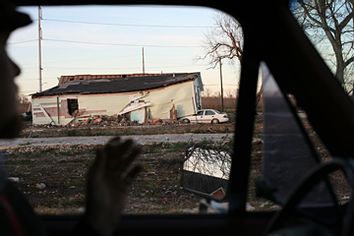
Around the block from the corner of Forstall and Galvez in the Lower Ninth Ward, a ragtag armada of pirogues, sailboats and motorboats stripped of their engines sit on a dusty curb. Though they may have once been used in the aftermath of Hurricane Katrina to rescue flood victims, their next cue will be as props for “Black Water Transit,” a Hollywood “post-Katrina gunrunning thriller” once slated to star Samuel L. Jackson and Bruce Willis, now set to feature Lawrence Fishburne and Karl Urban. Production workers have also built a “wrecked” house from the ground up at this desolate corner in the city’s hardest-hit neighborhood. Tilted from its foundation at a nearly 45-degree angle, the movie set sits next door to several real houses wrecked by Katrina’s floodwaters and slated for demolition months ago. (Producers won a concession from the city to leave them standing, agreeing to pay for demolition if filming went past June 30.) Earlier this month the filmmakers rammed a car through the front of their fake Katrina house. Near the end of production they will blow it up with pyrotechnics.

Just across the street, on Forstall, stands a stark reminder of the real destruction that happened here nearly two years ago: The gutted shell of Mount Carmel Church, its brick façade still bearing spray-painted skulls and crossbones from the early days after the deluge, apparently indicating that dead flood victims had been found inside.

In the past year, visits to the Lower Ninth Ward by Hollywood stars, politicians, foreign dignitaries and busloads of volunteers have mostly faded into memory. But parts of New Orleans can still astonish with surreal scenes of Katrina’s lasting aftermath.

Half a dozen blocks downriver from the movie set, Japanese artist Takashi Horisaki is completing latex castings of a flood-wrecked shotgun house on Caffin Avenue, which he plans to install at the Socrates Sculpture Park in New York City later this summer. This house, too, would have been bulldozed months ago but for the cooperation of the Army Corps of Engineers, which is implementing the city government’s tear-down list. A graduate of Loyola University in New Orleans, Horisako has gotten help from dozens of volunteers over the past two months to help make his deadline, and he hopes his art will remind New Yorkers that New Orleans and its residents are still hurting.

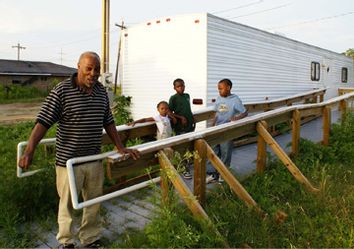
It’s true for Johnnie Blunt, whose hurricane-damaged house nearby at Charbonnet and Dorgenoise might still be standing if he were a film producer or conceptual artist. Blunt, 63, his wife, Charlene, 34, and five of their six children, all between the ages of 4 and 10, were among the last families in the Gulf region to receive an emergency trailer, which sat next to their damaged house for four months before they received a key from the Federal Emergency Management Agency. The Blunts evacuated ahead of the hurricane and spent the next 20 months living outside Baton Rogue, La. They returned to their old neighborhood the last week in May to move into their one-bedroom trailer — only to discover that their home had been demolished by the city, without warning they say, two days earlier.

A cabdriver and part-time minister, Johnnie Blunt had planned to rebuild the cinder-block-on-slab house, the front of which also served as his small community church. “We had talked to them at City Hall ever since Katrina, and they told us to gut and board up our house and they would take it off the list to knock down,” says Blunt, who did the work with his wife on weekend trips back to the city to comply with post-disaster property ordinances. “We figured we were OK and didn’t have anything to worry about. The only thing wrong with the house was a big tree had put a hole in the roof, but the walls outside were brick and in perfect condition.”

Blunt and his children — Wayne, Wallace, Worlonzo, Wanesheir and Wenzy (15-year-old Wille is living with her grandmother) — stand on the front steps of their trailer on a late Sunday afternoon, looking out across a neighborhood that feels like a forgotten rural outpost. Nearly two years after 13 feet of water rolled through, the city’s aggressive cleanup of the Lower Ninth has left empty fields where weeds stand 6 feet tall, wild chickens cluck after bugs, and front steps lead to houses that are no longer there.

The silence is broken by a pit bull that turns a corner and starts barking at the children, who cower and flee inside. The dog belongs to a neighbor who lives in another FEMA trailer down the street. “They’re afraid of that dog and he knows it,” explains Blunt, who says he will enroll his children in the nearby Martin Luther King Jr. Charter School when it reopens in August, one bright spot in the Lower Ninth’s long dirge of tragedy since the storm. “We thought about trying to find some kind of summer camp for them, but we didn’t know where to look and now it’s probably too late.”

Blunt has other worries. Back in 2005, because of some money troubles, he decided to stop paying his homeowner’s insurance so he could finish paying the mortgage on his house. It was two months before Katrina struck. “That turned out to be a really bad decision,” he says. Meanwhile, the city not only tore down his house but also reassessed his property lines, he says, redrawing his lot much smaller than he believes it to be. Nearly broke, he had paid property taxes on the house a few weeks before it was demolished in May. Although he filed an application last year for federal grants aiding homeowners affected by Katrina, he has yet to get a dime from Louisiana’s Road Home program (which is funded by the U.S. Department of Housing and Urban Development) — and he’ll have to refile before July 31 now that he no longer has a home to repair. “I don’t understand it,” says Blunt, who is more bewildered than angry. “It seems like they’re doing everything they can to keep people from moving back here.”

Blunt is not alone in his experience. Mayor Ray Nagin’s administration has been criticized for inconsistencies in how the city has implemented its power to tear down hurricane-damaged structures deemed “imminent dangers,” while placing liens on the properties for the cost of the work. A report in the Times-Picayune recently cited at least a dozen cases in the Lower Ninth Ward in which homes in apparently salvageable condition were listed for demolition. Housing advocates point to haphazard enforcement of the law, a confusing and inconsistent notification process, and the lack of an appeals process. The city’s tear-down campaign runs parallel to its Good Neighbor Program, which gives property owners 120 days to clean, gut and board up hurricane-damaged houses, and has an appeals process for residents to contest tear-downs or show they are working on their property. Activists have threatened lawsuits unless the city reforms its tear-down process.

To date, the private market has revealed little interest in rebuilding the Lower Ninth Ward, an area that before Katrina had one of the highest homeownership rates in the city. In the aftermath of the disaster, the area just east of the catastrophic breach in the Industrial Canal became a national emblem of the destruction Katrina wrought on the city’s black working class. But like Blunt, many were struggling long before the hurricane. “After I bought this house in 1989, I worked and worked to pay that mortgage off,” he says. “I left for work early so I could walk and not have to pay bus fare. [Some days] I didn’t eat lunch.” Many years later, he says, “we’re supposed to be enjoying it.”

But that dream of a well-rooted family life, and a solid investment in a home, is long gone for now. “We asked FEMA for a bigger trailer and they said they couldn’t do that,” Blunt says. “So we said, OK, we’ll make do.”

On the other side of the Industrial Canal, the city’s recovery continues in patchworks of steady progress and static desolation. Much of public housing remains shuttered, and its thousands of former residents scattered, as a lawsuit against HUD’s plan to raze most traditional public housing projects in the city awaits a court date. (A bill currently before Congress sponsored by Rep. Maxine Waters, D-Calif., would also force HUD to reopen some units while its revitalization plans are in progress.) Like Blunt, thousands of homeowners have yet to receive long-promised state and federal aid to supplement shortfalls in insurance payments.

Yet a tide does seem to have turned on blocks where the flood was less devastating, including some predominantly black neighborhoods in the Seventh and Ninth wards. With scant political leadership, economic aid or coherent planning, it’s an improvised effort that has mostly happened through individual will, investment by nonprofits and community development corporations, and the work of thousands of volunteers from all over the country.

Perhaps the most important rallying cry for natives has been the city’s unique street culture of music, food and community celebration. Hundreds of New Orleans residents still displaced by Katrina recently returned to the Seventh Ward from cities as far away as Atlanta to attend the Original Big Seven Social Aid and Pleasure Club’s annual second line parade. Drawing primarily from former residents of the closed St. Bernard housing project, the club’s honored guest this year was Gloria Irving, 71, a former St. Bernard resident who last year was at the forefront of protests over the development’s closure. In April 2006, Irving led a group of demonstrators who forced open a security fence at the development, driving her motorized wheelchair through a line of police and housing authority security guards. Rescued by boat from St. Bernard five days after Katrina, she spent most of the next 16 months in Houston before moving back to New Orleans. “This is our day — we’re home and we’re here to stay!” Irving declared from her backseat perch in a convertible at the recent second line parade.

While notable progress has been made in parts of the Seventh Ward over the past year, similar homecomings have yet to happen in neighborhoods like Johnnie Blunt’s. Still, he expresses no doubts about his own family’s return. “We was always planning on coming back,” Blunt says. “This is home, where I eat and work and do everything. Now we’re stuck right here and have to live with what we got,” he says, motioning toward the trailer. “This is my family, we’re tough, we’re OK. The Lord will take care of us.”

Additional photos by the author in connection with this story are available here.

Continue Reading Close

“The first time I was back since the storm … drugs were everywhere”

With much of New Orleans still uninhabitable, drug dealers are deluging neighborhoods. Violent crime is surging -- and so is anxiety about the city's recovery.

  • more
    • All Share Services

In midwinter in New Orleans’ Hollygrove neighborhood, the weeds in some yards along Olive Street are 6 feet tall. A few blocks from the golf links of the New Orleans Country Club, abandoned buildings with open doors and windows face the street like blank skulls. Much of this 17th Ward neighborhood still looks as it did 18 months ago after Hurricane Katrina struck and it was submerged in 9 feet of water.

Ronald Jones, 34, who grew up in Hollygrove, comes by several times a week to visit his mother, who is living in a FEMA trailer while her home is being gutted and repaired. But as the 17th Ward and other areas devastated by the flood struggle to come back to life, an almost daily litany of violence and death has become the city’s latest crisis. Jones has seen four friends from Hollygrove buried in the past year, all young black men between the ages of 22 and 26, all of whom he says were killed in drug-related murders.

New Orleans has long been plagued by drugs and violence, but many who returned after Katrina hoped for a new start for the city — for about six months after the disaster, crime had declined dramatically. In the past year, however, with the rebuilding process still sluggish in many ways, a sharp upturn in violent crime has shaken confidence in many neighborhoods and emerged as a major obstacle to the city’s recovery.

According to federal law enforcement officials and government-funded researchers, a resurgent drug trade — in some ways more diverse, chaotic and violent than what existed before the storm — is largely responsible. It has found fertile ground in once flooded neighborhoods that just a year ago were mostly vacant, and has spread to what used to be relatively safe and well-policed neighborhoods and parishes.

“What’s different now is that more people have drugs, people you wouldn’t expect to be into it,” says Jones, an Army veteran and rap musician who goes by the name “J Dawg.” “I see a lot of little cats that didn’t mess with it before the storm but they’re out there now. They came back with connections they made out of town. They aren’t playing by the rules and don’t know what they’re doing, and people are getting killed.”

High-profile crimes, including the killing in early January of a young filmmaker during a home invasion, a murder for which police have still not identified a suspect or a motive, turned national attention briefly on the city. But the killings didn’t let up with the end of that news cycle. Amid the relatively small population of approximately 200,000 — about half the size it was prior to Katrina — at least 34 murders have already been recorded since the beginning of this year, putting the city on track to outpace the 161 homicides recorded in 2006. Turf battles have exploded, as displaced dealers return to town to resume business, outsiders attempt to stake out new territory, and higher-quality drugs at cheaper prices flood the streets.

The related wave of murders, and the youth of its perpetrators, has taken aback even some of the brashest chroniclers of the city’s well-known “drug/thug” subculture. “We didn’t start out that young, we didn’t start shooting each other until we were 21,” says New Orleans gangsta rapper Skip, a native of Hollygrove who has shared stages with Juvenile, the platinum-selling hip-hop star who grew up in the Magnolia projects and is credited with popularizing the city’s “bounce” style of rap. “The kids I saw growing up, now they’re murderers. You don’t want to play with those kids. It’s known in New Orleans that you don’t hit your horn at a kid standing in the street, cause someone’s going to jump out with an AK-47. Ain’t no reverse that quick, you gonna die.”

Last June, five teenagers were shot and killed in a single drug feud, and police arrested a 19-year-old suspect. The incident prompted Gov. Kathleen Blanco to send the Louisiana National Guard back into the city, where they continue to patrol some of the still half-empty wards that were decimated by Katrina.

“In a lot of neighborhoods the drug market has gotten itself back together before anything else,” says Eloise Dunlap, a sociologist with the National Development and Research Institutes in New York who has studied the behavior of drug dealers and users for 25 years. Dunlap is conducting a four-year study funded by the National Institute of Health on the emergent drug trade in post-Katrina New Orleans. She says the scale of it is comparable to the crack cocaine crisis that ravaged New York City during the 1980s. However, she said, “in New Orleans you have a completely unique situation, in which a city was completely emptied out and then the drug dealers returned. It’s extremely dangerous at this time. You have people who go back and forth to [other cities], and we really don’t have a handle on who they are or where they’re from.”

Bruce Johnson, co-investigator for the study, said that with much of their customer base still gone, dealers have turned some blocks in flooded-out neighborhoods into open-air drug markets for drive-through traffic. “A lot of the houses and bars and corner stores where transactions used to take place are gone now, so it’s happening on street corners,” he says. “There are blocks and blocks of abandoned houses where someone can hide a drug stash and run their business.”

Exactly how great a quantity of illegal drugs is now washing through the city remains a matter of debate among law enforcement officials, who continue to struggle with an overwhelmed criminal justice system left crippled after Katrina. Michael Sanders, a spokesman for the Drug Enforcement Agency office in New Orleans, says the quantity appears to be “about the same” as it was prior to Katrina, but he acknowledges that with a population downsized by half, the drugs are now more concentrated and more widely available. He also says that comparisons are difficult, because his office engaged in no drug enforcement during the last three months of 2005 while assisting the New Orleans police after the flood. And many of the low-income neighborhoods that the agency usually targets had no significant returning population until well into 2006.

But Jim Bernazanni, director of the FBI office in New Orleans, said he has seen a sharp spike in the city’s drug trade over the past year. His view is supported by new figures on arrests and seizures released to Salon by the New Orleans office of High Intensity Drug Trafficking Area, a federally funded anti-drug trafficking program. According to HIDTA regional director Tony Soto, the program’s five local interagency task forces saw a 77 percent increase in drug arrests in the past year: 1,283 drug arrests in 2006, compared with 724 in 2005. HIDTA’s cocaine seizures in New Orleans jumped by 189 percent in 2006, while marijuana seizures increased 134 percent last year.

Low-income areas have also seen an influx of new kinds of drugs associated with newly arrived dealers. Soto said Latino dealers have brought methamphetamine, a drug that, compared with other U.S. cities, had made few inroads in New Orleans before Katrina. And in January, the FBI busted a Vietnamese gang in New Orleans East that had smuggled 170,000 ecstasy tablets from Vancouver, British Columbia. Usually associated with affluent college students, ecstasy is now a common street drug in low-income neighborhoods here, officials say.

“Most of the dealers who were active before the storm went to Houston and made connections they didn’t have before with Mexican and Colombian drug cartels,” says Bernazanni. “Sixty percent of the city is still uninhabitable, so you’ve got [dealers] fighting over the 40 percent that’s left, and spilling over into neighborhoods and surrounding parishes where it wasn’t as much of a problem before.”

Neighboring Jefferson Parish saw a 135 percent jump in its murder rate in 2006 over the previous year. And in late February, the once relatively quiet suburb of Metairie was besieged by a raging gun battle that took place at an apartment complex in the middle of a Sunday afternoon. Though some details of the incident remain unclear, at around 2:30 p.m. on Feb. 25, four gunmen armed with two AK-47 assault rifles, a shotgun and four large-caliber handguns unleashed a barrage of at least 71 rounds at a ground-floor apartment on Lausat Street. Three men inside were wounded, one critically, and one of the assailants was killed. Only one suspect has been arrested, and no witnesses have come forward. Jefferson Parish sheriff Harry Lee told reporters he believed that the shooting was drug-related.

For their study, Dunlap and Johnson are recruiting people on the streets in high-crime neighborhoods, collecting data from 50 drug dealers and users in New Orleans and from 50 displaced New Orleans residents in Houston. Emphasizing that her subjects are guaranteed anonymity, Dunlap says they are asked open-ended questions about their involvement in the drug trade, covering everything from the type and cost of drugs purchased, to how distribution networks function, to how much pressure dealers feel from law enforcement.

In September, Dunlap presented excerpts from her interviews at a meeting of the American Psychological Association held in New Orleans. “The first time I was back since the storm … the drugs were everywhere,” one subject said. “Dealers are willing to give credit.” Another subject said that more experienced dealers who once ruled the neighborhoods had lost control: “[Outsiders] have come in and they’re bringing their organized drug trafficking b

Interviews for the study are being managed by Edward Morse, a professor in public health at Tulane University who has studied drug subcultures in New Orleans for 30 years. “It wasn’t hard to find them — the dealers had no customers and had nothing to do,” says Morse, who was back on the streets conducting interviews six weeks after Katrina. For a while after the storm, he says, “New Orleans was a paradise for drug users. There were lots of very good drugs and not many people to buy them.”

Morse and his two trained ethnographers offer their subjects $25 and free pizza for two hours of conversation, conducting interviews in homes, bars, corner stores and inside cars. “We listen to them and they seem to enjoy having someone to talk with about their problems.” From the dealers’ point of view, he says, “these are businessmen who have gotten stuck with Katrina like everyone else. But the attitude is, if you don’t do what you’re supposed to do, I’ll kill you.”

Rev. John Raphael, minister of New Hope Baptist Church in Central City and a community activist, says that New Orleans needs not only more law enforcement and rebuilding aid for residents, but drug treatment centers, job training programs and, in particular, greater community outrage at a culture of casual, endemic violence. “We need to create an environment where it’s not acceptable to take the life of another black youth,” said Raphael, who during two weeks in January presided over the funerals of three young black men killed by drug violence. A former police officer, Raphael is often at murder scenes within minutes of police arriving. Since last fall he has organized several marches against crime in Central City, and for years has led a campaign against violence that posts “Thou Shalt Not Kill” posters and billboards in high-crime neighborhoods. He recently simplified his message to one word: “Enough!”

“The perception is that we don’t care, that we don’t care about the person who gets killed or the person doing the shooting,” he said. “It’s written off by the news media and the community at large to the drug trade and that makes us feel a little better about not doing anything. We’re trying to change that perception.”

Bernazanni, who stayed in his flooded FBI office building for three days after Hurricane Katrina, said efforts to stem the new tide of drug violence are hampered by, among other obstacles, a population that has little faith in the local court system and does not trust the police. “You have a generation of young people here who are the products of an education system that didn’t educate, a judicial system of no consequences, and a culture of political corruption that has driven businesses away. What you have left is crack cocaine and an AK-47. They suffer from a fundamental misunderstanding of the social contract, of how to deal with people and how to resolve conflicts without using a gun.”

In January the Department of Justice announced it was sending federal reinforcements, including six assistant U.S. attorneys, nine FBI agents, six Alcohol, Tobacco and Firearms agents, and three U.S. marshals, while authorizing DEA agents to enforce all federal criminal laws as well as drug violations. In February, Attorney General Alberto Gonzales announced additional federal funding to help the New Orleans Police Department rebuild its crime lab, which was destroyed during Katrina, and funding for programs assisting crime victims and witnesses.

But the problem here goes deeper than law enforcement issues, says Dunlap. She says her research indicates that while drugs are a catalyst for violence, violent behavior is most often learned. “I’m sure that gangster rap plays some role, but from past experience I’ve seen how drug abuse and the violence associated with it are taught in families. You have to have a source that keeps feeding kids into this subculture.”

One of the city’s recent murders seems to bear out Dunlap’s point. On Feb. 7, 17-year-old Clarence Johnson gunned down Robert Dawson, also 17, outside a po-boy shop on Clio Street in Central City. According to the Times-Picayune, a witness told police that Johnson’s mother, Vanessa, 44, handed her son the gun he used and told him to “get them all.” According to the report, Dawson’s mother, Dorothy, said they had just returned to New Orleans that day after being exiled in Dallas following Hurricane Katrina. The boys were in a fistfight a few hours before the shooting. Inside Vanessa Johnson’s apartment, police found cocaine and a photograph of her son holding a pistol and a wad of cash. Clarence Johnson has since been charged with second-degree murder, and his mother, Vanessa, who was convicted of possession of cocaine in 1999 and sentenced to probation, has been charged with accessory to second-degree murder.

Morse, the Tulane public health professor, believes the worst is yet to come. “I don’t think we’ve seen it yet,” he said. “Most of these kids realize at age 15 that they’re screwed and the only way to do anything in New Orleans is with the drug trade. I think it’s really going to hit the fan come this summer,” he said, pointing to the time of year here when crime rates traditionally spike along with the sweltering weather. “It’s very depressing to hear a 15-year-old say, ‘This is it, this is life,’” Morse added. “And I ask them what they’ll be doing at age 22, and they say, ‘I’ll be dead.’”

Continue Reading Close

No direction home

Mardi Gras Indian chief Kevin Goodman lost family and his home to Hurricane Katrina. Can the New Orleans he loved resurface again?

  • more
    • All Share Services

No direction home

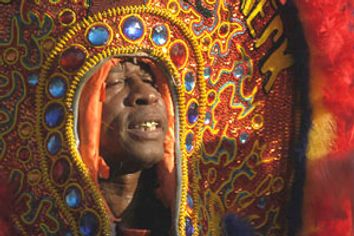
On Sunday afternoon in New Orleans’ Congo Square, Kevin Goodman, Big Chief of the Flaming Arrows, performed with fellow Mardi Gras Indians and musician Cyril Neville in a drum circle, part of a series of performances to bring healing to the city. The event was a memorial to the thousands who lost their lives in Hurricane Katrina or have died in the year since from illnesses and stresses associated with the disaster. Held on the spot where slaves once drummed and the Storyville neighborhood, leveled long ago, gave birth to jazz, the performers were joined by hundreds of the city’s residents in the grand New Orleans tradition of celebrating life while grieving loss.

Goodman’s Flaming Arrows, a tribe founded by his father, Therdot, marched the streets of New Orleans’ 7th Ward for more than 40 years. A lifelong resident of the city who worked as a house painter before the hurricane, Goodman has served as Big Chief for 16 years and had never missed a Mardi Gras. But a year after the storm breached the levees and flooded his neighborhood with 6 feet of water, Goodman, 46, is still living in Austin, Texas, where he was evacuated with literally nothing but the clothes on his back after surviving for days in harrowing conditions.

With people like Goodman gone, New Orleans’ unique culture remains at risk. Many of the neighborhoods that nurtured its wild creativity lie in ruin, their artists and musicians flung apart by the disaster. Goodman’s story also reflects the personal devastation and displacement experienced by so many following a natural disaster and a government failure of historic proportions.

“It still makes me angry when I think of the way we suffered,” Goodman says, his usually infectious smile falling away as he recalls the desperation of the many people who waited days to be rescued.

Everyone important in his life has been scattered across a thousand miles of the South, from San Antonio to Atlanta. Like so many other New Orleanians who loved their city but lived by modest means, he finds that Katrina continues to take a toll. In recent months, two members of Goodman’s family have died and another remains in critical condition in a Dallas hospital, all from illnesses that took a turn for the worse after exposure to toxic floodwaters and the stresses of dislocation.

The New Orleans that Goodman lost was 10 or so blocks of the 7th Ward, where he grew up, centered on the corner of Frenchmen and North Rocheblave streets. Places like the 7th Ward were the soul of a city defined by its patchwork of neighborhoods. Schools and churches, corner stores and bars, and extended families that went back for generations wove a network of support and survival, and were a source of the city’s culture and creativity.

“Even though New Orleans was ragged, it was beautiful to me,” Goodman said recently over a soul food dinner of country-style steak with gravy and butter beans, in his new south Austin apartment. “I know New Orleans like the back of my hand, every Indian and every Indian suit. I loved sewing, I loved masking, I loved singing and dancing — anything that went on with a tambourine and a drumbeat, I was there.”

Goodman believes that the New Orleans he knew will never recover and that, despite their deep ties, many survivors like him will not return. “The city was always about the rich getting richer and the poor getting poorer,” he says. “They didn’t care about us. I don’t want to live in a place where if a hurricane blows through again, then the ones with the money make it out and the ones who don’t get left to drown.”

While long in coming, signs of recovery are beginning to appear in the city’s devastated neighborhoods. New Orleans has reached nearly half its pre-Katrina population, and funds from huge federal block grants are finally arriving to help with the rebuilding. Among hurricane evacuees, Goodman is fortunate to have settled well into life in a new city, finding a warm welcome in Austin and new opportunities in his career as artist and musician. He says he will always be an Indian, and he has performed more in the past year than any other. But the scars of what he has lost may never heal.

After the levees were breached last August, Goodman and his family waded through the floodwaters and used a wood door to float the small children to a nearby church. Huddled with dozens of other survivors with little food or water, they were picked up the next day by some men from the neighborhood with a boat and taken to an I-10 overpass. By then the Superdome had been closed to additional evacuees. They hiked the elevated highway in hundred-degree heat, past unforgettable scenes of suffering. When they reached the drier ground of the Morial Convention Center, more disaster awaited them. They spent four days in the heat with little food and water, no toilets and no electricity. Around them, diabetics went into insulin shock, elderly people died in their wheelchairs, and bodies lay under sheets on the sidewalk.

“I couldn’t even take the smell on me, and everything around smelled worse than I did,” Goodman recalls. “I couldn’t eat — my stomach just shut down. I felt like I was losing my mind, but I knew I wasn’t. What was going on wasn’t supposed to be.” His brother Brian’s two grandchildren, 3-month-old twin girls, nearly died in Goodman’s arms from dehydration. Several times he had to wrap the twins in his body to keep them from being crushed by the crowds, which rushed the curbs expecting rescue buses every time headlights were seen coming down the street. On Saturday, a man was shot dead by police in front of Goodman and a crowd of hundreds. (Amid the wider chaos, the circumstances of the shooting of Danny Brumfield, 45, were disputed. Witnesses claimed he obstructed a police car in the street to plea for help. A statement released by the New Orleans Police Department last October said the shooting was in self-defense.)

“The cops just kept driving like nothing had happened — that was cold-blooded,” Goodman recalls. “What scared me the most was the way they shot like that toward the crowd, with thousands of people for blocks around. That was the straw that broke it for me. I was done. I didn’t care where I was going, as long as it was out of that place.”

Goodman has been back to visit his neighborhood several times in the last year. He found mostly empty streets, gutted houses and a few FEMA trailers.

“Before the hurricane, I could walk three blocks and see most of my family — grandmother, uncles, nieces, nephews, cousins, grandbabies, all of them being raised right there,” Goodman remembers. “I could go out my front door and see my people, the people who loved me — that’s what kept us together. Without the people like that, why should I be there?”

Family, and the art and music that became so important in his life, were woven tightly together. Goodman, an accomplished vocalist, percussionist and visual artist, learned the art of Mardi Gras Indian costuming and masking from his father, who founded the Flaming Arrows in 1963 and reigned for 20 years as “Big Chief Merk.” The fabulous hand-sewn “suits” of feathers, rhinestones and beads can cost $10,000 to make, weigh more than a hundred pounds, and take up to a year to create. Traditionally, a costume can be worn only once, and making a new suit every season is an extended community effort involving family, friends and neighborhood supporters.

During Mardi Gras, tribes take to the street with drumming, singing and dancing, and they stage elaborately choreographed standoffs with other Indian gangs. “We knew that on Carnival morning everybody in the neighborhood was going to be in front of our door, because they knew we were going to have the most beautiful costumes in the world,” says Goodman. “Our grandmothers and old people in the neighborhood looked forward to seeing us on Mardi Gras day. That’s what we did it for, but none of them are there anymore.”

Separated from his family when rescue finally came, Goodman’s art and music would become his lifeline in a new city. On the morning of Sept. 3, buses finally rolled into the convention center and helicopters began airlifting evacuees. The twins were rushed to a triage unit at the New Orleans airport and treated for dehydration. Goodman’s brother and his brother’s immediate family were flown to Dallas. After being airlifted by helicopter to the airport himself, Goodman boarded a plane before being told that he was going to Austin, a city he knew nothing about. A few hours later he was at Austin’s downtown convention center. The mayor shook the evacuees’ hands as they got off the bus. Strangers hugged them. “We had all the food we could eat and could take a shower anytime we wanted,” Goodman remembers.

Camped out at the convention center while the city made housing arrangements, Goodman and other evacuees started playing music on donated instruments. Among them was Kevin Bush, an old friend from the 7th Ward. Wheelchair bound after being paralyzed 10 years ago by a stray bullet, Bush had spent days after Katrina lashed to a rafter in his attic before being rescued. Cyril Neville had relocated to Austin and came by the convention center to join some jam sessions. During the second week, Goodman organized a second-line parade and made Bush his Second Chief for the Austin incarnation of the Flaming Arrows. Later that month, he joined Neville’s new Austin-based band, Tribe 13, for a performance at Antone’s, the famous downtown blues club.

“On a scale of 1 to 10, I’d say the reception we got here was a 10-plus — that’s kinda made me want to stay,” Goodman says. “The people here really enjoy our work and our costumes and our performances. They showed me the music scene here. In a lot of ways it’s like New Orleans.”

Goodman had lost everything in his New Orleans apartment, including sewing material worth thousands of dollars and two Indian suits considered priceless, but was able to send for two other suits that survived the flood at the Backstreet Cultural Museum in New Orleans’ Treme neighborhood. He’s had a full schedule since. In December, he joined several other Mardi Gras Indians for a tour sponsored by Jazz at Lincoln Center that went to India, Sri Lanka and the United Arab Emirates. He marched as Big Chief for Austin’s New Year and Mardi Gras celebrations and appeared at the annual South by Southwest music festival. “I never missed a Mardi Gras in 45 years and I didn’t miss it this year — I just did it here in Austin,” Goodman says. “I still have the Indian spirit that carries me everywhere I go. That gets me through whatever situation I’m in. Right now my focus is on making a new life in Austin.”

Two brothers in San Antonio are his closest family. His mother, sisters and two nieces are in Atlanta and are fine. But his brother Brian, who suffered a severe cut on his leg wading through hurricane debris, contracted meningitis, apparently from exposure to the flood waters. Goodman’s 16-year-old niece, Precious, who suffers from lupus and had undergone a kidney transplant less than a year before Katrina, lost all of her medications in the flood. A few days after their evacuation, she was hospitalized with kidney problems and lapsed into a coma after having surgery to remove her transplant. Under the stress of their displacement and their daughter’s deepening illness, Brian and his wife, Tina, began having more serious health problems of their own. Tina, 54, was hospitalized in the spring for congestive heart failure and died at a nursing home outside Dallas in May. Brian had a relapse of meningitis soon afterward and died following surgery, at the age of 50, in June. Precious remains on life support at the same Dallas hospital.

“She’s more like my daughter than my niece,” says Goodman, who is seeing a counselor in Austin to deal with his losses of the past year. “Precious and I were real close. When she was a girl she masked Indian with me as my queen. She was a happy person who loved to sing and dance. She had a hard time when she got sick and was missing so much school, being away from her friends. Then the hurricane happened.”

Goodman’s 6-year-old daughter, Kavonne, lives in New Orleans’ Gentilly neighborhood with her mother and stepfather, which keeps drawing Goodman back to the city for visits. In April he performed in a Mardi Gras Indian celebration at Jazz Fest, and returned again for the Congo Square appearance. Goodman hopes that he can continue the Indian tradition in Austin — but of course, he says, it’s not the same.

Many in New Orleans have vowed not to give up its ghost. On a recent Sunday night at Les Bon Temps Roule, an uptown club on Magazine Street, the Wild Tchopitoulous and Golden Comanche Indian gangs held a benefit to raise money for making new costumes for Mardi Gras 2007. “A lot of people lost their houses and aren’t back, but they’ll come back — eventually everyone will be back,” said Roderick Childers, Big Chief of the Wild Tchopitoulous, adding that Goodman would still have his place in the Indian pantheon if he returns. “I know Kevin, and he’s my man, and a man can do what he want to do, but the tradition and culture is here. You can go anywhere and costume and play, but it’s not going to be the same.”

Like everything else in New Orleans’ recovery, fortune has lain with higher ground. Most of the uptown tribes lived in neighborhoods that had much less flooding than downtown areas like Goodman’s in the 7th Ward.

“They say you can’t be an Indian anywhere else, but for a lot of us New Orleans isn’t the same place now either,” Goodman says. “We’re all scarred from Katrina. Some people want to come back, but there’s no affordable rental property, and everything is still so tore up. So a lot of people don’t have anything to come back to but bad memories.”

He wonders what life in New Orleans would be like without the neighbors he grew up with at Frenchmen and North Rocheblave.

“I keep thinking about Mrs. Marker,” says Goodman, recalling an elderly neighbor who helped raise him. “She wasn’t my blood relation, but she was like my grandmother to me. She told me, ‘Son, don’t hang out on that street corner. Son, don’t pick up no gun.’ All those elderly ladies out there at the Convention Center were Mrs. Marker to me. We were all brought up to respect these people, and that’s who raised us and taught us right from wrong. So where are we going to be now without them?”

Continue Reading Close

Locking out New Orleans’ poor

Almost a year after Katrina, public housing residents can't return home. Critics blame government negligence -- and hushed plans for big redevelopment.

  • more
    • All Share Services

Locking out New Orleans' poor

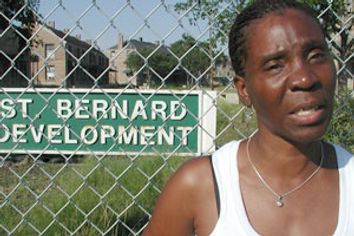
Sitting under a homemade banner reading “Survivors Village” strung between two light poles, former residents of New Orleans public housing have vowed to stay camped out on a traffic median in front of the abandoned St. Bernard development until officials from the U.S. Department of Housing and Urban Development offer a plan for reopening their apartments. While lawyers representing the displaced tenants plan to file a class action lawsuit against HUD later this month, the protesters, who set up their tent camp under a blazing sun the first weekend of June, say they will tear down a government-erected fence on July 4 and begin repairs themselves unless housing officials respond.

“Nobody wants to disrupt their lives by going to jail or getting hurt, but July 4 is do-or-die for us,” said Endesha Juakali, a housing activist and former St. Bernard resident who ran a community center and day care at the development. “These people have leases and they have been illegally evicted from their homes. We’re going in, we’re prepared for dozens of people to go to jail, and there’s no backing down on this.” Former tenants had threatened to tear down the fence the prior weekend, prompting a public plea from HUD Secretary Alphonso Jackson not to break the law or expose themselves to the dangers of mold and lead in the hurricane-damaged apartments.

The FEMA housing assistance that many hurricane evacuees have relied on to pay rent in other cities will expire on June 30. HUD officials say that former residents of public housing in New Orleans are eligible for the agency’s own disaster housing assistance program to continue receiving aid. “What they don’t seem to understand is that people want to come home to New Orleans,” said Juakali. “They don’t want to sign another lease in Houston or somewhere else.”

Ten months after the Katrina, at least 80 percent of public housing in New Orleans remains closed. Six of ten of the largest public housing developments in the city are shuttered, with the other four in various states of repair. Fewer than 1,000 of the 5,100 families who lived in the older housing developments before the storm have returned, according to the Housing Authority of New Orleans. HANO, as it is popularly know, has been under the direct control of HUD since going into federal receivership in 2002. Jackson announced last month that HUD would invest $154 million in rebuilding public housing in New Orleans, and that he would work with the city to bring displaced residents home. But critics say they see mismanagement and neglect echoing the disastrous government response in the early days of the catastrophe. And some fear that government officials and business leaders are quietly planning to demolish the old projects and privatize public housing.

Former tenants and housing activists say that many apartments that received minor to moderate storm damage could be quickly repaired, such as the second- and third-floor units at the St. Bernard development. With more than 3,000 people living there before the hurricane, St. Bernard was the largest public housing project in the city.

“Alfonso Jackson was not telling the truth when he said there’s lead in these apartments,” said Walter Smith, a 30-year employee of HANO who has been laid off since September. “I was one of the authority’s first lead inspectors and we don’t have lead paint in these buildings. As for mold, that’s what happens if you have a flood and don’t clean out your apartments for nine months. But mold was always a problem in St. Bernard before Katrina. People here learned to live with it.”

Lawyers representing displaced tenants plan to file a class action lawsuit against HUD and the housing authority, claiming that the agencies have failed in their responsibility to relieve the severe housing shortage in the city and help residents return. “Most of the people not being allowed back in had leases, and there are federal laws governing under what circumstance HUD can get people out of their homes and keep them out,” said Bill Quigley, director of the public law clinic at Loyola University and one of the lawyers working on the suit. “While the purpose of HUD is to get people into housing, since Katrina they have acted to keep people out. HANO has laid off a huge portion of their maintenance staff and focused on fencing off properties.”

Plagued for years by drugs and crime, and once the focus of an intense community policing program, public housing in New Orleans was far from an ideal home for the city’s poor. But activists and former tenants view the fences erected around St. Bernard and other developments starting in March as a clear sign that housing officials have no plans to reopen them.

“What we’re seeing is a push to privatize low-income housing in New Orleans, using Katrina as an excuse and River Garden as the model,” said Jay Arena, a housing activist. River Garden, a mixed-income redevelopment begun in the late 1990s, replaced the 1,500 housing units of the St. Thomas projects with more than 1,600 new apartments. In the end, only 120 apartments were designated for public housing at River Garden, with only about 40 occupied by low-income tenants to date. Both Jackson and Mayor Ray Nagin have praised River Garden as a model of how public housing in New Orleans should be rebuilt.

“HANO and HUD are playing a delay game with displaced tenants,” Arena said, “hoping that the longer they take to reopen public housing, the fewer tenants will come back.”

HUD officials contend that health and safety concerns prevent reopening St. Bernard. “Our first concern is always the well-being of our tenants, and our environmental studies have found the presence of mold in 90 percent of damaged public housing units in New Orleans,” said Donna White, a spokesperson with HUD’s public affairs department in Washington. “We also have a problem with the state of the neighborhoods where the developments are located. People have to have stores and schools and public transportation, and a lot of those services are not back yet.”

Housing activists and former HANO workers counter that HUD is overstating safety concerns. Marty Rowland, a civil engineer who volunteers for a local housing advocacy group, said he conducted an informal survey of five buildings at St. Bernard last winter and found that while the first floors had flooded, most second and third floors appeared to have little water damage. “There was flooding but no more so than other areas of Gentilly where buildings have been gutted and are being renovated,” Rowland said. “If you got electricity back, people could move back in on those floors in short order.”

Living in temporary housing in New Orleans or driving in from cities such as Baton Rogue, Houston and Atlanta, former tenants have organized in recent weeks to put pressure on federal and city housing authorities.

“I came back to New Orleans because this is where I want to be, but HANO is not giving us a chance,” said Stephanie Mingo, a former resident of St. Bernard who returned from Houston last week. Mingo lost her mother during Katrina and saved herself, two daughters and a grandchild by floating on a refrigerator to the nearby Interstate 10 overpass. Since last weekend she has been camping on the traffic median in front of the development.

“My kids are stressing and I’m stressing,” Mingo said. “Our young people are getting killed in Houston. Our elderly are getting sick and dying. I left on Thursday and I’m not going back to that place. We’ve offered to go into these apartments and clean up ourselves, but they don’t want to hear what we have to say.” Tens of thousands of evacuees moved into temporary housing in Houston last September. As the months have worn on, many say they now feel less than welcomed, and as outsiders, are facing more problems with crime than they did in New Orleans.

Taking on the feel of a homecoming block party with smoking barbecue grills and music thumping from a portable sound system, the protest at St. Bernard attracted a few dozen former tenants and a hundred supporters, including Rep. William J. Jefferson, whose district includes the 7th Ward. “You all have the right to return,” Jefferson told the crowd, calling on housing officials to reopen apartments that weren’t flooded, as soon as possible. (Jefferson is currently under investigation by federal officials in a bribery case that gained national attention.) “You’re not going to have a tourism industry here without your workers, and the folks that are out of town and want to come home kept this city going for years.”

According to the housing authority, 49,000 people lived in public housing before Katrina, 20,000 in older, large-scale developments such as St. Bernard, and 29,000 in Section 8 rental housing, which was also devastated by the storm. HANO had been dismantling traditional public housing for nearly a decade before the storm through Hope VI, a Clinton-era program that favors vouchers and mixed-income developments. Troubled for years by mismanagement, HANO itself was taken over in 2002 by a HUD reorganization team, which prior to the hurricane got good marks from many observers for reforming a housing authority considered one of the worst in the nation.

But since Katrina, HANO has been sharply criticized for its management and treatment of former residents. Tenants who had been evacuated to temporary housing across the country were notified by the authority last fall that they had until Dec. 31 to remove property from the apartments or their possessions would be thrown out, a deadline that was extended to Jan. 15 and then dropped. While no effort has been made to clean out or gut flooded buildings, the authority has spent hundreds of thousands of dollars erecting fences and installing steel plates on doors to close off the developments — though it only installed the new security months after hundreds of units had been ransacked and looted. Meanwhile, housing advocacy groups have filed a lawsuit against HANO for leasing units at River Garden to 35 of its employees and to 11 New Orleans police officers, despite an extensive waiting list for public housing tenants.

In Katrina’s aftermath, public officials in Louisiana have made some astonishingly frank comments. “We finally cleaned up public housing in New Orleans. We couldn’t do it, but God did,” Rep. Richard H. Baker, a Republican from Baton Rouge, was quoted as saying in the Wall Street Journal last September. Former New Orleans City Council president Peggy Wilson, a candidate in the recent mayoral election, declared that the city should keep out “pimps” and “welfare queens,” while City Council president Oliver Thomas, who is African-American, said that public housing should be for people who work, instead of for “soap opera watchers.”

Thomas, who later apologized for his comment, has proposed screening returning public housing tenants for work history and employability. “We have to build a working-class community that’s able to take care of themselves,” Thomas told New Orleans evacuees in Houston in March. “We’ve had three generations of poverty where people never expected to get better. If we have an opportunity to make it right and make it better, we should.”

Critics across the country as well as in New Orleans have called public housing a failed experiment that foments drug use, crime and poverty. Yet, before Katrina, crime was down at developments in New Orleans compared with previous decades. Data from the 2000 census showed that the majority of public housing residents in New Orleans worked. Employment among St. Bernard residents was 60 percent, while in the city overall 73 percent of residents had a wage-earning job or salary. (Residents of public housing also included many children, and tenants past retirement age.)

“I’m not going to say that public housing is the best thing in the world for people, or that we want it back exactly like it was, but this city is desperate for any kind of housing it can get right now, and we need to get as many viable units back on line as soon as possible,” said Laura Tuggle, a public interest lawyer who works on housing issues for New Orleans Legal Assistance. Tuggle cited a recent call from a personnel manager at Harrah’s Casino. “They had employees who lived in public housing and they want to get them back, but there’s nowhere for them to live now.”

After months in exile many former residents say they are desperate to return and are taking an increasingly confrontational approach with HANO. At a protest at St. Bernard in April, several HANO officials and a dozen police officers stood by as a hundred former residents and supporters forced open a gate on the new security fence and briefly reentered the complex. Gloria Irving, 70, a grandmother living in Houston, led the demonstrators by driving her motorized wheelchair through the line of police and HANO security guards. No arrests were made.

Later that month, HUD Secretary Jackson replaced HANO’s federal receivership team. At the first board meeting in May, Donald Babers, a career HUD official serving as the authority’s recovery adviser, and William Thorson, the new federal receiver, yielded the first hour and a half to public comment after being shouted down by former public housing residents. A similar scene played out at a recent meeting of the City Council’s housing committee, where residents demanded to know when HANO and HUD would present a schedule for reopening housing developments including St. Bernard. Officals for the agencies said they needed another 12 to 18 months to do assessments and develop a plan.

But housing advocates believe HUD already has plans, which the agency is refusing to make public. At the same City Council meeting, housing officials announced they were submitting 11 applications for low-income tax credits to the Louisiana Housing Financing Agency for rebuilding public housing. “If you go to the state agency asking for tax credits worth millions of dollars, you have to already have a plan for what you want to do,” said Tuggle. “As I understand it, Secretary Jackson seems to be making all of the decisions about New Orleans and the public here is not being told much.” Tuggle, who tracks housing issues closely, says she believes that “some pretty big redevelopment” is on the horizon.

While redevelopment could take decades, the old developments — some of which, like St. Bernard, were built as WPA projects in the late 1930s and early 1940s — were the social anchors of their neighborhoods and the only home many New Orleanians had ever known.

“I’m here today because my family lived here. We were born and raised in this place,” said Kenneth Simms, 34, a former St. Bernard resident who drove to New Orleans from Baton Rogue. “My older sister lived right over there, my other sister lived over there, my older brother over there, and my aunties lived in the back. There are hundreds and hundreds of people we know and love from here, and they want to come back and work. So what are we going to do?”

Jualaki, who ran the community center here, said he expects many displaced residents to return to the city this summer. He has joined with local ministers to create temporary housing in gutted-out churches.

“We’re preparing shelters for people. These are people who were in New Orleans doing minimum wage jobs and haven’t been able to come back,” said Juakali, who is living in a FEMA trailer parked in front of his hurricane-damaged house across the street from St. Bernard. “We’re expecting hundreds if not thousands to start coming home. What are we going to do with them? The city doesn’t have a plan. The state doesn’t have a plan. The feds don’t have a plan.”

Continue Reading Close