Bill Van Esveld

Israel relents on hunger striker Khader Adnan

But policy of detaining hundreds of Palestinians for years without charges remains in effect.

  • more
    • All Share Services

Israel relents on hunger striker Khader AdnanKhader Adnan

Khader Adnan may live to see his 34th birthday after all. He has been on hunger strike for 66 days to protest against his “administrative detention,” which allows the Israeli military to detain Palestinians without charge, indefinitely, on the basis of evidence the detainees are not allowed to see. Today, in the face of mounting pressure, Israel reportedly promised to release him in April if it could not discover any new evidence against him. His lawyer said that Adnan will end his strike.

Israeli, Palestinian and international rights groups have long said that Israel’s administrative detention practices are unlawful, but Adnan – whose hunger strike was the longest of any Palestinian prisoner –gained particular attention. Palestinian prisoners in Israeli jails and members of Palestinian political factions had gone on solidarity hunger strikes, and demonstrators in the West Bank, Gaza and in Tel Aviv called for Israel to end arbitrary administrative detentions. Security forces dispersed protests outside the Ofer military jail in the West Bank with rubber bullets and tear gas.

Minutes before the Supreme Court was scheduled to hear Adnan’s emergency appeal, according to a statement by his lawyer, Israel agreed to release him on April 17 unless it found new evidence of wrongdoing. Israeli authorities should immediately respect the fundamental due process rights of all administrative detainees, not just Adnan.

Today, more than 300 Palestinians are in administrative detention, some for four years or more, none of them charged with any crime. Israel says the Geneva Conventions allow it to detain Palestinians without charge for “imperative reasons of security,” but the convention’s official commentary states that “such measures can only be ordered for real and imperative reasons of security; their exceptional character must be preserved.”  In Israel’s case, the exception has become the rule.

Israel said that Adnan, for instance, is a member of Islamic Jihad, a banned Palestinian group whose armed wing has conducted deadly, illegal attacks against Israeli civilians, but no one told him or his family why armed soldiers arrested him at his home at 3:30 a.m. on December 17. “We have no idea why it happened,” his wife said.  Israel had arrested Adnan eight times over the years, but the only known “evidence” against him this time, his lawyer said, was that an interrogator accused him of participating in a graduation ceremony at a kindergarten supported by the banned group.

As of last week, Adnan’s wife estimated that he had lost a third of his body weight, and doctors said that even if he ended his hunger strike, his life could still be in doubt. The Israel Prisons Service transferred Adnan to a series of hospitals, but refused to allow him to meet in private with his doctor, lawyer or his family. His sister said that prison guards were stationed in Adnan’s hospital room and had been drinking juice and snacking in front of him, and had shackled him to his hospital bed.

Israel’s Supreme Court has ruled that the military may not use administrative detention as punishment but only as a preventive measure against suspected security threats. Yet in practice it is impossible to determine whether that rule is followed.  Because the military does not indict them for any particular offense, detainees are unable to defend themselves against specific charges. The standard of evidence is also lower than in a criminal proceeding – not proof “beyond a reasonable doubt,” but merely “reasonable grounds to assume” that the detainee might pose a security risk.  That malleable standard allows the military to detain Palestinians for indefinitely-renewable periods of up to six months, without any meaningful way to know whether genuine security threats are involved.

Further, Israeli military laws allow military judges to consider evidence against the detainee without allowing him or his attorney to see it, or even disclosing to them that it exists. Military prosecutors often justify the use of secret evidence on the basis that it comes from Palestinian collaborators whose lives could be endangered if the evidence were disclosed. Yet in practice, military courts do not even entertain alternatives that would give the semblance of balancing such concerns against due process rights, such as by redaction or partial disclosure of the confidential evidence.

According to the Israeli rights group Yesh Din, which has monitored hundreds of military court trials, “In practice, in most hearings on administrative detention the detainee is not aware of the content of the evidence against him, if any, and cannot defend himself.”

Administrative detention violates Israel’s human rights obligations to inform detainees promptly of the reasons for their arrest and of any charges against them. Israel, which seems to have partly recognized its due process obligations in Adnan’s case, should end the procedure immediately.

Israel's misguided crackdown strategy

To lower the risk of violence, the usual, get-tough response to Palestinian protests is the wrong approach

  • more
    • All Share Services

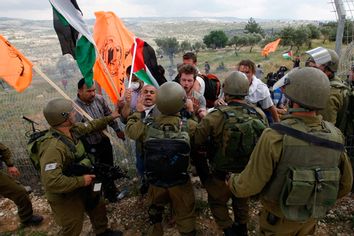
Israel's misguided crackdown strategyProtesters are forced back by Israeli security force officers in the West Bank village of Bilin.(Credit: Reuters/Mohamad Torokman )

The Israeli foreign minister Avigdor Liberman has said that he fears “tens of thousands” of Palestinians may demonstrate this month to support a Palestinian bid for upgraded United Nations status, and predicts “bloodshed on a scale we haven’t seen.” According to leaked documents, the military is preparing for “mass disorder” and has spent $22 million on crowd-control equipment, and issued orders to fire at the legs of any Palestinians who cross the “red lines” that it has demarcated around settlements.

But if Israel wants to lower the risk of violence around the expected U.N. vote, its usual, get-tough response to Palestinian protests is the wrong approach. Instead, it should start by meeting its legal obligation to respect freedom of peaceful assembly and expression in the occupied territories.

Israeli military orders in the West Bank have effectively banned even peaceful protests. Any gathering of 10 or more people, even in a private home, about “a political matter or one liable to be interpreted as political,” is prohibited without a military permit, on pain of up to 10 years in prison. The Israeli military commonly imposes “closed military zones” on Palestinian villages that seek to hold demonstrations, restricting access to the villages for up to six months at a time.

The military has also repeatedly subjected Palestinian advocates of peaceful protests to arbitrary arrests, abusive military prosecutions and unfair trials. In 2009, for instance, the Israeli military arrested Mohammed Khatib, a protest organizer from the village of Bil’in who had called for nonviolent protests against the confiscation of village lands by Israel’s separation barrier. The military charged him with throwing stones at a demonstration in 2008. Khatib’s passport showed, though, that he was on the Pacific island of New Caledonia at that time. He was released on condition that he present himself at a police station at the time of weekly protests, effectively barring him from participating. In 2010, the military detained him again and charged him with “incitement.” Security services justified the detention on the grounds that “incitement materials” were confiscated at his home, but the materials proved to be records of his trial, his lawyer said.

Not all Palestinian protesters are nonviolent. Youths frequently throw stones at Israeli forces. And there is no question that Israel may treat violence as a criminal offense and that its security forces may use lawful force as necessary to protect themselves and others.

But scores of witness accounts and videos over the years have shown Israeli troops shooting, firing tear gas and throwing concussion grenades at Palestinian protesters who were clearly peaceful and posed no risk to life or property. In another Bil’in case, for example, the Israeli rights group B’Tselem collected videos and other evidence showing that in April 2009, a soldier killed Bassem Abu Rahme by firing a high-velocity tear-gas canister directly at him from 30 meters away, and that he had not thrown stones, damaged the separation barrier or otherwise endangered soldiers. A military investigation into his death is ongoing.

The head of the Israeli military’s Central Command told U.S. officials in February 2010 that he “did not know what [the demonstrations] were about” but felt that Palestinian villagers “were only demonstrating because they were told to do so” by “suspicious people,” according to a leaked diplomatic cable. The cable’s subject was “IDF Plans Harsher Methods with West Bank Demonstrations.” It is hard to see how such methods lower the risk of violence, especially when used against advocates of peaceful protests.

Israeli authorities should instead show the same respect for the freedom of peaceful assembly in the West Bank as they do in Israel itself. Israeli demonstrators need no permits for demonstrations of up to 50 people, and the police must grant permit requests for larger demonstrations unless there is “near certainty” of harm to the public. Police have not declared protest areas in Israel to be “closed zones” or violently suppressed peaceful demonstrators there. Activists who organized three of the “tent protests” that sprang up across Israel after July to protest spiraling housing costs told Human Rights Watch that they had failed to obtain the required permits, but police allowed the protests to go ahead.

Contradicting fears of bloodshed around the Palestinian initiative at the United Nations, a recent Israeli intelligence briefing said that while some West Bank Palestinians may protest, they do not want violence, Haaretz reported. But whatever Israeli forces’ views of Palestinian protests, Israel should revoke the military laws and end the prosecutions that penalize Palestinians for holding even peaceful demonstrations, and change Israel’s approach to using force against nonviolent protesters. 

Continue Reading Close