Bouazza Ben Bouazza

Tunisia to extradite ex-Libyan prime minister

  • more
    • All Share Services

TUNIS, Tunisia (AP) — Tunisia’s Justice Ministry says it will extradite former Libyan Prime Minister Al-Baghdadi Al-Mahmoudi — currently being held in Tunis — back to Libya.

Official Mondher Bedhiafi told The Associated Press on Tuesday that Al-Mahmoudi’s extradition will take place in the coming weeks.

Al-Mahmoudi was arrested last September in southern Tunisia for crossing the border, en route to Algeria, without permission from Tunisian authorities.

Several international organizations including Human Rights Watch have spoken out against the extradition because of the perceived risks involved.

Al-Mahmoudi was the last head of government under former Libyan dictator Moammar Gadhafi, who was killed last year.

Islam won’t be basis of new Tunisian constitution

  • more
    • All Share Services

Islam won't be basis of new Tunisian constitutionThe leader of the Islamist Ennahda Party, Rached Ghannouchi, delivers a statement in Tunis, Monday, March 26, 2012. Islamic law will not be enshrined in Tunisia's new constitution, preserving the secular basis of the North African nation, Tunisia's ruling Islamist Ennahda Party said Monday.The decision marks a break between the moderate Islamist Ennahda and an increasingly vocal minority of ultraconservative Muslims known as Salafis who have been demanding Islamic law in a country long known for its progressive traditions. (AP Photo/Hassene Dridi)(Credit: AP)

TUNIS, Tunisia (AP) — Islamic law will not be enshrined in Tunisia’s new constitution, preserving the secular basis of the North African nation, Tunisia’s ruling Islamist Ennahda Party said Monday.

The first article of the new constitution would remain the same as in the 1959 version and it will not call for Shariah, Islamic law, to be the source of all legislation, as many conservatives had wanted.

The decision marks a break between the moderate Islamist Ennahda and an increasingly vocal minority of ultraconservative Muslims known as Salafis who have been demanding Islamic law in a country long known for its progressive traditions.

“We do not want Tunisian society to be divided into two ideologically opposed camps, one pro-Shariah and one anti-Shariah,” said Rachid al-Ghannoushi, the founder of the Ennahda Party in a press conference. “We want above all a constitution that is for all Tunisians, whatever their convictions.”

He added that in his opinion, 90 percent of Tunisia’s existing legislation was already in line with the precepts of Islamic law.

Ziad Doulatli, another party leader, told The Associated Press that decision was taken so as to “unite a large majority of the political forces to confront the country’s challenges.”

“The Tunisian experience can serve as a model for other countries going through similar transformations,” he added.

In Egypt, as well as many other Muslim countries, Shariah is enshrined in the constitution as the source of all legislation.

Under more than 50 years of secular dictatorship, Tunisia stood out in the Arab world for its progressive laws, especially regarding the status of women. Many leftists and liberals feared this would be rolled back with the victory of an Islamist party at the polls.

Ennahda, however, has always pledged to maintain the character of the state and formed a coalition government with two secular parties.

The decision, however, is bound to provoke a backlash from the Salafis — some 10,000 of whom demonstrated Sunday in Tunis, the capital, calling for Islamic law.

Despite their numerous demonstrations, the degree of support that the Salafis have from the broader Tunisian society is not clear. Ennahda’s decision to spurn their demands suggests they do not have widespread appeal.

The first article of Tunisia’s constitution states that “Tunisia is a free, sovereign and independent state, whose religion is Islam, language is Arabic and has a republican regime.”

Tunisians overthrew their dictatorship in a popular uprising last year that inspired pro-democracy movements across North African and the Middle East.

In October, they elected a new assembly to govern as well as write the country’s new constitution. Secular and Islamist groups have been holding demonstrations to influence the new document.

According to Fadhel Moussa of the leftist Democratic Modernist Axis, the agreement on the first article settles a long debate in the assembly and opens the way to creating the rest of the new constitution.

Continue Reading Close

Tunisians Call For End To Campus Veil Standoff

  • more
    • All Share Services

TUNIS, Tunisia (AP) — Around 200 students and professors demonstrated in Tunisia’s capital on Wednesday calling for an end to the standoff by ultraconservative Muslims at a nearby university.

For more than a month classes and exams at Manouba University’s humanities department have been put on hold by a sit-in demanding students be allowed to attend class in the conservative face veil, known as the niqab.

“Science before the niqab,” and “no to shackles, no to niqab, knowledge is free,” read the signs of the demonstrators, who urged the minister of higher education to resolve the dispute so that classes could resume.

University policy prevents students from covering their faces during class.

The sit-in has been the latest crisis faced by Tunisia since it overthrew its long-serving dictator last year, who had aggressively promoted secular policies.

In his absence there has been a resurgence of ultraconservative Muslims known as Salafists, who are seeking a greater role for Islam in public life.

The department’s dean, Habib Kazdaghli, attended the protest and said that the people blocking classes weren’t even university students.

Kazdaghli said the Salafists attacked him and prevented him from going to his office.

“The people not from the department should leave the premises and they represent a majority of those at the sit-in,” he said, calling for the police to clear out the conservatives so classes could resume.

The actions by the Salafists, including calls for more public prayer, have put the new Tunisia government, headed by a moderate Islamist group, in an awkward position.

The governing moderate Islamist Ennahda Party originally did not speak out against the actions of the Salafists, but subsequently has condemned any violence or interruption of classes.

Continue Reading Close

Tunisia’s ex-president goes on trial in absentia

If convicted, Ben Ali faces five to 20 years in prison for each offense

  • more
    • All Share Services

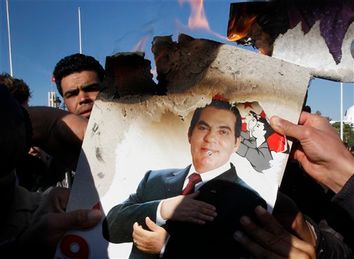
Tunisia's ex-president goes on trial in absentiaFILE - In this Monday, Jan. 24, 2011 picture, protestors burn a photo of former Tunisian President Zine El Abidine Ben Ali during a demonstration against holdovers from Ben Ali's regime in the interim government in Tunis, Tunisia. Tunisia's former autocratic leader whose downfall triggered uprisings in the Arab world has condemned his upcoming trial in absentia in Tunis as a "shameful masquerade." Ben Ali - in exile in Saudi Arabia - also said Sunday, June 19, 2011 in a statement from his French lawyer that he didn't flBeee Tunisia but left to avoid "fratricidal and deadly confrontations." (AP Photo/Christophe Ena, File)(Credit: AP)

Tunisia’s former autocratic ruler, whose ouster triggered a series of Arab world uprisings, went on trial in absentia Monday in the first of what will likely be a long series of court proceedings five months after he went into exile.

The Tunis Criminal Court is hearing two embezzlement, money laundering and drug trafficking cases against Zine El Abidine Ben Ali. It follows the discovery of around $27 million in jewels and cash plus drugs and weapons at two palaces outside Tunis after he flew to Saudi Arabia on Jan. 14.

Ben Ali, 74, vigorously denied the charges in a statement through his French lawyer, calling the proceedings a “shameful masquerade of the justice of the victorious.”

Five public defenders have been assigned to Ben Ali and his wife, Leila Trabelsi, who is accused in one of the two cases in Monday’s trial. Tunisian law prohibits a foreign lawyer from defending a client in absentia, judicial officials said, meaning French lawyer Jean-Yves Le Borgne cannot take part in proceedings.

Saudi Arabia did not respond to an extradition request, and some Tunisians expressed frustration that he would not be present for his judgment. A verdict could come later Monday.

Ben Ali and his wife are charged in the discovery of a trove of valuable jewels and cash in Tunisian and foreign currency at a palace in a village north of Tunis. Images of the cache shown on TV after the discovery shocked Tunisians.

The second case surrounds the seizure of arms and drugs at the official presidential palace in Carthage during a search by a commission investigating abuse of authority formed after Ben Ali’s departure. He faces charges of possessing and trafficking drugs, detention of arms and munitions and failing to declare archaeological works also found at the palace.

If convicted, Ben Ali faces five to 20 years in prison for each offense.

More serious charges, including plotting against the security of the state and murder, will be dealt with at future trials. Judicial authorities say that Ben Ali and his entourage are implicated in 93 civil cases and 182 others that fall under military jurisdiction.

In the statement released by Le Borgne, Ben Ali “vigorously denies” accusations against him, saying he never had huge sums of money and claiming most of the weapons found were gifts from visiting heads of state.

“As for the drugs allegedly found, that is a lie and an ignominy … It is absurd and defamatory,” the statement from the lawyer said. The trial has “no goal but to accuse yesterday’s president.”

“I devoted my life to my country and aspire, at the twilight of my existence, to conserve my honor,” Ben Ali said in the statement.

Backed by his powerful party that controlled all sectors, Ben Ali governed with an iron fist, suppressing dissent and quashing all freedom of expression. An official for the Ministry of State Domains, Mohamed Adel Ben Ismail, evaluates the fortune amassed by Ben Ali and the powerful Trabelsi clan of his widely detested wife at a quarter of the value of the Tunisian economy.

In power for 23 years, Ben Ali’s regime unraveled with a monthlong uprising around the country triggered by the fatal self-immolation of an unemployed man in the rural heartland. That sparked protests that moved through the countryside to Tunis, the capital, and failed to die down despite concessions from the president. In a surprise move, he left for exile.

Ben Ali denied that he fled Tunisia, saying he left to avoid “fratricidal and deadly confrontations” among Tunisians. The statement said he would clarify the circumstances of his departure at an appropriate time.

Continue Reading Close

Libyan oil minister withdraws from government

Defection a blow to to the Gadhafi regime

  • more
    • All Share Services

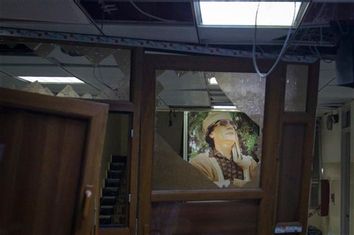
Libyan oil minister withdraws from governmentIn this photo taken on a government organized tour, a poster of Libyan leader Moammar Gadhafi is seen in a damaged official building following an airstrike in Tripoli, Libya, early Tuesday, May 17, 2011. (AP Photo/Darko Bandic)(Credit: AP)

Libya’s oil minister defected and fled to Tunisia, a Tunisian security official said Tuesday, one of the highest profile figures to abandon Moammar Gadhafi’s government.

Shukri Ghanem, the head of the National Oil Co. and Libya’s oil minister, crossed into Tunisia by road on Monday and defected, the Tunisian official said. The official, based in the region around the Ras Jdir border crossing, spoke on condition of anonymity because he was not authorized to speak to the media.

Ghanem is one of the most prominent members of Gadhafi’s government to leave amid fighting between the military and rebels seeking to end Gadhafi’s more than 40-year rule.

Others who have defected include Foreign Minister Moussa Koussa, one of Gadhafi’s earliest supporters; Interior Minister Abdel-Fatah Younes; Justice Minister Mustafa Abdul-Jalil, and Ali Abdessalam Treki, a former U.N. General Assembly president. A number of ambassadors and other diplomats also have resigned their posts.

A NATO-led campaign — authorized by the United Nations — is enforcing a no-fly zone over the country and launching airstrikes to try to protect civilians from attacks by Gadhafi’s forces.

Early Tuesday, NATO jets pounded two government buildings in the Libyan capital, including the Interior Ministry, setting them on fire. A government spokesman suggested that the ministry was targeted because it contained files on corruption cases against senior members of the Benghazi-based rebel leadership.

In Geneva, meanwhile, the U.N. refugee agency said Tuesday that Libyan authorities appeared to be encouraging African migrants to board unseaworthy boats bound for Europe.

Melissa Fleming, a spokeswoman for the U.N. High Commissioner for Refugees, told reporters that the Libyan conflict has opened up a route for migrants that was closed for two years because of an agreement between Libya and Italy.

Already some 14,000 people — mostly from sub-Saharan Africa — have used Libya as a springboard to reach Europe, and thousands more are poised to make the treacherous sea journey in the coming weeks as weather conditions in the Mediterranean improve.

“The authorities (in Libya) are not discouraging, at all, in fact there may be signs that they are encouraging these boat journeys,” she said.

Some are migrants fleeing the fighting in Libya, but others appear to be crossing into Libya from elsewhere in Africa because it is easier to get onto smugglers’ boats there.

Ghanem, the latest minister to defect, had been at odds with the Gadhafi regime before, basically losing his post for a while in 2009 as two of Gadhafi’s sons differed on the direction the country should take in reforming its political and economic systems. His resignation was seen, at least in part, as linked to the creation of a new superstructure governing the nation’s oil sector, with the new agency designed to replace one he supported.

Before assuming the oil ministry’s portfolio, Ghanem served for around three years as prime minister at a time when Libya was emerging from under the cloud of more than a decade of international sanctions.

Ghanem is among Gadhafi government officials under U.S. sanctions announced by the Treasury Department in early April.

Abdel Moneim al-Houni, a former Libyan Arab League representative who was among the first wave of Libyan diplomats to defect, confirmed that Ghanem had defected but said no official announcement has been made out of concern for the safety of family members who are still in Tripoli. Al-Houni said that he spoke to Ghanem after he crossed the border.

“Most of the officials remaining in Tripoli are forced to stay under intimidation and pressure. They are not happy with what is happening,” Al-Houni told the AP.

Guma El-Gamaty, London-based spokesman for the Libyan opposition’s Interim National Council, said “all what we know is that Shukri Ghanem is in Tunisia.”

NATO has stepped up strikes on the Libyan capital Tripoli, and one of the buildings hit early Tuesday was used by the Interior Ministry, which is responsible for internal security.

Libyan spokesman Moussa Ibrahim suggested the ministry was targeted because it contained files on rebel leaders in Benghazi, the de-facto capital of the eastern half of the country, which is under opposition control.

“If they (NATO) are really interested in protecting civilians … then we call upon them to stop and start talking to us,” Ibrahim said.

In Moscow, Russia’s foreign minister on Tuesday urged Libya’s government representatives to allow the delivery of humanitarian aid.

Minister Sergey Lavrov says that Gadhafi’s representatives reiterated their willingness to consider a peace plan tabled by the African Union that called for an immediate cease-fire and dialogue between the government and the rebels. The rebels have rejected that plan.

The meeting follows a Monday visit to Moscow by the United Nations special envoy for Libya.

Bouazza ben Bouazza reported from Tunis, Tunisia. Associated Press reporters Maggie Michael and Tarek el-Tablawy contributed from Cairo, Egypt.

Continue Reading Close

New Tunisian gun fight, new leader

Central city violence delivers another interim president

  • more
    • All Share Services

New Tunisian gun fight, new leaderA supermarket is on fire after it was sacked and looted in Bizerte, Tunisia, Saturday, Jan. 15, 2011. The Tunisian capital's main train station has been burned to the ground, and shops have been sacked and looted in violence that came after the North African nation's president fled the country.(AP Photo/Hassene Dridi)(Credit: AP)

Soldiers and police have exchanged fire with assailants in front of Tunisia’s Interior Ministry amid unrest after the longtime president was ousted.

Associated Press reporters saw the shootout Saturday that left two bodies on the ground on a big square in central Tunis. It was not clear whether the two were dead or injured, or who they were.

Snipers could be seen lying down on top of the ministry’s roof.

The exchange came soon after Tunisia swore in a new interim president on Saturday. The country has been grappling with looting, deadly fires and widespread unrest after protests forced President Zine El Abidine Ben Ali to flee on Friday.

THIS IS A BREAKING NEWS UPDATE. Check back soon for further information. AP’s earlier story is below.

TUNIS, Tunisia (AP) — Tunisia swore in a new interim president on Saturday — the second change of power in this North African nation in less than 24 hours — and grappled with looting, deadly fires and widespread unrest after protests forced its longtime leader to flee.

At least 42 inmates were killed in two prison fires Saturday, looters emptied shops and torched the main train station and gunfire echoed through the capital.

The interim president — Fouad Mebazaa, the former president of the lower house of parliament — ordered the creation of a unity government that could include the opposition, which had been ignored under President Zine El Abidine Ben Ali’s 23 years of autocratic rule. Ben Ali fled the country Friday for Saudi Arabia following a popular uprising and deadly riots.

Anger over corruption and a lack of jobs and civil liberties ignited a month of protests, but Ben Ali’s departure — a key demand of demonstrators — did not quell the unrest. While the protests were mostly peaceful, after Ben Ali’s departure rioters burned the main train station in Tunis and looted shops.

Mebazaa, in his first move after being sworn in, seemed intent on reconciliation and calming tensions. In his first televised address, he said he asked the premier to form a “national unity government in the country’s best interests” in which all political parties will be consulted “without exception nor exclusion.”

The leadership changes came at a dizzying speed. Ben Ali left abruptly Friday night and his longtime ally, Prime Minister Mohammed Ghannouchi stepped in briefly then with a vague assumption of power that left open the possibility that Ben Ali could return. But on Saturday, Constitutional Council President Fethi Abdennadher declared the president’s departure was permanent and gave lawmaker Mebazaa 60 days in which to organize new elections. Hours later, Mebazaa was sworn in.

It was unclear who might emerge as the main candidates in a post-Ben Ali Tunisia: The autocratic leader has utterly dominated politics for decades, placing his men in positions of power and sending opponents to jail or into exile.

It was also not clear how far the 77-year-old Mebazaa would go to invite the opposition into the government. He is a political veteran who has been part of the ruling apparatus for years, including leading parliament for two decades.

Ben Ali’s downfall sent a potentially frightening message to autocratic leaders across the Arab world, especially because he did not seem especially vulnerable until very recently. For ordinary people, the unrest that followed his departure was frightening.

A fire at a prison in the Mediterranean coastal resort of Monastir killed 42 people, coroner Tarek Mghirbi told The AP on Saturday. The cause of the fire was not immediately clear. Witnesses said another deadly fire also broke out at a prison farther down the coast, in Mahdia, but the exact number of deaths was not yet known.

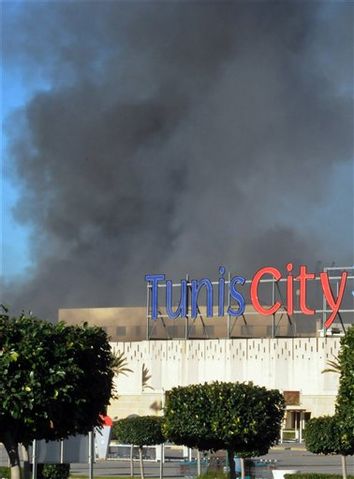
Sporadic gunfire was heard in the capital of Tunis on Saturday. Black smoke billowed over a giant supermarket as looters torched and emptied it. An Associated Press photographer saw soldiers fire warning shots and try to stop looters from sacking the supermarket in Ariana, north of the capital, to no avail. Shops near the main bazaar were also looted.

A helicopter circled low over the capital, apparently acting as a spotter for fires or pillaging.

Public television station TV7 broadcast phone calls from residents of working-class neighborhoods on the capital’s outskirts, describing attacks against their homes by knife-wielding assailants.

“This isn’t good at all. I’m very afraid for the kids and myself,” said Lilia Ben Romdhan, a mother of three in outer Tunis. “If (he) had stayed in the country it would be better.”

Kamel Fdela, selling oranges and bananas in the neighborhood, said he wants democracy but was worried about whether that would come to pass. He also feared potential food shortages with store closed amid the chaos.

“God willing, a real man will take over,” he said.

Tunisian airspace reopened Saturday, but some flights were canceled and others left with delays. Thousands of tourists were still being evacuated from the Mediterranean nation known for its sandy beaches, desert landscapes and ancient ruins. Tour operator Thomas Cook’s German subsidiary sent home 200 tourists from Tunisia on Friday, but 1,800 were still waiting to be flown out.

President Barack Obama said he applauded the courage and dignity of protesting Tunisians, and urged all parties to keep calm and avoid violence.

Saudi King Abdullah’s palace confirmed Saturday that the ousted president and his family had landed in Saudi Arabia, saying the kingdom welcomed him with a wish for “peace and security to return to the people of Tunisia.”

It did not give Ben Ali’s exact whereabouts, but a source inside the kingdom said he was in the small city of Abha, about 310 miles (500 kilometers) south of Jeddah. The source said Ben Ali had been taken there to avoid sparking any possible demonstrations by Tunisians living in the larger, seaside city of Jeddah. He spoke on condition of anonymity because of the sensitivity of the matter.

Ben Ali managed the economy of his small country of 10 million better than many other Middle Eastern nations grappling with calcified economies and booming young populations. He turned Tunisia into a beach haven for European tourists, helping create an area of stability in volatile North Africa. There was a lack of civil rights and little or no freedom of speech, but a better quality of life for many than in neighboring countries such as Algeria and Libya.

Ben Ali won frequent praise from abroad for presiding over reforms to make the economy more competitive and attract business. Growth last year was at 3.1 percent.

Unemployment, however, was officially 14 percent but actually far higher — 52 percent — among the young. Despair among job-seeking young graduates was palpable.

The riots started after an educated but jobless 26-year-old committed suicide in mid-December when police confiscated the fruits and vegetables he was selling without a permit. His desperate act hit a nerve, sparked copycat suicides and focused generalized anger against the regime into a widespread, outright revolt.

Arabs across the region celebrated news of the Tunisian uprising on Twitter, Facebook and blogs. Thousands of tweets congratulating the Tunisian people flooded the Internet, and many people changed their profile pictures to Tunisian flags.

Egyptian activists opposed to President Hosni Mubarak’s three-decade regime looked to the events in Tunisia with hope. About 50 gathered outside the Tunisian Embassy in Cairo to celebrate, chanting “Ben Ali, tell Mubarak a plane is waiting for him, too!”

Ben Ali, 74, came to power in a bloodless palace coup in 1987. He took over from a man formally called President-for-Life — Bourguiba, the founder of modern-day Tunisia who set the Muslim country on a pro-Western course after independence from France in 1956.

Ben Ali consistently won elections with questionable tallies: In 2009, he was re-elected for a fifth five-year term with 89 percent of the vote.

U.S. diplomatic cables recently released by WikiLeaks called Tunisia a “police state” and described the corruption there, saying Ben Ali had lost touch with his people. Social networks like Facebook helped spread the comments to the delight of ordinary Tunisians, who have complained about the same issues for years.

——

Nicolas Garriga, Oleg Cetinic in Tunis, Hassan Ammar in Doha, Qatar and Angela Doland in Paris contributed to this report.

Continue Reading Close

Page 1 of 2 in Bouazza Ben Bouazza