Bradley K. Martin

A history of threats fulfilled

North Korea has long followed through on revenge fantasies, making its current blustering all the more worrisome

In this Sunday, April 15, 2012 photo, a North Korean vehicle carrying a missile passes by during a mass military parade (Credit: AP Photo/David Guttenfelder)
This piece originally appeared on GlobalPost.

FAIRBANKS, Alaska — History offers some guidance on what to expect as North Korea threatens to ”wage a sacred war” against the South Korean government and its supporters. In all the decades since the June 25, 1950, start of the Korean War, the North has not repeated its all-out invasion of the South.

Global Post

That would be more reassuring if the regime had not repeatedly shown its determination to avoid coming across as a habitual bluffer, a paper tiger.

In separate incidents in 2010, after issuing dire threats of “revenge,” it did indeed sink the South Korean naval ship Cheonan and shell the South’s Yeonpyeong Island.

Although short of all-out war, both of those attacks — like others earlier such as the 1968 capture of the U.S. Navy spy ship Pueblo — were major and deadly provocations.

The government of South Korean President Lee Myung Bak and conservative South Korean news media organizations, the two groups specifically targeted by the latest threats, will need to be vigilant.

The current rhetoric stems from North Korea’s resentment of South Korean comments showing contempt for a huge and lengthy celebration commemorating the late North Korean founding dictator Kim Il Sung’s 100th birthday, which was April 15.

The centerpiece of the celebration was to be a rocket launch — supposedly putting a satellite into orbit. In the view of South Korea and the United States, it was a test of the North’s developing missile technology. In a major humiliation, the launch fizzled. Taking note of that, South Korean government and media comments also questioned the priority that the North throughout its history has given to circuses over bread, and guns over butter.

“Traitor Lee Myung Bak,” the North’s Foreign Ministry spokesman complained in a statement issued Sunday, “let loose a string of such malignant invectives that can be uttered only by a shark — that the North might spend a ridiculous amount of money for the celebrations of the centenary of the birth of President Kim Il Sung, and that the amount of fund[s] would be enough to buy a large quantity of food.”

In fact, in an April 16 radio address Lee estimated that the regime could have used the money it spent on the birthday bash to buy a six-year supply of corn for its perennially hungry population.

Because Lee and his supporters desecrated a holiday so sacred it amounted to “the great jubilee in human history,” the North’s military and civilians alike “are shaking with irrepressible resentment,” the ministry’s statement said. “They are now eagerly waiting for the issue of an order so that they may mercilessly punish the traitor.”

If there is reason to hope nothing will come of the current threats it is that phrase about waiting for “an order.”

On Friday, the regime packed Pyongyang’s Kim Il Sung Square with neat rows of tens of thousands of soldiers and civilians crying passionately for the blood of Southerners. Spokespersons for various groups in the North were quoted as saying that new leader Kim Jong Un had only to give the order and they would follow.

In other words, as has happened quite a few times over the decades, the gigantic weapon of a furious army and people has been cocked, and this time it is up to Kim — a 20-something grandson of Kim Il Sung — to pull the trigger by issuing the order to go ahead if he chooses to do so.

Not mentioning that crucial element of awaiting an order, though, was a message Monday from a unit of the military called the “special operation action group,” which warned that “the special actions of our revolutionary armed forces will start soon to meet the reckless challenge of the group of traitors.”

“Targets are the Lee Myung Bak group of traitors, the arch criminals and the group of rat-like elements including conservative media destroying the mainstay of the fair public opinion,” said the statement, released by the North’s Korean Central News Agency. (A search of KCNA articles published since January 1996 found no other mention of a special operation action group.)

“Once the above-said special actions kick off, they will reduce all the rat-like groups and the bases for provocation to ashes in three or four minutes,” the statement said. The actions will employ “unprecedented peculiar means and methods of our own style. Our revolutionary armed forces do not make empty talk.”

Among grievances the special operation action group mentioned were South Korean military boasts last Thursday that the South’s newest missiles can reach any part of North Korea — including, in the words of the North’s statement, “striking the supreme headquarters through an office window.”

The announcement included a media target list, for involvement in a campaign to “build up public opinion in favor of the rats’ group.”  The list included broadcasters KBS, MBC and YTN, as well as national daily newspaper Dong-A Ilbo, which it pointedly noted has its headquarters in downtown Seoul.

Dong-A Ilbo explained that what put the newspaper atop the list was an April 17 article quoting a South Korean intelligence source on the results of reading Kim Jong Un’s lips as the young leader spoke with three senior military brass. The lip reading was done from a telecast by North Korea’s Central TV station showing the four reviewing a military parade on April 15.

The paper doesn’t come out and say so, but some of Kim Jong Un’s quotations make him appear like a kid playing under the Christmas tree with his new toys. He “smiled whenever vehicles with ballistic missiles passed, including the new long-range missile, and said, ‘Great. Great.’”

The threatened special actions are supposed to be unprecedented. That would seem to rule out another missile or nuclear test (although either or both could be in the cards separately) or an assassination raid on South Korea’s presidential Blue House, as was attempted in 1968. Since Kim Jong Un’s image polishers have attempted to portray him as info-tech-savvy, a cyber attack seems one strong possibility — although in that case the threatened “ashes” might be figurative.

Meanwhile, whether it follows through with this particular threat or not, the multitasking regime probably has succeeded at least for the time being in distracting a great many of its subjects from grinding poverty and official repression and corruption, channeling their anger away from manifest policy failures and toward external enemies.

Behind North Korea’s tears

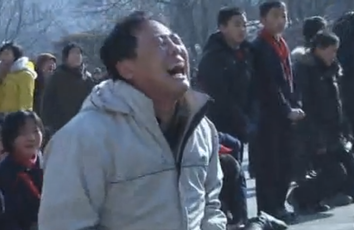
Culture, coercion and fear for the future explain the extreme displays of grief over Kim Jong Il's death VIDEO

Screengrab of a video from the nation's government propaganda mouthpiece, the Korean Central News Agency
This article originally appeared on GlobalPost.

FAIRBANKS, Alaska — North Koreans videotaped after hearing the news of ruler Kim Jong Il’s death appeared to go berserk with grief. There are several explanations for this — by no means all of them involving sincere love for the notoriously self-centered dictator.

Global Post

First there’s Korean culture. Koreans are noted for being emotionally demonstrative at such times. It’s the thing to do.

Take the case of South Korean President Park Chung Hee, who resisted intense popular pressure that he step down after 18 years as military-backed dictator. In 1979, his intelligence chief shot him to death.

Although Park had drastically overstayed his welcome with the South Korean people, he got a noisy, tearful sendoff. Along the route of his Seoul funeral procession women, especially, outdid themselves in screaming, wailing and shaking their fists at heaven.

Second, the footage of mourners for Kim Jong Il appears to have been shot mainly or entirely in Pyongyang, the capital.

Only certified Kim family loyalists are allowed to live in Pyongyang, where housing and food supply are better than in the provinces. In some of the more benighted provinces people live in slum conditions, lack the facilities for basic hygiene and suffer malnutrition, even starvation.

The South Korean magazine Weekly Chosun reported in October that it had obtained a list of 2,108,032 Pyongyang residents compiled in 2005 by State Security, a secret police organization. Of those capital residents, about 830,000 were members of the ruling Workers’ (communist) Party and most of the rest were their family members or prospective party members, the publication suggested, adding that there are only about 2 million party members in the entire country.

Pyongyang dwellers tend to see themselves as having a vested interest in maintenance of the Kim family regime. Defector reports suggest that many of them had few illusions about Kim Jong Il, considering him a leader far inferior to his late father.

Still, it could have come as a genuine shock to some to realize they must contemplate life without Kim Jong Il, a known quantity at least, in charge of the country. Most of them know little about his son and heir Kim Jong Un, who is only about 29 years old and notably inexperienced in affairs of state.

The third factor: Especially if it continues for more than another day or two, much of the grieving display can be put down to a combination of indoctrination and coercion.

Oh Young Nam, a police officer who defected to South Korea, in an interview not long afterward described the scene following the 1994 death of Kim’s father and predecessor as dictator. “The media showed North Koreans weeping in front of the statue of Kim Il Sung,” Oh said.

“That lasted only three days” on people’s own volition, Oh continued. Kim Jong Il wanted it to continue so he “made every organization send a certain number of people to weep each day in front of the Kim Il Sung statue.”

The late Hwang Jang Yop, a former party ideology boss who defected to South Korea in 1997, wrote that after Kim Il Sung’s death “the entire country was swept up in a flood of tears.”

“Most of the mourners were crying because they had been brainwashed by Kim Il Sung’s personality cult,” according to Hwang. “But there was also the fact that anything other than mourning was not allowed.”

“The party conducted surveys to see who displayed the most grief, and made this an important criterion in assessing party members’ loyalty. Patients who remained in hospitals and people who drank and made merry even after hearing news of their leader’s death were all singled out for punishment.”

Hwang at the time supervised an ideological think-tank called the Juche Science Institute. There, he said, “Professor Hong Seung Hoon, the director of economic research, was demoted for remaining dry-eyed and busy repairing his bicycle. This incident eventually took its toll on Dr. Hong’s health and led to his death.”

Fourth, many of the residents of Pyongyang double as actors to impress visiting foreigners. They start as little children performing in events such as the Arirang “mass games” that have been the regime’s main tourist attraction in recent years.

They’re good at their work. So if you see a video showing more sobbing and tearing of hair a week from now, and are inclined to believe the mourners are really and truly torn up, you may want to think again.

Continue Reading Close

What’s next for North Korea?

Kim Jong Il's son is poised to take power, but his hold on the country is far from certain

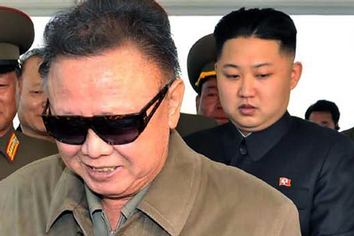
Kim Jong Il, left, with his son Kim Jong Un (Credit: AP)
This article originally appeared on GlobalPost.

FAIRBANKS, Alaska — What’s next now that Kim Jong Il is dead?

Global Post
Kim, whose official age was 69 but who actually was 70, died Saturday of a heart attack, according to North Korean state media.

He leaves behind a pretty much officially designated heir, his son Kim Jong Un, whose age is about 29. The young man has been given exalted titles including full general but has little experience compared with what his father had under his belt when Kim Jong Il’s own father and predecessor, Kim Il Sung, died in 1994.

The regime appears to have tried to position Kim Jong Un as a sort of reincarnation of Kim Il Sung, whom the young man greatly resembles physically. Barbers have given him the same haircut his grandfather sported when he took over the country in 1945 with Soviet sponsorship. There are rumors in South Korea that the young man has had plastic surgery to accentuate the resemblance. He wears the same “people’s clothing” — Mao suits — that his grandfather wore, not the zippered jumpsuits favored by Kim Jong Il.

This sort of branding effort recognizes that Kim Jong Il was never remotely as popular as Kim Il Sung, and was quite aware of that fact. Kim Jong Il publicly moped around Pyongyang for three years as he enforced a mourning period for his own father. It will be surprising if Kim Jong Il in death rates a similar production.

Assuming that the state news account is correct and Kim Jong Il was not killed but died naturally, the focus will be on his brother-in-law Jang Song Taek, who appears to have acted as his right hand since his illness became serious.

Many South Korean and foreign analysts had predicted that Jang could act as regent while the youthful Kim Jong Un consolidates his rule. Jang has no son of his own, and his wife is Kim Jong Un’s aunt.

Important factors to consider regarding Jang are that he has been deeply involved in trade and financial transactions — to the extent Kim Jong Il reportedly punished him by sending him away for “correction by labor” when he was caught in corrupt schemes — and that he has been close to the North Korean military and to the Chinese.

While Jang had a largely civilian career, his brothers were promoted to general officer rank in the North Korean People’s Army. That connection on top of his in-law relationship with Kim Jong Il has been a major source of influence for him.

As for China, there was a report a few years ago that Jang wanted to take over the North Korean economy and engage in Chinese-style reforms. That was not Kim Jong Il’s policy: The now-dead ruler visited China repeatedly, praised its achievements but never proved willing to risk the threats to his rule that he feared might arise if he freed his people to engage in de facto capitalism.

Most North Korean families that have managed to prosper under the regime have at least one member — usually a woman — engaged in trading in public markets. The Kim Jong Il regime repeatedly sought to stifle those markets, even as it failed to maintain the food-rationing system that had kept the people reasonably loyal through the 1980s.

Whether Kim Jong Un can smoothly become a one-man ruler like his father and grandfather is impossible to say now. If Jang is on his side — that’s not certain — and if there is no successful revolt by opponents, he may have a chance despite his serious lack of experience.

Kim Jong Un also has inherited from his father a Karl Rove-like figure who reportedly has been working to prepare the people to accept him as a near-deity in the Kim dynastic tradition. That is Choe Yong Hae, former chairman of the Kim Il Sung League of Socialist Working Youth. Choe had a similar role in preparing Kim Jong Il’s succession, but had far more time to put his strategies into effect.

By the time Kim Il Sung died in 1994 and Kim Jong Il became sole ruler, he had been officially heir for at least 14 years and had been deeply involved in day-to-day administration of the regime for longer than that. Kim Jong Un by comparison is just getting started. The regime started mentioning him in news reports just three years ago.

If the state news accounts should turn out to be false and Kim Jong Il actually died of other than natural causes, the possibilities might include a military coup. Security in the self-isolated country is so tight that a coup would be difficult, but there have been attempts in the past.

Some South Korean and other analysts see a takeover by an anti-Kim military dictatorship as the ticket to the North’s economic transformation, akin to the changes wrought in the South under President Park Chung Hee, a major general who took power there in 1961.

Whoever rules will have to deal with China, South Korea, the United States and Japan. The Chinese have been impatient with Kim Jong Il’s failure to reform and open the economy, but they would have security concerns if developments in Pyongyang seemed to point to reunification of North and South Korea or to a close relationship between North Korea and the United States.

Ironically, Kim Jong Il’s death has come just before the opening of 2012, which the regime had been promoting as not only the 100th anniversary of Kim Il Sung’s birth but a year in which the country would show significant progress toward becoming a “strong and powerful state.”

There seems to be little possibility the country will become strong economically in the coming year, but the regime can still celebrate its elevation in recent years to the status of nuclear power.

Washington and the capitals surrounding Pyongyang have grown deeply pessimistic about persuading North Korea to give up its nuclear weapons capability.

Continue Reading Close
www.salon.com/writer/bradley_k_martin/index.html