Britta Sandberg

Detainee abuse continues at Bagram

Afghanistan's Bagram prison may be worse than Guantanamo. Why does President Obama tolerate it?

  • more
    • All Share Services

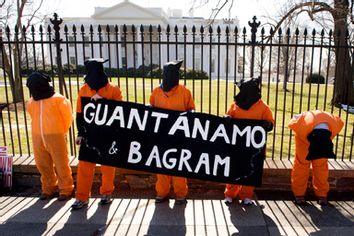
Detainee abuse continues at BagramProtesters calling for the closing of the U.S.detention facilities at Guantanamo Bay, Cuba, and at Bagram Air Base, Afghanistan, stand outside of the White House in Washington, March 5, 2009.

The day that Raymond Azar was taken by force to Bagram was a quiet day in Kabul. There were no attacks and the sun was shining.

Azar, who is originally from Lebanon, is the manager of a construction company. He was on his way to Camp Eggers, the American military base near the presidential palace, when 10 armed FBI agents suddenly surrounded him.

The men, all wearing bulletproof vests, put him in handcuffs, tied him up and pushed him into an SUV. Two hours later, they unloaded Azar at the Bagram military prison 31 miles northeast of Kabul.

As Azar later testified, he was forced to sit for seven hours, his hands and feet tied to a chair. He spent the night in a cold metal container, and he received no food for 30 hours. He claimed that U.S. military officers showed him photos of his wife and four children, telling him that unless he cooperated he would never see his family again. He also said that he was photographed while naked and then given a jumpsuit to wear.

A need for this sort of place

On that day, April 7, 2009, President Barack Obama had been in office for exactly 77 days. Shortly after his inauguration, Obama had ordered the closing of the Guantánamo Bay detention center and ordered the CIA to give up its secret “black site” prisons. He wanted to shed the dark legacy of the Bush years — there should be no torture anymore, no more secret kidnapping operations of terrorism suspects, no renditions. At least, that was what Obama had promised. He did not mention Bagram in his speeches.

Azar was in Kabul on business. His company had signed contracts with the Pentagon worth $50 million for reconstruction work in Afghanistan. On April 8, Azar was placed onto a Gulfstream and flown to Virginia to face charges. He was accused of having bribed his U.S. Army contact to secure military contracts for his company, and he was later found guilty of bribery.

It was a classic case of corruption, which is not the sort of crime for which a suspect is normally sent to a military prison. No one can explain to Azar why he was taken to Bagram, where the U.S. military treated him like a terrorism suspect and, in doing so, inadvertently provided him with an insight into a world it normally prefers to keep under wraps.

Bagram is “the forgotten second Guantánamo,” says American military law expert Eugene Fidell, a professor at Yale Law School. “But apparently there is a continuing need for this sort of place even under the Obama administration.”

From the beginning, “Bagram was worse than Guantánamo,” says New York-based attorney Tina Foster, who has argued several cases on behalf of detainee rights in U.S. courts. “Bagram has always been a torture chamber.”

And what does Obama say? Nothing. He never so much as mentions Bagram in any of his speeches. When discussing America’s mistreatment of detainees, he only refers to Guantánamo.

Classified location

The Bagram detention facility, by now the largest American military prison outside the United States, is not marked on any maps. In fact, its precise location, somewhere on the periphery of the giant air base northeast of the Afghan capital, is classified. It comprises two sand-colored buildings that resemble airplane hangars, surrounded by tall concrete walls and green camouflage tarps. The facility was set up in 2002 as a temporary prison on the grounds of a former Soviet air base.

Today, the two buildings contain large cages, each with the capacity to hold 25 to 30 prisoners. Up to 1,000 detainees can be held at Bagram at any one time. The detainees sleep on mats, and there is one toilet behind a white curtain for each cage. A $60 million extension is expected to be completed by the end of the year.

Unlike Guantánamo, Bagram is located in the middle of the Afghan war zone. But not all the inmates were captured in combat areas. Many terrorism suspects are from other countries and were transported to Bagram for interrogation after being captured. Since the military prison first came into operation, all the detainees there have been classified as “enemy combatants” rather than prisoners of war, which would make them subject to the provisions of the Geneva Convention.

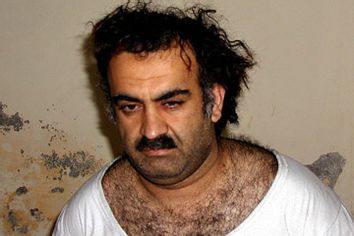
Bagram’s most prominent temporary detainee to date was Khalid Sheikh Mohammed, the self-proclaimed chief architect of the Sept. 11, 2001, terrorist attacks. After his arrest in Pakistan, Mohammed was initially taken to Bagram for three days and was then held at a secret prison in Poland before being flown to Guantánamo. He told representatives of the Red Cross that he was beaten in Afghanistan, suspended from shackles attached to his hands and sexually humiliated. “I was made to lie on the floor,” he said. “A tube was inserted into my anus and water poured inside.”

“In my view, having visited Guantánamo several times, the Bagram facility made Guantánamo look like a nice hotel,” says military prosecutor Stuart Couch, who was given access to the interior of both facilities. “The men did not appear to be allowed to move around at will, they mostly sat in rows on the floor. It smelled like the monkey house at the zoo.”

Sleep deprivation and sexual humiliation

From the beginning, Bagram was notorious for the brutal forms of torture employed there. Former inmates report incidents of sleep deprivation, beatings and various forms of sexual humiliation. In some cases, an interrogator would place his penis along the face of the detainee while he was being questioned. Other inmates were raped with sticks or threatened with anal sex.

Omar Khadr, a Canadian inmate who was 15 at the time, says military personal used him as a living mop. “Military police poured pine oil on the floor and on me. And then, with me lying on my stomach with my hands and feet cuffed together behind me, the military police dragged me back and forth through the mixture of urine and pine oil on the floor.”

At least two men died during imprisonment. One of them, a 22-year-old taxi driver named Dilawar, was suspended by his hands from the ceiling for four days, during which U.S. military personnel repeatedly beat his legs. Dilawar died on Dec. 10, 2002. In the autopsy report, a military doctor wrote that the tissue on his legs had basically been “pulpified.” As it happens, his interrogators had already known — and later testified — that there was no evidence against Dilawar.

According to an internal military investigation of the prisoner abuse cases at Abu Ghraib prison in Iraq, which triggered worldwide outrage when it became public in 2004, the practices there were inspired by the treatment of inmates at Bagram.

Hundreds of innocent inmates

To this day, there are hardly any photos from inside Bagram, and journalists have never been given access to the detention center. Although exact numbers are unknown, there are believed to be about 600 detainees at Bagram, or close to three times as many as there currently are at Guantánamo. According to an as-yet-unpublished 2009 Pentagon report, 400 of the Bagram inmates are innocent and could be released immediately.

The detainees at Bagram still have no right to an attorney, which means that they have no legal recourse against their imprisonment and no opportunity to testify in their cases. Some have been there for years, without knowing why.

Obama has announced new guidelines for the treatment of the Bagram detainees, which would require that a U.S. military official provide assistance to each detainee — not as an attorney but as a personal adviser of sorts. This representative could then review evidence and witness testimony for the first time, and could request that a review board examine the case.

Worst abuse

However, attorney Tina Foster feels that the new initiative is just a cosmetic measure. “There is absolutely no difference between the Bush administration and the Obama administration’s position with respect to Bagram detainees’ rights,” she said during an interview.

Foster, a petite 34-year-old with dark brown eyes and black hair, took on the cases of Guantánamo detainees as an attorney with the New York-based Center for Constitutional Rights. That was before she discovered that the worst prisoner abuse happened long before the detainees arrived in Guantánamo — at Bagram.

Since 2005, Foster has worked exclusively with Bagram cases. She has appeared in court to file habeas corpus petitions for three Bagram inmates. Normally, every prisoner is entitled to habeas corpus rights, which would give him the opportunity to petition a U.S. court to investigate the reasons for his arrest.

“This ugly chapter of American history”

In early April of this year, a judge ruled in favor of Foster’s petition, arguing that because her three clients, two Yemenis and a Tunisian, had not been “captured in a battlefield situation” in Afghanistan but instead had been taken to Bagram from a third country, they too had rights guaranteed by the U.S. Constitution. “That was a huge success,” says Foster.

Last Monday, the U.S. Justice Department submitted a 64-page brief to the appeals court, challenging the decision. The Justice Department lawyers argued that, as a military prison in a combat zone, Bagram constitutes a special case.

Foster, who supported Obama during the campaign and then voted for him, is disappointed by her former idol. “When I heard his announcement to close Guantánamo, I breathed a sigh of relief that perhaps this extremely ugly chapter of American history was finally being put to an end,” she says. “Unfortunately, since then, the Obama administration has completely failed in delivering the change that was promised.”

Left in the snow

Foster plans to continue fighting for that cause, even though one of her clients, whose witness testimony figured prominently in her case, is now dead. Jawed Ahmad, who was also known as Jojo Yazemi, was a journalist working in Afghanistan for a Canadian television station. He was 22 when he was arrested in October 2007.

The Americans accused him of being in contact with the Taliban. They incarcerated Yazemi at Bagram, where he became just another “enemy combatant” — detainee No. 3,370. They left him standing in the snow for six hours, beat him, threatened him and submitted him to sleep deprivation for weeks. It was only after fellow journalists in New York launched a major media campaign in support of Yazemi that he was released — after 11 months and without any explanation as to why he had been detained in the first place.

Just six months after his release, gunmen driving a white Toyota pickup truck, the kind favored by many Taliban, shot and killed Yazemi in Kandahar. “It was one of the most terrible moments of my life,” says Tina Foster. “He was a great person and a friend.” And he was also Foster’s star witness in her case against Bagram.

Translated from the German by Christopher Sultan.


This article has been provided by Der Spiegel through a special arrangement with Salon. For more from Europe’s most-read newsmagazine, visit Spiegel Online or subscribe to the daily newsletter.

New evidence of a secret torture prison

It has long been clear that the CIA used the Szymany military airbase in Poland for extraordinary renditions. Now there is new evidence of a secret torture prison nearby.

  • more
    • All Share Services

New evidence of a secret torture prison

Only a smattering of clouds dotted the sky over Szymany on March 7, 2003, and visibility was good. A light breeze blew from the southeast as a plane approached the small military airfield in northeastern Poland, and the temperature outside was 2 degrees Celsius (36 degrees Fahrenheit). At around 4 p.m., the Gulfstream N379P — known among investigators as the “torture taxi” — touched down on the landing strip.

On board was the most important prisoner the U.S. had been able to produce in the war on terror: Khalid Sheikh Mohammed, the architect of the 9/11 attacks on New York and Washington, also known as “the brains” behind al-Qaida. This was the man who had presented Osama bin Laden with plans to attack the U.S. with commercial jets. He personally selected the pilots and supervised preparations for the attacks. Eighteen months later, on March 1, 2003, Sheikh Mohammed was captured in Rawalpindi, Pakistan by U.S. Special Forces and brought to Afghanistan two days later. Now the CIA was flying him to a remote area in Poland’s Masuria region. The prisoner slept during the flight from Kabul to Szymany, for the first time in days, as he later recounted:

“My eyes were covered with a cloth tied around my head. A cloth bag was then pulled over my head … I fell asleep … I therefore don’t know how long the journey lasted.”

Jerry M., age 56 at the time, probably sat at the controls of the plane chartered by the CIA. The trained airplane and helicopter pilot had been hired by Aero Contractors, a company that transferred prisoners around the world for U.S. intelligence agencies. According to documents from the European aviation safety agency Eurocontrol, Jerry M. had taken off from Kabul at 8:51 a.m. that morning. Only hours after landing in Poland, at 7:16 p.m., he took off again, headed for Washington.

A large number of Polish and American intelligence operatives have since gone on record that the CIA maintained a prison in northeastern Poland. Independent of these sources, Polish government officials from the Justice and Defense Ministry have also reported that the Americans had a secret base near Szymany airport. And so began on March 7, 2003, one of the darkest chapters of recent American — and European — history.

Obama under pressure

It was apparently here, just under an hour’s drive from Szymany airport, that Sheikh Mohammed was tortured exactly 183 times with waterboarding — an interrogation technique that simulates the sensation of drowning — in March 2003 alone. That averages out to eight times a day. And all of this happened right here in Europe.

Over six years later, these acts of torture are putting President Obama under intense pressure. On the one hand, he released four memos in which his predecessor George W. Bush had legalized such interrogation methods. On the other hand, he decided not to prosecute the torturers. And he initially neglected to launch investigations into these “special interrogation methods.”

It is the decision that has earned Obama the harshest criticism during the first 100 days of his presidency. Democrats from the Senate and the House of Representatives announced last week that they would form a truth commission, essentially putting them at odds with their own president. Obama quickly realized that he had apparently underestimated the volatile nature of the issue. So he had Attorney General Eric Holder announce that no one stood above the law. Holder promised that an investigation would be conducted to find out who in the White House and the Justice Department had declared these methods legal.

What the CIA did back then to prisoners in the Polish military airbase of Stare Kiejkuty, north of Szymany, had been authorized by the president. According to witnesses, Stare Kiejkuty housed a secret CIA prison for “high value detainees” — for the most prominent prisoners of the war on terror.

There is now no doubt that the Gulfstream N379P landed at least five times at Szymany between February and July 2003. Flight routes were manipulated and falsified for this purpose and, with the knowledge of the Polish government, the European aviation safety agency Eurocontrol was deliberately deceived.

The public prosecutor’s office in Warsaw has the statement of a witness who described how people wearing handcuffs and blindfolds were led from the aircraft at Szymany. He said that this happened far away from the control tower. According to the witness, it was always the same individuals and the same civilian vehicles that stood waiting on the landing field.

If we are to believe the statements of Sheikh Mohammed, a large number of those present at the small airfield wore ski masks. This is what he told a delegation from the International Committee of the Red Cross that questioned him in the U.S. military prison at Guantánamo, Cuba, in late 2006:

“On arrival the transfer from the airport to the next place of detention took about one hour. I was transported sitting on the floor of a vehicle. I could see at one point that there was snow on the ground. Everybody was wearing black, with masks and army boots, like Planet-X people.”

Just under an hour’s drive corresponds roughly to the distance from Szymany to the Stare Kiejkuty military base, known as a training camp for Polish intelligence agents. The route there passes for two kilometers through a fenced-off military zone, past dense pine forests, then heads northeast for 20 minutes, and finally leads over an unpaved road alongside a lake. The entrance to the base is at the end of this road.

“I was never threatened with death”

Sheikh Mohammed said that they cut the clothes from his body, photographed him naked and threw him in a 10-by-13-foot cell with wooden walls. That was when the hardest phase of the interrogating began, he claims. According to Sheikh Mohammed, one of his interrogators told him that they had received the green light from Washington to give him a “hard time”:

“They never used the word ‘torture’ and never referred to ‘physical pressure,’ only to ‘a hard time.’ I was never threatened with death; in fact I was told that they would not allow me to die, but that I would be brought to the ‘verge of death and back again.’”

He says he was questioned roughly eight hours a day. He spent the first month naked and standing, with his hands chained to the ceiling of the cell, even at night. They led them into another room for questioning, he says. That’s where the bed stood that he says he was strapped to for waterboarding. The mastermind behind the 9/11 attacks told members of the Red Cross that he eventually realized where he was being held:

“I think the country was Poland. I think this because on one occasion a water bottle was brought to me without the label removed. It had an e-mail address ending in ‘.pl’. The central-heating system was an old-style one that I would expect only to see in countries of the former communist system.”

Thereafter, the al-Qaida operative described how he was strapped to a special bed and submitted to waterboarding:

“Cold water from a bottle that had been kept in the fridge was then poured onto the cloth by one of the guards so that I could not breathe. This obviously could only be done for one or two minutes at a time. The cloth was then removed and the bed put into a vertical position. The whole process was then repeated during about an hour. Injuries to my ankles and wrists also occurred during the waterboarding as I struggled in the panic of not being able to breathe.”

Part 2: Investigations across Europe

For more than a year now, Warsaw public prosecutor Robert Majewski has been investigating former Polish Prime Minister Leszek Miller’s government on allegations of abuse of office. At issue is whether sovereignty over Polish territory was relinquished, and whether former Polish President Aleksander Kwasniewski and his left-leaning Social Democratic government gave the CIA free reign over sections of the Stare Kiejkuty military base for the agency’s extraterritorial torture interrogations.

Majewski has questioned a large number of witnesses who worked in the former government, and this year his team even plans to fly to Guantánamo. “No European country is so sincerely and vigorously investigating former members of the government as is currently the case in Poland,” says Wolfgang Kaleck from the European Center for Constitutional and Human Rights in Berlin, which supports the investigations.

The public prosecutor’s office has also launched a probe to determine whether the Polish intelligence agency made 20 of its agents available to the CIA, as was recently reported by the conservative Polish daily newspaper Rzeczpospolita. A former CIA official confirmed this information. There was reportedly a document issued by the intelligence agency that mentioned both the 20 Polish agents and the transfer of the military base to the Americans. Two members of a parliamentary investigative committee in Warsaw had an opportunity to view this document in late 2005, but it has since disappeared.

The missing piece of evidence

Journalist Mariusz Kowalewski at Rzeczpospolita and two colleagues have been searching for months now for proof of the existence of a secret CIA base in Poland. The journalists have discovered flight record books from Szymany that had been declared lost, and based on refueling receipts and currency exchange rates, they have reconstructed flights and routes, and spoken with informants. Over the past few weeks, their newspaper and the television network TVP Info have revealed new details on an almost daily basis.

Kowalewski has collected a wide range of documents on his white Apple laptop. He is convinced, though, that he only knows “a fraction of what actually happened.” He is certain that there was a CIA base in the Masuria region, where high-ranking al-Qaida prisoners were brought. All that is missing is the final piece of evidence. There are rumors circulating that one of the most important interrogators of Sheikh Mohammed, an American named Deuce Martinez — the man who didn’t torture him, but rather had the task of gently coaxing information out of him — was in Poland at the time. That is the proof that’s still missing.

Similar conclusions were reached by the second investigative report on CIA kidnappings in Europe, which was submitted two years ago by the special investigator of the Council of Europe, Dick Marty. According to Marty’s report, members of the former Polish military intelligence and counterintelligence agency, WSI, were given positions with the border police, customs and airport administration to safeguard the activities of the CIA. “The latest revelations in Poland fully corroborate my evidence, which is based on testimony by insiders and documents that have been leaked to me,” says the investigator today. Now, under the “dynamic force of the truth” that Obama has unleashed, Marty says that Europeans must finally reveal “which governments tolerated and supported the illegal practices of the CIA.”

All that remains is the question of who in Poland at the time approved the collaboration with the CIA and gave the Americans unencumbered use of sections of Stare Kiejkuty.

“The order to give the CIA everything they needed came from the very top, from the president,” a member of the Polish military intelligence agency told the Marty team in 2007. Kwasniewski denies this. He says that there was close intelligence corporation with the U.S., but no prisons on Polish soil. When asked to comment on the reports, former Prime Minister Miller said: “All of this is just another opportunity for me to say that I have nothing to say.”

It’s very possible that the debate on torture and responsibility which is currently being conducted in the U.S. will soon also reach Europe. After all, Germany granted the U.S. flyover rights and dropped its bid to extradite 13 CIA operatives in the case of Khalid el-Masri, a German citizen who claims he was abducted by the Americans. The Italian intelligence agency allegedly assisted the CIA with the kidnapping in Milan of the Islamic cleric Abu Omar. Britain’s intelligence agency, MI6, reportedly delivered information directly to CIA agents who were conducting interrogations in Morocco. And there are also reports of a secret prison in Romania. Investigations have been launched into these allegations in nearly all of these countries.

Jerry M., the pilot who flew Sheikh Mohammed from Kabul to Szymany in March, 2003, now lives in Birmingham, Ala., in a brick house with white shutters and box trees planted in front of the door. Two stone lions guard the path that leads to the entrance. For two years, Jerry M. only had a post box address, like everyone else who flew CIA prisoners around the world: P.O. Box 22 99 43, code name Jerry Allen Bostick.

It appears the 62-year-old would rather deny all knowledge of this period in his life. When asked by a reporter over the phone if he had ever been to Poland, he said, “I have no idea what you’re talking about. Really no idea.” When he was asked if he had ever worked for a company named Aero Contractors, the line suddenly went dead. Jerry M. had hung up.

Translated from the German by Paul Cohen

Continue Reading Close

The leader of the Pakistani Taliban vows to strike America

Rival Islamic militant groups are joining forces to make Pakistan into a stronghold -- and are receiving support from Pakistan's ISI intelligence agency.

  • more
    • All Share Services

The leader of the Pakistani Taliban vows to strike America

Last Thursday, at 7 a.m., Baitullah Mehsud dialed the telephone number of Alamgir Bhittani, a radio correspondent in the Tank region of Pakistan’s North-West Frontier Province. The voice of “Bait,” as the Pashtuns call the feared leader of the Pakistani Taliban, was soft and flattering.

He had called the journalist to boast about his exploits, telling him that his fighters were the ones who had created a blood bath the previous day at a police academy near the northeastern Pakistani city of Lahore. He told Bhittani that he had ordered his men to “eliminate” as many supporters of what he called the traitorous Pakistani regime as possible.

Wearing stolen uniforms, the group of 10 terrorists had gained access to the training camp to kill recruits. The attackers took hostages and hid in one of the buildings. Helicopters and elite army and police units appeared on the scene. In the end, three of the terrorists blew themselves up, and the rest were arrested. When the blood bath was over, eight police recruits were lying dead in the barrack’s yard.

The attack, Mehsud said, was in retaliation for President Asif Ali Zardari allowing the Americans to pursue him and his allies in the border region between Afghanistan and Pakistan. “I am not afraid of death,” Mehsud boasted, before adding a threat. Soon, he said, the Americans would also be made to suffer. “We will take the battle to Washington with an attack that will astound the whole world.”

Washington takes this threat seriously. Since his election in November, President Barack Obama has been urging his allies to stop treating the drama of the Afghanistan war as an isolated problem but, rather, as a regional conflict that also has to be conducted in Pakistan.

When Obama explained his plans for an intensified Afghanistan campaign at the NATO summit in Strasbourg and the southwestern German city of Baden-Baden last weekend, there was almost as much mention of Pakistan as neighboring Afghanistan. The president has also redefined the goals of the war. His aim is no longer to bring democracy to poverty-stricken Afghanistan, but to hunt down and defeat the Taliban and al-Qaida, both in Afghanistan and Pakistan. Obama wants stability in the region.

The new strategy has even yielded a new abbreviation in military jargon: AfPak. And its goal is to save AfPak, which is in danger.

Iraq veteran Gen. David Petraeus, the head of U.S. Central Command, hopes to interrupt what he calls a “downward spiral” in the war by increasing the number of U.S. troops in Afghanistan to 68,000 and, later, to 78,000. In addition to their current operations along Afghanistan’s eastern frontier with Pakistan, U.S. troops will also assume responsibility for fighting the Taliban in the southern part of the country next year. When that happens, combat operations along almost the entire border with Pakistan will be under U.S. military command.

Instead of an “Afghanization” of the conflict through the training of Afghan soldiers and police, the new strategy will result in an Americanization of the war.

The Americans are also redefining the war as a struggle against three enemies who, from their bases in Pakistan, threaten Afghanistan, their own country and the entire Western world. The first are the Afghan Taliban fighters, led by Mullah Omar, who have left Afghanistan for their new stronghold in Quetta, the capital of Pakistan’s Baluchistan province. Their allies are the Pakistani Taliban in the tribal regions along the border with Afghanistan under the command of the notorious Baitullah Mehsud. Finally, Osama bin Laden’s al-Qaida, which continues to operate in Pakistan, provides ideological and material support for both groups. Bin Laden and the hardcore of his network are also believed to be based in the mountainous border region between Afghanistan and Pakistan, where they have apparently been operating for some time.

Obama has described the regions on both sides of the border as the “world’s most dangerous place.” The biggest threat there, for Obama, is not just the possibility of the West suffering a defeat in Afghanistan, but the potential collapse of Pakistan, a nuclear power. The effect on the power structure in this part of the world and the consequences for the West would be incalculable.

David Kilcullen, a top advisor to Gen. Petraeus, recently told the Washington Post that “within one to six months we could see the collapse of the Pakistani state,” adding that such a scenario “would dwarf everything we’ve seen in the war on terror today.” The U.S. government now plans to spend up to $500 million a year to better equip and train the Pakistani military as part of an “emergency war budget.”

The fighting has already spread to both sides of the border. More than half a year ago, the Americans tried to strike the Islamist militants in their hideouts on Pakistani territory with precision guided missiles, a campaign that began under the Bush administration and that Obama is now continuing, only with greater force.

U.S. military commanders no longer ask the government in Islamabad to sanction the airstrikes, which are conducted with unmanned Predator drones. According to a Pakistani intelligence report from February, there have already been 80 such attacks this year alone, claiming 375 lives, including those of both civilians and militants.

In January, Usama al-Kini, the head of al-Qaida in Pakistan, was one of about a dozen senior al-Qaida leaders killed in the attacks so far. Al-Kini, who was on the FBI’s “most wanted” list, is believed to have been responsible for the first major al-Qaida attacks on U.S. embassies in East Africa in 1998. The Americans celebrated his death as an important blow against the terrorist network in Pakistan.

CIA director Leon Panetta praises the drones as the “most effective weapon” in the struggle against militant groups in Pakistan. Last week, the Americans attacked one of Mehsud’s camps in northwestern Pakistan, killing 12 militants.

Mehsud, 35, is seen as the prototype of the ruthlessly ambitious new generation of Taliban fighters. During the U.S. invasion in November 2001, he was in command of only a small group of fighters. Later on, he helped hide fleeing al-Qaida leaders in the mountain villages of South Waziristan. The “Arabs,” the derisive term the local population uses for foreign militants, showed their appreciation by providing Mehsud with financial support and training for his fighters.

Mehsud was once a physical education teacher at a Quran school. He is relatively uneducated and carries no religious title. Nevertheless, he has installed, and is systematically expanding, a reign of terror in the tribal regions. Traitors are labeled “spies” and “enemies of Islam” and are publicly beheaded. When the family members of one such “traitor” were carrying the body of their relative to his grave, a suicide bomber blew up the mourners.

Mehsud is like a magnet, attracting extremists from around the world. They include former Kashmiri militants seeking a new challenge now that their organization has been banned as well as retired trainers for the Pakistani intelligence agency, Inter-Services Intelligence (ISI). Hundreds of young jihadists from the Gulf states, Central Asia, Uzbekistan, Turkmenistan and Chechnya have also joined Mehsud’s group.

This has led to the development of the world’s most important training center for international terrorism in Waziristan. Even rival groups have joined forces there.

The credit for this reconciliation of former adversaries goes to Islamic fundamentalist Mullah Omar, the leader of the Taliban until the fall of 2001 and Afghanistan’s quasi head of state at the time. One of the founders of the Taliban, Omar lost an eye in battle. He is believed to have married one of bin Laden’s daughters and given safe haven to al-Qaida in Afghanistan.

Mullah Omar’s Taliban is not only regaining strength in Afghanistan, but is also becoming a force to be reckoned with elsewhere. At the beginning of the year, as the New York Times reported, Omar sent a six-member team to Waziristan to warn the Pakistani militant groups about the Americans’ new Afghanistan strategy and appeal to them to put aside old rivalries. The goal, they said, must be to join forces to liberate Afghanistan from the American occupiers. In a letter accompanying the envoys, the spiritual leader of the Taliban wrote: “If anybody really wants to wage jihad, he must fight the occupation forces inside Afghanistan.”

Nuclear nightmares

Surprisingly, Baitullah Mehsud was receptive to the appeal for unity and aligned himself with other Taliban leaders. In late February, fliers written in Urdu turned up in the Pakistani-Afghan border region announcing the formation of a new platform for jihad. The Shura Ittihad-ul Mujahideen (SIM), or Council of United Holy Warriors, declared that the alliance of all militants had been formed at the request of Mullah Omar and bin Laden. The group made it clear that, from now on, its enemies would include not only Afghan President Hamid Karzai and Pakistani President Asif Ali Zardari, but also U.S. President Barack Obama.

“There is a new quality to this,” says Imtiaz Gul in his office at the Center for Research and Security Studies in Islamabad. “These groups are now the Pakistani face of al-Qaida.” Gul, who has just written a book about terror in the tribal areas, is convinced that all Taliban leaders are in close contact with al-Qaida. According to Gul, their training camps for suicide bombers are run by foreign al-Qaida commanders. “Even the materials and style of the explosive vests the Taliban are now using are identical with those of al-Qaida suicide bombers,” says Gul.

The expansion of the combat zone is driving Pakistan toward the abyss. The militant attacks pose a threat to the state, but so do the military operations against the Taliban, which may be doing as much damage as good. The drone attacks in the border region drive the extremists into Pakistan’s interior and its cities. Besides, the attacks, which almost always claim the lives of Pakistani women and children in addition to militants, serve as a recruiting tool for new jihadists.

“I am strongly opposed to the drones,” says Petraeus advisor Kilcullen. “What good does it do us if we have eliminated half of all al-Qaida leaders but have antagonized the entire Pakistani population?” Kilcullen, an Australian, masterminded the most recent U.S. strategy in Iraq, which went hand-in-hand with the troop buildup. He now believes that “we can negotiate with 90 percent of those with whom we are fighting — but from a position of strength.” He also helped develop Obama’s new AfPak strategy.

The Pakistani military is hardly capable of stopping the Taliban’s victory march. A few weeks ago, the extremists gained control over the idyllic Swat Valley in the heart of Pakistan, where they have introduced Islamic Sharia law and have taken over an emerald mine to help finance their movement. The government in Islamabad is so weak that it agreed to a cease-fire with one of the most ruthless militants in the valley, Maulana Fazlullah. Fazlullah and his thugs have terrorized the residents of the Malakand region for more than two years.

The terror has since penetrated into the country’s interior, including the state of Punjab and its capital, Lahore. The city, Pakistan’s liberal cultural center, is near the border with India. Evidence of the city’s mounting Talibanization includes signs in show windows announcing that female children will no longer be served. In October, Islamic militants blew up beverage shops near Lahore’s main train station because unmarried couples were allegedly using the shops for their romantic trysts. Three bombs were detonated at a local art festival a short time later. Nowadays, terrorist acts claim more lives in Pakistan than in neighboring Afghanistan. Last year, such attacks claimed 2,267 lives.

The military avoids serious confrontation with the extremists. Many officers still do not see the Taliban as their enemy. Pakistan’s true enemy, in their view, is India, the country from which Pakistan once seceded and with which it has since waged three wars. Quite a few officers say that the fight against terrorism in the northwestern part of the country is being forced upon them by the Americans and that they are fighting the wrong war.

For decades, the military leadership has granted the ISI substantial freedom in its treatment of terrorist groups. This laissez-faire attitude gives them room to maneuver.

Gen. Ahmed Shuja Pasha, a pleasant man with carefully parted hair, sits in his elegant office at ISI headquarters in Islamabad. “The ISI is a security agency and is on the front lines of defending the country,” he says.

In truth, however, the intelligence agency pursues its own covert foreign policy. Pasha points out that in the 1980s, Pakistan — together with the Americans — supported the Afghan mujahedin in their war against the Soviets. This type of assistance was considered desirable at the time, he explains, and adds: “You must understand that both Afghan and Indian intelligence are working against us. It would certainly be strange if we were the only ones who were doing nothing.”

The Americans have long suspected the ISI of playing a double game. After Sept. 11, 2001, former President Pervez Musharraf willingly pursued the al-Qaida terrorists who had sought refuge in the border region and received billions in military aid in return. At the same time, however, he spared the Taliban leaders, allowing them to go into hiding.

In a recent article in the New York Times, Obama administration officials were unusually candid in accusing the ISI of supporting the Taliban in its struggle against the Western alliance and the Karzai government in Kabul. That support, they said, includes ammunition and fuel, as well as the recruitment of fighters. The officials claimed that wiretapped telephone conversations prove that members of Pakistani intelligence have even given the Taliban advance warning of planned raids.

These conclusions are consistent with the impression that Mike McConnell, the former director of the National Security Agency (NSA), a U.S. intelligence service, gained on a visit to Islamabad last year. A Pakistani two-star general candidly explained the mind-set of his fellow military commanders to McConnell, noting that although the army is fighting the Taliban at the instruction of politicians, it also supports the militants. The Americans, the general reasoned, will eventually leave Afghanistan, at which point it will be up to the Pakistani military to prevent India from advancing into the power vacuum. “That is why we must support the Taliban,” the general said.

According to Bruce Riedel, an advisor to Obama, Pakistan has “created a Frankenstein that threatens the Pakistani state itself.” Former Secretary of State Madeleine Albright has described Pakistan as an “international migraine,” noting that it has nuclear weapons that could fall into the hands of terrorists — a nightmare scenario, in the wake of 9/11.

ISI director Pasha is familiar with these fears in the capitals of the West. He pours tea into cups made of fine English porcelain. He says that he is saddened by the notion that the world believes his country could fall into the hands of terrorists. “That is unimaginable,” he says. “It will never happen.”

But the general has been known to make mistakes. Only recently, he referred to brutal Taliban leader Baitullah Mehsud as a good “patriot.” Good for Pakistan or the ISI, or for whom?

The American government has now placed a $5 million bounty on Mehsud’s head.

Translated from the German by Christopher Sultan.


This article has been provided by Der Spiegel through a special arrangement with Salon. For more from Europe’s most-read newsmagazine, visit Spiegel Online or subscribe to the daily newsletter.

Continue Reading Close

Turning their backs on jihad

Disenchanted with Osama bin Laden, former holy warriors are renouncing violence.

  • more
    • All Share Services

Noman Benotman walks into a restaurant on Park Lane, the exclusive, minimalist sort of place that is currently all the rage in London. People in business suits converse in hushed tones at nearby tables. Benotman, wearing an orange polo shirt and a gray checked blazer, fits in perfectly.

Benotman, a 41-year-old man from Libya, was once a jihadist. He fought against the Soviets in Afghanistan, and it was in those days, which some would later romanticize as heroic, that he met Osama bin Laden. Benotman says that he was once adept at using an AK-47, and that he remembers making out the faces of Soviet helicopter pilots before shooting them down.

After the Soviet army withdrew in disgrace from Kabul and Kandahar, Benotman returned to his native Libya, where he became one of the leaders of the Libyan Islamic Fighting Group (LIFG). The group, several hundred strong, sought to overthrow the regime of Libyan dictator Moammar Gadhafi, which they believed was corrupt and un-Islamic. Before Sept. 11, 2001, Benotman was an important figure in the expanding global network of terrorism.

Today he sits in a London restaurant and orders an espresso with a glass of water from a waiter dressed in a white uniform. He speaks with a flawless British accent.

Nothing short of spectacular

Benotman has just returned from Libya, where he is working on behalf of the Gadhafi regime, the same regime he hoped to oust only a decade ago. He has been assigned a very delicate task. His job is to convince imprisoned members of his former terrorist group to sign a peace treaty of sorts. He has traveled to Libya 25 times in the last 16 months, and his efforts are paying off. Now, he says, the document that will allow his former comrades to be reintegrated into society is as good as written — and on the verge of being signed.

Under the agreement the terrorists, most of them in prison for many years, will renounce violence and the murder of civilians. It will also include a denial of recent al-Qaida claims that the LIFG has joined forces with the international terrorist organization. This is untrue, says Benotman, explaining that the Libyans distanced themselves from al-Qaida long ago. His new mission is anything but secretive. Arab television broadcaster Al-Jazeera recently reported on his trips to Libya — a story about a former jihadist’s attempt to bring about peace, after all, is nothing short of spectacular.

Libya is not the only place where efforts to part ways with al-Qaida and its founders are under way. Almost seven years after the attacks of Sept. 11 and 10 years after bin Laden and his second-in-command, Ayman al-Zawahiri, founded the “International Islamic Front for Jihad against Jews and Crusaders,” the organization is beginning to show cracks.

If one imagines al-Qaida as experts have characterized it — as a system of terror franchises with branches worldwide — then there is clearly an uprising taking place among many branch managers. They are distancing themselves from the icons of terror, and from their goals and methods. So far, it apparently remains an internal process; disputes within the various groups that have been smoldering for some time are now rising to the surface. And there is little to indicate a causal connection between this development and the United States-led war on global terrorism.

His utmost to kill

Counterterrorism experts from Europe and the United States met in Florence in May to discuss the current state of affairs. Just how many terrorists remain engaged in the war against the West was a matter for debate. But most of the experts believed that bin Laden still exerts direct influence over a widely diverse group of terrorist organizations, both as a symbolic figurehead and as a financier of training camps and attacks around the world. And all at the conference agreed that bin Laden himself remains determined to do his utmost to kill as many people in the West as possible.

The al-Qaida leadership is still believed to be hiding out in the mountainous, inaccessible border region between Pakistan and Afghanistan. From their isolated location, bin Laden and Zawahiri compose periodic messages to their followers around the world, often seeking to portray the dissidents as creatures of the hated West. The Egyptian doctor Zawahiri, in particular, insists that renegades like Benotman have either been paid off by the West or tortured into compliance, and that Western intelligence agencies engage in propaganda to create divisions and uncertainty among his holy warriors.

But Zawahiri’s messages, delivered by video or broadcast on the Internet, appear to be losing their effectiveness.

In late May, India’s influential Deoband religious movement issued a fatwa against terrorism. In a joint proclamation at a meeting in New Delhi attended by representatives of the country’s leading Islamic organizations, the groups stated: “It is the goal and purpose of Islam to extinguish all forms of terrorism and to disseminate the message of global peace. Those who use the Koran and the teachings of the Prophet Muhammad to justify terror are merely upholding a lie.”

The supreme mufti of the Deobandis and three envoys signed the document. “In terms of its theological significance, this is roughly the equivalent of a ruling by the Supreme Court in Washington,” activist Javed Anand later said. The Deobandis, whose name is derived from a small city in the Indian state of Uttar Pradesh, once inspired and offered religious instruction to fighters in the Islamic world. Militant Pakistani groups, jihadists in Iraq and even the Taliban invoked the Deobandis for many years. But those days are now gone.

Former militants who have renounced jihad often begin to proselytize among their former comrades-in-arms. In late April, a handful of former members of the militant Islamist group Hizb ut-Tahrir, which was founded in Jordan in 1953 and eventually spread to about 40 countries, established a foundation to combat fundamentalism among Muslims in Europe.

Maajid Nawaz, 31, is the director of the new organization, known as the Quilliam Foundation. In his past, Nawaz helped develop secret terrorist cells in Pakistan and later in Denmark. He spent five years in an Egyptian prison, where he turned his back on radical Islam. The foundation was established in the British Museum, and when he gave his speech at the event, Nawaz was wearing a well-tailored Hugo Boss suit and his beard was neatly trimmed. “I turned away from Islamism,” he said, “because I recognized it as the curse of Islam.”

“Do not exceed the limits”

This small rebellion within al-Qaida had its beginnings in May 2007, in the form of a fax received at the London-based Arab newspaper Al-Sharq al-Awsat. It was sent by one of the eminent authorities of al-Qaida, a man who was once bin Laden’s mentor before he went from the Pakistani city of Peshawar to Afghanistan, and long before he became a shining light in the Islamic world. The man’s name is Sayyid Imam al-Sharif. Like Zawahiri, Sharif is an Egyptian doctor, and he later competed with Zawahiri for bin Laden’s favor. Sharif is better known under his nom de guerre, Dr. Fadl.

Ironically Dr. Fadl, 58, sent the fax from a prison in Cairo, where he has been serving a life sentence since 2004. He wrote that jihadism is reprehensible and that it violates the precepts of Islam and Shariah law. Killing people solely on the basis of their nationality is not in keeping with the Koran, he wrote, especially since the victims of such acts are often “innocent Muslims and non-Muslims.” “Fight, on God’s behalf, against those who fight you, but do not exceed the limits,” the converted Dr. Fadl wrote.

A man once referred to as “al-Qaida’s chief ideologue,” and one of the organization’s founders, disassociating himself with al-Qaida, bin Laden and Zawahiri? It was a sensation, a turning point for the terrorist network.

Part 2: “Things are slowly changing”

“When I first read the fax, I thought that he must have been coerced,” says Mohammed al-Shafey, an editor at the London-based Arab newspaper, which printed the document of renunciation. “Fadl was the brain, the think tank of jihad. Only later, when I read his new book, did I realize that he really meant what he wrote.” Dr. Fadl wrote the book Shafey is referring to, in which he explains the reasons for his change of heart, in his prison cell and announced its completion in the fax he sent to London.

Dr. Fadl is not only seen as the brain of al-Qaida but is also considered one of Zawahiri’s mentors. Both men are surgeons and attended medical school in Cairo together. Zawahiri was one of thousands arrested in 1981 after former Egyptian President Anwar al-Sadat was assassinated. Fadl fled to Pakistan and settled in Peshawar, where he treated wounded fighters from Afghanistan.

After completing a prison sentence in Cairo, Zawahiri went to Peshawar, then a magnet for Islamists. At that time, it was clear to the two men that Dr. Fadl was the superior intellect. He was said to have encyclopedic knowledge of the Koran.

On Aug. 11, 1988, in Peshawar, Fadl and Zawahiri met for the first time with a young Saudi Arabian named Osama bin Laden and a Palestinian named Abdullah Assam. The four men would later found al-Qaida, “the basis,” as a fighting alliance against infidels, the West and the United States, after the collapse of the world’s other superpower, the Soviet Union. Bin Laden had money and followers, while Fadl and Zawahiri had dreamed up the ideological underpinnings for jihad.

Fadl soon wrote something of a manual for jihadism. According to the document, holy war is the natural state of Islam and the “only way to end the domination of the infidels.” With such a manifesto in his past, Fadl’s renunciation of al-Qaida is not easily dismissed as insignificant.

Greatest trial in history

It is a heavy blow to bin Laden and Zawahiri when one of the founders of their network describes al-Qaida’s ideology and the attacks of Sept. 11 as mistakes. “Dr. Fadl is fundamentally questioning their theological authority,” says Lawrence Wright, who describes the history of al-Qaida in his book “The Looming Tower.” In a recent piece for the New Yorker, Wright wrote, “Fadl repeatedly emphasizes that it is forbidden to kill civilians — including Christians and Jews — unless they are actively attacking Muslims.” Wright believes that the terrorist organization faces the greatest challenge in its history.

Just how seriously Zawahiri took Fadl’s pamphlet of renunciation is evident in the 200-page response he issued in March of this year, which was also published on the Internet. Zawahiri writes that he can only imagine Dr. Fadl’s conversion to be the work of Arab intelligence agencies working in concert with the CIA, and that the document must have been written under duress.

“If you claim that these operations were illegal,” al-Qaida’s number two man writes, addressing Fadl directly, “then this must also apply to all operations conducted in Palestine.” According to Zawahiri, Fadl has never questioned Palestinian attacks on Israelis.

Paul Cruickshank of New York University and terrorism expert Peter Bergen spent six months investigating the turmoil within al-Qaida. The two were the first to interview Noman Benotman, and they also spoke with other critics of the terror organization — including Sheik Salman al-Oudah. On the sixth anniversary of the Sept. 11 attacks, the Saudi went on the television channel MBS to publicly demand of bin Laden how many innocents had already been killed in the name of al-Qaida. Oudah also wanted to know how bin Laden planned to face the almighty with hundreds, even thousands, of innocent lives on his conscience.

“Al-Oudah is neither in prison nor is he suspected of being a friend of the Americans or a tool of the Saudi government,” says Cruickshank. On the contrary: In 2004, the sheik called on Iraqis to fight against the US occupiers in their country.

Cruickshank believes that, ironically enough, it was the Iraq war that delayed latent criticism of bin Laden and his concept of jihad. “What’s emerging now has been simmering for a long time.” The fact that American soldiers were occupying holy ground provided every major terrorist leader with a convenient justification for jihad in Iraq.

There is no doubt that al-Qaida remains an unscrupulous and dangerous terrorist organization, even if it has lost some of its influence in Iraq. In Pakistan and Afghanistan, its core countries, it is enjoying renewed support. Allied with the newly strengthened Taliban, al-Qaida is doing its part to seriously jeopardize the regimes in Islamabad and Kabul. “In the long term, however, they will face problems as a result of the ideological debate,” says Peter Bergen. “They are already having trouble finding recruits in Europe today.”

Wearing a suit for Friday prayers

This shift in the general mood that experts like Bergen believe is happening in Europe is clearly in evidence at London’s Al-Tawhid Mosque. Two of the presumed attackers who planned, and failed, to commit attacks in London and Glasgow in late June 2007 were frequent visitors to the mosque. “But now people have had enough of Islam constantly being equated with terrorism,” says Usama Hasan, the mosque’s 36-year-old imam.

These days Hasan wears a suit when leading Friday prayers. “I am a Muslim living in the West, and I want everyone to see it.” Hasan, himself a former fighter in Afghanistan and member of a fundamentalist group, now preaches the renunciation of violence and condemns terrorism.

“I have the feeling that things are slowly changing,” says former Libyan terrorist Benotman, referring to the small series of prominent renegades. He was once so well known among jihadists that he dealt directly with bin Laden. That was in the summer of 2000, when roughly 200 people representing groups from many countries came together in Kandahar. Benotman was living in a guesthouse that bin Laden owned.

The Libyans, fearing retaliation against their own country, were opposed to the crusade against the United States that was discussed at such great length in Kandahar. According to Benotman, even Taliban leader Mullah Omar was in favor of attacking Israel instead of the United States. “We told bin Laden at the time that he could not force his strategy on all Arabs,” the Libyan recalls today. “His response was that there was an operation under way that he could no longer stop, and that the fighters were ready to act.” Bin Laden was referring to the attackers of Sept. 11.

After the attacks on America, the Libyans parted ways with al-Qaida. Several Libyan newspapers published Benotman’s open letter to Zawahiri last year. He has been living in London in recent years. He says that he has never been in prison, neither in Libya nor anyplace else.

Then the elegantly dressed man, a one-time jihadist, walks out of the chic restaurant and disappears into the Green Park Underground station.

- – - – - – - – - – - -

This article has been provided by Der Spiegel through a special arrangement with Salon.

Continue Reading Close