Caroline Tiger

Bittersweet chocolate

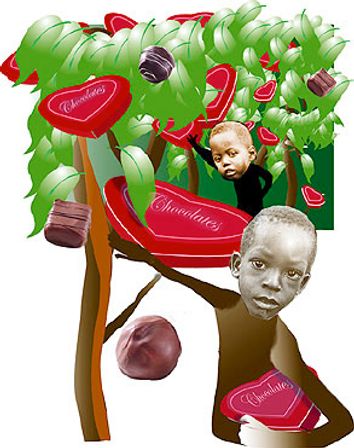
Chances are good that child workers -- some of whom are slaves -- helped produce your valentine bonbons. The chocolate industry has promised to get kids out of the cocoa trade. But profits still come before progress.

  • more
    • All Share Services

Bittersweet chocolate

Of the $1.1 billion in boxed chocolates that Americans are expected to buy on Valentine’s Day, very little will be untainted by the scourge of child labor. Although some who buy those bonbons will do so without knowing the sinister history of their purchases, others, like the chocolate makers, will have known for at least two years, if not longer, that cocoa beans imported from the Ivory Coast — used to make nearly half the chocolate consumed in this country — are harvested in large part by children, some as young as 9, and many of whom are considered slaves, trafficked from desperately poor countries like Mali and Burkina Faso.

The most recent survey of conditions on West African cocoa farms, completed by the International Institute for Tropical Agriculture for the U.S. Agency for International Development, estimated that nearly 300,000 children work in dangerous conditions on cocoa farms in the four countries surveyed — Ivory Coast, Nigeria, Ghana and Cameroon — the vast majority of them in the Ivory Coast. The report, released in July 2002, says that of the 300,000 children, more than half (64 percent) are under 14 years old. Twelve thousand had no connection to the family on whose cocoa farm they toiled, but only 5,100 of them were paid for their work. Almost 6,000 were described as “unpaid workers with no family ties,” provoking advocates to refer to them as “slaves.” The rest work on their families’ farms, kept home from school to do punishing work during the all-important harvest seasons. The latter category are, in the definition of the International Labor Organization, child laborers.

The existence, and the plight, of these children were publicly acknowledged by chocolate companies in 2001 after high-profile stories in the media — most significantly, a documentary by the BBC and a prize-winning series by Knight Ridder reporters — had exposed the horrific details of the children’s lives, and their connection to the chocolate consumed, often by unknowing consumers, in this country.

And yet, despite committing themselves 16 months ago to a highly publicized four-year plan to abolish child slaves and laborers from the cocoa farms with whom they do business, the chocolate industry, worth billions a year in U.S. revenue alone, has managed to continue making and selling products without demonstrating any discernible progress in solving the child labor problem.

The chocolate companies say their efforts so far have been defeated by the chaos of civil war and the stubborn traditions of an agriculturally based society. But those who monitor child slavery around the world, and others who scrutinize the labor practices of American companies with factories abroad, insist that chocolate companies have failed to take serious steps to end the abhorrent labor practices.

“You have potentially conflicting interests here,” says Alec Fyfe, senior advisor for child labor at UNICEF. On the one hand, Fyfe says, there’s “an industry trying to protect itself from adverse publicity and [from] consumers walking away from their product.” On the other, “a group interested in protecting children’s interests. Where’s the overlap?”

- – - – - – - – - – - -

Hershey’s and M&M/Mars control two-thirds of the U.S. chocolate market, which generated $13 billion from retail sales of 3.1 billion pounds of chocolate in 2001. Both companies, along with other major producers like Nestlé, Archer Daniels Midland, Cadbury, Guittard and Bernard Callebaut, import cocoa beans from the Ivory Coast, which, as the largest cocoa producer in the world, provides almost half the cocoa beans that end up in America. Most of the cocoa from the Ivory Coast comes from 450,000 small farms of 12 acres or less.

In September 2000, a BBC documentary entitled “Slavery: A Global Investigation” featured a segment on boys enslaved on Ivory Coast cocoa farms, showing children with heavily scarred backs from beatings with whips and switches.

Awareness of the problem became more widespread in June 2001, when a four-part Knight Ridder series on the same topic told the stories of boys in the Ivory Coast, most of them 12 to 16 years old, some as young as 9, who had been sold and then tricked into indentured labor on cocoa farms. The boys told reporters that they were underfed, locked in their filthy sleeping quarters, and forced to work more than 12 hours a day, sometimes hauling 50-pound bags of beans that were bigger than they were.

Caught in the glare of negative publicity, representatives of the chocolate industry admitted the problem existed, but insisted they should not to be held responsible since chocolate companies didn’t actually own the farms. But this argument didn’t deflect continuing criticism, and the issue was taken up by two congressmen, Sen. Tom Harkin (D-Iowa) and Rep. Eliot Engel (D-N.Y.). The Knight Ridder series came out the same week that an agricultural bill was up for a vote in the House of Representatives. After reading the newspaper articles, Engel quickly added a rider to that bill, proposing a federal system to certify — and label — qualified chocolate and cocoa products as “slave free,” much in the way that tuna produced under certain federal guidelines can earn “dolphin safe” labeling. The measure passed the House of Representatives — and created a potentially significant problem for Hershey’s, Nestlé, M&M/Mars and the other major companies that wouldn’t qualify for the “slave free” label.

Before the bill could reach the Senate, the Chocolate Manufacturers Association, a trade group that represents the major American chocolate makers, hired former senators George Mitchell and Bob Dole to lobby against it. With possible consumer boycotts and punishing federal regulation looming, chocolate companies found a way to deal with the issue — and dodge the labeling bullet. According to a source on Capitol Hill who was involved in the talks between the industry and a handful of congressmen, Mitchell and Dole urged the chocolate companies to make a deal, saying, “Too many reporters are willing to go to Africa and get kids on record that they’re slaves.”

The solution — crafted in October 2001 by the biggest chocolate companies in the world, in negotiation with Harkin and Engel — was a document called the Harkin-Engel Protocol. The companies that signed the protocol — Hershey’s and M&M/Mars, among others — promised to follow through on a four-year, six-point plan. The companies’ stated goal was to rid the industry of child slavery by July 2005, at which time their products would be certified as “slave free.” To work toward that goal, the companies committed themselves to instituting programs in West Africa to improve the lives of cocoa farmers and make them aware of the consequences of child labor — not just trafficking in children, but also keeping their own kids home from school to work the farms. The “slave free” tag would be the payoff — a signal to consumers that their candy bars and M&Ms could be consumed without guilt.

But halfway to the protocol deadline, little headway has been made. And critics of the chocolate industry say companies are attempting to control implementation of the initiative to make as little impact as possible on their own bottom line. Most importantly, say these critics, the chocolate companies are avoiding the crucial role of cocoa pricing in the perpetuation of child slavery. It is a subject that needs to be addressed, say child labor experts, but it is a threat to industry profits.

Two months after the protocol was signed, the Child Labor Coalition, comprising more than 70 advocacy groups focused on domestic and international child labor issues, released a statement acknowledging the industry’s initiative but asking them to go a few steps further. The statement suggested that the industry commit to ending exploitative child labor practices on cocoa farms all over the world, not just in West Africa but also in Indonesia and Brazil, where anecdotal evidence suggests it exists. Susan Smith, a spokesperson for the Chocolate Manufacturers Association, acknowledges that the problem may exist elsewhere, but says, “There are only so many things we can do at a time.”

The CLC’s statement also asked the industry to consider ensuring “that family farmers get a fair price for their products and agricultural workers are compensated fairly for their labor.” Smith says that the industry is addressing pricing, but through indirect avenues. “We’re teaching the farmers about marketing their products to get more money,” she says. “To produce more and a higher quality of cocoa and how to sell the cocoa, what buyers are looking for.” Smith cites the Sustainable Tree Crops Program, which has been tested and is ready to be implemented. Among its goals is devising a way to get radio updates about the world market to isolated farmers so that they know how much they should get for their beans. Another goal is to improve the farmers’ quality of life and the quality of the cocoa by introducing environmentally safe pest- and disease-control methods. “This all relates to the prices the farmers are getting,” says Smith.

The industry’s reluctance to deal with cocoa pricing directly was evident at a workshop held in early February in Washington, where the chocolate industry presented its findings to representatives from the International Labor Organization, the Department of Labor, USAID and UNICEF on why more than half the children working on cocoa farms in the Ivory Coast have never attended school. Their conclusion — that Ivory Coast farmers will always keep their children home to work the fields because it is a practice embedded in their culture — contradicted years of research by child labor experts who identify poverty — in this case, caused in part by low and unpredictable cocoa prices — as the root of child labor and child slavery.

“There was a very selective use of data which seemed to bolster the view that poverty is not a major cause of the problem and that kids working on those farms are no worse off in terms of education,” says Fyfe, who attended the meeting as a UNICEF representative. “It was very perverse.”

A more balanced use of data, says Fyfe and others who have studied the causes of child labor, would have led directly to a discussion of cocoa pricing and, ideally, to a plan to regulate pricing. Such a plan would help farmers escape poverty and reduce the need to use children on their farms. Of the millions of dollars that the chocolate industry says it is investing in programs like the Sustainable Tree Crops Program to reeducate farmers in West Africa, very little trickles down to the cocoa farmers, say critics of the chocolate companies’ handling of the child labor problem. Instead, the farmers remain at the mercy of a world market price for cocoa that fluctuates according to supply and demand, as well as weather and political instability.

At the time the Harkin-Engel Protocol was signed, cocoa prices were at an all-time low. The Ivory Coast’s government-run board had been protecting the country’s farmers since 1955 by setting a minimum price at which they’d export their product, but it was split and privatized in 1999.

Suddenly, farmers with no idea of the mechanics of free trade or world market prices or commodities brokers were left to fend for themselves. Working mostly in isolation on their small family farms spread throughout the country, the farmers did not, and still don’t, have the means to confer among themselves about the prices they’re getting for their cocoa. They operate at the mercy of pisteurs, or buyers, who drive out to the farms and give each farmer cash to haul away his cocoa beans. (The farmers are generally too poor to own trucks.) It’s difficult to know how much cash exchanges hands at the farm gates, but Global Exchange, an internationally focused human rights organization based in San Francisco, estimates that the cocoa farmers make between $30 and $100 a year. Transfair USA, the only independent third-party certifier of Fair Trade practices in the United States, estimates that farmers earn about one cent for each 60-cent candy bar that’s sold here.

The pisteurs are paid by exporters, multinational companies with offices in Ivory Coast port cities like Abidjan and San Pedro. Three U.S. companies — Illinois-based Archer Daniels Midland, California-based Nestlé USA, and Minnesota-based Cargill — are among the major exporters.

Since 70 percent of the population of the Ivory Coast is involved in cocoa farming, the fall of cocoa prices in 1999 and 2000 greatly increased rural poverty and led to the cutting of teachers’ salaries, a reduction in government spending for healthcare, and, according to a report by the International Labor Rights Fund, to “the widespread use of cheap child labor.”

Right now, because of civil unrest in the Ivory Coast, cocoa supply is down and cocoa prices are higher. But farmers have not benefited from the higher prices, since many are not even able to get their product to port. Watchdog groups like Global Exchange, Save the Children and the International Labor Rights Fund insist that without minimum pricing to ensure a steady income, farmers are not likely to make major changes in labor practices — and pay — on their farms.

There are some cocoa farmers, outside the Ivory Coast, who are guaranteed a minimum price for their cocoa — they belong to Fair Trade Certified producer groups, or collectives made up of democratically managed farms. There are 20 collectives in eight countries — Ghana, Cameroon, Bolivia, Costa Rica, Nicaragua, Dominican Republic, Ecuador and Belize — that represent more than 42,000 farmers and their families. Importers and chocolate makers who buy Fair Trade cocoa produced by these farmers sign a contract with the Fairtrade Labelling Organizations International (FLO), based in Bonn, Germany, promising to document that they pay the co-op’s farmers the Fair Trade price: the world market price plus a premium that guarantees a living wage and extra money to go back into the co-op community. The supply chain is designed to be transparent, with the FLO reserving the right to inspect documentation tracking the product from the farm to the manufacturer.

Fair Trade Certified chocolate was introduced to the U.S. last fall. The certified licensees, small companies like Dean’s Beans, Ithaca Fine Chocolates, Day Chocolate and Cocoa Camino, produce only a tiny fraction of the amount of chocolate produced by major outfits like Hershey’s and M&M/Mars. Other companies, such as Scharffen Berger Chocolate in San Francisco, choose not to buy from West Africa at all, since they believe that any cocoa from that part of the world is probably besmirched by the involvement of child labor. Producers of organic chocolate, sold by such U.S. companies as Newman’s Own and Dagoba, is also “slave free,” since organic farms are subject to their own independent monitoring system that checks labor practices.

The amount of cocoa purchased by companies signed on to pay the Fair Trade price for Fair Trade Certified cocoa is too small to make a dent in the amount of cocoa produced worldwide — only three of the 89 million pounds of cocoa farmed by Fair Trade Certified collectives in 2000 could be sold at the Fair Trade price.

Global Exchange is trying to pressure M&M/Mars to commit to buying at least 5 percent of its cocoa beans from Fair Trade Certified collectives. (Part of the campaign enlists supporters to send valentines to the company asking them to “have a heart” and sell Fair Trade chocolate.) That would take care of the 85-plus million pounds of Fair Trade cocoa that could not be sold at Fair Trade prices in 2000, and probably more, since M&M/Mars imports hundreds of thousands of tons of cocoa each year. The organization, and other supporters of the Fair Trade strategy, acknowledge that a company that pays the Fair Trade price is likely to increase the price of its products, but they point to the increase in sales of Fair Trade coffee, which is more expensive than coffee without the Fair Trade label, as a sign of the potential success of Fair Trade chocolate. According to a report by the Fair Trade Federation, certified Fair Trade coffee imports in the U.S. grew more than 50 percent, from 4.3 million pounds in 2000 to 6.7 million pounds in 2001.

- – - – - – - – - – - -

Chocolate makers, government groups like the Department of Labor, and a handful of non-government groups, including Free the Slaves, have held numerous meetings since the Harkin-Engel Protocol was signed. They’ve set up committees and subcommittees. They have the beginnings of a foundation, based in Geneva. But it is still unclear how much has been done to meet the commitments outlined in the protocol. Bill Guyton, executive director of the World Cocoa Foundation, has visited Africa frequently in the past few months to see farmers and government officials. “The farmers know about the issue,” he says. “They want to know how they can work with us to overcome their problems.” An office is being set up in Ghana as headquarters for a program, spearheaded by the ILO, that focuses on improving awareness among farmers of child labor issues. But none of the chocolate industry’s proposed child labor projects have officially begun. Says Guyton, “The activities will be rolled out at different time periods.”

For right now, at least, the civil war in the Ivory Coast that has been raging since September overshadows the child labor problem — the issue of child soldiers is pressing as well. (It is believed that some of the child laborers are being “drafted” into military service.) But a plan for accomplishing the goals after the civil unrest is resolved appears elusive.

Fyfe, who attended the February meeting where the chocolate industry gave its briefing on the extent of child labor in West Africa, says there was very little connection between the ILO, the DOL, USAID and the other organizations whose representatives stood up, one after the other, to describe proposals for programs they want to implement. “I couldn’t see what the mechanism was for who would take leadership in bringing all this together in some kind of coherent strategy,” Fyfe says. “That was missing for me.”

Ther Aung of the International Labor Rights Fund agrees. “It’s all very vague,” she says. The only definite objective appears to be the “slave free” labeling, set for July 2005. And that goal is a source of controversy among child labor experts. “Labeling is only as good as the monitoring,” says Fyfe. Of the labeling systems he’s studied — including rugs produced in India and shoes produced in Brazil — he’s found the industries that self-police, as the chocolate companies have proposed, to be markedly less legitimate. (The scenario is at the root of the old joke in labor rights circles about “slave free” labels being stitched on by exploited child laborers.)

Even if the industry does have the best of intentions in labeling, Fyfe questions if it is a workable goal, considering that the cocoa farms are so small and spread out. “How will you be able to monitor a supply chain so fragmented over such a large scale?” he asks. “Even in traditional monitoring — sending inspectors into factories — they don’t do a good job of that in the U.S., much less in the Ivory Coast, and that’s the easiest kind of monitoring to do.”

Anti-sweatshop activists have found that opening factories to inspectors as a means of monitoring is ineffective. “It’s impossible because of the sheer number of factories around the world,” says Jason Marks, a spokesperson for Global Exchange. The money is better spent, Marks says, on worker empowerment — giving workers a living wage and allowing them the right to form trade unions. Worker empowerment is what makes Fair Trade collectives easy to monitor — they’re more invested in maintaining the criteria that a FLO inspector comes to check on once a year.

“Labeling is not the magic bullet,” Fyfe agrees. “It’s got to be seen as part of a much broader strategy. There are much more fundamental things that have to be done to deal with children being exploited at work — poverty, education, good government, child protection laws, good public services.” He and others are hoping that the industry will think about refocusing their efforts — and multimillions — into strategies that incorporate all of those factors.

The Father, the Son and the Holy JumboTron

In the new Media Reformation, churches employ high-tech gizmos and hip spin to boost their diminishing flocks.

  • more
    • All Share Services

The Father, the Son and the Holy JumboTron

“What did Jesus do?” asks Michael Slaughter, pastor of Ginghamsburg Church in Tipp City, Ohio. “Jesus spoke in parables, which was storytelling — it wasn’t abstract ideas. It was passing on wisdom through the telling of stories.”

And telling stories, says Slaughter, is what he is doing every Sunday, albeit with an arguably unholy twist. Where Jesus might have relied on little more than his voice and a nice turn of phrase, Slaughter employs a huge screen and Sony 3-chip studio cameras, an SVHS-format video system, Media 100 nonlinear digital video editing equipment and a Hughes/JVC 320 projection system — all of it operated by something called “the worship team.”

He also operates a Web site, complete with discussion boards. “We are doing a series on marriage and home,” reads one posting. “I’m looking for a video clip that shows a wife supporting her husband and vice versa. Any ideas?” A response: “In Father of the Bride Part 2 (my wife made me watch it) there are a coupla scenes when the husband totally pampers his pregnant wife.” Other discussion threads: subwoofer placement; which mini-DV camcorder to buy; and which image, converted into a slide and presented via PowerPoint during a service, will best communicate “sanctification.”

Signs of the apocalypse? Heavens no, say the leaders of up-and-coming “media churches.” Hell yes, say critics of the trend. For his part, Slaughter calls the Media Reformation, a label he coined in his book “Out on the Edge,” a revolutionary bid by wired church leaders to keep religion alive. If the church doesn’t adopt electronic media — the language of the postmodern culture — it will lose the next generation and the next and eventually die out, he says. The evidence? According to Christianity Today, church attendance went from close to 50 percent of the population in the late ’50s to 43 percent in 1999. In other words, church attendance diminished even as baby boomers came along and increased market share.

But at Ginghamsburg, attendance has gone from 1,200 to 4,000 since Slaughter began integrating multimedia into his services in December 1994. He started with a single screen and has continued to add bells and whistles ever since, boosting his flock and his reputation. In fact, Slaughter’s success and aggressive outreach efforts have prodded a growing number of pastors into the digital age, bringing slick production values and a hip spin on doctrine into churches across the country. New media churches have even popped up in the typically staid Northeast.

“We have a new stained-glass window,” says Leonard Sweet, dean of the theological school at Drew University in New Jersey. “It’s called the screen.”

A typical service at Ginghamsburg begins with the church band’s jazzy rendition of “Somewhere Over the Rainbow,” piped through a state-of-the-art surround-sound system. Congregants then watch a three-minute video clip from the “Wizard of Oz,” specifically, Dorothy embarking on her journey with the Tin Man, the Cowardly Lion and the Scarecrow. There are yellow bricks stacked on the altar table. The theme of the service? Traveling companions: You need them. Don’t go down that yellow brick road (to God) alone.

Next: A prayer, another song, a dramatic sketch and a short message from Slaughter followed by another band number. This time the musicians break into “I’ll Be There for You,” the theme from “Friends.” The lyrics appear on a theater-size screen.

The Ginghamsburg service is as staged, though not as well-rehearsed, as a Broadway show. Slaughter says the worship team began to conceptualize this particular program four days earlier, when Ginghamsburg’s four full-time media staffers, plus some of the church’s media volunteers (there are 75 to 100), gathered in a conference room on the church’s 100-acre campus to brainstorm.

Slaughter describes the creative process behind the worship services in his book, which can be purchased at Ginghamsburg’s online store or at the conferences hosted by the pastor and his worship team. At their Ohio facility the group recently led a one-day seminar called the M3 Conference (the three “m’s” are multimedia, multisensory and multicultural), which was attended by 500 pastors (at $90 a pop) from all over the country. The day consisted of two keynote speeches and four “break-out workshops in the worship arts,” which range from multimedia to graphic design. The gathering was a variation on the Media Reformation conference that Ginghamsburg has hosted in 30 cities nationwide since 1996.

Though he is often identified as the leader of the media church trend, Slaughter isn’t the only one involved in what has become a lucrative cottage industry. Companies like Highway Video, a small production outfit based in Mountain View, Calif., produce videos as worship tools, selling them to interested churches and religious organizations. The content of Highway Video’s creations, each about three to five minutes long, varies from documentary-style man-on-the-street interviews about religion and spirituality, to abstract images of fast-moving clouds superimposed with scriptural verse.

In one video, called “Are You Ready?” images of a subway platform with cars racing by in fast-motion and people walking down a busy city street flash by as the voice of a young man says, “I’ve been following you all day. I saw you talking to your friends, to your family — I have so many gifts for you. That fiery rise over the low hills this morning? My idea. So was that cool breeze over the mountain.” In the end, “he” asks if “you” are ready to receive his gifts. It’s God as a sort of all-powerful benevolent stalker.

In the spring of last year, Highway Video had 300 clients. Currently that list is closing in on 4,000, most of them evangelical churches, including all Christian denominations. Who else is using video and other multimedia? A 2001 study of 14,000 American houses of worship — from Judeo-Christian to Buddhist — by the Hartford Institute for Religious Research, determined that 40 percent use visual projection equipment, and 16 percent say this equipment is “always” in use. Two-thirds use electric instruments or recorded music during services; one-third use these resources “often.” But Scott Thumma from the Hartford Institute says it’s mostly Christian houses of worship — especially evangelical — that are getting into religious showbiz.

“For a lot of other groups,” says Thumma, “it just doesn’t resonate with their culture. Their way of worshipping rules out the possibility.” Non-Western cultures are not (yet) as media-obsessed, he says. Plus, evangelicals have a history of investing in new inventions — a pipe organ, a slot on local cable — that will attract followers. Their focus has long been on presentation, on watching the pastor perform and even creating a cult of personality around him. It’s something they share with Baptist churches, which also have adopted new media with gusto.

But it isn’t just historical precedent behind the churches’ faith in multimedia. And it isn’t just evangelical churches that are ready to take the leap. The problem that Sweet calls “the mass exodus from traditional religion in Western culture,” is a huge motivation. To illustrate the seriousness of the phenomenon, Sweet points out that on Sundays in London, more people are visiting the local IKEA than all of the churches combined. Attendance patterns aren’t much better in the United States.

Kimon Sargeant, a Ph.D. in the sociology of religion, explains the trend this way: With the movement in Western society toward a culture of choice and individuality, churches are no longer guaranteed the next generation’s attendance. Something had to change — church had to become as attractive as secular forms of entertainment, as gripping as the Super Bowl, MTV or “The X-Files,” or perish.

Which is where Michael Slaughter comes in. “When’s the last time you wanted to spend all day at church?” he asks. It is a rhetorical invitation to appreciate his approach: There is no room in the variety show at Ginghamsburg Church for the audience to become bored.

Renaissance, a 2-year-old nondenominational church in Millburn, N.J., is a brand-new media church. Founders spent the bulk of their start-up money on audio-visual equipment, even before they had a permanent home. Every Sunday, their “setup team” hauls equipment in two trailers to the local high school, where they rent the auditorium and several classrooms for the children’s ministry. It takes about four hours for tech setup.

Renaissance creative director Steve Young has grand plans for media programming. He wants to create a kind of video wallpaper that will run during the entire service. There’ll be montages and constant surges of images — a concept similar to Highway Video’s “vibe videos,” which show images of sunsets, mountains, the ocean and the sky, sped up like those science-class videos of a flower morphing from bud to bloom, only the church ones are branded with phrases like “Don’t be afraid,” or “There’s nothing to fear,” or “Be patient.”

Young describes with palpable excitement the lines he’s seen outside one church in Texas that presents Christian rock concerts as part of their Generation X ministry on Saturday nights. “They start lining up hours before the doors open,” he says. “It’s like a U2 concert.”

For now, though, Renaissance is decidedly less high-tech than Ginghamsburg, and the church’s 40 members are not knocking down any doors. Their service begins with David Cobia, Renaissance’s pastor, and Young, both dressed casually in cords and jeans, playing some Christian rock songs — Cobia’s on lead guitar and Young is on the keyboard. The lyrics are projected onto the home-movie-size screen on the stage behind them. There’s a PowerPoint presentation of graphics that illustrate the Scriptures, then the words themselves, and for one interactive segment, Rorschach ink blots. Later in the service, a clip from “Four Weddings and a Funeral” is shown. It’s the scene where the bumbling minister botches a wedding ceremony, illustrating how tongue-tied you can get when you’re trying to explain your faith.

Cobia created a special series of services called “Living a High Impact Life” (its visual metaphor, shown on-screen, was a field of wheat blowing in the wind) to prepare his core flock for Easter, the day that Renaissance threw open its doors to the public. The event was supplemented by what Young calls a “marketing blitz,” developed by the church’s Leadership Group working in tandem with a California ad agency whose clients include Coca-Cola and Nike. Says Cobia, the folks at the agency “get what we’re about” since they’ve worked with these kinds of churches before — in California. Renaissance couldn’t find a local ad agency able to think of church as anything but traditional.

(Some preliminary designs from the California firm went a little too far with the technological theme: One ad had an image of a PalmPilot against a solid red background with copy about the church printed inside the PDA’s screen. It was too small to read, but the agency was on the right track.)

In one service, Cobia gets to the heart of what he and other religious leaders believe is a major obstacle in bringing new parishioners to the pews. When he asks his audience to name the first thing that comes to mind when he says the word “evangelist,” no one speaks, so he answers himself: embarrassment. He cites a poll in which people were asked to rate occupations by their degree of honesty — evangelists came third to last, above drug dealers and organized crime bosses.

If Cobia had gone on to list some specifics, he might have hit on Tammy Faye and Jim Bakker as well as the caricature of the evangelical priest preaching about hellfire and brimstone, or pop-culture parallels like Ned Flanders and the Church Lady. These are the associations that churches like Ginghamsburg and Renaissance are trying to shake to attract a clientele that’s turned off by the preconceived notions of organized religion.

But it is by straying from hellfire and brimstone that churches of the Media Reformation are infuriating their peers. Mainline Protestants call this brand of church “religion lite” and “Hallmark card religion.” In his book “Losing Our Virtue: Why the Church Must Recover Its Moral Vision,” evangelical theologian Dave Wells says, “With tricks, gadgets, gimmicks and marketing ploys, it shamelessly adapts itself to our emptied out, blinded, postmodern world.”

Gary Gilley, pastor of the Southern View Chapel in Springfield, Ill., has written in his church newsletter (in boldface), “The gospel is not about helping Harry [a typical new churchgoer] feel better about himself and his circumstances; it is about his rebelliousness against a holy God who will ultimately condemn him to hell if he does not repent and trust in Christ for the forgiveness of his sins.”

Leonard Sweet sees this criticism as a necessary symptom of change. He compares what’s going on now, this “turning” as he calls it, to the Protestant Reformation, which was prompted by the invention of the printing press and Martin Luther’s determination to mass-produce the Bible in the language of the common people. That rabble-rouser was accused of heresy and forced to hide for his life in a castle. “These turnings can be quite difficult for the church to go through,” says Sweet. No one is likely to die for the Media Reformation, though Ginghamsburg and its disciples will likely endure eternal grumbling from traditionalists.

Os Guiness, a prolific old-school evangelical pastor, predicts that media-driven churches will fold once their fickle consumers — baby boomers and Generation Xers — fall out of love with the product on offer. If it’s lights, video and music that attracts them to God, he reasons, their staying power will last only until the next bright, shiny thing comes along and catches their attention. “Will today’s cutting-edge pastor suddenly find himself stampeded by the herd tomorrow?” he asks.

But Sweet argues that this particular turning is actually a return to the past, to medieval forms of worship. Multimedia is a throwback to a pre-literate culture, he says, before the Protestant Reformation, before the invention of the printing press, when churchgoers read images — church paintings, stained glass windows, tapestries — instead of words.

“Images and metaphors are so much deeper and more complex than words,” says Sweet. “It’s the most primary language — when you dream, do you dream in words? The natural language of your mind is metaphors and images.”

What would Jesus do? Lord knows he employed occasional dramatic flair, if not mind-bending feats of faith, in his appearances before crowds of heathens and believers alike. Would he approve of soundboards, JumboTrons and movie clips? Impossible to say, but theoretically, the media-friendly ministers will find out — if not in this world, then in another.

Continue Reading Close