Cathy Young

What we owe Xena

Ten years ago the Warrior Princess stormed the small screen, leading the way for the "girl power" that followed.

  • more
    • All Share Services

What we owe Xena

I’m not sure when I first heard about “Xena: Warrior Princess,” or when I first tuned in to see what it was all about. I remember watching reruns on the SciFi Channel and being drawn by the show’s unique balance of dark drama and wacky comedy, the fights that mixed gritty realism with stylized martial arts, the reinvention of ancient history and myth combined with snappy modern dialogue — and the characters, above all Xena herself.

There was something different about this show and its hero. Eventually, after watching a sixth-season episode that made me curious about story lines I had missed, I went on the Internet to catch up, and fell in love.

This month marks the 10th anniversary of the first time Xena rode onto America’s television screens. Actually, not quite the first: the Warrior Princess, played by New Zealand’s Lucy Lawless, had debuted several months earlier on “Xena’s” parent show, “Hercules: The Legendary Journeys,” as an evil warlord (warlady?) plotting to kill the great Hercules. This first incarnation of Xena was less a true warrior than a femme fatale who kicked ass. Still, the character appealed to viewers and producers alike: Originally meant to turn good, have a fling with Hercules, and die at the end of a thee-episode arc, Xena got a reprieve and a show of her own. For the next six years, she battled on, conquered the syndicated action/adventure market and changed history — the history of the world in the Xenaverse and the history of popular culture in real life.

“Xena” is credited by many, including “Buffy the Vampire Slayer” creator Joss Whedon, with blazing the trail for a wave of female action heroes: Buffy, Max of “Dark Angel,” Sydney Bristow of “Alias,” Starbuck in SciFi’s new “Battlestar Galactica” (in which Lawless guest-starred last week) and the Bride in Quentin Tarantino’s “Kill Bill.” (Tarantino is an enthusiastic “Xena” fan: He talks about his love for this “really cool show” in an interview on the DVD of “Double Dare,” a recent documentary about Hollywood stuntwomen featuring “Xena” and “Kill Bill” double Zoë Bell.) Nonetheless, the series could have adopted as its own the Rodney Dangerfield mantra “No respect.”

“Buffy” largely eclipsed “Xena” on the cultural landscape as the “girl power” show, garnering the critical analysis, the accolades for creative innovations that “Xena” did first (such as a musical episode) and, when it wrapped up, the grand farewell in the media. Too often, “Xena” got written off as campy swords-and-sorcery fare, a kids adventure show or a chicks-in-leather lesbian romp. Yes, of course it was campy, and it was a fantasy action show with gods and monsters that appealed to many children. And it did play unabashedly with lesbian themes. But it was so much more than the sum of all those parts. It had great characters and smart writing; riveting stories that often drew not only on ancient history and mythology but on sources as varied as medieval legends, Shakespeare, Richard Wagner and “The Producers”; and a cool, bracing feminism that was practiced, not preached.

How was Xena a female pioneer? Let me count the ways. She had no male support or regular romantic interest. She didn’t, unlike Wonder Woman or the Bionic Woman, have a conventionally feminine day-to-day alternate identity, though on a mission she could pose as a Roman matron, a virgin priestess or an exotic dancer. Xena was not “strong but feminine”; she was unapologetically strong and unapologetically female, sexy and powerful, unafraid to get sweaty and dirty on the job, and all the more beautiful for it. Nor did she care about pleasing anyone: In one memorable exchange, a slick opportunist seeking to enlist Xena as an ally says, “I like you,” and she shoots back, “Don’t. I’m not a likable person.” (As Lawless once said, Xena is “a good person who doesn’t think she is.”)

A flawed hero haunted by her dark past, even the “good” Xena could be angry, arrogant and, at times, driven by rage and revenge. She could also be vulnerable and tender, capable of caring and feeling deeply — Lawless did a superb job of capturing this blend of toughness and vulnerability — but those qualities always felt like aspects of her humanness, not reassurances of her womanhood. Yet while she pushed the limits of how much like a male hero a heroine could be, Xena was the first and probably is still the only action heroine who was also a mother — not counting warrior moms who fought only to protect their young, like Linda Hamilton’s Sarah Connor in “Terminator 2.” She was, safe to say, the only one who gave birth and breast-fed onscreen.

The show’s groundbreaking depiction of women was not limited to Xena herself. Her sidekick and friend, Gabrielle (Renee O’Connor), a village girl who had left home to travel with Xena and pursue her dream of becoming a warrior, had her own heroic journey. And there were plenty of other strong female characters: the vengeance-obsessed warrior Callisto, whose family had been killed in one of warlord Xena’s raids; the charismatic guru Najara, who was either a noble crusader against evil or a dangerous fanatic; Lao Ma, a fictional Chinese philosopher-empress whom the series whimsically credited with writing the Tao Te Ching; and Boadicea, Britain’s historical warrior queen.

Unlike some other female-empowerment shows, “Xena” eschewed overt feminist messages (with occasional exceptions, such as a jab at beauty pageants when Xena went undercover as a contestant). Xena and Gabrielle fought a variety of mostly male baddies, but they were not fighting sexism or the patriarchy. Gender, in the Xenaverse, just wasn’t a big deal: No one questioned Xena’s ability to fight and command, or Gabrielle’s desire to be a warrior, because they were girls. Ironically, one of the few episodes that dealt explicitly with gender issues introduced a man-hating female outlaw just to teach her the lesson that it’s not women vs. men, it’s good people vs. bad. In fact, plenty of the show’s good people were men; its primary male regular, Xena and Gabrielle’s occasional tag-along, Joxer (Ted Raimi), was a comically bumbling warrior wannabe — but also, in his own way, a true hero willing to risk his life for his friends. Meanwhile, the Amazons were not an idealized sisterhood but tribes with their own power struggles, conflicts and tyrannies. Women on “Xena” were simply human, no better or worse than men: feminism as it ought to be.

Yet “Xena” was exceptional for much more than its feminism. This tongue-in-cheek adventure show not only tackled “big” issues — redemption and justice, revenge and forgiveness, personal loyalty and the greater good, pacifism and violence — but usually handled them without pat resolutions and with an understanding that in many situations there are, in Xena’s words, “no good choices, only lesser degrees of evil.” Was it right for Xena to pay for her crimes with death or life imprisonment when she could do much good as a free woman? Was it just that she should be acclaimed as a hero when countless people were dead or shattered because of her? What did she owe her victims, and what responsibility did she bear for their crimes? How could Gabrielle reconcile her reverence for life with the need to defend the innocent with deadly force? Was even justified violence destructive to the soul?

The characters, too, were surprisingly rich and complex. (And brought to life by a talented cast: Besides Lawless, O’Connor and Raimi, standouts included the sadly unknown Hudson Leick as Callisto, Kathryn Morris of “Cold Case” as Najara, Marton Csokas as Xena’s past lover/fellow warlord Borias, and New Zealand TV star Kevin Smith — tragically killed in a movie set accident several months after the end of “Xena” — as the god of war Ares.) While Xena struggled with her past and present, Gabrielle grew from a spunky kid into an idealistic fighter who didn’t kill, then a total pacifist, and finally a formidable but battle-weary warrior. The women’s relationship developed from starry-eyed hero worship on Gabrielle’s part and affectionate protectiveness on Xena’s into a deep emotional bond. Yet, more often than not, it was rife with tensions and conflicts. Less central to the series, but still fascinating, were Xena’s relationships with her nemesis Callisto, with her onetime lover turned mortal enemy Julius Caesar (yes, the Julius Caesar), with Borias and with Ares, the god with a very human weakness for the Warrior Princess.

“Xena” was a show that made bold choices: to make its archvillain, Callisto, a tragic and often sympathetic character with a legitimate gripe against the hero; to allow the sidekick a series-long character growth arc that in some fans’ eyes made her the true hero of the show, and suggest that this growth was ultimately tragic; to let a comic-relief character die a noble and poignant death; to reinvent the history of the transition from pagan religions to monotheism with Xena as a protagonist. And it managed to do all that while (almost) never taking itself too seriously or losing its sense of humor and fun. Even some dark moments that could have easily slipped into melodrama were given a cool twist by the snappy dialogue that was one of the series’ trademarks. Callisto told Xena, “A part of me was hoping you would win and put out the rage in my heart. Sometimes it scares even me” — and added with a gleeful grin, “But then I get over it.”

The sense of mischievous, quirky, anything-goes fun was heightened by the setting: a pseudo-historical, kind of mythological world in which ancient Greeks wore medieval or Middle Eastern clothes and talked late-20th century American English (where else could you hear an Olympian god talk about someone’s “inferiority complex”?); in which Caesar and Pompey coexisted with Amazons, centaurs and gods; and in which the Trojan War, the Battle of Marathon and the death of Cleopatra were separated by just a few years. This time tweaking culminated in the hilariously demented sixth-season episode, “You Are There,” in which the Xenaverse was invaded by a Geraldo Rivera-type TV reporter named Nigel, hot on Xena’s trail with a microphone and a camera crew.

Unlike “Buffy” with its tight, carefully planned story arcs, “Xena” was the product of spontaneous evolution more than intelligent design. Sometimes, this approach could lead to glaring inconsistencies: The dialogue in Xena’s first onscreen encounter with Ares implied that she had never laid eyes on him before, yet later on it was hinted and then confirmed that they had a history in her warlord days. But this spontaneity was ultimately a strength more than a weakness: a loose, freewheeling creativity that included actors ad-libbing or changing their lines. And, somehow, it worked.

Not always, of course. Talk to a few “Xena” fans, and you will hear a lot of theories about when, if ever, the series jumped the proverbial shark. Most agree that it reached its pinnacle in the brilliant third season and had its peaks and valleys after that: There were some wobbly story lines, some recycled plots and other signs of creative fatigue, and in the final season a tendency to amp up the sexual titillation and overly graphic violence (with an overdose of both in an episode that had the heroines infiltrate a harem to rescue Gabrielle’s kidnapped niece). But at its most uneven, it was still a terrific show.

One offshoot of the show’s evolution was the much-talked-about lesbian subtext. Early on, some viewers — mostly though not exclusively gay women — discerned a romantic attraction in Xena and Gabrielle’s developing bond. Despite an early crop of male love interests, the idea that there was something going on between the Warrior Princess and her young companion made the rounds of Internet chat rooms and quickly got back to the show’s producers. After the initial surprise, they began to play to this perception with deliberate sexual innuendo, from double entendres (when a love-struck villager asked Gabrielle if Xena had considered settling down, Gabrielle replied, “No, she likes what I do,” then quickly corrected herself, “She likes what she’s doing”) to scenes of the duo sharing a hot tub.

The subtext took on a life of its own, and eventually the possibility that Xena and Gabrielle were “more than friends” was treated as a plausible reading of their relationship — preferred in some episodes, downplayed or contradicted in others. (There was no question that, however defined, it was the most important relationship in the two women’s lives.) In the last two seasons, another kind of subtext — between Xena and Ares, whose dynamic had been rife with sexual tension from the start — was also brought to the fore and developed into a complex love-hate relationship. Late in the series, both of these ambiguous romantic “texts” were explicitly acknowledged in “You Are There,” the off-the-wall comedy with the TV reporter: The nosy Nigel accosted Xena and Gabrielle with questions about their special relationship and demanded to know if Xena was in love with Ares. Both questions, of course, went unanswered.

The subtext gave “Xena” an added edge; it also resonated with vast numbers of lesbians who saw the heroines as role models and felt empowered by seeing what was, to them, a same-sex couple at the center of a television show. Many say that the series helped them come to terms with their sexuality, such as a 24-year-old British nurse who says that she found strength and happiness in the fact that everyone involved with the show thought that “one woman being genuinely in love with another is fine and lovely and beautiful.” For others, the subtext had a flip side. From the start, many straight female fans were concerned that it played into some vexing stereotypes: that a tough, independent woman in a traditionally male role must be a lesbian, that two women who have a close relationship and no boyfriends must be lesbians, or that a woman’s story must be a romance. Even some fans who appreciated the subtext saw it as a mixed blessing. One woman, a 28-year-old bisexual New Yorker, told me that while she’s “glad the characters became gay icons,” the disadvantage is that this can overshadow everything else that made “Xena” so great: “I hate it when I tell someone I love ‘Xena’ and I get the response, ‘Oh yeah, the show with the lesbians, right?’”

One might say that Xena’s sexual ambiguity adds to her larger-than-life quality: She is beyond labels, all things to all people. And yet it’s a pity that so much of the buzz generated by a show about a mythic female hero has ended up focusing on who she’s sleeping with. As openly gay “Xena” producer Liz Friedman once said in an interview, the show was “not about the romantic foibles of Xena and Gabrielle,” it was about redemption and friendship.

The fan-driven growth of the subtext illustrates another “Xena” phenomenon: the special relationship between the show and the fandom. Other than “The X-Files,” “Xena” was the first cult hit of the Internet age: the face that launched a thousand Web sites. One of the producers and principal writers on “Xena,” Steven Sears, participated in discussions on “Xena” message boards (and occasionally still does); other staff members and actors reportedly lurked there as well, and seemed well aware of fandom debates. In the last season, popular fan-fiction writer Melissa Good was hired to write several scripts for the series, two of which were made into episodes.

This involvement with the fandom turned out to be a double-edged sword. Almost from the start, the fandom was bitterly divided among various factions, particularly subtext fans pitted against those who saw Xena and Gabrielle as friends. Fandom wars over relationships are nothing new: “X-Files” fans clashed vehemently over whether Mulder and Scully should do the deed. In the “Xena” fandom, though, these wars had the added angle of sexual politics. Some of the anti-subtext sentiment was undoubtedly driven by bona fide bigotry. Some lesbian fans, on the other hand, approached the argument as a real-life gay rights struggle and labeled all dissent as homophobic: To them, denying a sexual relationship between Xena and Gabrielle was tantamount to denying the reality of their own lives, and the “Are they or aren’t they” tease was an insulting way to keep the characters in the closet.

In a way, knowing that the staff paid attention to fan opinions may have made matters worse: There was an incentive for the rival groups to out-shout one another to make themselves heard. Many fans who had no appetite for these wars fled the online fandom. Story lines that were seen as betraying the subtext, particularly the Xena-Ares relationship in the fifth season, were met with intense hostility from a small but vocal group; at other times, non-subtext fans grumbled about what they saw as pandering to the pro-subtext fan base (such as several sixth-season episodes emphasizing Xena and Gabrielle’s transcendent bond as soul mates). At the end of the series’ run, the Internet fandom exploded in a hysterical backlash against the finale, in which Xena died to right yet another past wrong and Gabrielle was left to travel alone. The official Xena forum at the Studios USA Web site filled with cries of betrayal and profanity-laced rants against the producers — who attempted appeasement by releasing a “director’s cut” version, in which the poignant final shot of Gabrielle alone on a ship was replaced by a hokey image of Xena standing next to her as either ghost or imaginary friend.

Yet, like “Xena” itself, the fan base, on and especially off the Internet, transcends the stereotype. Most of the fans, for instance — including some devoted subtext fans — are straight, and quite a few are men. They are lawyers and stay-at-home moms, high school kids and Ph.D. students, white-collar workers and artists, soldiers and college professors; East and West Coast urbanites and residents of Midwestern and Southern small towns (not to mention Australians, Europeans, Israelis and Russians); Wiccans and churchgoing Christians. They include a middle-aged psychology instructor who first started watching because she thought Xena looked cool and now regards the show as a philosophical guide to living, and an exploration geologist in his 30s who discovered “Xena” when he wanted to tape a baseball game and set the VCR to the wrong channel.

The afterlife of “Xena” has been a mixed success. Its ability to attract new fans has been hampered by the fact that for the past four years it has aired exclusively on Oxygen, the Lifetime Channel’s poor relation, its limited market access now compounded by the indignity of an 8 a.m. Eastern time slot. Its DVD sales have lagged far behind those of “Buffy,” “Angel” and “The X-Files.”

In spite of it all, “Xena” lives and thrives. Fans still flock to the annual convention. On the Internet, several “Xena” boards remain active; with no new battles to fight over the show’s direction, what remains of the online fandom is a far more peaceful, live-and-let-live kind of place that continues to draw new members. And in the wider culture, the impact of “Xena” is definitely still felt. In fact, “Xena, Warrior Princess” has become a kind of generic term for “tough chick.” (Condoleezza Rice, who does a pretty good Xena-style steely gaze herself, has been nicknamed “Warrior Princess” by her staff — much to the dismay of many left-leaning “Xena” fans.) Recently, a Chicago Daily Herald review of a gender-bending, nearly-all-female production of “Henry IV” was titled “Shakespeare Meets Xena,” and the reviewer noted that today’s audiences can easily accept the feminization of the play’s power struggles and battle scenes because of “familiarity with battling babes like Xena.”

And just last month came the news that a team of astronomers at Caltech who discovered a new heavenly body that may be the solar system’s 10th planet have nicknamed their find “Xena.” It’s not going to be the object’s official moniker — the astronomers have already applied to register it under another name — but for now, it has already made headlines as Planet Xena. Take that, Buffy.

How much should we know about the sex life of Kobe Bryant’s accuser?

Rape shield laws were created to protect victims from having their sex lives used against them in court. But where's the line between protections for victims and the constitutional rights of defendants?

  • more
    • All Share Services

How much should we know about the sex life of Kobe Bryant's accuser?

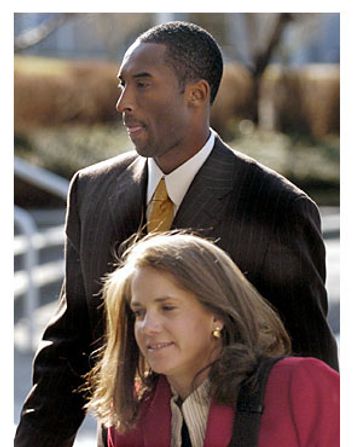
On Wednesday, the 19-year-old woman who accuses basketball star Kobe Bryant of raping her took the stand at a pretrial hearing in the Eagle County, Colo., courthouse. Apart from the usual explosive mix of sex and celebrity, the case has also generated heated debate about the rape shield laws that protect the accuser’s sexual history. The purpose of the closed-door hearing was to determine what, if any, parts of this history could be admitted into evidence at the trial.

The tactics of Bryant’s defense team, which has demanded access to the young woman’s mental health records and suggested that she had sex with three different partners in the days before and after the alleged rape, have been roundly deplored by feminists and victims’ rights advocates. In New York Newsday, writer Lorraine Dusky has slammed defense attorney Pamela Mackey for “amoral antics.” Wendy Murphy, a former sex crimes prosecutor who teaches at the New England School of Law and appears regularly on television, charges that the defense has exploited misogynistic myths about rape accusers — “that women are mentally ill, and vindictive, and lie for sport.”

But the reality is much more complicated. The Bryant case is only the latest example of the conflict between protections for rape victims and the constitutional rights of defendants — and a reminder of how excruciatingly difficult it can be to find a fair balance between the two.

There is no question that until the feminist rape law reform movement came along in the 1970s, the treatment of women in rape cases was often shameful. Just 30 years ago, evidence of the accuser’s “unchaste character” (extramarital relationships, the use of birth control, the habit of going to bars alone) could be introduced in a trial with the explicit goal of impeaching her testimony. Jurors were specifically instructed to consider such evidence in assessing the woman’s credibility and the probability of consent — on the charming theory that if she was a slut, she was also likely to be a liar and probably wouldn’t say no to any man.

By 1980, 46 states had instituted rape shield laws making the accuser’s prior sexual activity generally inadmissible in a sexual assault trial; today, such laws are virtually universal. However, they allow for certain exceptions — such as the woman’s past relationship with the defendant, or evidence that a sexually transmitted disease alleged to have resulted from the rape may have been due to consensual sex with someone else. In many states, other evidence may be admitted at the judge’s discretion “in the interests of justice,” though the burden is generally on the defense to show that its relevance outweighs the negative effects on the accuser. Likewise, the courts can sometimes admit into evidence the accuser’s medical history, including mental illness and drug abuse (which is protected by medical confidentiality laws rather than rape shield statutes).

In high-profile cases such as Kobe Bryant’s, the use of compromising personal information about the alleged victim invariably causes an outcry about “nuts and sluts” defense tactics (a term coined some years ago by legal scholar Susan Estrich). Victims’ advocates warn that rape shield laws are being eviscerated and that women will be discouraged from reporting sexual assaults. These are legitimate concerns, to be sure. Yet in some of these controversial cases, it seems clear that excluding the evidence in question would have been egregiously unfair to the defendant.

In 1991, a Maryland real estate agent named Gary Hart (no relation to the politician) was accused of raping a waitress he had been dating. The woman claimed that their relationship had been platonic, and that Hart had attacked her while she was staying overnight at his apartment. Hart claimed that they had been sexually involved, and that the woman had gotten angry because he refused to take her along on a trip. The defense was able to bring in evidence that Hart’s accuser had a history of emotional instability, had made several false claims of sexual assault to psychiatrists and police, and had on several occasions reacted to romantic rejection with outbursts of violent rage. Hart was acquitted.

The trial received extensive local coverage, and the use of the alleged victim’s troubled personal history in the courtroom was widely treated as if it were a gratuitous smear. A letter published in the Baltimore Sun asserted that even if the woman had not been raped by Hart, she suffered “a brutal form of abuse … inside the courtroom.” This curious logic ignores the fact that if Hart did not commit rape, his accuser was guilty of a pretty brutal form of abuse toward him — and that her reliability as a witness was key to the case.

In many other cases, the overzealous application of rape shield laws has resulted in miscarriages of justice. In a much-publicized 1998 case in New York, Columbia University graduate student Oliver Jovanovic was convicted of kidnapping and sexually abusing a Barnard College student whom he had met on the Internet. While Jovanovic claimed that the encounter involved consensual bondage, the trial judge ruled that the defense could not use e-mail messages in which the young woman had told him about her interest in sadomasochism and her S/M relationship with another man. Jovanovic was sentenced to 15 years in prison. His conviction was eventually overturned by an appellate court that held he was denied the chance to present an adequate defense — a ruling predictably deplored by feminist activists as a blow to victims.

And then there are the more obscure cases:

  • In Oregon, James Anderson was accused in 1989 of raping a fellow patient at a substance abuse clinic. He subsequently served a prison term. Anderson may or may not have been innocent, as he has consistently claimed; but the case against him was based solely on the woman’s testimony, and her serious credibility problems were kept out of the courtroom by the judge’s application of the rape shield law.
  • At the trial, the defense attorney questioned the woman about the fact that the morning after the alleged rape, she did not say anything about it to clinic staff members. The woman claimed that she was too embarrassed to talk about it; the prosecutor picked up on this point in his summation, scoffing that the defense expected a rape victim to “just walk up to one of the staff” and discuss “those most intimate details.” But there was something the jury didn’t know: The day before, she had discussed equally “intimate details” — an alleged earlier rape and childhood sexual abuse — with one of the clinic counselors. The jurors never heard the counselor testify about this and never saw his notes, which contained the comment that “client … has a lot of other issues around incest/rape,” because all information about the woman’s sexual history had been ruled inadmissible.

  • In 1993, Charles Steadman, an 18-year-old Wisconsin resident, was tried on charges of raping his 22-year-old foster sister. He claimed that the sex was consensual, and there was no evidence of force or struggle. The jury never found out that when the woman filed the complaint against Steadman, she herself was facing charges of sex with minors. (She was eventually convicted and received probation with mandatory psychiatric treatment.) The defense wanted to argue, quite reasonably, that this could have given her a motive to lie — particularly since she had earlier had a sexual relationship with Steadman when he was a minor. She might have thought that being a victim might improve her legal prospects as a defendant; she might have worried that if her encounter with Steadman became known, it would get her into more trouble with the law and with her family.
  • None of those possible motives could be introduced at Steadman’s trial: The alleged victim’s legal problems were related to her past sexual activities and hence inadmissible. Steadman was convicted and given an eight-year prison sentence.

    Like many such cases, the Kobe Bryant case is primarily a “he said, she said” matter, with ambiguous corroborating evidence that county judge Frederick Gannett characterized as weak even as he sent the case to trial. The woman’s sexual activities prior to the alleged rape may well be relevant to the physical evidence; if, as the defense has hinted, she engaged in consensual sex shortly after her encounter with Bryant, it may well be relevant to the question of whether she was raped; if she is mentally unstable, it may well be relevant to her credibility.

    These are wrenching questions. Obviously, a woman with a history of mental illness or substance abuse could still be a rape victim. Obviously, the prospect of having embarrassing personal details exposed in court (let alone paraded in the media) may discourage victims from coming forward. Just as obviously, suppressing relevant evidence may result in sending an innocent person to jail. And if it’s frightening to put oneself in the place of a sexual assault victim who finds herself on trial in the courtroom, it is no less terrifying to imagine that you — or your husband or brother or son — could be accused of rape and denied access to evidence that could exonerate him.

    For some feminists, the dogma that “women never lie” means that there is, for all intents and purposes, no presumption of innocence for the defendant. After the 1997 trial of sportscaster Marv Albert, defending the judge’s decision to admit compromising information about Albert’s sexual past but not about his accuser’s, attorney Gloria Allred decried “the notion that there’s some sort of moral equivalency between the defendant and the victim” — forgetting that as long as the defendant hasn’t been convicted, he and his accuser are indeed moral equals in the eyes of the law. Wendy Murphy has blasted Kobe Bryant’s attorneys for feeding uncorroborated rumors about the alleged victim to the media maw. Yet, appearing on Fox News, she made the claim, highly prejudicial to Bryant and so far untested in a court of law, that the woman “suffered pretty terrible injuries” the likes of which she had not seen despite having prosecuted “hundreds of sex crimes cases.”

    In a law review article published in 1977, when rape shield laws were being adopted across the country, Columbia University law professor Vivian Berger, generally a supporter of feminist law reforms, cautioned against “sacrificing legitimate rights of the accused person on the altar of Women’s Liberation.” Twenty-seven years later, we are still grappling with this issue, and Berger’s warning remains as timely as ever.

    Continue Reading Close

    Secrets and lies

    The most pernicious thing about racial preferences is the culture of concealment that they spawn.

    • more
      • All Share Services

    Secrets and lies

    The fortunes of affirmative action seem to be at their lowest ebb since President Johnson first invoked the phrase 36 years ago, in an executive order banning discrimination in hiring. In recent years, race-conscious policies intended to increase the representation of blacks and Hispanics in higher education and in public employment have been abandoned by some leading universities, outlawed by voter initiatives in California and Washington state and wounded by court rulings across the country.

    The latest setback took place in Michigan late in March. Judge Bernard Friedman of the U.S. District Court in Detroit ruled that the admissions system at the University of Michigan Law School was illegal because it favored black and Hispanic applicants. The decision, the implementation of which is on hold pending appeals, came less than four months after another federal judge in Detroit, Patrick Duggan, handed defenders of affirmative action a rare victory, upholding the university’s even more race-conscious undergraduate admissions policies. One or both cases could end up before the U.S. Supreme Court — which, given its current leanings, may well deliver a death blow to racial and ethnic preferences in college admissions.

    In a time when ideological polemics are generally muted, few issues arouse as much intensity as affirmative action — particularly when it comes to educational opportunities, long seen as the key to a better life. Yet, despite the passions, the debate remains hobbled by taboos. Even conservatives often soft-pedal their opposition to racial preferences for fear of being tarred as racist: It’s telling that when the topic came up in one of the presidential debates, George W. Bush gave an evasive answer proclaiming his support for “affirmative access.”

    Affirmative action’s defenders, too, have always thrown a smoke screen around the subject. For the most part, they staunchly and indignantly deny that there are any such things as quotas, race-based admissions or lower standards for minority applicants. Schools, they say, take race into account as only one of many factors in selecting students — just like geographical origin, community service or special talents and skills — as they are permitted to do under the Supreme Court’s 1978 ruling in Regents of the University of California vs. Bakke.

    Yet, apart from the question of whether government institutions should sort citizens by race to any degree at all, the claim that race has been merely a “plus factor” in admissions to public universities does not withstand factual scrutiny — which is why universities have long tried to keep these policies under wraps. Whatever the moral and practical virtues of diversity, one may legitimately ask if any system that requires Soviet-style secrecy and deception in order to function can fail to have a corrosive effect, not only on the academic climate but on race relations.

    The two lawsuits against the University of Michigan (filed by white applicants who claim that they were unfairly denied admission while less-qualified blacks and Latinos were accepted) provide some of the strongest evidence that at many schools, race or ethnicity has not been merely one of many ingredients in admissions but often the key ingredient.

    Until 1998, applicants to the undergraduate program at the university were evaluated on a chart based on SAT scores and grades, with separate criteria for different groups: Thus, with an SAT score of 930-1000 and a grade-point average of 3.2-3.3, white or Asian applicants were automatically rejected while blacks and Hispanics were accepted, sometimes into remedial programs.

    Meanwhile, the administration flatly denied the use of differential race-based standards for judging applicants. Finally, in 1997, philosophy professor Carl Cohen (no right-winger but a former director of the Ann Arbor chapter of the American Civil Liberties Union) used the Freedom of Information Act to compel the university to release its admissions data, including the evaluation charts.

    Faced with litigation and adverse publicity, the University of Michigan replaced the charts with a point system that emphasizes grades, downplays standardized-test scores and awards additional points for “other factors.” An “outstanding” essay is worth three points, and up to five can be given for extracurricular achievements or for “leadership and service” — but “underrepresented racial/ethnic minority identification” earns 20 points. (By the way, university officials continue to deny that there are any racial dual standards in admissions.)

    At the University of Michigan Law School, the race-conscious criteria have been less clearly defined but are just as obvious. For a black applicant, the chance of being admitted is three to 50 times greater than the chance of a white applicant with similar LSAT scores and college grades. In 1995, all African-American applicants with an LSAT score of 159-160 and a GPA of at least 3.0 were accepted, compared with just 2 percent of whites and Asians. Hispanics also benefited from preferential treatment, though less markedly.

    As Judge Friedman noted, the law school’s policies are “practically indistinguishable” from a quota system, which Bakke expressly forbids. In 1975, the school adopted a policy reserving 10 to 12 percent of slots for blacks, Latinos and Native Americans. Today’s guidelines only require admitting a “critical mass” of minorities; as it happens, that mass has consistently hovered between 10 and 12 percent.

    The situation is similar at other selective schools. Indeed, defenders of racial preferences implicitly acknowledge the central role of race when they fret that without preferences, minority enrollment at top universities and professional schools would plummet. That’s what happened when the University of California adopted colorblind admissions a few years ago. The numbers of blacks admitted into the freshman class at UC-Berkeley fell by more than 50 percent; for Hispanics, the drop was 38 percent. At Berkeley’s Boalt Hall Law School, the entering class of 1997 had one African-American student, down from 20 the previous year.

    Originally, affirmative action was explained as a temporary measure to help blacks overcome the obstacles posed by racial oppression and social disadvantage. But that justification has become hard to sustain 37 years after passage of the Civil Rights Act, when the beneficiaries of racial preferences in higher education are often children of middle-class professionals. So defenders of affirmative action have taken a new tack: Now, the argument is that diversity on campus enriches the experience of higher learning for everyone, and is so essential an educational benefit that it justifies racial classifications.

    The “diversity” rationale — which was embraced in Bakke by only one of the five justices who voted for affirmative action, Lewis Powell — may or may not have a solid constitutional basis. But does it have a basis in fact? The University of Michigan has touted an “Expert Report” by its psychology department chairwoman, Patricia Gurin, purporting to prove the benefits of diversity. Yet, as a recent paper published under the auspices of the National Association of Scholars (which opposes racial preferences) points out, Gurin substitutes apples for oranges: Mostly, she analyzes the impact of diversity-related activities such as participation in racial awareness workshops or ethnic studies classes, not of the racial composition of the student body. Moreover, while she finds that “diversity experiences” tend to have a positive, if small, effect on the quality of education, her measures of quality are based solely on students’ self-assessment of their intellectual growth in college. Gurin’s own data suggest, as does a larger study by psychologist Alexander Astin, that actual racial diversity has no effect on outcomes of education, be it academic achievement or civic engagement.

    Does this mean that racial diversity is not a desirable goal? Hardly. In a nation that embraces the ideals of equality and yet must live with a shameful history of racism, no person with a conscience can be unperturbed by the scarcity of African-Americans in our best colleges. The growth of the black middle class and greater racial integration can be seen, in part, as benefits of affirmative action. But what about the costs?

    According to advocates of colorblind policies, these costs include not only the injustice to white and Asian victims of reverse discrimination but the harm that affirmative action in its present form is doing to its original goals of racial equality and integration. Racial preferences, critics say, have the perverse effect of helping keep blacks in the back of the bus — and perpetuating the very racial gap in educational achievement that makes it impossible to achieve diversity without lowering standards.

    The argument that racial preferences stigmatize their own intended beneficiaries, sending them a none-too-subtle message that they can’t compete with members of other groups, has been made by a number of black conservatives, from Clarence Thomas to Shelby Steele. It is given a new twist in the powerful, controversial recent book “Losing the Race: Self-Sabotage in Black America” by John McWhorter, a black associate professor of linguistics at Berkeley.

    McWhorter’s principal concern is with the persistent educational underachievement of black Americans. The standard explanations of socioeconomic disadvantage and underfunded schools don’t hold up. Only 14 percent of black college students are from poor families. More depressing, in 1995, black students from homes with an annual income of $70,000 or more had lower SAT scores, on average, than white students with a household income below $10,000, and black students with at least one parent who had a graduate degree scored lower than the children of white high school graduates. It’s not just on the SAT that the academic gap shows up. In Shaker Heights, Ohio, a racially integrated, affluent suburb with high levels of school funding, black children make up about half of the students but fewer than 10 percent of the top fifth of their class and 90 percent of the bottom fifth.

    Racism isn’t the explanation either, argues McWhorter, since the black children of West Indian and African immigrants generally do quite well in school (a fact that should also rebut theories of genetic racial differences in intelligence). In his view, the real problem is that African-American culture is infected by a “virus” of hostility toward learning and academic excellence — a product of internalized racist stereotypes of black mental weakness combined with distrust of the values of the dominant culture. A smart, bookish black kid risks being taunted for “acting white.”

    The result, according to McWhorter, is that even middle-class black students who seem to value educational opportunities often perform far below their potential — not because of laziness but because of a “cultural disconnect,” a lack of commitment to schoolwork.

    McWhorter believes that some affirmative action is needed in public contracting and the corporate establishment, where racism can still hinder black advancement, but strongly opposes preferences in education. “Lower standards in college admissions only preserve the problem,” says McWhorter, interviewed by phone from his Berkeley office. “If a culture is already saddled with a legacy of racism that makes it distrust school, the last thing you want is a policy that doesn’t expect the best of its young people. Lower the bar, and you’re encouraging them to only do as well as they have to.”

    Some corroboration for McWhorter’s thesis comes from the testimony in the hearing on the University of Michigan Law School’s admissions policies — ironically, offered by the university to support its claim that LSAT scores don’t reflect merit. Jay Rosner, executive director of a foundation that provides LSAT preparation courses to minorities, testified that despite outreach efforts and reduced fees, black students generally show far less interest than whites in taking these courses, to such an extent that he once had trouble filling the 15 seats in a prep course at Howard University.

    One might object that cramming for the LSATs has nothing to do with real qualifications. But maybe the attitudes Rosner described do reflect on qualities that are relevant to success in law school, be it study habits or motivation.

    The system of racial spoils not only fails to challenge black students but also puts them in an environment where they are likely to lag behind their white and Asian peers — which is bound to have a further demoralizing effect. In their much-hyped 1998 book “The Shape of the River: Long-Term Consequences of Considering Race in College and University Admissions,” William Bowen and Derek Bok (former presidents of Princeton and Harvard, respectively) brush this issue aside, pointing out that “77 percent of black graduates who ranked in the top third of their class were ‘very satisfied’ with their undergraduate educational experience.”

    But that’s not very comforting, considering that some 200 pages earlier, Bowen and Bok acknowledge that the average black student at the 28 schools whose data they examined ranked in the bottom quarter of their class. And those in the top third would have had a good chance of being admitted under race-neutral standards.

    What’s more, black students at the institutions in Bowen and Bok’s sample were much more likely than whites to drop out — 21 percent vs. 6 percent. At some schools, attrition has been even more dismal. At Berkeley before the repeal of preferences, the black dropout rate was 42 percent, triple the rate for whites.

    Affirmative action opponents such as Stephan and Abigail Thernstrom, authors of “America in Black and White,” argue that minority students are far better off at schools where they can get in without special treatment. For many, this means less prestigious schools; under colorblind admissions in the University of California system, African-American and (to a lesser extent) Latino enrollment has shifted from UCLA and Berkeley to UC-Santa Cruz and UC-Davis. At the third most selective school, UC-San Diego, black admissions are down about one-fifth from the affirmative action era. Yet, as University of San Diego law professor Gail Heriot reported in the Weekly Standard, black students are now about as likely as whites to make the dean’s list, from which they were virtually absent five years ago. Under racial preferences, some of those UC-San Diego honors students might have been floundering at Berkeley instead.

    In “The Shape of the River,” Bowen and Bok try to counter this argument by citing numbers that show that black students who attended some of the most elite institutions, such as Harvard or Princeton, graduated at higher rates than blacks with similar academic credentials who went to less challenging schools. But the comparison may be meaningless; as the Thernstroms argue, the elite schools are set up in such a way as to make it difficult to get in and virtually impossible to flunk out. And it is surely absurd to suggest, as Bowen and Bok do, that a drop in the numbers of blacks at top-tier colleges and universities will seriously damage the black middle class.

    The suggestion that more black students “belong” at second-tier colleges may seem offensive. But isn’t it even more condescending when Bowen and Bok declare that the performance of minority students admitted to top schools thanks to affirmative action can’t be considered “disappointing,” despite a “very large” racial gap in grades?

    What’s more, while preferences make the campus population more diverse, they may also exert a pull toward racial Balkanization rather than integration. At many colleges and universities, “diversity” dogma includes programs that smack of separatism — special minority housing, special counseling, separate freshman orientation sessions and workshops — and often encourage students to develop an identity rooted primarily in race.

    The pitfalls of identity politics are illustrated by the rather confused rhetoric about the viewpoints and perspectives that minorities are said to bring to the classroom. Often, the clear implication is that there is a distinct “black [or Latino] point of view.” On the other hand, diversity champions often deplore the pressure on black students to express “the black perspective” in class discussions. Yet another claim, made at the hearing before Judge Friedman by some of the witnesses supporting the University of Michigan, is that the presence of a “critical mass” of minority students dismantles racial stereotypes by allowing nonminority students to see that there is no single “minority viewpoint.” However, it’s hard to escape the conclusion that the “diversity activities” on many campuses aim precisely to inculcate an orthodox minority viewpoint.

    In her report, the University of Michigan’s Gurin gushes about the interracial socialization made possible by diversity; but the data she cites from the Michigan Student Survey show that, sadly, black students are least likely to be involved in such interaction. Almost 40 percent of African-Americans said their relations with whites were often “guarded and cautious” or “somewhat hostile.”

    Do preferential admissions contribute to these tensions? McWhorter believes so. “Black students often suspect that white students feel that they got in through affirmative action — which they often did,” he says. “One way to reduce Balkanization would be if black students all got into school for the same reason as everybody else.”

    Finally, another major casualty of affirmative action, as mentioned before, is open debate.

    In “The Shape of the River,” Bowen and Bok note that “institutions have been reluctant to talk about the degree of preference given black students” partly out of concern that “the standing of black students in the eyes of white classmates would be lowered if differences in test scores and high school grades were publicized.” They make this point in the context of acknowledging that racial preferences may indeed have something of a stigmatizing effect. But the former university presidents seem oblivious to the fact that their statement reveals another serious problem: the existence of a taboo on discussing an important academic policy.

    Sometimes, this taboo can turn into attempts to impose outright censorship. Ten years ago, Timothy Maguire, a law student at Georgetown University in Washington, published an article in the Georgetown Law Weekly, provocatively titled “Admissions Apartheid,” that compared the credentials of white and black students entering the school. (He had obtained the data while working in the admissions office.) In the ensuing firestorm, there were calls for his expulsion and for a campus speech code prohibiting such “racial harassment.” The administration not only shamelessly denied the dual standards but launched disciplinary proceedings against Maguire for violating “confidentiality,” even though he had not disclosed any names and similar data had been circulated among the faculty in earlier years. Maguire was threatened with expulsion, though he got off with a reprimand.

    Other examples abound. At California State University at Sacramento, Janine Jacinto, a white student turned down by the graduate program for social work, learned about the central role of race in admissions (a straight-A average was worth three ratings points, while minority status was worth five) by sheer chance. While discussing her rejection with a professor, she was accidentally overheard by another student who had, apparently just as accidentally, picked up a photocopied ratings sheet in her advisor’s office, mistaking it for a handout. Jacinto sued the university, which eventually agreed to accept her, pay her legal fees and end race-based admissions in the graduate program — but tried to impose a gag rule on Jacinto as a condition of the settlement.

    In recent years, the legal and political battles over affirmative action have forced the issues out into the open, though the evasions continue and frank discussion of racial preferences remains difficult. A month ago, I was on a panel at Boston College Law School on diversity where everyone, myself included, tiptoed carefully around the elephant in the room — the dramatic racial disparities in applicant credentials, law school performance and subsequent rates of failure on the bar exam. To talk about it would have been tantamount to telling the black men and women in the audience that, academically, they probably weren’t as good as their white or Asian classmates.

    Already, bans on racial preferences have spurred a quest for alternative ways to admit more minority students, from deemphasizing or even abandoning the SAT (recently proposed by University of California president Richard Atkinson) to “percent solutions” under which state universities must admit anyone who graduates in the top 10 percent of his or her class (as the law now mandates in Texas). Interestingly, Judge Friedman explicitly suggested in his ruling that the University of Michigan Law School could have chosen such racially neutral ways of achieving a diverse student body.

    Other critics of affirmative action, however, are aghast at such proposals. The much-maligned SAT is still the best predictor of college performance. (Ironically, too, there is evidence that the exam with which Atkinson wants to replace it would indeed boost minority admissions — but the gain would come from Hispanics, while African-Americans would actually lose ground.) “Percent solutions” force universities to admit students from catastrophically shoddy schools who are incapable of doing college-level work.

    Some affirmative action defenders, including prominent legal scholar Ronald Dworkin, see these proposals as more evidence that ending preferences will have disastrous effects. “Political pressures to maintain racial diversity without racial preferences will destroy the great public universities by lowering the standards for everyone,” says Jeffrey Rosen, George Washington University law professor and legal commentator for the New Republic (and an ambivalent supporter of affirmative action).

    To McWhorter and the Thernstroms, the moral is that such pressures must be resisted. The real solutions, they say, can only be long term — boosting the school achievement of black and Hispanic students starting in kindergarten.

    In the short term, however, there are alternatives to watching the numbers of blacks at top schools dwindle while waiting for better times. Glenn Loury, a black conservative economist who has recently broken rank with his ideological comrades, partly over affirmative action, now supports some race-conscious remedies as long as they aim to improve performance rather than relax standards. His proposals include not only special summer courses but “provisional admission of black students to the state university, conditional on their raising their academic scores to competitive levels after a year or two of study at a local community college.”

    Of course, if racially exclusive, such efforts would still raise legal and moral questions. (Would it be fair to extend these opportunities to the black daughter of a lawyer and an executive but not to the white son of a gas station attendant and a salesclerk?) Still, this model of affirmative action would at least encourage achievement rather than condone underachievement.

    In the end, the question facing us is not whether America should do more to expand opportunities for blacks. It’s whether African-Americans deserve equal citizenship or benign white paternalism.

    Continue Reading Close

    Sex and science

    Are women discriminated against in the lab? Or are gender imbalances due to intellectual differences?

    • more
      • All Share Services

    Sex and science

    These days, it’s not unusual to see women’s names attached to major scientific discoveries. The team of physicists who succeeded in stopping a light beam earlier this year was headed by Harvard professor Lene Hau; astronomer Wendy Freedman was one of the three leaders of the Hubble Space Telescope Key Project, which measured the expansion rate of the universe.

    Nevertheless, science remains an overwhelmingly male field: At some leading research institutions, the percentage of women faculty in science departments is still in the single digits.

    Now, as the New York Times reports in its quarterly Education Life supplement, a movement that seeks to remedy bias against women in science is sweeping universities.

    But is this effort, which the Times says could “change the face of science education,” based on facts or myth? And is it championing gender justice or gender politics?

    A major victory for proponents of women in science occurred in late January when top administrators and professors from nine major universities — including Harvard, Princeton, Yale and Stanford — met at the Massachusetts Institute of Technology for a symposium on gender equity in science and engineering. They issued a terse though vague statement recognizing that “barriers still exist” and pledging to work for change.

    The location for the gathering was not chosen randomly. It was at MIT that the gender equity initiative was born a few years ago, from a study that has been both hailed as groundbreaking and assailed as “junk science.”

    The Study on the Status of Women Faculty in Science at MIT, publicized in the MIT faculty newsletter in March 1999, brought the issue of sexism in science into the spotlight. It became a big story for two reasons: MIT’s extraordinary admission that it had practiced unintentional but pervasive discrimination against women faculty, and the claim that the study had uncovered tangible proof of discrimination in pay and work space.

    “It was data-driven, and that’s a very MIT thing,” MIT School of Science dean Robert Birgeneau, a champion of the women’s cause, told the New York Times.

    Other schools scrambled to follow MIT’s lead; the Ford Foundation shelled out $1 million for similar studies. Columnist Ellen Goodman and others touted the MIT study as a rebuke to anyone who believed the battles for equal opportunity were over. The MIT women who had goaded the school into doing the study were hailed as heroines — particularly biologist Nancy Hopkins, whose complaint started it all.

    In April 1999, Hopkins was invited to a White House panel on equal pay, where President Clinton lauded the “courage [of] the administrators and women scientists” who “sought to make things right and … told the whole public the truth.”

    But did they?

    Anyone looking at the study should have spotted red flags. For one, the two committees that investigated gender bias at MIT were made up primarily of interested parties: aggrieved women professors. More important, the 150-page, single-spaced report that documented the committee’s findings was kept under wraps. What MIT released was a data-free summary that broadly discussed disparities in allocation of resources (with a passing acknowledgment that these disparities did not exist in all departments) and the women’s feelings of “marginalization” and misery. The published report also made no mention of rebuttals offered to specific charges of discrimination by several male professors and officials, which, according to Science magazine, were included in the full study.

    In December 1999, the Independent Women’s Forum, a conservative group based in Arlington, Va., published a sharp critique of the MIT report by University of Alaska at Fairbanks psychologist Judith Kleinfeld, who meticulously analyzed the study’s methodological flaws and accused MIT of producing a “political manifesto masquerading as science.”

    MIT officials continue to defend their decision not to divulge information about differences in salaries, lab space and perks because of confidentiality. But that makes it impossible to evaluate the study’s conclusions — for instance, one cannot judge whether differences in rewards were partly due to differences in seniority or achievement. The MIT report angrily brushed aside the merit issue, declaring that “the last refuge of the bigot is to say that those who are discriminated against … are less good.”

    However, a new IWF report, “Confession Without Guilt?” released days after the nine-university initiative was unveiled, bluntly states that MIT’s senior women — at least in the biology department, ground zero of the women’s revolt — were indeed less good.

    The IWF report’s authors, consulting behavioral scientist Patricia Hausman and Canadian psychologist and statistician James Steiger, looked at six male and five female faculty members who had earned their Ph.D. degrees between 1971 and 1976 and found that on average, the men had published twice as many research papers, received four times as many citations in scientific journals and raised more money in government grants. This cohort was not picked in order to stack the deck: Steiger notes that it didn’t even include two of the department’s three male Nobel Prize winners. (It is encouraging to note, however, that women who earned their doctorates between 1988 and 1993 were far more evenly matched with their male peers — though, as the recent New York Times article asserted, they were not more productive. It is worth noting that according to the MIT study, junior faculty women perceived no unfair treatment.)

    Hausman and Steiger concluded that if there were gender differences in compensation and resources at MIT, they may have been merit-based — and that the school had “jumped the gun” in issuing its mea culpa to avoid litigation.

    Is it possible that the senior women accomplished less because they were held back by sexism? “That’s a reasonable question,” says Hausman. “But why didn’t they say that in their report? What they said was that there was no conceivable situation to explain [the disparities], that to even suggest that there are productivity differences is bigotry.”

    In response to the new IWF attack, some women at MIT have questioned the group’s political motives and suggested that the MIT report was just an internal memo, not a study to be judged by scientific standards. Yet the report was so highly acclaimed precisely because it was supposed to be, as Hillary Clinton gushed at the White House meeting, the work of “some of the best scientists in the world,” who used “scientific method” to get the facts.

    Dissenters on the MIT faculty — and they do exist — are keeping mum. In 1999, physicist June Matthews, who sat on the first of the two gender committees, was quoted in the Chronicle of Higher Education as saying that there was “a lot of hype and hysteria” along with some well-founded complaints. Matthews now says that she “regrets” the Chronicle article and that she was misquoted. (Author Robin Wilson stands by the story.)

    Matthews also told me that while she “did not agree with everything” in the MIT report, she “strongly disagreed” with Kleinfeld’s critique — which she hadn’t read.

    To Kleinfeld, these comments suggest a climate of orthodoxy and intimidation. Whatever the reasons for Matthews’ apparent retraction, it’s clear that the real story about the gender bias allegations at MIT is shrouded in the kind of secrecy one might expect to encounter when writing about, say, Russian moles in the FBI.

    The plot thickens if one tries to pin down the details of the events that sparked the women’s complaint in 1994.

    It has been widely reported that after years of struggle, biologist Hopkins felt she’d had enough when she was removed from a course she had founded. She drafted an angry letter to President Vest about MIT’s mistreatment of women, then showed it to female colleagues who asked to cosign it — and the rest was herstory.

    But there are several very different versions of these events. According to the initial story in the Boston Globe, MIT told Hopkins that “it would discontinue a course she had designed” and that “a male professor [who] had joined her in teaching it … was going to turn the course into a book and a CD-ROM — without her.” According to the Chronicle of Higher Education, Hopkins’ “department took away a course she had helped develop” and gave it to “a male colleague.”

    The most recent version, in the New York Times Education Life quarterly, says that Hopkins “was dropped from a course she had developed with a male professor. He wanted to teach it with another professor, a man; they planned to turn the course into a CD-ROM and book.”

    MIT will not comment on the episode. But the records of past courses in the catalogs available at the MIT library don’t quite match any of these accounts. They indicate that in the fall of 1991, Hopkins started co-teaching an introductory biology course with a revised curriculum emphasizing “the general principles of biochemistry and modern genetics.” In 1994, she was replaced by a male professor who later published a textbook and CD-ROM on molecular biology. (He was also the principal author of two earlier editions of the course’s textbook.)

    A source at MIT told me this was Hopkins’ “stolen” course. Yet it’s hard to tell how much of a role she had in developing the new curriculum. In spring 1991, a slightly different version of the same revamped introductory biology course was taught by two other professors. In 1993, the two introductory biology courses were turned into two units of one course, both based on the same core curriculum but each covering some distinctive material.

    Also in 1994, MIT canceled a graduate course in animal virology that Hopkins had co-taught for several years, usually with two men; however, it had existed long before she became involved.

    When I e-mailed Hopkins asking for clarification, she declined to comment, saying that she had “no desire to embarrass any individual” — despite my promise not to disclose names or identifying details. Perhaps most remarkably, she suggested that the specific facts were less important than the larger patterns of sexism: “The particular events are almost irrelevant in fact. If it had not been those — it would have been others.”

    Hopkins’ story has another curious wrinkle. She has claimed that before her consciousness-raising experience, she “shunned” all things feminist, not wanting to be associated with “angry” women. Yet, for several years before she complained of discrimination, Hopkins had co-taught a reproductive biology course that dealt with sociopolitical as well as biological issues — and was cross-listed in women’s studies. That’s not a crime, but it does contradict Hopkins’ self-creation as a “reluctant feminist” (to quote the title of the New York Times article).

    Perhaps Hopkins was ill-used, whether it was sexism or simply academic politics. Clearly, at worst, she was nudged out of a course she had helped develop, not robbed of a course she had single-handedly designed as the early coverage implied. In any case, as Hausman, coauthor of the IWF report, points out, if a male scientist had accused female professors (unnamed but easily recognizable to colleagues) of serious misconduct, it’s doubtful that any media outlet would have unquestioningly aired such charges. Yet Hopkins’ tale of woe became a symbol of the indignities suffered by women scientists.

    Kleinfeld, Hausman and Steiger are careful to note that they are not claiming that women at MIT didn’t suffer discrimination, only that there’s no proof that they did. The IWF, known for its skeptical scrutiny of claims of women’s oppression, may have an ideological agenda; but so did the authors of the MIT report, and at least the IWF has been upfront about its numbers and methods.

    The MIT study aside, what’s the big picture?

    Reliable information on the treatment of women in science is hard to come by, partly because private institutions do zealously guard their data on salaries and benefits. Princeton’s recent statement that its bias investigation found no disparities was just as evidence-free as MIT’s “confession.” State universities are more open. Last fall, UCLA’s gender equity committee released a detailed report showing “small or nonexistent” salary differentials for men and women with the same rank, seniority and specialty. In physical sciences, seniority-adjusted compensation was actually somewhat higher for women; in life sciences, women were paid less but rose faster to the rank of full professor.

    Of the nearly 30 women professors or doctoral candidates at top research universities whom I have interviewed, about three-quarters believed they had not encountered any bias worth mentioning. Some were emphatic about it: “Nope, I’ve never experienced any discrimination [or] discouragement … and I’m not worried about any,” Emma Goldberg, a graduate student in physics at the University of California at Berkeley, wrote in an e-mail.

    Several younger women said that, if anything, being female was a plus, and a couple worried about receiving unfair advantages.

    Janice Jenkins, a senior professor of biomedical engineering at the University of Michigan, who became the first woman in her department in the 1970s, recalled being introduced by a dean at a meeting as “Ms. Jenkins” while others were addressed as “Professor,” and being casually asked by a colleague to photocopy some papers. Yet she unapologetically dismissed such minor insults as quaint things of their era, insisting that, overall, she had seen nothing but fairness and respect from male professors.

    The women who did see gender bias as a serious issue almost invariably spoke of problems that they themselves describe as “fuzzy” and nearly impossible to quantify, such as men’s tendency to feel more comfortable around one another and to think of “the boys” when considering someone for a symposium or a high-level position. Pamela Bjorkman, a biologist at the California Institute of Technology, mentioned incidents in which “if a woman is in charge of a project and someone needs information, they’ll talk to a man who’s not in charge … it would generally be just that they’re calling up a friend or something.” Ironically, as proof that all these intangibles have real effects, some women cited the MIT study.

    Do the intangibles matter? “People have grievances, and whether they’re attributed to the correct things or not is difficult to tell,” said Jennifer Widom, a professor of computer science at Stanford. “I tend to believe hard facts when they’re produced correctly, and I’m more skeptical of these nebulous things.” Jenkins was more explicitly scornful of “all these petty stories” and of the handwringing about the “climate” for women.

    Some critics of gender-bias claims may be too quick to dismiss issues raised by advocates for women in science. Hausman scoffs at the notion of men helping each other get ahead, since “men often treat each other abominably.” Yet it’s entirely possible for men to compete ferociously with some men and form cliques with others.

    Still, given the triviality or amorphousness of many complaints, it’s hard not to conclude that women would be better served by Jenkins’ no-nonsense approach. So what if a man who needs information on a research project calls a male friend on the team rather than the female team leader? Surely, too, women may in fact misattribute personal or professional conflicts to sexism.

    Biologist Bjorkman, who is convinced that women face significant gender-based barriers, nonetheless concedes that “most academics feel they’re getting a raw deal.” Competition in science may be especially rough. A 1999 New York Times article about feuds in science featured tales of bitter fights over credit for joint work and of debates so acrimonious that some of the combatants stopped attending scientific conferences.

    When women get embroiled in such disputes, there is little doubt that at least sometimes, the gender card is played. Take an episode recounted in the 1999 Science magazine article on women’s struggles in science, involving Margaret Geller, an astronomer at the Harvard-Smithsonian Center for Astrophysics.

    Under the rules of the center, its members who are Smithsonian employees, including Geller, are not eligible for Harvard tenure. Yet, in 1997, Harvard offered Geller the Mallinckrodt chair, normally given to outstanding tenured researchers.

    Far from being pleased, Geller was furious when she learned that tenure wasn’t part of the package; she refused to accept the chair and accused the university of sex discrimination, even though six men at the Harvard-Smithsonian Center were in the same boat. At one point, Harvard considered granting tenure to all Harvard-Smithsonian professors; this only further enraged Geller, who felt that she shouldn’t have to share the honor.

    It may seem insulting to suggest that brilliant female scientists may see sexism where there is none or, worse, exploit baseless allegations of sexism to their advantage. But why not, if we are ready to believe that brilliant male scientists are capable of Archie Bunker-like behavior? Bright and talented people of either sex can be thin-skinned, abrasive egomaniacs; women just have the option of giving such behavior a feminist gloss.

    Most women scientists, including those who are confident that they have not run up against gender-based barriers, welcome gender equity initiatives. Harvard biologist Joan Brugge believes that the publicity surrounding the MIT study may have made many women more willing to walk into a department chairperson’s office and talk about salary and perks — just as many men have done for years.

    Even if the past inequities have been exaggerated, is there anything wrong with the current crusade to make things better for women in a heavily male-dominated field? There may be, if this crusade ends up sacrificing science to politics. If concern about unfair treatment boosts some women’s assertiveness, it may cause others to develop a hypervigilance that does them little good. One black female professor told me that if she encountered a situation that seemed unfair, she couldn’t tell if it was due to her gender, race, girlish appearance or imagination — and concluded, “It could drive a person completely batty.”

    Nor is it much of a prescription for collegiality if men feel they must walk on eggshells around women. And ostensibly pro-feminist talk about the need for special “sensitivity” to women can sound disturbingly like old-style paternalism.

    There also is the issue of affirmative action, which most champions of women in science regard as absolutely essential. The policies they endorse include not only efforts to ensure that women candidates are considered but blatant “reverse discrimination,” from “target of opportunity” hiring in which a search is limited only to women to special monetary incentives for departments to hire women.

    Aside from the not entirely insignificant issue of fairness to men, there is the stigma that may cling to women as a result. Lynne Hillenbrand, an astronomer who recently got a junior faculty post at Caltech, is one of a number of women who find the idea of special accommodations offensive. “If you’re given an opportunity for the reason of being female, it doesn’t do anyone any favors; it makes people question why you’re there.”

    One of the few specific goals outlined in the nine-university statement was “to work toward a faculty that reflects the diversity of the student body.” But how realistic is that? In the physical sciences, even today only about a quarter of Ph.D. degrees go to women. Meanwhile, turnover in universities is notoriously slow. Professorial ranks are still full of people who started their academic careers 30 or 40 years ago — nearly all of them men. (In 1960, women received 10 percent of doctoral degrees in biology and fewer than 4 percent in the physical sciences.)

    A faculty that looks like the student body is, for the foreseeable future, a utopian goal; but, as Hillenbrand points out in a recent article in Status, the newsletter of the American Astronomical Society Committee on the Status of Women in Astronomy, aggressive attempts to achieve it can create “an environment where women are clearly preferred over men in faculty/staff hiring” — an environment in which she, for one, doesn’t particularly care to work. The only fair solution, she concludes, is “to live with the historical inequities until they are slowly repaired with nonbiased hiring.”

    Some believe that female scientists will always face special problems as long as the numbers are so skewed. Why, then, are relatively few women still entering the sciences?

    Conventional explanations include discrimination, gender stereotyping and general oppression. But it’s not clear why these barriers would operate in science or engineering so much more than in other traditionally male fields like law and medicine, where women now earn close to half of professional degrees; psychology, where women’s share of doctorates has gone from 15 percent in 1960 to a staggering 67 percent in 1998; and even biology, where women made up about a third of doctoral scientists in 1995, compared with 5 percent in physics.

    Judith Kleinfeld believes that the explanation lies, at least in part, in innate intellectual differences between the sexes. She points out that while overall sex differences in mathematical ability are insignificant, males vastly outnumber females at the top of the scale; the gap is even greater in visual-spatial reasoning. Politically correct or not, many scientists (including women such as Canadian neurobiologist Doreen Kimura) believe these differences are influenced by hormones.

    Even mathematically gifted girls are less likely than boys to pursue careers in the hard sciences. Kleinfeld is convinced that this is largely a result of free choice. She points to her own daughter, a mathematically gifted Rhodes scholar who now works in third world development projects. “I did everything to get her interested in a scientific career,” says Kleinfeld. “She told me, ‘I’m not your guinea pig for the advancement of women in science. I want to work with people.’”

    Kleinfeld argues that interest in people and “living things” rather than objects and abstract ideas is more characteristic of women, as is an inclination toward careers that allow more room for family and for a balanced life.

    Interestingly, some advocates for women in science recognize the role of these preferences. Their response, however, is to argue that the culture of science should change. A 1993 article in Science on women’s attrition from scientific fields deplored such “outmoded stereotypes” as “an emphasis on scientific knowledge independent of real-world uses and an image of scientists as obsessed with science to the exclusion of other human endeavors.”

    But what if trying to jettison these “stereotypes” results in the loss of something essential to scientific pursuit at the highest level?

    It’s too early to tell whether the sex differences that make science a predominantly male field are impervious to societal change. Perhaps in the future, it will be more common for women to combine motherhood with a high-pressure career by ceding the primary-caregiver role to fathers. Perhaps we will shake off the still-lingering cultural message that a real woman must be a “people person.”

    In the meantime, girls and young women are already making dramatic strides in science. Female high school students now take more mathematics and science courses than their male peers; in recent years, girls have made up close to half of semifinalists, about 40 percent of finalists and about a third of the winners in the Intel (formerly Westinghouse) Science Talent Search. Remarkably, the last winners of the top award, sometimes dubbed the “junior Nobel Prize,” have been girls — two of whom did projects in physics.

    Few would object to extra efforts to encourage girls to pursue an interest in science. But these efforts may not always pay off. While female science majors are more likely to continue in the field if they receive encouragement from parents and teachers, a study included in a 1998 National Science Foundation report also shows paradoxical evidence of the opposite pattern: young women picking a science major to please an adult authority figure, and then dropping out because their heart isn’t in it.

    Of course we should ensure that women with talent and passion for science have the same opportunities as men — even if such women are fewer in numbers. What doesn’t help is to insist that numerical imbalance, or some women scientists’ feelings of unhappiness, is proof of inequity. In the end, such a mind-set may only ensure that many women scientists will never find true satisfaction in their careers.

    Continue Reading Close

    One good reason to vote for Bush

    Social Security is on its last legs, and the limited privatization backed by the GOP candidate can save it. But Al Gore won't even admit there's a problem.

    • more
      • All Share Services

    One good reason to vote for BushRepublican presidential candidate Texas Gov. George W. Bush delivers a speech on Social Security at the Rancho Cucamonga Senior Center, in Rancho Cucamonga, Calif., Monday, May 15, 2000. Bush outlined a plan that would allow workers to invest part of their payroll taxes in private accounts. (AP Photo/Eric Draper)(Credit: Associated Press)

    This year, Social Security turns 65, the retirement age set by its own rules — a milestone rich with ironic symbolism at a time when a growing chorus calls for retiring the system itself. Moving from a government system to private retirement accounts was once a fringe libertarian fantasy. Now, partial privatization of Social Security is a mainstream Republican proposal. In a mostly lackluster, idea-free presidential race, Social Security reform is one issue that highlights a basic philosophical divide between the two candidates. It’s also at least one good reason to root for George W. Bush.

    The grandmother of all middle-class entitlements, Social Security is undoubtedly the most popular government program in America, credited with dramatically reducing old-age poverty. Yet it has a major structural flaw that you don’t need to be a whiz to grasp. The people who work and pay into the system are financing the benefits of today’s retirees while relying on the next generation of workers to fund their future benefits. However, there are fewer and fewer workers supporting more and more beneficiaries — both because people are living longer and staying around to collect the checks, and because birth rates fell sharply after 1960. In 1950, the ratio of workers to pensioners was 16 to 1; today, it’s 3.3 to 1, and in 25 years it’s projected to drop to 2 to 1.

    The postwar baby boom followed by the baby bust has obviously worsened the problem. But any pay-as-you-go retirement program will always be at the mercy of such demographic vagaries. Surveys in recent years have found widespread popular support for reforms that would let people invest a portion of their Social Security contributions in the stock market. In a Washington Post/ABC News poll in September, 75 percent of registered voters 18 to 30 years old, 66 percent of those 31 to 44 and 57 percent of those 45 to 60 endorsed such proposals.

    Naysayers — from leftist economist Robert Kuttner to columnist Ellen Goodman — are wont to dismiss the new enthusiasm for privatization as a myopic, irrational response to the booming economy and the soaring Dow Jones. (Some anti-privatizers greet every market downturn with barely disguised glee.) But when you know how well your money could do in the private market, it’s pretty irksome to hand over 6.2 percent of your salary — 12.4 percent if you count the employer’s share — to Uncle Sam for a promised annual return rate of 2 percent. It’s especially galling for self-employed people like me, who have to shell out the entire 12.4 percent out of their own wallets.

    In fact, estimates of how retirement savings would have fared in a private system are based on long-term trends, including the downturns and the crashes. Even before the current boom, from 1929 to 1996, the average annual return rate on market investments was about 7 percent.

    Besides, the popularity of privatization (which began to show up in the polls in 1994) also has to do with a sense of a looming crisis. That bite taken out of your paycheck really hurts if you doubt you’ll ever collect the reward, even at 2 percent interest. According to the latest report from the Social Security Board of Trustees, issued in March, by 2015 revenues from payroll taxes will not keep up with the benefits. To keep the checks coming, the government will have to use the “trust fund,” the Social Security surplus accumulated since 1983 — which, by current estimates, will be empty by 2037. Then, the only way to keep the system alive will be to hike the payroll tax, slash the benefits or both.

    But that’s only the half of it. There’s no actual money in the “trust fund,” only bonds the federal government has issued in return for borrowing the payroll-tax surplus to finance other operations. To draw on the trust fund for Social Security payments, those bonds will have to be redeemed — for which, in the words of the Washington Post, “the government will have to find the money somewhere.” Presumably somewhere in our pockets. Or somewhere else in the federal budget, which means squeezing other programs.

    The man and woman in the street may not know the details, but they do know something is seriously wrong. In a June 1999 Gallup poll, nearly three out of five agreed that Social Security needs a complete overhaul or major changes.

    In 1996, the Social Security advisory council appointed by President Clinton unanimously concluded that investing in the stock market was the only way to save the system, though it was sharply divided on how that should be done. Six of the 13 members wanted the government to invest payroll tax revenues; seven favored individual investment accounts, and five of those seven backed a plan that would allow people to put nearly 80 percent of the employee share of the Social Security tax, or 5 percent of their earnings, into private retirement savings. That’s considerably more radical than Bush’s plan, under which only 2 percent of earnings, or 33 percent of the employee share, could be diverted into individual accounts.

    Some would go much further. The Cato Institute, a libertarian think tank in Washington (where I have an unpaid position as a research associate), champions a gradual transition to a fully private pension system based on the Chilean model. Social security privatization in Chile, launched in 1981, could be seen as tainted by its association with the Pinochet regime. Still, the fact remains that these reforms have been highly successful; they have won converts among initially hostile labor leaders and inspired several other Latin American countries, including Argentina and Mexico, to adopt similar programs. Chilean workers are required to deposit 10 percent of their salaries into personal savings accounts, managed by private investment companies that are subject to government approval and regulations prohibiting high-risk investments. An additional 3 percent goes to disability insurance. A government safety net guarantees any retiree a minimum income equal to 40 percent of average wages — similar to the average benefit in the United States.

    The real question is not whether a privatized retirement system would work better, it’s how to get there from here — how to allow workers to take their money and opt out of the state-run system while preserving the benefits due to retirees and those nearing retirement. Bush has been accused of ducking the tough issues, and it’s true that he hasn’t done a very good job of explaining his plan. Many privatization proponents argue that the massive infusion of money into the market would spur economic growth and boost tax revenues. If that’s a little too iffy, the budget surplus offers an excellent opportunity to help pay for the transition. (It won’t be cheap: economist Paul Krugman estimates that Bush would need to put aside half a trillion dollars out of the surplus to pay for transition costs.)

    Meanwhile, Al Gore decries Bush’s limited privatization proposal as “risky,” while promising new benefits that would worsen Social Security insolvency and ducking tough questions about his accounting at least as much as Bush does. A parody of the presidential debates making the rounds of the Internet, in which Gore proposes “changing the laws of mathematics to allow us to give $50,000 to every senior citizen without having it cost the federal treasury a single penny until the year 2250,” is not so far off the mark.

    An article Tuesday in the Washington Post — which has endorsed Gore and can hardly be suspected of bias against him — points out several serious problems with Gore’s approach to Social Security reform. It concludes, “Without saying so directly, Gore would have the country wait to see if the anticipated crisis in Social Security really exists.” Some economists do, in fact, believe that everything will be fine if productivity growth outpaces the Social Security trustees’ cautious predictions; but this head-in-the-sand approach still sounds pretty risky.

    Moreover, Gore wants to draw on general revenues, not just payroll taxes, to help finance Social Security. As the Post notes, “This would place the retirement system in competition with defense, healthcare, education and other programs for possibly scarce resources. Social Security was set up to be self-financed through the payroll tax so it wouldn’t be subject to such political pressures.” Under Gore’s plan, retirement benefits may be safe from the whims of the market but not from those of politicians. And, unlike Bush’s proposal, which would also require massive short-term infusions of cash, Gore’s approach would not provide a long-term solution to Social Security’s structural flaws.

    Of course it would be nice if Social Security privatization had a spokesman other than Bush; the man probably couldn’t make a convincing case for celebrating Mother’s Day, let alone privatizing retirement benefits. Perhaps it isn’t very smart for him to talk about using the budget surplus for a big tax cut in the same breath that he talks about using it to finance Social Security benefits during the transition. But Gore’s handling of this issue has been truly pernicious. What he proposes is the equivalent of doing nothing about a tumor that is more likely than not to turn cancerous. Worse, he has sought to demonize the very idea of privatization and to discredit it as a crackpot right-wing notion, conveniently forgetting to mention that it has been championed by quite a few eminent Democrats — including Sen. Daniel Patrick Moynihan of New York, Sen. Bob Kerrey of Nebraska, and Gore’s own running mate, Joe Lieberman. That is, the old incarnation of Lieberman, before he was picked as Gore’s running mate and dropped his politically incorrect beliefs.

    At some point, discussions of Social Security inevitably get bogged down in competing numbers, formulas and economic projections. Each side brandishes its own calculations and accuses the other either of panic-mongering or of excessive optimism. But perhaps, in the end, this debate is about philosophy, not economics.

    The reason Gore so adamantly opposes any steps toward privatization, I suspect, is not just that he’s pandering to the senior citizens (well, that too), but that he viscerally dislikes reforms that would minimize the state’s control over a major sphere of American life. On some fundamental level, he really does believe that government knows best.

    The rhetoric of many other privatization opponents shows an even more ideological hostility to markets (one even comes across such comical clichés as “the shark-infested waters of Wall Street”) and individualism. In a New York Times op-ed column in May, Princeton economist and Gore advisor Alan Blinder wrote that “universal social insurance is one of those precious ties that bind our society together,” forcing the affluent to share their wealth with the less fortunate, and that “privatization, whether partial or total, would weaken that tie.”

    Never mind that privatization critics like Blinder are unabashedly condescending to the poor, presuming that they won’t be able to invest wisely. And never mind that in many ways, the current Social Security system actually robs the poor to pay the rich. Yes, lower-income workers get a higher dividend on their contributions, but they also pay a higher portion of their income into the system because earnings above $76,600 a year are exempt from the payroll tax, as are other forms of income such as capital gains and interest from savings or investments. The poor are also likely to get less out of the system because, like it or not, they generally do not live as long as the well-to-do. (In a privatized system, any retirement savings you don’t live to collect would go to your heirs. In the current government-run system, the surviving spouse gets only 50 percent of the benefits and adult children get zilch.) While they live, the elderly poor are, not surprisingly, far more dependent than the affluent on Social Security benefits, since they are far less likely to have savings, stocks, and private pensions. So, if Social Security goes bust, the poor will suffer much more.

    Unlike some of my libertarian friends, I believe we have an obligation to provide a safety net for the less fortunate, and that the government is often the most effective vehicle for doing so. But why not do it honestly? If we’re going to help those who can’t help themselves for various reasons, let’s pay taxes explicitly allocated to such programs. If we’re setting money aside to take care of ourselves, then let’s have a real savings system in which that money belongs to us. Social Security is based on the illusion — or, to put it more bluntly, the lie — that the payroll taxes we pay aren’t really taxes but contributions toward our retirement.

    Besides, while mutual care may be a noble principle, so is freedom of choice and the ability to control the fruits of our labor. Bush may not sound very persuasive or passionate when he talks about empowering ordinary people, but personal savings accounts would be a real form of empowerment.

    A couple of years ago, in a diatribe against those who would hand over our retirement trust fund to those Wall Street sharks, psychologist Theodore Roszak — an erstwhile prophet of the 1960s Age of Aquarius — angrily charged that the “privatizers” hate Social Security because it “stands as evidence that self-interest and the profit motive cannot be relied on to provide for the public good.”

    But maybe it’s the other way round. Maybe the anti-privatizers hate privatization because its success would stand as evidence that self-interest and the profit motive (with some regulatory protections) can do more for the public good better than idealistic but ill-conceived bureaucratic schemes.

    Continue Reading Close

    A man’s right to choose

    Is it fair that women have reproductive rights while men have reproductive responsibilities?

    • more
      • All Share Services

    A man's right to choose

    In the wake of the Food and Drug Administration’s recent approval of the abortion drug RU-486, there were familiar arguments about a woman’s right to choose vs. the unborn child’s right to life, as well as speculation about ways in which the drug would change the terrain of the abortion wars. As usual, though, these discussions completely ignored one group of people who still have no legal voice in decisions about having — or not having — children.

    They’re called men.

    It is widely assumed by activists on both sides of the debate that legal abortion puts women on equal footing with men, giving them the same freedom to enjoy sex without consequences. Actually, when sex results in conception, the man and the woman find themselves on very unequal footing.

    If she does not want to be a mother, a woman can end the pregnancy, with or without her partner’s knowledge. (It’s hard to tell how RU-486 will affect a woman’s ability to exclude the man from her decision; a drug-induced abortion at home may be more private and less invasive than surgery at a clinic, but it’s not easy to hide from an intimate partner.)

    If she wants to carry her baby to term, a woman can force the father to pay child support — so, as lawyer Melanie McCulley points out in a 1998 article in the Journal of Law and Policy, he “does not have the luxury, after the fact of conception, to decide that he is not ready for fatherhood.” A woman also can have a baby and not tell the father, making a unilateral decision to give the child up for adoption or raise it on her own.

    To some extent, this inequality stems from the obvious fact that a woman’s body is the vessel for gestation and the vehicle for birth. Once upon a time, biology colluded with cultural and legal male privilege to ensure that women generally paid the price for illicit sex. Scientific progress and the advancement of women changed that. Even as reliable contraception and legal abortion allowed women to control their reproductive fates, their ability to hold absentee fathers financially liable for their children was enhanced by new methods of establishing paternity enforced by friendlier courts.

    “In the old days, a woman’s biology was a woman’s destiny,” writes Warren Farrell, author and men’s issues advocate, in the forthcoming book “Father and Child Reunion” (to be published in January). “[T]oday, a woman’s biology is a man’s destiny.”

    The rhetoric of pro-choice advocates rarely mentions men at all, except to celebrate women’s freedom from male control over their reproductive lives. Anti-abortion rhetoric occasionally refers to bereaved fathers of aborted fetuses but more often invokes evil males for whom legal abortion makes it easy to seduce and abandon women, and who may even coerce women into having abortions.

    Many men, and some women, see a very different situation — one in which women have rights and choices while men have responsibilities and are expected to support any choice a woman makes. “If she wants an abortion, he’s supposed to shut down all of his emotional bonding to the child,” says Fred Hayward, founder of the Sacramento, Calif., group Men’s Rights Inc. “Then, if she changes her mind and decides to have the baby, he’s supposed to turn it all back on and be a father.”

    Hayward’s opinion is shared by Ron Henry, a Washington attorney (married with three children) who works pro bono promoting shared parenting by divorced and unmarried parents: The expectation that men will “switch” to support the woman’s change of heart, Henry says, is “a fundamental denial of men’s humanity, as if they just exist to make the woman happy.”

    Activists aside, where do most men fit into the picture? Tellingly, very few studies have looked at the men implicated in unwanted pregnancies. The only book on the subject, apparently, is the 1984 volume “Men and Abortion: Lessons, Losses, and Love” by Drexel University sociologist Arthur Shostak and journalist Gary McLouth, based on a survey of 1,000 men in abortion-clinic waiting rooms and some in-depth interviews.

    Most men in the survey reported that ending the pregnancy was a mutual decision, and only 5 percent didn’t want the abortion — though nearly half of the single and divorced men said that they had suggested getting married and having the baby. As for the roughly 50 percent of men who don’t show up at the clinics, various estimates cited by Shostak and McLouth suggest that while some fit the stereotype of the feckless runaway male, a significant percentage oppose the abortion or are too upset about it to come along. As many as one in six men are never told about the pregnancy or the abortion.

    Some men who spoke to the Bergen (N.J.) Record a few years ago for an article on men and abortion keenly felt their powerlessness. Bill, a builder, was ecstatic when his fiancée became pregnant. Raised in a broken home, he dreamed of being the caring father he never had. His joy turned to grief when she told him she had miscarried — and agony when he came across a receipt from an abortion clinic.

    “I cried for two hours, then went into my truck and just drove and drove for hours,” recalled Bill, who was 25 at the time. “I hadn’t even been given a chance to say yes or no to that baby … OK, she was the one carrying it, but I was never even consulted.”

    When he confronted his 20-year-old fiancée, she told him she felt too young for motherhood. Somehow, they worked things out; in less than a year, she got pregnant again and assured Bill that she wanted to have the baby. Several weeks later, after a fight about buying a house, she went to stay with a friend for a few days “to clear her head” — and had an abortion. When her sister called to tell Bill, he screamed with anguish and rage, threw some lamps around and smashed all the framed photos of them together; after cleaning up the mess, he went to a bar and drank himself senseless. His fiancée actually returned, but they soon broke up.

    “I couldn’t get over the pain,” said Bill. “I didn’t even date anybody for a year, and I lost all interest in sex. It was a long time before I could trust anyone again.” (At the time of the interview eight years later, he was happily married, with a stepson he had adopted and a baby on the way.)

    Of course, men’s lack of reproductive rights has another side: being forced to assume the burden of unwanted parenthood, at least financially. In the eyes of the law, it seems that virtually no circumstances, however bizarre or outrageous, can mitigate the biological father’s liability for child support, as an overview of cases published in Divorce Litigation journal in 1999 shows.

    Did the woman ask him to impregnate her and sign an agreement relieving him of any financial obligations? He’s still liable if she changes her mind. Was he underage and legally a victim of statutory rape? Makes no difference. (One such case, in Kansas in 1993, involved a 12-year-old boy molested by a baby sitter.) Did the woman have her way with him when he had passed out from drinking and brag to friends that she had saved herself a trip to the sperm bank? Tough luck, said Alabama courts. Did she retrieve his semen from the condom she had asked him to wear during oral sex and inseminate herself with a syringe? Yes, it’s a true story, and in 1997 the Louisiana Court of Appeals told the man to pay up, saying that a male who has any sexual contact with a woman — even oral sex with a condom — should assume that a pregnancy may ensue.

    Even in less dramatic cases that involve sex between two consenting adults with no coercion or deception, there is a fundamental imbalance. A woman who gets pregnant in her freshman year in college can decide that she’s not ready to be a mother, or that having a child would disrupt her life too much. A man can find himself in the predicament of “A Dad Too Soon in N.J.,” a 27-year-old newlywed graduate student who wrote to Ann Landers that he got a young woman pregnant as a “very naive” 18-year-old and tried in vain to persuade her to have an abortion or put the baby up for adoption. The woman had recently filed for child support, and he was “burned up” about having to make payments he couldn’t afford for a child he had never wanted — a child that, as he saw it, the mother alone decided to bring into the world. (Predictably, Ann’s response was that “Dad” should quit whining and meet his obligations.)

    Some argue that the law should treat women and men more equally. One proposed measure is “veto for fathers,” which is as simple as it sounds: No abortion can be performed without the prospective father’s consent. (Proponents of this idea do stipulate that a man who blocks an abortion must be willing to take full responsibility for raising the child.)

    The language of the Veto 4 Fathers Web site strongly suggests a general anti-abortion agenda. But the idea is also endorsed by men’s and fathers’ groups, such as Fathers for Equal Rights and the National Coalition of Free Men (NCFM), which emphasize that their position on the issue of choice is distinct from that of the pro-life movement.

    The NCFM’s “Declaration of the Father’s Fundamental Pre-Natal Rights,” adopted in 1992, states that “the prospective father has the fundamental right to participate with his partner-in-conception in any decision affecting the future of the fetus he helped create” and “a fundamental right of custody” equal to the woman’s.

    A competing proposal, “Choice for Men,” leans in favor of the partner who doesn’t want to be a parent: It would allow a man to legally “abort” his parental rights and responsibilities within a limited time of being notified of the pregnancy.

    “Ending paternity suits against men is the equivalent to legalizing abortion for women,” Hayward of Men’s Rights Inc., wrote in the Berkeley, Calif., alternative weekly the Spectator in 1992. McCulley’s article in the Journal of Law and Policy, provocatively titled “The Male Abortion,” endorses this idea and features a model statute under which an unwed father could petition for paternity termination.

    So far, neither paternal veto nor male choice has much chance of becoming law. While polls show that at least two-thirds of Americans believe a husband should be notified before his wife has an abortion, and a majority may even favor a father’s right to block an abortion, the Supreme Court does not agree. In 1976, the court struck down abortion laws mandating spousal consent; in 1992, in Planned Parenthood vs. Casey, it also nixed spousal notification requirements as an “undue burden” on women seeking abortions.

    In the 1980s, some men managed to obtain court injunctions or restraining orders barring their wives, ex-wives or girlfriends from having an abortion, but all these orders were thrown out by appellate courts. (Almost invariably, the women went ahead and had the abortion anyway while the injunction was still in force.)

    As for “men’s right to choose,” the federal judiciary has yet to tackle this issue. Six years ago, the National Center for Men in New York announced its search for a plaintiff for a “Roe vs. Wade for men” lawsuit, an effort that attracted some media attention but ultimately fizzled.

    Some men fighting paternity claims in several states have tried to argue, so far without success, that “forced parenthood” denies equal protection for men as long as women have the right to abortion. Peter Wallis, a New Mexico real estate broker, was equally unsuccessful in his suit against his ex-girlfriend, Kellie Smith, in 1998 for “intentionally acquiring and misusing” his bodily fluids by getting pregnant against his wishes; after a flurry of publicity, the case was tossed out. A few family court judges have sided with men who could prove that they were deliberately trapped — for instance, that the woman lied about using birth control — but none of those decisions survived on appeal.

    If such a case does go to the Supreme Court, the equal protection argument is unlikely to hold up. It doesn’t take a brilliant mind to make the case that men and women are not similarly situated with regard to pregnancy and childbearing. Moreover, under prevailing constitutional doctrine, unequal treatment of the sexes, while generally presumed to be illegal, can be justified (unlike race discrimination) by a “compelling state interest” — such as ensuring adequate support for children already born.

    Legal issues aside, do champions of men’s reproductive rights have a moral leg to stand on? Are they apologists for male fecklessness or male dominance, backlashers who resent women’s new rights, or cutting-edge fighters for equal justice?

    The objection to paternal veto is easy to understand: A woman has physical primacy in every case. In surveys and interviews, even men who resent having so little say when it comes to dealing with a pregnancy generally agree that the woman should have the final word. (In Shostak’s abortion clinic sample, nearly 60 percent of men agreed that a boyfriend should have input in the abortion decision, and 80 percent felt a husband should have an equal role — yet, somewhat paradoxically, 60 percent agreed that if a wife wants the abortion, she should have it even over her husband’s objections.)

    It is not necessarily a sign of anti-male bias, as men’s advocates contend, that a man’s ability to control his income and his labor isn’t accorded the same respect as a woman’s ability to control her body. In our culture, bodily autonomy is seen as a more fundamental value than property; that’s why chopping off an offender’s finger seems to us far more barbaric than stiff financial penalties or even forced labor.

    And yet, in a broader sense, men’s autonomy is an issue. Advocates of choice for men like to cite a passage from a Planned Parenthood statement, “9 Reasons Why Abortions Are Legal”: “At the most basic level, the abortion issue is not really about abortion. … Should women make their own decisions about family, career and how to live their lives? Or should government do that for them? Do women have the option of deciding when or whether to have children?”

    Substitute “men” for “women,” and it’s hard to deny that coerced fatherhood drastically curtails a man’s ability to make key decisions about how to live his life, including when or whether to have children with the woman he loves. Think of “A Dad Too Soon,” the young husband saddled with college loans, graduate school tuition, car payments and other expenses, and forced to give up a quarter of his earnings because he made a mistake as a teenager. (His admittedly one-sided narrative also suggests that the mother’s paternity suit was partly driven by vindictiveness: Having waited for eight years, she filed the claim days after his wedding.) Yet, in the eyes of Ann Landers and many others, he deserves only a stern rebuke. Pay up and shut up. You play, you pay. It takes two to tango.

    Advocates of “choice for men” have a point when they charge that there is a certain hypocrisy in these declarations, now that the link between sex and procreation has ceased to be binding for women. “We are no longer being truthful when we chide the male defendant: ‘It took two to make the baby,’” writes Fred Hayward. “It might have taken two to conceive an embryo, but thanks to legalized abortion, only one person controlled whether or not the baby was made.”

    Some maverick feminists agree with this view. Karen DeCrow, an attorney who served as president of the National Organization for Women from 1974 to 1977, has written that “if a woman makes a unilateral decision to bring pregnancy to term, and the biological father does not, and cannot, share in this decision, he should not be liable for 21 years of support … autonomous women making independent decisions about their lives should not expect men to finance their choice.”

    Yet, by and large, feminists and pro-choice activists have not been sympathetic to calls for men’s reproductive freedom. “If there is a birth, the man has an obligation to support the child,” says Marcia Greenberger, co-president of the National Women’s Law Center. “The distinction with respect to abortion is the physical toll that it takes on a woman to carry a fetus to term, which doesn’t have any translation for men. Once the child is born, neither can walk away from the obligations of parenthood.” (Actually, a woman can give up the child for adoption, often without the father’s consent, and be free of any further obligation.)

    Indeed, on the issue of choice for men, staunch supporters of abortion rights can sound like an eerie echo of the other side: “They have a choice — use condoms, get sterilized or keep their pants on.” “They should think about the consequences before they have sex.” (The irony is not lost on men’s choice advocates or pro-lifers.) Yes, some admit, it’s unfair that women still have a choice after conception and men don’t, but biology isn’t fair. As a male friend of mine succinctly put it, “Them’s the breaks.”

    Is all this really about the “best interest of the children”? Single mothers are not required to seek money from the father, unless they apply for government benefits; many never file for child support, often because they don’t want the guy in their or the children’s lives. What’s more, when a single woman exercises her reproductive autonomy by going to a sperm bank, she denies her child any chance of getting a penny from the man who supplied his DNA, and the government won’t and can’t stop her.

    Feminists often argue, correctly no doubt, that many pro-lifers are motivated less by concern for the unborn than by the belief that women who enjoy sex should pay a penalty for it. But maybe even more people today have a similarly punitive attitude toward men. In some comments I have heard, from both men and women, about the danger of “letting men off the hook,” the real fear seemed to be not that the children would suffer, but that the men would get off scot-free.

    The willingness to liberate women but not men from the unwanted consequences of sex may stem partly from the lingering attitude, conscious or not, that sex is mainly for the man’s pleasure. It may also reflect the belief that men are irresponsible and thus more likely to abuse their freedom.

    Some day, perhaps in our lifetime, science will add a new wrinkle to these issues. Reproductive technology will have advanced to the point where the fetus can be taken from the womb early in the pregnancy, with no more medical risk than an abortion, and incubated until it becomes viable. Will the law then allow the man to petition for custody of the unborn child if the woman doesn’t want it? Will he be able to sue her for child support afterward? Will many feminists argue that it’s an intolerable violation of a woman’s reproductive freedom that her child should be brought into the world without her consent, let alone that she should be stuck with the bill?

    In the meantime, we have to deal with biological realities as they are. Given these realities, it may be nearly impossible to come up with a solution that wouldn’t be unfair either to men or to women. The current situation is clearly inequitable to men. But allow a veto for fathers, and it raises the disturbing specter of giving a man authority over a woman’s body. Allow choice for men, and some will find it galling that a woman who wants to avoid the burden of parenthood has to undergo surgery or drug treatment with unpleasant side effects while a man merely fills out some forms.

    The argument for at least notifying the prospective father of an abortion (with a waiver for cases in which the woman has a reasonable fear of bodily harm from the man, or the pregnancy results from rape), seems compelling. Shostak, co-author of “Men and Abortion,” believes that a man should have an opportunity to “plead his case” to a woman if he wants her to have their baby.

    There is also a strong case for providing some options for men to terminate their paternity. (At the very least, a woman who never bothered to let the man know that he was a daddy shouldn’t be able to hit him up for back pay 10 or 15 years later.)

    Of course, “choice for men” could have complications beyond the issue of children’s economic welfare; for one, the man could later have a change of heart. While proposals for a “paper abortion” would make the procedure irrevocable, Fred Hayward concedes that “it’s a tough one,” since sometimes the child could clearly benefit from reestablishing a relationship with the father.

    McCulley believes that a quick, early paternity termination would be better for the child than long, traumatic and often ultimately unsuccessful battles to extract money from an unwilling father. More intriguing, some proponents of men’s right to choose, such as Jack Kammer, author of the online book “If Men Have All the Power How Come Women Make the Rules,” argue that the option of declining fatherhood would make child abandonment less common.

    “The notion of fatherhood as a trap, a burden, a yoke is strong in male culture,” says Kammer. “By making fatherhood a choice, we will allow it to become an obligation freely taken, not to be resented or avoided.”

    And that, advocates for men say, is the real point — not men’s ability to control women or to desert children, but the ability to have input in decisions that profoundly affect their lives.

    Maybe there is no good answer to the dilemma of male reproductive rights. Still, it is an issue that should prompt us to rethink some deeply held assumptions. It should make us realize that, if men who want a right to be released from their parental obligations seem callously egocentric to many people, that’s how women who want abortion on demand look to many anti-abortion advocates. It should make us ponder the fact that, while paternal desertion is often cited as evidence of male irresponsibility and selfishness, more than a million American women every year walk away from the burdens of motherhood.

    Above all, perhaps, the issue of men’s reproductive autonomy brings home the fact that abortion can create a radical imbalance rather than equality between the sexes. For years, women have been sending a mixed message to men: Sometimes we expect them to be full partners in child-rearing, sometimes we treat them as little more than sperm donors, walking cash machines or bystanders. If men’s parental role is to be taken seriously, women need to assume a moral, if not legal, obligation to involve their partners in any decision about pregnancy and we all need to have a serious conversation about men’s reproductive rights — no matter where that conversation may lead.

    Continue Reading Close

    Page 1 of 5 in Cathy Young