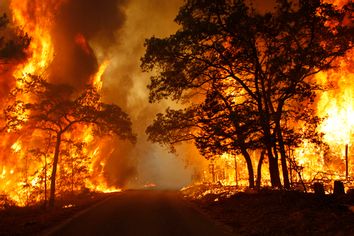
Look back on 2011 and you’ll notice a destructive trail of extreme weather slashing through the year. In Texas, it was the driest year ever recorded. An epic drought there killed half a billion trees, touched off wildfires that burned four million acres, and destroyed or damaged thousands of homes and buildings. The costs to agriculture, particularly the cotton and cattle businesses, are estimated at $5.2 billion — and keep in mind that, in a winter breaking all sorts of records for warmth, the Texas drought is not yet over.
In August, the East Coast had a close brush with calamity in the form of Hurricane Irene. Luckily, that storm had spent most of its energy by the time it hit land near New York City. Nonetheless, its rains did at least $7 billion worth of damage, putting it just below the $7.2 billion worth of chaos caused by Katrina back in 2005.
Across the planet the story was similar. Wildfires consumed large swaths of Chile. Colombia suffered its second year of endless rain, causing an estimated $2 billion in damage. In Brazil, the life-giving Amazon River was running low due to drought. Northern Mexico is still suffering from its worst drought in 70 years. Flooding in the Thai capital, Bangkok, killed over 500 and displaced or damaged the property of 12 million others, while ruining some of the world’s largest industrial parks. The World Bank estimates the damage in Thailand at a mind-boggling $45 billion, making it one of the most expensive disasters ever. And that’s just to start a 2011 extreme-weather list, not to end it.
Such calamities, devastating for those affected, have important implications for how we think about the role of government in our future. During natural disasters, society regularly turns to the state for help, which means such immediate crises are a much-needed reminder of just how important a functional big government turns out to be to our survival.
These days, big government gets big press attention — none of it anything but terrible. In the United States, especially in an election year, it’s become fashionable to beat up on the public sector and all things governmental (except the military). The Right does it nonstop. All their talking points disparage the role of an oversized federal government. Anti-tax zealot Grover Norquist famously set the tone for this assault. “I’m not in favor of abolishing the government,” he said. “I just want to shrink it down to the size where we can drown it in the bathtub.” He has managed to get 235 members of the House of Representatives and 41 members of the Senate to sign his “Taxpayer Protection Pledge” and thereby swear never, under any circumstances, to raise taxes.
By now, this viewpoint has taken on the aura of folk wisdom, as if the essence of democracy were to hate government. Even many on the Left now regularly dismiss government as nothing but oversized, wasteful, bureaucratic, corrupt and oppressive, without giving serious consideration to how essential it may be to our lives.
But don’t expect the present “consensus” to last. Global warming and the freaky, increasingly extreme weather that will accompany it is going to change all that. After all, there is only one institution that actually has the capacity to deal with multibillion-dollar natural disasters on an increasingly routine basis. Private security firms won’t help your flooded or tornado-struck town. Private insurance companies are systematically withdrawing coverage from vulnerable coastal areas. Voluntary community groups, churches, anarchist affinity groups — each may prove helpful in limited ways, but for better or worse, only government has the capital and capacity to deal with the catastrophic implications of climate change.
Consider Hurricane Irene: As it passed through the Northeast, states mobilized more than 100,000 National Guard troops. New York City opened 78 public emergency shelters prepared to house up to 70,000 people. In my home state, Vermont, where the storm devastated the landscape, destroying or damaging 200 bridges, more than 500 miles of road, and 100 miles of railroad, the National Guard airlifted in free food, water, diapers, baby formula, medicine and tarps to thousands of desperate Vermonters trapped in 13 stranded towns — all free of charge to the victims of the storm.
The damage to Vermont was estimated at up to $1 billion. Yet the state only has 621,000 residents, so it could never have raised all the money needed to rebuild alone. Vermont businesses, individuals and foundations have donated at least $4 million, possibly up to $6 million in assistance, an impressive figure, but not a fraction of what was needed. The state government immediately released $24 million in funds, crucial to getting its system of roads rebuilt and functioning, but again that was a drop in the bucket, given the level of damage. A little known state-owned bank, the Vermont Municipal Bond Bank, also offered low-interest, low-collateral loans to towns to aid reconstruction efforts. But without federal money, which covered 80 percent to 100 percent of the costs of rebuilding many Vermont roads, the state would still be an economic basket case. Without aid from Washington, the transportation network might have taken years to recover.
As for flood insurance, the federal government is pretty much the only place to get it. The National Flood Insurance Program has written 5.5 million policies in more than 21,000 communities covering $1.2 trillion worth of property. As for the vaunted private market, for-profit insurance companies write between 180,000 and 200,000 policies in a given year. In other words, that is less than 5 percent of all flood insurance in the United States. This federally subsidized program underwrites the other 95 percent. Without such insurance, it’s not complicated: many waterlogged victims of 2011, whether from record Midwestern floods or Hurricane Irene, would simply have no money to rebuild.
Or consider sweltering Texas. In 2011, firefighters responded to 23,519 fires. In all, 2,742 homes were destroyed by out-of-control wildfires. But government action saved 34,756 other homes. So you decide: Was this another case of wasteful government intervention in the marketplace, or an extremely efficient use of resources?
Facing Snowpocalypse Without Plows
The early years of this century have already offered a number of examples of how disastrous too little government can be in the face of natural disaster, Katrina-inundated New Orleans in 2005 being perhaps the quintessential case.
There are, however, other less noted examples that nonetheless helped concentrate the minds of government planners. For example, in the early spring of 2011, a massive blizzard hit New York City. Dubbed “Snowmageddon” and “Snowpocalypse,” the storm arrived in the midst of tense statewide budget negotiations, and a nationwide assault on state workers (and their pensions).
In New York, Mayor Mike Bloomberg was pushing for cuts to the sanitation department budget. As the snow piled up, the people tasked with removing it — sanitation workers — failed to appear in sufficient numbers. As the city ground to a halt, New Yorkers were left to fend for themselves with nothing but shovels, their cars, doorways, stores, roads all hopelessly buried. Chaos ensued. Though nowhere near as destructive as Katrina, the storm became a case study in too little governance and the all-too-distinct limits of “self-reliance” when nature runs amuck. In the week that followed, even the rich were stranded amid the mounting heaps of snow and uncollected garbage.
Mayor Bloomberg emerged from the debacle chastened, even though he accused the union of staging a soft strike, a work-to-rule-style slowdown that held the snowbound city hostage. The union denied engaging in any such illegal actions. Whatever the case, the blizzard focused thinking locally on the nature of public workers. It suddenly made sanitation workers less invisible and forced a set of questions: Are public workers really “union fat cats” with “sinecures” gorging at the public trough? Or are they as essential to the basic functions of the city as white blood cells to the health of the human body? Clearly, in snowbound New York it was the latter. No sanitation workers and your city instantly turns chaotic and fills with garbage, leaving street after street lined with the stuff.
More broadly the question raised was: Can an individual, a town, a city, even a state really “go it alone” when the weather turns genuinely threatening? Briefly, all the union bashing and attacks on the public sector that had marked that year’s state-level budget debates began to sound unhinged.
In the Big Apple at least, when Irene came calling that August, Mayor Bloomberg was ready. He wasn’t dissing or scolding unions. He wasn’t whining about the cost of running a government. He embraced planning, the public sector, public workers and coordinated collective action. His administration took unprecedented steps like shutting down the subway and moving its trains to higher ground. Good thing they did. Several low-lying subway yards flooded. Had trains been parked there, many millions in public capital might have been lost or damaged.
The Secret History of Free Enterprise in America
When thinking about the forces of nature and the nature of infrastructure, a slightly longer view of history is instructive. And here’s where to start: in the U.S., despite its official pro-market myths, government has always been the main force behind the development of a national infrastructure, and so of the country’s overall economic prosperity.
One can trace the origins of state participation in the economy back to at least the founding of the republic: from Alexander Hamilton’s First Bank of the United States, which refloated the entire post-revolutionary economy when it bought otherwise worthless colonial debts at face value; to Henry Clay’s half-realized program of public investment and planning called the American System; to the New York State-funded Erie Canal, which made the future Big Apple the economic focus of the eastern seaboard; to the railroads, built on government land grants, that took the economy west and tied the nation together; to New Deal programs that helped pulled the country out of the Great Depression and built much of the infrastructure we still use like the Hoover Dam, scores of major bridges, hospitals, schools and so on; to the government-funded and sponsored interstate highway system launched in the late 1950s; to the similarly funded space race and beyond. It’s simple enough: big government investments (and thus big government) has been central to the remarkable economic dynamism of the country.
Government has created roads, highways, railways, ports, the postal system, inland waterways, universities and telecommunications systems. Government-funded R&D, as well as the buying patterns of government agencies — (alas!) both often connected to war and war-making plans — have driven innovation in everything from textiles and shipbuilding to telecoms, medicine and high-tech breakthroughs of all sorts. Individuals invent technology, but in the United States it is almost always public money that brings the technology to scale, be it in aeronautics, medicine, computers, or agriculture.
Without constant government planning and subsidies, American capitalism simply could not have developed as it did, making ours the world’s largest economy. Yes, the entrepreneurs we are taught to venerate have been key to all this, but dig a little deeper and you soon find that most of their oil was on public lands, their technology nurtured or invented thanks to government-sponsored R&D, or supported by excellent public infrastructure and the possibility of hiring well-educated workers produced by a heavily subsidized higher-education system. Just to cite one recent example, the now-familiar Siri voice-activated command system on the new iPhone is based on — brace yourself — government-developed technology.
And here’s a curious thing: everybody more or less knows all this and yet it is almost never acknowledged. If one were to write the secret history of free enterprise in the United States, one would have to acknowledge that it has always been and remains at least a little bit socialist. However, it’s not considered proper to discuss government planning in open, realistic and mature terms, so we fail to talk about what government could — or rather, must — do to help us meet the future of climate change.
Storm Socialism
The onset of ever more extreme and repeated weather events is likely to change how we think about the role of the state. But attitudes toward the Federal Emergency Management Agency (FEMA), which stands behind state and local disaster responses, suggest that we’re hardly at that moment yet. In late 2011, with Americans beleaguered by weather disasters, FEMA came under attack from congressional Republicans, eager to starve it of funds. One look at FEMA explains why.
Yes, when George W. Bush put an unqualified playboy at its helm, the agency dealt disastrously with Hurricane Katrina back in 2005. Under better leadership, however, it has been anything but the sinister apparatus of repression portrayed by legions of rightists and conspiracy theorists. FEMA is, in fact, an eminently effective mechanism for planning focused on the public good, not private profit, a form of public insurance and public assistance for Americans struck by disaster. Every year FEMA gives hundreds of millions of dollars to local firefighters and first responders, as well as victims dealing with the aftershock of floods, fires and the other calamities associated with extreme weather events.
The agency’s work is structured around what it calls “the disaster life cycle” — the process through which emergency managers prepare for, respond to and help others recover from and reduce the risk of disasters. More concretely, FEMA’s services include training, planning, coordinating and funding state and local disaster managers and first responders, grant-making to local governments, institutions and individuals, and direct emergency assistance that ranges from psychological counseling and medical aid to emergency unemployment benefits. FEMA also subsidizes long-term rebuilding and planning efforts by communities affected by disasters. In other words, it actually represents an excellent use of your tax dollars to provide services aimed at restoring local economic health and so the tax base. The anti-government Right hates FEMA for the same reason that they hate Social Security — because it works!
As it happens, thanks in part to the congressional GOP’s sabotage efforts, thousands of FEMA’s long-term recovery projects are now on hold, while the cash-strapped agency shifts its resources to deal with only the most immediate crises. This represents a dangerous trend, given what historical statistics tell us about our future. In recent decades, the number of Major Disaster Declarations by the federal government has been escalating sharply: only 12 in 1961, 17 in 1971, 15 in 1981, 43 in 1991, and in 2011 — 99! As a result, just when Hurricane Irene bore down on the East Coast, FEMA’s disaster relief fund had already been depleted from $2.4 billion as the year began to a mere $792 million.
Like it or not, government is a huge part of our economy. Altogether, federal, state and local government activity — that is collecting fees, taxing, borrowing and then spending on wages, procurement, contracting, grant-making, subsidies and aid — constitutes about 35 percent of the gross domestic product. You could say that we already live in a somewhat “mixed economy”: that is, an economy that fundamentally combines private and public economic activity.
The intensification of climate change means that we need to acknowledge the chaotic future we face and start planning for it. Think of what’s coming, if you will, as a kind of storm socialism.
After all, climate scientists believe that atmospheric concentrations of carbon dioxide beyond 350 parts-per-million (ppm) could set off compounding feedback loops and so lock us into runaway climate change. We are already at 392 ppm. Even if we stopped burning all fossil fuels immediately, the disruptive effect of accumulated CO2 in the atmosphere is guaranteed to hammer us for decades. In other words, according to the best-case scenario, we face decades of increasingly chaotic and violent weather.
In the face of an unraveling climate system, there is no way that private enterprise alone will meet the threat. And though small “d” democracy and “community” may be key parts of a strong, functional and fair society, volunteerism and “self-organization” alone will prove as incapable as private enterprise in responding to the massive challenges now beginning to unfold.
To adapt to climate change will mean coming together on a large scale and mobilizing society’s full range of resources. In other words, Big Storms require Big Government. Who else will save stranded climate refugees, or protect and rebuild infrastructure, or coordinate rescue efforts and plan out the flow and allocation of resources?
It will be government that does these tasks or they will not be done at all.
To stay on top of important articles like these, sign up to receive the latest updates from TomDispatch.com here.
What can a humble loaf of bread tell us about the world?
The answer is: far more than you might imagine. For one thing, that loaf can be “read” as if it were a core sample extracted from the heart of a grim global economy. Looked at another way, it reveals some of the crucial fault lines of world politics, including the origins of the Arab spring that has now become a summer of discontent.
Consider this: between June 2010 and June 2011, world grain prices almost doubled. In many places on this planet, that proved an unmitigated catastrophe. In those same months, several governments fell, rioting broke out in cities from Bishkek, Kyrgyzstan, to Nairobi, Kenya, and most disturbingly three new wars began in Libya, Yemen, and Syria. Even on Egypt’s Sinai Peninsula, Bedouin tribes are now in revolt against the country’s interim government and manning their own armed roadblocks.
And in each of these situations, the initial trouble was traceable, at least in part, to the price of that loaf of bread. If these upheavals were not “resource conflicts” in the formal sense of the term, think of them at least as bread-triggered upheavals.
Growing Climate Change in a Wheat Field
Bread has classically been known as the staff of life. In much of the world, you can’t get more basic, since that daily loaf often stands between the mass of humanity and starvation. Still, to read present world politics from a loaf of bread, you first have to ask: of what exactly is that loaf made? Water, salt, and yeast, of course, but mainly wheat, which means when wheat prices increase globally, so does the price of that loaf — and so does trouble.
To imagine that there’s nothing else in bread, however, is to misunderstand modern global agriculture. Another key ingredient in our loaf — call it a “factor of production” — is petroleum. Yes, crude oil, which appears in our bread as fertilizer and tractor fuel. Without it, wheat wouldn’t be produced, processed, or moved across continents and oceans.
And don’t forget labor. It’s an ingredient in our loaf, too, but not perhaps in the way you might imagine. After all, mechanization has largely displaced workers from the field to the factory. Instead of untold thousands of peasants planting and harvesting wheat by hand, industrial workers now make tractors and threshers, produce fuel, chemical pesticides, and nitrogen fertilizer, all rendered from petroleum and all crucial to modern wheat growing. If the labor power of those workers is transferred to the wheat field, it happens in the form of technology. Today, a single person driving a huge $400,000 combine, burning 200 gallons of fuel daily, guided by computers and GPS satellite navigation, can cover 20 acres an hour, and harvest 8,000 to 10,000 bushels of wheat in a single day.
Next, without financial capital — money — our loaf of bread wouldn’t exist. It’s necessary to purchase the oil, the fertilizer, that combine, and so on. But financial capital may indirectly affect the price of our loaf even more powerfully. When there is too much liquid capital moving through the global financial system, speculators start to bid-up the price of various assets, including all the ingredients in bread. This sort of speculation naturally contributes to rising fuel and grain prices.
The final ingredients come from nature: sunlight, oxygen, water, and nutritious soil, all in just the correct amounts and at just the right time. And there’s one more input that can’t be ignored, a different kind of contribution from nature: climate change, just now really kicking in, and increasingly the key destabilizing element in bringing that loaf of bread disastrously to market.
Marketing Disaster
When these ingredients mix in a way that sends the price of bread soaring, politics enters the picture. Consider this, for instance: The upheavals in Egypt lay at the heart of the Arab Spring. Egypt is also the world’s single largest wheat importer, followed closely by Algeria and Morocco. Keep in mind as well that the Arab Spring started in Tunisia when rising food prices, high unemployment, and a widening gap between rich and poor triggered deadly riots and finally the flight of the country’s autocratic ruler Zine Ben Ali. His last act was a vow to reduce the price of sugar, milk, and bread — and it was too little too late.
With that, protests began in Egypt and the Algerian government ordered increased wheat imports to stave off growing unrest over food prices. As global wheat prices surged by 70 percent between June and December 2010, bread consumption in Egypt started to decline under what economists termed “price rationing.” And that price kept rising all through the spring of 2011. By June, wheat cost 83 percent more than it had a year before. During the same time frame, corn prices surged by a staggering 91 percent. Egypt is the world’s fourth largest corn importer. When not used to make bread, corn is often employed as a food additive and to feed poultry and livestock. Algeria, Syria, Morocco, and Saudi Arabia are among the top 15 corn importers. As those wheat and corn prices surged, it was not just the standard of living of the Egyptian poor that was threatened, but their very lives as climate-change driven food prices triggered political violence.
In Egypt, food is a volatile political issue. After all, one in five Egyptians live on less than $1 a day and the government provides subsidized bread to 14.2 million people in a population of 83 million. Last year, overall food-price inflation in Egypt was running at more than 20 percent. This had an instant and devastating impact on Egyptian families, who spend on average 40 percent of their often exceedingly meager monthly incomes simply feeding themselves.
Against this backdrop, World Bank President Robert Zoellick fretted that the global food system was “one shock away from a full-fledged crisis.” And if you want to trace that near full-fledged crisis back to its environmental roots, the place to look is climate change, the increasingly extreme and devastating weather being experienced across this planet.
When it comes to bread, it went like this: In the summer of 2010, Russia, one of the world’s leading wheat exporters, suffered its worst drought in 100 years. Known as the Black Sea Drought, this extreme weather triggered fires that burnt down vast swathes of Russian forests, bleached farmlands, and damaged the country’s breadbasket wheat crop so badly that its leaders (urged on by western grain speculators) imposed a year-long ban on wheat exports. As Russia is among the top four wheat exporters in any year, this caused prices to surge upward.
At the same time, massive flooding occurred in Australia, another significant wheat exporter, while excessive rains in the American Midwest and Canada damaged corn production. Freakishly massive flooding in Pakistan, which put some 20 percent of that country under water, also spooked markets and spurred on the speculators.
And that’s when those climate-driven prices began to soar in Egypt. The ensuing crisis, triggered in part by that rise in the price of our loaf of bread, led to upheaval and finally the fall of the country’s reigning autocrat Hosni Mubarak. Tunisia and Egypt helped trigger a crisis that led to an incipient civil war and then western intervention in neighboring Libya, which meant most of that country’s production of 1.4 million barrels of oil a day went off-line. That, in turn, caused the price of crude oil to surge, at its height hitting $125 a barrel, which set off yet more speculation in food markets, further driving up grain prices.
And recent months haven’t brought much relief. Once again, significant, in some cases record, flooding has damaged crops in Canada, the United States, and Australia. Meanwhile, an unexpected spring drought in northern Europe has hurt grain crops as well. The global food system is visibly straining, if not snapping, under the intense pressure of rising demand, rising energy prices, growing water shortages, and most of all the onset of climate chaos.
And this, the experts tell us, is only the beginning. The price of our loaf of bread is forecast to increase by up to 90 percent over the next 20 years. That will mean yet more upheavals, more protest, greater desperation, heightened conflicts over water, increased migration, roiling ethnic and religious violence, banditry, civil war, and (if past history is any judge) possibly a raft of new interventions by imperial and possibly regional powers.
And how are we responding to this gathering crisis? Has there been a broad new international initiative focused on ensuring food security for the global poor — that is to say, a stable, affordable price for our loaf of bread? You already know the sad answer to that question.
Instead, massive corporations like Glencore, the world’s largest commodity trading company, and the privately held and secretive Cargill, the world’s biggest trader of agricultural commodities, are moving to further consolidate their control of world grain markets and vertically integrate their global supply chains in a new form of food imperialism designed to profit off global misery. While bread triggered war and revolution in the Middle East, Glencore made windfall profits on the surge in grain prices. And the more expensive our loaf of bread becomes the more money firms like Glencore and Cargill stand to make. Consider that just about the worst possible form of “adaptation” to the climate crisis.
So what text should flash through our brains when reading our loaf of bread? A warning, obviously. But so far, it seems, a warning ignored.
To stay on top of important articles like these, sign up to receive the latest updates from TomDispatch.com here.
Christian Parenti, author of the just-published “Tropic of Chaos: Climate Change and the New Geography of Violence” (Nation Books), is a contributing editor at the Nation magazine, a Puffin Foundation Writing Fellow at the Nation Institute, and a visiting scholar at the City University of New York.
Continue Reading
Close
It was another quiet evening in the suburban Sunbelt — Dallas to be exact, February 2006 — and a short, puckish, middle-aged and middle-class father of four named Dave Rabbit was helping his youngest son, a senior in high school, do homework on the Vietnam War. Although Dave had spent most of his adult life managing a family-owned business that designed and manufactured custom T-shirts and caps, he knew about Vietnam, having served three tours there with the Air Force from 1968 to 1971. But that was 35 years ago and now almost a universe away. The decades since the war had been consumed by the simple pleasures and routine trials of being married, raising children, maintaining a summer house on the Gulf Coast and now watching two grandkids grow up.
His son’s homework assignment involved the subject of music and the war, so Dave started Googling “rock ‘n’ roll” and “radio” and “Vietnam War.” Then a very strange thing happened. The all-American dad ran into his former incarnation as wild young renegade. Dave Rabbit, the 57-year-old regular guy, stumbled upon Dave Rabbit the drug-addled, smack-talking, 22-year-old Air Force sergeant who was responsible for one of the strangest stunts in broadcast history. It all went down in 1971, when Dave manned a pirate radio show from the back room of a brothel. He blasted Jimi Hendrix and Steppenwolf, portrayed LBJ as a pervert, talked constantly about smoking pot and having sex with Vietnamese hookers.
Then another strange thing happened. After coming across the old recording of his Vietnam radio show on the Internet, Dave discovered that it had been copied and passed around for decades, first as an 8-track, then a cassette, then as an MP3. Dave Rabbit was a underground cult hero.
The discovery was a revelation for the loquacious Texan granddad, and in a fit of inspiration and perhaps crazy bravado, Dave has decided to resurrect his renegade persona, create a new radio show, and broadcast from a stealth location in Iraq. On Tuesday the reborn pirate DJ flies to the Middle East.
“The show is for the front-line troops searching those houses, putting their lives on the line,” Dave says. “We’re going to slam the terrorists and those knuckleheads, the idiots with bombs strapped to them. But most of all we want the show to be tremendously funny.” Worried about security, Dave prefers not to publicize his real name. He asks to be known only as “Dave Rabbit,” the moniker he adopted in Vietnam in homage to the legendary L.A. rock DJ Jimmy Rabbit.
The context of Dave’s Vietnam radio show speaks volumes about it. In 1965, Armed Forces Radio, known as American Forces Vietnam Network, experienced a brief shot of iconoclasm in the DJ voice of Adrian Cronauer, later the subject of the Robin Williams movie, “Good Morning, Vietnam.” But by 1970, when Dave was on his third tour, Cronauer was long gone. As the lights went down over Vietnam each night, and Charlie crept closer to the wire, the official armed forces radio network was back to playing Dionne Warwick, Glen Campbell and the lobotomized optimism of the official news.
At the time, the U.S. military effort in Vietnam was lost but not yet over. The young American draftees and enlistees were still slogging through menacing jungles, burning down suspected Viet Cong villages, killing or being killed, and coming home horribly maimed. At congressional hearings in Washington, a grim-faced former swift boat lieutenant named John Kerry summed up the mood in one rhetorical question: “How do you ask someone to be the last man to die for a lie?”
Out in the field, some U.S. military units suffered a total collapse of discipline; drug abuse, sabotage, “combat refusals” and “fragging,” the murder of officers by their own men, were rampant. The Green Machine — the mighty U.S. military — was stalled out in the paddy mud, with no clear way out of Vietnam other than ragged-ass retreat. It was amid this squalid meltdown, and because of it, that Dave launched his show, the sound of psychedelic chaos and youthful fury.
The first show aired at 8 o’clock on New Year’s Eve, 1971. Called Radio First Termer, the show was broadcast from a homemade studio that Dave and his friends had constructed in a Saigon whorehouse. They bribed the madam with goods from Air Force supply, like silverware and radios, to keep the room a secret. Dave’s friends included “Pete,” the engineer, and a female news personality, “Nugyen,” who was actually a highly placed administrator in the American Forces Vietnam Network — the U.S. military’s official English-language television and radio network. “She helped, you know, ‘monitor’ when the heat was getting to be too much,” says Dave.
The nightly three-hour show is haunting, heady stuff. One show starts with the languid, dreamy notes of a sitar, over which the sultry voice of Nugyen announces, “The following program is in living color and has been rated X by the Vietnam academy of maggots. The purpose of this program is to bring vital news, information and hard acid rock to the first termers and non-re-enlistees in the Republic of Vietnam. Radio First Termer operates under no Air Force regulations or manuals. In the event of a vice squad raid this program will automatically self-destruct.”
Radio First Termer is a mix of skits, jokes, news updates about possible vice raids, and a lot of rock ‘n’ roll. It has a play list full of now forgotten psychedelic bands like Blood Rock, Cactus and Sugarloaf, along with those we remember, like Hendrix, the Who and Led Zeppelin. Much of show’s humor is right out of the locker room. Early on, Dave intones, “Here’s the Rabbit philosophy: Pussy is the breakfast of champions.” That’s one of the more classy asides.
But the show can also be subversive, as when Dave reads “another quickie from the latrine walls around the Republic of Vietnam” over the eerie intro to the mournful Vanilla Fudge cover of “You Keep Me Hanging On.” “This joker writes, ‘Eighteen days until I can go home to picket and protest this fucking waste of human lives that lifers and the government call a war.’” In another passage, after playing a recording of a sputtering, furious officer, allegedly describing his hatred of Radio First Termer, Dave responds, “Fuck you, sir.” He continues: “Tsk, tsk, tsk. Can you believe that’s what the base commander thinks of me and my nasty ways. You notice how I emphasized the word ‘sir’? The guy’s got an inferiority complex.”
To stay on the air, which meant overriding the military’s own programming, Dave depended on the aid of about a dozen sympathetic technicians at key relay stations of the American Forces Vietnam Network, as well as like-minded friends in the military police. “What are they gonna do,” asks Nugyen in one skit, “Send you to Vietnam?” Dave, defiant and mocking, his voice distorted into a crazed frogfish rasp, responds: “Ha ha! Fooled ya, sister — they already did!”
Radio First Termer lasted 21 days and 63 broadcast hours. “We were at the top of shit list of the Air Force base commander in Saigon, who was dying to shut us down,” Dave says. Nevertheless, he planned to continue broadcasting until he learned that his friends in the military police and radio network were also in danger of being disciplined or court-martialed. To protect his buddies, Dave called it quits. He and the crew were so scared of jail that they destroyed all their archives.
As it turned out, an unknown listener had taped and saved one of the Radio First Termer shows. As the years rolled on, the surviving show was copied and recopied, building a considerable following. After Vietnam, Dave experienced one brief close encounter between Mr. Rabbit past and Mr. Rabbit present.
“In 1982, I met a guy at a party in Dallas,” says Dave, his Texas accent having thickened a bit since the homogenizing influences of his stint in the Air Force. “He was in the service over in Europe, and we were talking and Vietnam came up, and he says, Did you ever hear of Dave Rabbit? And I said, Well, yeah, I am Dave Rabbit. He asks me to do some of the gags. I did some of the ones I remember, like, ‘The sanitation department asks that you don’t throw toothpicks in the toilet — crabs can pole vault!’ and I did the Captain Ivan Pansy voice.”
The soldier told Dave that tapes of his one surviving Radio First Termer show were still circulating in Europe and were popular at military parties. Later the guy gave Dave a copy of the show. But before long, one of Dave’s daughters taped over the program by mistake. “I put in the tape one day and there this teeny-bopper music instead of Radio First Termer,” he says. “So I put out ads in the paper and on a billboard. I tried every way to find the guy who’d given me the show, but nothing came of it and I just pretty much forgot about it.”
One of Radio First Termer’s biggest fans, a 37-year-old lawyer in North Carolina named Will Snyder, had discovered the show in high school through a friend. Once the Internet was able to host audio files, he put digital recordings of the show on the Web. “I think the show captures a sensibility of an important time in history,” Snyder says. “With the Web site, I was mostly looking for other recordings, to see if there was more than one remaining show.”
Snyder found many fans but no other recordings. “A guy wrote to me saying that he knew of a therapist who had used Radio First Termer to treat posttraumatic stress disorder with some of his Vietnam Veteran patients,” he says.
Over the years, weird rumors circulated about who Dave Rabbit was and how Radio First Termer came to be. One theory postulated that Dave Rabbit was really Art Bell, talk radio’s king of conspiracy theory and the supernatural.
Bizarrely, Dave didn’t know about any of this. After Vietnam, he slowly lost touch with his two collaborators, gave up dreams of a broadcast career, laid off the psychedelics, and buckled down. The news that he had a cult following came as a shock. “I just couldn’t believe it. I mean I was just going along with my life, and totally unbeknownst to me there was this parallel universe,” he says with exuberance. “Finding those recordings was like a dream come true.”
By chance, David Zeiger’s documentary, “Sir, No Sir!” — which celebrates GI antiwar resistance and rebellion in Vietnam — came out around the same time that Dave stumbled on his underground fan base. Zeiger had used a few sections of audio from the one surviving Radio First Termer show and is adding an interview with Dave as an extra on the DVD issue of the documentary this winter.
Since Dave “came out of the rabbit hole,” as he puts it, he has started doing occasional podcasts. So far they have included remixed versions of his old show, interviews with Zeiger and Tim Goodrich of Iraq Veterans Against the War, and one or two rather garrulous and rambling descriptions of vacations with the family. For the most part, they are full weirdness and ribald humor about Preparation H, life in prison, Osama bin Laden, and bizarre rants about things like “goddamned fucking bullshit duty-free shops” that sell booze to tourists knowing that it will be confiscated by security.
His podcasts have been downloaded hundreds of time in various countries, including, Dave says, Lebanon, Libya and China. In countries less than friendly with America, he says, he is paranoid that those offended by his broadcasts might come looking for him, another reason he doesn’t want to divulge his real name. On the Web, Dave hangs out on a conspiracy theory Web site called Above Top Secret, where discussants touch on issues ranging from 9/11 to the mysteries of friendly-fire deaths in combat. He is also part of a strange podcasting scene at Podomatic, where online DJs tend to ventilate about subjects from Jesus Christ to penis size to the possibility of a viral outbreak at Area 51.
In heading to Baghdad with press credentials, Dave will be stepping up his radio game to a whole new level. The show will be broadcast live in Iraq, and once Dave is home, it will be podcast worldwide. To pull this off successfully will be an amazing feat, as Baghdad is now in the grips of civil war and a tidal wave of criminal violence.
The new show will involve Dave and two new collaborators. Their identities are also being kept “top secret,” but Dave says one of them is “a well-known broadcast personality.” The crew will also bring a professional photographer and rely on armed security. They’ll stay and operate from a “non-military location,” which likely means one of the two fortified hotel complexes where journalists stay.
In the lead-up to the show, Dave is remaining cagey about details, yet describes the new show as a mix of skits and music. Featured personalities will be, of course, Dave Rabbit, his new sidekick Charlie Cooper and a sultry Iraqi woman (she’s not really Iraqi) named Nadira.
“We’re gonna do some sexist off-color type stuff,” says Dave. The crew will also have a studio gofer named Omar bin Fucking. Some of the original Radio First Termer characters will reappear, like Captain Ivan Pansy. “And of course, we’ll have the ‘base commander,’ because that guy is the same wherever you go,” says Dave with a chuckle.
There will be messages from the latrine walls around Iraq and some drug humor, but not as much as in the original show. “In Nam, it was a major part of the culture,” Dave says. “But we’ve learned a lot about drugs since the ’60s and it’s not all pretty. So we not going as heavy on that type of humor.”
And what about antiwar politics? “They’ll be there, but in a subliminal sense,” says Dave, who calls himself apolitical. “I never vote.” But get him started about the politics of war and he’s soon livid. “How many jobs could you make, or people could you feed, with all that money being used to stir up a civil war in Iraq? The only thing we do by staying there is get more American soldiers killed. It’s insanity. I’m really scared about where it’s all headed. Nothing is going to stop the fighting. Just like in Vietnam, you can’t defeat an enemy that doesn’t know the word ‘defeat.’”
At the same time, the all-American dad’s politics have clearly mellowed since his days in the Saigon brothel, railing against LBJ and Nixon to the sound of the Doors. Now his thoughts are focused on his fellow soldiers, as young as he was in Vietnam. “If I can help them, comfort them just a little, bring home a little bit closer, that’s all I aim for,” Dave says.
Continue Reading
Close
The acquittal earlier this month of four California corrections officers charged with arranging for a young inmate to be raped by Corcoran State Prison’s notorious “Booty Bandit” was the result of a massive legal and political show of force on the part of the state’s prison guards union, prisoners’ advocates say. The four guards were facing nine years in prison.
State prosecutors alleged that in March 1993, the four Corcoran State Prison Security Housing Unit officers, led by Sgt. Robert Alan Decker, deliberately transferred inmate Eddie Dillard to the cell of Wayne Robertson, aka the “Booty Bandit” knowing that the younger, smaller inmate would be raped. At trial, Robertson testified that he had indeed beaten and sodomized Dillard for two days because guards had said that Dillard needed to “learn how to do his time.”
But the defense — led by four adroit lawyers and funded by the guards’ union — countered that the accused guards had no idea at the time that Robertson was a rapist. “I agree that Wayne Robertson is a rapist and a thug, but that fact was not known to the floor staff,” said defense attorney Curtis Sisk in his opening arguments. One of the officers told the jury that the first time he even heard of Wayne Robertson was in an article in the Los Angeles Times.
The California Correctional Peace Officers Association — which paid the defendants’ legal costs and launched a media campaign to support them — is one of the state’s most powerful lobbies. During the last election cycle, the group poured millions of dollars into state races, supporting candidates from both parties and waging
a $2 million media campaign on behalf of Gov. Gray Davis.
“We are obviously very pleased. The four guards and their families are the real victims here,” said union president Don Novey.
With a pending federal trial and several criminal investigations of prison staff still open, the CCPOA left as little as possible to chance during the state investigation and trial. The union’s publication, the Peace Keeper, encouraged rank-and-file members not to trust or speak with the FBI and state investigators. Critics of the union say this and quick intervention by CCPOA lawyers effectively shut down the flow of information at the source.
As the so-called “Booty Bandit” trial approached, the CCPOA also turned to the public relations side of the political equation, targeting Hanford-area residents with a slew of radio and TV ads full of menacing, tattooed convicts and brave guards walking “the toughest beat in the state.” (The union says the timing of the ads was mere coincidence, and was not related to the pending case.)
And once arguments in the case opened, the CCPOA’s concern was manifest in attendance of a steady stream of local chapter officials and union heavies.
For prisoners’ rights activists like Tom Quinn, a private investigator who specializes in researching cases against California jails and prisons, the presence of CCPOA honchos was just another example of how a code of silence is encouraged and enforced by the leadership of both the union and the Department of Corrections.
“Fundamentally, the claim that these guards didn’t know that Robertson was a rapist is totally implausible,” Quinn said. “The SHU [Security Housing Unit] is a unique social experiment designed to generate information.” Along with elaborate records and dossiers kept on all the inmates, Quinn points out that guards have a relatively clear view into most of the SHU cells, both from the tier and from inside the control booth. “Furthermore,” adds Quinn, “the C.O.s [correctional officers] are constantly working snitches. They know who’s who. And they knew … that Robertson was a rapist.”
Quinn’s claims were affirmed by Connie Foster, who worked as a staff member at Corcoran in 1993. “I heard about Robertson a week after I arrived,” Foster said.
But despite claims like these, the state has had difficulty breaking the guards’ silence. Among other things, say the union’s critics, the CCPOA’s massive campaign war chest has proved a valuable tool in discouraging local district attorneys from prosecuting cases against prison guards.
The Dillard case, for example, was almost filed by the Kings County district attorney, but Greg Strickland, who then held the county post, dropped the charges, citing lack of evidence. Many speculate that Strickland was also scared of the CCPOA. He had already crossed the group once, by prosecuting Corcoran guards involved in a 1995 beating incident. Sure enough, the union’s wrath materialized during the next D.A.’s race, in the form of a massive campaign donation to Strickland’s opponent. In testimony before a state legislative committee, Strickland suggested the creation of “an independent prosecution unit” because, as he put it, “My incumbent owes the CCPOA $30,000 worth of campaign contributions.” That project was vetoed by Gov. Davis, but a compromise was eventually struck, leading to the creation of a new inspector general position, which is filled by gubernatorial appointment.
Lockyer spokesman Nathan Barankin said that getting good investigations from local prosecutors and police forces in the small towns that house many of these prisons continues to be a problem. He said in the Dillard case specifically, there was no investigation after the crime was committed.
Barankin did acknowledge that, in the wake of this case and the federal investigation at Corcoran, a number of changes have been implemented both by the Legislature and the Department of Corrections. Besides the new inspector general position, new shooting policies have been implemented at all state prison facilities.
Still, Barankin conceded, the new policies are not a guarantee that this will never happen again: “You can investigate until you’re blue in the face, but you still have the question of who prosecutes it.” Barankin said local district attorneys would normally prosecute these cases, but that in the small counties where most state prisons are located, “to accept one of these cases would eat up everybody you have in the place, plus every red cent you’ve got to get one of these cases to court.” The local D.A. could hand the case off to the attorney general, but Barankin said by the time that happens, usually “the A.G.’s office comes in to pull together the pieces. D.A.s have their own investigators” who work closely with local police right after the crime is reported. “It remains to be seen if this new inspector general will work the same way.”
While prisoners’ rights activists sympathized with Barankin, they blamed Lockyer’s office — specifically deputy attorney general Vern Pierson — for botching the prosecution. They say the state’s strategy failed to make the code of silence and culture of terror at Corcoran central issues in the case.
Based on his research of California jails and prisons, Quinn said the “Booty Bandit” trial was about much more than the fate of four prison guards. “Clearly, part of what was on trial here was the guards’ code of silence, the power of the CCPOA and the culture of terror that defines life in California’s maximum security prisons,” he said.
Quinn acknowledged that much of that was impossible to pursue in court when Judge Louis Bissig disallowed conspiracy charges brought against the four guards. “Our hands were tied by some of the judge’s rulings and the fact that it took five years for this crime to surface and be prosecuted,” Pierson told the Los Angeles Times. “And it’s never easy when your best witnesses of what really happened are felons and officers who have committed [crimes] themselves.”
That sentiment was echoed by Barankin. “Having the conspiracy charges thrown out by the judge was gigantic. That can’t be quantified,” he said. But Barankin conceded that “there were all sorts of places along the way where things fell apart.”
Activists say much of the blame rests with Pierson, arguing that his most crucial misstep was the handling of star witness Roscoe “Bonecrusher” Pondexter. A former guard and onetime professional basketball player, Pondexter testified against the four accused guards in exchange for immunity from prosecution.
Pondexter testified that he was once a sadistic “search and escort” officer in the Corcoran SHU. He ran with a gang of guards called the Sharks and his specialty was to beat and strangle prisoners. “We would show them ‘the Corcoran way’ and tell them this was a ‘hands on’ institution,” said Pondexter. He was eventually fired for brutality.
But Pondexter’s testimony was later picked apart by defense attorney Katherine Hart, who showed that Pondexter was on vacation the day Dillard was moved into the Booty Bandit’s cell. Pondexter had previously testified he was working that day. “You had a faulty memory about that, didn’t you?” asked Hart.
“Yes,” Pondexter admitted, squandering much of his credibility in the process.
Afterward, a vexed and embarrassed Pondexter was heard complaining to a friend that Pierson hardly prepared him for testimony, briefing and questioning him for only 25 minutes, just before he took the stand.
Barankin refuted that claim, saying prosecutors spent “a considerable amount of time preparing Mr. Pondexter for the trial.” When asked about why they did not check records that showed Pondexter was not even working that day, Barankin said, “The defense had access to information we didn’t have. We found out the same time [the jury] did.”
Also missing from the state’s case was much of the detail that had emerged during grand jury testimony and during last year’s legislative hearings. According to both these inquiries, the story of the Dillard rape and ensuing coverup went as follows: Dillard and Robertson — both members of the Piru Bloods, a Los Angeles street gang, though separated by a 20-year age difference — had first come into conflict at Tehachapi State Prison in 1992. There Robertson made sexual advances on Dillard and was rebuffed. Soon thereafter Robertson, already a documented jailhouse rapist, was transferred to the Corcoran SHU.
In 1993, Dillard kicked a female guard and was sent north to Corcoran. In his grand jury deposition, Robertson told how Sgt. Robert Alan Decker showed him a list of four proposed cellmates. Robertson chose Dillard and a few days latter, while lying on his bunk, looked up to see the protesting Dillard being thrust into his cell by two officers.
Dillard explained the rest when he took the stand: “Before I knew it, we were getting into it. We were tussling and he said he was going to rape me. I tried to fight him off but I couldn’t. He raped me,” said, Dillard, his voice breaking. Dillard finally escaped the cell when guards came to take Robertson to an unrelated disciplinary hearing. Desperate, Dillard refused to re-enter the cell.
Finally, Dillard told an officer that Robertson had raped him. The officer filed a report and passed it on to a sergeant, but the report was lost. Dillard was then examined by a prison medic, who saw no sign of rape. A doctor examined Dillard and ordered a “rape kit” — a full internal rape examination — but the order was quickly and mysteriously countermanded and Dillard was never properly examined. After getting a new cell, Dillard started sending administrative complaints, known as “602s,” about Sgt. Decker and the rape to officials in Sacramento.
Records show that on June 16, 1993, Dillard suddenly withdrew his complaint and stopped his follow-ups. That was the same day that Decker signed in for a visit with Dillard on his new cell block. According to Dillard, Decker gave him a simple choice: Drop the 602, or go “back in the cell with Robertson.”
Little of this chronology was spelled out during the trial, though, and none of the defense witnesses seemed to remember much — all of which undermined the prosecution’s case.
“We went over everything, covered everything, a lot of documents,” the jury foreman, who declined to give his name, told the Los Angeles Times. “In the end, there was just too much reasonable doubt. There just wasn’t a lot of evidence that supported what the prosecutor was trying to prove.”
That was the fault of the prosecution, said prisoners’ rights attorney Catherine Campbell. “My impression was that [Pierson] was on automatic, doing a job that was distasteful to him,” she said. “He had no moral passion. The lapses, particularly the one with Pondexter — that sort of thing throws a witness off center.”
The attorney general’s office stood by Pierson, saying that he had inherited an impossible situation. “The football field is littered with Monday-morning quarterbacks,” said Barankin. He agreed that “most right-thinking people should feel a sense of moral outrage based upon the evidence that we were privy to. Unfortunately, the jury was not allowed to hear all that evidence.”
The issue of the code of silence may yet be raised in court. Eight other guards stand trial in March on federal charges for shooting Corcoran inmates.
Continue Reading
Close
America’s latest cultural export to the United Kingdom isn’t some hot new software or a hip-hop single, it’s a controversial medical theory that seeks to explain why so many people die in police custody. The concept, called “excited delirium” (ED) or “in-custody death syndrome,” is being put forward by a small but vocal clique of big-city coroners. Proponents of excited delirium argue that most people who die in police custody are not the victims of police brutality, but rather victims of their own cocaine or amphetamine abuse, which can trigger this fatal condition.
Since the mid 1990s excited delirium has been floated as an explanation in several high-profile police custody deaths in the United States. But so far, the “excited delirium” debate has yet to begin in the U.K. Last week, the Royal Society of Medicine in London held a conference on “The Medical Aspects of Death in Custody” due to the record number of people (65) who died in custody last year in England and Wales.
While excited delirium was not proved as the cause of many of these deaths, in other countries, such as Canada, most of the people who died from excited delirium between 1988 and 1995 were in police custody at the time, according to one study. Medical examiners say this may just be the tip of the iceberg, but it’s hard to say for sure since nobody tracks the number of ED-related
deaths that occur each year.
“You can’t prevent most of these deaths,” says Dr. Boyd Stephens, chief medical examiner for the City and County of San Francisco. This view is shared by his colleague, assistant medical examiner Dr. Steve Karch, who has just returned from addressing the conference on drugs, restraint and postural asphyxia.
“Whether or not these people [who die in custody] see the police is irrelevant. They could be seeing a seven-headed monster. They’re delirious, they get a surge of adrenaline and they die,” Karch says. He and others contend that the real cause of death is long-term amphetamine abuse, which causes heart disease and increases neurotransmitters, called Kappa 2 receptors, in the part of the brain — the lymbic amygdala — that is responsible for fear. Translation: Speed and crack make you paranoid and prone to heart attacks.
Karch says that being high and paranoid leads to erratic behavior, delirium and a heightened heart rate, often accompanied by a rise in body temperature. All of this, plus a weakened heart, can kill a person, and the police have nothing to do with it, he says.
But not everyone is so impressed by the new theory. A bevy of critics, ranging from police accountability activists, to former cops, to toxicologists and coroners, think Karch and other proponents of excited delirium have turned the causal sequence upside down.
“Most of the people who die in police custody die not from drugs or some mysterious syndrome but from police abuse,” says Van Jones, executive director of the Ella Baker Human Rights Center in San Francisco. “Officers choose to escalate confrontations and use force when dealing with disturbed and excited people.” Jones points out that many of the cases cited as prime examples of excited delirium or sudden in-custody death syndrome involve gross police misconduct and extreme violence.
The in-custody death of Aaron Williams in San Francisco, which was later attributed to excited delirium, is one such example. In 1995, Williams was chased and beaten by 12 police officers. According to press reports, he was high on drugs and “acting crazy” at the time. Once he was captured, the police twice sprayed him with pepper spray — a chemical agent that causes gagging and massive mucus production. The police then covered Williams’ face with a surgical mask and hogtied him, which consists of manacling hands and feet together behind the back. They then repeatedly kicked him in the head, according to eyewitnesses quoted in press reports. (Although the San Francisco Police Department denies this part of the account.) He was then left untended in the back of a paddy wagon with his face down. Less than an hour later, the prisoner arrived dead at the local cop shop.
“Williams was a classic case of excited delirium. The police had nothing to do with his death,” says Karch, who reviewed the autopsy report. The San Francisco medical examiner found evidence of numerous “blunt trauma” wounds to the head and abdomen, but came to the same conclusion as Karch. The city of San Francisco settled the case out of court for $98,000.
But Van Jones sees the Aaron Williams case as clear-cut police homicide. “The cops violated almost every one of their own rules — from spraying him twice to beating him and leaving him unattended,” says Jones.
Instead of excited delirium, Jones, the ACLU and other human rights activists say that pepper spray is the real killer. They argue that it was never proven to be safe. In fact, the one test that determined the weapon to be “less than lethal” was conducted by FBI agent Thomas Ward who later pled guilty to taking a $57,000 kickback from a pepper spray manufacturer. According to the ACLU, more than 100 people in the U.S. have died as a result of pepper spray since the early 1990s.
“These sorts of deaths are multi-factoral: obesity, heart trouble and amphetamine use are part of the problem. But excited delirium is not the cause of death,” says D.J. Van Blaricom, an expert witness on in-custody death who was a police officer for 30 years, 11 of them as police chief of Bellevue, Wash.
Blaricom says that more than anything it is the combination of pepper-spraying and hogtying that is leading to in- custody deaths. “Many of these cases involve exhausted, overweight or injured prisoners who are left hogtied and face down. They simply suffocate, and die from “positional asphyxia,” Blaricom says. “So it’s really a combination of bad police practices that is causing in-custody death syndrome.”
Karch disagrees. He maintains that hogtying is perfectly safe and dismisses positional asphyxia as a myth, pointing to a study in the Annals of Emergency Medicine. But that study used fit young men who exhausted themselves on exercise bikes before being hogtied. The International Association of Police Chiefs, a police professional organization, immediately dismissed the study as irrelevant because it failed to reproduce “field conditions.”
The death of Mark Garcia, also from San Francisco, is another case that is contentious. Proponents of ED say his death was a classic case of the condition. Garcia, 41, was arrested wearing only a shirt as he was running and rolling in the street shouting for help; his family speculates that Garcia, who had a history of cocaine abuse, was high and had just been robbed and partially stripped by his assailants.
Police pepper-sprayed him four times, a violation of department policy, and failed to wash his face with water, which is also required by department procedure. Police then hogtied the 331-pound Garcia, according to press reports, and placed him face down in a paddy wagon. Garcia died of suffocation and positional asphyxia soon thereafter.
A 1995 study by the ACLU examined 26 known deaths of people who had been pepper-sprayed and found several common denominators: alcohol and drugs were involved in 24 of the 26 cases; two suffered from acute psychiatric disorders; and in 14 of the 26 cases, the victims had been hogtied by police. While acknowledging the contributing role of heart disease and drug abuse, the ACLU rejects the notion of ED as being separate from police brutality.
“If we want to avoid death in custody, police must not only declare a moratorium on life-threatening practices such as using pepper spray, [but] they have to [also] follow established rules,” Jones says. And when the police violate their own rules willfully, Jones says they should be held accountable. “Police have to learn to de-escalate confrontations with agitated people; they have to practice verbal judo,” she says. “If 5-foot-2 female social workers and nurses can do it, then I am sure the cops can too.”
Whether these people are dying from police brutality or medical conditions such as excited delirium is still up in the air. But medical examiners like Karch are championing a new neurochemical test which, they say, will accurately determine if the person has died from excited delirium or another cause. “I’m not here to defend police brutality, but you’ll never know if police
brutality occurred unless you gather all the facts,” he says. He believes the test should be standard procedure in all suspected ED deaths. The test relies on taking fresh samples of brain tissue, and detecting changes in the brain chemistry. But the samples have to be taken within 12 hours of death — and many autopsies aren’t done until well after that time.
Continue Reading
Close
Eddie Dillard, a 23-year-old gang member from Los Angeles
serving time for assault with a deadly weapon in California’s
Corcoran State Prison, was a prison malcontent. One day Dillard
made the mistake of kicking a female guard; for this sin and
others he was promoted to the top of the correctional officers’
shit list.
Dillard was transferred to the cell of Wayne Robertson, better
known as the “Booty Bandit.” For a time, his vocation was
beating, torturing and sodomizing fellow inmates while prison
guards looked the other way. This psychopathic serial rapist was
the guards’ resident enforcer, one whose specialty was reining in
abrasive young toughs.
Dillard protested the transfer, pointing out that Robertson was a known
predator. “Since you like hitting women, we’ve got somebody for
you,” came the reply. There, in a tiny box with the Booty Bandit,
began the tragic re-education of Eddie Dillard.
Lessons commenced with verbal abuse and threats, soon
progressing to a violent and bloody assault in which Robertson
beat the smaller, younger Dillard into submission. For the next
several days Robertson beat, raped, tortured and humiliated
Dillard, tearing open his rectum in the process. Guards and other
inmates listened to the echoes of the young man screaming,
crying for help and begging for mercy.
When the cell door finally opened to let him out, Dillard rushed
onto the tier and refused to go back inside. But it was too late: He
had been “turned out.” He was reduced to a psychologically
broken, politically servile “punk” — in the prison argot, the lowest
form of life. Dillard was now jailhouse chattel, to be sodomized,
traded and sold like a slave. Robertson, on the other hand,
received new tennis shoes and extra food for his services.
When he was released from prison, Dillard told the Los Angeles
Times of the trauma he still suffers: “They took something from
me that I can never replace. I’ve tried so many nights to forget
about it, but the feeling just doesn’t go away. Every time I’m with
my wife, it comes back what he did to me. I want a close to the
story. I want some salvation. But it keeps going on and on.”
Dillard’s case is not an isolated incident. Though using rape as a
management tactic may sound like an extreme concept, the
Dillard case appears not to have been an isolated incident. The
Boston Globe, for example, reported that guards in Massachusetts
prisons have used known rapists in the same fashion as their
California counterparts: “Several prisoners at Shirley [State
Prison] said that Slade [a notorious prison rapist] has had a long
history of attacks there, but that he is typically reshuffled by the
guards into cells with ‘fresh fish,’ or new inmates.”
In the age of AIDS, such prison discipline often amounts to a
slow-motion death sentence. As one Massachusetts prison rape
survivor put it, “Nowhere in the book of rules was it written that I
got to be here to get raped, that I have to have them destroy my
mind, that I am supposed to get AIDS.” This same inmate, who is
HIV-positive, said he went to the guards for protection, but their
response was: “Welcome to Shirley. Toughen up, punk.”
The story is repeated across the country.
“Everything and everybody in here worked to keep you a whore –
even the prison,” explained James Dunn, a prisoner and onetime
sex slave in Louisiana’s notorious Angola prison. “If a whore went
to the authorities, all they’d do is tell you that since you [are]
already a whore, they couldn’t do nothing for you, and [that you
should] go back to the dorm and settle down and be a good old
lady. Hell, they’d even call the whore’s old man up and tell him to
take you back down and keep you quiet … the most you’d get out
of complaining is some marriage counseling, with them talking to
you and your old man to iron out your difficulties.”
A veteran corrections officer, also from Louisiana, described a
similar situation in a recent letter to a newspaper: “There are
prison administrators who use inmate gangs to help manage the
prison. Sex and human bodies become the coin of the realm. Is
inmate ‘X’ writing letters to the editor of the local newspaper and
filing lawsuits? Or perhaps he threw urine or feces on an
employee? ‘Well, Joe, you and Willie and Hank work him over, but
be sure you don’t break any bones and send him to the hospital.
If you do a good job, I’ll see that you get the blondest boy in the
next shipment.’”
When asked to comment on prison rape, Massachusetts
Department of Correction spokesman Anthony Carnevale
explained: “Well, that’s prison … I don’t know what to tell you.”
Inmate-on-inmate rape in male prisons remains largely ignored,
despite the fact that it is central to the politics of incarceration.
The group Stop Prison Rape Inc. estimates that 600,000 men and
boys are raped every year in American correctional facilities.
(Other academic studies place the number much lower.)
Most state prison systems, as well as the Federal Bureau of
Prisons, lump all assaults, sexual and otherwise, into a single
category; thus, they have no idea how many rapes are reported.
Whatever the real figure, rape appears to be an integral part of
prison life and one of its most terrifying features.
Prison rights activists say the struggle to bring attention to prison
rape is often an uphill one. “Prison rape continues because it’s a
management tool. It benefits the guards and wardens. There’s no
way around that fact,” explains Tom Cahill, of Stop Prison Rape.
Cahill should know. Thirty years ago, as a young political activist
in San Antonio, Texas, he was set up by prison guards and
gang-raped.
“I was put in a gorilla cage. That’s a cell organized by guards for a
‘turning out party,’” says Cahill. “They told everyone I was a child
molester.” Six of Cahill’s 30 cellmates beat, tortured and raped
him for two days. And like thousands of other survivors, his life
was never the same.
“It’s the ultimate humiliation, and it works on you for the rest of
your life,” says Cahill, his voice raising with anger. “I still feel
mistrustful of people, and even among my friends I feel
stigmatized. I still have flashbacks and bouts of incredible,
consuming rage.”
Cahill’s inner turmoil led to the destruction of his marriage. He
ended up on the streets, and got involved in political fights that
often landed him back in jail. While proud of his left-wing
politics, Cahill now sees much of his sojourn as a macho and
quixotic quest for redemption. Today, at age 62, Cahill lives on
the bucolic north coast of California, where he channels his anger
into activism.
Many survivors are not so lucky. Some never pull out of the
psychological nose-dive caused by prison rape and crash into a
life of violence, self-destruction and sexual aggression.
Victims of prison rape often turn their anger against innocents
when they are set free. John William King — the young white
supremacist who dragged African-American James Byrd to death
in Jasper, Texas, in 1998 — is one such case. King was an ex-con;
he’d served 21 months for burglary in the Beto Unit, the toughest
joint in Texas. Shortly after arriving in prison, King — then
5-foot-7 and 140 pounds — was attacked by black prisoners and
raped, according to his attorneys. He emerged from the dungeon
transformed.
Prison rape victims often implode psychologically after they
return to the outside world. Jeannette Eatton saw that happen to
her 19-year-old son, Alan. While serving time for petty theft and
under-age drinking Alan was befriended by an older convict
named “Cowboy, ” who eventually raped his good-looking young
friend at knifepoint.
“Alan wasn’t the same after that. He withdrew and started
disliking people. He’d always been a people person. And he
despised gays after that,” says Jeannette Eatton.
Six months after his release, a drunken, bitter Alan Eatton
crashed his motorcycle and died. He’d just turned 20. In death,
the young man from central Illinois drew an unlikely comparison
to the famous T.E. Lawrence, who was almost undoubtedly raped
in a Turkish prison. Lawrence — solider, author, adventurer and
champion of the Arab cause — was a classic case of post-rape
self-destruction. His dissolution involved self-imposed isolation,
rage and depression; he abandoned his career and then died in a
motorcycle accident that looked suspiciously suicidal.
More often than not, prison higher-ups ignore the problem. Utah
prison officials, for instance, seeking accreditation of the
system’s medical facilities, maintained that there had never been
a single rape in any Utah prison. Among the many nasty facts
deflating the claim was a detailed trial transcript in which one
inmate was convicted and sentenced to 15 years for raping a
fellow prisoner.
In Massachusetts, following the Boston Globe exposi, corrections
bureaucrats still felt free to deny reality — even as a freshly raped
convict was in the hospital under going rectal surgery.
Such denials are perfectly rational: To admit that inmates rape
each other is to invite lawsuits. In 1994, the Supreme Court ruled
in Farmer vs. Brennan that penitentiary officials are responsible
for protecting prisoners from sexual predation. The case was
launched by Dee Farmer, a pre-op transgender person serving 20
years for credit-card fraud, who was housed in a tank full of
violent male prisoners — where, to no one’s surprise, Farmer was
promptly and viciously gang raped.
Since then, several other inmates have tried to sue for damages
after contracting HIV as jailhouse sex slaves. One Illinois case was
filed by Michael Blucker, a 28-year-old, married man serving time
for a nonviolent crime. Blucker says he was beaten, gang-raped
and then coerced into a form of sex slavery. In at least two cases
correctional officers allegedly escorted Blucker from cell to cell,
where he was raped and forced to service customers who paid his
prison-guard pimps with cigarettes, drugs and candy.
Despite the precedent set in Farmer’s case, Blucker was not
awarded damages. Upon his release he became a devout
born-again Christian who treats his HIV with prayer rather than
protease inhibitors.
The transformation from convict to “punk” usually begins in one
of two ways. A younger inmate might be taken under the wing of
an older inmate; once debt and dependence are established the
older inmate will rape and “turn out” the young prisoner.
Alternatively, a gang of inmates may attack a weaker prisoner
with overwhelming numbers and “punk” their prey. Once the
victim has been “turned out,” the aggressors announce their
control to the general population, which in turn cements the deal
through its tacit or active approval of the victim’s new status.
The freshly minted punk will find himself vulnerable to assault
from all sides, as the prison grapevine informs everyone of his
subordinate status. In the interests of survival, the targeted
prisoner will usually choose one inmate as his “daddy” or
“husband.” In exchange for control of the punk, the “man”
offers protection against other aggressors.
Although the “daddies” have sex with other men, they are, in the
hyper-macho cosmology of prison, not homosexual — because
they are not sexually penetrated themselves. The cult of manhood — and the struggle to defend, defile
and define it — is the axis around which the prison sex system
turns.
The prison world’s other subordinate “gender” is the “queens” –
transsexuals and cross-dressers who may embrace homosexual
sex and a sexually submissive position in the prison hierarchy.
Queens suffer sexual assault, but often they use their sexual
powers and feminine charms to play stronger inmates off one
another or to find a husband of their own liking.
By whatever route one arrives, the second sex of the Big House
are, like many women outside, forced into roles that range from
nurturing wife to denigrated, over-worked “whore.”
The fatalistic logic of the joint explains away the workings of this
system with a sort of macho karma: “He must have wanted it or
he would have fought it off.” The only one path of escape for the
punk or potential punk is to kill his persecutor. But for a young
man facing only five years it’s a tough choice: be raped or
commit murder and face a potential life sentence.
Convict and writer Jack Henry Abbot took the latter path. “I was
even told by the pigs who transported me to prison that I was
being sent there to be reduced to a punk, to be shorn of my
manhood,” wrote Abbot in his classic “In the Belly of the Beast.”
“They felt I would be less arrogant once I had been turned into a
cocksucker … Before I was twenty-one years old I had killed one
of the prisoners and wounded another. I never did get out of
prison. I never was a punk.”
One of the few not-so-dark spots on the landscape is the San
Francisco county jail system, run by maverick former lawyer
href="/people/story/1999/06/07/sheriff/index.html">Michael
Hennessey and his right-hand man, Michael Marcum –
whose risumi includes fratricide and five years’ hard time at
Folsom Prison.
“The most important thing you can do,” explains Hennessey, “is
have a thorough system for vetting prisoners. You have to
separate violent and nonviolent offenders and, within those
categories, the vulnerable from dangerous.” San Francisco also
has a clear protocol that, unlike most jail and prison systems,
does not force victims to name their attackers. Hennessey has
also designed his two new jails to avoid “blind spots,” the
standard terrain of assaults. In 1998 the San Francisco jail
system, with a daily population of about 2,000, had nine reported
rapes. When asked what he thought the real number of rapes was,
Hennessey paused. “I’d like to think it’s not too much higher than
that.”
Continue Reading
Close