More than seven years ago, Ric Hunt, a wandering computer jock from Iowa, proposed to an astonished Pedro Gómez, the principal of Yelapa’s telesecundaria school (for kids in seventh to ninth grades) that they start a computer lab in the jungle. At that time Yelapa, an indigenous community down the Bay of Banderas coast from Puerto Vallarta, had no grid-based electricity; Gómez was still struggling with the satellite technology that brought lessons to the school daily from Mexico City.
But the Honda-powered satellite was precisely the point for Hunt; he had somehow stranded himself in one of the few places on earth where he couldn’t plug in easily. That was important to him, since he wanted to become a registered Microsoft technician and travel through Central America wiring up hotels. He needed to use a computer to study for the Microsoft exams, and his elegant solution to this problem was to invent the jungle computer school in exchange for the right to use A.C. power at the telesecundaria.
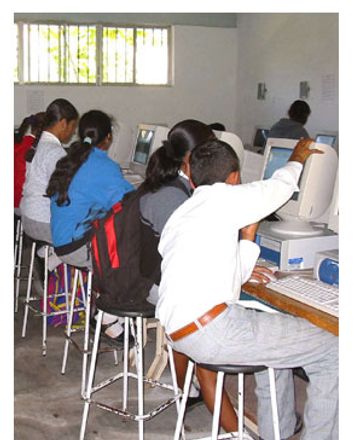
The story of how the jungle computer school has struggled into existence, despite the differing motives and understanding of its founders, provides some perspective on how the technological frontier advances — by chance as much as design. From its almost accidental beginning, a computer school has taken root, with a dozen Pentium 5 machines, some of them networked to a printer, and classes not only for the secondary school kids but also for students in the new preparatorio (the equivalent of high school), which shares the space.
Hunt jump-started the school with a donation of two old computers, one with an AMD 586 processor and the other with an Intel 386, plus a scanner and a laser printer. Just getting this hardware to Yelapa was a logistical triumph, since there were no roads to the place and everything had to come in by boat. But he and Gómez quickly ran into difficulty with each other, partly because of the language barrier, partly because the school considered Hunt’s Microsoft activities to be using too much generator time when gas was getting expensive, and partly because Hunt’s plans, which included a satellite network connecting all the schools in the district, were far too grand for Yelapa’s simple needs and Gómez didn’t understand them. The teacher was totally baffled, for instance, when Hunt showed him how he had gotten the machines to boot in any one of three operating systems — DOS, Windows 95, or Unix. Gómez had only a vague idea of what any operating system did. (A map of the satellite network, which Hunt is still promoting, may be found on his Web site.
I met Hunt in 1998 and took part in many meetings between him and Gómez. With other North American residents, I helped translate for the computer school, structure a program, write proposals, and make contacts, all the while suspecting, as most of us did, that Hunt could never pull it off. What he proposed to do was technically feasible, but it was far beyond the Yelapa kids’ needs or the school’s ability to manage.
Yelapa has electricity now, and eventually, says Gómez, the school would have thought about computers. It eventually got equipment for its current lab through the Jalisco Department of Education and COBAEJ, a public organization that helps direct state funds for education, as well as software from Microsoft (partly due to Hunt’s efforts). But, Gómez adds, “This [the computer lab] is the future of Yelapa. And Ric got it going.”
By doing so he helped give the town a toehold on the network frontier. With local resources now accessible from anywhere in the world, the environment here is essentially defenseless. Local agencies have to meet pressures that result from decisions they have no control over and that they have few resources to counter. Considering the changes wrought by what he sees as a new social form, the “network society,” sociologist Manuel Castells suggests that the old ’60s slogan has to be flipped over; people must think locally and act globally. “If you don’t act globally in a system in which the powers are global, you make no difference in the power system,” Castells says.
It is hard to see how a hamlet like Yelapa can have much of a global impact, though it is already acting globally through the various Web sites that advertise tourist residences in town. None of these, however, are run by Yelapans. In time, the computer school will generate a cadre of local youths who understand something of global technology. COBAEJ requires schools to maintain a strict curriculum, with classes in computer science as well as math, chemistry, physics and English. Students in the prepa are getting instructions in theoretical “informatics” from Alex Urrutia, a Yelapa native who left town at an early age and wound up as a Microsoft techie in Montreal before returning to the village on a self-generated sabbatical two years ago. The secondary school kids are learning Word and Excel, and looking things up in Encarta, just as Microsoft had hoped.
There is still no Internet connection. Urrutia wants to teach a second-year class on the needs of businesses and the use of the Internet, but can’t go online. The original appropriation to get the prepa going included Internet money, he says, but Gómez vetoed it, partly because he wanted to spend the funds elsewhere. Yelapa is so remote that it had never had a high school before; it could not justify spending the money on importing teachers to live there. (The telesecundaria gets its lessons by satellite for the same reason.) The first two years of prepa operation have been carried out with pickup teaching staffs; last month, in fact, the school lost its English teacher, a North American, when he abruptly left town with no notice.
There will be plenty of time for the Internet, Gómez told me, when the students have a firmer grasp of the basics and when the school’s enrollment reaches three full classes. (It started with only a sophomore class, adding a junior class this year as the first students advanced; only next year will there be a full complement.) Nevertheless, the indefatigable Hunt, who now lives in Mexico City, has scared up a small private donation to cover initial ISP costs and is working with UNETE, a business group that supports public schools, to provide more equipment and network connections. Meanwhile Urrutia says that some of his students e-mail him from their homes. Some Yelapa families have computers, and there is one locally run cybercafe, a single machine in a local restaurant, Mimi’s.
Mimi herself is part of another movement to bring Yelapa’s young people into the mainstream; she is on the all-Yelapan board of a project to start a youth center in town that will offer art, music, dance, martial arts and computer classes for kids, using both local and expatriate talent for instruction. Before opening its doors, the school received donations of four laptops and promises of five more desktop computers this year. The center grew out of a bequest from a longtime American resident, Sam Harrison, who died in Yelapa and left $5,000 to be spent for the benefit of the local youth.
Aware that their $5,000 would melt very quickly, the project leaders went looking for official backing, an effort that succeeded beyond anyone’s expectations; the youth center dovetailed neatly with the plans of the Mexican government for the development of Yelapa. The municipio of Cabo Corrientes, of which Yelapa is a part, wants to create a cultural center in the town. On receiving a presentation about the youth project, the municipio promptly made its board the lead agency for formation of the cultural center, with the municipio’s ecology officer, Yelapa resident Luis Enrique Morales, as liaison. (It bothered no one that these goals and responsibilities are significantly out of sync; everyone in Yelapa expects to multitask.)
The presence of Morales, the establishment of a municipio office in Yelapa, the appearance of actual police here, plus Yelapa’s increasing Internet presence, all attest to the new influence of the outside world on the town. Whether it has the political skill, and influence, to keep local control is questionable. The community leaders are well aware of the effects of development on other Mexican locales that have become tourist centers. Their control of the land and their traditional political autonomy, as part of an indigenous community, give the locals some protection. Nevertheless, Yelapa politicians have frequently been bought in the past, and the land has become very valuable. In addition, the indigenous Chacala community that Yelapa belongs to is in debt to the federal government for unpaid taxes on the land it leases to tourist developers. Urrutia thinks that the combination of fiscal mismanagement and rising crime and drug problems may create a wedge for outsiders to gain control of community land.
As this issue is being decided, Yelapa’s people will go on wiring up as fast as they can, and more tourists will be attracted to it from all over the globe. Already, its new commercial villas promise all the comforts of home, rather than jungle romance in a thatched hut. It is hard to say what the impact of the first neon sign will be. Given Yelapa’s small size and skimpy economy, the coming of electricity and digital technology may cause very fast growth and make it a frontier boomtown. At the same time, projects like the computer school and the youth center, and the town’s new political sophistication in dealing with Mexican governments, rather than relying on its weakening protection as an indigenous community, offer Yelapa some way of interacting with the network that has annexed it to the global economy.
An array of investors, developers and governments — operating in real time over the global communications network and basing their decisions on financial and political events — is conducting real estate development around Mexico’s Bay of Banderas. Their immediate purpose is to transform the two-state area around the bay, centered on Puerto Vallarta, into a mega-resort that will triple tourism and population in the area within 20 years. That process will require building plans and the construction of physical infrastructure, as well as multiple investment and marketing initiatives, and will incur massive social displacements.
Small towns in the southern part of the bay like Yelapa and Pizota are included in these plans, but they have special requirements: They are isolated geographically, off of the highway grid; and they are on the wrong side of the digital divide. Yelapa did not get electricity until three years ago, and Pizota still has none. Yelapans are only now beginning to enjoy the fruits of television, telephones and computer technology (including two cybercafes and one game arcade).
In order to be integrated into the bay’s development plan, and made into a place comfortable for tourists, Yelapa will have to be helped over the digital divide (though not helped too much; part of the plan for Yelapa and Pizota is to let them remain attractively primitive). In the process, the towns will find themselves socially displaced; where once they were isolated, they are becoming connected to the global network. The digital divide, which Yelapa is now crossing, is one dimension of the network, but the barrier is more than purely technological. The global network links the entire world economy into a single marketplace. When it incorporates a locality that has previously been isolated, the border, the edge of the network map, becomes a frontier between a primitive environment and a powerful invader. In this respect, Yelapa is a frontier town and a representative of what happens locally when the world comes calling.
Although it is a thoroughly Mexican village, Yelapa is politically an Indian reservation. The people are now mostly mezistado and they have little trace of any indigenous customs; they don’t know their indigenous history or how they got here. Because of its geography, this area has always been remote from both the Spanish and the Mexican governments, and it has run its own affairs. Today, Yelapa is being integrated into a global society and its global economy.
Sociologist Manuel Castells calls the emergence of a global society and economy, a “network society” because, he thinks, power resides in the real-time economic and communications networks rather than in localities. But the network frontier is no more about digital technology than the American frontier was about guns, axes and iron pots; rather, they are both concerned with who exercises power over land and resources. “The most significant thing about the American frontier is, that it lies at the hither edge of free land,” wrote Frederick Jackson Turner in his seminal essay, “The Significance of the Frontier in American History,” and later, more ominously, “The first frontier had to meet its Indian question, its question of the disposition of the public domain…”
With jungle, bay, views, and beaches, Yelapa’s land is one of the most beautiful chunks of coast in Mexico, and it is practically undeveloped. As part of an indigenous community that owns its own land under a Spanish charter, Yelapa holds all its land in the public domain; except under special circumstances, its land cannot be bought by outsiders. Nevertheless, the increasing price of land around the whole Bay of Banderas has increased the value of Yelapa’s land; tourist rents have doubled and even tripled in the past two years. The community has already granted a long-term lease to a multinational company, Omnilife, under terms that permit Omnilife to sublet the land to any outsider for any type of tourist center. At least one outsider has laid claim to Yelapa land and tried to sell it.
With electricity have come appliances worth stealing, and the latest advance of the network frontier has been to send in Marshal Dillon. After an entire history without a police force, Yelapa last month saw armed deputies patrolling the town’s paths, always in a squad of all four members. Their first bust was a local crack user and thief who had been more or less tolerated since everyone in town had known him all his life. A day before the police appeared, an Anglo crack addict left Yelapa with apologies to everyone and promises to enter a treatment program. Like the good citizens of Dodge, the burghers of Yelapa welcomed the law, and at the town meeting that was called to announce the police presence, the people burst into spontaneous applause.
In fact, Yelapans are almost dazed at the largesse provided by the network in the past few years. In a town where most women still wash clothes by hand in a river, one enterprising resident has opened a wash-and-fold laundry. In addition to electricity, the town now has a 24-hour medical clinic, paved pathways with lighting at night, a cement pier at the beach where previously all supplies had to be unloaded on the sand, and telephones. All of this, acknowledges Luis Reynoso, the former president of the Chacala community, to which Yelapa belongs, came from the Mexican federal, state and municipal governments. Yelapa had asked for this assistance for years, but got it only when the Bay of Banderas became a major focus for integrated tourist development.
Yelapa still lacks a road, the feature that John Steinbeck saw as the defining element of cultural expansion. In “The Log From the Sea of Cortez,” his account of a 1940s expedition to then undeveloped Baja California, he wrote: “Once we thought that the bridge between cultures might be through education, public health, good housing, and through political vehicles — democracy, Nazism, communism — but now it seems much simpler than that. The invasion comes with good roads and high-tension wires. Where these two go, the change takes place very quickly.”
Yelapans and the expatriate community are fond of telling each other scare stories about maps showing “The Road” that many fear — and others hope — will eventually be built into town. Some of these tales describe a kind of corniche snaking down the mountainous coast south of Puerto Vallerta; others report on a series of feeder roads to the bay from the main highway inland. No one has ever shown such a map publicly. There is a bulldozed road over the mountains in back of town, but it’s not suitable for tourism either in condition or destination.
But with or without a road, the global network is established. Yelapa is firmly tied to global marketing plans, and its rentable properties may be inspected, reserved and paid for via the Internet. Its local autonomy has been diminished by the activities of the Mexican government, and its media isolation has been dented by Rupert Murdoch, whose Sky TV is now the source of all news programming. After much struggle, the town’s secondary and college preparatory schools have access to computers, and it is continuing to adopt new technology: the municipal government has even promised to install a system of potable water.
But the increasing connectivity to the outside world and the pervasiveness of new technology do little to change the Yelapa economy or give its young people jobs. Many Yelapans routinely leave town to look for work, and there are entire communities of Yelapans in San Jose and Santa Cruz, Calif. The community government, unable to settle its differences internally, has begun making alliances with mainstream Mexican political parties. Wherever its place on the digital divide, Yelapa’s ability to maintain its local character under intense global pressure to develop depends on whether it can continue to protect its land, and how it responds to life on the network frontier.
Next: Think locally, act globally.
Continue Reading
Close
Only a few miles north and west of Puerto Vallarta around the Bay of Banderas, you can still have some of the best beaches in Mexico pretty much to yourself. But hurry on down; no paradise, no matter how pristine or inaccessible, is immune to global development pressure. A coalition of private developers and the Mexican government are beginning to unroll a mega-resort in the area, from the beaches in the north to the jungled coast in the south. The plan is ecologically sensitive, to minimize its impact on the environment and attract international eco-tourist dollars, but massive nonetheless. According to the master plan created by FONATUR, the Mexican tourist development bank, the Banderas tourist trade, along with the local population, will nearly triple in size in the next 20 years, to 6 million visitors and 670,000 inhabitants.
Since the 1960s, Puerto Vallarta has grown more or less haphazardly into Mexico’s second-largest resort. It began as a chic in spot after the Elizabeth Taylor-Richard Burton romance and grew steadily over the years as a haven for pleasure seekers of all sorts, attracted by the natural beauty and easygoing attitude of the place. Liz and Dick are now memorialized by life-size statues in a downtown restaurant, but Puerto Vallarta has grown far beyond its glamorous start. It attracts hundreds of thousands of tourists yearly for a great variety of activities — fishing, golfing, swimming, boating, para-gliding, shopping, eco-touring, flirting, partying, exploring. It’s a popular gay destination. It is the center of tourism for the bay and so important that when Hurricane Kenna wrecked its seafront promenade and buried it under 6 feet of sand in the fall of 2002, FONATUR spent nearly a million dollars to get it cleared and rebuilt by Christmas.
Pinched between steep mountains and the bay, Puerto Vallarta now has nowhere left to build. The beaches to the north in Nayarit, which are really the best on the whole bay, have resisted development because of the aridity of the land and the lack of utilities and infrastructure. Rainfall there is only six inches a year, compared to 60 inches in Puerto Vallarta. To the south, the coast is mostly mountainous jungle that is difficult to get at.
Nevertheless, the Bay of Banderas is so big and so rich in natural tourist attractions that FONATUR wants to make the area into a single integrated resort that will compete with major tourist centers both in Mexico and abroad. It is coordinating the establishment of water and highway infrastructure, development of local building regulations, and financing from multiple sources, both Mexican and foreign. As a result, prices of primitive beachfront land are now pushing $2 million an acre.
The development of the Nayarit beaches began in the mid-1990s between Nuevo Vallarta, a condominium complex with a large marina a few miles north of Puerto Vallarta, and the five-star Four Seasons hotel built on the site of a former ejido (land collective) at Punta de Mita, the northern point of the bay. Local legend, to which everyone subscribes, from waiters to real estate agents and developers, is that the ejido residents were forced off the land at gunpoint, with the permission, if not the actual assistance of, the Mexican government. They were resettled outside the hotel’s discreet gate in concrete block houses in a town named Emiliano Zapata. These they have now decorated with plants and flowers, and the town sits uneasily between the resort and a condo/restaurant strip at Anclote.
The ejido land is now a global asset. It is controlled by Dine, a small subsidiary of a Mexican conglomerate named DESC, which has interests in automobiles, chemicals, food products (it owns Smuckers and Reynolds, among others) and real estate. DESC is traded on the New York Stock Exchange and has branches throughout Mexico and in the U.S. and Spain. Though real estate contributes only 4 percent of its revenue, DESC says it owns prime land for residential and office development in Mexico City and tourist development on both coasts. Punta Mita is one of its main properties.
Dine solved the water problem by importing it from wells near the large agricultural valley that stretches northeast from the bay toward Tepic. This is the general water solution for all north coast development, which is why it is restricted to low-density occupancy (nine bedrooms per 2.5 acres in some spots); and that in turn is why this part of the coast will eventually be reserved for the very rich. Adjacent to the Four Seasons, Dine is now offering multimillion-dollar homes with exclusive access to the beaches, which are patrolled by armed guards.
High-density development will happen at the other end of the beach strip, where Nuevo Vallarta has apparently beat out Puerto Vallarta to become the site of a new convention center that will serve to attract more hotels and, it is whispered, a casino. Mexico does not now have gambling, but anything is possible here, particularly with foreign assistance. Puerto Vallarta wanted to put the convention center on the edge of the last remaining green spot in town, an ecologically threatened mangrove swamp. This month, pressure from environmentalists apparently convinced its investors to switch to Nuevo Vallarta.
Between Nuevo Vallarta and Punta de Mita, the infrastructure is being completed for further development under tight environmental regulations. The four-lane highway that was built north from the Puerto Vallarta airport halfway around the bay to Bucerias in 1999 will be extended all the way to Punta de Mita; this $25 million project, funded by the federal government, will start next month.
Most of the land here is privately owned, and the process of acquiring it for development is being coordinated by FONATUR. This agency loftily defines its role as being a provider of “planning tools for designing sustainable resort cities which harmonize Ecological, Urban, and Social considerations with Tourism and Business activity.” It is also essentially a bank for the development of tourism, finding financing and providing low-cost loans, and has been a leading force in the development of resorts at Los Cabos, Cancun, Puerto Escondido and Loreto.
FONATUR wants to drive development as hard as it can, without wrecking the environment. Its master plan for the bay, a blueprint for vigorous development, also includes emphasis on water treatment, bay pollution, and protection for ecologically delicate areas. Every development project needs to spell out its water system in an environmental impact report, and include a water treatment plant in its construction. Some golf courses are now watered by desalinization. “It’s getting hard to build here,” says Alexis Burwell of La Punta Realty, with considerable respect for the rules that make it that way, and their enforcement.
Those who do build, though, or promise to, are doing very well. There are a a score of active developments along the coast now, and Burwell says the properties are selling well, from the self-contained complex in Nuevo Vallarta with condos, private villas, shopping center, golf course, marina and spa, to the dozen lots up the coast “in a pristine cove on a private beach bordering an ecological preserve.” Or perhaps you’d be interested in an “Amazing protected cove and private beach; Perfect for hotel site.”
Most of the money for this development, several real estate agents told me, is from Mexican and other North American sources. There are also Spanish and Italian investors, and Japanese backers are always rumored, particularly in stories about a casino. “Every time we hear about the Japanese, it’s usually just a story to hide the real backers,” says Ron Walker, a Puerto Vallarta consultant. Some of Mexico’s banks, which also fund development, have been sold to companies in the U.S., Spain and Hong Kong.
FONATUR is eager for any kind of investment. The agency’s director, John McCarthy, says the source of tourist development money is irrelevant to Mexico; the important thing is the promotion of the investment. FONATUR has a $137 million kitty to help the process along in the next two years.
Puerto Vallarta is pushing its residential colonias to the edge of the mountains and up the Valley of Banderas. Its growth as a tourist center, Walker thinks, can only come via eco-tourism, which is already its fastest-growing segment. In the global economy, Walker points out, Puerto Vallarta competes with Paris and Rome for tourists. “I think it’s illogical for us to compete on an international scale, when we have a competitive advantage in ecology,” he says. “Mexico is a country which is linguistically and ethnically the most varied, and with the most biodiversity, in the world. That’s the area where I think we should give emphasis. I can’t think of any country that offers it in such abundance as Mexico does.”
Fifteen miles south of Puerto Vallarta, at the Boca de Tomatlán, the highway veers inland and the rest of the coast to the southern tip of the bay at Cabo Corrientes is very difficult to reach. But the mountainous jungle is a magnificent haven for Walker’s eco-tourism. Here the state of Jalisco and the local municipio of Cabo Corrientes are working to improve the infrastructure of small coastal communities such as Yelapa so as to facilitate tourism here as well. The dilemma of building roads to some of these places, solving the problem of how to reach such remote sites by sacrificing their most attractive asset, their isolation, continues to vex planners and residents. But development of the north bay beaches will put increasing pressure on the jungled coast to the south, the last open area available. From tip to tip, the entire bay is now in play.
Next: Digital Divide or Network Frontier?
Continue Reading
Close
After years of semi-isolation as a remote getaway on the edge of the Mexican Riviera, the indigenous village of Yelapa is dropping in on the world. In the past three years, Yelapa has paved its pathways, electrified its houses, installed 200 phones, cleaned up its garbage, and redefined alliances with Mexico’s two largest political parties. It remains protected by its geography, since it is accessible only by boat, and by its almost unique heritage as a community whose people have owned their land since before the Spanish arrived. Now more tightly connected to the world of communications and commerce, Yelapa is attempting to become a new kind of frontier town, one that sets its own rules for trade.
The map of the Bay of Banderas is dotted with the names of small villages that have been obliterated by tourist development. The canonical example is a few miles south of Puerto Vallarta, at Mismaloya, where high-rise hotels dominate the beaches and a tourist restaurant occupies the spot where Ava Gardner once tethered her iguana. Former beach residents have been forced into the hills. Across the bay at its northern tip, Punta Mita, a five-star hotel and a million-dollar housing community sit on the site of a former ejido (land collective), and the displaced ejido residents live in cement-block houses outside the gate. Although the methods may have been a little rough, most Mexicans here like the result: a tourist center, second only to Cancún in popularity, which has created thousands of jobs.
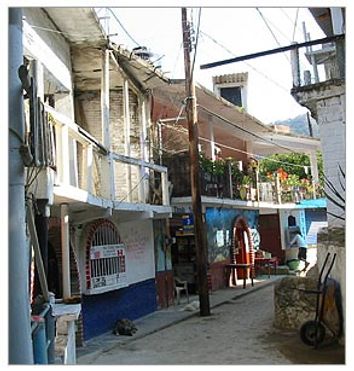
Yelapa shares in this popularity, and it has been a tourist mecca since the 1960s. However, visitors came here not for the traditional tourist fare of mariachis and margaritas but for the town’s more primitive and simpler way of living. Except for a crude bulldozed dirt strip over the mountains to the south, there are no roads to or in Yelapa, hence no cars. Until three years ago, there was no grid-based electricity, hence no television, refrigeration or phones. There is still no common water supply, though a couple thousand people live here. Normally, meaning unless there has been a particularly egregious crime, there have been no police.
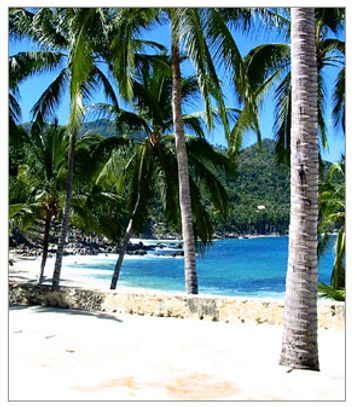
Yelapa has thus become known as a mellow place to live, where anything goes so long as it goes discreetly, as well as a spectacularly beautiful vacation spot. The land behind the town is mountainous jungle, which descends to a rugged coast of volcanic rocks interrupted by beaches at the mouths of the town’s two rivers. The jungle is a deciduous rainforest that is home to more plant varieties than any other area on earth outside the Amazon, many of them in what looks like continuous flower. The climate, except in the rainy season, is perfect.
With property around the bay becoming ever more valuable, Yelapa would be a prime target for development except for its special status as an indigenous community with title to its own land. Like Pizota down the coast, Yelapa is part of the community of Chacala, which has group title to 50,000 acres on the bay. Unless the entire community votes approval, none of this land may be sold to outsiders. That, plus the continuing difficulty of access, gives Yelapa some elbow room in the global marketplace. Rather than sell its land, it has leased out valuable properties for income.
But it is no longer willing to take refuge in primitiveness. A long and bitter political struggle over control of Chacala’s government seems to have ended in favor of the Verdes (Greens), a pro-growth group of young Turks affiliated with the business-oriented PAN (Mexican President Vicente Fox’s party); and they are determined to modernize Yelapa by bringing its citizens some of civilization’s amenities. Only this month, on March 7, the Verdes succeeded in blocking an attempt by the PRI-backed Rojos (Reds) to recall the Verde officers elected last June and hold a new election. The Verdes did it the old-fashioned way: by physically preventing a state-appointed mediator from attending the assembly where the vote was to be taken. They considered this only fair: The Rojos had forged the names of several Verde leaders as signatories on the election petition seeking their ouster!
“We are not going to let them win,” says Alfonso Garcia Martinez of the Verdes. “The election was fair. We are going to stay in power by providing services for the people — like the paving, like the town pier, like electricity.” This in itself would be a remarkable change. Chacala has long been notorious for electing sticky-fingered leaders from both parties (a reputation that has helped keep developers away). The community is now in debt for back taxes that mysteriously disappeared on the way to the state treasury. It took Yelapa three tries to actually pay for the link to the electric grid, the first two payments having vanished.
At stake is the town’s control of its tourist trade, the most important source of local revenue. Tourist guides fondly call Yelapa a fishing village, but it really isn’t. The Bay of Banderas is getting fished out, and only a few people here make a living from the sea. Most money comes into town as remittances from relatives in the United States and from tourists. Almost every waterfront house is now occupied by or offered to tourists. And while it is the people of Yelapa who put up the money for electricity, because they wanted light, refrigeration and TV, tourists will certainly be attracted by the new and more comfortable ambience it provides (though with its steep hills, dusty paths and plentiful scorpions, Yelapa life will still be too gritty for some).
In response to the new technological possibilities, a community of more than a hundred expatriates, who have lived here quietly following their bliss for many years, has recently blossomed with entrepreneurial spirit. Of 33 rentals currently advertised on one Web site, 18 are offered by gringos, some of them trying to recoup their own rents and home maintenance expenses, and perhaps to make a living of their own; some entering joint ventures with locals, investing in houses and sharing the rentals with the landowners. This building activity pays local construction workers, and the visitors the houses attract pump money into the town. In addition the site lists a dozen retreats and yoga workshops hosted by outsiders.
The mere existence of yelapa.info, a free Web service run by longtime Yelapa visitor David Johnson out of Vancouver, B.C., indicates the biggest change in Yelapa: It is now globally accessible. When I came to stay here in 1989, you had to take the water taxi from Puerto Vallarta and set foot on Yelapa earth in order to rent a room. Now you can reserve a bungalow from Des Moines; you can also pay for it online, in which case the money may never even enter Mexico. The town-owned Lagunita Hotel now gets 40 percent of its reservations via the Internet.
The globalization has even become literal: Under a rock near the waterfall that is the town’s main tourist attraction is a small package cached by a group of scavenger hunters who have posted its latitude and longitude online and invited its members to track it down with their GPS devices. So far three have found their way here and done so. Eco-bicyclists have discovered the bulldozed road and now skid down the mountainside and pedal incongruously through town in helmets and Spandex.
With global commerce has come its underside, crime and crack cocaine. Locally grown marijuana has always been available in Yelapa, and not a few of the northern visitors have brought their own pharmacopeia; but crack showed up only a few years ago and quickly caught on among a small part of the younger set. Late in 2002, a South African woman who has lived more than 30 years in Yelapa was brutally beaten and knifed by a group of youths who had been smoking crack and decided to steal her refrigerator. The physical attack was in retaliation for her having filed a complaint about the theft. It is a rueful comment on globalization that this group called itself the “Bin Ladens.”
The tax problems and crack are seen by some here as threats to local autonomy. Although they have extraordinary rights as an indigenous community, Yelapans are also Mexican citizens and are part of a municipality based in the city of El Tuito, a few miles inland. It is from PAN governments in Tuito and Guadalajara (the capital of Jalisco) that funds have come for many of Yelapa’s new civic improvements. Now fiscal sins and the mini-crime wave caused by half a dozen crack users have opened the door for Tuito to establish a bureaucratic beachhead in the town. Several police have been assigned to Yelapa, and for the first time in its history, it will have to observe an outside authority on its own turf. When you link with the world, the world links back.
Next: Paradise at $250 a square meter.
Continue Reading
Close
Forty years after Elizabeth Taylor and Richard Burton put Puerto Vallarta on the map, the resort’s surroundings on the Bay of Banderas still contain miles of undeveloped shoreline — where, as the brochures might put it, ravishingly beautiful jungle meets some of Mexico’s loveliest beaches. Developers from all over the globe have driven prime beachfront prices north of Vallarta, in the state of Nayarit, to $800,000 an acre. But there are still bargains to be found to the south in Jalisco, where steep jungled mountains have preserved the coast’s isolation since long before the Spanish came.
Most of this coast, from a few miles south of Puerto Vallarta to the tip of the bay at Cabo Corrientes, remains reachable only by boat. One of the smallest of the towns so accessible, less than an hour from Puerto Vallarta in a fiberglass panga driven by the biggest outboard motor the owner can lay his hands on, is an indigenous community named Pizota.
In Pizota, about 85 people live by fishing, a little tourism, and the odd job at some of the larger resorts up the coast. Pizota has no roads or cars, no grid-based electricity, no municipal water supply, no visible government. Its children go to a one-room school that stops at the sixth grade. It sits on about half a mile of prime beach with a drop-dead view of the bay and a psychedelic sunset every night. Therefore, predictably, this tiny hamlet is about to be switched into the global commercial network.
Last November, Pizota agreed to lease 250 acres of its best land, including the beaches, for 30 years to one of Mexico’s most colorful entrepreneurs, Jorge Vergara Madrigal. Although his Guadalajara Chivas football team fields only Mexican players, Vergara is an enthusiastic participant in the global economy. Omnilife, his health products company, derives over a billion dollars annually in sales throughout Mexico, Latin and South America, and parts of Europe and the U.S. southwest. Vergara was also producer of 2002′s Oscar-winning “Y Tu Mama También,” an international hit, and the upcoming “The Assassination of Richard Nixon,” starring this year’s Oscar-winning Sean Penn. He plans a mammoth international cultural, sports and business center for the Jalisco capital of Guadalajara. Even his soccer empire is going global, with teams in the infant Major League Soccer organization in the U.S., and in Spain and Costa Rica.
According to word of mouth, Pizota’s only means of communication, Vergara intends to use the land to build a resort solely for the use of his million and a half independent Omnilife distributors. It will be an ecological wonder of wood, bamboo and palapa capable of housing 1,200 visitors at a time and carrying away all of their waste and sewage, all without using electrical power and without access by road. (There’s no small irony to Vergara’s plans, as one of the subplots of “Y Tu Mama También” involved the displacement of local fishermen and their families by huge new seaside resorts.)
Omnilife refuses to say publicly what its plans are for Pizota, and the contracts it signed with Pizotans say only that it will build a tourist attraction, or engage in any other profitable activity not actually illegal. Should the project not work out, Vergara can walk away on a year’s notice, or can sublet the property to a third party without Pizota’s approval. For these rights, Vergara will pay a reported $300,000 a year, a fraction of the debt and legal obligations he would incur in buying land just a few miles up the bay.
If carried out, the project means that Pizota will never be the same, which is more or less OK with the people who live there. They are willing to trade land and serious poverty for what looks like a lot of money and, they hope, jobs at the resort. Having experienced the noise and pollution of Puerto Vallarta, they also realize that they are giving up the choicest part of their existence, the tranquility, beauty, and seclusion of their surroundings, to become a small part of a bustling company town. They can only guess how that will work out. They have become, in a sense, an outpost on a kind of frontier between the global network of finance and business and their uncharted local world.
This frontier is constantly shifting, and the development of Pizota now depends completely on the global economy — on how well Omnilife distributors flog their product, on whether or not Sean Penn retains his box office draw, on the Chivas’ place in the league standings, and on the difficult progress of Vergara’s huge Guadalajara project, now six years in the planning and still barely started.
But even though in this sense the deal is something of a crapshoot for Pizotans, they are needy enough to risk their land on a link to the global economy, and innocent enough to think they have a chance of winning. Locally, their initial stake of $300,000 will go a long way. There is already some new building, and new and more powerful outboards have appeared on some pangas. There are rumors of a new school and a clinic, restaurants, and even a zoo, courtesy of Vergara. Other nearby villages expect to share in the jobs Omnilife will provide. I asked one Pizotan who now has to work outside the town if he felt the project would really develop. “I hope so” he said; “there’s nothing else for the people here.” Vergara’s force-fed tourism may give the often grim visage of globalization a more benign local face.
Although its inhabitants are largely mezistado (of mixed Indian and Spanish ancestry), Pizota remains a true indigenous village, part of a larger indigenous community called Chacala that holds title to some 50,000 acres in the southern part of the bay through a 16th century charter from King Philip II of Spain that is still recognized in the Mexican Constitution. The people have lived on this land for longer than anyone can document. Members of the community may buy and sell the usufructs of portions of land among themselves, but all of it ultimately belongs to the community and may not be sold to outsiders. (At least it couldn’t until Carlos Salinas changed the constitution in 1995 so that the land can be sold if its people vote to do so. Vergara did not ask to buy it.)
Therefore Pizota, unlike almost any other village of its size in Mexico, had some voice in whether or not its land would be leased. The entire community voted on the deal, even though most of the rent money goes to a few dueños (landlords) who hold title from Chacala to the land Vergara is leasing. The dueños agreed to turn over 10 percent of their rent to the community, Vergara sent his private jet to fly 15 Pizotans to Guadalajara for a Chivas game, and the project won big in a vote last November. Two days later, the contracts were signed. In February Omnilife held a party/sales meeting on the Pizota beach for 500 of its distributors, who arrived in two large ferries and spent a decorous afternoon eating rice and shrimp and consuming, to the astonishment of the locals, no alcohol at all. If that tradition continues, it will be an odd frontier town indeed.
Next week: Wiring up the jungle.
Continue Reading
Close
On Monday night, with no warning, Los Angeles police who were herding concertgoers from the Rage Against the Machine concert outside the Democratic National Convention shot homeless activist Ted Hayes with a steel beanbag; and then, while he lay barely conscious and gasping for breath on the ground, flipped him on his belly, stood on his head and neck and cuffed his hands behind him.
One of the night’s most memorable images was a picture of Hayes, splayed on the ground on top of the American flag he carried, which ran prominently in the Los Angeles Times. It was the beginning of a week that featured a mild form of martial law as the Democrats gathered at Staples Center mostly oblivious.
The day after his shooting, just out of the hospital, Hayes rather predictably held an angry press conference. But unpredictably, he blasted the protesters and praised the police. In Hayes’ view, the demonstrators were at best spoiled white kids, and at worst evil, violent anarchists up to no good.
“Those people robbed the homeless people’s freedom of speech last night,” he said. “Theyre quick to step over the homeless people, and our cause, to make their noise. Has anybody heard today what the message of the demonstrators is? Have you heard anything about corporate greed and how they are actually oppressing people? Have we heard anything about the corrupt politics of the Democrats?” Long drawn-out sneer: “Noooo-o-o … all we hear about is ruckus and tear gas and fighting and cops and robbers.”
Just to make sure people didn’t misunderstand, on Wednesday Hayes went on Fox News Network from a skybox in the very Staples Center outside which he had been shot, and used the occasion to denounce the American Civil Liberties Union for filing suit against the police who had shot him.
And he confessed to KPFK, the local Pacifica radio station, that his homeless convention had been a disaster, shunned by carpetbagging protesters, unable to attract local support because of what he calls the indifference of the “homeless-industrial complex” of social agencies, the message lost in the din of convention hoopla.
Thus did Ted Hayes become a sideshow in the grand media extravaganza from Los Angeles. He’s a quixotic figure who shuns his allies and embraces the enemy, a homeless leader who can rally only a couple of dozen people to his cause among all the 40,000 homeless of Los Angeles.
Hayes was furious that news about the protesters’ violent clashes with police drowned out his political message. But only by virtue of being shot did Hayes get the media’s attention — an irony that wasn’t entirely lost on him.
Few locals were surprised when Hayes got out of the hospital and praised the police. They smiled and said that’s just Ted; he is well known in Los Angeles for an unwavering dedication to nonviolence and a very practical bent for getting on with the authorities. Homeless people commit nonviolent crimes every day, he points out, referring to their need to deposit human waste in the streets, illegally. The police are thus a powerful natural enemy who must be engaged diplomatically.
Hayes lives in a homeless encampment called Dome Village, a score or so of Bucky Fuller domes, each 20 or so feet across and 10 feet high at the apex, located just over the Harbor Freeway from downtown L.A. and around the corner from the Medici Suites. A longtime L.A. activist, he agitates for a systemic approach to homelessness through a kind of national Marshall Plan headed by a Cabinet officer, a post for which he is a volunteer. Dome Village also houses a few of the homeless who rally around this idea.
The night he was shot, he had a permit to march nonviolently. He says his group had been promised it could even cross police lines, to set an example of nonviolent behavior. So when a phalanx of police, mounted and heavily armed, started sweeping the crowd down Olympic Boulevard, Hayes, in ragged white shirt and white trousers, carrying a large American flag, marched right up to them.
And they shot him. They were firing rubber bullets, hard cylinders about an inch across and an inch and a half long. Suddenly Hayes was lying on the ground, the flag twisted under his leg, and the crowd was running the other way.
It wasn’t supposed to end that way. He and his group had left Dome Village only half an hour before, after a brief rally at which he and his lieutenant, Dexter Clay, emphasized the importance of nonviolence while at the same time trying to whip up some enthusiasm. The march had originally been intended to circle the Staples Center with homeless people holding lights, but it wound up as a pilgrimage by a tiny band of no more than two dozen people.
Carrying signs and chanting, the group followed Hayes and his flag through the dark streets on the west side of the freeway to Olympic Boulevard, and then through the underpass to the convention site. At that point they met the concertgoers streaming down the center of the street, which is very wide, and something almost wonderful happened.
The concertgoers, who were euphoric, took up his cause. “All right! Support the homeless! Yay for the homeless!” They were laughing and smiling and some of them did turn around and join the march, which had been filing east down the north sidewalk while the crowd flowed west in the middle of the street.
By the time Hayes reached the police lines, there may have been a hundred or so people walking behind him. Suddenly there was gunfire. The mounted police kept coming, a solid line of black moving, pausing, firing again, moving, pausing again, firing.
Every time they stopped, the crowd stopped. A few protesters took up a chant of “Shame! Shame!” Then the police would fire again and the crowd would retreat. The whole event took no more than 30 minutes, from the time Hayes and the homeless arrived at the police line to the time the concertgoers were chased through the freeway underpass.
Hayes was taken to a hospital and his followers eventually straggled back to Dome Village. But there was no resentment or anger in evidence. No one talked about police brutality; no one even seemed to see anything unusual in the fact that their leader had been shot. They weren’t panicked, they weren’t dazed, they hardly seemed upset.
For protesters, though, Hayes has nothing but contempt. “Nobody cares about these homeless people,” he says. “Oh, but they care about the homeless people in Colombia, in Brazil, in Pakistan. They care about the children’s sweatshops in Asia — but what about the children right here in America, under their noses?”
Thanks to his shooting-inspired notoriety, Hayes got onto the protesters’ agenda on Tuesday night. But he drew an audience of precisely zero outside his own group of a few dozen. Only a few yards away, as he spoke, convention delegates ran a gamut of sarcasm and abuse from idle demonstrators who lined their route. When Hayes led his band out of the protest area, the homeless line crossed the delegate line at right angles, each filtering though the other and no one even bothering to talk.
Hayes was back out there Wednesday night, trying to convince protesters to stay peaceful and follow the orders of police.
On Thursday, the convention began winding down, as delegates and protesters got ready to go home, and the police prepared to retire to their stations. Dome Village remains, as do the homeless of Los Angeles. Ted Hayes got his minute in the national spotlight, but his issue didn’t. But he’ll be back out there long after the hoopla has faded.
Continue Reading
Close