Cliff Rothman

Egypt’s free pass

Bush officials stand up for Afghan women. So why do they say nothing as Egypt jails and tortures gay men?

  • more
    • All Share Services

Egypt's free pass

What is the difference between a persecuted Afghan woman and a persecuted Egyptian gay man?

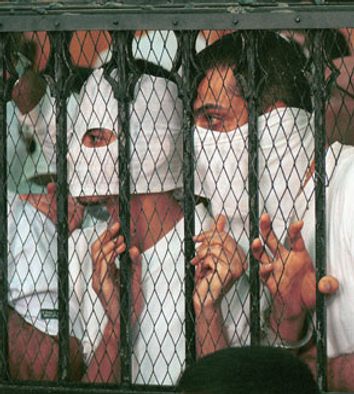
The first rightfully elicited an urgent denunciation via first lady Laura Bush in a special radio address Nov. 17. The second has elicited ongoing silence by the administration since the campaign of arrests and prosecution of gay men solely on the basis of sexual orientation was launched in Egypt last May.

And while the quick trials, hard-labor prison sentences and reported torture of gay Egyptian men have elicited an international outcry, the White House has been jarringly silent. But George Bush’s indifference to the civil rights and human rights of gay men has a long, unblemished history going back through his governorship of Texas, where his record on AIDS and civil liberties was a source of rancor to gay activists and the state health-care infrastructure. That apathy has continued up to and including the administration’s recent denial of compensation to same-sex partners of victims of Sept. 11.

It has been left to an ad hoc group of Congress members to take the lead as American human rights watchdog — in its most enlightened, as opposed to grandiose, posture. Last August, 35 members of Congress issued an urgent appeal to Egyptian President Hosni Mubarak to stop the crusade in his country against homosexuals. “People are being arrested because they’re gay, they’re being charged because they’re gay and they’re being sent to prison because they’re gay,” says Dennis Kucinich, D-Ohio, one of the letter’s co-signers, and head of the Progressive Democratic Caucus. “This is something that Congress ought to be speaking out on.”

There was no response until January, when openly gay Rep. Barney Frank, D-Mass., who had spearheaded the letter, was invited to an Egyptian state dinner — and refused to attend. In a letter to the Embassy Ambassador Nabil Fahmy, Frank noted that his presence would be “a betrayal of men very much like me who have recently been brutally arrested and imprisoned by your government for no other reason than the way in which they choose to express affection to other human beings in a mutually consenting relationship.”

The Egyptian Embassy responded immediately, denying that the actions were on the basis of sexual orientation, and insisting that it had responded to the earlier letter, but the response must have gotten lost amid anthrax-heightened security precautions. “All 52 of the accused are charged under article 9 (c) of law number 10/1961 which prohibits public lewdness irrespective of sexual preference,” wrote Fahmy in the reissued letter, dated Nov. 6, 2001.

Finally, two weeks ago, on March 5, the State Department acknowledged the persecution of Egyptian gay men. The 2001 Human Rights Report issued by the Bureau of Democracy, Human Rights and Labor catalogs arrests on the basis of “debauchery,” the refusal of the government to try the men in criminal court, confessions reportedly elicited under torture and a prison sentence meted out to a juvenile. The next day, when Mubarak and Bush met at the White House in a highly visible state visit, there was no public discussion of the Egyptian campaign still under way. A week later, five gay Egyptian men received hard-labor sentences in a hearing that lasted 15 minutes, according to witnesses. The men were charged with “habitual practice of debauchery,” a provision commonly used in Egypt to penalize consensual homosexual behavior. The same law was used to sentence 23 men to one to five years of hard labor on Nov. 14 of last year, in the notorious Queen Boat case.

But spurred by the new State Department report, and the Egyptian ambassador’s belated response, a consortium of 37 Congress members delivered another letter this week to Mubarak, rejecting their explanation and continuing to put pressure on Egypt. “We are encouraged that Ambassador Fahmy in his letter officially denies that the 52 men in Cairo were prosecuted because of their perceived sexual orientation. We say we are encouraged because this denial recognizes that such actions are essentially indefensible,” notes the letter.

The embassy has privately shared that international attention is causing it grief, however much a domestic hard-line against homosexuals benefits Mubarak’s standing with the conservative constituency. Bush walks a similar tightrope.

But on the larger world stage, it is in the best interests of the White House, which has regularly been a target of criticism for ignoring the human rights violations of strategic allies, to publicly encourage the equality of all Egyptian citizens, regardless of sexual persuasion. That Egypt is the second largest recipient of U.S. foreign assistance gives the White House additional leverage to request compliance with its human rights standards.

“Egypt is an important ally of the United States, and yet the United States remains silent on this issue,” says Sydney Levy, spokesman for the International Gay and Lesbian Human Rights Campaign, based in San Francisco. “President Bush must remember that against torture there should be no immunity, and there can be no neutrality.” When Laura Bush spoke out against the persecution of Afghan women last November, she noted that “all of us have an obligation to speak out.” The president also positioned himself squarely as the guardian of international human rights last December when he proclaimed both a Human Rights Day and Week, analogizing “human rights around the world” as an extension of the American Bill of Rights, and enlisting “all Americans to celebrate the universal principles of liberty and justice.”

This applies to gay men everywhere, including Egypt, as much as women in Afghanistan, or anywhere.

In defense of Andrew Sullivan

Whatever discrepancies exist between his public words and his private actions, the attempt to smear him sexually is a vendetta masquerading as journalism.

  • more
    • All Share Services

In defense of Andrew Sullivan

I would tell you my sex handle on America Online, but unfortunately, AOL deleted it. Oops. Too dirty. Most gay men I know have sex handles on AOL, or at least alternative anonymous names where they peruse cyberspace for LTRs (long-term-relations) or, ahem, short-term relationships. As someone has said, the Internet is like the new, more efficient gay bar.

I can’t speak for heterosexuals, because I don’t go trolling in heterosexual chat rooms. But judging by the steamy names of the chat rooms, they are also a pretty horny bunch.

Evidently, so is prominent gay editor, author and columnist Andrew Sullivan, who advertised for sex on AOL and on a sex Web site. Horrors. Sullivan, the stalwart gay conservative who has been an outspoken critic about what he decries as loose gay morals, irresponsible sex, excessive AIDS activist tactics and so on, was outed for his outri sexual preferences by several gay journalists last week, in what has become a media firestorm.

The author of the most extensive exposi, Michelangelo Signorile, has had a longstanding feud with Sullivan, and decided to expose his enemy’s alleged hypocrisy in a cover story in a local New York gay publication, LGNY. He revealed Sullivan’s AOL sex handle as well as savory details of a more raunchy sex ad on a gay Web site, where he was looking for partners who were also HIV positive and didn’t want to use a condom. And he quoted anonymous sources who reported having had sex with Sullivan, linking him to the said nasty sex ad and AOL handle.

Like all juicy stories in our sex-celebrity-Internet age, the story has metastasized.

The first mention of Sullivan’s private life was actually a paragraph by Michael Musto, two weeks ago, in the Village Voice. Then came Signorile’s LGNY story. Jim Romenesko’s Media News picked it up, but it was a New York Post story, following on LGNY’s, that forced Sullivan to finally issue a defiant defense, after two weeks, on his own Web site. Wednesday, Inside.com reported on the flap.

Meanwhile, a third gay journalist was working to expose Sullivan: David Ehrenstein, a Los Angeles writer who, like Signorile, has been at odds with Sullivan over his moralizing. Ehrenstein, out of pique over what he saw as Sullivan’s sexual double standards, in early May alerted editors at Salon.com and the Washington Post, among others, to Sullivan’s sex handle and personal ad.

“In light of Andrew Sullivan’s constributions (sic) to ‘Salon,’” Ehrenstein wrote, “I think you should be made aware of the following information, currently circulating ’round the ‘net. I warn you that it is blunt. But then so is Sullivan.” The e-mail included what was apparently Sullivan’s own posting on a gay sex site, and added: “I am, needless to say, not a disinterested observer. Mr. Sullivan and I have — as they say ‘had issues’ in the past.”

Well, I also have ideological differences with Sullivan. I am a gay, left-liberal, vegetarian Californian, and I often disagree with the Tory Catholic Sullivan. But however conservative Sullivan is, or how much he may moralize in ways that are different than me, he is entitled to sexual privacy. He acted confidentially, as most of us do, in good faith, online. He chose not to use his name or post a picture. Yet his adversaries decided to drag his most private sexual behavior through the town square for derision, to punish him for his political views.

As I read Signorile’s story about Sullivan’s alleged double life, and the excruciatingly detailed description of his online ad, I was pained at the violation of his privacy, and the obvious attempt to shame him. “It’s almost enough to make you cry,” a senior editor at the New York Times told me. Whatever discrepancies may exist between Sullivan’s public words and private actions don’t justify his abuse — and I do see it as abuse, vendetta masquerading as advocacy journalism. Sullivan calls it “sexual McCarthyism,” and many agree.

Indeed, some journalists passed on doing the Sullivan story. “I had to take the test of who does this affect, who is this relevant to. My conclusion is: It affects Andrew Sullivan only,” says National Public Radio’s Jon Beaupre, who has been president of the National Gay and Lesbian Journalists Association for two years. “People may disapprove of Sullivan or his behavior, but in the final analysis the main reason that people were pushing to cover this story was for scurrilous reasons, and I couldn’t justify that.”

It is Sullivan’s preeminence as gay spokesman, as much as his beliefs, that have made him vulnerable to attack, says Bill Ervolino, Signorile’s first editor at Nightlife magazine, who now writes a column for Bergen’s The Record. “Sullivan has long been an object of scorn by members of the gay community who covet the attention he receives by the media, resent that he is far more conservative than most gay Americans would admit to being, and resent that he is the only gay spokesman who really matters on television,” says Ervolino.

But Ehrenstein insists Sullivan deserves the scrutiny, and the attacks, because he has set himself up as a gay spokesman. “You’ve heard of head nigger in charge, going back to whole slavery thing. Well, Sullivan has become Head Faggot in Charge, and what better place to do that than at the New York Times,” he says. “This has to do with a specific industry and a history, and with his statements about sexuality. This is not just Joe Gay Person.”

Michael Musto agrees. “It was such a major case of sexual hypocrisy that I thought it was worthy of reporting. Sullivan for years has railed against Clinton for sexual indiscretions. He said that Clinton needed psychiatric help.” In fact, while Sullivan was harshly critical of Clinton for his “reckless” behavior in the Lewinsky mess, he also attacked Independent Counsel Kenneth Starr for the “scolding, moralizing conservatism” of the lurid Starr Report and of the entire “Lewinsky Kulturkampf.”

And while detractors call Sullivan a hypocrite, and use that as a defense for exposing his private sexual behavior, I cringe at the word. First of all, it implies that he believes one thing but purposely acts in a contradictory way. And there’s no proof of that. Sullivan’s writings about sex and relationships have always been complex, sometimes even contradictory. They’ve evolved over the years. He has certainly promoted gay marriage and monogamy; he has also defended the freedom and intimacy of unprotected sex with another HIV-positive lover.

At any rate, I defend Sullivan’s right to his contradictions. I have felt and seen in myself discrepancies between my intentions and my actions, between what I most deeply feel and what I have at times said or done, in moments of human frailty, fear or need.

I am single and would like to only have meaningful sex, with meaningful partners, with whom there would clearly be a future possibility. But sometimes I am needy, sometimes I am horny, sometimes I am carnal — well, often I am carnal — and I try my best to navigate between being an extremely sexual being and being constructive and safe. I defend my right to sexual experimentation — though, until recently, I never dreamed of defending it publicly. I remember, years ago, going to a leather bar in New York, and first making the connection that the most creative, interesting, edgy guys were often attracted to fringe sex. The emotions that touch highs and lows, the acting out of issues of control or power, the intensity of need, the creative acting out that spilled over into sex: No one should have to apologize for wanting to explore all that.

But I remember my own moment of fear and shock when I sent a picture online to someone on AOL, and I saw the following words appear in an instant message on my screen: “Didn’t you just do an article in Vanity Fair?” My picture had recently run in the contributors section of the magazine. It was my first, sudden realization that I could be fair game for sexual behavior that diverges from vanilla, and looks nasty in print, the painful realization that Sullivan had forced on him thanks to this scandal.

Ehrenstein doesn’t see the issue as “outing” because Sullivan was operating, even if anonymously, on the Internet, which he sees as public. “When you are going to put something out there in public space, is it private?” asks the author. “He is asking the world to come to his door. You go and find out who he is. People followed up the ads and found out it was him.” That Sullivan is a public figure who has spoken out on the issues involved also makes him “fair game. He has opened the door. What are you going to do? Are you just going to ignore this?”

But if Sullivan is fair game, so are we all. Sullivan is now being tortured, but we are all at risk.

I actually believe Ehrenstein and Signorile went after Sullivan for reasons of principle. They are sincerely offended by what they see as Sullivan’s passing judgment on gays who differ from him, especially his nasty attacks on gay leftists. Signorile writes:

In a particularly gratuitous slam, Sullivan only a few weeks ago on his Web site described San Francisco’s gay community as “frozen in time,” unlike gays in the rest of the U.S. who are “increasingly suburban, mainstream, assimilable.

“Here in the belly of the beast,” he wrote in a swipe, “Village People look-alikes predominate, and sex is still central to the culture,” as if his own … web page doesn’t evoke these very same stereotypes.

In his Internet rebuttal, Sullivan maintained that he only had sex with HIV-positive partners, and that the sex was consensual and outlined in advance. He chose to advertise on a graphic Web site because it efficiently telegraphed his particular sexual taste. He admits that he was naive when he was functioning sexually online, not suspecting that his private sexual behavior — which did not involve matters of state, security or governance — could become grist for public consumption.

Writing about my own online sexual activities, in solidarity with Sullivan, I cringe slightly. It’s not something I would like my mother to read. But I don’t assume that Andrew Sullivan wanted his boss, his friends, his family to read about his intimate sexual details. But he didn’t have a choice.

Musto insists there is a difference between Sullivan and other gays looking for sex online. “We all have our own sexual secrets. This case only happened to be reportable because of sexual hypocrisy.”

But I disagree. Sullivan was right when he insisted, in the closing line of what he says is his final word on the subject: “It is none of your business.”

Continue Reading Close

Why won't George W. Bush talk about AIDS?

Texas gays say their governor's "compassionate conservatism" doesn't include them.

  • more
    • All Share Services

Since George W. Bush took office as Texas governor, 9,921 Texans have died of AIDS and 19,532 new cases have been diagnosed. Texas ranks fourth in the country — behind only New York, California and Florida — for reported AIDS cases.

In those 60 months, Bush has never said the word AIDS publicly in either a health, social or policy statement, according to leading AIDS organization leaders on a city, county and state level, reporters covering the governor’s office, and gay community leaders.

“To the best of my knowledge he has never even said the word AIDS, in any form,” says Rep. Glen Maxey, the state’s only openly gay legislator. Echoes Don Maison, executive director of AIDS Services of Dallas: “Through the context of funding on AIDS and HIV and through two legislative sessions that we’ve been through with him, there’s no AIDS record.”

“AIDS? He’s never mentioned the word,” says Harry Livesay, the former director of advocacy and public policy for Bering Community Service Foundation, an AIDS service organization in Houston. Livesay founded the HIV policy group that brings together the state’s agencies to work on HIV and AIDS policy.

Technically, Bush has in fact said the word “AIDS,” Livesay admits, but only in “letters of commendation to organizations on anniversaries, or things like, ‘Laura and I join you in praying for recovery from AIDS,’” Livesay says.

A senior Texas official, who oversees and sets policy in the AIDS and HIV field, and who spoke only under the cover of anonymity, said that “in my … years [in this position], I have not heard AIDS addressed publicly” by Bush.

AIDS is off Bush’s radar screen, period. Bush is the only governor in the country who ignored an urgent letter in September from Children Uniting Nations chairwoman Daphna Ziman for feedback or resources regarding the AIDS epidemic in Africa.

“Forty nine governors responded, including his brother,” says Ziman, who just received the global peace and tolerance lifetime achievement award from the Friends of the U.N., along with Mikhail Gorbachev. “I mean, it’s a crisis for everyone. Ten million children with AIDS, can you imagine? One governor helped to arrange the shipment of 100,000 basketballs. Gray Davis offered me the support from the medical facilities at UCLA. We sent Bush the letter twice. A letter and a fax. We didn’t want to take a chance.”

Ziman says flatly: “When it comes to AIDS, I just think he doesn’t care.”

POZ magazine reported this summer that a request to Bush spokeswoman Linda Edwards for transcripts of Bush’s statements addressing AIDS yielded nothing beyond congratulations and condolences sentiments. A request last week by Salon News was fielded by Bush campaign spokesman Scott McLellan, who said he would respond. No transcripts were sent, and the Bush campaign offered no comment on the governor’s AIDS record.

While the national media has painted Bush in lavender-friendly hues, at least partly because he doesn’t engage in the gay-baiting rhetoric of a Pat Buchanan, gay, lesbian and gay-friendly Texans are alienated across the board.

AIDS is only one of several hot-button gay and lesbian issues Bush has at best ignored and at worst opposed since he took office in January 1995. He vehemently opposes both same-sex marriage and gay and lesbian child adoption. The latter has raised the ire even of gay Republican Log Cabin leader Rich Tafel, who thus far has maintained a measured response to Bush. Tafel hopes Bush is still open to being convinced.

“If he doesn’t think gays are fit to be parents, that would be a serious issue for an organization like ours,” Tafel says. “That’s an issue our members are asking about.”

It is common knowledge in political circles as well as among gay leaders that Bush scuttled the Texas hate-crimes bill that would have protected gays from discrimination based on sexual orientation. “Everyone knew that all he had to do was give the signal and the hate crimes bill would have sailed through,” says Maxey.

During his first-term election campaign, Bush allowed his strategists to use gay rights as a wedge issue, baiting then-Gov. Ann Richards for her support of repealing anti-sodomy laws. Once elected, Bush appointed a health commissioner unpopular with the gay community for his support of mandatory AIDS testing.

“He has been totally ineffective in dealing with HIV and AIDS issues as well as issues that are important to the gay and lesbian community, especially the hate-crime bill,” says Francisco Sanchez, the openly gay secretary of the Harris County Democratic Party.

Tim Thetford, a legislative aide to Rep. Harryette Ehrhardt, thinks Texas gays need to alert gays around the country to Bush’s policies.

“I think we need to make a statement that we have a do-nothing governor on gay and lesbian issues who is paternalistic and will avoid any confrontational issue,” says Thetford. “I think it’s more dangerous to have a president who ignores our concerns than it is to have one who opposed them. At least we can dialogue with someone who opposes us.”

Bush’s blind eye toward the gay community has also been apparent to the local press. “He has never been that sympathetic to gay issues,” notes Wendy Benjaminson, the political editor of the Houston Chronicle. “He is not sympathetic on hate crimes, on gay adoption or gay marriage.”

Bush’s attitude toward gays was reported in an exclusive story by political reporter Polly Hughes on the cover of the Houston Chronicle on Aug. 19. Maxey disclosed to Hughes what had been whispered about since the spring: a private conversation between the governor and Maxey, an openly gay legislator, after a particularly grueling legislative battle. According to Maxey, Bush pulled him aside and confided, out of earshot: “I value you as a human being, Glen, and I want you to know that what I say publicly about gay people is not directed at you personally.”

Though the Bush camp dismissed Maxey’s story as partisan spin, rumors had been circulating for months because Maxey had immediately after the exchange repeated the story verbatim to colleagues sitting nearby. “Do you believe what Bush just said to me?” is how a fellow legislator, who requested anonymity, described the interaction. Maxey also reported the story to several colleagues within days, and to another newspaper reporter, who confirmed the alleged Bush-Maxey exchange, but had not reported it because at the time Maxey had revealed if off the record.

But the cover story raising the issue of Bush’s two faces toward the gay community barely made a ripple outside of Texas, because it collided with the late-summer firestorm that consumed the national media at the time: the did-he-or-didn’t-he cocaine story. “We got the Maxey story the same day that the cocaine story broke, and it got overshadowed,” Benjaminson says.

Another Bush trait that has dogged him on the campaign trail — his unpreparedness on issues that don’t personally interest him — has been a longstanding irritation to Texas’ gay community.

“There was a major demonstration in March, 6,000-8,000 marching to protest anti-gay-and-lesbian foster care and adoption legislation. The next day he’s asked, ‘Where do you stand?’” Maxey recalls. “He has no answer. None … That kind of demonstration, and the very next day he’s totally unprepared to respond.”

Sanchez admits he is watching the Bush campaign with concern. “Over the past seven years [of the Clinton administration] we’ve seen tremendous progress at the executive level in how gays and lesbians are treated in the federal workplace and in the provision of health-care services and in the funding of HIV and AIDS issues. Those have been large-scale executive initiatives,” says Sanchez. “If you put a person in that office who has exhibited no leadership in those areas, then we either don’t move forward or we fall back, very far back.”

Continue Reading Close