Compiled by Dana Cook
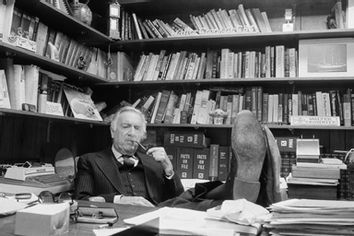
Walter Cronkite, 1916-2009

Remembrances of "the most trusted man in America" from Andy Rooney, Ronald Reagan, Isaac Asimov and others

CBS-TV newsman Walter Cronkite is interviewed in his CBS office at the broadcast center 524 West 57th Street on Feb. 3, 1981 in New York.

When longtime (1962-81) anchorman Walter Cronkite signed off the “CBS Evening News” with his signature “And that’s the way it is,” his audience believed that’s the way it was, for better or for worse. The avuncular newsman, after all, was often cited by opinion polls as the “most trusted man in America.” Several of his peers remember him below.

Andy Rooney, newspaper columnist and television commentator: A tough, competitive scrambler

A group of reporters would meet at St. Pancras station and board a train for Bedford. Among the friends I made on those trips were…Walter Cronkite with United Press…

Cronkite had escaped being drafted because he was color-blind….

These reporters were my teachers although they didn’t know it. While I tried to act more like one of them than a student, I watched and listened carefully. Anyone who thinks of Walter Cronkite today as the authoritative father figure of television news would be surprised to know what a tough, competitive scrambler he was in the old Front Page tradition of newspaper reporting. He became the best anchorman there ever was in television because he knew news when he saw it and cared about it. He was relentlessly inquisitive. The subject of his interview always sensed that Cronkite was interested in what he had to say and knew a great deal about the issue himself. (London, 1942)

From “My War, by Andy Rooney” (Times Books/Random House, 1995)

Charles Lynch, Canadian journalist: Swarming the king

During the closing stages of the war in Europe, the “theatre” as it was called was visited … [by] King George … All proceeded to the airport where a roped-off compound had been prepared for the press. [Press commandant Colonel William "Tug"] Warrener stood in front of the column, baton tucked under his arm, head held high, chin outthrust as the royal DC-3 rolled to a stop. The door of the aircraft swung open, the steps dropped into place, and King George VI descended on the soil of liberated Europe for the first time.

Warrener saluted smartly, and as he did so Walter Cronkite of United Press vaulted over the rope barrier and made a dash for the King. Cronkite was known to be fearless, having dropped into Holland by parachute to cover the Arnhem operation, so I followed and so did everybody else, and poor Warrener was left rooted to the spot, uttering shouts of “Scum!” and “Back, you bastards!” while we swarmed around King George and bombarded him with questions. (Netherlands, 1944)

From “You Can’t Print THAT!: Memoirs of a Political Voyeur,” by Charles Lynch (Hurtig, 1983)

David Schoenbrun, broadcast journalist: Middle America, middle-of-the-road, Middlebrow

Something strange was happening in the CBS broadcasting booth high over the [1952 Republican national] convention floor. A young man, in his early thirties, with a flat Kansas prairie accent, who pronounced words like “going” as though they were spelled “goeen,” was calling the story, shot by shot, straight, clear, factually. It was Walter Cronkite, who had won the assignment as anchorman of the convention….

Cronkite was a veteran UP wire-service reporter, who had learned to be the first and fastest with the facts. No punditing, no larger meaning of it all, no concern about why, only about who, what, when, where, and how. He was Middle America, middle-of-the-road, middlebrow. He was fascinated by what he was watching and he projected that fascination to his listeners in words they could understand. He knew everything that was going on, knew all the delegations, and by his knowledge managed to project an air of authority and truth. He was an overnight sensation, a national figure on his way to becoming the best known and most trusted man in the land. He would hit some bumps along the road and go into skids but he would end up as the giant of television. (Chicago)

From “America Inside Out: At Home & Abroad from Roosevelt to Reagan,” by David Schoenbrun (McGraw-Hill, 1984)

Reuven Frank, television news executive: Making him famous

The 1952 [Republican and Democratic national] conventions were the first most Americans had seen. …

CBS’s anchorman was the virtually unknown Walter Cronkite, who had signed on with CBS in its Washington bureau only two years before. A journalist since his college days, Cronkite had covered Eisenhower and his headquarters throughout the war in Euorpe…

…CBS…consciously gave him center stage and drew attention to him. The CBS producers developed what was for that time an ingenious procedure, putting Cronkite’s face in a corner of the picture of the proceedings, the relative size of a postage stamp. As a technical achievement, it was simple and unsophisticated, but no one had done it that way before, and it helped make Cronkite famous.

From “Out of Thin Air: The Brief Wonderful Life of Network News,” by Reuven Frank (Simon & Schuster, 1991)

Eve Arden, actor: The difference one man can make

We were given a welcome-back [from Europe] party by Dottie Leffler, a CBS publicist who had become a good friend while doing publicity for “Miss Brooks.” That evening I was miserable with what I thought might be the flu….When I arrived, I still felt awful, so Dottie took me to the guest room to relax awhile. I was feeling pretty sorry for myself when suddenly Dottie appeared in the door saying, “Here’s some company for you,” and in walked Walter and Mrs. Cronkite and their daughter Kathy.

As we talked I began to feel better and better. He’s always had that effect on me, whether on TV or the few times we happened to meet him on the street. He makes me believe in the difference that one man can make in this world. (New York, 1953)

From “Three Phases of Eve,” by Eve Arden (St. Martin’s Press, 1985)

Billy Graham, evangelist: Leading questions

I went to be interviewed by Walter Cronkite for his CBS television news show, recorded for broadcast the following night. He was an amiable host, and we had a great time, sitting together in a room overlooking Times Square. He asked the kind of leading questions I love to answer, about our work, our objectives, the message we preached, and what we had to offer New York.

The news staff then screened some film clips that they had taken around Times Square and Broadway, and Walter asked me to comment on them. I observed that thousands of frustrated and bewildered people there who were searching for reality, could find it if they would give their lives to Christ. (New York, 1957)

From “Just As I Am: The Autobiography of Billy Graham” (HarperCollins, 1997)

Fred Davis, TV game show host: Marvelous man

One of my favorite moments was when we had Walter Cronkite up [to Toronto], in the old days, as a guest panelist [on CBC's "Front Page Challenge"], before he became Uncle Walter. A marvelous man. And I took a chance. You know, you think with these big-timers they’re so busy, or they want to be alone. And sometimes they end up in their hotel room with nothing to do. And I said, after the show, “You wouldn’t like to come home and have a cup of coffee or a drink, would you?” And he said, “I’d love it.” And three of the most valuable hours I’ve ever had followed. Jo [Mrs. Davis] and I and Walter Cronkite sitting there.” (late 1950s)

From “Front Page Challenge,” by Alex Barris (Canadian Broadcasting Corporation, 1981)

Don Hewitt, television producer: Irresistible

Walter Cronkite replaced Douglas Edwards on the evening news. It wasn’t that Doug wasn’t first rate, it was that Cronkite was irresistible. He had “anchorman” written all over his face. The CBS brass only had to take one look at this former United Press correspondent and they were ready to make a major commitment to television news. They seemed happy to have me on board as his sidekick. (New York, 1962)

From “Minute by Minute…,” by Don Hewitt (Random House, 1985)

Dick Gregory, comedian and activist: Knew more than he reported

I carried the road show in my briefcase. It consisted basically of a copy of Life magazine, which showed still shots of the assassination [of John F. Kennedy] taken from Abraham Zapruder’s home movie of the motorcade, along with some other useful and revealing photos. I presented my assassination road show in nightclub and concert hall dressing rooms, press conferences and personal conversations all across the country.

One night in my dressing room at the Village Gate in New York City, I showed my road show material to Walter Cronkite. I pointed out that the Zapruder film shows that Governor Connally was not hit until seconds after the president was struck. They couldn’t have been hit by the same bullet…

Walter listened to my assassination rap with interest and patience. My stuff never made it on the “CBS Evening News” … It wasn’t out of character for Walter to know a whole lot more than he reports on the evening news! (1964)

From “Up From Nigger,” by Dick Gregory (Stein and Day, 1976)

Isaac Asimov, science fiction writer: “My father will be thrilled”

I taped a show with Walter Cronkite, who was narrating a program on the future, one called “The Twenty-first Century.” I was rather excited about this, for I admired Cronkite extravagantly.

I sat down in a chair across a low, round table from him, and while the technicians fiddled with the light, I wondered whether I could say, “My father will be very thrilled, Mr. Cronkite, when he finds out you’ve interviewed me.”

It seemed so childish a remark that I didn’t dare make it. I was afraid Cronkite would call off the whole thing in disgust.

My hesitation gave him the chance to speak first. He said, “Well, Dr. Asimov, my father will be very thrilled when he finds out I’ve interviewed you.” (New York, 1968)

From “In Joy Still Felt: The Autobiography of Isaac Asimov,” 1954-1978 (Doubleday, 1980)

Billy Crystal, actor and comedian: Light in his eyes

I was going to NYU and working as an usher at a theater playing “You’re a Good Man, Charlie Brown” when Walter Cronkite handed me his ticket stub. I led him by flashlight to his seat, then knelt down, shined the flashlight in my own face and said, “Mr. Cronkite, if there’s anything I can do to help you in any way during the show, please don’t hesitate to let me know.” Then, automatically, without thinking, I flipped the flashlight into his face as though it were a hand mike. “Yes, there is,” Walter Cronkite said. “You can take the flashlight out of my eyes.” (New York, late 1960s)

From “Absolutely Mahvelous,” by Billy Crystal with Dick Schaap (G.P. Putnam’s, 1986)

Abbie Hoffman, political activist: Image advice

“Hi, Abbie, this is Walter,” said the voice.

“Walter!” I responded excitedly, “but how can that be? I’m watching you right now on television.”

“It’s taped,” said the Anchorman.

A few months previous Cronkite had worn horn-rimmed glasses. After studying the effect for three days, I wrote him a letter recommending that he get contact lenses. I thought the effect of his glasses was detrimental to his image … “I took your advice, you know,” he offered graciously.

“We don’t want to lose you, Walter,” I said. “What’s on your mind?”

“I’d like to interview you — live, for 20 minutes, about the collapse of the movement,” he said.

His voice signed off exactly on cue with the television set. An experience to contemplate, talking live to Walter Cronkite while he sped home to Connecticut in his limousine, yet watching him “live” on television. (New York, 1969)

From “Soon to be a Major Motion Picture,” by Abbie Hoffman (G.P. Putnam’s, 1980)

Sally Quinn, journalist: Unaffected

… the tenth anniversary of “The CBS Evening News with Walter Cronkite.” He was our interview [on "CBS Morning News"] that morning. I was excited because I admire Cronkite as both a good print journalist and a good television journalist. And for someone who has achieved such near reverence, he is easy, natural, unaffected, smart, gentle and funny. Cronkite has a beguiling, self-deprecating sense of humor and an appetite for an occasional salty joke….

I was surprised at how comfortable I felt, even at the start of the interview, because I had been ill at ease at the thought of interviewing such a veteran. But Cronkite, though, not nervous, seemed less comfortable at being interviewed than we were interviewing him. (New York, 1972)

From “We’re Going to Make You a Star,” by Sally Quinn (Simon and Schuster, 1975)

Lesley Stahl, broadcast journalist: Convivial and unpretentious

The first time I met Walter Cronkite, I was surprised at how young he looked in person. I had always heard that television makes you look ten years older; it put 20 years on Cronkite. I liked him right away, but then, most people did. Convivial and unpretentious, he is of that rare breed who wear the cloak of fame comfortably.

He was our leader in the true sense. If he as much as breathed that we in the bureau had been second best on a story, we’d pour ashes on our heads for a week. Once Cronkite thought a story had merit, CBS would pounce on it with full energy, as with the space launches. And in the unusual case when he took a stand on an issue, it had enormous influence. (New York, early 1970s)

From “Reporting Live,” by Lesley Stahl (Simon & Schuster, 1999)

William Goldman, screenwriter: Script trouble

It was eventually common knowledge that I had written a dud … Time wrote an article about the progress of the movie and mentioned the lack of quality in what I’d done…

I was at CBS once in the news department and Walter Cronkite was walking along a corridor. The guy I was with knew Cronkite and introduced us, which pleased me because during this Watergate time, when everyone was lying, he was among the few Americans you could trust. Following is the entire conversation:

MY FRIEND: Walter this is Bill Goldman who’s writing “All the President’s Men.”

ME: How do you do, sir.

CRONKITE: I hear you’ve got script trouble. (and he continued on his way) (New York, mid-1970s)

From “Adventures in the Screen Trade: A Personal View of Hollywood and Screenwriting,” by William Goldman (Warner Books, 1983)

Julia Phillips, film director: Didn’t disappoint

Walter is one of the few big stars I have met who wasn’t a disappointment. He’d been gracious enough to meet me and Steven [Spielberg] in the hooker-laden bar at the Sherry Netherland to talk about the remote possibility of playing the anchorman reporting the nerve-gas derailment/coverup on the network news [in "Close Encounters of the Third Kind"]. Why not?

He had been an everyday fan/observer in Martha’s Vineyard while Steven was shooting Jaws… (New York, 1975)

From “You’ll Never Eat Lunch in This Town Again,” by Julia Phillips (Random House, 1991)

Patrick Buchanan, speechwriter, conservative commentator and presidential candidate: Truckled

Hank, who had been the accountant for CREEP, Richard Nixon’s now infamous 1972 Committee to Re-elect the President, was suing CBS and Walter Cronkite for malicious libel. Cronkite had led his “Evening News,” during the thick of the Watergate revelations, with the charge that Henry Buchanan, brother to White House aide Patrick Buchanan, had been operating a “laundry” in Bethesda for cleaning dirty money. The charge was utterly baseless; CBS had been worse than sloppy; and Hank intended to prove it in court.

At the Radio-TV Correspondents Dinner that year, as I was chatting away, I turned to have a friend introduce me, face to face, to the Most Trusted Man in America, the man I believed had libeled my brother. Cronkite extended his hand, smiled, and said graciously, “Hello, Pat, how are you?” Instead of some witty and cutting riposte, I responded, “Fine, Mr. Cronkite; how are you, sir?”

The rest of the night, I was beside myself for giving the appearance of having truckled. Both the “Mr.” and the “sir” had come out automatically, reflexively, because Walter Cronkite was an older man, and because of those years of indoctrination. (Washington, D.C., mid-1970s)

From “Right from the Beginning,” by Patrick Buchanan (Little, Brown, 1988)

Ronald Reagan, president (1981-1989): Didn’t throw any slow balls

Tuesday, March 3 [1981]

During the day I did a 1 hr. interview with Walter Cronkite — his last for CBS. He spent the 1st 20 min’s. on El Salvador. He didn’t throw any slow balls but the reaction was favorable. Because of our dinner we couldn’t watch the show but I was treated to another W. H. [White House] service. They taped the program & played it back for us later in the evening.

From “The Reagan Diaries,” ed. By Douglas Brinkley (HarperCollins, 2007)

Knowlton Nash, broadcast journalist: Intense competitiveness

When he retired in the spring of 1981, I flew down to New York to interview him for [Canadian Broadcasting Corporation's] “Newsmagazine.” In private he was basically the same as on the TV screen — a comfortable, reliable, knowledgeable “Uncle Walter.” But one thing not seen was his intense competitiveness. Nobody in the news business was more intent on beating the competition than Cronkite, a character trait probably from his days as a United Press news agency reporter, which was part of my background, too.

“I’ll miss getting my hands into the product every day … that’s been my life,” he told me. When I asked this “most respected man in America,” as opinion surveys had declared him, his feelings about the enormously high audience impact of TV news, he replied, “It’s far beyond reason…far beyond acceptability…What we can do is a bare microcosm of what the people need to know.” He, of course, was right.

He worried, too, about “showmanship” in TV news — the “giggle factor,” he called it.

From “History on the Run: The Trenchcoat Memoirs of a Foreign Correspondent,” by Knowlton Nash (McClelland and Stewart, 1984)

Andy Warhol, pop artist: Nixon’s language

Yoko’s [Ono's] black-tie birthday dinner for Vasarely’s…to the Dakota and had to leave our shoes in the hallway … I sat next to Walter Cronkite…

I talked to Walter Cronkite and that was interesting. I told him I’d just read the Jody Powell thing in Rolling Stone. He said he thought Carter was the most intelligent president. And he said that years ago when he went to interview Nixon one of those times he was running for president, they sat him outside the door and he heard Nixon on the phone saying “piss” and “cocksucker” and “fuck,” and Walter Cronkite thought it was a setup to have him hear all this so he would think Nixon was really macho, but then years later when the Watergate tapes came out he was surprised to hear Nixon talking like that all the time. (New York, 1984)

From “Diaries,’ by Andy Warhol, ed. by Pat Hackett (Warner Books, 1989)

Ann Richards, Texas governor (1990-1994): Talking Texas

I went looking [at the Democratic National Convention] for Walter Cronkite.

I had know Walter for a number of years, had been a guest speaker at a roast for him in Washington several years before. He had already called the hotel and said that if I got a chance I should come over and see him at the convention hall. He’s a warrior in the media battle, and he can set the tone for an entire broadcast. If Walter, by treatment or inflection or posture, makes it clear that you’re worth people’s 1time, then your stock can just take off.

“Walter,” I said when I found him, “I want you to be prepared for what kind of [keynote] speech you’re going to hear from me tonight.” He looked at me. “I’m going to talk Texas.”

He laughed. “Oh, well that’s great.” (Atlanta, 1988)

From “Straight from the Heart: My Life in Politics & Other Places,” by Ann Richards with Peter Knobler (Simon and Schuster, 1989)

Peter Arnett, war correspondent: Words of caution

Walter Cronkite came on the air from CNN’s Washington bureau. The grand old man of television was in a philosophical mood as he chatted about the handful of American correspondents who had stayed in enemy capitals in the earliest days of World War Two. “I don’t think the danger in Berlin or Tokyo, either one, was particularly imminent as it is for Baghdad today [during the Gulf War],” he observed.

Cronkite gave me some friendly advice over the air. “Peter, you’re a very valuable asset to courageous reporting around the world. You’ve proved that. Don’t grandstand this one. If you take all those things into consideration. Why, you know, save your skin, boy.”

For a moment I stared blankly into the four-wire microphone. I did not expect to hear this from Walter Cronkite, one of my role models. Why did everyone want me to retire? (Washington, D.C./Baghdad, 1991)

From “Live from the Battlefield: From Vietnam to Baghdad, 35 Years in the World’s War Zones,” by Peter Arnett (Simon & Schuster, 1994)

Helen Caldicott, physician and Nuclear Freeze activist: What he thinks

Walter Cronkite…was charming. When I met him and his wife, Betsy, at dinner one night, Walter amazed me by saying that if he had his way, he would remove all U.S. nuclear weapons from Europe. “What would the Russians do then, roll over people with their tanks?” he asked.

I said: “The American people love you, Walter. Why don’t you tell them that?”

He laughed and replied, “I’m only loved because they don’t know what I think.” (New York, 1980)

From “A Desperate Passion: An Autobiography,” by Helen Caldicott (Norton, 1996)


William F. Buckley Jr., 1925-2008

Remembrances of the National Review founder by James Michener, Jackie Robinson, Ted Koppel, Andrea Dworkin, Oliver North, Mike Wallace and other notables.

Mike Wallace, broadcast journalist: Cold War prescription

There were new voices being heard on the political landscape in the mid-fifties, and “Night Beat” tuned in on them … One such guest was an erudite and self-assured young man named William F. Buckley, then just emerging as the most engaging spokesman for the conservative cause. In those days as now, the overriding foreign policy concern was the aggressive designs of the Soviet Union, and I asked Buckley what steps we should take to gain the upper hand in what was still known as the Cold War:

BUCKLEY: By accepting certain goals and preparing for those goals irrespective of the cost. To list a simple program: Liberate Albania. Unification of Korea, Extirpation of Communist influence in Syria. Unification of Germany. (New York)

From “Close Encounters: Mike Wallace’s Own Story,” by Mike Wallace and Gary Paul Gates (William Morrow, 1984)

Irv Kupcinet, columnist and broadcaster: Wonderful guest

There were innumerable great arguments on the show ["Kup's Show"].

William Buckley would argue about anything with anybody. I seldom agreed with him, but he was always a wonderful guest and I’m frankly proud that we were the first to invite him on this kind of show when he was just starting his National Review. (Chicago, 1955)

From “Kup: A Man, an Era, a City,” by Irv Kupcinet with Paul Neimark (Bonus Books, 1988)

Garry Wills, journalist and author: Pleasant company

That higher bounce of a voice he saves for the telephone: “This is Bill Buckley. I read what you sent us, and love it and will run it soon. Could you come to New York and see us?” …

Luckily National Review’s first office (later abandoned), though cramped and slovenly, was air-conditioned. I waited in a little cubicle for visitors, glassed off from the one large room, with little stalls along the sides, that housed this busy small world of editors. Stuck in my bowl, I took a goldfish view of bustle in and out of stalls, stray interweavings in the middle of the room. My first impression was of youth; but that did not carry over to the man who came to pull me out of my bowl.

I was surprised, for some reason, to find him tall — less preppy-looking than his book-jacket picture had led me to expect; pleasantly disheveled and informal, despite the rich prance and neighing of his voice. Today many people who meet Buckley for the first time have seen and heard him on TV; but I knew him only, by repute, as a Wunderkind; and this tall 32-year-old seemed somehow more normal and adult than the image I had formed of him.

When we went into his office, though, he seemed a bit boyish in the company of fellow editors, each his senior by decades — James Burnham, John Chamberlain, Willmoore Kendall. Buckley sat on his desk, tucked his legs under him, and continued discussion of some policy matter. He showed a deference to others that might belie his superiority on the review’s masthead; but he showed the same deference when the conversation circled toward my chair. Buckley asked my opinion. I don’t remember what the subject was, but I fear I answered confidently. The others went through the motions, at least, of seriously considering an opinion from this stranger off the street. Those around Bill pick up his manners, acknowledging each other’s presence and giving all a hearing. It is one of the things that makes his company so pleasant. (New York, 1957)

From “Confessions of a Conservative,” by Garry Wills (Doubleday, 1979)

James Michener, novelist: Funny, delightful, outrageous

The [United States Information Service] board that [Frank] Shakespeare assembled was evaluated as “unquestionably the most effective and best-run advisory board in the nation.” … the rare skill demonstrated by its chairman, Frank Stanton …

His number two man when I came aboard was William F. Buckley, Jr., the right-wing ideologue and one of the funniest, most delightful and outrageous men in the nation. He and I were about as far apart politically as two men could be, but I held him in the warmest regard. Savagely brilliant and devastating in his witty dismissal of bores, he was one of the young men most influential in helping swing the nation far to the right, a sinful performance for which I suppose God will forgive him, for he convinced me that God was of course both a Catholic and a conservative. (Washington, D.C., late 1950s)

From “The World Is My Home: A Memoir,” by James A. Michener (Random House, 1992)

Pierre Berton, broadcaster, journalist and historian: Commitment

The strength of [CBC's] Front Page Challenge in its early years lay in its glittering array of international guests, from Eleanor Roosevelt to Mary Pickford, from Jacques Cousteau to Aleksandr Kerensky, [who] occupied the [mystery] guest’s panelist’s chair … William F. Buckley, who believed in keeping appointments, turned up at the last moment, bedraggled and unshaven, delayed by storms that forced him to change his flight schedule again and again. He had been traveling for 24 hours when he finally reached the studio, but to him a commitment was a commitment. “Bring me a six-pack of beer,” he begged. He got it, and the show went on. (Toronto, early 1960s)

From “My Times: Living With History 1947-1995,” by Pierre Berton (Doubleday Canada, 1995)

André Schiffrin, book publisher: Looking for debating points

Asked by a group at Rensselaer Polytechnic Institute — a college in Troy, New York — if I would be willing to engage William F. Buckley, Jr. in a public debate. Buckley was at the height of his fame. Someone there must have thought it would be interesting to have these two Yale alumni who were at such opposite ends of the spectrum meet for the first time.

I prepared meticulously for the debate, reading Buckley’s published works and making careful note of his viewpoints and arguments, until finally I felt ready to meet them head-on. Buckley was, as always, suave and debonair. I felt more awkward, wearing a hand-me-down, unfashionable double-breasted suit. Yet when we met onstage, I noticed that he seemed strangely nervous. Presumably, losing the debate to me in front of the several hundred people in the vast RPI auditorium would have been humiliating. Accordingly, he focused on making his debating points rather than sticking to his old viewpoints. Buckley’s main argument — in Troy, New York, of all places — was that there was no poverty in the United States. I had a hard time persuading the middle-class audience that poverty was still a major factor in our collective lives. Meanwhile, all my notes were in vain, since Buckley was quick to abandon his positions whenever necessary. I tried to point out these tactics to the audience, but the debate ended in an ambiguous draw. (Early 1960s)

From “A Political Education: Coming of Age in Paris and New York,” by André Schiffrin (Melville House Publishing, 2007)

Bob Avakian, Berkeley student and later leader of Revolutionary Communist Party: Antics of distraction

It was kind of a spring thaw, a lot of things were bursting loose, a lot of intellectual and cultural ferment was going on. The Beats were breaking out — they had started up in Greenwich Village in Manhattan and had come out to North Beach in San Francisco. I remember William Buckley came to debate some liberal about the first amendment, loyalty oaths and all that kind of stuff, and Buckley started these disgusting antics to distract the audience while the liberal was talking. At the time, I was of course still strongly opposed to communism and accepted all the conventional wisdom, or “un-wisdom,” about communism and how horrible it was. (Early 1960s)

From “Ike to Mao and Beyond: My Journey from Mainstream America to Revolutionary Communist,” by Bob Avakian (Insight Press, 2005)

Tom Brokaw, broadcast journalist and author: Long balls to deep right

I met and interviewed [for an Omaha television station] Bill Buckley, who filled the role of the national conservative intellectual as a columnist and editor of the magazine he had founded, National Review. When I tried my best fastball questions on him, he was like Ted Williams in the batting cage, flicking them away to deep right field. I came away thoroughly chastened and utterly charmed. (Mid-1960s)

From “Boom! Voices of the Sixties: Personal Reflections on the ’60s and Today,” by Tom Brokaw (Random House, 2007)

Jackie Robinson, baseball player: On the defensive

I joined the national headquarters of Republicans for [Lyndon] Johnson, based in New York, and accepted speaking assignments whenever I could to tell black and white and mixed audiences how deeply I felt that [Barry] Goldwater must be overwhelmingly repudiated. It was during the [1964 presidential] Johnson-Goldwater campaign that I had one of my confrontations with the articulate, eyebrow-raising William Buckley, owner of National Review magazine and star of the controversial “Firing Line” television show.

I was booked on a television Conservatism panel which included Bill Buckley, Shelley Winters and myself. When my friends and family learned I had consented to participate, they were aghast …

I was glad to receive these warnings. I didn’t have the slightest intention of backing out, although I already had a healthy respect for Buckley’s craft as a debater. The apprehensions of my friends made me create an advance strategy which I otherwise might not have employed. I lifted it strictly out of my sports background. When you know that you are going to face a tough, tricky opponent, you don’t let him get the first lick. Jump him before he can do anything and stay on him, keeping him on the defensive. Never let up and you rattle him effectively. When the show opened up — before Buckley could get into his devastating act of using snide remarks, big words and the superior manner — I lit right into him with the charge that many influential Goldwaterites were racists. Shelley Winters piled in behind me, and Buckley scarcely got a chance to collect his considerable wit. A man who prides himself on coming out of verbal battle cool, smiling and victorious, he lost his calm, became snappish and irritated, and, when the show was over and everyone else was shaking hands, got up and strode angrily out of the studio.

From “I Never Had It Made: An Autobiography of Jackie Robinson,” by Jackie Robinson with Alfred Duckett (Ecco/HarperCollins, 1995)

Andrea Dworkin, feminist and author: Elegant, brilliant and wrong

I think it’s worth everything to say what you believe. There are always consequences, and one must be prepared to face them. In this context there is no free speech and there never will be.

I think especially of watching William Buckley, on his “Firing Line” television program in the 1960s, debate the writer James Baldwin on segregation. Buckley was elegant and brilliant and wrong; Baldwin was passionate and brilliant and wore his heart on his sleeve — he was also right. But Buckley won the debate; Baldwin lost it. I’ll never forget how much I learned from the confrontation: Be Baldwin, not Buckley.

From “Heartbreak: The Political Memoir of a Feminist Militant,” by Andrea Dworkin (Basic Books/Perseus, 2002)

Larry L. King, journalist and novelist: Sprightly verbal show

The William Buckley piece, [a profile] … in Harper’s, got me tagged as “controversial” … I had great fun researching the Buckley piece, which included interviews with such writers as Murray Kempton, James Wechsler, Michael Harrington, Irving Howe, Norman Mailer and (by telephone) my old benefactor John Kenneth Galbraith. And I enjoyed, too, the sprightly verbal show toward which Mr. Buckley is inclined. He also treated me to a scary ride up Park Avenue at rush hour, from downtown to midtown Manhattan, perched behind him on a motor scooter while I hugged him for dear life. In matters of politics and the world’s realities, however, I suppose my piece judged the conservative iconoclast as a bit blockheaded. Mr. Buckley naturally was not taken with that evaluation, and refused an ad in his own National Review which Willie Morris hoped to place there to advertise my Harper’s piece … (Late 1960s)

From “None But a Blockhead: On Being a Writer,” by Larry L. King (Viking, 1986)

Larry King, radio and television talk show host: Couldn’t escape me

Miami is a personality town, and in Miami, I was a personality. In addition to working at WIOD, where I was also the color man for the Miami Dolphins, I had a television interview show on WTYJ and a daily newspaper column — first in The Miami Herald, then in The Miami News, and finally in The Miami Beach Sun-Reporter. During the 1968 Republican convention William Buckley was in town, and I had him on the television show. He said jokingly that he was afraid to come back to Miami because he couldn’t escape me; I was everywhere he turned.

From “Larry King,” by Larry King with Emily Yoffee (Simon and Schuster, 1982)

George Leonard, magazine journalist: Conservatives were in

Fifteen senior journalists from the nation’s most influential media descending from the sky in a luxurious jetliner and being swept away to the centers of the nation’s worst ghettos — seven ghettos in seven days. This junket to the Third World culture within our own borders was cosponsored by the National Urban League and Time-Life …

We took off from Chicago around lunchtime on Saturday … Bill Buckley sat nearby at a table next to the cockpit door, typing away at his newspaper column …

Our tour ended in Washington … We had elected Newsweek editor Oz Elliott to present our “findings.” In the middle of Elliott’s summary, Bill Buckley was spirited off for a tête-à-tête with President Nixon at the White House. The conservatives were in, no fooling. (1969)

From “Walking on the Edge of the World: A Memoir of the Sixties and Beyond, by George Leonard (Houghton Mifflin, 1988)

Mary Daly, philosopher and feminist: Getting the last word

“The Church and the Second Sex” came out … My American publisher, Harper & Row, sent me on publicity tours involving live appearances on television. I was literally hurled before the TV camera with golden opportunities either to perform brilliantly or fall on my face in front of millions of viewers … I debated with William F. Buckley, Jr., on his videotaped show, “Firing Line.” Buckley attempted to discuss my book without having familiarized himself with its contents. Although he lacked the wit to cover his ignorance, he did display considerable skill in getting the last word just before each commercial break. However, after each “pause” I managed to come back with a refutation of his ill-logic. After the show, friends seated in the studio audience told me that they saw him pushing a button under his seat whenever he decided it was the opportune time for a “break.” Although I could not see this, it did not seem improbable, since the commercial seemed invariably to immediately follow his punch lines. (New York, 1969)

From “Outercourse: The Be-Dazzling Voyage,” by Mary Daly (Harper San Francisco, 1992)

Howard Zinn, radical historian: Debate

I was invited to Tufts University to debate William F. Buckley, the well-known writer-columnist-conservative. (I was offered $300, which impressed me; I was accustomed to getting nothing. I learned later that Buckley got $3,000 — but I suppressed my resentment.) The Tufts gymnasium was packed that night with thousands of students, and thousands more were turned away. Obviously, it was not my presence but the famous Buckley who was attracting them.

When we were introduced by a Tufts philosophy professor the applause seemed fairly even for both Buckley and myself. As the debate went on, however, the applause diminished for Buckley, grew louder for me. I knew this was not because I was a superior debater, but that my arguments simply made more sense to a student body that had itself decided the [Vietnam] war was wrong.

At a certain point I glanced over at Buckley, who had a reputation for debonair coolness, and I saw he was sweating. Before the question period was declared at an end, he rose and said he had to go. In a column he wrote after the debate he said how appalled he was that American students should applaud such opposition to their own government as they heard that evening. I found it curious that Buckley did not seem to understand that unsparing criticism of government is an essential element of a democratic society. (Medford, Mass., 1970)

From “You Can’t Be Neutral on a Moving Train: A Personal History of Our Times,” by Howard Zinn (Beacon Press, 1994)

Oliver North, Army officer and Iran-Contra scandal protagonist: Poor posture, good vocabulary

Seymour Hersh, the reporter who first broke the My Lai story, came out with a book about the incident in which he suggested that war crimes were commonplace in Vietnam. After Hersh appeared on William F. Buckley’s “Firing Line,” three of us who taught at Quantico [Marine Corps University] … wrote a letter to Mr. Buckley, expressing our outrage at Hersh’s insinuations.

Not only did Buckley write back, but he invited us to appear on “Firing Line,” to discuss the issue …

We taped the show at American University in Washington. I was struck by Buckley’s posture: he slouched so badly that I thought he was about to fall off his chair. I have never been nervous about speaking in public, and the prospect of appearing on any other television show would not have bothered me. But to be interviewed by William F. Buckley was more than a little intimidating. Should I bring along a dictionary? Not having gone to Yale, I was not incontrovertibly certain that I would comprehend the copious elongated locutions he was inclined to approbate. In the end, I managed to understand most of Buckley’s vocabulary and all of his questions. (1971)

From “Under Fire: An American Story,” by Oliver L. North with William Novak (HarperCollins, 1991)

E.J. Kahn Jr., magazine journalist: Pounding a piano

I once spent a night at his Connecticut home, after a sybaritic cruise up the coast on his yacht. Didn’t get much sleep, because Pat Buckley wanted to play gin rummy, and she and I sat up till all hours, and Bill sat up just as long, pounding a piano at the other end of their living room until we called it quits. (1970s)

From “Year of Change: More About the New Yorker & Me,” by E.J. Kahn Jr. (Viking, 1988)

Barbara Frum, broadcast journalist: Gooey caramel

Buckley had come to the CBC studios in New York City to talk to me about his experiences as a delegate to the United Nations. At the end of that interview I couldn’t resist asking what he thought about the succession of pratfalls, CIA dirty tricks, and general foul-ups which had been plaguing the folks on Pennsylvania Avenue, the same folks who had appointed him to the UN mission …

Why I thought I’d get useful insight on the issue of paranoia from Bill Buckley I don’t know. Buckley is the master of the obfuscating, complexifying, convulstiforming sentence. His words and phrases are like gooey caramel; they pour over you, suffocating you till you can’t even breathe anymore — never mind remembering where you wanted to go with your next question. This time, to my amazement, he was almost brusque. He rebuffed my probes about government conspiracy, insisting with his traditional open-mindedness that the only conspiracy worth the name was of the left-wing variety.

His pique is understandable, of course. After all, the Right had been digging out the Communist Conspiracy for years, unthanked. Buckley revels in his role as the exquisite lance of the investigators. He wasn’t about to let some Canadian interviewer cast him as defender of the investigated. (1974)

From “As It Happened,” by Barbara Frum (McClelland and Stewart, 1976)

Shana Alexander, magazine journalist and news commentator: Magisterial manner

To debate Bill Buckley on the Merv Griffin program. Cecelia [Ager, her mother] sat in the front row. I’d once termed Buckley a “closet liberal,” and he’d been gunning for me since. Today’s topic was civil rights, and when I mentioned the crucial 1954 Supreme Court Brown vs. Board of Education decision, Buckley said I had my facts all wrong. His magisterial manner withered me, and I shut up for the rest of the program. But I’d been right, Cecelia said later, and had just fallen for a cheap trick the snake Buckley had picked up on the Yale debating team. I felt much better. (New York, 1976)

From “Happy Days: My Mother, My Father, My Sister & Me,” by Shana Alexander (Doubleday 1995)

Susan Mulcahy, gossip columnist: Shit-listed

“Though Page Six [of the New York Post] functioned separately from the news desk, it couldn’t escape some of the internal decisions that affected all editorial departments. Like the shit list.

The shit list — containing the names of people who were Not Our Friends …

Conservative editor and writer William F. Buckley, Jr., whose syndicated column ran in the Post, hit the shit list when he defected to the Daily News. I was told that Buckley’s name was not to be mentioned in the paper, and wasn’t, intentionally, for quite some time. In a case of guilt by matrimonial association, the name of his wife, Pat Buckley, was also stricken from the Post’s record, which made life complicated for those covering society functions. The Buckleys are one of the most social couples in New York. They attend, and she sometimes organizes, many of New York’s big galas. When one occurred, and the Buckleys were in attendance, they were not listed among the guests in the Post’s post-party coverage. (Early 1980s)

From “My Lips Are Sealed: Confessions of a Gossip Columnist,” by Susan Mulcahy (Dolphin/Doubleday, 1988)

Arthur M. Schlesinger Jr., historian and author: Old gladiator in genial decline

Bill Buckley and I appeared on “The Charlie Rose Show” [in 1995]. Our performances must have disappointed all those who looked forward to a slam-bang, no-holds-barred fight. Indeed, as I saw the show myself (it was taped at 6 P.M. and shown at 11), I thought that here were a couple of old gladiators who in their genial decline were substituting jollity for combat.

Thirty years ago Bill Buckley and I went on occasion from city to city like a couple of professional wrestlers. We really disliked each other then, and no holds were barred. Once, out of my own sense of mischief, I entered a National Review contest of some sort and won a prize. Buckley, out of his bolder sense of mischief, awarded me a live donkey, which lived in our backyard on Irving Street for a couple of days until I hired someone to take it away. Our relationship in those times was one of incessant — and heartfelt — reciprocal insult.

Then I came to New York. I liked Pat Buckley. Bill liked Alexandra. [A mutual friend] took it on as his mission to bring us together. Bill’s views moderated; today he would no longer defend Joe McCarthy, as he did 40 years ago. My attitudes mellowed with age. I developed a regard for Bill’s wit, his passion for the harpsichord, his human decency, even for his compulsion to épater the liberals (which is about all that remains from the wrathful conservatism of his youth). So now we are friends — and go easy on each other.

From “Journals 1952-2000,” by Arthur M. Schlesinger Jr. (Penguin Press, 2007)

Ted Koppel, broadcast journalist: Renaissance man

I spent the afternoon in New York watching William F. Buckley Jr. record the last two episodes of his interview program, “Firing Line.” Then he and I sat together and recorded this evening’s “Nightline.” We had pulled together a setup piece that was largely a celebration of Bill’s 33 years on the air, interwoven with a scanty profile that gives a limited sense of his extraordinary background. He had hosted his own television program longer than any other person has hosted a program.

Buckley, however, is one of the very few people of our time whom it is fair to describe as a Renaissance Man — gifted pianist, prolific author of both fiction and nonfiction, world-class sailor who developed his own method of celestial navigation. Most of all, though, Bill will be remembered as the popularizer of modern American conservatism. He has done this largely through his newspaper columns, the conservative journal, National Review, that he created and, of course, the television program …

He could be mean, dismissive and cantankerous, but he is too prodigiously bright and researched his opponents so carefully that he was rarely defeated in debate. Indeed, it can be fairly said that Buckley helped make conservatism part of the American political mainstream. (New York, 1999)

From “Off Camera: Private Thoughts Made Public,” by Ted Koppel (Alfred A. Knopf, 2000)

Continue Reading Close

Norman Mailer 1923 – 2007

Remembrances of Norman Mailer by Marlon Brando, Liz Smith, Irving Howe, Diana Trilling, Edward Abbey, Germaine Greer and other notables.

Marlon Brando, actor: His Texas accent

One afternoon I went to a cafeteria on Fourth Street and Seventh Avenue and sat down beside two men. When we started talking, one man spoke with a thick Texas accent, so I asked him where he was from.

“New York,” he said.

“How did you get that Texas accent?” I asked.

“I was in the army.”

“But why would you get a Texas accent in the army?” I’m sure I had a look of puzzlement on my face.

“It was protective coloration,” he said, “because if you were a Jew in the army, they called you all kinds of names, teased you and made it hard on you. So I pretended to be a Texan.” He said he had been out of the army for about eight months, but still hadn’t broken the habit. Then we introduced ourselves. He told me his name was Norman Mailer. (New York, 1943)

From “Brando: Songs My Mother Taught Me,” by Marlon Brando with Robert Lindsey (Random House, 1994)

Arthur Miller, playwright: Seeking converts

We were living then in a converted brownstone on Pierpont Street whose normal quiet was blasted one afternoon by a yelling argument in the hallway outside. Thinking violence was about to break out, I opened the door to find a small young man in army uniform sitting on the stairs with a young and beautiful woman whom I recognized as our upstairs neighbor. They went silent on seeing me, so I figured everything was under control and went back into our apartment. Later the young soldier, by now out of uniform, approached me on the street and introduced himself as a writer. His name, he said, was Mailer. He had just seen my play ["All My Sons"]. “I could write a play like that,” he said. It was so obtusely flat an assertion that I began to laugh, but he was completely serious and indeed would make intermittent attempts to write plays in the many years that lay ahead. Since I was at a time when I was hammering out my place in the world, I made few friends then, and Mailer struck me as someone who seemed to want to make converts rather than friends, so our impulses, essentially similar, could hardly mesh. (I am at the age when it is best to be charitable.) In any event, although we lived for years in the same neighborhood, our paths rarely crossed. (Brooklyn, N.Y., 1947)

From “Timebends: A Life,” by Arthur Miller (Grove Press, 1987)

Lillian Ross, staff writer for the New Yorker: His goal

I had written a “Talk of the Town” story about him in 1948, when his first book, “The Naked and the Dead,” was published and became a best-seller. (“Mailer is a good-looking fellow of twenty-five, with blue eyes and big ears, a soft voice, and a forthright manner … Mailer has an uneasy feeling that Dostoyevsky and Tolstoy, between them, have written everything worth writing, but he nevertheless means to go on turning out novels.”) After that, although he told me he didn’t think much of my “ear” for his talk, we became friends … Long walks I took with Mailer … We told each other what we wanted. I said I wanted to be “the best woman reporter in the world.” (It was before women’s lib. I was deliberately careful to use the qualifying word “woman.”) He said he would be “the best novelist of our time” (no qualification).

From “Here but Not Here: My Life With William Shawn and the New Yorker,” by Lillian Ross (Random House, 1998)

Shelley Winters, actor: Looking for a film deal

… to La Pavillon for supper …

Norman Mailer sat down with us and began talking to Burt [Lancaster] about buying his great war novel, “The Naked and the Dead,” for a film. I couldn’t figure out what I could play in that book, so I kept trying to change the subject. Finally when Burt got up to call the Gotham for our messages, Norman said, “Gee, thanks Shelley. Here I am making a quarter-of-a-million-dollar sale on my book, and you keep trying to sit on Lancaster’s lap.”

I knew he was kidding, but I got very dignified and explained to him that Burt and I had just seen a great show ["South Pacific"], and it was a very romantic evening, and he was lousing it up. When Burt came back from the phone, he suggested that he and Norman meet for lunch at 21 the next day … Mailer kissed my cheek as he got up to leave and whispered, “You’re on the fast track, kid.” (New York, late 1940s)

From “Shelley, also Known as Shirley,” by Shelley Winters (Morrow, 1980)

Irving Howe, academic and critic: Sophomoric sincerity

… a young literary star, Norman Mailer — still flushed with the fame of “The Naked and the Dead” and still a bit of a fellow traveler — got up to speak [at the Waldorf Conference of intellectuals]. His speech was good, bearing the print of a new mentor, the French anti-Stalinist writer Jean Malaquais. Mailer said both the United States and Russia were drifting toward “state capitalism,” he saw little hope for peace, he regretted having to declare his pessimism.

The session over, I jumped up to introduce myself to Mailer — so baby-faced at close range — telling him I thought his speech “honest.” He grinned with that charm of his which has since brought him to the gateway of heaven and the first circle of hell. No, he said, nobody is “really honest.” Come on, I wanted to say, drop this sophomoric sincerity; but I kept quiet, and we agreed to meet again. (New York, 1949)

From “A Margin of Hope: An Intellectual Autobiography,” by Irving Howe (Harcourt Brace Jovanovich, 1982)

Gore Vidal, novelist and essayist: Interesting, long-winded

I met Mailer at the novelist Vance Bourjaily’s house. Vance and his wife had organized a sort of New York literary salon, which tended to net writer-writers rather than teacher-writers.

Mailer tells me that I was curious about his age, and that of his parents. He says that I then calculated that I would “win” as I was bound, actuarially, to outlive him. I do think that this ancient saw has a limited truth. Between outliving one’s contemporaries and the ignorance of journalists, there is something — not very much — to be said for living a long time.

Years later, Norman told me, “I thought you were the devil.” I found him interesting if long-winded. (New York, 1950s)

From “Palimpsest: A Memoir,” by Gore Vidal (Random House, 1995)

Salka Viertel, actress and author: Wisdom, naiveté

But with all our varied difficulties [with McCarthyist blacklisting], life went on … people were still drawn to Maberry Road, especially the young. One of them was Norman Mailer, who seemed a mixture of ancient wisdom and astonishing naiveté, somehow thrown out of balance by his world fame; and much too young and complicated to be married. We were very fond of him. (Santa Monica, Calif., 1950)

From “The Kindness of Strangers,” by Salka Viertel (Holt, Rinehart and Winston, 1969)

Christopher Isherwood, novelist: Vulgarity as literature

Norman Mailer was in town (I think) because of a project to film his novel “The Naked and the Dead”… Norman and Christopher got along well together. Norman, in those days, was a deceptively quiet and polite young man who amused Christopher by his sudden outbursts of candor … my memory of Norman entertaining a fairly large group of paraplegics [involved in making the film "The Men"] at Christopher’s house. According to my memory, Christopher had asked his paraplegic guests in advance if there was any available celebrity they would like to meet. All had agreed on Mailer. He arrived on time, neatly dressed, demure and sober. The women present were obviously reassured. Then he began to tell stories about his army life — perfectly harmless funny little stories, with no horrors in them, no sex, no venereal disease. All that was startling was the dialogue. “By that time,” the sergeant was beginning to get a little bit impatient, so he said to me — ” Mailer kept the same nicey-nice party smile on his face, as he continued, without the least change of tone, “Why, you mother-fucking son of a bitch, another word out of you and I’ll ram this mop right up your ass!” The male guests roared. The women blinked and tried to smile — reflecting, no doubt, that they had read talk as rough as this in Mailer’s novel; coming from his mouth, you couldn’t call it vulgarity; it was practically literature. (Hollywood, 1950)

From “The Lost Years: A Memoir, 1945-1951,” by Christopher Isherwood, ed. By Katherine Bucknell (HarperCollins, 2000)

Adele Mailer, wife of Mailer (1951-1962): Sensitivity in his face

… I was just drifting off into sleep when the phone rang.

“Who the hell is this?”

It was Dan [Fancher]. “Del, how are you, kid?”

“I’m fine.” He sounded like he’d been drinking heavily. “Dan, it’s two o’clock. Are you okay? You must be at some kind of party.”

“No, it’s not a party. I’m at Norman’s apartment.” He was mumbling.

“Dan, I can’t hear you, whose apartment?”

“Norman Mailer, we’re just sitting around having a few drinks.”

“I thought you said he was living in Vermont.”

“Not anymore. He split up with his wife.” Dan hesitated a moment. “Why don’t you come up here for a drink?”

The cab stopped in front of a seedy old brownstone, a shade better than my tenement …

I followed Dan down the hall along a string of rooms … into a parlor with a lot of dark down furniture. I saw a skinny little guy sitting on the couch. I knew he was twenty-eight, but he looked much younger …

The boy wonder was wearing a plaid flannel shirt and dungarees, baggy on his slender frame. He looked at me, and his eyes were beautiful, not only in their color blue, but for their soft, almost melancholy expression. He was good looking, with a strong nose, a beautifully shaped sensual mouth, and a delicate chin with a small indentation. He had a lot of dark brown curly hair that I immediately wanted to touch and a warm smile that crinkled his eyes. There was a sensitivity in his face that I responded to. He half rose from his seat. (New York, 1951)

From “The Last Party: Scenes From My Life With Norman Mailer,” by Adele Mailer (Barricade Books, 1997)

Michael Harrington, author and socialist: Marvelous memory

…to a party at Norman Mailer’s huge loft over on First Avenue where, only two years out of St. Louis and goggle-eyed, I talked with writers and painters and gallery owners … Mailer — and I mean no harm to his image as an enfant terrible — is one of the nicest men I have ever known, with a marvelous memory for names of nobodies from St. Louis. In the world he dominated I became friends with Dan Wolf and Ed Fancher, who were to found The Village Voice… (New York, early 1950s)

From Fragments of the Century: A Social Autobiography, by Michael Harrington (Saturday Review Press/E.P. Dutton, 1973)

Louis Auchincloss, novelist: Writer’s true compliment

…Sunday afternoon meetings of young writers in a Greenwich Village bar called White Horse Tavern …

Norman Mailer congratulated me on a short story entitled “The Gem-like Flame” which had just appeared in a periodical called New World Writing. He gave me the only true compliment that one writer can give to another. He said that he would not have minded having written it himself. I was so pleased that I went right home. I wanted to leave one such assembly with a happy impression. (New York, 1953)

From “A Writer’s Capital,” by Louis Auchincloss (University of Minnesota Press, 1974)

Edward Abbey, writer and environmentalist: A listening, centripetal man

Last night I went to this Greenwich Village party and there was Norman Mailer, surrounded by a circle of listeners and interlocutors. I was too timid to butt in, though I wanted to very much. Fortunately, my pretty and resourceful Rita was there to help me out; she tapped the celebrated young man on the shoulder, calling out his name like a respectful acquaintance, and without wasting breath on apology or self-introduction informed him that there was someone here who wanted to meet him, then cheerfully introduced him to me and a couple of others.

A pleasant young man, Mailer. He shook hands firmly, grinned, looked at me for a moment with apparently friendly, interested eyes. (Not remarkable eyes, if I may contradict myself.) My nervousness vanished almost at once and in a moment we — three or four of us — were talking about books (his), Shakespeare, the theatre, the last war. He told us about some of his wartime experiences, how they were connected with his famous book ["The Naked and the Dead"].

I can’t recall that he said anything particularly brilliant or memorable, perhaps because he did more listening than talking. I thought him unnecessarily patient, tolerant; he had to listen to some dreadful crap: A simple young man talking about his easy life in the army, how he couldn’t understand how anyone could dislike it (he was drafted after the war was over); another guy, an insolent jerk, blowing smoke in [Mailer's] face, in his wine cup, describing in prolonged detail his experiences as a taxi driver (Mailer seemed to be sincerely interested). And so on.

Mailer had short curly sandy hair, a kind of pale fuzzy unhealthy looking face, soft brown eyes, big flapping ears, round shoulders, small hands. He is not tall, stands always in a slumped position, head between hunched-up shoulders, hands in pockets, chin on chest, cigarette dangling, the attitude and posture of a listening, centripetal man. He wore a dark brown suit, not too clean, rumpled, a short not too clean, shoes as badly in need of a shine as my own. (New York, 1953)

From “Confessions of a Barbarian: Selections From the Journals of Edward Abbey 1951-1989″ (Little, Brown, 1994)

Hiram Haydn, editor: Pugnacious

Back when Norman Mailer was submitting “The Deer Park” simultaneously to a number of publishers, after Rinehart had backed out of their contract, we [Random House] turned it down. I was primarily responsible for our decision. Yet he insisted on blaming and ridiculing Bennett [Cerf], whom he kept referring to as “Sally Cerf.”

Soon thereafter all three of us attended a party at the [William] Styrons’ in Roxbury, Connecticut. Mailer was his most pugnacious self that night. Throughout dinner he kept goading Cerf with “aspersions” on his manhood. He challenged him to “step outside.” Finally, to everyone’s astonishment, totally ignoring the twenty-five years’ difference in their ages, Bennett marched to the front door and went into the yard. Norman did not follow; he contented himself with ridicule. (New York, mid-1950s)

From “Words & Faces,” by Hiram Haydn (Harcourt Brace Jovanovich, 1974)

Jay Landesman, dramatist, producer and publisher: Amongst sycophants

Norman Mailer came to town promoting a new book. We went back to the days in the mid-1950s when he first became interested in hipsters and Beats, a piece of research that led to his famous essay on the White Hipster. Told that I was one of the originals on the Beat scene, he was extremely accessible when we got together. In London, we met up at his publisher’s party. Andre Deutsch had rounded up the usual suspects: critics, columnists, PRs, Sonia Orwell and Jonathan Miller. Surrounded by a crowd of sycophants, Mailer looked so self-satisfied in his three-piece Savile Row suit I felt it was my duty to dirty him up a little bit. Unable to get anywhere near him, I slipped the joint that would do the deed to Deutsch instead. “For Norman,” I whispered, “he’ll probably need it about now.” Instead of thanking me, Deutsch grew quite upset. “He doesn’t do that any more,” he hissed …

At dinner at our house, and later in his speech at the Mayfair Theatre, Mailer’s view of America confirmed that we’d left [the U.S.] just in time. “Fucking has become a matter of status in America,” he told a contentious audience. “The civil rights movement will never solve anything. As long as people see themselves as a minority, there is no hope for them. The matter will be decided by an increase in violence … Modern man is becoming schizophrenic, caught in a double bind, between the dream that the culture tries to sell him and the realities of life.” (New York, mid-1950s; London, 1965)

From “Jaywalking,” by Jay Landesman (Weidenfeld and Nicolson, 1992)

Norman Podhoretz, magazine editor: Cultural radical

It was at Lillian’s [Hellman's] home … that I first met another famous fellow traveler of old, Norman Mailer …

In the eight years since I had last seen him [speaking at a Progressive Party rally], Mailer had moved away from Stalinism .. .he had gone over to the species of Trotskyism (reflected in his second novel, “Barbary Shore”) … he soon lost faith in Marxism altogether. But here he diverged into a track of his own … Mailer in giving up on revolutionary socialism proclaimed himself the leader of a new revolution: a cultural rather than a political revolution, a revolution that would “move backward toward being and the secrets of human energy” instead of forward toward the struggle for control over a more and more highly industrialized world. In his own eyes, in other words, he was still a radical — indeed more of one than ever before. (New York, 1956)

From “Breaking Ranks: A Political Memoir,” by Norman Podhoretz (Harper & Row, 1979)

Mike Wallace, broadcast journalist: Papa for president

Norman Mailer … deigned to grace Night Beat with his presence. Mailer was then known primarily as a novelist. He had only just begun to branch out into the kind of highly charged, intensely personal journalism that would become his literary forte in the sixties and seventies. Nor had he yet developed his outsize television persona — part guru, part buffoon — that would make him, variously, an object of mirth, admiration and wonder in later years. But there is no doubt that when he appeared on Night Beat he was starting to move in that direction.

The big hero in Mailer’s life at that time was Ernest Hemingway. In fact, he had proposed in a newspaper article that Hemingway run for President because “this country could stand a man for President since for all too many years our lives have been guided by men to were essentially women.” Needless to say, I referred to the article in our interview:

WALLACE: What do you mean by that — men who were essentially women? Who among our leaders is so unmasculine that you regard him in that light?

MAILER: Well, I think President Eisenhower is a bit of a woman. (New York, 1957)

From “Close Encounters: Mike Wallace’s Own Story,” by Mike Wallace and Gary Paul Gates (William Morrow, 1984)

Alfred Kazin, literary critic: Cancer theory

Mailer has me to lunch at the Oak Room in the Plaza. Norman can be studiously correct and most polite when he is not pursuing his favorite demons. But even here at the Plaza he is trying, with a missionary’s sweet earnestness, to persuade me that cancer is produced by sexual repression. Cancer or no cancer, there is a fashion show going on in the Oak Room, and the models dip and circle most deliciously as they parade their sexy dresses around our table. Norman, utterly absorbed and intent on persuading me, never looks up for a moment. (New York, late 1950s)

From “A Lifetime Burning in Every Moment,” by Alfred Kazin (HarperCollins, 1996)

Paul Krassner, satirist: Spelling and doing

When Norman Mailer wrote his first novel, “The Naked and the Dead,” he used the euphemism “fug” for “fuck”. At our first encounter in [Exposé editor] Lyle Stuart’s office, I asked Mailer if it was true that when he met actress Tallulah Bankhead she had said, “So you’re the young man who doesn’t know how to spell fuck.” With a twinkle in his eye, he told me that he had replied, “Yes, and you’re the young woman who doesn’t know how to.” … (New York, 1960)

From “Confessions of a Raving, Unconfined Nut,” by Paul Krassner (Simon & Schuster, 1993)

Willie Morris, magazine editor: Well-mannered

I first met him in Austin in ’61…The novelist Barbara Probst and her husband Harold Solomon, New York intellectual exiles at the University of Texas, gave a party for him after a lecture, and he ended at Celia’s and my house for nightcaps. I saw little in that initial encounter of his reputation as a veritable Coriolanus of the city pavements. Quite the contrary. He was gracious, witty, well-mannered, and for one who had grown up among Jewish Southern boys with their sunny and expansive countenances, and deep abiding drawls, a rather nice Jewish boy from Brooklyn: short, blue-eyed, with outsized ears and an abundant crown of wiry hair. Beyond the hair and ears he had a strong, almost suffering, Jewish face, Old Testament somehow to me in its lines and contours in repose. Was it not true that he built model airplanes all through high school? …

From “New York Days,” by Willie Morris (Little Brown, 1993)

Ved Mehta, New Yorker staff writer: Pugilistic challenge

…to a party given by a New York woman who liked to entertain a lot of literati…the writer Norman Mailer and his girlfriend (later his third wife), Lady Jeanne Campbell, arrived….

The hostess brought Mailer and Lady Jeanne around, and introduced my friend to them. “You must have read Mr. Mailer’s famous book ‘The Naked and the Dead,’” she said.

I expected Mailer to lash out. I knew he got angry if only his first book was mentioned, as if to imply that his later books were not as good. Also, he seemed the kind of writer who thought his name alone was sufficient introduction. But he put on a gallant face.

“I’m very happy to meet you, sir,” my friend said. “I’ve not read your book, but now that I’ve met you I most certainly will.”

Mailer simply turned away abruptly.

I, however, was leery of Mailer still, and rightly so, for later on, without any provocation, he came back to me, thrust a fist in my face, and called me an impostor. “You are faking being blind,” he said. I thought he was referring to the visual elements in my writing, but then realized from something he said that he was talking about the way I got around. I tried to move away, but he challenged me to a boxing match outside. “If you don’t come out and fight with me, you will show yourself to be a coward,” he said. Luckily for me, Lady Jeanne intervened. (early 1960s)

From “Remembering Mr. Shawn’s New Yorker,” by Ved Mehta (The Overlook Press, 1998)

William F. Buckley, Jr., conservative commentator: Heavyweight prelim and TV show host

…a number of encounters with Mailer over the years, including a great big brawling extravaganza the night before the Patterson-Liston fight in Chicago which the press turned into a kind of polemical prelim before the main athletic event. The theater, seating two thousand, was sold out, and our exchange was published in Playboy magazine. For years, Norman had wandered all over the land ventilating his impression that he had won that debate. (1962)

From “On the Firing Line: The Public Life of Our Public Figures,” by William F. Buckley, Jr. (Random House, 1989)

Diana Trilling, author and critic: “He got my attention”

Norman and I…met…at a party at Lillian Hellman’s where he had turned to me at the dinner table with the opening remark, “And how about you, smart cunt?” I am usually addressed with appalling respect: he got my attention. We became good friends… (early 1960s)

From “The Beginning of the Journey: The Marriage of Diana and Lionel Trilling,” by Diana Trilling (Harcourt Brace, 1993)

Budd Schulberg, novelist and screenwriter: To maintain fame

When we were covering the Liston-Patterson heavyweight title fight together…Norman expressed this hunger [to be in the limelight] quite nakedly. He told me he was going to usurp Sonny Liston’s place in the winner’s circle at the press conference. I questioned whether this would be a dignified move for a novelist. Should the author of “The Naked and the Dead” and “The Deer Park” have to compete with the prizefight champion of the world? Norman’s answer was a revelation. Since he had not had a successful novel in some years (and of course, like so many gifted young Americans, had never been able to equal his first great success), he felt driven to execute a “caper” (I believe that was the word he chose) that would help to keep him in the public eye. (Chicago, 1962)

From “The Four Seasons of Success,” by Budd Schulberg (Doubleday, 1972)

Mordecai Richler, novelist: Sexual revolution

…Mailer spoke at the Mayfair Theatre. Once more you had to admire his courage, but regret his recklessness. There were more than 300 people in the theatre, an audience that included critics, other novelists, editors, and playwrights….

He spoke with regret for the eighteenth century when society was orderly and the British navy and the orgasm were both going good …He was, like most of us, against the piggish rich and for an end to the war in Vietnam….He complained about the shrinking purchase power of the pound and the decline of craftsmanship, ugly architecture, greedy doctors, and high taxation…

It was inchoate, but charming, for Mailer is certainly an engaging man. When he smiles his whole face rumples; it is suffused by the most infectious warmth. Then pulling at his ear lobe, making a fist, discovering it with something like admiration, he told us we were living through a sexual revolution. Sex, once so ring-a-ding, had been corrupted by the search for status, and now Mailer felt that all the cool cats in the house had to be brave in bed. He also seemed to think that promiscuity was a malaise peculiar to the twentieth century.

By this time I held Mailer in a double-vision. I could hear the self-inflated programmist going on and on about a sexual revolution, but what I saw was a warm chunky man of forty-two who was really saying that screwing today wasn’t nearly as satisfying as when he was a kid and that, like the rest of us, he suffered sourness and insults in and out of bed, and wasn’t it a shame, a bloody shame. (London, 1965)

From “Hunting Tigers Under Glass,” by Mordecai Richler (McClelland and Stewart, 1968)

Edmund Wilson, literary critic: On good behavior

We went…to dinner at the [Robert] Lowells’: Norman Mailer…was unexpectedly quiet — I had never met him before — not throwing his weight around… (New York, 1966)

From “The Sixties: The Last Journal, 1960-1972,” by Edmund Wilson (Farrar Straus Giroux, 1993)

Anthony Burgess, novelist: My last book

…at a party given by Panna Grady in Manhattan…a literary hostesss of strange but compelling beauty, had her apartment filled with the great cultural names of the period…Norman Mailer, who said: “Burgess, your last book was shit.” (New York, 1966)

From “You’ve Had Your Time,” by Anthony Burgess (Heinemann, 1990)

Andre Dubus, novelist: Using “Advertisements”

…my editor phoned and summoned me and my wife to New York…we would have lunch at the Algonquin with the publisher and the house lawyer… …….

I turned on the bedside lamp. On the floor was Mailer: a paperback copy of “Advertisements for Myself.” I had not started reading it, but there it was, and I picked it up and read Mailer, who by then had endured every writer’s peril I could imagine…

Mailer was at the Algonquin. I saw him as we walked in, Pat and my editor and I. In the night, he had been with me, and now he was eating lunch with a woman. We were passing him, he was on our right, and farther down the room, the publisher and house lawyer were waiting. I told my editor I wanted to meet Mailer. We went to his table, and my editor spoke to him, Mailer stood, his eyes merry and intent. I extended my hand and as we shook, I said: “Mr. Mailer, I spent last night reading ‘Advertisements for Myself,’ and I’m using it the way boxers use resin on the soles of their shoes before going into the ring; because I think these guys are going to screw me.”

He grinned and his eyes brightened, and still shaking my hand, he said: “Well, that book’s been used in a lot of ways, it may as well be used like this. Don’t let them get to you.” (New York, 1967)

From “Meditations from a Movable Chair,” by Andre Dubus (Random House, 1999)

Ultra Violet (Isabelle Collin Dufresne), model, actor and associate of Andy Warhol: Force of nature

In the late spring of 1968 I meet Norman Mailer at a birthday party for Senator Jacob Javits in the large Javits apartment on Park Avenue….

The minute I see Mailer, I recognize him as a force of nature. He radiates energy and belligerence. His crinkled black-and-white hair stands up; his blue eyes crackle. He is his own man, macho, cunning, provocative. Want to tell him how much I admire him for marching on the Pentagon in the huge protest against the Vietnam War and then celebrating that crusade in his book “Armies of the Night,” but I am a little afraid that if I choose the wrong words he may punch me. I’ve heard that he’ll punch anyone who antagonizes him, if he’s sufficiently booze-soaked, and I can see that tonight the booze is going down him fast. (New York)

From “Famous for 15 Minutes: My Years with Andy Warhol,” by Ultra Violet (Harcourt Brace Jovanovich, 1988)

Alberto Moravia, novelist and journalist: Public figure, always successful

…to Cape Kennedy to witness the Apollo launching…I was sent by L’espresso…Norman Mailer…there for the same reason I was. Only he wrote a book, and I wrote three articles….

…you have to understand the difference between Norman Mailer and me in a professional and social sense. I am, or at least I believe I am, a writer whose success or lack of it depends on how the book is written. Norman Mailer, on the contrary, is a public figure, and he succeeds always. He wrote a first novel, “The Naked and the Dead,” a good book, which went well. He wrote a second, not so good, and that was all right, too. He stabbed his wife, and that was all right; he married the daughter of a lord, and that was all right, too. He ran for mayor of New York and failed, but that was all right; he wrote five hundred pages on the flight of the Apollo, and that was actually all right. This said, it must also surely be said that Norman Mailer, who defines himself as a conservative revolutionary, is one of the most likable American public figures and the author of two or three important books. (1969)

From “Life of Moravia,” by Alberto Moravia with Alain Elkann (Steerforth Press, 2000)

John Updike, novelist: Hey handsome!

Mailer, as much shorter than I expected as [Robert] Lowell was taller, danced about me on a darkened street corner (44th and Second Avenue, if memory serves, taunting me with my supposed handsomeness, with being the handsomest guy he had ever seen. I took it to be Maileresque hyperbole, absurd yet nevertheless with something profound in it — perhaps my secret wish to be handsome, which only he, and that by dim streetlight, at a drunken hour, has ever perceived. (New York, c. 1970)

From “Picked-Up Pieces,” by John Updike (Alfred A. Knopf, 1975)

Germaine Greer, feminist and author: Positively blowsy

When at last I met the great man he was sitting in a snot-green dressing-room at the New York Hall, lit like a matinée idol, being photographed by a very apologetic (and rather plain) professional. Mailer feigned butch embarrassment, while I wondered if the star treatment was altogether normal, for Mailer does not strike one as a great photogenic. I was asked to pose beside him. ‘You’re better looking than I thought,’ he said. ‘I know,’ said I, remembering his descriptions of women’s liberationists…My convent education prevented me from saying how disappointed I was. I expected a hard, sort of nuggety man, and Mailer was positively blowsy. I contented myself with saying that his eyes were less blue than certain retouched colour photos had led me to believe. (New York, 1971)

From “The Madwoman’s Underclothes: Essays & Occasional Writings 1968-1985,” by Germaine Greer (Picador/Pan, 1986)

Jill Johnston, journalist and dance critic: Rude to me

…I was seated next to Mailer himself on the stage at Town Hall for the scandalous public forum on feminism that he moderated….Though I never liked Mailer or his writing, his outrageousness was an example that entered my own gestalt during the sixties. Moreover, the very vehicle of my fame, the Village Voice, was partially owned by Mailer, who had founded the paper in 1955 along with Dan Wolf and Ed Fancher….Mailer, who I could only suppose abhorred me personally (if not because of his attack on feminism, then because he was rude to me whenever I saw him), introduced me as “the master of free association of the Village Voice.” (New York, 1971)

From “Paper Daughter: Autobiography in Search of a Daughter, Volume II,” by Jill Johnson (Alfred A. Knopf, 1985)

Henry Grunwald, editor of Time magazine: Left-conservative

A long feud between Mailer and Time began, as he later explained to me, with a savage review of his second novel, “Barbary Shore” [1951]… So after I took over as managing editor [in 1970], I decided it was time for a truce, and I wrote to him suggesting a meeting. To my surprise, he agreed. Mailer walked into the Brussels Restaurant with that strange rolling gate suggesting a wary prizefighter, a diffident and engaging smile on the ruddy face beneath the Brillo hair. We realized quickly that we would like each other much better than we had anticipated. He thought me less of a hawk than he had expected, and I found him less radical than I expected. In fact, I thought him deeply conservative—left-conservative, as he put it. He declared himself bored by Marxism, but his conservatism was not so much political as instinctive and atavistic.

…..

Much later Mailer and I reminisced about the sixties. We were both drinking mineral water, not martinis. He had grown stouter, grizzled and patriarchal and in many ways even more conservative. … (New York)

From “One Man’s America: A Journalist’s Search for the Heart of His Country,” by Henry Grunwald (Doubleday, 1997)

Sally Quinn, print and broadcast journalist: “Poison Quinn”

…Norman Mailer and Norman Rosten. They both had books on Marilyn Monroe coming out that month. August 6, the day we were to go on the air [CBS Morning News], was the eleventh anniversary of Monroe’s death. That sounded jazzy, and Mailer is always entertaining, if not a little dangerous, to take on live. Earlier that year I had covered his fiftieth birthday party for the Post and afterward he had referred to me in The New York Times Book Review as “Poison Quinn,” which of course gave me a modest cachet. I didn’t know whether Mailer was annoyed with me or not, though we had maintained a sparse and arch correspondence since.

He was to have a press conference that afternoon at the Algonquin Hotel. I waited around through the conference and, as I tried to approach him, his female secretary pushed me away, telling me that Mailer refused to speak to me because he was so furious. I tried crawling behind a curtain and inching my way toward him, but the same secretary, dressed from head to toe in a leather motorcycle outfit, threatened to crush me personally if I didn’t leave Mailer alone.

So much for Norman Mailer. (New York, 1973)

From “We’re Going to Make You a Star,” by Sally Quinn (Simon and Schuster, 1975)

Andy Warhol, pop artist: Looking Irish

…to Norman Mailer’s in Brooklyn Heights. He used to live in a whole house but now he lives on just the top and rents the bottom out and he’s had the front part made all glass looking out over Manhattan and it’s beautiful.

Wall to wall, it was an intellectual party like from the sixties…Norman looks good now, white hair, looks Irish. His little mother was there…. (1976)

From “Diaries,” by Andy Warhol (Warner Books, 1989)

Liz Smith, gossip columnist: Liked my column

I had been bylining the Liz Smith column [in the New York Daily News] for a year when I first met Norman Mailer at a cocktail party on the Upper West Side. I can’t remember the host and would like to bless his name, but I had been watching the Aquarian closely before he turned and came my way. He introduced himself. I made some gushing remarks. “You are one of my heroes!”…

He seemed genuinely amused by this outpouring, said something nice about liking my column, finding it fresh and engaging. This turned my head all the way around. (New York, mid-1970s)

From “Natural Blonde: A Memoir,” by Liz Smith (Hyperion, 2000)

< Edward Robb Ellis, journalist, author: Short and fat

…the B. Dalton book store at 666 Fifth Avenue had announced that Normal Mailer would appear there today to autograph copies of his latest book, The Executioner’s Song…

…….

…I saw him and instantly had two impressions: Short…Fat. Although I knew Mailer had put on weight, I was unprepared for the sight of a man with such a thick body. I would have known his face had I passed him on a street — which, in fact, happened to me many years ago.

Stepping down into the pit, Mailer held out his arms, flashed a smile and said: “This is the first time in my life I ever signed books, but I’m glad to do it for such a worthy cause.” Meaning, of course, that the proceeds would go to the Public Library.

Mailer is perhaps five feet eight inches tall. He wore a dark jacket, a maroon turtleneck sweater, tan slacks and black Oxfords. I sat 15 feet from him. His rumpled hair is now not just gray but rather the color of silver. It is thinning out a the top of his head. He has grizzly eyebrows, a rutted forehead, electric blue eyes and a ruddy complexion. This morning he must have cut himself shaving, because there was a tiny bandage on the left side of his chin.

A sunburst of laugh wrinkles radiates from his eyes. Mailer is 56 years old. He smiled often and spoke in a soft voice, which somewhat surprised me, for I’ve seen him ever so boisterous on television. His hands are square, fingernails clean….

…Many folks carried not only “The Executioner’s Song,” but also copies of his previous books which they wanted autographed, and Mailer obliged them….

I began to think I’d better get in line myself, but when I arose and walked back along it, I discovered it consisted of more than a hundred people, so I decided to leave without an autograph because I had been privileged to sit near him, to observe him. (1979)

From “A Diary of the Century: Tales from America’s Greatest Diarist,” by Edward Robb Ellis (Kodansha International, 1995)

Milos Forman, film director: Film role

A number of the characters in “Ragtime” were based on real people. Studying their portraits in old magazines and books, I noticed that one of them, the famous architect Stanford White, looked remarkably like Norman Mailer. There was additional symmetry to their lives because both men had unleashed famous tabloid furors, so I asked Mailer, whom I’d met socially, if he’d be interested in reading for the small role. Mailer did a fine audition, and I cast him as Stanford White.

When it came time for him to act, I was as jittery at the prospect of directing the great and notorious author as he was about acting, though he didn’t react the way a nervous actor typically does. He didn’t snarl at me or launch into an abrupt monologue about some long-winded abstraction as my actors sometimes do when they’re at a loss over something in the scene. He struggled bravely with the role. I like him a lot in the film. (New York, 1980)

From “Turnaround: A Memoir,” by Miloš Forman with Jan Novak (Villard, 1994)

Martin Amis, novelist: Missing booze

In his three-storey brownstone apartment in Brooklyn Heights, overlooking New York Harbor and the Dunhill lighters of Manhattan, Mailer perched on a stiff-backed chair, and told me to sit on the old velvet sofa. “I can’t sit on a soft chair. I writhe around a lot. Hurts my back,” he said with an apologetic wince.

Mailer’s sixth wife, the dark-eyed model and actress Norris Church…sat imposingly near by, reading a buxom magazine.

His face is more delicate and less pugnacious than you would expect, the body more rounded, dapper and diminutive. The tangled hair is white but plentiful, the frequent smile knowing but unreserved. Despite his long history of exhibitionism, he no longer enjoys giving interviews. You can sense him wondering how much of his charm he will need to disclose.

Mailer watched wistfully as I feasted on my drink. “It’s the terrible price you have to pay,” he said, referring to his own eight-month abstinence. “The day just wasn’t long enough, and I have to work so hard now, to make the money. My nerves have been pretty well encrusted by booze, thank God. It’s okay. It just means there’s nothing to look forward to at the end of the day.”

“Thanks a lot,” said Norris. “What about me?”

“No, the sex is great. The fucking’s great. I just miss it, that’s all.” (1981)

From “The Moronic Inferno, and Other Visits to America,” by Martin Amis (Jonathan Cape, 1986)

Peter Whitmer, author: Friendly gentleman

…As the show [Open Mind on WPIX] was ending and the credits were running, somebody switched camera angles and came straight at Mailer from the front. His ears stuck out like satellite dishes.

The director of the show, Jan Weledman, turned on the lights and said, “I’ll take you in to see Mr. Mailer.” She led me through the door into the studio. This was it! Was there a real Norman Mailer? I almost expected to find an out-of-work, off-Broadway actor, madly gasping for air while struggling to pull off a rubber Norman Mailer mask….

What I found was an elegantly dressed, impeccably mannered, thoroughly cooperative, open, and friendly gentleman. He was seated on the dais at the round interview table, dutifully autographing a pile of books for the WPIX personnel. Finished, he buttoned his double-breasted blazer, stepped down from the dais, and shook hands politely; he was not only real, but a lot taller than I had expected. (New York, early 1980s)

From “Acquarius Revisited: Seven Who Created the Sixties Counterculture That Changed America,” by Peter O. Whitmer with Bruce VanWyngarden (Macmillan, 1987)

Francis King, novelist: Slurping beer

Although I was International President elect, Mailer totally ignored me, as did the rest of American PEN…

After my election, I thought that I had better introduce myself to Mailer. I approached him as, in jeans, T-shirt and sneakers, he lolled in a chair, slurping at a can of beer. “Oh, Mr Mailer, I don’t think that you know me. I’m Francis King. I’ve just been elected International President.” He slurped once more at the can. He looked me over. “Yeah. They wanted me to stand for International President, but I decided that I wanted that like a hole in the head.” He said nothing more. I said nothing more. (New York, 1986)

From “Yesterday Came Suddenly,” by Francis King (Constable, 1993)

Roger Ebert, film critic: Movie director, tightly wrapped

With “Tough Guys Don’t Dance,” he was determined to make a “real” movie, a commercial feature film that could play anywhere and draw the crowds on Saturday night…the location shoot in Provincetown …I visited the set in November 1986… ….

He was all bundled up in a goose-down jacket too small for him, so that he seemed tightly wrapped, leaning up against the wall at an angle, his tennis shoes braced against the floor. He had not spoken more tan six words before I recognized that he was in a good mood; he had been shooting nights and sleeping days, keeping a punishing schedule for the first three weeks of the first big-budget Hollywood movie he had ever directed, and he was not tired; the experience seemed to exhilarate him. He told me the happiest time of his life was when he directed his underground film Maidstone, and that he believed film directing satisfies a side of his personality that’s never been touched by writing….

Mailer had been fighting for years for the title of America’s foremost man of letters, and now he wanted to be a movie director, too.

From “Two Weeks in the Midday Sun: A Cannes Notebook,” by Roger Ebert (Andrews and McMeel, 1987)

Continue Reading Close

My first time with Dylan

Johnny Cash, Joan Baez, Cher, Allen Ginsberg, Jimmy Buffett, Andy Warhol and others on their initial meetings with the folk legend.

Editor’s Note: A Martin Scorsese-directed documentary of Bob Dylan will appear early next year, followed shortly by a biopic from “Far From Heaven” director Todd Haynes, starring seven actors — including a woman and an 11-year-old black boy — each portraying a period in the singer’s development. Officially, the prolonged retrospective of Dylan kicks off this week with his own “Chronicles: Volume 1,” the first memoir in what will be a series. But before all that, Dana Cook looks back and finds what others have said about him.

Judy Collins, folksinger
“At my feet; lost soul”

“Bob Dylan was singing at one of the clubs in nearby Cripple Creek [Colo.] that summer, and one night he came to the Gilded Garter to hear me and the rock-and-roll band. Whenever we meet now, he says, ‘Remember that night I sat at your feet?’” (1959)

“I was hired at Gerdes, on West Fourth Street in New York.

“… I met up with Bob Dylan again. Dressed in sloppy clothes, with the funny railroad hat and a drink in front of him, grinning at me in the mirror across the bar at Gerdes, hunched over like a bum off the street, slouching up to the stage, he looked like a lost soul. We talked about Colorado and Minnesota. We were both a long way from home.” (1960)

(From “Trust Your Heart: An Autobiography,” by Judy Collins)

- – - – - – - – - – - -

Ronald Radosh, journalist and historian
“A young Woody Guthrie”

“One day, a young kid, very thin but with traces of baby fat on him, came knocking at our door, carrying a guitar and little else. He appeared to be just coming out of innocence. He had got my name, he said, from Carl Granich, Michael Gold’s son, who was a friend and awesome guitar picker from the young Communist circle in New York City. He had just arrived in Madison [Wis.] by bus. ‘I need a place to stay,’ he said. ‘Can you put me up?’ With only one room, this was not possible, so I sent the kid — his name was Bob Dylan, he told me — to the apartment shared by my friends on Mifflin Street. Bobby stayed for a few weeks, a stopover before he set out to find Woody Gurthrie in New York.

“It seemed to me that Dylan was a young Woody Guthrie: he sounded and played like Woody, and wore a workingman’s cap that he had copied from one Guthrie wore in a famous picture. As he acknowledged in an interview years later, he was a ‘virtual Woody Guthrie jukebox.’ Bob would come out to join us on spring afternoons on the Student Union terrace, where we would sit on the lawn, look at the girls, and intermittently pick and sing. One day we got into the ultimate ‘what are you going to do when you grow up’ conversation. Dylan looked at me earnestly and said, with a tone of complete assurance, ‘I’m going to be as big a star as Elvis Presley.’ I recall giving him a rather skeptical response, but Bob responded, ‘No, you’ll see. I’ll play the same and even bigger arenas. I know it.’” (1961)

(From “Commies: A Journey Through the Old Left, the New Left and the Leftover Left,” by Ronald Radosh)

- – - – - – - – - – - -

John Phillips, rock musician
“Worked at his ‘look’”

“We [The Journeymen] were on a bill with a scruffy, anemic-looking kid who had been kicking around the Village. This was his first paid gig. He looked pale and fragile, like he had just gotten over mononucleosis, but his audiences were spellbound. He sang with an angry, nasal whine and seemed to work at his ‘look’: tousled hair, rumpled shirt, jeans, bots, cap, the watchful, restless squint. When we had met him backstage before the show [band member] Lightnin’ was helping him tune his guitar. There were all kinds of wild stories going around about the guy. All we knew was that he was from Minnesota and went by the name of Bob Dylan.” (New York, 1961)

(From “Papa John: A Music Legend’s Shattering Journey Through Sex, Drugs, and Rock ‘n’ Roll,” by John Phillips)

Sylvia Tyson, folk singer
“Great blotter”

“It always struck me as ironic that Dylan became a cult hero, because when we first knew him [at the Newport Folk Festival] he was nervous, overweight, and penniless, and he used to hit on girls in the clubs, not to make it with them, but just to sleep on their floors. He was like a great blotter, soaking up everything from anyone who was any good, and his great talent was in the special way he put it all together. Also, he began to write his own material, and that was a revelation to everyone. We [Ian and Sylvia] began to think, ‘Hey, we can do that too.’” (1961)

From “I Never Sold My Saddle,” by Ian Tyson with Colin Escott)

- – - – - – - – - – - -

Ian Tyson, folk and cowboy singer
“Sponge”

“No one hanging around the New York folk scene in 1961 and 1962 could believe what happened to Bob Dylan. Bobby Zimmerman from bleakest Minnesota took a new name from the prolix Welsh poet, a new voice from Woody Guthrie, and songs from anywhere. He possessed an infinite capacity for reinventing himself, then living the lie he had created in a very Will Jamesian way. Albert Grossman, as adept as anyone at image creation, helped to manufacture Bob Dylan from Bobby Zimmerman, then wrapped him in a enigma.

“Dylan was an obnoxious little jerk in many ways. He crashed on couches around town. He was always bummin’ stuff. I never thought he’d make it like he did. He gave us [Ian and Sylvia] a song, ‘Tomorrow Is a Long Time,’ for our second album. Then he became so prolific when he was on amphetamines. He was just crankin’ them out. He absorbed everything like a sponge. He got away with singing out-of-tune and playing out-of-tune. He got away with it, but he ain’t gonna get my eighteen dollars at the door.”

(From “I Never Sold My Saddle,” by Ian Tyson with Colin Escott)

- – - – - – - – - – - -

Joan Baez, folk singer
“Urban hillbilly”

“I first saw Bob Dylan in 1961 at Gerde’s Folk City in Greenwich Village. He was not overly impressive. He looked like an urban hillbilly, with hair short around the ears and curly on top. Bouncing from foot to foot as he played, he seemed dwarfed by the guitar. His jacket was rusty leather and two sizes too small. His cheeks were still softened with an undignified amount of baby fat. But his mouth was a killer: soft, sensuous, childish, nervous, and reticent. He spat out the words to his own songs. They were original and refreshing, if blunt and jagged. He was absurd, new, and grubby beyond words. When his set was over, he was ushered to my table and the historic event of our meeting was under way. He stood there nervously, mumbling politely, smiling and looking amused. I sipped my Shirley Temple, feeling like the old dowager of the folk scene … There was no question that this boy was exceptional and that he touched people, but he had only just begun to touch me.” (New York)

(From “And a Voice to Sing With: A Memoir,” by Joan Baez)

Nat Hentoff, journalist
“Publicity conscious”

“Margot [his wife] and I were living in Greenwich Village, around the corner from Gerde’s Folk City, an informal gathering place for folk singers — both beginners and the more or less professional. A regular performer was a youngster who always wore a leather cap, blue jeans, and well-worn desert boots. Born Robert Zimmerman in the bleak mining town of Hibbing, Minnesota, he was known in Greenwich Village as Bob Dylan.

“… I agreed with a Missouri folk singer who said Dylan’s music sound was like that of ‘a dog with his leg caught in barbed wire.’” “I wrote about Dylan in other publications [besides the New Yorker], and I’d occasionally see him on the street in the Village. Invariably he’d ask about something I was writing about him, ‘When’s it coming out? When’s it coming out?’ At the same time, he would say to others that he wasn’t the least interested in what was written about him.” (New York, 1961)

(From “Speaking Freely: A Memoir,” by Nat Hentoff)

- – - – - – - – - – - -

Richie Havens, folk-rock singer
“His song”

“Finally I had the song.

“So I took the three crumpled-up pieces of paper back to the Broadway Central and spent eight hours a day for three days learning the thirteen verses and working out my own arrangement.

“… I got to sing at what I would call my first ‘legitimate’ coffeehouse where people like Odetta and Pete Seeger got to play … The audience responded wildly with almost deafening applause. A few minutes later, standing in the dark behind the audience, a young man stepped up in front of me with tears coming down his face. He was moved.

“‘Oh, man,’ he said, choking on his emotion, ‘that … that … that was my favorite version of that song.’ I could barely say thank you before I had to get away from him too. I wasn’t used to this kind of reaction. ‘Way too heavy for me,’ I whispered under my breath, heading for the dressing room, which was downstairs.

“Dave Van Ronk was blocking my way, waiting for me.

“‘Hey, man, do you know who that was who came over to you just now?’

“I didn’t have a clue. ‘No, I don’t,’ I answered.

“‘He wrote the song you just sang,’ he said.

“‘No, he didn’t,’ I said. ‘Gene Michaels wrote that song.’ I was so sure.

“‘The hell he did! The guy you just met wrote that song,’ Van Ronk said firmly. And he was right; he was right.

“Hell of a way to meet Bob Dylan!

“For a whole month, I’d been telling everybody that somebody else wrote his song and then on my first night in a real coffeehouse, I get the chance to tell Dylan himself that somebody else wrote ‘A Hard Rain’s a-Gonna Fall.’” (New York, 1963)

(From “They Can’t Hide Us Anymore,” by Richie Havens with Steve Davidowitz)

- – - – - – - – - – - -

Allen Ginsberg, poet
“Where hearts and heads were”

“I first met Bob at a party at the Eighth Street Book Shop, and he invited me to go on tour with him. I ended up not going, but, boy, if I’d known then what I know now, I’d have gone like a flash. He’d probably have put me onstage with him.” (New York, early 1960s)

“Dylan came to town for his West Coast tour. I saw a lot of him, and he gave me thirty or forty tickets for opening night. A fantastic assemblage occupied the first few rows of Dylan’s concert: a dozen poets, myself, Peter [Orlovsky], [Lawrence] Ferlinghetti, Neal [Cassady], and I think [Ken] Kesey, Michael McClure; several Buddhists; a whole corps of Hell’s Angels, led by Sonny Barger, Freewheelin’ Frank and Tiny; and then came Jerry Rubin with a bunch of peace protesters. Fantastic.”

(Quoted in “Faithfull: An Autobiography,” by Marianne Faithfull with David Dalton)

- – - – - – - – - – - -

“His image was undercurrent, underground, unconscious in people … something a little more mysterious, poetic, a little more Dada, more where people’s hearts and heads actually were rather than where they ‘should be’ according to some ideological angry theory.” (San Francisco, 1965)

(From “Deliberate Prose,” by Allen Ginsberg, edited by Bill Morgan)

Brenda Lee, singer
“Adorable”

“I paid my fourth visit to ‘The Ed Sullivan Show’…

“Bob Dylan was to make his national television debut…

“All the kids my age loved him. He was writing songs about the times and about what was going on. He was a beatnik with fur Eskimo boots and a long wool coat. His hair was unruly, all frizzy and curly. Bob showed up for dress rehearsal all rumpled, but nobody seemed to care. I thought he looked adorable. I introduced myself and told him what a fan I was. He knew my music, too, which thrilled me.” (New York, 1963)

(From “Little Miss Dynamite: The Life and Times of Brenda Lee,” by Brenda Lee with Robert K. Oermann and Julie Clay)

- – - – - – - – - – - -

Johnny Cash, country singer
“Happy like kids”

“I was deeply into folk music in the early 1960s, both the authentic songs from various periods and areas of American life and the new ‘folk revival’ songs of the time, so I took note of Bob Dylan as soon as the Bob Dylan album came out in early ’62 … I wrote Bob a letter telling him how much of a fan I was. He wrote back almost immediately, saying he’d been following my music since ‘I Walk the Line’…

“We actually met each other, when I went to play the Newport [R.I.] Folk Festival in July of 1964. I don’t have many memories of that event, but I do remember June [Carter] and me and Bob and Joan Baez in my hotel room, so happy to meet each other that we were jumping on the bed like kids.”

(From “Cash: An Autobiography,” by Johnny Cash with Patrick Carr)

- – - – - – - – - – - -

Levon Helm, rock musician
“Mod get-up”

“I met Bob for the first time in a New York rehearsal studio. Robbie [Robertson] and I had driven up from New Jersey, where we [The Band] were in the third month of our stand at Tony Mart’s. Robbie hadn’t been impressed with the drummer Bob was using and suggested he hire me instead, so I had come to sit in on a rehearsal. Bob was wearing some mod-style clothes he’d bought in England: a red and blue op-art shirt, a narrow-waisted jacket, black pegged pants, pointy black Beatle boots.

“I stuck out my hand when Robbie introduced me. ‘Nice to see you,’ Bob Dylan said. ‘Thanks for coming up.’” (1965)

(From “This Wheel’s on Fire: Levon Helm and the Story of The Band,” by Levon Helm with Stephen Davis)

- – - – - – - – - – - -

Marianne Faithfull, rock singer
“Elliptical”

“God Himself checked into the Savoy Hotel. Bob Dylan came to town wearing Phil Spector shades and an aureole of hair and seething irony.

“Dylan was, at that moment in time, nothing less than the hippest person on earth. The zeitgeist streamed through him like electricity. He was my Existential hero, the gangling Rimbaud of rock, and I wanted to meet him more than any other living being. I wasn’t simply a fan; I worshipped him…

“… one minute I was walking down Oxford Street and the next I was knocking somewhat trepidatiously on a mysterious blue door. Of course, with Dylan you are drawn willy-nilly into his world of encoded messages. Doors are no longer doors; they take on Kafkaesque significance. There are answers behind them.

“Behind the blue door there was a room full of hipsters, hustlers, pop stars, swallow- tailed waiters, folkers, Fleet Street hacks, managers, blondes and beatniks…

“The most remarkable thing about Dylan was his rap. Stream-of-consciousness thought fragments…

“What people saw as abrasive in Dylan was really his elliptical approach to everything. He was nothing if not a slippery subject, and he did not suffer fools gladly. His testiness came into play mostly with the press. A master of the anti-interview, Dylan fairly bristled at direct questions.” (London, 1965)

(From “Faithfull: An Autobiography,” by Marianne Faithfull with David Dalton)

- – - – - – - – - – - -

Cher, rock singer
“Out of the elevator”

“Sonny [Bono] had some work to do at a recording studio in New York. I was just sitting by myself out in the hall, bored to tears, playing on some old manual typewriter. When the freight elevator came up, and its wood-slat doors opened, out stepped Bob Dylan. It was the first time we’d met. He told me he liked what I’d done with ‘All I Really Wanna Do,’ which made me feel like floating away. Then he went in to talk to Son.

“I just sat there with my jaw hanging open. Bob F_____g Dylan.” (mid-1960s)

(From “The First Time,” by Cher with Jeff Coplon)

- – - – - – - – - – - -

Andy Warhol, pop artist
“All hunched in”

“Edie [socialite Sedgwick] brought Bob Dylan to the [Sam Green] party and they huddled by themselves over in a corner…

“Dylan was in blue jeans and high-heeled boots and a sports jacket, and his hair was sort of long. He had deep circles under his eyes, and even when he was standing he was all hunched in. He was around twenty-four then and the kids were all just starting to talk and act and dress and swagger like he did. But not many people except Dylan could ever pull that anti-act off — and if he wasn’t in the right mood, he couldn’t either. He was already slightly flashy when I met him, definitely not folksy anymore — I mean, he was wearing satin polka-dot shirts. He’d released ‘Bringing It All Back Home,’ so he’d already started his rock sound at this point.

“I liked Dylan, the way he created a brilliant new style. He didn’t spend his career doing homage to the past, he had to do things his own way, and that was just what I respected.” (New York, 1965)

(From “POPism: The Warhol ’60s,” by Andy Warhol with Pat Hackett)

Skeeter Davis, country singer
“Keeping a low profile”

“I took a taxi to the Bitter End. I found a seat from which to listen to the Fifth Avenue Band…

“As I listened to the band, I noticed a fellow seated in a booth against the wall. Each time the house lights went up, he would slide down in his seat. Each time the lights dimmed, he would ease back up. Obviously he didn’t want to be seen. I thought I recognized him. I called the club’s proprietor over to my table and asked him, ‘Isn’t that Bob Dylan?’

“‘Yeah, it is,’ the man said. ‘But I happen to own this place, girlie, and if you so much as bat an eyelash at him, I’ll pitch you out on your ear.’ After that warm response, I found myself concentrating on watching Dylan slide up and down in that booth rather than on listening to the band. Finally I could resist no longer. So what if the owner pitches me out, I’m leaving anyway.

“‘Hello. I don’t think you know me, but I know you and I just couldn’t help but to come over here and tell you how much I like your music like everyone else does.’

“‘I’m afraid everyone doesn’t.’ He laughed.

“‘I know you don’t know who I am’ — I felt awkward and apologetic — ‘but my name’s Skeeter Davis.’

“Sit down, Skeeter. Of course I know you. You know my friends John and June Cash, don’t you?…

“‘As I left he said to me,’ By the way, I like your music too, Skeeter. I intend to record a song of yours one of these days’…

“I was so happy when Bob Dylan released ‘I Forgot More Than You’ll Ever Know’ on his very next album, ‘Self Portrait.’” (New York, 1968)

(From “Bus Fare to Kentucky: The Autobiography of Skeeter Davis”)

- – - – - – - – - – - -

Peter Fonda, actor
“Screening Easy Rider”

“We had taken the film ['Easy Rider'] to New York City [in 1969] to show to the main executives at Columbia and to Bob Dylan. Dylan arrived for the screening with two Black Panthers and his manager, Fat Albert Grossman, and we rolled the film. When the lights came back up in the screening room, the Panthers were blown away. Dylan jumped up from his seat with his wife, Sarah, and hurried [Dennis] Hopper and me off to a private room as Fat Albert was trying to stop him. He told us the movie was fantastic, but we couldn’t have his song ‘It’s Alright Ma,’ and we should reshoot the ending — we should have Captain America ram his bike into the pickup and made it explode.

“… In 1994, I learned that one of the reasons he didn’t want us to use ‘It’s Alright Ma’ was that he guessed the film’s impact, and dreaded having to sing the song over and over again, endlessly, by popular demand.” (1969)

(From “Don’t Tell Dad: A Memoir,” by Peter Fonda)

- – - – - – - – - – - -

Emmett Grogan, anarchist and provocateur
“Clean”

“Now Emmett was sitting on the second step of a warped wooden flight of four front stairs that led up and into the funky, screened porch of a pine-walled cabin where a film editor … lived … Bob was sitting on the same step and in him Emmett saw a man who somehow made it through that swamp [of drug addiction] and settled down alive on the other side. A man who had a wife and five kids and simply played music for a living. A plain and easy-dressed man, complicated only by heresy. A physically small man who was strong for his size and not fat at all, but wiry with coached stringy muscles and shoulders that stuck out wider than you’d think. A man with a lot of friends, but afraid of those who weren’t, just the same. A man who kept a matchstick in his mouth to keep from smoking and who was sliding with the knowledge of growing older and leaving the brassy, punk snide of his younger-than-that-now behind him. Dylan was clean.” (Woodstock, N.Y., late 1960s)

(From “Ringolevio: A Life Played for Keeps,” by Emmett Grogan)

- – - – - – - – - – - -

Cathy Smith, groupie
“Famous sandwich”

“While we were living in Gordon’s [Lightfoot's] apartment Bob Dylan came to town. That was when the Mariposa Festival was being held on Centre Island…

“Dylan appeared at the door wearing a leather jacket, a wide-brimmed hat and heavy shades. He sat in Gordon’s favorite leather chair — the standard lounging chair with an ottoman for the feet. His wife Sara, who was very protective of Dylan, sat between his legs. They both had halos of dark curly hair.

“Everyone made conversation while Gordon and Dylan looked each other over and mumbled. Finally Gordon asked Dylan if he would like something to eat.

“‘Sure,’ Dylan said, ‘I’d love a cheese sandwich.’

“I rushed to the kitchen and began putting together a cheese sandwich. Then Gordon came in. ‘Make it ham and cheese,’ he said.

It made sense. A plain cheese sandwich wasn’t much to offer Bob Dylan.

And so, using all my culinary skills, I assembled the famous Dylan sandwich: ham and cheese, with butter and lettuce, on whole wheat. It sat on the arm of the chair all night, the lettuce slowly curling at the edges. It turned out that Dylan had recently rediscovered his Orthodox Jewish roots.” (Toronto, 1970)

(From “Chasing the Dragon,” by Cathy Smith)

Pamela DesBarres, groupie
“Dead fish”

“After the show, Waylon [Jennings] introduced me to … actual real-live Bob Dylan … Bob put out a limp, damp, world-weary fish hand for me to shake, and I said, ‘I’ve waited ten years for this?’ I was raging drunk and regretted it royally later…” (Los Angeles, 1971)

(From “I’m With the Band: Confessions of a Groupie,” by Pamela DesBarres)

- – - – - – - – - – - -

Jerry Wexler, record producer
“The music trip”

“I’ve always argued that a producer must serve the artist and the artist’s project, so when Bob Dylan said he wanted me to produce his new album I wasn’t troubled that he was primarily folk rock whereas I was R&B. He’d gone through his acoustic trip, his electric trip, his ‘Nashville Skyline’ trip, and now was interested in keyboards, background vocals, horns, and big textures — the polished R&B sound. He had the songs ready, and needed only the right musical context…

“If I was relaxed around Bob, it was probably because we’d met through our mutual pal Doug Sahm five years before, when we’d spent a weekend at my place on the Bridgehampton dunes. They played their acoustic guitars while I beat the conga, waves crashing on the Atlantic, the three of us bonded by music, memories, and good herb. Bob volunteered as a sideman on the first album of Doug’s I’d produced, and it was an up for all of us. During a break, Bob and I were kicking back in my office when he said, ‘Man, I’ve done the word trip — now I want to do the music trip.’ I knew what he was getting at.” (Long Island, N.Y., 1970s)

(From “Rhythm and Blues: A Life in American Music,” by Jerry Wexler with David Ritz)

- – - – - – - – - – - -

Joe Eszterhas, screenwriter
“Whiskey, coke and women”

“I’d waited in the living room of a Denver hotel suite at eight one morning for Bob Dylan to emerge from his bedroom. A half-full quart of Jim Bream stood on the living room cocktail table, along with three or four broken lines of coke. A pair of black silver-toed cowboy boots was under the table. One girl came out of Bob’s bedroom, then another, then another. They looked tired and sleepy and were scantily and hastily dressed. They said hi in a shy and embarrassed way and then they left. Five minutes later, Bob came out, bare-chested and barefoot, wearing jeans, his hair an airborne jungle, his complexion graveyard gray. He sat down at the cocktail table, took a long slug of Jim Beam, did a line of coke, smiled, and said, ‘Howya doin?’” (late 1970s)

(From “American Rhapsody,” by Joe Eszterhas)

- – - – - – - – - – - -

Etta James, blues singer
“Love of the Lord”

“Another mystery man showed up in the middle of the [Jerry] Wexler [recording] session — Bob Dylan. Like Jesus, he just happened to drop by one Tuesday evening to tell me he was a fan and play Wexler some of his new ideas. Bob had just entered into his heavy born-again period, so Jesus was much on his mind. Funny thing, he asked Jerry — a notorious atheist — to produce his new album ['Slow Train Coming'], filled with the love of the Lord.” (Los Angeles, 1978)

(From “Rage to Survive,” by Etta James with David Ritz)

Jimmy Buffet, rock singer
“Boat talk”

“I overheard the talk at the next table. Water Pearl was in the harbor, and everyone was talking about whether or not the owner was on board. She was a beautiful traditional Beguia schooner that had been built on the island and was a home away from home to a Minnesota boy named Zimmerman or to those who don’t know, Bob Dylan … ‘The boss’ was on board and heard I was in town as well and asked if I wanted to come out and see the boat and have lunch…

“We didn’t talk music. We talked boats over lunch … He gave me a tour of Water Pearl, and I can still smell that unique combination of pitch, canvas, and wood that is the essence of a traditional sailing rig … I have seen Bob on a number of occasions since then, but that was the last time I saw Water Pearl. She foundered on a reef off Panama a few years later and went down.” (Gustavia, St. Barts, 1980s)

(From “A Pirate Looks at Fifty,” by Jimmy Buffett)

- – - – - – - – - – - -

Bob Geldof, rock singer and promoter
“Man in a pub”

“The [studio] door opened. Bob Dylan came in and sat down beside me. ‘Hi,’ he said. He looked terrible. His face was all puffed out and there were black bags under his eyes. He looked as if he had just got up. We started to talk about his last tour of Ireland. He began to laugh as I reminded him of things I’d been told about it. I was sitting there, talking to Bob Dylan. It was like talking to a man in a pub, I thought.” (Hollywood, 1985)

(From “Is That It?” by Bob Geldof with Paul Vallely)

- – - – - – - – - – - -

Brian Bosworth, football player
“Who the hell is Bob Dylan?”

“My agent, Gary Wichard, and I were in the L.A. airport. We were waiting to use the phone and Gary says, ‘Look, it’s Bob Dylan.’

“‘Who the hell is Bob Dylan?’

“That freaked Gary out. ‘You don’t know who Bob Dylan is?’

“Just then Dylan gets off the phone and says, ‘Hey, Boz,’ and introduces himself. I’d never heard of him, but I guess he’d heard of me. After that I bought a few of his albums and now I listen to his music. I like it. Small world.” (late 1980s)

(From “The Boz: Confessions of a Modern Anti-Hero,” by Brian Bosworth and with Rick Reilly)

- – - – - – - – - – - -

John McEnroe, tennis player and commentator
“Getting me wrong”

“Bob Dylan concert in London, 1994: After the concert I was invited backstage. I’ll never forget the first thing Dylan said to me: ‘I heard you can dunk a basketball, and you play great guitar, and I know Carlos Santana wouldn’t lie.’ It pained me to have to disillusion him on both counts.”

(From “You Cannot Be Serious,” by John McEnroe with James Kaplan)

- – - – - – - – - – - -

Gene Simmons, rock musician
“Trading licks”

“I had another once-in-a-lifetime experience when I hooked up with Bob Dylan and ended up cowriting a song with him. We weren’t put together by anyone else — I just looked up Dylan’s number, called his manager, and said that I had long been an admirer. I had never spoken to Dylan, never met him. He came to my guest house in Beverly Hills [Calif.], and the whole experience was very cordial. I spent about two minutes telling him how important he was to music in general and to me personally. He’s a very easygoing guy, but he doesn’t say much. Then we sat down, picked up acoustic guitars, and traded licks back and forth. He had something I liked, I had something he liked, and so on. When we recorded the demo, he was nice enough to come down to the demo studio. Since then I have been begging him to write the lyric, and he keeps telling me that I should do it. Can you imagine that? Bob Dylan is telling me to write lyrics.” (Late 1990s)

(From “KISS and Make-Up,” by Gene Simmons)

Continue Reading Close

My first time with Brando

Michael Jackson, Kirk Douglas, Mary Tyler Moore, Tennessee Williams, Rocky Graziano, Joan Baez, Tony Bennett, Michael Caine, Mario Puzo and many others recall their initial encounters with the acting legend.

Harold Norse, poet
“Shy and tense”

“… the summer was spent on the beach and attending parties, at one of which I met Marlon Brando. At eighteen he was indescribably attractive, but shy and tense. Two years later we met again at a party of Tennessee’s [Williams] in a ballroom on Irving Place in New York, just before Marlon got the role of Stanley Kowalski in ‘A Streetcar Named Desire.’ Hundreds of people milled about or danced to the all-black jazz band. I was standing alone when Marlon approached. ‘Don’t I know you from somewhere?’ he drawled, sizing me up with intense interest.

“‘Yeah,’ I said with a grin. ‘Provincetown. We met once.’” (1942)

[from "Memoirs of a Bastard Angel: A Fifty-Year Literary and Erotic Odyssey," by Harold Norse (William Morrow, 1989)]

- – - – - – - – - – - -

Maureen Stapleton, actor
“Wallowing in women”

“Janice Mars and I rented an apartment at 37 West 52nd Street between Fifth and Sixth Avenues …

“One of our more frequent guests was a young actor who was making his mark in the theater and soon would answer the call of Hollywood. His nickname was ‘Bud’ and Bud had made a splash in ‘I Remember Mama.’ He’d go on to do ‘Candida’ with Katharine Cornell and in 1947 would hit the jackpot playing Stanley Kowalski in ‘A Streetcar Named Desire.’ Marlon Brando was a great actor and a charter member of the 37 West 52nd Street regulars. Marlon was an original golden boy and you knew he was going to be big time just by the way he looked. Dames chased him and more often than not he’d let himself be caught. He was always wallowing in women. He’d drop by with his girl of the moment, and then go off and leave her with us. We were supposed to pick up the pieces. I spent hours — days!– listening to those poor girls sighing over Bud. Janice and I became professionals at doling out tea and sympathy to Marlon’s exes. Believe me, they needed plenty of tea and plenty of sympathy — he was something to sigh about.

“Not only did Bud hang around the apartment, he’d sleep there too. He kept his drums in the closet and would haul them out and start banging away when the mood suited him. Eventually he rented a second-floor apartment in our brownstone … (New York, 1945)

[from "A Hell of a Life: An Autobiography," by Maureen Stapleton with Jane Scovell (Simon & Schuster, 1995)]

- – - – - – - – - – - -

Irving (Swifty) Lazar, literary and show business agent
“An agent’s instinct”

“In addition to helping Broadway actors make a painless transition to film, I was taking on such challenges as negotiating a raise for the likes of Marlon Brando, who was then making his Broadway debut in ‘I Remember Mama.’ Marlon was having a rough time getting by on sixty-five dollars a week. The extra ten I got him made a difference.

“Even if I had only gotten him five dollars more, I suspect that Brando would have kept coming to my office with his girlfriend, Blossom Plumb. The two of them would arrive — Brando in an old trench coat — and take chairs in opposite corners of the room. They wouldn’t speak, just listen to me making deals on the phone. After a few hours, they’d leave. Next day, same routine. It definitely gave me the idea that Brando was taking notes on my ‘character.’ Although he did, in later years, develop an agent’s instinct for getting his money first and fast, he fortunately never got a part that enabled him to use whatever he learned from me. (New York, 1945)”

[from "Swifty: My Life and Good Times," by Irving Lazar with Annette Tapert (Simon & Schuster, 1995)]

- – - – - – - – - – - -

Kirk Douglas, actor
“Electrifying”

“I went up for a part in a play called ‘Truckline Cafe.’ I didn’t get it. Bitter, I went to see the play, watched another actor play my role. I loved the first two acts — he was terrible. He mumbled, you couldn’t hear what he was saying. I congratulated myself on how much better I would have been. Suddenly, in the third act, he erupted, electrifying the audience. I thought, ‘My God, he’s good!’ and looked in the program for his name: Marlon Brando.”(New York, mid-1940s)

[from "The Ragman's Son: An Autobiography," by Kirk Douglas (Simon and Schuster, 1988)]

- – - – - – - – - – - -

Tennessee Williams, playwright
“Household repairs, magnificent reading”

“I first met Marlon Brando in 1947 when I was casting ‘Streetcar.’ I had very little money at the time and was living simply in a broken-down house near Provincetown [Mass.]. I had a houseful of people, the plumbing was flooded, and someone had blown the light fuse. Someone said a kid named Brando was down on the beach and looked good. He arrived at dusk, wearing Levi’s, took one look at the confusion around him, and set to work. First he stuck his hand into the overflowing toilet bowl and unclogged the drain, then he tackled the fuses. Within an hour, everything worked. You’d think he had spent his entire antecedent life repairing drains. Then he read the script aloud, just as he played it. It was the most magnificent reading I ever heard, and he had the part [of Stanley Kowalski] immediately. He stayed the night, slept curled up with an old quilt in the center of the floor.”

[from "Memoirs," by Tennessee Williams (Doubleday, 1972)]

- – - – - – - – - – - -

Rocky Graziano, middleweight boxer
“Contenda dreams?”

“… hit Stillman’s gym every day.

“…

“… I spots this young blond kid always watching me train … the first thing I think about. Gotta be a fag.

“He looks like the kinda guy you find delivering groceries for a high-class grocery store …

“…

” … I go away an come back and the next day an there’s this guy, maybe leaning against a post, watching me for a long time. He’s got on a T-shirt, worn-out sneakers, and dungarees. He’s dressed just like the kids dress today, only in those days when you dressed like that you were down ‘n out … a bum.

“…

“Before ya know it, he’s bringing me my towel when I need it, and he’s asking me real nice if I teach him how to stand and t’row a few punches, and maybe spar with him a lil bit …

“I say, ‘Eh, what’s ya name?’ and he says, ‘Bud.’ I look at the kid kinda funny, an he says, ‘Lotta people call me Buddy.’ That sound better when I think of the song, ‘Buddy, Can You Spare a Dime?’

“…

“… ‘I’m in a play,’ he tells me. He says, ‘You know, Rock, you could do me a big favor if you come and see me. I get you two of the best seats in the house, on the arm.”

“…

” After the curtain goes up [on 'A Streetcar Named Desire'] an everything’s happening, I get the shock of my life. This kid I been sendin on errands is the star. Jesus, that’s him, that’s the kid I been sparring with in the gym. …” (New York, 1947)

[ from "Somebody Down Here Likes Me Too," by Rocky Graziano with Ralph Corsel (Stein & Day, 1981)]

- – - – - – - – - – - -

Anthony Quinn, actor
“Provocative improvisations”

“Brando was an instant legend among our group. He flouted convention in Streetcar and in acting class–and from what I could gather, in the rest of his life as well. His improvisations in our Actors’ Studio sessions were prominent for the way he managed to mock the process and still do provocative work. Once, when we were asked to do a dance and freeze our poses at the clap of the instructor’s hands, Marlon wound up locked in a headstand. We were then supposed to do a bit based on our frozen postures, and when Marlon’s turn came he delivered his premise with deadpan seriousness.

“‘I have a stomachache,’ he announced to the rest of the class, ‘and I’m standing on my head hoping I can pass it out of my mouth.’ “(New York, 1947)

[ from "One Man Tango," by Anthony Quinn with Daniel Paisner (HarperCollins, 1995)]

- – - – - – - – - – - -

Tony Bennett, singer
“Always a pretty girl”

“…Marlon Brando, who was then on Broadway in A Streetcar Named Desire, often came down and hung around with the musicians at [trumpeter Billy] Verlin’s studio on his matinee days. This was long before the general public knew who he was. Billy didn’t recognize him and was about to tell him to split until one of the guys said that he was an actor. That was okay with Billy. Brando always had a pretty girl on his arm and strolled into the studio wearing his trademark T-shirt.”(New York, 1947)

[ from "The Good Life," by Tony Bennett with Will Friedwald (Pocket Books/ Simon & Schuster, 1998)]

- – - – - – - – - – - -

Sheila Graham, gossip columnist
“Deflated me”

” … I knew Jessica Tandy…from her time in Hollywood, and after the show [A Streetcar Named Desire] I went backstage and asked her to introduce me to her co-star. ‘He’s so virile, so exciting with that torn shirt,’ I gurgled.

“Marlon’s dressing room seemed to be as narrow and long as eternity, as, guided by Jessica, I stumbled towards the stationary figure at the other end. ‘Oh Marlon,’ said Jessica, who was also flustered by his stern visage, ‘I want you to meet — ‘ He interrupted: ‘Your mother?’ My complete deflation. He was probably joking, but I didn’t stay long enough to find out. In fact this was the only close encounter I ever had with him.” (New York, 1947)

[from "Hollywood Revisited: A Fiftieth Anniversary Celebration," by Sheilah Graham (St. Martin's Press, 1984)]

- – - – - – - – - – - -

Tony Curtis, actor
“Clubbing together”

“…Marlon got there [Hollywood] a year before us. We socialized with each other, took out our dates, met at social clubs without having to carry membership cards. We finished work and at the end of the day couldn’t wait to get in our cars, go home, clean up, then hit the clubs: Morocco, Ciro’s, Mocambo, Lucy’s, and the Club Gala….

“…….

“For a short time in those days, I roomed in the same house on Barham Boulevard with Marlon Brando. He was doing A Streetcar Named Desire and I was doing The Prince Who Was a Thief. Later I said, ‘Marlon, I wonder what would’ve happened if you’d turned left down Barham Boulevard and gone to Universal to be the son of Ali Baba, and I’d turned right and become Stanley Kowalski?’”

“Marlon said, ‘Then I’d have been stuck with “Yondah lies the castle of my faddah,” and you’d have been yelling ‘Stel-l-a-a!’” (late 1940s)

[from "Tony Curtis: The Autobiography," by Tony Curtis with Barry Paris (William Morrow, 1993)]

- – - – - – - – - – - -

Shelley Winters, actor
“Pet raccoon”

“Marlon Brando already had quite a reputation among theater people as a brilliant actor because of a small part he’d done in Truckline Cafi, in which he had one scene and flashed across the stage like sexual lightning. He also had another extraordinary reputation, but I figured it couldn’t be true because when did he have time?…”

” …Marlon invited me to dinner at his…new apartment one night after my show….

“It was really a cold-water flat, there was ice on the inside of the windows! Marlon was lifting weights in an untorn long-sleeved gray sweat shirt and asked me to take my coat off. ‘I’ll keep it on,’ I said.

“Marlon had a goddamned raccoon in a cage, and I think it was wearing some other raccoon’s fur coat, it was so cold in there. And it smelled so bad I immediately told Marlon I couldn’t stay unless he put it in the bathroom. Marlon explained that the bathroom was just a toilet and was even colder than the living room, which had the smallest electric heater I had ever seen….Marlon compromised by putting the raccoon in the small bathtub next to the kitchen sink. He put a wooden door over it; then he put the heater under the sink, aimed at the bathtub to keep the damned raccoon warm…. (New York, late 1940s)”

[ from "Shelley II: The Middle of My Century," by Shelley Winters (Simon & Schuster, 1989)]

- – - – - – - – - – - -

Stanley Kramer, film director
“World’s greatest actor”

“…I got a call from an energetic young MCA agent named Jay Kantor about a client of his, Marlon Brando, who had never appeared in a film but had become a towering Broadway star as a result of his smash performance in Tennessee Williams’s A Streetcar Named Desire….

“I made a bid of $50,000 for Brando and sent with it a copy of [Carl] Foreman’s screen treatment for the film [The Men] we wanted to make….

” For his first visit to my office, I invited several paraplegics from the Birmingham Hospital. I’m not sure how eager they were to welcome him because I had heard some bitter words from them about movie stars who thought they could understand and convey the feelings of paraplegics after just a short interview.

“I think they were startled when Brando arrived, not in fine, tailored clothing but in jeans and a torn T-shirt. He didn’t look like a movie star, nor did he act like one, mingling with them as if they were old friends. They received him politely, and when he asked if he could accompany them back to the hospital, they seemed befuddled. Why would he want to go there?

“The next thing I knew, Brando was living at the hospital in a wheelchair and learning how difficult life could be for a paraplegic. He was experiencing, as much as an outsider could, the real, everyday meaning of the role he was about to play.. . . ”

“By the time we finished The Men, I was convinced he was the world’s greatest actor…. (Hollywood, 1950)”

[from "A Mad, Mad, Mad, Mad World," by Stanley Kramer with Thomas M. Coffey (Harcourt Brace, 1997)]

- – - – - – - – - – - -

Christopher Isherwood, novelist
“High camp”

” …the paraplegics [of Birmingham Hospital] had been involved in the shooting of a film about themselves. This was The Men. Its script had been written by Carl Foreman. Fred Zinnemann directed it, Stanley Kramer produced it; its stars were Marlon Brando and Teresa Wright….

“Christopher…enjoyed meeting Brando, although his first impressions were bad. Brando seemed to Christopher to be just another young ham giving himself airs. He was talking about Vivien Leigh, with whom he’s spent the whole afternoon, waiting to be called onto the set for a take. And now he gravely announced: ‘I don’t think she’s very sincere.’ This was too much for Christopher. ‘My God, Mr. Brando,’ he exclaimed, ‘how sincere do you think you’ll be, when you’ve been in this business as long as she has?!’ But, to Christopher’s surprise and pleasure, Brando wasn’t either offended or crushed. He grinned at Christopher appreciatively, as much as to say, ‘Good for you–we understand each other!’ What Christopher understood at that moment–or thought he did–was that Brando was capable of high camp and that most of his public behavior was probably camping. As for Brando’s private behavior and his private self, I’m no wiser about that now than Christopher was then; I’ve never gotten even a glimpse. (Hollywood, 1950)”

[from "The Lost Years: A Memoir, 1945-1951," by Christopher Isherwood, edited by Katherine Bucknell, (HarperCollins, 2000)]

- – - – - – - – - – - -

Roger Vadim, film director
“Foot massage”

“I met Marlon about the same time I met Brigitte [Bardot]. I was sitting with Christian Marquand on the terrace of a cafi in the Boulevard Montparnasse when an extraordinarily handsome young man at the next table caught our attention. He had taken off his shoes and was massaging his naked foot, which he had placed on the table between a glass of Perrier and an ashtray. Groaning with ecstasy, like a woman about to have an orgasm, he kept saying, ‘Shit … that feels good … Shit … that feels good.’

“We started up a conversation and the Adonis explained that one of his greatest pleasures in life was massaging his feet after walking a long time. He introduced himself as Marlon Brando and told us that he was alone in Paris and living in a very uncomfortable little hotel on the Left Bank. (Paris, 1950)”

[from "Bardot Deneuve Fonda: My Life with the Three Most Beautiful Women in the World," by Roger Vadim (Simon and Schuster, 1986)]

- – - – - – - – - – - -

John Gielgud, actor
“Studying speeches”

“Joseph Mankiewicz’s ‘Julius Caesar’ … was the first film I really enjoyed making …

“…when Brando’s tests for Antony arrived they were so successful that he was engaged …

“…

“Brando was very self-conscious and modest, it seemed to me. He would come on to the set in his fine, tomato-coloured toga, his hair cropped in a straight fringe, and would look around nervously, expecting to find someone making fun of his appearance. Then he would take out a cigarette and stick it behind his ear. He told me that he was so well-off that he sent all his money home to his father and that he really had no need to work at all. I begged him to play Hamlet, and said that I would like to direct him if he did, but he said he never wanted to go back to the theatre.

“I had only one scene with him in the film. We went through the speeches in the morning and he asked me ‘What did you think of the way I did those speeches?’ So I went through them with him and made some suggestions. He thanked me very politely and went away. The next morning, when we shot the scene, I found that he had taken note of everything I had said and spoke the lines exactly as I had suggested.

“… the very first day I was introduced to him he said, ‘You must come and do a speech for me — one of my Antony speeches. I’ve got a tape recorder in my dressing-room.’ He had tapes of Maurice Evans and John Barrymore and three or four other actors and listened to them every day to improve his diction. I thought he would have made a wonderful Oedipus. (Hollywood, 1953)”

[from "An Actor and His Time," by John Gielgud (Sidgwick & Jackason, 1979)]

- – - – - – - – - – - -

Sidney Skolsky, gossip columnist
“Acceptance”

“… Rebel Marlon Brando beat Bing Crosby (‘Country Girl’) and won an Oscar for ‘On the Waterfront.’ Previously, Brando couldn’t win an Oscar for his performance in ‘Streetcar,’ although Vivien Leigh, Karl Malden, and Kim Hunter did. Marlon couldn’t get it for ‘Viva Zapata’ either, although Anthony Quinn did for Best Supporting Actor.

“I sat behind Marlon at the Pantages Theater on his winning night. He slumped in his seat when the envelope with the name of the Best Actor was to be opened. He was chewing gum faster than he rode his motorcycle. Bette Davis shouted, ‘Marlon Brando!’ She handed him the Oscar. Marlon’s acceptance speech consisted of ‘thank you.’ It was a big deal that night. As if society had accepted Marlon Brando, and he had accepted society.” (Hollywood, 1954)

[from " Don't Get Me Wrong -- I Love Hollywood," by Sidney Skolsky (G.P. Putnam's, 1975)]

- – - – - – - – - – - -

Mary Tyler Moore, actor
“In disguise”

“… with no real boys to answer our pubescent yearnings, we spent our free time indulging in fantasies about Marlon Brando. ‘On the Waterfront’ had propelled him to the number one position as leading man …”

“… We were outside his house. Our hearts were beating in syncopated rhythms …”

“… an old man with a limp exited his house and joined another man who waited outside in a car. We were so grateful for any action it didn’t matter who it was. Someone had been in his house and come out! Then it occurred to us — it was Brando! He was wearing a disguise … We tailed him for about a quarter of a mile.

“… When we got to the place where Coldwater Canyon intersects, his car slowed down and a hand motioned from the passenger window for us to follow to a wide spot on the side of the road … We came to a halt about two car lengths behind, and watched, slack-jawed, as Marlon Brando opened the car door and made his way toward us. The limp was gone, so was the gray wig. He was looking straight at us with his head sort of down and his eyes kind of up. There was a smile on his Marlon Brando face, a smile that could have meant anything. He never broke eye contact with us. (I’m pretty sure he was looking at me, but then I bet everyone in the car thought the same for herself.) He walked to us in the slowest, sexiest walk I’d ever seen.

“He bent over, both hands on his knees, scanned the passengers for a moment, and then looking down at his feet said, ‘Don’t you girls have anything better to do on a Saturday night?’ We giggled, cleared throats, and made attempts at responses, but none of us was able. ” (Beverly Hills, Calif., mid-1950s)

[from "After All," by Mary Tyler Moore (G.P. Putnam's Sons, 1995) ]

- – - – - – - – - – - -

Peter Fonda, actor
“Pup at his feet”

“We headed for Rome in the summer of 1955 where Dad [Henry Fonda] was to film ‘War and Peace’ … I flew overseas on a Boeing Stratocruiser, on the same flight as Marlon Brando and Dean Martin, who were on their way to Europe to make ‘The Young Lions.’

“I went down to the Stratocruiser lounge area and listened to Brando tell stories while Martin gave me beers. It was a long flight and after many beers, I fell asleep … In those days, I wore a tie and jacket whenever I traveled. But even in my tie and jacket, sneaking cigarettes and beers, I felt like a newly whelped pup around Brando.”

[from "Don't Tell Dad: A Memoir," by Peter Fonda (Hyperion, 1998) ]

- – - – - – - – - – - -

Anna Kashfi Brando, actor and wife of Marlon Brando
“Marilyn Bongo”

“I saw Marlon Brando for the first time in October 1955 while lunching in the Paramount Studio commissary. The meeting was not notable for stirring a sudden emotional surge. No bells rang. No glances were transfixed across a crowded room … ”

“… This man, I became aware, was staring at me — staring, that is, when he was not alternatively occupied with kissing and nibbling at the nape of a blonde (subsequently identified to me as Eva Marie Saint) seated beside him. Ripples of attention were expanding from the source of the staring and nibbling.

“…A.C. Lyles left our table … was introduced … to the starer. Evidently the man expressed a desire to meet me, for he then followed A.C. back to our table.

“‘This,’ I understood A.C. to say, ‘is Marilyn Bongo.’ Through the commissary noises and in the exotic environment, it sounded reasonable.

“‘Hi,’ the man said. Somehow I had expected a statement more profound. The voice sounded like a caterpillar squiggling through a soda straw. The face, with incipient heaviness about the jawline, reflected a wistfulness, an open sensuality, and an ineffable indifference. The bluish-gray eyes lay in ambush behind a ciliary curtain, promising power in reserve, an inexhaustible force. He had the features of a man whose inner turmoil was preparing an organized escape.” (Hollywood)

[from "Brando for Breakfast," by Anna Kashfi Brando and E.P. Stein (Crown Publishers, 1979)]

- – - – - – - – - – - -

Joan Collins, actor
“Curious about people”

“His [George Englund's] best friend at the time was Marlon Brando, who was almost as great an admirer of George as I was …”

“Marlon adored him, he emulated his vocabulary and mannerisms, his prowess at storytelling, his slightly superior attitude toward others not on his wavelength. Sometimes I found it hard to tell the difference between the two voices on the telephone …

“…

“Marlon had an insatiable curiosity about people. What made them tick? What did they think about the world and other people, what were their feelings, observations, needs? At any gathering Marlon would usually gravitate to the quietest, and what to the unpracticed eye appeared the dullest, person in the room, and engage that person in animated and spirited conversation for hours. He was a master at making the shrinking violet bloom and the wallflower leave the wall. His interest was genuine. He really was interested in that pimpled, bespectacled young woman whose manner bespoke the library rather than the boudoir. He would draw her out slowly, painstakingly, with questions asked with intelligence and such obvious concern that the girl would flower before our eyes …” (Hollywood, late 1950s)

[from "Past Imperfect," by Joan Collins (Simon and Schuster, 1978)]

- – - – - – - – - – - -

Zsa Zsa Gabor, actor
“What men can do with me”

“I appeared on the [Tonight] show with Marlon Brando. The show was still live in those days. I wore a low-cut pink Oscar de la Renta evening gown rather like a powder puff, and, of course, my diamond earrings and diamond necklace … We started bantering about this and that. Then Marlon leaned forward and leered, ‘I don’t know why Zsa Zsa has to talk so much. With those boobs she really doesn’t have to say anything.

“Marlon’s first comment was fairly acceptable to the American TV audience. His next comment, though, definitely was not … Marlon announced, ‘Do you know what I want to do with that girl, Johnny [Carson]? I want to fuck her.’ Then, turning his attention to me, Brando went on, ‘Zsa Zsa, a man can only do one thing with you: throw you down and fuck you!’” (New York, early 1960s)

[from "One Lifetime Is Not Enough," by Zsa Zsa Gabor with Wendy Leigh (Delacorte, 1991)]

- – - – - – - – - – - -

Debbie Reynolds, actor and singer
“Napoleonic”

“I walked into the small trailer, very basic, with a sofa, a makeup table and mirror, and a padded, backless stool. Marlon was sitting there, his legs apart in a very relaxed, Napoleonic, sexual manner. He never rose, never stood up. I sat down on the little stool across from him …

“‘Are you Tammy?’ he asked, in his slow, mumbled accent.

“‘No, I’m Debbie.’

“‘No, you’re Tammy,’ he said.” [Reynolds had acted and sang the title song in "Tammy and the Bachelor."]

“He sat there all askew while I sat there very primly, legs together and back straight. He was putting me on; and I knew it. But I was so busy trying to figure out how to match wits with him — and get over my discomfort — that I had to go along.” (Tahiti, 1962)

[from "Debbie: My Life," by Debbie Reynolds, with David Patrick (William Morrow, 1988)]

- – - – - – - – - – - -

Mort Sahl, comedian
“Marching for publicity?”

“When Brando decided to march to Mississippi, he called me up one night and asked me to dinner. He’s the only artist, one of a select few, whom I can separate from his character. I mean, his work is so monumental that I would stand in line to see him. In the past, I’d found him less than civil. For instance, at the time he directed and acted in the movie ‘One-Eyed Jacks,’ all the studios were jockeying and lobbying in the trade papers for awards. I took out an ad in the back of The Hollywood Reporter and Daily Variety and nominated him as the best director.

“I went over to his house and Richard Harris was there. Now, Brando prides himself on being cagey, and he said, ‘I’ve got Harris here because I’m suing “Mutiny on the Bounty.” Harris was in the cast and he can be my witness.’ In other words, it wasn’t just a free dinner. He was going to get that much out of Harris. Then he turned to me and said, ‘Will you go to Mississippi on Sunday and march for us?’ That’s one thing about the liberals: they knew that when I march, nobody laughs. Brando said he was going to march for the Negroes in Mississippi. Did I want to go? I said I didn’t. He said, ‘It’ll be great publicity.’ I found that shocking, but I still don’t think publicity motivates him.” (Los Angeles, early 1960s)

[from "Heartland," by Mort Sahl (Harcourt Brace Jovanovich, 1976)]

- – - – - – - – - – - -

Knowlton Nash, broadcast journalist
“At civil rights march”

“As part of our [CBC] program [on the civil rights march], we interviewed Marlon Brando at the top of the steps of the Lincoln Memorial. At that point I was halfway up the stairs and had the only microphone in that areas. So I tossed it up to reporter Kingsley Brown who was to do the interview, but my aim was bad and it struck Brando on the side of the head. Brown looked aghast and apologized while Brando massaged his head, slowly smiled, and still did the interview.” (Washington, D.C., 1963)

[from "History on the Run: The Trenchcoat Memoirs of a Foreign Correspondent," by Knowlton Nash (McClelland and Stewart, 1984)]

- – - – - – - – - – - -

Miriam Makeba, singer
“Strong opinions of Stokely Carmichael”

“… I perform at a small coffee house called the Ashgrove. It is on Melrose Avenue in Hollywood …

“…

“… I look in the mirror of my tiny, two-by-four dressing room and there he is standing at the door. My mouth drops open and my eyes go pop!

“‘I’m Marlon Brando. I’ve been asking for you to join us at our table.’

“… Brando stays for [the remaining sets] … After, he asks me, ‘Would you like to come and have some coffee with us?’

“We stop at his house … Right away, Mr. Brando starts talking to me about South Africa. The next thing I know, we are arguing. He wants to know everything, and he has strong opinions. I must say, he is the first celebrity who has ever asked me about home. He wants to know when the Boers came. I tell him. He goes to the encyclopedia and says, ‘That’s not true! That’s not what it says here!’

“I am mad. ‘Well, who wrote that?’ I won’t let Mr. Brando or anybody tell me about South Africa. I tell him this, too.

“He laughs. ‘Miriam, you have a split personality.’

“‘I do?’

“‘Yes,’ he says. ‘Because when you’re singing you come alive. And then when you’re off stage you’re quiet. And now that I’m talking to you about South Africa, you become a lioness!’

“…

“Before he says good night and leaves me, he takes my hand and looks into my eyes. He smiles in a quiet and almost sad way. ‘Miriam, you have something that most of us have lost. Something very special. And that’s humility.’” (1963)

[from "Makeba: My Story," by Miriam Makeba with James Hall (New American Library, 1987)]

- – - – - – - – - – - -

Joan Baez, folk singer
Weary of everything

“I first saw Marlon Brando in person during the civil rights march on Washington, in 1963. He was standing about twenty feet away, surrounded by newsmen and stargazers; I was barefoot, leaning against a pillar on the Capitol steps, wearing a purple dress. I tried to see his face clearly, hoping he would glance over just once and look straight into my eyes. As he evaporated into the crowd my heart pounded so hard my body shook.

“Sometime in the late sixties I finally met Marlon Brando under the legitimate guise of raising money for some cause. When I stepped up to his front door [in Los Angeles] to greet him, he handed me a gardenia. I see the white gardenia now through a wistful, fragrant haze. I can say that he was a gentleman, and that he was funny. He seemed a little weary of everything, a little sad, though he told me that he was happy. We shared stories about crazy people we’d met as a result of being the object of other people’s fantasies. Though he was aging somewhat it was not difficult to match up his eyes with the eyes of a young lion, the wild one, and all of my phantoms. Time was a veil. My memories of that meeting are as heavily laden with pathos as the gardenia was with its heavenly perfume.”

[from "And a Voice to Sing With: A Memoir," by Joan Baez (Summit Books, 1987)]

- – - – - – -

Shana Alexander, magazine journalist
“Submitting to ‘navel-picking’ and news commentator”

“… I began a marathon Life interview with Marlon Brando, then in Rome shooting ‘Reflections in a Golden Eye’ for John Huston. A leonine presence with a noble head, small broken nose, eyes like bruises in a Mayan mask …

“Marlon was a supple, sensual, lazy, charming trickster, and a riveting storyteller, but the Life assignment took me seven years to complete. Though Marlon loved to talk, and could hold forth for many hours on a dazzling variety of subjects — bioaquanautics, tropical sex practices, Indians, Eskimos, Buddhist philosophy, the ten deadliest animals in the world, Japanese erotica, the social life of apes, the Black Panther Party, poisons of the Amazon — he loathed talking for publication. He considered submitting to an interview ‘navel-picking’…” (1966)

[from "Happy Days: My Mother, My Father, My Sister & Me," by Shana Alexander (Doubleday 1995)]

- – - – - – - – - – - -

Tariq Ali, New Left activist
“Talked Vietnam”

“I arrived at his rented accommodation somewhere in Chelsea and was greeted by the much-amused secretary, a Ms. Sanchez, who introduced me to my host. We sat down and talked about Vietnam. Brando was deeply hostile to the war and it was he who told me that [Henry] Kissinger was not an insipid nonentity, but a man desperate to become a grey eminence to the powerful and the mighty. He asked whether I thought the United States could win the war. I gave him three reasons why they could never win a permanent victory and would be forced to leave sooner or later. He nodded in agreement. Then I asked him whether his position would be the same if he thought that his country could win the battle. I explained that many Americans were despondent because they thought the situation was hopeless and not because they were on principle opposed to the intervention. He grinned and assured me that he did not belong in that category: ‘You said on TV that in your opinion US intervention in Vietnam was as immoral as that of Nazi Germany and Fascist Italy in Spain during the Thirties. Well, I’d go along with that …’” (London, 1966)

[from "Street Fighting Years: An Autobiography of the Sixties," by Tariq Ali (Citadel Press, 1987)]

- – - – - – - – - – - -

Michael Caine, actor
“Director problem”

“Sidney Furie, who had directed me in ‘Ipcress,’ was also working at Universal on a picture called ‘The Appaloosa,’ a western starring Marlon Brando. Sidney came to my dressing room one day almost in tears with horror stories at how badly things were going over on his set. The main problem seemed to be that Brando would not take him seriously.

“I had some free time so I went back with Sidney to the set and met Brando, who was sitting on a horse at the time. We said hello and then Brando asked me what I thought of Sidney as a director. I told him that I thought he was excellent, and Brando said, in front of Sidney, ‘I don’t think he can direct traffic.’

“Sid just stood there terribly hurt, and I found myself saying, ‘It’s a western — there isn’t any traffic.’ This got a slightly tense laugh after a moment while everybody waited to see if Marlon laughed, which he did and things lightened up a bit.” (Hollywood, 1966)

[from "What's It All About?: An Autobiography," by Michael Caine (Turtle Bay Books/Random House, 1992]

- – - – - – - – - – - -

Omar Sharif, actor
“Pleasant plasticity”

“Marlon Brando … changed not only acting technique but also the behavior and habits of a generation that adopted the T-shirt and jeans …

“Marlon Brando did what no actor had done before. He imposed his style, his expression, and his wardrobe. He was the forerunner of the budding actor films …

“Marlon Brando has no equivalent in the seventh art: he is — all by himself — a school. He injected a new plasticity into movement, gesture, facial expression. This pleasant plasticity, spectacular in the noble sense of the word, although appearing natural, spontaneous, is the fruit of long inner toil. Marlon Brando did away with unnecessary gestures. Austerity is the keynote of his way of moving and looking.

“…

” I knew Marlon Brando — No, I didn’t really know him. What’s more, who can claim to really know him? A few close friends? Not even they! Marlon Brando is being drawn into himself. He doesn’t reveal himself. Even approaching him is hard. His inner life — what he loves, what he knows — seems to be enough for him.” (Hollywood, mid-1960s)

[from The Eternal Male: My Own Story, by Omar Sharif with Marie-Therese Guinchard (Doubelday, 1977)]

- – - – - – - – - – - -

Kenneth Tynan, theatre critic
“Friendship proven”

“…the echt sixties party that we gave in (or around) 1967 … Our theme was the work of [French artist] Clovis Trouille and we peopled the Mount Street flat with fibre-glass models of girls dressed like the creatures of Trouille’s imagination …

“The guests included Gore Vidal, Richard Harris and Marlon Brando, the latter pair drunk on arrival; Marlon joined me in the bathroom, locked the door, and dared me to kiss him on the lips as proof of our friendship. (I did.)” (London)

[from "The Diaries of Kenneth Tynan," edited by John Lahr (Bloomsbury, 2001)]

Alan King, actor, comedian and film producer
“His favorite actor”

“Once I spent a weekend in a house where Brando was also a guest. It was in Runnymede, near Windsor Castle; Elliott Kastner and Tessa Kennedy, mutual friends, were our hosts. Marlon, who then weighed over 300 pounds, had just traveled alone all over Europe. He wore a Greek sailor’s hat, and he said nobody recognized him. He also said he couldn’t fly on the Concorde because he couldn’t fit in the seat.”

“I asked him … ‘Who’s the greatest actor you ever saw?’ He didn’t miss a beat. ‘Paul Muni,’ he said.

“Muni, my first hero. Probably because my parents had taken me to the Yiddish theater to see him when his name was still Muni Weisenfreund. I got to know him toward the end of his life, when he was doing ‘Inherit the Wind’ on Broadway…

“I talked to Marlon about Muni and the Yiddish theater, and it turned out Marlon could speak Yiddish … (London, late 1960s)”

[from "Name-Dropping: The Life and Lies of Alan King," by Alan King with Chris Chase (Scribner, 1996)

- - - - - - - - - - - -

Mario Puzo, novelist
"No trouble"

"... the role of The Godfather ... I had always thought Marlon Brando would be great ... I contacted Brando, wrote him a letter, and he was nice enough to call me. We had a talk on the phone. He had not read the book but he told me that the studio would never hire him unless a strong director insisted on it. He was nice over the phone but didn't sound too interested. And that was that.

"... I remembered what Brando had told me so I had a little talk with Francis Ford Coppola ...

"... he fought and got Brando. And incidentally Brando never gave any trouble. So much for his reputation. (1969)"

[from "The Godfather Papers & Other Confessions," by Mario Puzo (G.P. Putnam's, 1972)]

- – - – - – - – - – - -

Gordon Pinsent, actor
“Inhaling chocolate cake”

“I met Brando first after knowing Wally [Cox] and his wife Pat for only a week or so …

“… the door banged open and in came Stanley Kowalski, the Wild One, Emiliano Zapata, Marc Antony, Napoleon, Sky Masterson, and soon Don Corleone, with Colonel Kurtz on the far horizon, all in the extra large person of Marlon Brando.

“He was heavy, to be kind about it, and had his hair knotted at the back, while sporting a wide sweatband on his forehead.

“With not a word to anyone, and heaving like a vastly out-of-shape escaped convict, he hurled himself at the fridge, ripped open the door, grabbed a chunk of chocolate cake, squashed it onto his face, and flopped into the nearest chair. Deciphering Brando wasn’t the easiest chore at the best of times, but when spoken through a pound of cake, his speech became a linguist’s nightmare.

“‘You want to go to a movie!’ The famous voice seemed a little clearer now.

It took me a moment or so to realize who he was talking to. ‘Me?’ I’d been in Hollywood a matter of months and this is who I’m going to the movies with? This is stupid! ‘Sure, but I’ve got to go home for money.’

“‘I’ve got money. Come on,’ he said, and off we went. (1970)”

[from "By the Way," by Gordon Pinsent (Stoddart, 1992)]

- – - – - – - – - – - -

Cybill Shepherd, actor
“Not impressed with me”

“It would be an understatement to say that I failed to impress Marlon Brando. On a warm summer night Peter [Bogdanovich] and I drove the great acting coach Stella Adler to a party in her honor at Brando’s home atop Mulholland Drive. There were Japanese lanterns strung through the trees, and I was seated on a garden bench next to Brando, but for once I was chattering away rather than deferring to the conversation of others. Brando was holding a beer bottle when he looked at me with unsubtle disgust.

“‘If this girl doesn’t shut up,’ he said to no one in particular, ‘I’m going to hit her in the face with this bottle.’ Then he turned to me and said, ‘Would you get up and go over there so I can watch you walk away?’ (Beverly Hills, Calif., early 1970s)”

[from "Cybill Disobedience," by Cybill Shepherd with Aime Lee Ball (HarperCollins, 2000)]

- – - – - – - – - – - -

Hugh Downs, television host
“Indians and toys”

“When Marlon Brando came on Today, he was concerned about American Indians. But he talked across a range of subjects, including little toy trucks that had commercial labels on them such as ‘Standard Oil.’

“‘Can you imagine how children’s minds are affected by this brainwashing?’ He asked. ‘Once they play with this supposedly innocent toy, they’ll grow up and see Standard Oil at a gas station. They’ll just sail right in and won’t even know why!’

“He then assailed a magazine article which had commented on his private life and his marriages in ways he felt were unjust and inaccurate … (New York, mid-1970s)”

[from "On Camera: My 10,000 Hours on Television," by Hugh Downs (G.P. Putnam's, 1986)]

Dick Cavett, television talk show host
“Leashed violence”

“…speaking of strong physical impressions, the most powerful one I got from a guest was from Marlon Brando. The power in him hits you the second you meet him …

“There was a knock at the door. I opened it to find a crowd of people, most of whom had formed a flying wedge to get Brando in through the mob outside the theater. Suddenly he came at me through the crowd, like a tank pushing through a haystack …

“Being alone with him in a small room is like being in a cage with a large animal. It is hard to know where the effect comes from, but there is a sense of leashed violence about his presence that is exhilarating and weird …

“My time alone with Brando in the dressing room before the show was a little spooky. He sat on my couch, took off his aviator glasses, and gave me an eye-widened stare. I had read about this habit of his and stared back …(New York, early 1970s)”

[from "Cavett," by Dick Cavett with Christopher Porterfield (Harcourt, Brace, Jovanovich, 1974)]

- – - – - – - – - – - -

William Kunstler, radical lawyer
“Aloof, reclusive, retiring”

“The trial of Russell [Means] and Dennis [Banks], called the [Wounded Knee] Leadership Trial, began on January 8, 1974 in St. Paul, Minnesota …

“I met Marlon for the first time at this trial. Born in Omaha, Nebraska, he has an affinity for Native Americans and had donated vehicles and bail money and supported their causes for many years. One evening, I joined Marlon and his girlfriend in their hotel room. He told me he had come to St. Paul to watch the Leadership Trial because he was planning a movie about Wounded Knee and wanted to see me in action. ‘I’m a method actor, and I have to see the subject that I’m playing in his native habitat,’ he said. Of course, I was very flattered …

“Marlon and I became friends — as much as it’s possible to be friends with him — and have worked together, over the years, on many political issues. Marlon is aloof, reclusive, and retiring. He loathes public appearances so much that he is no longer accessible to people in the movement, or anyone else for that matter. But with all his quirks, I liked him very much when we first met and still do.

[from "My Life as a Radical Lawyer," by William M. Kunstler with Sheila Isenberg (Birch Lane Press/Carol Publishing, 1994)]

- – - – - – - – - – - -

Charles Kuralt, broadcast journalist
“No fisherman”

“I spent a few days in the company of Marlon Brando. He wasn’t very good company. For Brando, I guess I have to make an exception to my rule that the very famous, down deep, are just like you and me. Marlon Brando is not one bit like you and me.

“I was covering a big public squabble between the state of Washington and the Puyallup Indians over fishing rights …

“Marlon Brando showed up from Hollywood and moved into a suite on the same floor of the same hotel where I was staying. I don’t think anybody invited him, but Brando was eager to be known as a supporter of Indian causes, and he brought along a beautiful brunette secretary to handle his press releases …

“His aim was to catch an illegal salmon on reservation waters, get arrested and make headlines to publicize the Indian cause. Morning after morning, he went out and trolled a salmon lure from a boat with a flotilla of photographers following and the Fish and Game officers watching from a respectful distance. The problem was that Marlon Brando was a movie star, not a fisherman …

“I don’t think Marlon Brando helped the Indian cause much, or furthered his own reputation either as Indian rights crusader or salmon fisherman. The press and the public, and maybe the fish, too, were all pretty weary of him before he left town …” (Olympia, Wash., mid-1970s)

[from "A Life on the Road," by Charles Kuralt (G.P. Putnam's, 1990)]

- – - – - – - – - – - -

John Cassavetes, film director
“Too involved with causes”

“Brando is one of the best actors that ever lived, and I like him personally. But I’m angry with him. He’s so involved with causes. I would think that if he were so concerned about the plight of Indians, for example, he would make a picture about them instead of going to Washington and talking about it. I don’t think an actor should involve himself with causes. Whatever he has to say can be better said on screen.” (1970s)

[from "Cassavetes on Cassavetes," edited by Ray Carney (Faber and Faber, 2001)]

- – - – - – - – - – - -

Mike Douglas, television host
“Getting to know him”

“…After enough years, enough thousands of shows, there were few names on the guest list that really got my adrenaline flowing. Marlon Brando. There’s one. Getting a chance to meet the man I considered perhaps the finest actor of our time, and then have him come on the show for a rare interview–if I wasn’t the host, I guarantee you I’d be watching that day.

“…….

“He was expansive about his career, his co-stars, Tahiti. He was good. So honest. One hundred percent Brando. We took a break then spent one full segment on ‘the plight of Native Americans.’ He was and is a compassionate spokesman for that cause.

“But here’s the point, and it’s the point of a show like ours–I believe people listened more closely to his message because they were more sympathetic, because they had gotten to know Marlon Brando a little bit. After fifteen minutes, they were thinking, ‘This Marlon Brando’s all right, now let’s hear what he has to say about Indians.’” (mid-1970s)

[ from "I'll Be Right Back: Memories of TV's Greatest Talk Show," by Mike Douglas with Thomas Kelly and Michael Heaton (Simon & Schuster, 2000)]

- – - – - – - – - – - -

Eleanor Coppola, filmmaker and wife of Francis Ford Coppola
“Absorbing all details”

“September 22, Pagsanjan

“I went to the French plantation set to see how Francis was doing and how the boys were holding up. The ['Apocalypse Now'] shot was down on the dock, so I walked down there and found Francis in the shade talking to a heavyset man with short gray hair. When I got closer, the man said, ‘Hi, Ellie.’ He looked familiar and then I realized that he was Marlon Brando. I was fascinated that he recognized me and knew my name after such brief meetings. He seemed to be looking at me in microscopic detail. As if he noticed my eyebrows move slightly, or could see the irregular stitching on the buttonhole of my shirt pocket. Not in a judgmental way, just in a complete absorption of all the details.

“…

“Marlon is very overweight. Francis and he are struggling with how to change the character in the script. Brando wants to camouflage his weight and Francis wants to play him as a man eating all the time and overindulging.” (Phillipines, 1976)

[from "Notes on the Making of Apocalypse Now," by Eleanor Coppola (Limelight Editions, 1979)]

- – - – - – - – - – - -

Jennifer Lee, actor
“Vulnerability”

“Marlon Brando comes by Windsor Gardens to pick up an old girlfriend … Marlon’s really sweet; he does this odd embarrassed little dance kicking up one leg like a chorus-line dancer. Since he’s a tad overweight, this makes a touching image. He’s all vulnerability, with ‘I’ll do anything for love’ written all over his face. See him a few days later at a Filmex screening for Bud Cort’s film ‘Why Shoot the Teacher?’ where he tells me I look ravishing!” (Hollywood, 1977)

[from "Tarnished Angel: Surviving in the Dark Curve of Drugs, Violence, Sex and Fame," by Jennifer Lee (Thunder's Mouth Press, 1981)]

- – - – - – - – - – - -

Michael Jackson, singer
“Like a father”

“Marlon Brando has become a very close and trusted friend of mine. I can’t tell you how much he’s taught me. We sit and talk for hours. He has told me a great deal about the movies. He is such a wonderful actor and he had worked with so many giants in the industry — from other actors to cameramen. He has a respect for the artistic value of filmmaking that leaves me in awe. He’s like a father to me.” (Beverly Hills, Calif., mid-1980s)

[from "Moon Walk," by Michael Jackson (Doubleday, 1988)]

- – - – - – - – - – - -

Robert Lindsey, writer
“Inquisitive”

“Within twenty minutes of our first meeting [to discuss collaborating on his autobiography], he had my shoes off, my belt loosened and my fingers wired to an instrument that measured by galvanic skin response, all the while explaining that it was a technique he sometimes used to get a personality profile of people by asking questions and observing the reaction of the meter. I was more puzzled than jittery. At our first meeting, I discovered that he was the most curious man I had ever met and that he felt uncomfortable, possibly even embarrassed, to be thought of as a movie star. The movies, he said, were the least important aspect of his life, a thought that he would repeat over and over. As a writer, I was accustomed to asking people questions, but he turned it around and bombarded me with endless questions about my family, my childhood, my marriage, my ideas. I felt as if I were being debriefed by a CIA interrogator. He was inquisitive about everything and informed about many topics — physics, Shakespeare, philosophy, chess, religion, music, chemistry, genetics, scatology, psychology, shoe making, or whatever else he might suggest we discuss.” (Beverly Hills, Calif., 1988)

[from "Songs My Mother Taught Me," by Marlon Brando with Robert Lindsey (Random House, 1994)]

- – - – - – - – - – - -

Sandra Bernhard, comedian
“Impetuous”

” Here at Cafe Rosso I spend some of my most wonderful evenings, in deep conversation with the greatest artists of our time …

“Come with me to this table, where I sat with Marlon Brando just days before his appearance on Larry King. I myself thought his ideas risky. ‘Marlon,’ I screamed. ‘Yes, I understand, but will Hollywood? You have the luxury of really delving into it here with me, but you know Larry — it would all go through the roof. Just think about it, that’s all I ask!’ But of course he is so impetuous, and it blew up in his face. He called me late that night and wept about the whole thing. What could I do but console him?” (Beverly Hills, Calif., mid-1990s)

[from “May I Kiss You on the Lips, Miss Sandra?” by Sandra Bernhard (William Morrow, 1998)

- – - – - – - – - – - -

Continue Reading Close
www.salon.com/writer/compiled_by_dana_cook/index.html