Compiled by Mark Follman

Marching off the cliff

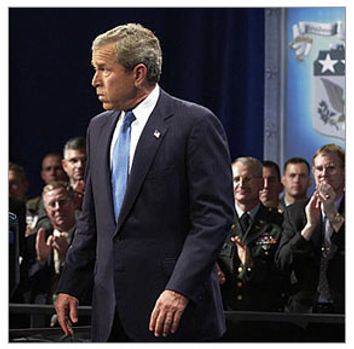
Free-falling in the polls, Bush stayed with the same tough-guy message. But Michael Lind, Karen Kwiatkowski, Ruy Teixeira and others say he landed with a splat, while AEI's Michael Rubin says the speech was "a good start."

  • more
    • All Share Services

Marching off the cliff

Michael Lind, senior fellow at the New America Foundation and author of “Made in Texas: George W. Bush and the Southern Takeover of American Politics.”

George W. Bush began and ended his speech with a brazen lie. He claimed that the United States is in Iraq to fight al-Qaida.

Before the war, Bush, Cheney and the neoconservatives did all they could to convince the American people that there was some link between Saddam Hussein’s tyranny in Iraq and al-Qaida. They succeeded in deceiving a large number of Americans. Now Bush is trying the same trick again. He is trying to justify his failed and unnecessary war in Iraq by parading, once again, the corpses of those murdered by Osama bin Laden and his followers in New York, Washington and Bali. The shamelessness of George W. Bush is matched only by his contempt for the intelligence of the American people.

Near the beginning of his address, the president claimed: “Iraq is now the central front in the war on terror.” The United States must prevail in Iraq to deny “the terrorists” a “base of operation” — a reference to al-Qaida, presumably, with its need for bases for worldwide operations. As if to underline the implication that Iraq, like Afghanistan, had been a “base” for al-Qaida, Bush said: “This will be a decisive blow to terrorism at the heart of its power.”

Bush repeated this lie at the end of his address. He accurately described al-Qaida as totalitarian and seeking to impose Taliban-like regimes throughout the Middle East. But then, with breathtaking cynicism, he linked the U.S. war in Iraq to al-Qaida once again, following a recitation of al-Qaida attacks in Tunis and Bali with a recitation of places in Iraq where American soldiers now are fighting and dying.

Karen Kwiatkowski, lieutenant colonel, U.S. Air Force (ret.), served in the Pentagon’s Near East South Asia directorate headed by Deputy Undersecretary of Defense Bill Luti, who also led the Pentagon’s secret intelligence unit, the Office of Special Plans. Salon published her insider account, “The New Pentagon Papers,” in March; she currently teaches at James Madison University.

President Bush has a five-step strategy toward Iraqi deoccupation. The soldier-scholars in the Army War College audience must have been wondering, “Wheres the rest of it?” No mention of deoccupation, only the mush of “We went to Iraq to defend our security, not to stay as an occupying power.” And more troops will go to Iraq, more violence will be committed, and we will build a brand-new, American-style maximum security prison for the Iraqis. Afterward, we’ll have a photo op as we bulldoze the cursed Abu Ghraib and build a city park in its place.

The other American audience watched from the nation’s living rooms. They’ve been recently occupied with high gas prices, a slow economy, bankrupt state legislatures, a skyrocketing federal debt eating away at their financial security and the lack of mission clarity that threatens daily the lives and sanity of our men and women deployed in Iraq. Bush told these Americans that he wants “freedom, independence, security and prosperity for the Iraqi people.” I don’t know if that resonated. I do know that he has come a long way from his campaign promise that America would no longer nation-build around the world, or seek gratuitous feel-good interventions.

The president tonight sounded strangely Brezhnevian, circa 1978 — 138,000 American troops are staying in Iraq indefinitely, but Iraq is promised imminent “sovereignty” and “democracy.” Pay no attention to the men with guns. Bush mentioned our work to eliminate any residual reluctance of Iraqi security forces to fire upon their fellow citizens, er, terrorists. Ah, the exquisite challenge of bringing freedom and self-rule to an ungrateful people.

The Soviet invasion and subsequent puppetry in Afghanistan lasted 10 years, and four changes of leadership. Monday night, President Bush again asked the American people to be patient. After listening to his vacant, unrealistic and uninspired presentation to a controlled military audience, I think I understand why.

Lawrence Korb, former assistant secretary of defense in the Reagan administration; senior fellow at the Center for American Progress.

I think the first thing Bush has done, interestingly enough, is what the Army War College has complained about: He’s conflated all terrorists together. On Monday night he talked about Iraq a lot and somehow linked that again to what happened on Sept. 11. Secondly, he never admitted, as again the Army War College study said, that he was ill-prepared when he went into Iraq, did not have enough troops on the ground when Saddam fell, did not provide the troops with any guidance. That’s how we got into this mess.

He again brought up with the whole domino theory for the Middle East, that if you make Iraq into a democracy, then you’ll have democracy all throughout the Middle East. I mean, what about Saudi Arabia? We’re not going to make it a democracy. We’re trying to get oil from the country. Or Egypt, Pakistan.

Bush also said that [the occupation will end June 30], but we’re still going to have the same number of troops there, and they’re going to be under American command. How is that complete sovereignty? I mean, if you’re completely sovereign you can’t have foreign troops in your country unless you can give them orders and command them.

Who can be opposed to handing over power, providing security, rebuilding the infrastructure, getting more international help and having national elections? Nobody can be opposed to that. The problem is, “OK, who are you handing over power to?” Can you imagine — you know, in our country, we have an election in November, we wait two months to hand over power, we used to wait four. Here we’re going to be handing over power in less than five weeks — and we don’t know to whom, how much support they’ll have or what power they’ll have.

My central concern is that the president has not yet recognized the mistakes he has made and therefore does not have a basis on which to improve the situation. He played fast and loose with the number of troops. (I think we’re going to have to put more troops in Iraq to provide the security necessary to rebuild the infrastructure.) Then he talked about how he’s going to go to NATO and thank the 15 countries that provided support and, as he said, almost 20,000 troops. Well, 10,000 of them are British. That means you have to divide up 14 other countries to account for the other 10,000. The president is trying to give the impression that we have a lot of international support when we don’t.

Arianna Huffington, nationally syndicated columnist and the author of “Fanatics and Fools: The Game Plan for Winning Back America.”

It’s appropriate that President Bush was at the War College; it’s just too bad that he chose to spend his time there speaking and not listening. If he had listened to the experts there over a year ago, he wouldn’t have needed to give this desperate speech.

He came up with a “five-point plan,” but he should have made it six. The missing element being the firing of all those responsible for the incredibly incompetent planning for this war and occupation.

The real problem with the Bush administration, shown especially in the Iraq war, isn’t that it makes mistakes — all administrations make mistakes — but that it refuses to learn from them.

Like Bush said, wars are “chaotic,” but how can you trust someone who refuses to admit reality? The first step to fixing a problem is seeing it accurately, and Bush’s speech hardly gives one confidence that he does.

He still talks about “victory” over the “terrorists” and “foreign fighters” and “Saddam loyalists.” But he doesn’t seem to realize that we’ve lost the Iraqi people, that many of them, who don’t fall into any of the above designations, now consider us the enemy. How can he solve this when he won’t acknowledge it? He still seems to think that the U.S. public needs assurance that we’ll win every military engagement. Of course we will. The question is whether or not there will be an unending number of military engagements, and his speech failed to give a solution for stopping — and not just winning — them.

What needs to be demolished is not just Abu Ghraib, but the policy apparatus that led us into this position. And that’s not “looking backward” or “playing the blame game.” Doing this is the only way to move forward and regain international credibility. Which is badly damaged, despite Bush’s ludicrous contention last night that “our coalition is strong.” It’s not, and neither are our chances for success in this war until he truly acknowledges what’s gone wrong.

Until he does this, any attempt to “make a diplomatic push for international support” is simply writing a check with nothing in the bank.

Ruy Teixeira, senior fellow, the Century Foundation and the Center for American Progress.

President Bush’s speech, whose purpose was to rally public opinion in favor of his Iraq policy, proposed no change of course and no timeline for concluding U.S. involvement. Indeed, with the exception of bulldozing the Abu Ghraib prison, Bush offered absolutely no new ideas on how to deal with the huge difficulties the U.S. currently confronts in Iraq. Instead, he appeared to be relying on a strategy of looking stern and determined, saying that “the terrorists cannot be allowed to win” and comparing the American vision of “liberty and life” with the terrorists’ vision of “tyranny and murder.” If that all sounds familiar, it’s because Bush has been striking the same poses and saying the same things — to decreasing effect — ever since the U.S. invaded Iraq, and, in fact, considerably before it.

This is not likely to be an effective strategy. The public has turned increasingly negative on the war in Iraq and, more broadly, on Bush’s conduct of the war on terrorism. Simply asserting that we’re doing the right thing and we must continue to do it is not going to turn those negative views around. Instead, since the public believes that the current course in Iraq is not containing, much less resolving, the very serious problems, proposing a change from that course was the only plausible way to turn public opinion in his direction.

That is exactly what Bush failed to do and why we may reasonably expect that public opinion will not turn in his favor. And public opinion now is remarkably negative.

Is Bush doing a good job on the war on terrorism? The Annenberg Election Survey has now measured it in net negative territory: 46 percent approval, 50 percent disapproval. That’s a first and a very significant first. It means Bush’s area of greatest strength is rapidly turning into a political liability.

Is Bush doing a good job in Iraq? The Annenberg poll has Bush’s approval rating on Iraq at 39 percent approval, 57 percent disapproval, including just 33-61 among independents and 30-66 among Hispanics. The new CBS News poll has Bush’s Iraq rating even lower, at 34-61.

Has the war in Iraq been worth fighting? On whether “the situation in Iraq was worth going to war over, or not,” the Annenberg poll finds just 40 percent saying it was worth it, compared with 54 percent who say it wasn’t. The split is slightly more negative among independents (39-55), much more negative among moderates (30-64) and stunningly more negative among Hispanics (22-75).

Is the U.S. making progress in Iraq? In a new Democracy Corps poll, by a 55-41 margin, voters believe the U.S. is losing control in Iraq, rather than making progress. And the new ABC News/Washington Post poll finds that 65 percent of the public thinks the U.S. “has gotten bogged down in Iraq,” compared with just 33 percent who think we’re making good progress.

Finally, is the war in Iraq helping fight terrorism and making the U.S. safer? In the Democracy Corps poll, by identical 50-45 margins, voters believe that the war on Iraq has made the war on terrorism harder, rather than helped it, and that the Iraq war has made us less, not more, secure.

Turning these very negative views around is going to be very difficult. Based on Bush’s performance tonight, I’d say he’s still in the denial stage.

Rachel Bronson, director of Middle East studies and the CFR-Baker Institute report on post-conflict Iraq at the Council on Foreign Relations.

With his speech, the president will likely win back some support from his base. He will assuage the fears of some that he does not comprehend the current difficulties or understand its ramifications. In fact, he took great pains to prepare Americans for an increasingly violent spring and summer. The president laid to rest any notion that the June 30 date would slip and outlined a political structure for the interim Iraqi government. The president’s five points made him appear clear-headed and determined.

Unfortunately, Bush did not directly address the top questions of the day. What will sovereignty mean with 135,000 American troops, and possibly more, still in the country? Will the president hold those responsible for the Abu Ghraib prison scandal accountable, regardless of where the ongoing investigations lead? How exactly will the president get more international support? It’s hard to believe that discussing “NATO’s role” at the upcoming NATO summit will seal the deal. How should Americans define success and failure?

The most disheartening aspect of the speech was the president’s determination to continue to link the 9/11 terrorism with the Iraq war. He backed off a little, by saying that “Iraq is now the central front in the war on terror,” but insisted upon defining “our terrorist enemies” in Iraq as those determined to impose Taliban-like rule country by country. Until the president makes clear that we have lost much support in Iraq — not because of religious extremists, but because of a basic lack of law and order — it will be difficult to fashion a truly workable strategy for success.

Sandra MacKey, author of “The Reckoning: Iraq and the Legacy of Saddam Hussein.”

The gap between rhetoric and reality in President Bush’s speech to the nation on Monday night was like a walk with Alice through Wonderland. As he has done time and again, the president stood before the American people and lied about the reasons the United States invaded Iraq and the causes of the ongoing loss of life and treasure in a quagmire largely of the administration’s own making.

He placed the blame for the violence that is likely to accompany the June 30 “transfer of power” solely on terrorists and Saddam loyalists. At no time did he admit to the American people that the bloody turmoil will largely be the result of a broad range of Iraqis engaged in the struggle for the right to define their own state, and to distribute political and economic power among themselves. It’s a problem inherent to Iraq’s own deep internal fissures, far less than it is a problem of foreigners attempting to import the ideology of al-Qaida, or of leftover die-hard loyalists from the Saddam regime.

The president outlined five steps Monday night to salvage the American misadventure in Iraq: Transfer of sovereignty to the Iraqis; establishment of security by the joint efforts of American and Iraqi military forces; reconstruction of the infrastructure; recruitment of international help in policing and rebuilding Iraq; and administration of national elections. These are all valid goals. However, the president again failed to warn the American people of the real — and daunting — obstacles to those goals.

Either he was unwilling to share the truth with the American people or, frighteningly, he does not understand the real forces at work in Iraq.

Michael Rubin, former political advisor to the Coalition Provisional Authority in Iraq; resident scholar at the American Enterprise Institute.

President Bush successfully contextualized Iraq as an essential component of the war against terror. His reminder that the U.S. cannot afford to fail is important, especially in an election year where Democrats and Republicans alike seek to make Bush’s management of the Iraq war a campaign issue. Bush was wise to let Iraqis know that the Coalition Provisional Authority would not simply transfer itself into an embassy on June 30; it will be a mistake if any American continues to occupy CPA headquarters in Saddam’s Republican Palace on July 1.

There were significant omissions in the Bush speech, however. Before the war both the State and the Defense Departments underestimated the trauma of President George H.W. Bush’s abandonment of Iraqis in 1991. Iraqis remain unconvinced that the U.S. will stick to its rhetoric and will not once again cut and run. While Bush rightly says that “whenever people are given a choice … they prefer lives of freedom to lives of fear,” he ignores the fact that Iraqis will not again put their necks on the line if they doubt U.S. commitment to their future. Comments by both Secretary of State Colin Powell and CPA Administrator L. Paul Bremer in the past week suggesting that the U.S. might withdraw its troops shook Iraqi confidence in the United States. Iraqis — who fear the worst — will notice that Bush did not roll back Powell’s statements.

Iraqis will also be disappointed by the trust Bush places in the United Nations. The U.N. may be respected in the United States and Europe, but Iraqis have a very different experience. Many Iraqis believe that the raid on Ahmad Chalabi’s compound was meant to squash the Governing Council’s investigation into the U.N. oil-for-food program. U.N. special envoy Lakhdar Brahimi’s credibility took a hit in the past month when Iraqis learned that his daughter was engaged to Prince Ali of Jordan, the half-brother of King Abdullah. We may respect Brahimi’s role in Afghanistan, but Iraqis are prickly nationalists and distrust any mediators’ ties to neighboring countries.

By focusing on the role of Saddam’s elite guards in the insurgency, Bush downplayed the role of regional states like Iran and Syria in the current conflict. Ignoring their complicity may be politically expedient, but it can cost American lives. Over the eight months I worked for the CPA, I would sometimes visit the black market for documents. The price of Iraqi passports and identity cards increased as the cost of Iranian passports decreased. That’s basic supply and demand. When I drove along the Syrian border in January, it was still unguarded. Tire tracks breached the single coil of barbed wire that delineated the frontier in the vicinity of Jebel Sinjar.

Bush also glossed over what elections for Iraq will mean. He laid out a multistep process, but the results of elections will be far different if they are party-slate (enabling tyranny of the majority) or single-constituency (making individuals accountable to specific districts). The devil is in the details, but with stakes so high, details cannot be ignored. All in all, a good start. But both Americans and Iraqis wait to hear more.

As’ad AbuKhalil, Arab media expert; professor of political science at California State University at Stanislaus.

George W. Bush is certainly concerned about his reelection. His plummeting popularity in the polls explains his need for a “major” speech on Iraq. He may have sounded convincing to those in the U.S. who know little about Iraq and who do not follow foreign affairs closely. But for Iraqis (and Arabs in general) Monday’s speech will go down as yet another desperate effort in the series of U.S. propaganda campaigns that followed Sept. 11 and the two subsequent U.S.-led wars.

The major problem with how Bush’s rhetoric plays in the Middle East is that it assumes that Arabs and Muslims can easily be manipulated by empty words about “freedom.” Will Iraqis really care that Bush has now decided to demolish the Abu Ghraib prison? Will that erase the horrific crimes of Saddam — and those of the U.S. occupation that followed — behind the prison’s walls? The pictures of U.S. abuses at Abu Ghraib will stay in the Iraqi and Arab collective memory for a long time to come.

Bush insulted the intelligence of the Iraqi people with his latest speech in more ways than one: He talks about free elections, freedom and democracy, when all Iraqis, including children, know full well that an ayatollah who has not left his house in six years (Ali Sistani) insisted on free elections, while the leader of the Coalition Provisional Authority fiercely opposed them. He tells Iraqis that they will have full sovereignty, and yet assures the military audience before him that he will send additional troops if they are needed, and that all troops in Iraq will serve under U.S. command. What kind of sovereignty is that? Bush says that American “technical advisors” will stay in key ministries; Arabs will surely recall the thousands of American “advisors” who were in Vietnam.

Bush and neoconservatives still foolishly refer to a “free Iraq” as a model for the region. They may be right — if other Arab populations are eager to incorporate into their lives daily car bombs, shootings by soldiers at checkpoints, torture of prisoners by liberating armies, the rise of fundamentalist groups and violent militias, clerical control of political affairs and many empty promises of democracy. Colonization does not work in the 21st century, and the Iraqis who suffered under Saddam will settle for nothing less than full independence.

Sean Wilentz, Dayton-Stockton Professor of History at Princeton University.

The White House is still in the deepest denial — and still determined to evade responsibility for what Gen. Anthony Zinni has called the obvious screw-ups in the planning and prosecution of this war. I was particularly struck by Bush’s attempt, early in the speech, to blame our current troubles on our “swift removal of Saddam Hussein’s regime last spring.” This, he said, “had an unintended effect” of allowing the Baathists to regroup. So, let me get this straight: If the war had only gone worse last year, it would be going better now? If only we hadn’t accomplished our mission then so easily, we’d be accomplishing it more easily now?

As ever, this White House can’t even bring itself to utter the perennial mealy-mouthed evasion, “Mistakes were made.” This White House never makes any mistakes, active or passive; it simply suffers from the unintended consequences of its triumphs. If Abraham Lincoln had thought that way, he never would have fired Gen. George McClellan, and the Confederacy would have won the Civil War.

Editor’s note: This story has been corrected since its original publication.

Fox vs. Franken

A fair and balanced set of excerpts from the Fox News lawsuit against Al Franken over alleged trademark theft. Plus: Outraged replies from Franken and others.

  • more
    • All Share Services

Fox News [Network], the owner and operator of the world famous Fox News Channel (“FNC”), is the owner of a federal trademark registration in the mark “Fair & Balanced”. Fox News has used the mark “Fair & Balanced”, sometimes depicted as “Fair and Balanced”, (the “Trademark”) to distinguish and brand FNC’s distinctive method of newsgathering and reporting since its well-publicized launch in October 1996. “Fair & Balanced” has been a registered trademark of Fox News since December 22, 1998. Fox News has made continuous use of the Trademark since 1996, and the mark has become a signature slogan of FNC.

Fox News employs a variety of on-air news personalities to give FNC its distinctive, number-one rated position in the national cable news marketplace. Prominent among those news personalities is Bill O’Reilly (“O’Reilly”), who is the host of cable television news’s number-one rated program “The O’Reilly Factor.” …

Penguin, through its imprint, EP Dutton (“Dutton”), plans to publish “Lies and the Lying Liars Who Tell Them: A Fair and Balanced Look at the Right,” written by Franken (the “Book”), on September 22, 2003… The preliminary cover of the Book (the “Preliminary Cover”), which is on display, among other places, in advertisements for the Internet sale of advance copies of the Book and on defendant Franken’s official web site, prominently features Fox News’ trademark “Fair and Balanced” as well as a photograph of O’Reilly in what appears to be the FNC television studio…

Defendants’ intent in using the Trademark in this unauthorized fashion is clear — they seek to exploit Fox News’ trademark, confuse the public as to the origin of the book, and accordingly, boost sales of the Book. This behavior constitutes willful trademark infringement…

Moreover, since Franken’s reputation as a politicial commentator is not of the same caliber as the stellar reputations of FNC’s on-air talent, any association between Franken and Fox News is likely to blur or tarnish Fox News’ distinctive mark…

FNC was launched in October 1996. From the time of its launch until the present, FNC has been dedicated to presenting news in what it believes to be an unbiased fashion, eschewing ideological or political affiliation and allowing the viewer to reach his or her own conclusions about the news. FNC was created as a specific alternative to what its founders perceived as a liberal bias in the American media…

FNC’s balanced approach to reporting the news has become extremely popular and FNC is now the most watched 24-hour news network in the nation… Indeed, during the 2003 war in Iraq, FNC was the most watched cable news source for up-to-the-minute news. According to “Advertising Age” magazine, FNC is “the biggest cable winner” and its “grip on the crown seems even tighter now.” …

Currently, “The O’Reilly Factor” is the most popular program on FNC. “The O’Reilly Factor” bills itself as a “No Spin Zone” and the goal of the program is to present the audience with the straight facts while allowing the audience to reach its own conclusions about the news…

O’Reilly himself has become a national celebrity and one of America’s most trusted sources of news and information. He is inextricably linked with Fox News and the “Fair and Balanced” trademark in the minds of the viewing public…

To reflect its unique approach to the reporting of news, FNC adopted the slogan “Fair and Balanced,” along with the phrase “We Report, You Decide” at the time of the network’s inception…

On April 23, 1997, Fox News applied to the United States Patent and Trademark Office for a trademark in the phrase “Fair & Balanced” for “entertainment services in the nature of production and distribution of television news programs.” On December 22, 1998, Fox News’ trademark in “Fair & Balanced” was registered on the PTO’s Principal Register. Since then, Fox News has also obtained a registration on the Principal Register in “Fair. Balanced. Unafraid.” in connection with neckties.

Since 1997, Fox News has expended $61 million and thousands of hours in promoting and advertising its brand, including the “Fair and Balanced” mark. These marketing efforts have global reach…

In addition, Fox News has developed merchandise for sale that includes the “Fair and Balanced” logo… [a] Fox News mug contains the phrase “Balance is Important in News and Hot Coffee.” There is also a “Fair and Balanced” necktie available for sale on the Fox News web site in a number of colors…

Defendants use of the Trademark in the Book is likely to cause confusion among the public about whether Fox News has authorized or endorsed the Book…

Indeed, as Franken admitted during [a recent Los Angeles book expo], the “Fair and Balanced” trademark was, in fact, used on the preliminary cover of the Book for the express intention of capitalizing on FNC’s reputation…

Franken has recently been described as a “C-level political commentator” who is “increasingly unfunny.” Franken has physically accosted Fox News personalities in the past, and was reported to have appeared either intoxicated or deranged as he flew into a rage near a table of Fox News personalities at a press correspondents’ dinner in April 2003. Franken is neither a journalist nor a television news personality. He is not a well-respected voice in American politics; rather, he appears to be shrill and unstable. His views lack any serious depth or insight. Franken is commonly perceived as having to trade off of the name recognition of others in order to make money. One commentator has referred to Franken as a “parasite” for attempting to trade off of Fox News’ brand and O’Reilly’s fame in the Preliminary Cover of his Book…

As a result of Defendants’ actions, Fox News is irreparably harmed…

[Editor's note: Following are statements released by Al Franken and his publisher, Dutton, on Aug. 12 in response to the lawsuit.]

Al Franken:

I normally prefer not to be out of the country on vacation when I’m sued. However, from everything I know about law regarding satire, I’m not worried.

But I’d like to thank Fox for all the publicity. As far as the personal attacks go, when I read “intoxicated or deranged” and “shrill and unstable” in their complaint, I thought for a moment I was a Fox commentator.

And by the way, a few months ago, I trademarked the word “funny.” So when Fox calls me “unfunny,” they’re violating my trademark. I am seriously considering a countersuit.”

Lisa Johnson, Executive Director of Publicity, Dutton:

It is extraordinary that one of the largest media corporations would take such action. In trying to suppress Al Franken’s book, News Corp. is undermining First Amendment principles that protect all media by guaranteeing a free, open and vigorous debate of public issues. The attempt to keep the public from reading Franken’s message is un-American and runs contrary to everything this country stands for.

James Gleick, spokesperson for Authors Guild:

Fox News’ attempt to use trademark laws to silence criticism is deplorable. Book authors and publishers, television journalists and networks all depend on First Amendment protections to pursue their craft. News organizations, which willingly enter the rough-and-tumble of public debate, must accept the possibility of drawing sharp criticism as part of the bargain.

If Fox disagrees with Mr. Franken’s position, it has ample access through its affiliated companies to respond in a manner that respects our joint need for vigorous, open debate. That way, the various positions can be heard, and people can decide.

Continue Reading Close

The world press on Uday and Qusay

Guardian: Uday was a monster even by the standards of Saddam Hussein's Iraq.

  • more
    • All Share Services

United Kingdom, Suzanne Goldenberg in the Guardian

He was a monster even by the standards of Saddam Hussein’s Iraq, a sadist with a taste for cruelty so extreme that even his father was forced to acknowledge that his first-born son would not be a worthy heir.

And yet for all that Uday Saddam Hussein symbolised the brutality of the Iraqi regime, his powers were severely circumscribed. Although he retained the privileges of the much-indulged son of a dictator, he was shunted from the real centres of power in the military and security services by his quieter, younger brother Qusay.

Although Uday nominally had a role in politics — following his election to parliament with 99% of the vote in 1999 — he was studiously absent from Iraqi television during the dying days of the regime. It was clear controllers realised that showing too many pictures of the most hated man in Iraq was hardly going to spur resistance.

It was not the life that Uday had intended. Of Saddam’s two sons, he was the flamboyant one — towering well over 6ft, with a penchant for fast cars and loud and drunken parties, expensive suits and flowing robes, as well as murder, rape and torture…

[Uday's] search for public approbation appears to have taken over in the mid-1980s when Uday first took a close interest in sport. Footballers say he never really understood or showed much interest in the game itself, but was desperate enough for a win that he would phone up the dressing room during half-time to threaten to cut off players’ legs and throw them to ravenous dogs. As football overseer, Uday kept a private torture scorecard, with written instructions on how many times each player should be beaten on the soles of his feet after a particularly poor showing…

Uday’s excesses carried over in his private life … his private pleasure palace, a bad taste Arabian nights fantasy, was decorated with indoor fountains and erotic murals and was in the grounds of his father’s presidential estate. A nearby chamber contained huge stashes of drugs as well as an HIV testing kit, according to US forces. He is also reported to have operated an even more private torture chamber on the banks of the Tigris.

Uday’s marriages were a further source of embarrassment to his father. His two brief dynastic liaisons were dissolved after Uday beat up his brides…

Israel, Zvi Bar’el in Haaretz

With the deaths of Saddam Hussein’s sons, the American forces can chalk up an important symbolic achievement. Uday and Qusay Hussein were not just senior commanders who carried out their father’s policies before the war, but they also embodied the threat that his regime could return.

It is unclear whether the two sons personally led some of the armed opposition against the American forces; the fact that they were found in a villa in Mosul without many security guards may be seen as an indication that they were in the process of escaping, not commanding guerilla forces.

Uday and Qusay were bad news for some of the Ba’ath leaders. They managed to make themselves hated among the party elite during Saddam’s rule, as they circumvented the system that applied to everyone else, appointed and fired clerks and commanders at will and caused a rift within the family (the desertion by Saddam’s in-laws to Jordan in 1995 is attributed to a dispute with Uday and Qusay). Ultimately, Qusay, who was responsible for defending the Baghdad area, was viewed as failing in his task and leading to the rapid fall of the capital.

The fact that former senior Ba’ath members will express no sorrow at their deaths, will, for most of Iraq’s citizens, come as a big revelation. In fact, in the short term, the manner of their deaths could boost more resistance operations against U.S. troops: Unlike other Iraqi leaders who turned themselves in, Uday and Qusay fought until the bitter end against the enemy, which turned them into shahids (martyrs).

In Iraq, several organizations are competing against each other to fill the post-war political void, among them the movement led by the young Shi’ite leader Muqatda a-Sadr, who declared the establishment of a private army in the city of Najaf. Other power-brokers are Sunni religious leaders in Baghdad who fear the new-found status of the Shi’ites, the Sunni public that rejects the structure of the new Iraqi government, terror organizations outside of Iraq who sent fighters into the country to attack American forces…

Furthermore, the question regarding Saddam’s location has yet to be answered. As long as he appears to be still alive and still active, and his audio tapes continue to surface, the killing of his sons will not remove the threat of his shadow from over the Iraqi public.

Australia, Tony Parkinson in The Age

It says something for the psychology of fear and intimidation in Iraq that Saddam Hussein’s reign of terror has survived more than three months longer than his regime… But the deaths of the former dictator’s sons and successors in a gunfight with U.S. forces in northern Iraq brings to a grisly end this mythology of invincibility: the legend that says Saddam’s regime is so ruthless and resilient it is never vanquished, never beaten. Finally, the spell has been broken.

Potentially, the consequences will be profound, and perhaps more significant in terms of practical impact than the symbolism of Saddam’s statues falling when U.S.-led forces took control of Baghdad back on April 9. Most crucially of all, the deaths of Qusay and Uday Hussein will greatly reduce the fear among Iraqis that Saddam is soon to return to power and take vengeance on those who co-operated with the Americans…

Each in their own way, Saddam’s sons had come to encapsulate the worst excesses of [an] insane egotism: Uday, the eldest, a murderer, rapist and psychopath; Qusay, his father’s anointed successor, more restrained as an individual, but no less callous and calculating in his ambition to make Iraq the most feared military power in the Arab world. Their elimination represents a crucial circuit-breaker for the Bush Administration, facing heavy criticism over its motives for war… the dramatic events of the past 48 hours will lift the morale of American troops in Iraq, as they begin to see an end to what has become a long, hot and nasty summer…

More than 20 years under Saddam’s rule has inculcated in Iraqis a natural, life-preserving reluctance to speak, other than in whispers, about the dark secrets of the regime. The deaths of Saddam’s sons does not mean there will be miracles overnight — either in cracking the code on Iraq’s weapons programs, or in ending in the short term the spate of attacks on US and British forces. But the raids that led to their deaths suggest that US intelligence is gradually closing the noose around the dictator and the last redoubts of his regime. This must begin to erode the militia groups’ willingness to fight. That being so, it would seem the Baathists no longer pose a long-term threat…

Saudi Arabia, editorial in Arab News

That Uday and Qusay Hussein are dead is a victory for the Americans and, far more important, a victory for the Iraqi people. Both needed the break.

Uday and Qusay may have been organizing the postwar resistance to the invaders and directing a campaign for which they had years to plan and recruit and store away men and materiel. But how they ran the chain of command to their units when U.S. electronic surveillance of the whole country is apparently so complete remains a mystery. It is possible that the resistance of diehard Baathists is being mounted by independent units, operating to a flexible plan. For the moment there appears to be no letup in the assault on American troops, two more of whom were killed within hours of the death of Uday and Qusay…

There is now an immense intelligence effort centered on the Mosul villa where Saddams sons were run to ground… For the ordinary American soldier in Iraq, yesterday was a heartening and morale-boosting day. The hunt for Saddam will be redoubled and there may indeed be valuable clues in the Mosul villa, yet the harsh truth remains that the only way that the Americans can fulfill their international legal obligations to the Iraqi people is to stem the rising tide of violence in the country: in Mosul, in Fallujah, in Baghdad. Until that stops Iraqis will not be able to focus on a future without Saddam and his brutal Baathist regime.

By concentrating all their efforts on Saddam and the Baathists, moreover, the Americans may well be ignoring other sources of resistance and violence in Iraq. The disparate groups that make up the country are still finding their voices — for too long they were silenced and supposedly subsumed into Saddams machine. Now that the regime is gone, these groups are clamoring to make their voices heard. Perhaps the resistance is rather a violent medley of messages, to the ordinary Iraqis as much as to the Americans, that these different groups exist and are a force to be reckoned with.

If that is so, the deaths of Saddams sons were in truth only a small step along the long and difficult road to a free, peaceful and united Iraq.

Continue Reading Close