Craig Fehrman

When Roger Ailes was honest about what he does

"No! No more farmers. They all ask the same goddamn dull questions"

  • more
    • All Share Services

When Roger Ailes was honest about what he does

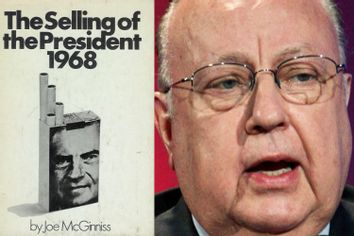
The Internet is buzzing about Tom Junod’s Esquire profile of Roger Ailes, and with good reason: It offers some great details and terrific writing. It also offers an excuse to look back at Joe McGinniss’ “The Selling of the President” (1969), the classic of campaign reporting that first introduced many readers to the stage-managed world of political theater — and to a 27-year-old Roger Ailes, the man who decades later would create the Fox News Channel.

McGinniss based his book on the unlimited access granted to him by Richard Nixon’s media team during the 1968 presidential campaign. “Voters are basically lazy,” read one memo obtained by McGinniss. “Reason requires a high degree of discipline, of concentration; impression is easier. Reason pushes the viewer back … Impression can envelop him, invite him in.” Ailes deftly applied these principles to a series of televised town halls that proved crucial to Nixon’s victory. Even today, McGinniss’ book can tell us something about Ailes. Considered in the context of Junod’s new profile, though, it can also tell us something about the evolution of political journalism.

While Harry Treleaven and Frank Shakespeare took care of Nixon’s television ads, Ailes handled the town halls, which ran in 10 different markets. Ailes settled on a format where Nixon appeared before a friendly studio audience and answered questions from a pre-selected panel of six or seven people. “Let’s face it,” Ailes told McGinniss — and his book’s strengths come from its frank dialogue and McGinniss’ deadpan tone — “a lot of people think Nixon is dull. Think he’s a bore, a pain in the ass. They look at him as the kind of kid who always carried a bookbag … Now you put him on television, you’ve got a problem right away. He’s a funny-looking guy. He looks like somebody hung him in a closet overnight and he jumps out in the morning with his suit all bunched up and starts running around saying, ‘I want to be President.’ I mean this is how he strikes some people. That’s why these shows are important. To make them forget all that.”

Ailes loved explaining how he helped his audience forget. And in McGinniss’ book, as in Junod’s profile, he comes across as competitive, vindictive — and very, very good. With his town halls, Ailes controlled the smallest details. (After the first broadcast, he wrote an exhaustive, itemized memo: “F-2: I may try slightly whiter makeup on [Nixon's] upper eyelids.”) He obsessed over the presentation. (“I’m going to fire this fucking director. I’m going to fire the son of a bitch right after the show,” Ailes said during another broadcast that lacked sufficient close-ups. “I want to see faces. I want to see pores. That’s what people are. That’s what television is.”) He refined Nixon’s delivery. (Ailes pushed Nixon to cut a 2 minute 35 second answer on the economy to 1 minute 10 seconds. “I don’t want to take a chance of missing the shots of the audience crowding around him at the end,” he explained.)

But Ailes remained most concerned with his panels, which he balanced according to age, ethnicity and occupation. While prepping a Philadelphia broadcast, Ailes admitted that “on this one we definitely need a Negro … U. S. News and World Report this week says that one of every three votes cast in Philadelphia will be Negro. And goddammit, we’re locked into the thing, anyway. Once you start it’s hard as hell to stop, because the press will pick it up and make a big deal out of why no Negro all of a sudden.”

McGinniss seemed particularly struck by Nixon’s region-specific rhetoric. For example, the campaign designed specific ads to run during wrestling and “country and western programs.” But Nixon also customized his message for Ailes’ broadcasts — “nothing big enough to make headlines,” McGinniss writes, “just a subtle twist of inflection, or the presence or absence of a frown.”

This won’t surprise anyone who’s witnessed Fox News’ narrow-casting. But in 1969, it was a revelation. Already, McGinniss could (and did) quote Daniel Boorstin and Marshall McLuhan on the superficial, celebrity-driven nature of television. But he backed up their theories with concrete examples and translated them to the political arena. Theodore White, who, by this point, had actually copyrighted the phrase “The Making of the President,” didn’t even mention Ailes in his book on the ’68 election. McGinniss used Ailes to show how modern campaigning worked.

McGinniss, a 26-year-old sports columnist, stumbled across his book’s topic while taking a train to New York. A fellow commuter had just landed the Hubert Humphrey account and was boasting that “in six weeks we’ll have him looking better than Abraham Lincoln.” McGinniss tried to get access to Humphrey’s campaign first, but they turned him down. So he called up Nixon’s, and they said yes.

“The Selling of the President” spent more than six months on best-sellers lists, and McGinniss sold a lot of those books through television, appearing on the titular shows of Merv Griffin, David Frost and Dick Cavett, among others. On “Today,” Barbara Walters tore into McGinniss on air — because, he later learned, she was friends with Ailes (she referred to him as “Roger”) and worried the book would end his career. In fact, Ailes loved the book. He even did a radio show with McGinniss to promote it, and Ailes was surely as proud and funny and profane as he is in the pages of “The Selling of the President.”

But that was then, and this is now. For his Esquire profile, Junod did a ton of reporting — enough to sustain not only the story, but also an ongoing series of interviews and outtakes. But he never got Ailes to open up in the way McGinniss did. The best contrast comes in their handling of Ailes’ blue-collar background. Ailes keeps pitching himself to Junod as an ex-ditch digger, “an average guy from flyover country.” In “The Selling of the President,” though, Ailes doesn’t seem to care. It’s not just that he runs around skydiving for pleasure and ranting at hotel staffers (and, for that matter, firing the close-up-challenged director); it’s that he sees the residents of flyover country as nothing more than a political variable. At one point, Nixon’s staff suggests that Ailes include a farmer on one of his television panels. “No! No more farmers,” he replies. “They all ask the same goddamn dull questions.”

It’d be easy to chalk this shift up to Ailes’ increased media savvy. After all, “Barbara” aside, Ailes fed Junod the same line about avoiding Manhattan media parties that he did the New York Times a year ago. But the change in Ailes is also a change in the reporter’s focus. Even in 1968, people were surprised by the candor of Ailes et al. (William Buckley assumed McGinniss had relied on “an elaborate deception which has brought joy and hope to the Nixon-haters.” But even Buckley liked the book.) More important, Junod seems less interested in Ailes’ methods than in his motivations. The Esquire profile doesn’t contain anything like the recently leaked Fox News memos because that was never its point.

A comparison of Ailes in 1968 and 2011, then, suggests that journalism itself has become more personality-driven. This doesn’t mean it’s worse, as some of Junod’s best moments center on trying to understand Ailes. But it does suggest we’re now less interested in how the sausage is made or sold than in why someone got into the sausage business in the first place. This is true of McGinniss, too. His 2011 self is writing a book on Sarah Palin, and access has been hard to come by.

A table for few at T.G.I. Friday’s

The restaurant chains of the "casual dining" industry were already in trouble. Then came the recession.

  • more
    • All Share Services

A table for few at T.G.I. Friday's

One of my best friends in college worked at T.G.I. Friday’s as a cook, though he would never dignify it with that term. “I was an assembly-line worker,” he recalls. He relied on a grill for meats, a couple of deep-fryers for appetizers, and a flotilla of microwaves for everything else. In the six years he worked there, the only skill he learned — the only skill he needed — was “not burning anything.”

Of course, when we’re talking about BBQ Pork Ravioli Bites, preparation may be beside the point. Friday’s and its ilk trade in the kind of middlebrow mall fare and managed smiles so ably parodied in the movie “Office Space.” These chains elicit not the loathing of a Blockbuster, but a head-shaking chuckle, and the self-loathing of indulging in caloric disasters like the Awesome Blossom.

Still, it’s been a rough couple of years for Friday’s. Though it is a private company, and data is closely held, it’s known that locations across the country have closed. The Friday’s in New York’s financial district shut down for only a few days, but that was because a bartender was allegedly selling cocaine. In 2008, because of an intra-family feud, Carlson Companies, the family-run firm that owns the Friday’s brand (and about half of all the individual Friday’s outlets), had to hire a CEO who was not a Carlson for the first time. And a customer found a snake’s head in his broccoli.

But the most telling sign of Friday’s struggles has been its lack of cohesive corporate strategy. In addition to the (alarmingly titled) Give Me More Stripes rewards program, the chain has cooked up the following promotions in 2009: 10 Meals for $9.99; Buy One Lunch, Get One Free; Five Cent Appetizers; and the World’s Largest Inauguration Party. For the month of May, Friday’s unveiled its most desperate promotion yet — it would offer all 16 full-portion sandwiches and salads for $5, its lowest price since the first Friday’s opened in 1965. Friday’s isn’t looking for a strategy, it’s looking for a savior.

In the restaurant business, though, who isn’t? As USA Today reported last month, restaurant sales have declined for 10 straight months, and customer traffic for 19 straight months. Now, a new study making waves within the industry suggests that four out of 10 chains could fold within the next year due to massive debt and rising commodity and energy prices.

While many companies are facing these problems, it’s even worse for Friday’s and other “casual dining” chains. The classic definition of casual dining includes sit-down service, alcohol, almost mythical portion sizes, and a check between $10 and $25 per person — and you can see part of the problem right there. The most obvious reason for Friday’s struggles is that people need to cut costs, which can mean cooking at home or driving through McDonald’s.

But casual dining’s struggles actually predate the recession. In 2002, the sector did $100 billion in business. By 2008, that number had dropped to $75 billion, and Friday’s fits this pattern. Back in 2003, slumping sales forced the chain into a $200 million “revitalization” campaign, dumping its brown-wood look in favor of sleeker steel and glass. Friday’s finished remodeling just as things began to fall apart. Recently, an analyst at Morgan Stanley predicted that of the nation’s 81,000 casual dining restaurants, at least 1,200 — from any and all chains — will need to close.

When the first Friday’s opened in Manhattan in 1965, at the corner of 63rd and First Avenue, it was a singles bar. In fact, it was the singles bar, according to contemporary press accounts, which made it sound like the set of “Cocktail.” As similar restaurants opened (Chili’s in 1975, Applebee’s in 1980), an oak-paneled genre, heavy on the faux-Tiffany and secretary drinks, was born. Friday’s grew quickly, its red-and-white awnings sprouting in the South, then in the Midwest, hitting 100 restaurants by 1984. By 2006 it had expanded to more than 800 restaurants in almost 60 countries, and become one of “America’s Greatest Brands,” at least according to the American Brands Council.

It had also widened its appeal from singles and siphoned customers away from the fine-dining sector. Unfortunately, so had all the other endlessly replicating casual dining chains, to the point that analysts now complain about how they “lack sufficient differentiation.” Bennigan’s, which keeps trying to die, even if a few franchises won’t quite let it, self-identified as an Irish pub, but it served the same steaks, shrimp and fried, cheesy, quasi-Southwestern appetizers as Friday’s and everyone else. Indeed, if pressed to isolate something exceptional about Friday’s, besides its primacy, the best I could do is Most Shameless. The chain engages in ferocious cross-marketing, pushing “Ultimate” items endorsed by the Food Network or entrees based on the Jack Daniel’s World Championship Invitational Barbecue. Friday’s was the first chain to partner with the Atkins Diet.

Why did this formula, where the menu and the atmosphere emphasize coverage over quality, work so well once upon a time? I visited a Friday’s last week, in a chain-choked strip of Orange, Conn., to find out. On a Friday night at 7:30, there was no wait. In fact, an entire wing of the restaurant sat empty. The food, to this eater, at least, did not measure up to casual-dining competitors Texas Roadhouse or Ruby Tuesday and its salad bar. (And it looks like Consumer Reports will back me on this in its July restaurant issue.) I tried the Jack Daniels Burger, served with the dark, syrupy-sweet sauce that is the lifeblood of Friday’s menu, and the best I can say is that it was cheap and filling. Thanks to Friday’s latest promotion, “Buy One Entree, Get One Free,” my wife and I ate for $13.15 plus tip.

We made it about six minutes before the first “Birthday Song,” where Friday’s staff marches out to clap and chant for one lucky customer. In the hour we were there, this happened no less than five times, and I think it starts to get at the chain’s appeal. The buzz of conversation, in English and in Spanish, never let up, and there did seem to be a festive atmosphere. Perhaps Friday’s works in the same way as its birthday routine — bland, predictable, but still loud and fun.

There are also practical considerations. Chains like Friday’s draw on singles bars, sports pubs and family dining, and if the model ends up dulling each part, there’s still a convenience in finding them together. Parents can drink without worrying about drunks (and on my visit, a highchair seemed to block every aisle). Large groups can bank on a wide selection that leaves no one rapturous, but no one angry, either. Also, lest we forget, Friday’s is the chain of choice of Kevin Federline — its dress code remains flexible, and I saw nothing above jeans, along with a not insignificant number of sweat pants.

If these are the best defenses casual dining can offer, though, it’s in more trouble than we thought. First, they obviously limit its audience — and, worse, limit it to groups getting killed by the recession. Casual dining has always counted suburban baby boomers and lower-income families as its base. (For example, more than a third of Applebee’s customers earn household incomes of less than $50,000 a year.) There’s nothing wrong with this, of course, except that retirement-scared boomers and lower-income workers have been the first to cut back on spending.

To be fair, these two groups include a whole lot of Americans. But as recently as 2007, Friday’s and its culinary brethren were actually focused on upgrading their clientele — remodeling restaurants, adding more expensive food, even phasing out coupons and promotions. And this brings us to the second, long-term problem with Friday’s formula. Even if Friday’s had better demographics, even if it didn’t have to worry about the death of malls and the birth of “fast-casual” places like Panera and Chipotle — no waiters, a cut above fast food — the chain has diversified itself into a corner. And it doesn’t have a clue where to go next.

Casual-dining execs talk about innovation, evolution and, yes, a few failures; they parrot the rhetoric of “never letting a serious crisis go to waste.” But, honestly, what can they change? Thanks to their all-inclusive nature, they can’t expand the menu or the experience. They certainly can’t increase the kitsch. So Friday’s only option is to offer last-ditch discounts, where it sells a $12 sandwich for a Subway-like $5 without altering its underlying formula. This might prolong the chain’s death, but it won’t prevent it — not in a land where, in the last 20 years, the number of restaurants has increased at twice the rate of the population.

Continue Reading Close