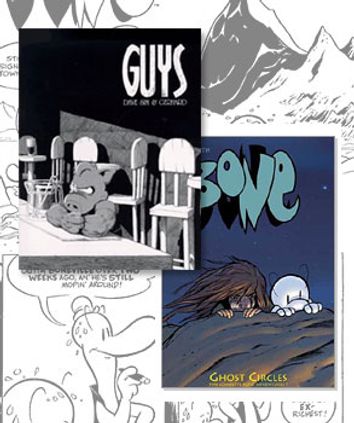
In the ecosystem of modern comic books, funny animals are the endangered species. Superheroes still make up most of the population, but thanks to the rise of “literary” graphic novels, creatures of different colors — war correspondents, lovelorn slackers and self-obsessed cartoonists — roam alongside the men and women in tights. But the art form’s increased respectability undercuts some of its youthful fun. Whole menageries of talking critters — screw-loose squirrels, lucky ducks, li’l devils, amorphous shmoos — are going extinct.
Overall the old funny-animal comics make no great loss, having mostly been cheap knockoffs of Disney properties or Saturday morning TV characters. But some ingenious creations did spring onto the scene, like Carl Barks’ classic Donald Duck comics and R. Crumb’s ribald adventures of Fritz the Cat. Two lesser-known yet landmark titles — one accessible to all readers, the other forbidding and definitely not for kids — have unfolded in recent years in extended but self-contained, novelistic story lines, and will conclude within months of each other. Dave Sim’s “Cerebus” finished its staggering 6,000-page, 300-issue publication in March, while Jeff Smith’s “Bone” completes its more modest but still impressive 55-issue run this month.
Jeff Smith’s Bone cousins don’t look like bones, but rather like half-pint, pie-faced humanoids — distant kin to Walt Kelly’s Pogo the Possum or Casper the Friendly Ghost, perhaps. And Dave Sim’s Cerebus should not be confused with Cerberus, Hades’ three-headed guard dog in Greek mythology. Instead, “Cerebus” chronicles the exploits of a talking aardvark who drinks heavily and has a penchant for violence, one-liners and messianic tendencies.
“Bone” and “Cerebus” share superficial similarities. They’re both drawn in black-and-white and self-published by their creators. In both, quirky, anthropomorphic beings shed light on mankind’s foibles and virtues. Both books extend their lives outside the comic shops through hefty, trade-paperback reprint volumes available at bookstore super chains. The 16th and last “Cerebus” collection, “The Last Day,” chronicles the aardvark’s final hours and publishes this month, while Smith will sandwich all 1,300 pages of “Bone” between two covers in a volume due to publish in July.
But beneath the surface, “Bone” and “Cerebus” prove to be so different, they’re almost like photographic negatives of each other. “Bone” celebrates optimism and narrative simplicity, while “Cerebus” embraces cynicism and experimentation worthy of a mad scientist. Sim and Smith started as comrades in arms, yet their relationship soured into one of the industry’s strangest feuds. “Bone” and “Cerebus” mark opposite ends of the comic-book spectrum in tone and complexity. Their heroes aren’t technically human, but you can place virtually all modern graphic novels somewhere between them.
Smith’s “Bone” may be the most friendly and engaging comic book of the past decade. Since 1991, Smith has written and drawn the adventures of the three Bone cousins: good-hearted mensch Fone Bone, happy-go-lucky goofball Smiley Bone and greedy, hot-headed Phoncible P. “Phoney” Bone, who needs constant rescuing when his get-rich-quick schemes go awry. The “Bone” saga begins with the trio fleeing their never-seen home of Boneville and discovering “a deep, forested valley filled with wonderful, terrifying creatures.” Recurring characters include an enigmatic, cheroot-chomping red dragon; a farm girl named Thorn who becomes Fone Bone’s unrequited love; and ravenous, none-too-bright Rat Creatures, the book’s answer to Wile E. Coyote. Fone Bone’s exclamation “Stupid, stupid rat creatures!” became a comic shop catchphrase.
Throughout “Bone,” Smith demonstrates a graceful command of unappreciated comic-book styles. The early issues include scary chases as dynamic as anything drawn by action-obsessed artists like Frank Miller (of “The Dark Knight”), but prove essentially comic and sunny. Smith’s sharp characterizations and clean drawing style reflects his love of the “Pogo” and “Peanuts” strips and especially Barks’ “Donald Duck” tales, which took the Donald and his zillionaire uncle, Scrooge McDuck, on adventurous treasure hunts in exotic locales. Even the name Fone Bone pays homage to the late Don Martin, penciler of Mad magazine’s most outlandishly elastic cartoons.
“Bone” began as a fantastical, freewheeling romp — one of the first extended story lines depicted “The Great Cow Race” — but it gradually yet seamlessly turned into a dark, sprawling fantasy epic. Recent issues have found the Bones on the wrong end of a massive siege akin to the Helm’s Deep sequence of “The Lord of the Rings: The Two Towers.” The Bones and Thorn learn that she’s not only the heir to a fallen kingdom, but possibly the decisive figure in an apocalyptic battle between good and evil. In Tolkien terms, she’s like Frodo and Aragorn wrapped up in one.
“Bone” is also more sophisticated than it first appears. In the story arc “Rock Jaw: Master of the Eastern Border,” Smiley and Fone Bone protect a bunch of cute woodland creatures from the title character, who resembles a big cat from Disney’s animated “Jungle Book.” Yet Rock Jaw has not just wicked claws, but also a Manichean worldview that sets off a debate over the purpose of life — in between bona fide cliffhangers. In the “Ghost Circles” story line, evil magic turned the lush valley into a blasted wasteland, against which the Bone cousins’ capacity for loyalty and humor provide the only human element.
Even when Smith pours on the mystical hoodoo a little thick, the funny but multifaceted characters keep the tale on a solid footing. More than any other current comic title, “Bone” deserves — and could support — the kind of popular attention that elevated Harry Potter from the rank and file of children’s books. “Cerebus,” on the other hand, will never be more than a cult success, since it’s such an iconoclastic project — not just in comics, but in all of mass media — that it defies categorization. Call it “satire” by default. Dave Sim began the book in 1977 as a spoof of “Conan the Barbarian” comics that replaced the longhaired muscleman with a 3-foot, sword-swinging, talking aardvark. “Cerebus” initially made hay from the incongruity of a deadpan, self-centered “earth-pig” playing the macho hero.
But Sim had bigger ambitions for the book than anyone could imagine, and by 1979 had announced, at the age of 23, that “Cerebus” would be a self-contained story of 300 issues — the “War and Peace” of comic books. Sim parodied modern politics by taking Cerebus from mercenary to diplomat to, in the 25-issue “novel” “High Society,” the elected prime minister of a fictitious, preindustrial nation (that bears a passing resemblance to Sim’s native Canada). The subsequent book “Church and State” ran twice as long (about 1,100 pages) to illustrate the abuse of religious authority as Cerebus became pope of a Catholic-style church. By the end of “Church and State,” a character prophesied that in the final issue, the eponymous aardvark would “die alone, unmourned and unloved.”
The artist known as Gerhard designs the book’s intricate backgrounds (which look far more solid and tangible than most comic drawings) while Sim scripts the book and draws the characters. “Cerebus” shows the talent and vision to rival any of the stars of the current comic books scene, including Alan Moore and Neil Gaiman. As a restless, anything-goes stylist, Sim proves equal parts theatrical stage manager, cinematic cameraman and comedy-club impressionist. Recurring characters include ersatz versions of Groucho Marx, Mick Jagger and the Three Stooges, reinterpreted for Cerebus’ milieu but with their vocal and visual traits captured with hilarious accuracy. Sim has also offered poignant, realistic portraits of late-career F. Scott Fitzgerald, Ernest Hemingway and Oscar Wilde. The 11-issue “short story” “Melmoth” juxtaposes a near-catatonic Cerebus killing time in a café with an accurate account of Wilde’s last days that works as a kind of historical biography in pictures.
For literally decades, Sim’s aardvark has shown a classic comedian’s gift for slapstick and the slow burn. Yet “Cerebus” proves its most moving generally at the end of its extended story lines, when Cerebus receives some kind of enlightenment instead of worldly power or romantic attachment. The “earth-pig” ultimately proves more tragic than comic: No matter how many epiphanies he has, he can never significantly change his brutal, selfish nature. As a violent, charismatic and funny antihero whose pursuit of power never provides peace of mind, Cerebus resembles few other characters in contemporary pop culture so much as Tony Soprano.
In the late 1980s and early ’90s, Sim became a folk hero for independent comic book artists. He spoke out for creators’ ownership of their work, used “Cerebus” to boost other up-and-coming comics and even ran a 13-page excerpt of “Bone” in 1992. (“You guys are going to love this one,” Sim announced.) Sim has proved resoundingly that one can write, draw and self-publish a monthly comic for 27 years — but not necessarily that one should.
As Sim’s ideas about religion and gender relations changed over time, the setting and characters of “Cerebus” became increasingly unwieldy vehicles for their creator’s personal views. Sim dabbled more heavily in dense textual pieces, including mannered pastiches of Wilde and Fitzgerald’s prose styles. He indulged in metafictional gambits, injecting himself into the narrative to talk directly to Cerebus. He recycled ideas and twice took Cerebus off the earth itself to travel the solar system — which admittedly provided some of the book’s most breathtaking moments.
In reading “Cerebus” over the last 10 years, it became increasingly difficult to separate the work’s wild creativity from Sim’s strident views about women, beliefs that Sim insists on calling “anti-feminism,” while his critics — and most of his dwindling readership — find them indistinguishable from straight-up misogyny. Appreciating later “Cerebus” can be like trying to separate the work of, say, Richard Wagner or D.W. Griffith from their personal beliefs.
But Sim’s comic book isn’t — necessarily — as didactic as Sim himself. By far the book’s most sympathetic and well-rounded role is Jaka, a princess turned dancer and Cerebus’ true love (insofar as he’s capable of love). With one or two exceptions, Sim’s men never prove to be avatars of reason, but Machiavellian plotters, self-absorbed artists or colorful clowns. For all of Sim’s polemics, “Cerebus” comes closer to the equal-opportunity misanthropy of “Gulliver’s Travels” than to the elevation of one gender over another.
Since he began condemning women as emotion-based “devouring voids” and the source of a host of marital and social problems, Sim turned from champion to persona non grata in the comics field, and even had a highly public falling out with Jeff Smith. In a 1999 interview with the Comics Journal, Smith described a weekend visit from Sim, who expounded on his views about women in front of Smith’s wife. “Bone’s” creator claims to have said “Dave, if you don’t shut up right now, I’m going to take you outside and I’m going to deck you” and that the “Cerebus” creator hastily backed down.
But a year after the interview appeared, Sim published an editorial in “Cerebus” calling Smith a liar and challenging him to a three-round boxing match to settle their differences. (Not surprisingly, the challenge coincided with the Ham Ernestway storyline in “Cerebus.”) Smith opted not to box his fellow cartoonist, sent “Cerebus” a letter telling Sim to “get stuffed” and has avoided further comment on the affair. However, in the letters page of “Bone’s” penultimate issue, Smith tipped his hat to Sim and Gerhard for getting to 300: “The troubles between Dave and I are personal, not professional, so congratulations, boys. You did it and you did it on time. I know it took a dedication few artists will ever have.”
Though “Cerebus” tries its readers’ patience in all possible ways, it remains a book that stretched the possibilities of the comic book form further than any rational person could expect. “Bone” doesn’t match “Cerebus” for insane ambition, yet proves about a zillion times more satisfying — not the least by making the devalued “cartoony” comic books seem cool again.
“Bone’s” bittersweet ending inspires the kind of melancholy that accompanies the final chapter of any wonderful piece of escapism, but at least Smith expects to pen further tales in the “Bone universe” in the future. (He next plans to do a limited Captain Marvel series for DC Comics.) In interviews, Sim has said he has no immediate plans to continue with comic books at all, and likens himself to a prisoner facing the end of a 27-year sentence. “Cerebus’” conclusion may leave readers both impressed at Sim’s achievement and relieved that it’s over. In “Cerebus” 121, the Oscar Wilde character’s capper for “Church and State” applies to the culmination of the comic book itself: “The ending was less of a grand finale than a grand finally.” At least “Cerebus,” like “Bone,” gave funny animals a grandeur all their own.
If comic books have a “Citizen Kane,” the clear choice is “Watchmen,” written by Alan Moore and drawn by Dave Gibbons. Just as Orson Welles’ kaleidoscopic biography of a newspaper tycoon invariably tops cinematic best-ever lists, Moore and Gibbons’ apocalyptic yet intimate superhero tale commands a similar status in its medium. And as the flashbacks from Charles Foster Kane’s estranged loved ones come together to form a tragic portrait on film, so do the distinct voices and aspirations of Moore’s Watchmen coalesce into engrossing and credible human beings — never mind the cowls and capes. “Watchmen” proves that a story published in “funny book” form can be as perceptive, relevant and mature as any novel, film or television series.
When DC Comics published “Watchmen’s” 12 issues in the mid-1980s, comics were viewed as the bottom of the pop culture barrel, no more than adolescent fantasies of brightly-costumed characters in never-ending, rock ‘em-sock ‘em fight scenes. But “Watchmen” proved as far removed from standard superhero fare as “Trainspotting” is from “Reefer Madness,” and gave adventurous readers a brand-new addiction. “Watchmen” and its contemporaries not only popularized the term “graphic novel,” they made it a necessary distinction that set these new, deeper works apart from juvenile-sounding “comic books.”
Other comics depicted alienated supermen and antiheroic vigilantes before “Watchmen,” but never before had they seemed so much like people of flesh and blood, instead of ink and pulp. “Watchmen” also made the ordinary lives of street-corner bystanders as crucial as the doings of its atom-age |bermensch, and could intercut fate-of-the-world confrontations in Antarctica with quiet, awkward moments of middle-aged romance. Dr. Manhattan, the book’s only “super-powered” individual, becomes so detached he grows to prefer the surface of Mars to the company of his lover or colleagues. Like Billy Pilgrim in “Slaughterhouse-Five,” he perceives time from all angles, flashing backwards and forwards, from scenes of love and teamwork in his youth to his perfect isolation on Mars’ airless deserts.
Welles didn’t invent the landmark filmic techniques (as well as the ideas from radio and live theater) that he used in “Citizen Kane,” but he gave them an electrifying new showcase. Likewise, Moore drew diverse cinematic, literary and cartooning styles together in a style unprecedented in comics. But creating an encore to an instant classic is a tricky business, and Welles never equaled “Kane.” After “Watchmen,” the Moore’s most significant graphic novel is “From Hell,” an epic autopsy of the Jack the Ripper slayings, serialized through the 1990s and now finally being published in book form by Eddie Campbell Comics.
As ambitious and affecting as anything ever rendered in pictures and word balloons, “From Hell” combines an intricate mystery, insightful social criticism and unflinching brutality capable of unnerving the most desensitized pop audience. It’s publication as a book promises to give it a new lease on life. That’s what happened with Art Spiegelman’s Pulitzer-Prize winning “Maus,” which was originally published in installments in the arty comic “Raw.” “From Hell” is the only graphic novel since “Maus” to rival its ambition and historical depth.
One of the rare comic book masters who’s solely a writer, Moore first made his mark in the 1980s with serials in British comic book anthologies. But he became a sensation when he took over DC Comics’ “Swamp Thing.” With Moore at the helm, the lurid horror title about a shambling plant man offered Hitchcockian thrills, debates about hot-button issues from gun control to incest and visual flights worthy of psychedelic rock album covers.
“Swamp Thing” shook up staid DC Comics, home of Batman and Superman, and became the first mainstream comic book to be published without the seal of the industry’s self-censoring Comics Code Authority. Moore began catching up with his earlier serials, including the British dystopian tale “V For Vendetta” and the first of his revisionist hero books, “Miracleman.” His work for DC culminated with the 12 issues of “Watchmen,” which perfected a cinematic writing style replete with jump cuts, “tracking shots” and close attention to recurring symbols; each issue had its own equivalents to the famous “Rosebud” sled and shattered snow-globe from “Kane.”
By the end of the 1980s, Moore felt disillusioned with mainstream comic publishing. As is standard practice in the industry’s nearly feudal system, he didn’t own “Watchmen” or any other characters he invented for DC, and he objected to the publisher putting “Suggested for Mature Readers” labels on his books, a criticized practice that paralleled the labeling of rock albums at the time. After leaving DC, in 1989 Moore and illustrator Eddie Campbell began working on “From Hell,” which was initially serialized in the fittingly-named anthology “Taboo.” When “Taboo” folded, “From Hell” came out in self-contained, glossy volumes through 1996, with a coda, “Dance of the Gull Catchers,” released in 1998.
Subtitled “Being a Melodrama in 16 Parts,” “From Hell” takes on the most notorious unsolved mystery in the annals of crime, the 1888 “Jack the Ripper” killings of five prostitutes in London’s East End. But Moore is more excited by history than he is by any horror show. In his introduction to the series, Moore wrote “It’s my belief that if you cut into a thing deeply enough, if your incisions are precise and persistent and conducted methodically, then you may reveal not only that thing’s inner workings, but also the meaning behind those workings … ‘From Hell’ is a post-mortem of a historical occurrence, using fiction as a scalpel.”
Open “From Hell” and you may involuntarily draw back — it feels like the dark, sooty atmosphere of Moore and Campbell’s Victorian London could seep into your own living room. Campbell renders “From Hell” in a scratchy, drippy black and white, with each panel seemingly drawn using a blend of London’s chimney ash and tabloid ink. With no campy sound effect balloons, “From Hell” unfolds in an eerie silence, its pauses worthy of Harold Pinter. Although it’s still a suspense-driven thriller, “From Hell” condemns the urban destitution and the maltreatment of women of the time in the starkest possible terms, with Moore and Campbell peering into the darkest corners of the victims’ squalid lives.
Inspired by the Ripper’s centennial, Moore found himself sucked into the lore of “Ripperology,” where wild suppositions and fierce factions rival the theorists of the Kennedy assassination. “Watchmen” is replete with Pynchonesque paranoia, and “From Hell” posits a similarly complex conspiracy at the heart of the slayings. Inspired by “Jack the Ripper: The Final Solution” by the late Stephen Knight, “From Hell” suggests that Prince Albert “Eddy” Victor had fathered an illegitimate child, and when four Whitechapel prostitutes attempted to exploit this information, they were executed (the fifth victim was allegedly a case of mistaken identity). Complicit parties include Scotland Yard, the Freemasons and Victoria herself, while such London notables as Oscar Wilde and James “Elephant Man” Merrick make cameo appearances.
For the killer, Moore’s finger falls on Sir William Withey Gull, Victoria’s royal physician. Though Gull was in his 70s in 1888 and had suffered a stroke, he had the surgical skill deemed necessary to commit the crimes. But throughout the book, Moore maintains that he’s more concerned with creating a tapestry of the era than unmasking a suspect, and that “From Hell” is not so much a “whodunnit” as a “wha’ happen.” In his own afterward, Campbell admits his belief in Gull’s innocence, but his pen depicts the top-hatted Gull and his shadowy, horse-drawn carriage as indelible images of doom.
You can read “From Hell” as a police procedural as it follows Scotland Yard’s Inspector Abberline through the case, but Moore’s larger point is that the Ripper murders were the fullest expression of 19th century injustices and hypocrisies. In one scene, reflecting the epidemic of fake “Jack the Ripper” letters at the time, Victorian men from all walks of life — a clergyman in his study, a laborer in a tub, two teenaged boys staying up late — are shown to be writing confessional letters to the police, grisly missives that flow together as if they’re the same letter.
Moore emphasizes the disparity between society’s highest and lowest members by using his signature juxtapositions, in which the dialogue or background details of one scene comment on another. (Think of the baptism scene intercut with images of Mob hits at the end of “The Godfather.”) Most of Chapter 7 alternates between Gull and the second victim, Annie Chapman, on the last day of her life, a telling contrast of privilege and poverty. While Gull arises from a luxurious bed, Chapman awakens in a seedy flophouse, sleeping along the same bench with other destitute women.
Amid “From Hell’s” chilling gloom are some embers of human warmth. Abberline, stifling in a loveless marriage, is drawn to an open-hearted working girl he meets at a corner pub, only to later face embittering disappointment. The most poignant figure is Marie Kelly, the least defeated of her fellow prostitutes, who makes it her mission to protect them along with cast-off street children. But when she begins to suspect that she’s the killer’s designated target, she abandons her dreams of a better life and fatalistically embraces alcohol and hedonism.
Moore and Campbell refuse to avert their eyes to even the most brutal or despairing content. Not only do we see the victims plying their trade in the least glamorous ways possible — hurried couplings against filthy alley walls for a handful of pence — but the murders are captured with ghastly precision. The book reaches its zenith (or nadir) in Chapter 10 with the last and grisliest of the killings, shown in such detail that it’s all you can do to keep your eyes on the page. Still, the graphic novelists aren’t in it for splatterpunk shock value. “From Hell” asserts that the Ripper killings provided a catalyst for the 20th century, both figuratively — the murders and their coverage anticipated tabloid journalism and the modern fascination with serial killers — and literally. As Gull goes about his dreadful business, he experiences increasingly vivid visions of London in the 1990s.
“From Hell” is as heavily researched as any scholarly work. Although the appendix is superfluous in the human body, here it’s as crucial as the heart. Almost every page features end-notes in which Moore not only cites his historica sources but muses on everything from London’s “dionysiac” architecture to streetwalking lingo like “thrupenny upright.” He writes, “Any adequate appendix listing Eddie’s sources [for the book's images] in the way I am listing mine would be twice as long as this current monstrosity, which in itself looks set to end up twice as long as the work to which it refers.”
You’d think that you’d flip past the end-notes with eyes glazing over, but instead the opposite happens. To read “From Hell” is to temporarily become a Ripperologist yourself, jazzed by the case’s facts, myths and weird coincidences. As you go, you realize that the hero isn’t Abberline pursuing his investigation but Moore conducting his own. In “Appendix II: Dance of the Gull Catchers,” Moore and Campbell use the comic form to recount, with tongue often in cheek, the strange history of Ripper theorizing. Ripperologists are shown as a mob of manic men with butterfly nets, and Moore himself eventually joins their ranks.
Alongside the multi-colored pages of most comics, “From Hell” is as grim and artfully ugly as the picture of Dorian Gray. And though “From Hell” has enjoyed auspicious awards and flattering imitations (Dave Sim, creator of the satiric “Cerebus” comic book, is using Moore’s method of historical recreation to create a fictionalized life of F. Scott Fitzgerald), it remains less well-known than “Watchmen” both inside and outside the comic book realm. The planned film adaptation of “From Hell” (frequently associated with “Menace II Society’s” Hughes Brothers) might raise its profile.
During the rest of the 1990s, when not meditating on the Ripper, Moore wrote the novel “Voice of the Fire” (unpublished in the U.S.) and has dabbled in shamanism. Lately, he’s been explosively productive, even cracking Entertainment Weekly’s “It” list last summer. He’s created a spate of new titles, including “Tom Strong,” about a square-jawed hero evocative of the 1930s pulps, and “Top 10,” about a superpowered police force that’s something like “Hill Street Blues” with capes.
The best of these is the six-issue “League of Extraordinary Gentlemen,” which is the souffli after the rich Victorian meal of “From Hell.” Set in 1898, Moore assembles fictitious figures like Allan Quartermain, Dr. Jekyll and Captain Nemo and pits them against such period villains as Fu Manchu. In a characteristic Moore touch, virtually all of the background figures come from literature; they include characters created by Henry James to Edgar Allen Poe.
Like the rest of Moore’s current comics, “League” is a lark. But nice as it is to see the comic book stores replenished with Moore’s work, none of his current stuff is nearly as challenging or innovative as “From Hell” or “Watchmen.” It would be a shame if he stays in the relative safety of the lite books at the expense of his deeper, more grown-up writing. Perhaps the second coming of “From Hell” will prompt him to make another stab at it.
Continue Reading
Close
Dr. Arthur Schnitzler, an Austrian novelist and playwright renowned for his psychological acuity and frankness about sex, died in 1931, but he’s just been initiated into an exclusive fraternity. It’s a men’s club comprising such diverse members as Vladimir Nabokov, Stephen King, Lionel White, Anthony Burgess and William Makepeace Thackeray — all writers whose work has been made into films by the late Stanley Kubrick. Except for “2001: A Space Odyssey,” based on a short story by Arthur C. Clarke, every Kubrick film — beginning with “The Killing” in 1956 — has been adapted from a novel.
Kubrick was a Schnitzler fan for decades, telling Robert Emmett Ginna in a 1960 interview, “It’s difficult to find any writer who understood the human soul more truly and who had a more profound insight into the way people think, act and really are, and who also had a somewhat all-seeing point of view — sympathetic, if somewhat cynical.”
Kubrick would reveal an affinity with that perspective as he developed his signature filmmaking style, an icily formal, deliberately paced approach that conveys a clinical, third-person-omniscient point of view. That cool, scrutinizing tone proved the most consistent quality in his body of work, linking movies as diverse as “Lolita,” “The Shining,” “A Clockwork Orange” and “Barry Lyndon.”
Of all of Schnitzler’s work, Kubrick was most drawn to “Traumnovelle,” a slim, 1926 novella published in the United States as “Rhapsody: A Dream Novel.” The book is an erotic reverie frequently interrupted by bouts of paranoia. Kubrick contemplated filming the book for decades, and even considered a big-budget, hardcore pornographic treatment in the early 1970s. Diane Johnson, who collaborated with Kubrick on the script for “The Shining,” says he showed it to her in 1979, and that “Kubrick had apparently shown ‘Dream Novel’ to all the writers he had worked with, to friends, perhaps people at Warner Bros. He had shown it to others since, over the years, apparently searching for the suggestion that would unlock for him something that drew but puzzled him.”
At some point after the release of “Full Metal Jacket” in 1987, Kubrick found the key to “Traumnovelle” and, working with screenwriter Frederic Raphael, adapted the book, retitling it “Eyes Wide Shut.” The most conspicuous change involves updating the setting from Vienna circa 1900 to modern New York, just a few years shy of 2001. But the sexual odyssey undertaken by the main character remains essentially the same as in Schnitzler’s novella.
At the beginning of “Traumnovelle,” a well-heeled Viennese couple, Fridolin and Albertina (in “Eyes Wide Shut” they become New Yorkers Bill and Alice Harford, played by Tom Cruise and his wife, Nicole Kidman) put their daughter to bed. They casually swap stories of being propositioned at a recent masquerade ball, then confess to more serious but unconsummated temptations from earlier in their marriage.
That night, Fridolin, a medical doctor, has professional duties that call him away, and as he strolls turn-of-the-century Vienna’s cobbled streets, one sexual opportunity after another is laid before him: the willing daughter of a recently deceased colleague, a saucy prostitute, a simple girl whose father is pimping for her. He manfully resists them all until he reaches a mysterious villa where a secret society gathers for a masked orgy: The men dress up first as monks, then as musketeers, while the women wear nun’s habits, then nothing but veils. At first an observer, he’s exposed as a stranger before he can join in the debauchery and only escapes unscathed thanks to the intervention of an alluring, aristocratic woman.
When he returns home, Albertina awakens and relates a dream with Freudian parallels to Fridolin’s recent sexploits. In her dream, as a merciless queen condemns her husband to death, Albertina takes part in a Bacchanalian romp: “Just as I saw you,” she tells him, “though I was far away, you could also see me and the man who was holding me in his arms. All the other couples, too, were visible in this infinite sea of nakedness which foamed about me, and of which my companions and I were only a wave, so to speak.”
Stung by this intimation that his wife has a faithless heart, Fridolin leaves and retraces his steps, prepared to seize the pleasures he previously refused and fantasizing about a double life as “a libertine, a seducer” as well as a family man. But this time all the carnal avenues are closed, and he winds up at that deadest of dead ends, a mortuary. The book ends with the daughter’s laughter, but Schnitzler doesn’t indicate whether the marriage’s status quo has been restored or overturned.
Kubrick reportedly said he was never sure whether “Traumnovelle” was a comedy or a tragedy, and he considered casting Steve Martin in the Fridolin role. There’s nothing overtly funny in the book, but you can view it as a deadpan exploration of the old saw that you won’t get any if you go looking for it. Structurally, “Traumnovelle” has a symmetry reminiscent of the first and last acts of “A Clockwork Orange,” where Malcolm McDowell’s ultra-violent Alex abuses people in the first part, then is abused by them later.
Much of Schnitzler’s writing is marked by an interest in sex. Like Anton Chekhov, Schnitzler practiced medicine before pursuing a literary life, and his specialties in syphilis and psychiatry would later inform his writing. His concern with the heart in addition to the areas below the belt is reflected in such titles as “Casanova’s Homecoming” and “Liebelei,” a play variously translated as “Flirtations,” “Playing With Love” and “Dalliance” (the latter is the title of Tom Stoppard’s English translation).
Like Kubrick, who offered scathing depictions of war and the military in “Dr. Strangelove” and “Full Metal Jacket,” Schnitzler was a pacifist, sharply critical of the armed services. His stream-of-consciousness novella “Lieutenant Gustl” got him court-martialed by the Austro-Hungarian military reserve for painting a damning portrait of a brutish soldier. “Lieutenant Gustl” and the tragicomedy “Das Weite Land” (translated as “Undiscovered Country” by Stoppard) reveal a special abhorrence of the Hapsburg Empire’s obsession with dueling — a topic Kubrick himself tackled in “Barry Lyndon.”
Schnitzler wrote his most famous work, “Der Reigen,” aka “La Ronde,” in 1902, with no expectation of seeing it publicly performed. He printed only 200 copies to distribute among friends. The play lays out a sexual daisy chain of five men and five women: A prostitute sleeps with a soldier, who sleeps with a chambermaid, who sleeps with her young employer, who sleeps with a married woman, and so on, ending up with the prostitute again. In David Hare’s transatlantic hit adaptation of the play, retitled “The Blue Room,” Kidman herself played all the female roles. Kidman’s highly publicized nude scenes in both “The Blue Room” and “Eyes Wide Shut” are giving Schnitzler his biggest boost of the century.
“Traumnovelle” and “La Ronde” are the best examples of Schnitzler’s equivocal and all-seeing eye — the perspective that so attracted Kubrick. In prose and drama, Schnitzler approaches sexual inconstancy in a clinical, nonjudgmental way. Neither “Traumnovelle” nor “La Ronde” offers tidy explanations of the human heart. The works suggest Rorschach blots, awaiting the reader’s interpretation, and it’s inevitable that Schnitzler’s adapters should put their own stamp on the material. In Max Oph|ls’ 1950 film of “La Ronde,” Anton Walbrook’s crooning narrator/stage manager adds some Gallic savoir-faire, while Hare’s “Blue Room” employs the coarse joke of identifying the length of each erotic encounter — from “45 seconds” to “one hour and one minute” — at every fade to black.
Given his fascination with sex, death, consciousness and Vienna, one could easily imagine Schnitzler as a nom de plume of Sigmund Freud himself, who was in fact born six years earlier than the playwright. They admired each other, but weren’t close. In a 1922 letter congratulating Schnitzler on his 60th birthday, Freud makes this remarkable profession: “I think I have avoided you from a kind of reluctance to meet my double … Your preoccupation with the truths of the unconscious and of the instinctual drives in man, your dissection of the cultural conventions of our society, the dwelling of your thoughts on the polarity of love and death; all this moves me with an uncanny feeling of familiarity.”
Many of these preoccupations apply to Kubrick himself, especially when his films pursue themes of relationships and sexuality. As a domesticated, civilized man beset by his baser instincts, Fridolin/Bill Harford can be seen as a more controlled, straight-laced sibling to Humbert Humbert of “Lolita,” Alex of “A Clockwork Orange” or even Jack Torrance of “The Shining.” But Schnitzler provides Kubrick a route to a more intimate treatment of human passion than he’d ever attempted before.
It’s hard to read “Traumnovelle” without trying to see it as Kubrick did, and in your mind’s eye you can see his Steadicam roaming starry Vienna as it did the Overlook Hotel in “The Shining.” Advance buzz has it that despite the updated setting and some new characters, “Eyes Wide Shut” will be more faithful to Schnitzler than “The Shining” was to King, or “A Clockwork Orange” was to Burgess. But no matter how faithful the film is to the book, it’s fittingly Schnitzlerian that Kubrick would expire just after having consummated his dream project.
Continue Reading
Close