Kevin Ryan doesn’t want to talk about his recent fling with Web stardom. He’s a bit rueful and more than a little nervous about it, in fact, and wishes the whole thing would just go away.
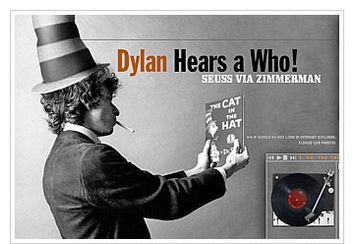
If you missed his star turn, here’s what happened: Ryan, a 33-year-old Houston music producer and author, went into his home studio and engineered a sort of retro mash-up of two of his favorite artists, Bob Dylan and Dr. Seuss.
Ryan took the text from seven Seuss classics, including “The Cat in the Hat” and “Green Eggs and Ham,” and set them to original tunes that sounded like they were right off Dylan’s mid-’60s releases. He played all the instruments and sang all the songs in Dylan’s breathy, nasal twang. He registered a domain name, dylanhearsawho.com, and in February posted his seven tracks online, accompanied by suitably Photoshopped album artwork, under the title “Dylan Hears a Who.”
“Green Eggs and Ham” was set to a tune and arrangement somewhere between “Highway 61 Revisited” and “Subterranean Homesick Blues,” complete with Dylan’s rushed, occasionally sneering phrasing. Familiar passages are run together in impatient run-ons:
Would you eat them in a box?
Would you eat them with a fox?
Not in a box not with a fox
Not in a house not with a mouse
I would not eat them here or there
I would not eat them anywhere
All this accompanied by an up-tempo electric band, complete with the jaunty skirling of a Hammond organ.
It was clever and delightful. Ryan had immersed himself so fully in Seuss’ words and Dylan’s style that he managed to merge two quite different creative intelligences. Many who have heard the tracks come away convinced they’re really listening to Bob Dylan.
Reached in Houston, Ryan confirmed the work was his but declined to speak about it on the record except to say he never expected it to attract any attention. Instead, “Dylan Hears a Who” was quickly picked up by bloggers and the popular Web site BoingBoing and went viral, attracting hundreds of thousands of visitors.
Then Dr. Seuss Enterprises, the La Jolla, Calif., firm that publishes the works of the late Theodor Geisel, heard “Dylan Hears a Who.” Only two weeks after word of the site began spreading, Ryan got a cease-and-desist demand from the Seuss lawyers, who said the site and songs infringed the company’s copyrights and trademarks. Ryan complied quickly and quietly. Instead of the Dylan/Seuss tracks, visitors to dylanhearsawho.com find a brief message saying the site has been “retired” at the request of Dr. Seuss Enterprises.
If you were caught up in the momentary wonder of how someone could execute such an ingeniously perfect blending of period musical style, ’60s attitude and loopy storytelling, it was tempting to see all of this as just another case of a heavy-handed corporate copyright holder — a master of copyright war, to call on the old Dylan oeuvre — sticking it to the little guy.
Ryan — best known as the coauthor of “Recording the Beatles,” a meticulous investigation of every track, take and song the group committed to vinyl — was face-to-face with a company that zealously guards its intellectual property. Losing a copyright-infringement case can be extremely expensive. In addition to the federal law’s $150,000 maximum in statutory damages, defendants can find themselves on the hook for the plaintiff’s legal fees. (Dr. Seuss Enterprises declined comment on “Dylan Hears a Who,” questioning why it was even a subject of interest. Dylan’s attorney did not return a call for comment on Ryan’s work.)
As it happens, if Ryan was going to get into a fight over the legal limits of parody, he couldn’t have run into a better-prepared opponent than Dr. Seuss Enterprises. The company helped write an important chapter in current case law regarding what is and what isn’t parody for purposes of fair use. In 1996, Dr. Seuss successfully sued Penguin Books to stop publication of “The Cat NOT in the Hat,” a send-up of the O.J. Simpson murder written and illustrated in the Seuss style.
Still, the Copyright Law of the United States was put on the books by the very first Congress not to secure the intellectual property rights of the corporate few, but to “promote the progress of Science and the Useful Arts” — even when that progress involves a writer, artist or musician lifting words, images or melodies from one source as part of making something new.
So if there was a legal defense for Ryan using Dr. Seuss’ words and images — and Dylan’s name and likeness, for that matter — it probably lay in the Copyright Law’s “fair use” exception. The provision, which reaches back at least to early 18th century English law, allows “the fair use of a copyrighted work … for purposes such as criticism, comment, news reporting, teaching … scholarship, or research.”
What does that mean when it comes to the unlikely trio of Dylan, Seuss and Ryan?
I asked Jennifer Rothman, an assistant professor at Washington University Law School in St. Louis who specializes in intellectual property, entertainment law and the First Amendment. Her take surprised me, coming from someone who said she’s on the side of small creators vs. corporate intellectual property interests.
“There’s no question that big intellectual property holders are intimidating small-time players with cease-and-desist letters and unreasonable I.P. claims and that the small players often buckle under,” she said. “This does chill speech.”
But the general climate aside, she said Ryan “is not standing on solid ground. If I were him, I wouldn’t want to litigate this because most courts would likely find he violated current I.P. law.”
Then she walked me through her reasoning, using as a primer Campbell v. Acuff-Rose, the U.S. Supreme Court’s unanimous 1992 ruling that found 2 Live Crew’s smutty, suggestive and sophomoric take-off on Roy Orbison’s “Oh, Pretty Woman” deserved fair-use protection as parody.
The key to the court’s finding was that Luther Campbell, the author of the 2 Live Crew work, did more than grab snippets of the original lyrics and sample portions of the song’s instrumental track. In the language of fair use, Campbell’s version was a “transformative” new work.
“While we might not assign a high rank to the parodic element here, we think it fair to say that 2 Live Crew’s song reasonably could be perceived as commenting on the original or criticizing it, to some degree,” Associate Justice David Souter wrote for the court. “2 Live Crew juxtaposes the romantic musings of a man whose fantasy comes true, with degrading taunts, a bawdy demand for sex, and a sigh of relief from paternal responsibility. The later words can be taken as a comment on the naivete of the original of an earlier day, as a rejection of its sentiment that ignores the ugliness of street life and the debasement that it signifies.”
However, whether a work is “transformative” in going beyond an original with “new expression, meaning, or message,” is just one of the factors courts must consider when assessing fair use. Judges must also weigh whether a new work is created for profit; whether the original work merits protection from copying; how much of the original was appropriated to make a new work; and what market impact the appropriation might have on the original work.
In Rothman’s opinion, Ryan’s work flunks two essential tests.
First, it fails to be a transformative work in that there’s no clear comment on or criticism of the Seuss original. “I think he’s not even close to the line on this. He’s far in the infringing camp,” Rothman said.
Second, “Dylan Hears a Who” appropriates too much of the original material. “It takes the entire Dr. Seuss material; it’s not like taking just a few lines to make a point,” Rothman said. “One question a court would ask is, Did the defendant take more than was necessary for a parody? and here I think the answer is clearly yes.” The one factor that might weigh in Ryan’s favor, Rothman said, is that “Dylan Hears a Who” did not appear to be commercial.
I asked Rothman to back up for a moment and consider an argument that went like this: By inserting Dr. Seuss’ words into a novel context, specifically, the voice and style of a radical 1960s troubadour, the “Dylan Hears a Who” project comments on the original work by exposing a sly, rebellious, countercultural dimension to his work that has remained hidden. At the same time, it exposes a playful though pointed creative intelligence shared by two of the most important figures of the 1960s.
Rothman said that wasn’t a bad stab at a defense, but didn’t think a court would buy it. “It’s too obvious that the point of the site is, Wouldn’t it be fun to sing Dr. Seuss in a Dylan voice? And that’s not something most courts would be sympathetic to.”
Ryan himself — speaking, of course, after he heard from Seuss’ lawyers — seems to confirm Rothman’s judgment when he wrote in an online forum that “Dylan Hears a Who” was merely “a fun little project.” Having fun doesn’t make it impossible to produce parody, but to have a ghost of a chance of prevailing in a fair-use dispute, you need some serious justification and the ability to demonstrate it. In a sense, Ryan undid his most serious defense by admitting he used someone else’s protected material just for fun.
Ryan’s work aside, Rothman said the current copyright regime is an increasing burden to artists and one that, the three-century history of fair use notwithstanding, is drawing an ever tighter circle around the choices of writers, musicians, filmmakers and creators of all stripes.
A case in point is an often-cited incident involving filmmaker Jon Else and his 1999 documentary “Sing Faster: The Stagehands’ Ring Cycle.” As detailed in “Free Culture,” by Stanford University law professor Lawrence Lessig, Else shot a scene of stagehands playing checkers. In the background, “The Simpsons” was on TV. Else wanted to use a four-and-a-half-second shot that included the cartoon, which was incidental to the scene. It was probably a case of fair use, but he sought permission from the copyright owners. Fox said Else could use the 4.5 seconds at its educational rate: $10,000. Dismayed by the cost and the prospect of costly and time-consuming litigation to keep the shot intact, the filmmaker dropped his request and wound up digitally substituting a documentary he owns the rights to onto the TV in the scene.
“In theory, fair use means you need no permission,” Lessig concludes. “The theory therefore supports free culture and insulates against a permission culture.” But summarizing Else’s experience, he says, “The fuzzy lines of the law, tied to the extraordinary liability if lines are crossed, means that the effective fair use for many types of creators is slight. The law has the right aim; practice has defeated the aim.”
So is there hope for daring creators? Even those who, like Ryan, make something remarkable on a lark? Rothman points to efforts such as the Chilling Effects Clearinghouse, set up by the Electronic Frontier Foundation and law clinics at Harvard, UC-Berkeley, Stanford and several other universities to help pool information on copyright issues and advice for artists facing cease-and-desist demands.
But she also suggests that the most effective response might be fighting fire with fire: being prepared to go to court to fight unreasonable intellectual property demands from corporations. Of course, a movement like that would need deep pockets, and Rothman says some have arrived on the scene: Google, for instance, which has seen copyright law become a major factor in many of its activities.
“We’re just starting to see a movement to push back,” she said. “I and other I.P. scholars are saying we need more litigation of these questions.”
In the meantime, “Dylan Hears a Who” lives on, even if Ryan’s site is shut down. The songs were online long enough for music fans to do what fans do on the Web: copy the songs and repost them. Despite the fumings of the intellectual property grinches, Bob Dylan’s gig with Dr. Seuss is guaranteed a long run.
I flew down to Las Vegas last week to see a historic 32-story casino dynamited. I thought I could extract a little universal meaning from the event. Although I hail from the peace-loving town of Berkeley, Calif., I’ve also seemed to inherit that American male gene that makes us love seeing stuff blown up. Apart from whatever deep thoughts the experience might provoke, I was sure I’d love the show.
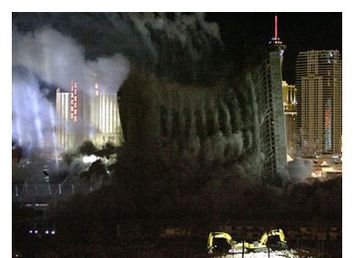
I did enjoy it, though the hours of standing around in the Strip’s outdoor haze of cigarette smoke and diesel fumes didn’t seem like a fair trade for 30 seconds of hot man-on-building action at 2:30 in the morning. The climax, after a four-minute fireworks show, was two quick rounds of explosions that sent the hotel tower and an adjoining nine-story inn at the old Stardust resort crashing to the desert floor. All that mass slamming to earth made the ground shake and unleashed a roiling cloud of cement dust. The throng, such as it was — a smattering of bereaved Stardust fans and former employees, plus a few random stragglers who had wandered up the Strip for the night’s best free show — scurried away. Sporting a dust mask I’d bought for two bucks from an entrepreneurial fellow spectator, I trudged back to my smoke-free hotel, looked at the pictures and video I’d shot, and went to sleep.
So the Stardust is gone except for the cleanup. There’s a little nostalgia out there for the old place if you go looking for it. I understand the former workers’ sense of loss; the place that fed them and their families has been erased. It’s a little harder to fathom the wistfulness, expressed by some natives and by former Stardust guests, for the old Las Vegas they say the Stardust represented. It was maybe a friendlier and classier place, in the sense that Frank Sinatra and pals represented chumminess and class; a place that was a little more humane in scale and perhaps more affordable without maxing out your credit cards.
It’s true the Stardust was older than most Strip hangouts: It dated to 1958, the tail end of the first building boom on the south end of Las Vegas Boulevard. When it opened, it boasted the biggest casino floor, the most hotel rooms (some at $6 a night) and an absurdly large swimming pool. It’s true that it drew lots of colorful characters and provided both a playground and a steady payday for real-life mobsters. For a while, it was world headquarters for Wayne Newton. It hosted Don Rickles, who at 80 survives the Stardust on another nightclub stage nearby.
But with all due respect to the recently departed, that Stardust and that romantic Vegas vanished into the desert about the same time the casino business went corporate, decades ago. The Stardust itself was a model of that change: Physically, it grew out of its original sprawl of low-rise barracks into bigger and swankier quarters. The hotel tower reduced to dust last week was put up in 1991 as the resort’s owner, Boyd Gaming, struggled to keep up with the Strip’s new generation of super-sized gambling and entertainment palaces.
From the outside, the structure was, without its bars of indigo and scarlet neon, as featureless and functional-looking as a warehouse. So, yes, it’s not easy for a hard-hearted outsider to work up a lot of emotion over a building that dated all the way back to the day before yesterday. As far as old-style Sin City class and affordability, the Stardust mourners can always drop by the Frontier, the next stop south of the Stardust, where you can get a room for 45 bucks and catch bikini bull riding three nights a week.
The truth is, sad as it may be for those who can sit in a Las Vegas bar and conjure up Frank, Dino and Sammy strolling in the door, the loss of one more name from Las Vegas’ past is far less arresting than what has been happening up and down the Strip. Resort owners and investors, driven to compete with each spectacular new arrival — the Wynn, the Bellagio, the Venetian, Paris — have been knocking down buildings and putting up new ones at a ferocious pace. By one count, crews have dynamited 15 hotel buildings, including the two at the Stardust, in the last 14 years. The oldest structure imploded, the Stardust’s nine-story inn was 42 years old. The newest was a 7-year-old tower at the Desert Inn. The average age of the imploded hotels: 21 years, three months. Your local rent-a-space building is likely to get a longer run.
Landing in Las Vegas the afternoon before the Stardust had its last big moment, I spotted it well to the north. Stripped down to its concrete-and-steel skeleton, though, it was a little hard to pick out from the forest of new buildings and construction cranes rising nearby. The Wynn is putting up a second tower, called the Encore, just across from the Stardust site; a bit to the south and west, Donald Trump is erecting his trademark horrific gold-mirrored slab; and back on the Strip, still further south, a colossal new hotel, the Palazzo, is going up next to the Venetian. At the Encore and Palazzo, the construction is going on 24 hours a day. There’s a hurry to get them open and get them pulling in crowds and cash.
Looking at the gently lit Stardust tower after sunset, glancing at the new buildings rising nearby and at all the massive, crowded hotels up and down the boulevard, it was clear they’re all of a piece. That night, it was the Stardust’s turn to make way. Already, the town’s Strip watchers are guessing which hotel will go next. Looking around, it’s almost as if every building you can see — established, brand-new, under construction — is on the knockdown list. The ground is that valuable. The crowds arriving to spend their money on something bigger and better are that big. That’s Las Vegas.
Soon, something bigger and better will fill the blasted 63 acres where the Stardust stood, too. Specifically, Boyd Gaming’s Echelon Place. The name’s got as much romance in it as you’d find in the average Pentagon file drawer. It will be a $4 billion mega-resort with four hotels, 5,300 guest rooms, a shopping mall, a convention center, a couple of theaters, and two dozen restaurants. It’s supposed to open in 2010, and then a new generation of newlyweds, convention-goers, gamblers, vacationers and employees will start fashioning memories they’ll share on that not too distant evening when they gather to watch the whole thing come down.
Continue Reading
Close
Nov. 20, 1977, was the greatest day a National Football League running back ever had. The Chicago Bears’ third-year halfback, a flu-ridden Walter Payton, entered the game against the Minnesota Vikings at Soldier Field and ran and ran and ran. On the last of his 40 carries — a fourth-down sweep called by a coach who lacked the imagination to try anything else (even at chip-shot field-goal range, even with the game nearly over) — he slammed and stumbled 4 yards. Payton’s total for the day: 275 yards — a couple better than O.J. Simpson’s mark, and an NFL record to this day.
Payton kept running for a long time after the clock ran out on that game, but the number on the scoreboard that afternoon remained emblematic of the ironies of his career. The Bears had won, but they had scored a meager 10 points. A minor tragedy compared to Payton’s death of a rare liver disease and cancer on Monday at age 45, but a tragedy nonetheless: Payton’s career was spent with a team that always seemed to find a way to make the least of his enormous talents.
Payton’s obituaries include most of his individual career records: He rushed for 16,726 yards (No. 1 all-time) on 3,838 carries (No. 1); gained 100 yards or more in 77 games (No. 1); gained 1,000 yards or more in 10 seasons (tied for No. 1); and gained 21,803 yards combined for rushing, receiving and returning (No. 1).
They mention his nickname, “Sweetness,” which described his off-field personality far better than his playing style — for which “Patton” might have been more fitting. They talk about the demanding workouts he designed for himself and the fact he accomplished everything without ever being the fastest or biggest or the most spectacular at his position.
They speak of his toughness: He missed just one game in his 13 seasons. He had a sprained ankle one week in his rookie season and insisted then and ever after that he could have and should have played. They mention his bravado: He never met a tackler on neutral terms, but braced himself to give at least as punishing a shot as he was about to take. And they touch on the irony of someone so rugged dying so quickly: His diagnosis of primary sclerosing cholangitis, a bile-duct disease that can be reversed only with a liver transplant, was made just a year ago.
But while his career histories mention the twilight irony of Payton’s career — when the Bears finally made it to the Super Bowl after the 1985 season, Payton didn’t score in the team’s 46-10 victory over the New England Patriots, and coach Mike Ditka apologized for not giving his star a chance to get into the end zone — Payton’s disappointment seemed to be deeper than Ditka or anyone else could understand.
Getting to the title game seemed to mean a lot less, he said, because his team so thoroughly humiliated its opponents. “I don’t know,” he said, “maybe a 14-12 game would have meant more.”
That disappointment and the thousand others that came with toiling for a team that only rarely approached his level of excellence — the Bears were just 61-70 his first nine seasons, before a brief mid-1980s renaissance — kept Payton from assuming the larger-than-life proportions of other football heavies.
Jim Brown, the Cleveland Browns running back who held the career rushing record before Payton broke it, watched for two decades as a clutch of players approached but failed to surpass it. Disdainful of most of them, Brown apparently recognized a fellow tough guy in Payton, though Payton was reputed to be as gentle and self-effacing off-field as he was tough and single-minded on it, and pronounced him worthy of his title.
Payton once said of the rushing mark, “I want to set the record so high that the next person who tries for it, it’s going to bust his heart.” And he set it very high. But for all that, he seemed to have only leased his place in history. By all accounts, that place should have eventually gone to Barry Sanders, who went to work for Detroit in 1989. By last year, fans assumed that, barring a catastrophe, Sanders’ games would add up to the record this year — his 11th in the league.
Maybe Payton’s heart-busting strategy worked, or maybe Sanders didn’t have a heart to break. The would-be immortal quit the Lions before the season, fewer than 1,500 yards short of the mark. He was tired of playing for a team that had never been close to winning everything.
It’s tempting to think that seeing the team Sanders spurned do just fine without him this year would have made the otherwise all-business Payton crack a smile. But then again, maybe part of Payton would have understood just what Sanders was thinking. “Get ready for another year of getting run into the ground? For this bunch? No thanks.”
Payton’s answer would have been ready: “Are you nuts? Go in there and run the next play.” Or, if he could have, he might have just grabbed a helmet and headed onto the field himself. His team might have never been as good as he was, and his body failed him at the end, but his heart was never busted.
Continue Reading
Close
So Long, MJ. Goodbye to the Greatest Ever. The Perfect Departure. Never Mind Who’s Next — He’s Irreplaceable. Tough Luck for the NBA.
Thirty-six hours of instant analysis/eulogy/postmortem/ deification. Enough. Listening to the awed tones of Frank Deford and a thousand and one other commentators, reading the front-page requiems and career wraps, looking at the highlight clips — they all end with the perfectly scripted exit: the championship-grabbing steal and jumper against Karl Malone and the Jazz last June — finally made me see it.
This is all wrong.
It’s not time for Michael Jordan to leave. Forget the National Basketball Association for a minute. I’m not ready. The world’s not ready. I reject his resignation.
I say this not as someone who has followed every step of Jordan’s career — though I’ve gotten in the way of enough media over the last 15 seasons that we could talk about everything from Michael’s late-blooming high school career to his late nights in Atlantic City. Nor do I weigh in as someone who has haunted pro locker rooms and can tell you what Michael’s sneakers smell like — though we know, don’t we, that he’s got more of them than anyone and they’ve got a sweeter odor than yours or mine.
No, I say this first as a California guy who still thinks he’s a Chicago guy, the rail-hanging teen heckler who went out to the Stadium to watch the Sloan-Van Lier-Walker-Love-Boerwinkle Bulls of the early 1970s, a team of fierce overachievers whose style of play was as elegant as a Hells Angels stomping. And second, I guess, as a member of an even larger group — that big slice of humanity that doesn’t often get to enjoy the illusion that we engineer our own graceful exits.
The only time I ever saw Jordan play in person — October 1985, Oakland-Alameda County Coliseum Arena, against the Golden State Warriors — I watched from the last row. He made a great drive in the first quarter — don’t remember whether he scored — got fouled, made his free throws, then went to the bench. I spent the second, third and fourth quarter bellowing for him to get back in there. It didn’t look like anything was wrong with him from where I was sitting, and it seemed weird that he was just off by himself, ignored by teammates and coaches. That’s not what I had shelled out six or nine bucks for. Was he hurt? I didn’t buy it. “Michael! Put your shoe back on!” I screamed.
Anyway, he had broken his foot, and he missed the Bulls’ next 60-some games. He came back in the playoffs. The team didn’t want him to risk reinjury by going back on the floor for a series that was a foregone conclusion against the Larry Bird-at-the-top-of-his-game Celtics. Jordan didn’t know what “foregone conclusion” meant. He blew through the Boston defense for a 63-point game and single-handedly forced the series to its three-game limit.
The image of Michael sitting on the bench is a precious one — the only time in his entire career when something other than himself (and we won’t go into the baseball thing) stopped him cold. And it happened at a moment when no one could say what direction this guy was going to go. Without knowing it, I think the people who saw Jordan fall to earth that night witnessed the baptism of a modern Achilles, albeit one not often given to sulking, one mostly unstingy with supplicants, one blessed always with a good agent. But nevertheless, an apparent demigod, one who, once he understood the dimension of his powers and was joined by a cohort of worthy mortals, seemed always to perform miraculously in the desperate rush of big-game battle.
That’s just what that last highlight sequence shows. With only seconds left in a contest that, if lost, could break his team’s soul, Jordan confronts Malone — he’ll do as Hector in this capsule “Iliad” — and stabs the ball from his hands. With this prize in his hands on the other end of the court, he gives a defender a combined fake/shove — the Greeks didn’t fight fair, either — and drains a jumper. That’s the game, the series, the championship. And, Michael says now, his career.
But wait. Let’s interrupt for a minute this really upbeat memorial service — sorry, celebration of his career — that the cosmos is staging to mark the occasion. Not to question Jordan’s reasons for wanting to quit. Anyone whose life is lived so long in the high-intensity radiation of celebrity deserves a break. He certainly doesn’t owe the league or his franchise or even the fans anything. And his hoops mentor and kindred spirit, Phil Jackson, quit the Bulls’ coaching job.
But look beyond. Look at the moment and the man.
What I see is a game-sequence blur. Jordan bringing the ball upcourt for
a three, Jordan falling back as he releases his jumper, Jordan switching
hands in the middle of a high-altitude drive, Jordan’s joy and sweat and
exhaustion and pain and triumph. What I see as the montage fades is that
his game, his genius, has not yet run its course, and I can just feel how
much fun it would be to see him on the court just one more time. Michael!
Put your shoe back on!
But there’s more to this than nostalgia and the mind’s-eye highlight reel.
Michael’s exempting himself from decline. This goes beyond taking a pass
on the spectacle of a great athletic talent going into eclipse. We get to
see that every season in every game. Mickey Mantle gimping around the
bases. Dan Marino, who suddenly looks better as a glove model than throwing
a football. Gordie Howe trying to play hockey — ice hockey — into his 60s
or 70s or whatever it is, a truly unnatural act. Jordan’s short-circuiting
that, and that’s OK. There is such a thing as staying too long.
This is a case, though, of leaving too early. Michael’s trying to do
what most of us, untouched by a divine talent, could never contemplate:
He’s trying to quit with his illusion of immortality intact.
Yes, the just-please-help-them-win-God part of me that has long imagined
the black day someone would grind down Jordan and the Bulls is relieved.
Thank goodness it wasn’t Karl Malone. But an even bigger part of me is
disappointed. That feared defeat, that unwanted ending, that sad last act,
is a vital part of the plot. It’s also parallel to the narrative line we
all live through our whole lives. We get to the end of things — a job, a
romance, the lives of the people we love — and we stick around for whatever
is next.
But that next story doesn’t begin until you have an ending, a
denouement, for the first. I don’t like that Michael is lopping off his
tale’s conclusion. I don’t like that he’s messing with the story arc. It’s
a little like having Shakespeare decide Romeo and Juliet don’t really have
to die. Or even more like the Bard deciding that, with no way to top his
work in “Hamlet,” he was going to call it quits as a playwright and
toss quoits instead.
What would be wrong, really, with a script that ended like this? Jordan,
head down, crying, walking off the victors’ court having lost for the first
and only time in the finals. The crowd, which wanted nothing so badly as to
see him lose, is on its feet. Everyone there knows they’ll never see
another one like him, a man who has grown somehow in being dethroned, in
giving up his demigod status. Then everyone — the fans, the league, the
media folks — can celebrate the greatness, mark its passing, and begin the
next story.
Continue Reading
Close