Dan Hoyle

Hard times at the bottom of the Bush economy

From a tent city in Reno to a drug dealer's block in Detroit, I saw how Republican rule has hit those living on the American fringe.

  • more
    • All Share Services

Hard times at the bottom of the Bush economy

The Flying J Truck Stop outside of Jerome, Idaho, has some of the cheapest gas in the area, so on a Tuesday afternoon in late September, vehicles were lined up at its 16 pumps. For Rickie S., this would normally mean brisk business — he’s been an itinerant polisher of semitrailer wheels and hubcaps for the past 26 years. He doesn’t have a résumé or calling card but insists his work is world-class. “Get on a CB and ask about Rickie — I’m known coast to coast,” he says. But lately the truckers, who have been crunched by high gas prices for months, have been reluctant to hire Rickie even for a few bucks to buff and shine their rigs.

Business has gotten so bad that Rickie, who is 50 years old, has decided to abandon his trade.

“I’m done. I just threw away my rags, all my polish. You can’t make any money doing that anymore,” he says, taking a seat on his Army duffel bag and pushing back his Conway trucker’s mesh cap. He glances at the dirt caking the rims of my van, accumulated over 11,000 miles of traversing the country since June, and shares his story of economic blues. “I’ve got three blankets, two dollars, one beer and a 50 percent chance of survival,” he says. “This economy is bad, man! And guess what? The buck stops here.”

With the American financial system in crisis, politicians in both parties have taken every opportunity to denounce the corporate pirates of Wall Street and sound off on behalf of the anxious working majority. But far off embattled Main Street is another troubling picture of the nation’s economic swoon, where the working poor and lifelong scrappers struggle to keep from sliding onto Skid Row. For those on the bottom rung of the economic ladder, the current crisis is in a sense a mere aggravation of years of hard times. But for some it has turned particularly harsh.

According to the U.S. Census Bureau and the Bureau of Labor statistics, the national poverty rate increased from a record low of 11.3 percent in 2000 to 12.5 percent in 2007 — an increase of approximately 5.8 million Americans living below the poverty line. “In George W. Bush’s presidency, there’s been an almost total absence of benefits of growth trickling down to the middle class, much less to those at the bottom,” says Jared Bernstein, an economist with the left-leaning Economic Policy Institute, whose extensive writing on the working poor includes the book “The State of Working America.” The nation’s unemployment rate has risen from 4 percent in 2000 to 6.1 percent at present. Bush’s economic policy has been marked by tax cuts largely beneficial to the wealthy, while federal funding for many programs helping low-income people has not kept pace with inflation.

Traveling around the country for three months this summer and fall, I found abundant evidence of an economy under strain. At the truck stop in Idaho, amid overgrown lots in run-down Detroit, at idle slot machines and in a dusty tent city in Nevada, I met people struggling to survive on the fringes of the faltering economy. Many were suspicious of a journalist’s inquiries and wary of divulging personal information (including their last names). But they were outspoken about the way economic hardship has hit home in recent months.

In Jackpot, Nev., a casino town of 1,416 people, Olivia A., 38, waits tables at Barton’s Club 93 Casino. She is a lot less busy these days, even with the prime rib special dinner on a recent Monday going for the tantalizing price of $5.98. The casino is not empty — there are still a few older women pulling on long, thin cigarettes and feeding slots with names such as Winning Times and Stinkin’ Rich — but Olivia says business is way down. As a result, her hours have been cut. A mother of three, she never expected to be struggling so hard to pay the bills when she left her job as an accountant in Mexico more than a decade ago to come to the U.S. with her husband. Leaving a middle-class job in Mexico was difficult, yet worth a better life for her children, she had thought.

But lately, every day seems less of an improvement over her previous life in Mexico. “Sometimes, I think about going back,” she says. “the only reason I’m here is for my kids. Back home I was a professional. I had a completely different life.”

The severity of the downturn can also be seen beyond the legal edges of the economy. On a recent Sunday afternoon on Jefferson Avenue, in Detroit’s notorious East Jefferson neighborhood, Joe, 37, is dressed in street-business casual: a white Adidas T-shirt, gray stonewashed jeans, white Adidas sneakers and a black do-rag. But the tattered state of his attire is a telltale sign that sales are down at his corner drug business, where he waits anxiously for today’s payday to come from across Alter Road. Three blocks to the north, the boarded-up storefronts and treeless sidewalks here give way to a leafy, boutique-strewn lane of Jefferson Avenue in Grosse Pointe, the wealthy suburb that is home to many of the top engineers and executives of the American auto industry. They have been some of Joe’s most profitable customers over the years. “When a white person come across Alter Road, they might spend $100 at a time,” explains Joe, “whereas round here, people only looking for dimes and nicks [$10 and $5 bags].”

Over the past year, Joe’s big buyers from the suburbs have been cutting back. Like everyone else in the Motor City, Joe has felt the impact of losses at Ford, General Motors and Chrysler. “As goes the Big Three, so go Detroit, and I mean everybody,” says Joe. He grew up on welfare, and admits to being “knee deep in the drug game” since he was 15 years old, but he complains that he is even less shielded from the economic crisis as a part of the illegal and informal economy. He says he has been struggling to make child support payments for two kids. “At least the autoworkers get memberships to Sam’s Club and Costco. We have to buy our Pampers at the corner store for $17!”

Detroit has the highest poverty rate of any American city at 33.8 percent, with many blocks boasting only a lone house surrounded by fields of overgrown weeds. Watching the cars pass by, Joe eyes a yellow BMW. “Right there! That dude spent about $300 last week right here on this corner,” he declares. “But he didn’t come round last weekend like he normally do. You know he’s thinking, ‘I can’t be blowing money now. I might lose my job.’”


Economists across the board agree that this decade has been nothing like the 1990s, which saw sustained, healthy economic growth at most levels. Still, Rea S. Hederman Jr., an economist at the conservative Heritage Foundation, seeks to paint a less bleak picture when it comes to the plight of the working class. He notes that consumption inequality has increased far more slowly than income inequality, as more and more people at the bottom of the economic ladder own cellphones, dishwashers and microwaves. Hederman, preferring the term “pro-growth” to “trickle down” economics, also points to a long streak of positive job growth numbers from August 2003 to January 2008.

But with regard to those numbers, Bernstein, of the Economic Policy Institute, says that the period from March 2001 to December 2007 was “the worst business cycle on record for job growth, and you won’t find an economist to disagree with that,” with jobs growing at just 0.7 percent annually, well below the 2 percent annual average. Put another way, in the 1990s, 21 million jobs were created, according to the Bureau of Labor Statistics, while in this decade only between 5 and 7 million jobs have been created, according to various estimates. (The decade isn’t over yet, but few economists are likely to be predicting a bonanza of job creation in the two years remaining.)

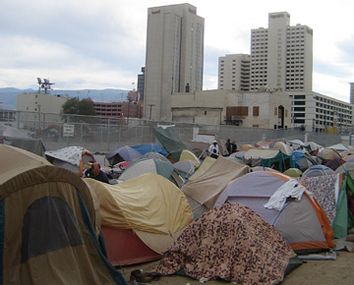
A stark picture of what it means to be down and out these days has cropped up just four blocks from the towering casino hotels of downtown Reno. After a local homeless shelter reached overflow capacity this spring, people began pitching tents in the dirt of an open lot; a tent city of more than 50 structures has since sprung up. On a warm late September afternoon, I weaved my way around people’s makeshift homes, some adorned with T-shirts featuring arty designs, others guarded by plastic animal lawn ornaments. People’s stories were a potent mixture of misfortune, bad decisions and dwindling opportunities.

In recent times, Bill Rosenbaum, 48, was installing carpet for new subdivision homes in Southern California and Arizona, traveling so much that he found it easier to stay in hotels. Then his van blew out and the home foreclosure crisis crippled the market for new carpet installation — and he was homeless for the first time in his life. He recently found a day job picking up pine cones for a rancher outside town. He hopes to save enough money to buy a new van and start his business back up.

Tammy Tyra, 47, of Seymour, Texas, was a trucker for the Landstar Carrier Group until last November, when she started having seizures. Diagnosed with epilepsy, she was forced to quit. Unable to find a new job, she eventually found her way to the tent city in Reno. She put her goal in simple terms: “I want to get me a freakin’ job!”

Alden Collins, 56, lost his job when he refused to take a pay cut from $10 to $8 an hour at a restaurant in Lake Tahoe. As he told his story, it quickly devolved into a song. (His friends nearby noted that he had been off his medication recently.) Nashing his teeth between notes, and banging his foot in the dirt to keep time, he sang, “Trying to go to work/ yeah yeah yeah/ but workin’ in the dirt just don’t work for me.”

Many of the people at the tent city suffered from mental health issues, and as social programs have been cut, they have less access to services. Those at the bottom have suffered in multiple ways, Bernstein says. “They’ve been hit on two sides. The markets are letting them down, and our government is letting them down.”

Debbie Weinstein, executive director of the Coalition on Human Needs, a Washington-based advocacy group for low-income people, says that “there’s been a great deal of shrinkage of a bunch of different kinds of services.” The organization has tracked 97 federally funded programs during Bush’s second term in office; according to data from Weinstein, federal funding for all but 13 of the 97 programs failed to keep up with inflation. Funding for major initiatives such as the Center for Mental Health, Adult job Training and Homeless Assistance Grants (which have budgets in the hundreds of millions of dollars), was down between 8 and 17 percent in inflation-adjusted dollars from 2004 to 2008.

According to both Bernstein and Hederman, those at the bottom usually receive less attention in times of economic crisis. They are a politically insignificant group compared to the broad American middle class, and expressing support in policy terms for the poor, who are often seen as lazy recipients of the un-American handout, can be risky for a politician in a close election. “The poor have been pretty invisible on the political stage,” Bernstein says. “It’s usually only in boom times that we look at those issues closely, and people debate if there are policy failures or they are just lazy bums.”

“I’d like to think people are more sympathetic in terms of volunteerism and charitable contributions,” Hederman says. But a bad economy can get in the way, he says. “People are also looking to save in case things get worse.”

Setting aside any moral imperatives to aid the working class and poor, it’s evident that the relative health of this population tells us something about the state of the country.

At the truck stop outside Jerome, Idaho, Rickie speaks of two decades as a troubled but hard-working independent contractor to truckers across the country. On a good day he said he could make $200 to $300 polishing rigs; lately, he was lucky to make $30 to $40. He expresses sharp frustration with the truckers, many of whom were loyal customers for years. “I feel like getting on that CB radio and saying, ‘Y’all are the sorriest motherfuckers I know, driving around the country with dirty wheels and dirty trucks. You gotta have some pride in your ride!’”

He cocks his head and watches a 18-wheeler with dirty rims easing out into traffic. “But people just don’t have any money for that anymore,” he adds. “I know.”

Obama’s big bet on Nevada

Latino voters in this economically pummeled swing state harbor fears, hopes -- and rising electoral power. They could help deliver Obama to the White House.

  • more
    • All Share Services

Obama's big bet on Nevada

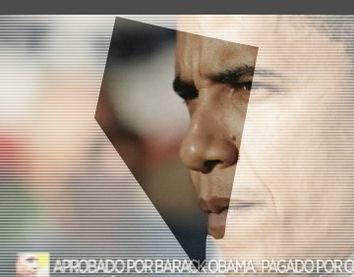
Barack Obama’s campaign headquarters in Reno sits in the heart of a bustling neighborhood of Latino clothing stores, taco stands and tax advisors. On a late September day outside of the King Ranch market, across the street from the campaign office, Latino voters spoke in Spanish about their hopes and concerns for the fast-approaching presidential election. Hermilla Sanvicente, 37, who works in real estate and also owns a hot dog stand, said that until this year, she had been uninvolved in politics. “But this time, between friends, we’ve been talking about it,” she said. “It’s very different.” She will cast the first vote of her life for Obama.

Bill Clinton is the only Democrat to win Nevada in a presidential election in the last 40 years. But the Obama campaign believes that by turning out thousands of newly registered younger and Latino voters, many of whom have been hard hit by a sinking economy, they can capture the Silver State’s five electoral votes. Those five votes could be pivotal on a national electoral map that remains too close to call.

In 2004, George W. Bush narrowly defeated John Kerry in Nevada, receiving 50.5 percent of the vote to Kerry’s 48 percent — including a crucial 40 percent of Latino voters. Because 90 percent of Nevada’s population lives in Las Vegas’ Clark County or Reno’s Washoe County, the campaigning is concentrated in those places. The Democrats traditionally do well in Las Vegas, while the Republicans dominate in rural Nevada (where Bush won as much as 80 percent of the vote). Both sides see Reno’s Washoe County, where Bush won 51 percent of the vote in 2004, as the crucial battleground in the state.

If the national race is a dead heat to the finish, Washoe County could indeed play a decisive part. How well the campaigns reach out to Reno’s Latino voters therefore could be key: They make up roughly 20 percent of the city’s population and 12 percent of its voting population.

Interviews with more than a dozen Latino voters last week, in Reno and in rural northern Nevada, showed that Obama has some momentum, but still has his work cut out for him. Support for Obama was strong in Reno (where he’s scheduled to campaign again Tuesday), and included several first-time voters, while in rural Nevada, many Latino voters seemed apathetic about the election. Some small-business owners expressed skepticism about Obama’s tax plan, and a few seemed unsure about his level of experience.

But one central theme of the Obama campaign seems to be resonating here. “I want Obama, because the other ‘huey’ just seems like Bush refried,” said Jesus Sanchez, 40, a construction worker, using the Mexican slang for “dude” to describe McCain. In his 23 years living in Reno, Sanchez says getting work has been “worse than ever.”

As Erik Herzik, the political science chair at University of Nevada-Reno, puts it, Nevada has been “ground zero of the economic meltdown. Nevada’s economy has been turned around like we’ve never seen before.” In August, unemployment in the state hit 7.1 percent, its highest rate in 23 years, above the national average of 6.1 percent. Nevada has the nation’s highest home foreclosure rate, a position it has held for the last 20 months, with one in every 91 households receiving a foreclosure filing in August, according to RealtyTrac, a researcher and seller of foreclosed homes. Latinos have been particularly hurt by the foreclosure crisis, and are also heavily represented in the state’s beleaguered gaming and construction industries.

The Obama campaign believes that the economic pain here will trump other concerns, such as Latino Catholics’ conservative stance on abortion, or historical mistrust between the Latino and African-American communities that some speculate could work against Obama.

“Latinos have been hit hard by the struggling economy — they’re some of the hardest hit by the foreclosure crisis,” said Jeff Giertz, an Obama campaign spokesperson. “Tourism and casinos are down, where a lot of Latinos work, so they are looking for solutions on the economy.”

But the economy isn’t the only worry on their minds. Several Latino voters I spoke with expressed deep concern about immigration reform, including putting a stop to government raids that have sent fear through Latino communities with large numbers of undocumented people. Bruno Limon, 18, a supermarket cashier, said he saw Obama on a Spanish language news broadcast recently in which Obama said he was going to stop the raids. “Maybe some of us shouldn’t be here,” said Limon, who is a U.S. citizen and plans to cast his first ever vote for Obama. “But they’re treating us like criminals.”

Of the two presidential candidates, there seems to be greater confidence in Obama’s ability to work for immigration reform. In 2005, McCain co-authored a major immigration bill with Sen. Ted Kennedy, but essentially it went down in a blaze of populist revolt fueled in part by right-wing talk radio. Since then, McCain has said he would no longer vote for that bill, struggling to placate the GOP base while also trying to appeal to Latino voters. Rick Garko, a McCain spokesman, insists that the issue comes down to “McCain’s ability to reach across party lines, something Obama has no record of doing.”

Unsurprisingly, in light of the migrant worker status quo, quite a few Latinos said they couldn’t vote at all — as many as three in four people I approached over several days. One man in cowboy boots declared, “I’ll vote for Obama, so that he gives me papers,” before lifting his young son into the back of a new-looking SUV.

McCain might be able to gain support from Latino small-business owners here, some of whom are wary of Obama’s tax policies and of change in tough economic times. Small-business conservatism could also exert paternal influence on the many construction workers who take their political talking points from their boss. Jose, 46, said in blunt terms that his boss had instructed that “we shouldn’t vote for ‘el negrito’ [Obama] because the country isn’t ready for a change.” “But,” he added, smiling and scooping up his young daughter, “with Mr. Bush, the economy’s headed down.” He remains undecided about his vote.

For others, an end to the war in Iraq is a priority. Latino voters see the war as aggravating a troubled economy, and many have relatives serving overseas. Marta, 37, a homemaker, said she remains undecided, but is clear that she wants to see an end to the war. She is looking to the debates to gain insight into Obama’s plan for Iraq.

Beyond the Reno area, the Obama campaign is hoping to reach out to Latino voters in rural northern Nevada, where it’s a tougher sell. In Elko, a mining and ranching town of more than 18,000 that Obama has visited three times (twice in the primaries), Latino voters were hardly burning with electoral passion. Elia Pineda, 30, a cashier at La Unica, a Mexican restaurant, didn’t know Obama had visited the prior week, and she didn’t care; she had never voted and said she wasn’t going to this election. Jose and Eva Alegria, an elderly couple in nearby Carlin, home to the largest gold mine in North America, had given up on voting several elections back.

Creating excitement around a Democratic candidate in rural northern Nevada, where Bush won upward of 80 percent of the vote in 2004, is difficult, said Debbie Stone, a Republican and executive director of the Chamber of Commerce in Winnemucca. “Northern rural Nevada is so Republican it’s silly,” she said with a laugh. Trying to find Latino voters who would discuss their thoughts on the election was an almost impossible task in the dusty, neon casino town of more than 7,100 people.

In Reno, visits to both the McCain campaign office (where I was shooed away for not clearing my visit through the proper channels) and the Obama campaign office revealed no Latino volunteers manning the phones, although in the Obama office one volunteer could be heard pleading to another potential volunteer, that “we very much need Spanish speakers.”

On the whole, the Obama campaign says it is confident that by running on the economy in Nevada, and by registering and turning out thousands of new voters, that Latino supporters will help deliver the state. They point to thousands of newly registered Democrats since 2006, closing the advantage in registered Republicans in Washoe County from 16,500 in 2004 to 3,200 now.

The McCain campaign is skeptical on this. “Democrats love to tout voter registration numbers, but that’s putting the cart before the horse,” said McCain spokesman Gorka. “High taxes and big government doesn’t fly in the West.”

From the perspective of Herzik of University of Nevada-Reno, “If I’m a Republican looking at this bulge in Democratic registrations, I’d be real nervous.” But the Latino vote has never materialized as much as anticipated, says Herzik. “It’s always been called the sleeping giant, but it has yet to wake up. If I’m a Democrat, I’d be foolish to take this to the bank, given past performance.”

But a secret weapon for the Democrats may be the legions of Bay Area liberals who have been making weekend migrations to Reno to canvass for Obama. Although the Obama campaign was cagey about the numbers, Alise Moss, 53, a healthcare consultant from Sparks, Nev., who has hosted several groups of California volunteers at her house, claimed that on a recent weekend the campaign had 400 volunteers show up. “We love those crazy Californians,” said Moss with a laugh. “California’s navy blue, and they don’t mind coming over here and knocking on doors, and all those rejections.”

If they can help get enough new Latino voters interested, they may help paint Nevada a rare shade of blue come Nov. 4.

Continue Reading Close

What small-town America thinks of Sarah Palin

From Minnesota to Mount Rushmore, the coffee shops and bars are buzzing with talk of whether the moose-hunting mom is fit to be vice president.

  • more
    • All Share Services

What small-town America thinks of Sarah Palin

There can be no doubt that the addition of Sarah Palin to the Republican ticket dramatically altered the presidential race, inspiring a once wary conservative evangelical base to get behind John McCain, and giving new momentum to his campaign. But how is Palin playing in towns across the American heartland?

In the weeks since the Republicans held their national convention, small-town coffee shops, laundromats and bars have been buzzing with talk about the “pitbull with lipstick” and her sudden rise to national prominence. In dozens of interviews across battleground states in the Midwest and Mountain West, where I’ve been traveling the last couple of weeks, voters’ reactions to Palin were at times surprising. There were plenty of predictable responses: From Palin devotees, “She’s got the balls and the moxie,” and from across the divide, “She’s less qualified than Spiro Agnew.”

But toward the center of the continuum, where most expect this tight presidential race to be won or lost, views of Palin were more complicated. Women identified with the no-nonsense “sports mom” but were turned off by her hard-line views on abortion. Some voters found her far more exciting than either McCain or Barack Obama, but said she was wrong about gay marriage. Some said they ultimately couldn’t go for a candidate so ignorant about foreign policy. Some thought she was just plain “hot.”

Although much has been made of Palin’s appeal to social conservatives, she has also excited many socially moderate swing voters who have been turned off by Obama, but also are unimpressed with McCain. Many voters seemed to define Palin exactly as the GOP has hoped — a “mom, moose-hunter, maverick,” as depicted in her video biography played at the convention.

Clearly, the Alaska governor’s charisma and highly glossed image have made a splash. At the laundromat in Luverne, Minn., Gerald Hayman, 48, who used to work for a company that picks up and disposes of dead farm animals, but is currently unemployed, shared his opinions while folding his clothes. Hayman doesn’t like McCain’s talk of an open-ended commitment in Iraq, and fondly remembers the way “Bill Clinton brought the economy up,” so he’d been leaning toward punching the Democratic ticket. But Palin has made him rethink that choice. “She don’t mind stepping on people’s toes, and maybe Washington needs that,” Hayman said. He added, “And she’s got a pretty nice pair of legs on her.”

At the Powder River Stockman’s Club in Broadus, Mont., a town of 451 people with no less than three taxidermists, S. Samuelson, 55, a second-generation rancher, tips his cowboy hat, nods and says: “She’s hot.” Between tales of breaking horses and negotiating the sale of calves, Samuelson admitted that he was very impressed by Palin, and said he even wished that she was running for president instead of McCain, whom he doesn’t like. Exuding the “live and let live” philosophy common in Big Sky Country, he didn’t share Palin’s zeal against abortion and gay marriage — “I don’t care what they do” — but he saw Palin as “kind of a fighter, who ain’t scared to shake stuff up.” That will probably win his vote, Samuelson said.

But at Stroker’s Tavern in Huntley, Mont., John Cook, a Republican, saw it differently. “Palin is great for Alaska — I’m enamored with her,” said Cook, 58, who is a carpenter. “But being governor of Alaska, a rural state like Montana, it’s still small-town politics. It doesn’t prepare you for national politics. There are 20 cities in this country that have more people than Alaska!”

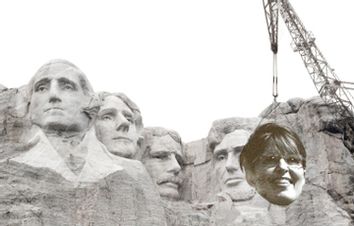
Near Keystone, S.D., the base of Mount Rushmore National Monument was an apt place to gauge the power of Palin mania. One way or the other, the November election will put a definitive crack in the white male monolith of the American presidency, as seen in the four 60-foot faces towering above. Here, Americans from all over pull up in their cars, trucks and R.V.s, and, not least because of gas prices, there was no shortage of opinions about the fraught presidential race.

“She’ll put a match under McCain’s butt!” huffed Gertrude Burke, 84, of Winslow, Mo. Her daughter Mary Burke, 62, shared her excitement, voicing common admiration of Palin as “down-to-earth, a mother, an outdoors woman … and very well educated.” At this her husband, Ken Burke, 64, piped in half-jokingly: “She has to be well educated, she’s been to five different colleges!” Although Mary Burke is pro-choice, since the introduction of Palin she said she is now leaning toward the Republican ticket.

Some former supporters of Hillary Clinton expressed excitement about Palin — but gender was secondary. To them, she seems a fresher, more maverick, more populist agent of change now than Obama (who has endured media scrutiny, including revelations and rumors about his past, for more than a year and a half). Although some don’t share Palin’s far-right positions on social issues, or weren’t fully aware of them, they were willing to overlook that.

Charles Kempf, 65, a retired maintainence worker, and Judy Kempf, 61, a retired office manager, are both lifelong Democrats from Mesquite, Nev. They said Palin’s “eloquent, intelligent and down-to-earth” way of speaking reminded them of Bill Clinton. Former Hillary Clinton supporters, they strongly dislike Obama and said they were resigned to not voting at all this year. But now they might vote Republican for the first time: “[Palin] kinda relates to us commonfolk … she’s got a family, she’s got problems,” as opposed to Obama, who “just talks above and is nothing but a script reader.” They don’t like Palin’s strong pro-life stance, Charles Kempf said, but “you’re not going to agree with everything, so you’ve got to overlook a few things.”

Norla S., 62, a hospital administrator from Mankato, Minn, also a Hillary Clinton supporter in the primaries, is currently undecided. “I was so upset that Hillary worked so hard to get there, and then Palin comes in and whoop to the top,” she said. She pondered this for a moment. “But if not [Palin], it’s just the old-boys network again.” Palin’s small-town credentials appeal to Norla, although she has questions about Palin’s experience. “But what the heck? A lot of people didn’t have experience before they got in, and she’s got a lot of good common sense.”

But other voters, though taken by Palin’s personality, appear less comfortable with her social politics, even in conservative regions such as northwestern Iowa. In the town of Le Mars — the “ice cream capital of the world” whose population of roughly 9,000 was 97 percent white as of the 2000 census — Cathy, 56, a swing voter who had backed Hillary Clinton, admitted that Sarah Palin excites her. Between sips of soup at the Bellissimo Coffee Works, Cathy spoke of how, as a small-town mom, she identifies with Palin. But Palin’s hard-line social views are a turnoff. “I really don’t care about the gay marriage issue,” she said. “I’ve known gay people all my life.”

Many younger voters expressed similar feelings about being put off by Palin. At Mount Rushmore, Republican voter Neal G., 23, currently an engineering and economics student at Ohio State University in Columbus, said he is “100 percent for gay marriage.” Taken together with Palin’s seeming “uninformed on a lot of issues,” he said that he is now reluctant to vote for his party’s ticket.

Some see the selection of Palin as a cynical move by McCain to court segments of the electorate in which his support was sagging. They think it will backfire.

“I respected him before, but Sen. McCain will do anything to get elected,” said Maureen K., 68, a university administrator from Pittsburgh. “And now with Palin, it’s like ‘American Idol’ replayed.” Her husband, Ralph, 68, a computer programmer, and a Republican, reluctantly agreed. “As much as I hate it,” he said, “I gotta vote for the Democrats.” Carl B., 35, a naval officer also from Pittsburgh, said that “people find it insulting that they would pick Palin to pick up female votes.” He said he will stick with his convictions and vote in November for libertarian candidate Bob Barr.

Palin’s view of the world beyond Alaska has not gone unnoticed. Even some of those eager to see a woman in power are unimpressed. “When she was talking about foreign policy experience and said, ‘I can see Russia from my backyard’ — Ding! Ding! — that was enough for me,” explained Pam Mueller, 64, of Grand Rapids, Mich., a former Hillary Clinton supporter. Mueller said she will stick with her party and vote for Obama. Gray Mayo, 70, from Northglenn, Colo., put it bluntly: “She should stay a sports mom. She’s no Hillary.”

With the meltdown on Wall Street and the economy weighing more than ever on the minds of Americans, how Palin fits into that picture remains murky. Jim Fitzsimmons, a swing voter from Denver, is struggling to pay the bills for his young family of five solely on his income in a retail job. But he’s skeptical as to how much a president can change the economy. He said he’s found Obama’s campaign to be long on “grandiose talk of saving the world” and short on “the x, y, z of what he’s going to do.” He and his wife, Therese, said they believe that McCain and Palin stand for reform, and they’re leaning toward voting for them. “McCain is part of that old boys network,” said Therese, “but Palin is the counterbalance.”

The economy deeply concerns Terri Christensen, 38, of Iowa, who owns a machine shop with her husband but also helps out at her parents’ restaurant, the B&L cafe, in Rock Rapids, where Rudy Giuliani, Mitt Romney and John Edwards stumped during the primary races in January. “Our small machine shop has been tortured by the economy, but it’s not important enough for the government to bail us out,” said Christensen. Although she is leaning toward the Republican ticket, the pick of Palin surprised her, as such an unknown. “I just want someone who can actually get something done,” said Christensen.

Joe Medley, 70, a retired teamster truck driver, identifies with Palin’s husband Todd’s working-class credentials as a union man and avid dog sledder. Medley has never voted Republican, but said he strongly dislikes Obama and has been excited enough by Palin to consider crossing party lines. With the economy sinking, he might have to come out of retirement, but he doesn’t believe either party can do much to bail out America right now. “The Democrats have always done more for the working man,” Medley said, “but I think we’re so far in debt, it doesn’t matter which person you put in there.”

That mood may point to the ultimate test for the Palin pick in the six weeks ahead: Can the excitement she’s generated help carry McCain through to victory, despite an economy tanking under a Republican administration? Although unfriendly stories about Palin’s past continue to bubble up in the media, none seem to be sticking much with voters. If anything, they’ve endeared her more to some, who see her as a small-town mom getting beat up by a bloodthirsty press corps. If she can run the media gantlet relatively unscathed — and if Obama and the Democrats fail to persuade voters they can turn the economy around — Sarah Palin may make history not only as America’s first female vice president, but as an unlikely and unusually influential candidate.

Continue Reading Close

What small-town America is saying about Obama

In diners and mobile homes from New Mexico to North Carolina, I listened to working-class people try to make sense of a black president named Barack.

  • more
    • All Share Services

What small-town America is saying about Obama

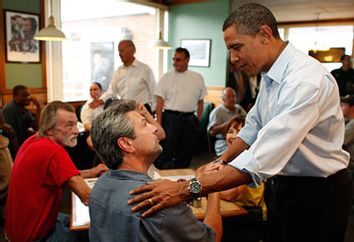
With less than two months until voting day, there are doubts hanging over Barack Obama’s campaign — and they aren’t just due to Alaska’s top moose-hunting hockey mom jolting the race and electrifying the Republican faithful. Although Obama has touted himself as a post-racial candidate, whether America is ready to elect a black man for president remains a vexing question for his supporters. In a tight national race, Obama continues struggling to gain wider support, particularly among white working-class voters and independents in battleground states.

But Obama has also inspired tens of millions of Americans with a powerful and historic campaign. After eight years of Bush and widespread disillusionment with Republican governance, could Obama’s inability to pull away from John McCain really come down to his skin color?

For three months during this summer and early fall, I’ve been traveling across America, exploring the nation’s small towns and rural areas and meeting the people there. From Michigan to New Mexico to North Carolina, I’ve conducted dozens of interviews with white working-class voters across 18 states, gauging, among other things, their thoughts and feelings about the first black man to have a serious shot at winning the White House. Beyond Obama’s race, what I found was a more complicated set of concerns — whether accurately informed or not — about his religious faith, values and cultural and educational background. That is, many of these white rural voters expressed a discomfort that may have more to do with unfamiliarity about the type of person Barack Obama is, rather than with direct concerns about his race.

Although I encountered a scattering of openly racist views, they were among a small minority. (These voters would probably never vote for a Democrat for president anyway.) Many voters dismissed the notion that hesitancy about Obama is due to his race.

“Obama isn’t even really black — Bill Clinton is more black than Obama,” said Mike Wallace, 44, of Dearborn, Mich. Wallace is a United Auto Workers pipe fitter who plans to vote for McCain, although he believes the vast majority of his co-workers at the local Chrysler plant will vote for Obama, as recommended by a UAW handout. Some voters revealed support for Obama even in blunt terms that seemed to run against their racial preferences. “I’m not a fan of the blacks,” explained Dennis Rodriguez, 48, a restaurant manager from Manistique, Mich., “but I just think Obama is the right man for the job.” Bob Morin, 53, a custodian and swing voter from Cubero, N.M. (a state Bush won by just 5,000 votes in 2004), told me, “I’ve got a few friends who say, ‘There’s no way I’m voting for a black guy,’ but I think most people have gotten over it.”

So why hasn’t Obama gained better traction outside the big cities?

“He’s just not someone I can personally relate to,” explained Cathy Massingale, 33, of Cullowhee, N.C., a Democrat who first supported John Edwards this election, and then Hillary Clinton. “Obama just doesn’t feel like someone who knows me.” Massingale’s husband is in the military, and she wants to see a withdrawal of U.S. troops from Iraq. But she said she remains undecided about Obama or McCain.

It may be that hesitancy about Obama stems from his being a type of black person that rural Americans are unfamiliar with. White rural Americans tend to identify two types of black Americans. They know local, churchgoing black people who like to hunt and fish, whose lives are similar to their own. On the other hand, they tend to think of urban blacks as a stereotype seen widely in pop culture (bling-wearing gangstas) or as the kind of black people they see on local TV news (often criminal suspects or convicts). Obama fits neither of these tropes, as a highly educated, upper-middle-class, self-made urban black man. (One with lighter skin and of mixed race, to boot.) He’s not foreign because he’s black, he’s foreign because he’s unknown — especially as someone seeking a job held exclusively by white men for more than two centuries.

“Obama’s like Jesse Jackson — what does he know except a bunch of cities with lots of blacks?” asked 60-year-old construction worker Louie, in White Branch, Mich., a lifelong Democrat who said he probably won’t vote for either candidate this year.

In the quaint and tidy town of Yellville, Ark., Cassie Gilley, 48, a soft-spoken school administrator, explained her view of white, rural America’s evolving relationship to race. “There’s a difference between racist and prejudiced,” she said over sandwiches at Subway, after a service at Yellville’s First Baptist Church. “A lot of people around here just haven’t spent much time with black people. When they get to know a black person, it’s OK. But they will bring their prejudice in at first.”

In overcoming that formidable hurdle, the many lingering rumors, myths and paranoid fears that dog Obama’s campaign make the task especially challenging.

Just outside of Cranks, Ky., in Harlan County, Mack Middleton is a retired coal miner and a die-hard union man — a United Mine Workers bumper sticker adorns his Dodge van — but he is also a swing voter who voted both for Ronald Reagan and Bill Clinton. This year, Middleton, 62, and his wife, Janice, 57, aren’t sure if they are going to vote at all.

“Obama, he’s not our kind of people,” said Middleton in a gruff, bitten-off speaking style, taking a break from canning green beans at the couple’s double-wide mobile home. “He don’t believe in the hereafter, and the Lord, the way I look at it … he’s Muslim.”

Several people, from Michigan to Alabama, referred to an insidious picture circulating on the Internet of Obama wearing a white head-wrap and a robe next to a photo of Osama bin Laden in similar dress, with the caption, “What’s the difference between Osama and Obama? Just a little B.S.” According to a survey in July by the Pew Research Center, 12 percent of Americans still believed Obama was a Muslim — even after the long Democratic primary battle that was covered heavily in the national media. Among rural Americans, 19 percent still believed he was a Muslim.

In Logan, W.Va., abandoned brick storefronts haunt downtown while the Fountain Plaza mall, anchored by a Wal-Mart Supercenter, gleams on the hill above town. Logan County was one of a few counties that voted for John Kerry in 2004 (George W. Bush won West Virginia overall), and, given a struggling economy, would seem primed to swing Democratic again. But Scott, 26, a former trucker currently unemployed, isn’t going to vote for Obama. “I know it sounds stupid,” he says taking a long drag from his Maverick cigarette, “but Barack Hussein Obama? And if he gets in, somebody’ll take him out real quick,” he said, referring to potential assassination, which was a surprisingly common theme along rural back roads.

The seemingly endless list of falsehoods about Obama — that he took his oath of office on the Quran, that he doesn’t salute the flag, that he refuses to wear an American flag lapel pin — could be interpreted as excuses for being uncomfortable with his race.

But class matters too, in regions like Appalachia, where Obama had a particularly tough time winning votes in the Democratic primary against Hillary Clinton.

Inez, Ky., is a town that epitomizes the Democratic Party’s decline from its peak of power in the 1960s. President Lyndon Johnson once stood on a porch in the impoverished town in the heart of Appalachia and declared a War on Poverty. Today in Inez, population 600, consumption of pain pills is a popular pastime, and the poverty rate hovers around 37 percent, three times the national average. In April of this year John McCain gave a speech in Inez, detailing the failures of welfare, to a receptive audience. In 2004, Martin County, of which Inez is the seat, voted for George W. Bush by a 2-to-1 ratio. The chairman of the Republican National Committee, Robert Duncan, lives in Inez.

Gary Ball, a former coal miner and editor of the firebrand Mountain Citizen newspaper that is published in Inez, points to an authenticity gap for Obama. “People around here see Obama as being privileged,” he said. Never mind McCain — with his seven houses — or recent blue blood candidates George W. Bush, John Kerry and Al Gore. “We know Obama’s plenty book-smart … but I liked Harry Truman, the last president to have a simple high school education.”

While George W. Bush received the same Harvard benediction as Obama, Bush never identified as an intellectual. Obama’s modest, single-mom upbringing does not overcome his evident intellectualism, according to Ball; for rural whites, he says, Obama remains on the losing end of this authenticity test.

Sarah Palin’s biography, of course, raises the stakes. Touting her moose-hunting, snowmobile-riding, small-town sensibility, Palin turned a convention of restless delegates into an explosion of camp revival energy, shifting the momentum of the race John McCain’s way. It is obvious that rural, working-class whites are more comfortable with the conservative small-town Palin, to whom they can relate.

Beyond the necessity of connecting with rural America, the Obama campaign is hoping to gain ground by winning over suburban independents in battleground states. In Columbus, Ohio, I encountered several white, upper-middle-class swing voters who said they would support Obama. But Terry Daniels, 53, a black man who runs a clothing store in downtown Columbus catering to the city’s suburbanites, was skeptical that would happen. “Everyone likes to think they’re progressive,” Daniels said, “but when it comes down to it, they’re not going to vote that way.”

Even though the economy purports to be a top issue for voters, the 2008 race has been as much of a contest of personalities as any in recent memory. (Even before Palin entered the picture.) Obama’s fate in November may in part depend on his ability to better familiarize the more insular segments of white America with an under-reported but growing post-civil rights demographic: the well-educated black urban middle class. Obama’s story is a historic example of this achievement, but it remains to be seen if America is ready to celebrate it by granting him the nation’s highest office.

Continue Reading Close

The fine art of battling oil addiction

Why I hope the president of Nigeria will make good on his plans to attend my show on oil politics.

  • more
    • All Share Services

The fine art of battling oil addiction

I performed my solo show “Tings Dey Happen,” about oil politics in Nigeria, more than 200 times in 2007, more than 100 times each at the Marsh theater in San Francisco and at the off-Broadway Culture Project in New York. I found no cure for the insecurities that came with observing reactions to the show’s politics — were those “hmms” of deep thought from the audience after that last scene, or just jaded “hmpfs”? — until one Saturday night last October in New York, when 60 Nigerians came to the show.

“Tings Dey Happen” is based on a year I spent in Nigeria as a Fulbright scholar in 2005 and 2006. I play more than a dozen Nigerian characters, including militants, ganja sellers and prostitutes, as well as a handful of Westerners, to tell the story of life on the volatile West African oil frontier. I knew when I set off for Nigeria in March 2005 that the show’s subject matter would be relevant for the foreseeable future, but I couldn’t have predicted how regularly it would become tied to front-page news. American oil consumption has become a political gusher, ever since President Bush acknowledged America’s “addiction to oil.” For the first time, we are in a presidential campaign in which no candidate can afford to ignore the dangers of global warming. The price of oil has hit record highs in March. And while the Iraq war and surrounding regional chaos remain daunting, Africa is increasingly at the heart of our oil problems, too. Nigeria alone now supplies 10 percent of America’s imported oil, and sub-Saharan Africa provides as much of our imported oil (20 percent) as the Middle East.

While I built “Tings Dey Happen” for Western audiences, I strove to make the characters as authentic as possible, even letting a portion of one scene play out in pidgin English, Nigeria’s lyrical lingua franca. In seeing a depiction of everyday people living in one perilous corner of the global oil economy, I hope audiences will abandon their political preconceptions and lose themselves in the drama of the Niger Delta.

For American theatergoers, the show is an immersion in a foreign reality. For Nigerians, it’s a trip home. On that Saturday night in October with the big Nigerian contingent, the house rocked with the energy of a poetry slam. Many times I had to add long pauses as clapping and laughter throttled the theater. There was none of the more common quiet shifting, no cautious unwrapping of candies or questioning “hmms.” I could launch into scenes with maximum gusto, confident my large Nigerian audience was tracking every cultural reference, phrase and mannerism. I wasn’t even bothered when they took cellphone calls during the show.

All of which made the matinee the following Sunday completely baffling. A group of 10 Nigerians sat in the front row this time — completely silent and serious. Stone-faced. That iced the rest of the crowd too. When Nigerians laugh and clap, it gives Americans in the audience permission to enjoy a white man’s depiction of black Africa. But this group of Nigerians did the opposite. Why had my all-star audience betrayed me?

At curtain call, the Nigerian man who had kept the grimmest visage during the show clapped a few times and then called out, “You done try-o! Well done.” To say someone “tried” is in fact a compliment in Nigeria — to continue trying in a country of decimated infrastructure and massive corruption is viewed as a success. After what I’d experienced in Nigeria, I wanted to shout back: “But you, you never try at all!” Instead I smiled and said, “Thank you.”

After the show, the group of Nigerians greeted me in the lobby. They all congratulated me heartily. Some of them had come for a second time. I shot back in pidgin, “Ah ah, wetin dey worry you? You no be Nigerian-o! To God, so serious!” (Translation: If you liked it, and you are Nigerian, you would have shown your appreciation. What happened?)

Well, they explained, the stone-faced man who was in the front row, he is the secretary to the president of Nigeria. And he very much liked the show. In fact, he would like to bring you to Nigeria to perform it there, they said, even do a “command performance.” I repeated the phrase, “command performance,” in an accent of Nigerian officialdom, giggling at the reminder of Nigeria’s bureaucratic pageantry.

“Yes now,” said a man in a black suit who had sat next to His Excellency, “but do you know what a ‘command performance’ is?”

I shook my head. My cultural knowledge had reached its limits.

“He’d like you to perform for the president of Nigeria, in his presidential villa.”

A goal of mine in creating the show has always been to spark conversation and debate toward social and policy change. My audiences have included large groups of U.S. State Department officials, Chevron employees, anti-Chevron activists, United Nations members, Human Rights Watch directors and oil analysts from Deutsche Bank. But I had yet to perform for the group that has the most impact on the lives of Nigerians — that nation’s political class. Now I was being asked to perform my show for the biggest man of Nigeria, head of Africa’s most populous country.

Over the next several months, a three-city Nigerian tour was planned, including a performance for the honorable president of the Federal Republic of Nigeria, Umaru Musa Yar’Adua. Deep into negotiations, a government staffer asked for a script or DVD of the performance that could be reviewed by senior government officials. My agent forwarded the script. We waited. In January, the news came: Because of heightened security in the oil-rich Niger Delta, and given the political sensitivity of the play’s content, the tour would have to be suspended, indefinitely.

I won’t lie; I felt some sense of relief about not returning to Nigeria after all. I’m still haunted by certain memories — of my Nigerian friends’ overwhelming expectations of marvelous presents, of malaria, of the incessant need to locate more bottled water. But I also dreamed of performing in the rugged villages where I had stayed, for the very people I play in the show. I dreamed of discussing Niger Delta politics with the president after performing at his villa, and asking him if there was anything he could do to rebuild the health clinics in the Ijaw village of Nembe Creek and the Itsekiri villages in the Escravos area.

Nembe Creek and Escravos are the two villages in the Niger Delta where I stayed several times, and their stories make up the bulk of “Tings Dey Happen.” The people are bitter and underserved, as are most people of the Niger Delta. They are angry that the huge oil wealth that is taken daily from their area has not translated into a significant rise in living standards. And they have learned that appealing to their local, state and federal governments is futile. So they turn militant and threaten and attack oil company infrastructure and oil workers in hopes of getting hush money in the form of work contracts. In the past decade, the Niger Delta has become a violent swamp as well as a poor one.

Reversing the cycle of bitterness and violence in the Niger Delta is one of the great challenges facing Nigeria, and it will take at least a generation’s rigor, intelligence and perseverance. I would be deeply honored if I could contribute to this effort by performing my play in Nigeria as a way of sparking a meaningful dialogue between the government and its citizens.

So, Your Excellency, what do you say? I brought the show to the movers and shakers of New York, and now back again to my home in San Francisco. But perhaps home for “Tings Dey Happen” is Nigeria. Perhaps you can send another envoy to San Francisco, and he can revive the negotiations? Your young presidency has signaled an openness to explore new solutions to the entrenched Niger Delta crisis, and perhaps my play could provide a fresh, albeit unusual, perspective. If you invite me back to perform for you and your fellow Nigerians, I promise I will give the performance of my life, even if you don’t laugh once.

Continue Reading Close