Dan Payne

Dukakis-Bush deja vu

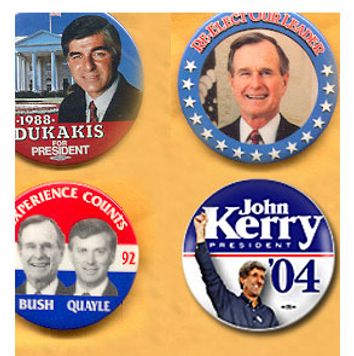
Recalling the presidential race of 1988, the Bush campaign is attacking John Kerry as soft on defense and out of touch with ordinary Americans. And once again, the media are only too happy to join in.

  • more
    • All Share Services

Dukakis-Bush deja vu

Last week, as the Bush campaign and the news media continued to question John Kerry’s heroism during and after the Vietnam War, I detected the beat of what I call the Bush family’s Texas two-step: “Wimp” your opponent, then “weird” him. Make him look soft on defense, then show him to be out of touch with the lives of ordinary Americans.

When I discussed this with a friend from Bush War I, the one against Michael Dukakis (I made TV spots for Dukakis during the presidential primaries), we were struck by the banality of the Bushes’ strategy. In 1988, opposing Dukakis, they ran against a Massachusetts liberal. In 2004, opposing Kerry, they’re again trying to run against a Massachusetts liberal.

Note the shorthand: “The senator from Massachusetts has given us ample grounds to doubt the judgment and the attitude he brings to bear on vital issues of national security,” Vice President Cheney charged in a political diatribe delivered at Westminster College in Missouri — one that offended the college president so deeply he immediately invited Kerry to speak in response.

Just as Kerry began national TV advertising focusing on his combat service, the Bush attack Hummer swung into action. With guidance from an anti-John McCain, pro-Bush publicist, a group of veterans fragged Kerry in an attempt to dishonor his exemplary military duty. As Joe Conason wrote in Salon last week, one of the Kerry-hating veterans, Texas lawyer John O’Neill, “has been assailing Kerry since 1971, when the former Navy officer was selected for the role by Charles Colson, President Nixon’s dirty-tricks aide.”

“I do not believe John Kerry is fit to be commander in chief,” retired Rear Adm. Roy Hoffmann said May 4 at a news conference. Hoffmann first gained notoriety in Vietnam as a Robert Duvall-type character (the cowboy commander in “Apocalypse Now” who loved the smell of napalm in the morning), a strutting, cigar-chewing Navy captain obsessed with body counts.

Sadly, such attacks are nothing new to Democrats running for president. Republicans have been painting Democrats as dangerously soft on defense since Nixon massacred George McGovern (an honest-to-goodness World War II hero bomber pilot) in 1972. The modest McGovern chose not to discuss his heroism during that campaign; in the Midwest, such a declaration would have been considered boastful. Besides, he was the antiwar candidate. That year, Massachusetts became enshrined as America’s most liberal state when it was the only state in the union to choose McGovern over Nixon. At the same time, in the same state, an antiwar Vietnam veteran lost a race for Congress. His name: John Kerry.

In 1988, Dukakis captured the Democratic presidential nomination in a manner not unlike Kerry did in 2004 — by winning a war of attrition. Flush with money, Dukakis was the last man standing: First Gary Hart, then Bruce Babbitt, then Paul Simon, then Richard Gephardt, then Al Gore and finally Jesse Jackson all folded their hands. Those of us in the Dukakis message camp quickly grasped what is known in advertising as your USP, or unique selling proposition. What can you say that both is compelling and no one else can say? I concluded it was that Dukakis was the only CEO in the field, the only governor, the only candidate who had balanced budgets, raised and lowered taxes, put police on the streets to fight crime, and reformed a cruel and dysfunctional welfare program. Undeveloped, however, this USP contained a fatal flaw. The weakness became apparent when Dukakis appeared in an early televised debate against conservative windbag William F. Buckley. But Governor, you have never had to command or raise enough funds for a military to defend America from its enemies abroad, Buckley droned snidely. The first wimp charge had been leveled.

One of the urban legends that persist about Dukakis is that he never fought back, never ran a negative TV spot. But that is not true, as I explain shortly. His distaste for first use of negative attacks grew out of the darkest day of his campaign, the day he dismissed John Sasso, his campaign manager, muse and auteur. Dukakis had painted himself into a corner when he self-righteously promised to dismiss anyone who had been involved in producing a video that showed candidate Joe Biden appropriating the life story of British politician Neil Kinnock. Without telling Dukakis, Sasso sent the tape to the New York Times, NBC News and the Des Moines Register. Biden may have been caught in a lie, but in Dukakis’ eyes, the graver sin was that Sasso denied to the press that the campaign had had anything to do with the tape.

By ditching Sasso, Dukakis planted the seeds of his own demise. Although the candidate had literally cut off the head of his campaign, Sasso’s plan would get him the nomination. But Sasso hadn’t gotten to the general election plan.

The subject of negative campaigning didn’t come up again until shortly before the delegate-rich Super Tuesday primaries, held mainly in the South. Dukakis had just lost the South Dakota primary to Gephardt, who used a last-minute TV spot to belittle Dukakis for suggesting that Midwestern farmers should do what Massachusetts farmers had done — diversify and grow Belgian endive. Distorted and simplistic, the endive spot nevertheless cost Dukakis the state.

Unbeknown to Dukakis, I had produced a TV commercial about Gephardt in case we needed it. The spot showed an acrobat, with his hair sprayed red, in a business suit doing somersaults and cartwheels, backward and forward, as an announcer described the flip-flops in Gephardt’s record in the House. One week before Super Tuesday, I flew to Miami to show Dukakis the spot. His best friend and campaign chairman, Paul Brountas, was there, along with a few Florida politicians. After viewing the spot, Dukakis grimaced, shrugged and threw up his hands. “I don’t know, guys, what do you think?” They said it was clever, memorable and, most important, necessary. Dukakis ultimately relented, and the ad ran only two days. Gephardt lost every Super Tuesday primary but his home state and quit the race a few weeks later.

By the time Dukakis traveled to Atlanta to accept his party’s nomination, I, seen as a holdover from the Sasso team, had been replaced by a new creative group hired by Susan Estrich, Dukakis’ new campaign manager. So I was surprised when Estrich asked me if I would produce a biographical video for the convention. Academy Award-winning actress Olympia Dukakis, the candidate’s first cousin, had volunteered to help. We decided she should play guide in a short film that would show her cousin’s roots in a house in Brookline, a Boston suburb where John F. Kennedy was born. The first time we scouted the location, I told the director, “This is perfect. It [looks like] Ward and June Cleaver’s house” in the TV show “Leave It to Beaver.”

My enthusiasm flowed from what the house said about Dukakis as a quintessential suburban kid with a normal, post-World War II upbringing. The idea was to show that Dukakis was a fully assimilated second-generation American. He had married his childhood sweetheart, took the subway to work, followed Boston sports, and was tight with a buck. The contrast with the privileged upbringing of George H.W. Bush, himself a native New Englander, was irresistible. But Dukakis would have none of what he called “that class-war stuff.” Perhaps it was because he thought of himself as fortunate; his father had been a doctor, his mother a teacher, and they had expected much of him.

In Massachusetts, Dukakis’ toughest campaigns had been against Democrats — conservative Irish Democrats; big, brawling Roman Catholic men who subscribed to old-style relationship politics; men who held ideals about helping the poor but who saw nothing wrong with helping some of their friends along the way. By the time Dukakis got to general elections against Republicans, the competition was so light he could start picking a cabinet and writing legislation. Kerry’s path as a politician has been considerably harder; as a senator, he has had to beat formidable Democrats and Republicans, the toughest being the wily and popular former GOP governor of Massachusetts, Bill Weld.

What’s more, at the Statehouse, Dukakis had won and lost a governorship as a reformer. He was about process, not outcomes; if the process was honest and fair, the results would take care of themselves. By extension, the campaign for president, Dukakis famously preached, was about competence, not ideology. Right after winning the nomination at the 1988 convention, Dukakis took off for a three-week sabbatical in the Berkshires. While there he decided he needed a new management team, new media producers, a new (and utterly implausible) plan to do door-to-door canvassing in California, but nothing new on message. Nothing.

Meanwhile, on the other side, the Bush team of Lee Atwater, Roger Ailes, James Baker and Peggy Noonan had no choice but to use the wimp-and-weird strategy against their opponent. A poll released right after the Democratic convention showed they were trailing by 14 points. Thus began the Republican version of Charles Manson’s “helter-skelter.” The GOP threw everything at Dukakis. They attacked him for mental problems (John McCain, are you listening?); his veto of a Massachusetts bill requiring public but not private school teachers to recite the Pledge of Allegiance; his “lax” furlough program; his membership in the ACLU; the filthy Boston Harbor (supposed proof that the “Massachusetts miracle” was a scam); and his refusal to support the death penalty, even for CNN’s Bernard Shaw, who posed a difficult question about the issue in a presidential debate. This was carefully designed helter-skelter — there was no pattern, but the bottom line was, this guy is not like the rest of us.

The best example of how helter-skelter works is detailed in Sidney Blumenthal’s “Pledging Allegiance” (1990). One of the most stubbornly stable people I have ever met, Dukakis was accused in a flier produced by followers of the loony Lyndon LaRouche of having a history of mental problems. Soon the archconservative Washington Times picked up the charge. Then the longtime anti-Dukakis Boston Herald tabloid trashed him for refusing to discuss it. Then the even more conservative Detroit News sent Dukakis a nutty questionnaire about his mental health, which Dukakis refused to answer. He believed the charges were so preposterous that no one would believe them. Besides, this doctor’s son felt the question itself was an unethical breach of patient confidentiality, even if there was nothing to report.

Dukakis finally agreed to release his entire medical file. But the damage had been done. President Reagan was asked at a White House press conference by a LaRouche-nik for his thoughts on the reports about Dukakis’ mental health. “Look, I don’t want to pick on an invalid,” Reagan replied. From a LaRouche flier to a presidential press conference, all in a few weeks, it was helter-skelter on speed.

Republicans also attacked Dukakis for allowing a weekend furlough for a convicted black felon, Willie Horton, who had attacked and raped a white woman — under a program begun by Dukakis’ Republican predecessor. “When we’re through, people are going to think that Willie Horton is Michael Dukakis’ nephew,” said political consultant Floyd Brown of Americans for Bush. By making the spot, Brown’s group allowed Bush and Ailes to deny that they had hatched it. (Brown’s group would later pump up the Whitewater pseudo-scandal against the Clintons, once again sucking in the press corps.)

One of the strangest ironies of the 1988 campaign involved Bush’s revolving-door furlough TV spot, a brutally effective black-and-white commercial that showed criminals — with swarthy complexions — moving in and out of jail through a turnstile. One of the creators of that spot was himself on furlough for vehicular homicide he had committed while driving drunk. News of this hypocrisy reached me only days before the general election, too late for Dukakis’ team to do anything with it. Why remind people of the whole Horton furlough thing? Besides, the lights were flashing “Game Over.”

Returning to 2004, Kerry, a former assistant district attorney with mob convictions on his résumé, and good relations with prosecutors and police chiefs, is tough to attack on crime. He also aggressively investigated U.S. officials’ actions in the Iran-Contra arms scandal, exposed the CIA’s secret deals with brutal Panamanian dictator Manuel Noriega, and uncovered a crooked international bank with ties to longtime Washington fixer Clark Clifford. Nevertheless, without primaries to provide introductions and context, Kerry has been fast-forwarded into a pre-election situation in which he is widely familiar but not well known — making him, by the Bush campaign’s lights, the perfect target for turning into a liberal wimp.

As mentioned earlier, the Bush camp decided to preempt Kerry’s claim to wartime heroism by rolling out a bogus, ad hoc group of anti-Kerry veterans, and now both sides are running multimillion-dollar advertising campaigns on Kerry’s military service and voting record. Kerry and many of his people believe that, unlike other Democrats, he should be able to repel the classic Bush and GOP soft-on-defense attacks because of his combat valor. He won’t easily be turned into a wimp on defense, no matter how many ways they try to call him French. His Vietnam service is the political equivalent of the family jewels — and Kerry will protect it at all cost.

When Kerry ran for Congress 32 years ago and lost — a campaign in which I participated — he was attacked by a previously unknown Vietnam veterans group. Eventually, President Nixon’s chief political hatchet man, Colson, confessed to setting up shell veterans groups to embarrass Kerry and give local newspapers fodder for Kerry attacks. With new anti-Kerry veterans groups being formed seemingly every day, will anyone in the media besides Salon and a handful of others look into these Kerry critics and their sponsors? Not likely. It’s easier to Google the Dutch painter whose work of art Kerry sold last year.

Meanwhile, the White House continues to stonewall on President Bush’s so-called military service. All records have been made public, the White House’s boy press secretary repeats, when of course they haven’t. Releasing the details of Bush’s dental checkup was a public relations coup. We are so open, the White House boasted, we even released the president’s dental records. I would have preferred viewing the teeth of someone who’d seen Bush in the Alabama National Guard. And Bush’s losing his flying credentials because he didn’t show up for a mandatory pilot’s physical? That too is “old news.” But what Kerry did in 1971, when he was an angry 27-year-old fresh from the killing along the Mekong River — that’s still relevant.

We are at once in a new and familiar place. We stand in the ridiculously early, post-primary, pre-convention period, but we already know the principal actors, their supporting casts, their lines, their points of conflict and, thanks to polling, even their story arcs. We also know that the news media — new and old alike — are hardly neutral observers or faithful recorders of events and utterances. They are a snarling Greek chorus.

Mainstream media appear to swallow what the GOP feeds them — whole. Reporters lurked for days around a story ginned up by right-wing gossip Matt Drudge that turned out to be a phony “intern” flap. The media have failed to find out from Commerce Secretary Don Evans why Canada’s economy has been growing jobs while our economy has been losing them, according to a report by the Center for American Progress. Yet they eagerly tell us that Evans is the man who said, “Kerry looks French.” The Web site of a certain onetime drug-addled, right-wing radio talk show host carries pictures of the Kerry-Heinz homes, with captions in English and French. The homes and their prices were also featured recently in major newsweeklies.

While the most secretive vice president in history attacks Kerry’s fitness to lead America in a time of war, major media cover Roman Catholic conservatives’ questioning of Kerry’s fitness to receive Communion. Teresa Heinz’s eight cars are national news; the fact that Laura Bush killed someone while driving one car is put aside as “old news.” Meanwhile presidential brother Jeb Bush twists an admitted — and corrected — mistake by a Florida college newspaper into a statewide story that says Kerry favors expanded oil drilling off the Florida coast.

How might Kerry run the government? What kinds of issues have mattered to him as a senator? What would a Kerry budget look like? Who are the policy people he turns to for advice? “Yeah, yeah, yeah, we’ll get to that. But what about the starlets, Senator?”

If Kerry had had his way, Cheney smeared, Saddam Hussein would still be in power. Cheney, who used five draft deferments to avoid military service during the Vietnam War, dared to challenge the commitment of Kerry, a decorated Vietnam veteran who volunteered to fight in that war, saw death up close, and carries a piece of shrapnel lodged in his arm.

A Bush commercial attacks Kerry’s votes against old weapons systems that are suddenly deemed necessary to today’s war on terrorism. But as President Reagan’s secretary of defense, Cheney had called for many of the same cuts he now faults Kerry for favoring. Moreover, Cheney had urged deep cuts in troop strength of anywhere from 100,000 to 500,000 active and reserve forces.

ABC News “discovered” a tape given to it by the Bush campaign that showed Kerry saying he had thrown his military medals over a fence around the U.S. Capitol when he and thousands of other veterans protested the war they had fought. (The ABC producer for the story was Chris Vlasto, a contributor to right-wing publications, who was also a producer of much of the network’s pseudo-scandal coverage during the Clinton years.) The national news media fixed on the “gotcha” aspect, the fact that Kerry had told a news organization 33 years ago that he had thrown medals, not ribbons. Today Kerry says they were ribbons. What does this tell us about Kerry that we need to know, other than the fact that a 27-year-old veteran was filled with anger and confusion and profound regret over what his government had asked him and thousands of other American soldiers to do? Whatever he threw, the act crushed him, as a Boston Globe photo of a crumpled Kerry reveals. Not far from where he and his mates had surrendered their combat decorations, he slumped to his knees, his first wife huddled over the solitary, broken soldier.

Kerry’s campaign has been distracted by vacations, shoulder surgery and the tragic news coming out of Iraq. Challengers often forget that they have to keep introducing themselves to voters. The Kerry campaign is launching a $27 million TV advertising campaign to fill in the gaps, and to protect the family jewels.

My view, shared by some but certainly not all in the Kerry campaign, is that as long as the subject is Vietnam, Kerry is ahead of the game. In Massachusetts, his military service is considered to be the third rail of Kerry politics. Touch it at your peril. Former Massachusetts Gov. Weld, having watched others get jolted, had nothing but praise for Kerry’s military service.

We may look back at this period and see that just when Bush looked as if he was on the ropes, talented GOP handlers saved him. Bush is managed by people who know how to sell him. Texans all, they created him — from diaper changer Karen Hughes to dark lord Karl Rove to Democratic turncoat and media consultant Mark McKinnon.

Most in the Kerry campaign know what to expect from the Republican mule drivers. They know, for instance, that Democrats having their convention in Boston, while not ideal, will matter not one whit to average voters in swing states four months later. But the national news media seem poised to treat liberal Massachusetts as a major story. When gay marriages become legal in Massachusetts on May 17, and national media fan out across the state to document same-sex nuptials, the Bush administration will try to make the whole thing Kerry’s idea.

Last week, Republican Gov. Mitt Romney of Massachusetts did his part, promoting a “foolproof” death penalty plan that would use DNA and other scientific tests to encourage the imposition of a death sentence. While it is unlikely to gain legislative action, much less approval, the plan will provide the Bush-Romney team with live ammunition when the Democrats come to Boston to nominate Kerry in late July.

Whether the Texas two-step succeeds will depend in large part on the toughness and discipline of Kerry and his campaign. It will also depend on whether members of the news media use this early phase of the campaign to find better ways to cover the race, the smears and the candidates — or approach the Bushes, as they have so often done, on bended knee.

How Kerry wins

John Kerry's former media advisor recalls how the Democrat has already faced every smear the Bush campaign will try against him -- and has prevailed.

  • more
    • All Share Services

How Kerry wins

Traitor. Two-faced. Aloof. Elitist. Sixties radical. Tax-and-spend liberal. Spoiled aristocrat. These are the familiar charges leveled against Sen. John Kerry. But they weren’t invented by the Bush campaign. They’re the same charges he has had to endure as long as he has run for office in Massachusetts. And in every race but one, his first, he took on his critics and won.

While President Bush and the country were enduring an awful week of hearings about 9/11 intelligence failures, and of widespread death and chaos in Iraq, Kerry did not join the fray. Instead he delivered a curiously timed economics speech. In not capitalizing on the disasters rocking the Bush administration, Kerry was, I hope, invoking the rule that in politics one should never commit homicide on an opponent who is committing suicide. Moreover, no one should have expected the Vietnam veteran to make political hay over the death of American soldiers. Even as the bloody violence in Iraq led critics, chief among them Kerry’s Senate seat mate Ted Kennedy, to declare Iraq was becoming Bush’s Vietnam, Bush campaign strategists were trying to use Vietnam against Kerry, rehashing old allegations that the decorated veteran’s opposition to the war in which he heroically served was somehow unpatriotic, or worse.

But Kerry has endured bad weeks before, and the Vietnam smear campaign in particular isn’t likely to work. Such strategies have been tried, and have failed, in virtually every race Kerry has ever run for public office. It’s worth comparing Kerry with his fellow Massachussetts Democrat Michael Dukakis to understand why Kerry is more likely to prevail. For Kerry, unlike Dukakis, Massachusetts was a crucible that readied him for the national battle ahead. Dukakis’ toughest fights were primaries. Kerry has had to run in both difficult primaries and general elections. In every case, he seems to need to feel the shape and impact of the attacks before he acts, which frustrates supporters who panic in the heat of battle and expect Kerry to act precipitously. But as soon as Kerry judges that the charges he’s facing are similar to those he has faced before, he and those who have been with him know what to do, almost by instinct — even if they disappoint the Beltway by not responding in the next e-mail.

Kerry’s election is by no means certain, but he will not lose because he was thrown off balance by what will be hurled at him in the months ahead.

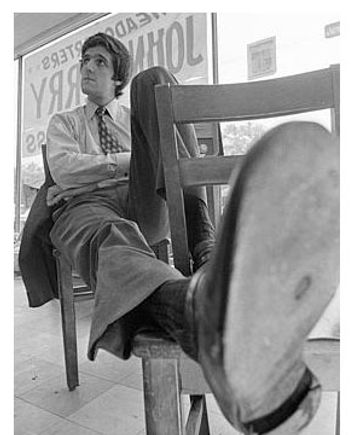
My journey with John Kerry began in 1972 in the basement of a suburban Boston house he was living in. I had been the press secretary for Robert Drinan, the first Catholic priest elected to Congress in 1970. I had dropped in to do some volunteer work in anticipation of Kerry’s run for Congress. Kerry had frozen the nation’s attention, and mine, when he testified before the Senate against a war in which he had heroically served. He had nearly derailed Drinan at a preliminary caucus staged by liberal activists to unite behind a single candidate to defeat a pro-Vietnam War incumbent. Though he and I were about the same age, Kerry seemed older. He was serious, well-read and well-traveled, knew important people, and had big things he wanted to do. In 1972, inspired by Drinan’s success and poised to capitalize on his national fame, Kerry decided to run for Congress. He briefly flirted with a central Massachusetts district occupied by an old New Deal hawk. But when an incumbent Republican quit Congress to join the Nixon administration, Kerry made his move. He and his wife Julia moved to Lowell, Mass., in the 5th District. A down-on-its-luck aging mill city on the border of New Hampshire, Lowell was a slow melting pot of second-generation Irish, French and Italian blue-collar workers. Proudly xenophobic, they had a name for newcomers: “blow-ins.” John Kerry was a celebrity, an outsider, a blow-in with no roots in their world.

Yet another blow-in, I joined the campaign in its earliest days in 1972, working on message, training staff, and briefing Hill Holliday, a brassy young Boston advertising agency that taught me about high-impact, memorable advertising. The campaign was led by Kerry’s brother-in-law David Thorne, his brother Cameron, and Tom Vallely, an ex-Marine whose father was a state judge.

During the primary, a half-dozen small-bore local politicians were pitted against Kerry’s national reputation, strong organization and financial advantages. John Marttila and Tom Kiley, fresh from directing Drinan’s successful congressional campaign, advised the campaign, as they do today. Back then, they taught Kerry workers to identify antiwar voters in the more liberal parts of the district and quietly “pull” them on primary day. The campaign used an alienation theme urged by enfant terrible Patrick Caddell, the pollster who was also guiding the disastrous George McGovern campaign for president. Accordingly, Kerry’s message was: “He’s not a politician. He listens.” Enough 5th District voters got the message, as Kerry won the seven-way primary easily with about one-third of the vote. Nevertheless, as one Kerry staffer recalled, “The overwhelming majority of Democrat voters did not support John.”

One who surely did not was Clement “Clemmie” Costello, publisher of the Lowell Sun.

Likened to the Manchester Union-Leader’s irascible conservative William Loeb, just spitting distance away, Costello launched a full-scale war against Kerry on the pages of his newspaper. Day after day the Sun carried negative stories that started on the front page, jumped to the back of the front section, and filled the entire back page with stinging sarcasm. To wit: “Between appearances on the Dick Cavett show, Kerry found time to appear with antiwar extremist Jane Fonda at a Vietnam Veterans Against the War rally in Valley Forge.” A photo of Jane Fonda ran, with a cutline that read “Fonda speaks with Kerry,” along with photos of Kerry being arrested at antiwar rallies. Anti-Kerry editorials and cartoons were so frequent they no longer shocked us.

Other full-page articles highlighted celebrities who had contributed to Kerry’s campaign, including conductor Leonard Bernstein, filmmaker Otto Preminger and author Kurt Vonnegut. Much space was given to disgruntled Vietnam veterans who did not like Kerry or his book, “The New Soldier.” Republican Paul Cronin and Independent Roger Durkin ran full-page newspaper ads attacking Kerry along similar lines. One displayed the cover of “The New Soldier” with scruffy Vietnam veterans flying an American flag upside down, making the internationally recognized sign of distress seem unpatriotic.

The irony was that John Kerry’s military service, which had propelled him onto the national stage, was being used to thwart his political career. Those of us working on his campaign were unsure of how to handle attacks on Kerry’s patriotism. We did not realize he could be painted as a traitor. He was a war hero, for chrissakes.

With no local leaders to vouch for him, his poll numbers tumbled. A comfortable 26-point lead dwindled to 10 points with two weeks to go. Durkin, the Independent, was third with 13 percent. Suddenly he quit the race and threw his support to Cronin, the Republican. The Lowell Sun and the other large daily paper in Lawrence trumpeted the move as a major rejection of Kerry’s candidacy. It was. Cronin beat Kerry by nearly nine points. The lights had seemingly been snapped off on a once bright political future. In hindsight, we had allowed the Sun’s attacks to stick. “We were kids, we didn’t know what we were doing,” Kerry told the Globe. “We got our asses handed to us.”

We now know that President Nixon and his chief hatchet man, Charles Colson, knew what they were doing and probably helped sabotage Kerry’s campaign. Colson almost certainly spoon-fed negative stories to the Lowell Sun and engineered Durkin’s dropping out of the race. Colson, who went to jail over Watergate, told Time magazine’s Joe Klein that Kerry “was a thorn in our flesh. He was very articulate, a credible leader of the opposition.” Colson admitted creating a rival veterans group to attack Kerry. John Kerry’s courage, in war and peace, had been turned against him.

In 1982, the political bug bit Kerry again. After his unsuccessful run for Congress, Kerry had told friends he was finished with electoral politics. He completed law school, took a job as a prosecutor, put a major mobster behind bars, and quickly rose to second in command in the state’s largest district attorney’s office. He left the D.A.’s office to enter private law practice, but found he was still drawn to politics. He decided to run for lieutenant governor.

Mike Dukakis was making his comeback against a tough Irish conservative Democrat and former professional football player, Ed King, who had ousted him four years earlier. It was a nasty grudge match; as a consultant to Dukakis, I had nicknamed it “The Rematch.” The Kerry forces printed two sets of campaign buttons, “King/Kerry,” and “Dukakis/Kerry.” Neither gubernatorial campaign was thrilled. In the race for lieutenant governor, the Democrat to beat was Evelyn Murphy, Dukakis’ environment chief during his first term. Kerry’s chances lay in the independent suburbs ringing Boston.

Accordingly he and his handlers decided on a daring ploy, to run as a candidate who supported a nuclear weapons freeze, tapping a hot national issue that had nothing to do with the lieutenant governor’s job and everything to do with winning suburban liberals. A knowledgeable environmentalist, Kerry campaigned on reducing acid rain. He used his record of convicting mobsters and street criminals as an ex-prosecutor to court mayors and law enforcement officials in bigger cities.

Just before the primary, he got big play in the news when he and his law partner, Roanne Sragow, sprang George Reissfelder from jail, a man who had spent 15 years of a life sentence for a murder he did not commit. If Massachusetts had had the death penalty, Reissfelder would have been executed.

Vietnam was not part of that campaign. “John didn’t want to have anything to do with Vietnam,” Cameron Kerry, John’s younger brother, told the Boston Globe. “He didn’t even want us to show a picture of him in uniform.”

The Dukakis Democrats had decided to screen out future Ed Kings by requiring that statewide candidates win at least 15 percent of the convention delegates to gain a place on the primary ballot. Kerry’s chief organizer for the convention was a cocky young Boston Irish kid named Mike Whouley. On the first ballot Murphy cleared the 15 percent hurdle easily; Kerry made it with but a handful of votes to spare. But his campaign wanted to see another woman get on the ballot to dilute Murphy’s appeal to female voters. Enough delegates switched their votes on subsequent balloting so that Murphy found herself sharing the ballot with a female state senator whose district included Murphy’s home town.

Kerry battled Murphy to a draw. Backed by $100,000 of his own money, Kerry ran a highly effective, wickedly funny TV spot that lampooned what lieutenant governors usually do. Created by media magician Ken Swope, the spot showed a mock lieutenant governor talking to a wooden duck and cutting his necktie along with a ribbon for a grand opening. Kerry edged out Murphy after an all-night primary. He carried Boston, Worcester and, curiously enough, Lowell; the Boston Globe said more than half his victory margin came from the old 5th District, which had rejected him a decade earlier. He joined the ticket with Dukakis, who had hung on to win the rematch.

Two years later, Paul Tsongas, who had beaten the first-ever African-American senator, Edward Brooke, to win his seat, announced without warning that he would leave the Senate. He had cancer. Three strong candidates emerged: Lt. Gov. John Kerry; Rep. Ed Markey, leader of the nuclear weapons freeze movement in Congress; and Rep. Jim Shannon, a protégé of Speaker Tip O’Neill. Shannon represented that same 5th District seat Kerry had lost. With O’Neill’s help, Shannon sat on the fundraising machine known as the Ways and Means Committee, which controls the federal budget.

The Boston Globe, with a new editor determined to make the paper “less predictably Democratic,” challenged the Democrats to refuse political action committee, or PAC, money. This was particularly painful for Shannon, who had the old ways and means to collect thousands of dollars in one-stop shopping for PAC money. After Markey dropped out of the race, Kerry accepted the PAC-money ban. Shannon resisted. Editorials followed. The Globe’s heavy-fingered editorial cartoonist muddied Shannon the day before a statewide liberal endorsing group was to meet. Looking at months of bad ink, Shannon cried uncle. He gave back the PAC money he had taken and forswore taking any in the future. This meant Kerry would face Shannon as he would later face Howard Dean, on equal financial footing.

At the Democrats’ nominating convention, Shannon beat Kerry for the party endorsement; Kerry used Shannon’s win as proof that Shannon was a party insider. Shannon was the preference of politically astute men at the Globe, in the state house, and in Washington. When the Globe later endorsed him, they saw few ideological differences with Kerry but chose Shannon because of his “skill and personality.”

The Kerry campaign exposed Shannon’s skill in writing a tax loophole that favored a major Massachusetts insurance company. Kerry, as he would in every campaign, pounced on his opponent’s mistake. Kerry derided the multimillion-dollar loophole as “a disgusting giveaway.” When Shannon insisted that he had done nothing wrong and would do it again, Kerry was right where he wanted to be — on the outside of politics-as-usual.

With the primary approaching, Kerry’s own polls showed Shannon moving into the lead as the candidates participated in a split-screen televised mini-debate. Kerry had been knocking Shannon for being both for and against the controversial MX missile system. Shannon tried to throw the flip-flop charge back at Kerry by questioning how he could now campaign as an antiwar candidate when he had fought in Vietnam. “If you felt that strongly about the war, you would not have gone,” Shannon, in high school during Vietnam, charged.

In the very next debate, a seething Kerry told Shannon, “You impugn the service of veterans in that war by saying they are somehow dopes or wrong for going,” he said. Shannon balked. Employing a Southernism popular in Congress to assail an argument as baseless, Shannon said, “John, you know that dog won’t hunt.”

The Doghunters were born. A band of Vietnam vets who supported Kerry heard their own service demeaned and rallied almost spontaneously.

One of the lead Doghunters was John Hurley, who had first watched Kerry nearly steal a caucus from his candidate, Drinan, 14 years before. (Hurley is now Kerry’s national vets recruiter.) Another was Tom Vallely, an ex-Marine and longtime Kerry friend who now runs the Vietnam Program at Harvard University. Chris Gregory, a Vietnam veteran leader, led former soldiers who staked out Shannon’s headquarters and shadowed him as he campaigned. In the days and years ahead, the ranks of the Doghunters would swell.

Vietnam veterans supplied the energy, an opponent gave him the opening, his field organization run again by Whouley turned out the vote, and John Kerry tightened his message. He won by three points. Had he known, Howard Dean might have seen it coming.

In the general election for the Senate, Kerry faced Republican Ray Shamie, a genial millionaire businessman with right-wing political views. Shamie had given Ted Kennedy a scare in the Senate race two years before, and in the just completed primary had stunned the remaining Brahmin Republican establishment by defeating former U.S. attorney general Elliot Richardson, a Watergate hero. Shamie was on a roll and Kerry looked as though he were sitting smack in his path.

The Kerry campaign learned that Shamie had been smitten with the ideas of the John Birch Society, an anti-Semitic, paranoid, right-wing group that was preoccupied with how communists controlled, among others, President Dwight Eisenhower. Moreover, Shamie maintained a library that displayed Birch publications for employees at his company.

Immediately after the primaries, a then-Shamie consultant recalls, “Congressional Democrats like Barney Frank and Ed Markey branded Shamie a right-wing nut. We had no Republicans in office then to respond, and the media followed the lead of the Globe, which was reporting the attacks.” Déjà vu Lowell, 1972.

Then it was “touch the third rail” time. (The third rail is the hot line on subway tracks.) The son of Gen. George Patton, who had himself been fond of the Birch Society, held his own press conference and charged that Kerry had blood on his hands for leading antiwar protests that encouraged the Viet Cong and thus caused more U.S. casualties. The Doghunters sprang into action. Vallely recruited a little-known congressman from Arizona, a Vietnam War hero named John McCain, to vouch for John Kerry’s valor in combat. I’ll never forget Vallely telling me about McCain that day in 1984. “This guy’s going to be a star,” he said.

Of all the commercials I have made for Kerry, my favorite capitalized on Shamie’s unflinching support for the Reagan arms buildup. Kerry, in sweater and jeans, walked through an old-time hardware store. The big political stories of the day catalogued a Pentagon spending spree, where it paid exorbitant prices for ordinary goods: $200 hammers, etc. In the commercial, Kerry displayed an item from the shelf and compared its retail price to what the military had paid. “The Pentagon paid $110 for this 10-cent diode.” He looked at the camera, smiled slightly, and said: “Anyone who thinks you need to spend like this to keep America safe … must have a screw loose.” The commercial won many awards, and Kerry easily won the election.

The 1990 senate race: First-term Sen. John Kerry, like Paul Tsongas before him, struggled to find a warm place in the considerable shadow of the lion of the Senate, Edward M. Kennedy. He wasn’t as liberal as Kennedy, wasn’t as powerful as Kennedy, wasn’t as much fun as Kennedy. Whatever people liked about Ted Kennedy, John Kerry wasn’t.

In his next contest, Kerry found himself pitted against the son of a wealthy, politically connected real estate developer. Jim Rappaport spent most of the primary campaign (he faced a Republican Vietnam vet) bashing Kerry falsely for having passed no laws in his first term as senator.

When Rappaport won the primary, we were waiting for him. We began with a round of positive TV spots. Rappaport stayed on the attack. Confident we had the goods on Rappaport, we struck back. We produced a series of soap-opera-style TV spots called “The Life of James Rappaport.” My favorite was called “We Buy a Cow From Ourselves,” which tells the story of one Rappaport getting a tax break for swapping ownership of a prized cow with another Rappaport. Each spot ended with footage of Jim Rappaport winking.

After the spots had been on for a week, Rappaport called for a cease-fire on negative ads. The Kerry campaign’s response: Too late, pal; the spots stay on. At the same time, newspapers all over Massachusetts were slamming Rappaport’s campaign tactics in columns and editorials. We pulled them together in one full-page newspaper ad nicknamed “Slimeball,” the word one Boston columnist had used to describe his campaign.

While Rappaport outspent him, Kerry outsmarted Rappaport at every turn. In their final debate, on a hunch or a tip, Kerry demanded to know which taxes Rappaport had been accusing him of raising. On live TV, Rappaport could not name a single one. Game over. Kerry won with 57 percent of the vote.

In 1996, Kerry faced the toughest opponent of his political life, the charming, shrewd and resourceful Bill Weld. Republicans hoped that Weld, who had won a second term as governor with 71 percent in a state where Democrats enjoy a near monopoly, would unseat Kerry using his incumbency and good relations with the press. The Kerry campaign called it the “21 press secretaries” problem. Weld could make news any day, every day.

The press liked Weld’s ironic detachment, his self-mocking, candid style. He jumped into the Charles River fully clothed to celebrate the cleanup of this once polluted waterway. When the Legislature debated a law permitting the keeping of ferrets as pets, he declared, “A ferret in the Barcalounger is a slice of heaven.” He told a radio audience that one of his daughters preferred Kerry and was working for him rather than her father.

Eager for season-long confrontations, the state’s news media formed a consortium that bullied Weld and Kerry into agreeing to debate a horse-gagging eight times, each debate sponsored by a media outlet in the consortium. In private, Kerry complained about the number of debates the entire campaign, in marked contrast to his current desire to debate Bush eight times. Weld did us the considerable favor of monotonously limiting his pitch to crime, welfare and taxes. Kerry’s argument was broader and more, uh, nuanced.

Kerry reminded voters that the affable Weld would be one more vote in the Senate to keep Jesse Helms head of the Senate Judiciary Committee. (Ironically, when President Clinton nominated Weld the following year for an ambassadorship to Mexico, Jesse Helms successfully blocked him.) Weld assisted in nationalizing his candidacy by calling Newt Gingrich, the unpopular speaker of the House, “Newtie,” and by casually saying Gingrich was his “ideological soul mate.”

Kerry and Weld agreed to a spending cap, but both violated it. Weld understated his advertising buys; Kerry put $1.7 million of his personal money into advertising. Together Kerry and Weld spent more than $20 million, the second-most spent on a Senate race in the country.

After Kerry also won a crucial endorsement from Massachusetts police unions, which undercut Weld’s crime argument, it was third-rail time. Weld wisely commended Kerry for his military service, but David Warsh, then a columnist for the Boston Globe, wondered if Kerry’s actions in Vietnam had constituted a war crime. After all, the Vietnamese sniper whom Kerry turned his boat into shore to chase had been wounded. The Doghunters knew what to do. Kerry’s boat crew and retired Adm. Elmo Zumwalt, who had given Kerry his Silver Star, gathered at Boston’s Charlestown Navy Yard to defend Kerry and recall his bravery. Kerry’s crew members said the Vietnamese sniper had stopped and turned with a grenade launcher pointed at Kerry and his crew. Somebody had to do it, they said, and Kerry was in the lead.

At one of the last debates Weld, a former U.S. attorney, was criticizing Kerry for opposing the death penalty. Weld demanded that Kerry tell the mother of a slain police officer, seated in the audience, why her son’s life was not as valuable as that of his killer, whose death Kerry opposed. (Never mind that Massachusetts didn’t have a death penalty statute.) Kerry denounced the killer and said, “I know something about killing,” in a grim reminder of his service in Vietnam. “I don’t like killing. I don’t think a state honors life by turning around and sanctioning killing.” You could feel the gender gap growing and the race slipping away from Weld. He had gone a bridge too far. Kerry beat him by nearly eight points.

Fast-forward to the fall of 2003. Kerry, the early front-runner, has fallen badly behind Howard Dean in Iowa and New Hampshire. He fires his campaign manager, reconnects with his Boston advisors, moves his campaign to Iowa, mortgages his Beacon Hill mansion for $6 million, and brings trusty Michael Whouley to Iowa to direct a strong organization built by John Norris. Once again, what turns Kerry and his campaign around emotionally are Vietnam veterans. Surrounded by the Doghunters at every stop, Kerry begins speaking more simply, more concretely, more humanely. Many of the vets are real people with real problems, and like most other senators Kerry doesn’t meet many people like them in Washington.

Hearing about Kerry’s campaign on the radio, a former crewmate of Kerry’s calls Kerry campaign headquarters. Jim Rassman, a Special Forces officer, explains how he had fallen overboard in a mine explosion while on Kerry’s swift boat in the Mekong River. Kerry, wounded in his right arm, saw him in the water taking fire. He ran to the exposed bow, reached in, grabbed Rassman, and pulled him back onboard. Now a retired police officer and registered Republican, Rassman says he just wanted to thank Kerry.

Kerry’s aides prepare a reunion in Des Moines — a moment of comradeship that only veterans of combat can understand. Kerry embraces his fellow veteran, chokes back tears, and speaks privately for a moment with a man he had not seen in nearly a quarter century. He introduces his comrade in arms, and after Rassman thanks him, Kerry says he had done nothing but pull an injured man out of a river, something “anyone would have done.”

No, they wouldn’t. That’s why we recognize the human exception known as heroism. Whatever humanity and passion John Kerry brings to public service flows from his experience as a Vietnam veteran. He believes that no one should be left behind.

Continue Reading Close