Dana Cook

The many sides of Ted Kennedy

Memories from those who loved and loathed the man

  • more
    • All Share Services

The many sides of Ted KennedyIn a Sept. 27, 2004 file photo Sen. Edward Kennedy, D-Mass, delivers his speech about the effect of the war in Iraq on America's security at George Washington University in Washington. Sen. Ted Kennedy has died after battling a brain tumor his family announced early Wednesday Aug. 26, 2009.

Most effective liberal legislator of his time.”

This assessment of the late Edward (Ted) Kennedy by one of the Massachusetts Democratic senator’s more illustrious constituents, the economist and diplomat John Kenneth Galbraith. More bouquets, and a few brickbats, from a large cast of notables which includes Lauren Bacall, Bob Geldof, Sumner Redstone, William Westmoreland and Shelley Winters and Newt Gingrich.

Ted Sorenson, JFK aide and international lawyer. “Resilient survivor”

I first met JFK’s brother Edward, then a Harvard student, in the fall of 1953, when we visited the Kennedy family home in Hyannis Port on the same weekend. We didn’t see each other much in the next few years. But I got to know him better when he played a key role in the 1960 presidential campaign, particularly in the Western states, and still better when he sought the Democratic nomination in Massachusetts for JFK’s vacated Senate seat in 1962.

…….

Jack’s death, followed by Bobby’s death less than five years later, deeply changed Ted. He matured rapidly. He knew he bore responsibility for the family name, assumed the mantle of family leadership from his brothers, and took on the job of nurturing and guiding their children, comforting their widows and supporting their causes.

…….

For one man to have survived so many tragic and traumatic blows — the assassinations of the two brothers he loved, the airplane accident that almost killed him in 1964 (after which I visited him in the hospital, finding him amazingly brave, determined and cheery), and the fatal automobile accident in which he was involved, as well as the final frustration of his presidential ambitions — and still be able to lead, laugh and offer hope to others, is testimony to Ted’s amazing resilience and capacity for survival.

from “Counselor: Life at the Edge of History,” by Ted Sorenson (HarperCollins, 2008)

Judith Campbell Exner, mistress of John F. Kennedy. “Baby brother”

… at Frank’s [Sinatra's] table in the Sands lounge … dinner in the Garden Room … I sat next to Teddy and Jack sat across from me … Teddy was such a rosy-cheeked little boy. Very good looking, full of Old Nick, a great teaser with a ready laugh, and eyes that never stopped flirting. But he had nowhere near the charm and sophistication or just plain likability of Jack. He was the baby brother walking in his older brother’s shadow. (Las Vegas, 1960)

from “My Story,” by Judith Exner (Grove Press, 1977)

Robert Novak, pundit
. “Lightweight playboy”

My first [presidential] election campaign was 1960, and the last when I would be on the road continuously from before Labor Day to election day, beginning in California to report on the contest for that state’s big bag of electoral votes … My most memorable interview during a week’s reporting there, however, contributed nothing to my story. I was told the youngest Kennedy brother, whom I had never met, had been assigned to Los Angeles as western states coordinator for Jack’s campaign. I got an appointment to meet Teddy in a newly rented office on Wilshire Boulevard, furnished with leased metal furniture and free from the clutter of a real working office … Edward M. Kennedy was then twenty-eight years old, a year younger than I. He was robust, trim, and good-looking. When I asked him about the tense battle for California, he floored me by telling me this state was not included in his domain as western coordinator. That meant he was in charge of thinly populated states with few electoral votes that [Richard] Nixon was going to win anyway. I wasn’t much interested, but asked about his states to be polite. He replied he was brand-new on the job and didn’t know anything about them. Teddy was neither charming Jack nor ferocious Bobby. He had the reputation of a playboy but also seemed a lightweight.

from “The Prince of Darkness: 50 Years Reporting in Washington,” by Robert D. Novak (Crown/Forum, 2007)

Shelley Winters, actor. “Political savvy”

… I suddenly became aware of a very young man standing next to me [at the Democratic National convention], stuttering somewhat. It was the very young Ted Kennedy. From my height of movie stardom, I looked down my nose at him. He managed to blurt out:

Miss Winters, my brother [presidential candidate John F.] would like very much for you to join him on the platform. He knows the contribution you made to the Democratic Party in New York State, and Ohio’s Democratic Party needs you too.

I smiled at the kid, and said, “Are you all born with political savvy, or do you acquire it with your mother’s milk?” (Columbus, Ohio, 1960)

from “Shelley II: The Middle of My Century,” by Shelley Winters (Simon and Schuster, 1989)

Clark Clifford, counsel to presidents. “Football player’s build”

… ten years earlier Teddy Kennedy had been asked to withdraw from Harvard College for cheating on a Spanish examination. The president [John F. Kennedy] and Bobby [Kennedy] wanted my judgment as to its effect on their brother’s possible candidacy [for the Senate, from Massachusetts] … during his freshman year at Harvard, a classmate, William A. Frate, had taken two Spanish-language examinations posing as Ted Kennedy … In my first meeting with Ted Kennedy, I listened carefully as he outlined the incident. As Ted understood fully, there were no extenuating circumstances. He knew that he and Frate had made a huge mistake. He had immediately thereafter enlisted in the Army for two years, during which he had received several commendations for superior service. He was readmitted to Harvard in the fall of 1953, and graduated in 1956 in the second quarter of his class. As I looked at his academic record, I noticed that his grades had gone up each year at Harvard … When he came to see me, I was struck by how different Ted was from his brothers. He was much bigger than Jack or Bobby, with the build of a professional football player. He was only twenty-nine, and the age difference had created a certain separation between him and his two older brothers. While they obviously loved him, they treated him very much as a kid brother. Ted had immense charm and a boyishness I found appealing. Next to him, the President and the Attorney General no longer seemed quite so young. (Washington, D.C., 1961)

from “Counsel to the President,” by Clark Clifford with Richard Holbrooke (Random House, 1991)

John Kenneth Galbraith, economist and diplomat. “Effective liberal legislator”

Edward Kennedy’s age and youthful inexperience were, at the beginning, sadly adverse circumstances. But not always. Arising early one morning in his first campaign to shake hands with the workers arriving at a Massachusetts factory, he was greeted by a man of mature years who came rolling down the line.

He said, “Teddy, m’boy, I hear you’ve never done a day’s work in your life.”

It was the candidate’s most vulnerable point; he braced himself to make a reply, but the old man didn’t wait for it: “Let me tell you somethin’, lad. You haven’t missed a thing.”

J.F.K.’s decision on his successor was better than he could ever have imagined. Edward Kennedy was elected to the Senate in 1962 and went on to become the most diversely effective liberal legislator of his time.

from “Name-Dropping: From F.D.R. On,” by John Kenneth Galbraith (Houghton Mifflin, 1999)

Henry Grunwald, editor of Time magazine. “Thirty-one and clean”

… a huge Time celebration of its fortieth anniversary … the event in May 1963 marked the height of Time’s power and self-assurance … Some researchers, writers and editors, myself included, were drafted to write background notes [on cover subjects] to help [publisher Henry] Luce and other designated toastmasters with their introductions … and to provide conversational fodder for the various table hosts. … The only member of the Kennedy clan in attendance was Senator Edward Kennedy, who had made the cover as part of a family group portrait. At thirty-one, he was slender and handsome and spoken of warmly in the background material (exuberant, patient, sensitive), with no hint of future blemishes. 

from “One Man’s America: A Journalist’s Search for the Heart of His Country,” by Henry Grunwald (Doubleday, 1997)

Oleg Cassini, couturier. “Bold skier”

The atmosphere at Sugarbush [ski area] was informal and almost collegiate. Every weekend seemed a breezy, high-society version of the Dartmouth Winter Carnival, with games and contests and practical jokes … Various Kennedys … would arrive from Boston and New York, including Senator Ted Kennedy, who was one of the boldest skiers I’ve ever seen, taking what I thought were unreasonable risks, especially when we had downhill competitions. (Warren, Vt., mid-1960s)

from “In My Own Fashion,” by Oleg Cassini (Simon and Schuster, 1987)

William Westmoreland, U.S. Army General. “Compassionate pose”

While several legislators came with preconceived ideas and left unchanged, none was as disappointing as Senator Edward Kennedy of Massachusetts, who made a five-day visit in late October 1965. I got the impression that Senator Kennedy embraced the refugee problem in Vietnam because it afforded an opportunity to be critical while achieving a pose of compassion, meanwhile avoiding specific commitment on the large issue of the war itself.

Several young, overbearing aides preceded Kennedy and by the time he arrived had located a refugee camp with probably the worst conditions to be found in the country. Although the senator’s escort officer pointed out that a new camp for those refugees was under construction a few miles down the road and would soon be occupied, Senator Kennedy insisted on holding a press conference with television cameras present in the heart of the old camp. He obviously came to Vietnam with political malice aforethought and had no inclination to observe anything that conflicted with the pose he chose to assume.

from “A Soldier Reports,” by William C. Westmoreland (Doubleday, 1976)

Bruce Hutchison, Vancouver Sun correspondent. “Knew his lines”

The third brother, Senator Edward Kennedy, received me some months after the latest murder [of Robert F. Kennedy] and again the man denied the public persona. Like Bobby, Teddy was cool, quiet, and thoughtful, but, unlike him, tall, physically impressive, plumply handsome, and immaculately dressed — a man of distinction anywhere, a man of intelligence also, and a talented actor who knew his lines, though not the plot of his private drama. (Washington, D.C., 1968)

from “The Far Side of the Street,” by Bruce Hutchison (Macmillan, 1976)

Willie Morris, magazine editor. “Another scotch and soda”

Jean [Stein] had a large apartment in one of the established buildings with their ornate front columns and opulent towers along Central Park West, and she had a “salon” there which brought people together … [The bartender] went away for a moment and I was standing near the bar alone in my shirtsleeves. Suddenly Senator Ted Kennedy came up. Mistaking me for the bartender, he said: “Another scotch and soda, please.” I was so taken aback that I mixed the drink and handed it to him. I glanced toward the corner of the chamber and saw [James] Jones laughing so hard he had to prop a hand against the wall. Later I heard the author of “From Here to Eternity” tell Ted Kennedy, “That’s not the bartender, that’s the damned editor-in-chief of Harper’s Magazine.” (New York, late 1960s)

from “New York Days,” by Willie Morris (Little Brown, 1993)

Arthur M. Schlesinger, Jr., historian and author. “Merry on drink”

A party at [Kennedy brother-in-law] Steve Smith’s … for Lauren Bacall. Ted and Joan Kennedy came in about Midnight … One way Ted Kennedy differs from Jack and Bobby: he is the only one who seems to be affected by drink. JFK, of course, drank sparingly in the years I knew him well; RFK perhaps drank a little more but never showed it. Ted becomes a little high in an entirely merry way, lurches a little, his face grows a little flushed, and he wants to sing. (New York, 1969)

from “Journals 1952-2000,” by Arthur M. Schlesinger, Jr. (The Penguin Press, 2007)

Alan King, actor, comedian and film producer. “Ombudsman”

He and I have been pals for a long time. People either love him or hate him, the way they do all the Kennedys, but even with the problems he’s faced — a lot of them self-inflicted — he’s still one of the hardest-working senators in the United States. And he may be one of the few voices left in American politics to take up the cause of the less fortunate. He’s an ombudsman; he has two offices filled with mail asking for help, and it isn’t just from his Massachusetts constituents.

Right after Chappaquiddick, I went up to visit him in Hyannisport. There was a sailboat race scheduled, the family was insisting that Teddy take part in it. “Come on, we gotta do something.” He in turn insisted that I tag along. I’d never been on a sailboat; it was like Rabbi Wise getting on a motorcycle. And there was Teddy screaming at me, “Hang over here!” “Shift your weight the other way!”

When we crossed the finish line, somebody took my picture. Teddy sent it to me. In the shot, I’m hanging off the side of the boat, and the inscription reads: “To Alan. Because of the events of the past summer, many of my friends jumped ship. I’m glad you decided to hang on.” (1969)

from “Name-Dropping: The Life and Lies of Alan King,” by Alan King with Chris Chase (Scribner, 1996)

C.L. Sulzberger, journalist. “Neither profound nor quick”

… I went out to McLean, Virginia, for a drink with Senator Edward (Teddy) Kennedy at his lovely house on a bluff over the Potomac.

Teddy took me around, first showing me the view and then displaying some mementos, including President Kennedy’s statement on the Cuban missiles as amended in his own handwriting, and also his completely re-edited (in his own handwriting) statement on Teddy’s decision to run for the senate while Jack was president. He also showed me several paintings he had done, including one of the family house in Hyannisport. They were somewhat better than Eisenhower’s. He uses the new quick-dry paints.

Teddy is a massive, handsome young man (thirty-eight), He is about six foot one and looks as if he weighs about 210 pounds. He is strongly and heavily built rather than fat, although he may well have trouble with his weight in another decade. He has broad shoulders, huge arms, and great square hands. His features are conventional, his complexion clear, and his eyes frank, open, and blue. He talks glibly but his intelligence is neither profound nor quick. (1970)

from “An Age of Mediocrity: Memoirs and Diaries 1963-1972,” by C.L. Sulzberger (Macmillan, 1973)

Rita Mae Brown, novelist and gay activist. “Smooth, well prepped”

… I stuck my head in his offices and an aide allowed me to speak to him. He was courteous, spoke forcefully about ending the [Vietnam] war, and when I asked him about job security for gay people he didn’t bat an eye. I know I had to be the first person to ask him that. This was shortly after Chappaquiddick, and people were saying Kennedy was finished in politics, but I found him smooth and well prepped. (Washington, D.C., 1970)

from “Rita Will: Memoirs of a Literary Rabble-Rouser,” by Rita Mae Brown (Bantam, 1997)

Mike Douglas, television talk show host. “Thunderous applause”

… In the entire history of “The Mike Douglas Show,” the loudest, most prolonged ovation was given to Ted Kennedy, just for walking on the stage. That was in 1971, only two years after the Chappaquiddick incident that almost ended his career and in the midst of a Republican administration that had left him in the shadows of national affairs. It didn’t matter. The audience would not stop and would not sit down.

That smile didn’t hurt, or the movie-star good looks, or that unmistakable Kennedy profile. Still, the thunderous applause surprised us both. I had wanted Ted on the show for a long time and was pleased to have finally landed him as a guest, but I was unprepared for the kind of reaction he elicited. I had been looking forward to a spirited conversation about issues, but all that changed when I heard that response. For our audience, this man was beyond issues, beyond mundane politics. He wasn’t just Ted, but the personification of every good thing the Kennedys meant to so many. (Philadelphia)

from “I’ll Be Right Back: Memories of TV’s Greatest Talk Show,” by Mike Douglas with Thomas Kelly and Michael Heaton (Simon & Schuster, 2000)

Jean Shrimpton, model. “With models”

… Teddy Kennedy’s birthday party … The guests were on three big separate tables. I found that I had been placed next to Teddy Kennedy while another model called Anne Turkel (who was once married to Richard Harris) was on his other side. Neither of us knew him and he certainly did not know us. I sat quietly and watched. Teddy Kennedy did most of the talking with Anne Turkel, who was much more his type than I.

Halfway through the evening Teddy’s wife Joan left the party. She had an alcohol problem, and as I watched her leave I thought that I, too, might have taken to the bottle if my husband on his birthday was sitting next to two strange women who had been asked merely because they looked good. I felt terribly sorry for her. Teddy Kennedy professed not to notice her departure while he chatted up Anne, but perhaps he had his problems living with the reality of being Jack Kennedy’s brother. Often fame is not much fun. (New York, early 1970s)

from “An Autobiography,” by Jean Shrimpton with Unity Hall (Ebury Press, 1990)

Sumner Redstone, media mogul (Viacom). “Liked to exchange ideas”

During the [1972 presidential] campaign Senator Ted Kennedy frequently called to compliment me on the job I was doing for [Edmund] Muskie. I just as frequently said, “Fine, Senator, but how about endorsing him? How about giving us your people to work for him?” That never quite happened.

Apparently some people had noticed my involvement in the Muskie campaign and thought I knew something about politics because a short time later I was invited to a small meeting of seven or eight business executives, at which I first met Senator Kennedy. We were all sitting around talking and everyone was lauding him when I said simply, “Look, I don’t want to disagree with everybody, but Senator, the problem is that you believe — or these people believe — that you can solve any problem by just throwing money at it. It doesn’t work that way.”

Conversation ceased, glances were exchanged. Everyone was appalled. Then Senator Kennedy said, “Sumner’s right.” He was clearly a man who relished an exchange of ideas, not one who insisted upon being agreed with. I think he appreciated that trait in each other. After that, Senator Kennedy called me regularly when he came to Boston and we developed a lasting friendship.

from “A Passion To Win,” by Sumner Redstone with Peter Knobler (Simon & Schuster, 2001)

Andy Warhol, pop artist.  “So sweet”

I went to the Loyola church for the 11:00 wedding of the Michael Kennedy kid to Vicky Gifford. … I went through the receiving line. Senator Kennedy was so sweet to me and thanked me again for doing the [campaign] posters for him. He and Joan were together at this thing. (New York, 1981)

from “Diaries,” by Andy Warhol (Warner Books, 1989)

Helen Caldicott, physician and Nuclear Freeze activist. “Humane politician”

… the [nuclear] freeze movement had several key supporters, including Ted Kennedy, who had sponsored the resolution in the Senate. He was always hospitable and rather formal: like Tip O’Neill, he addressed me as ‘Doctor.’ I found his large office poignant, the walls covered with Kennedy photos and memorabilia. I consider him to be one of America’s most humane politicians; for years he has pushed for a nationalised health care system, for decent wages, and for justice in many areas. ‘You’ve done more for this country than both your brothers combined,’ I once told him. (Washington, D.C., early 1980s)

from “A Desperate Passion: An Autobiography,” by Helen Caldicott (Norton, 1996)

Bob Geldof, rock musician and promoter. “Irish living room”

Meeting Teddy Kennedy was unsettling … [A friend] and I were shown into his office to wait for him. It was a small room in the Senate building. We were told as we waited that senior politicians tended to get larger offices. Kennedy is a senior senator, but he preferred this small one. All around Edward Kennedy’s room were snapshots which have become icons of history … Kennedy came in. He smiled and was affable, but something of the atmosphere of those photographs clung to him. It was like someone’s living room in Ireland come to life. That familiar Boston twang. He was getting jowly. The pores of his skin were large, the teeth still white, and the broken veins were visible through his florid complexion. I examined this man I already knew intimately. He cupped his forehead in his hand and rubbed his temple as he sat in his armchair. He seemed agitated. “Aah,” he said, his jaws working and his mouth moving. I ran through a quick analysis of what we were doing [with the Band Aid concert for famine relief] and what I thought needed to be done. We talked about his visit to Ethiopia. He had been there just before I had. Some of the images of his trip had set themselves in my mind as examples of how I did not want to do it. Now he seemed to be coming around to Reagan’s way of regarding the Ethiopians. “So long as they are an unfriendly government the practicalities of the situation are that things will not substantially change.” (Washington, D.C., 1984)

from “Is That It?,” by Bob Geldof with Paul Vallely (Viking, 1986)

Peggy Noonan, journalist and Reagan speechwriter. “Offloading memories”

I met with Ted Kennedy about a book he wanted to do, a memoir of the late thirties and early forties, when his brothers were young and in the navy and his father was ambassador. But he couldn’t seem to say what he wanted to say, and referred me to his friends for his memories. I met with his staff, who seemed to control the operation, and with no great respect. That’s civilization, and, as Huck said, I been there before. (Washington, 1987)

from “What I Saw at the Revolution: A Political Life in the Reagan Era,” by Peggy Noonan (Random House, 1990)

Dan Quayle, vice president (1988-1992). “Guy’s guy”

… Throughout my four years as Vice President, Ted was one of several Democratic Senators who would drop by my office to chat. He would always talk enthusiastically about his family, especially his mother. He speaks quickly, many times without completing sentences, just rushing on. He’s not an organized man — like many of us in public life — but he’s got other people around to do the organizing for him. He’s s guy’s guy, loud and fun-loving, but he also loves children and is very attentive to them. He enjoys being a Senator and the point man for the liberal agenda.

from “Standing Firm,” by Dan Quayle (HarperCollins, 1994)

Lauren Bacall, actor. “Extraordinary with friends”

While I was playing the [Woman of the Year] show in Washington, Ted Kennedy planned an evening. He bought lots of tickets for friends and people in his office, and gave a dinner at the Kennedy Center, with not only a toast to me but acknowledgment of my son Steve, who had come to visit for a couple of days. Ted also arranged for his son Ted junior to take us on a tour of the House, the Senate, the Supreme Court. He’s extraordinary with friends and their children; nothing is too much trouble for him. And there is no public figure I know of who has done more or as much fighting for the rights of the elderly, for national health care, for human rights. I am and will always be indebted to Ted Kennedy, for his friendship, his support of the arts, and his public stand on issues not always popular but essential to our country, to our conscience. (1990)

from “NOW,” by Lauren Bacall (Knopf, 1994)

Newt Gingrich, Congressman and Speaker of the House (1995-1999). “Clever tactician”

Every conservative should take a lesson from the liberals in the uses of deliberate, sustained, permanent offense. Ever since they became a majority in 1930, the liberals have learned to keep taking as much as they can get in the way of legislation every day. A model for this is Ted Kennedy. Truth to tell, I have grown to respect the way he handles the process. You may not like him or his politics, but it is hard not to take your hat off to the steady, tough-minded, straightforward way he pushes for what he wants. As soon as we Republicans became the majority in the Senate, Kennedy realized he needed allies on the Republican side and began reaching out to them. He never quits looking for new opportunities to expand the government, and he is remarkably skilled at getting Republicans to sign on to bills with him. We on our side are as yet not nearly as tenacious, as firm, as clear about our ends, nor as clever in our tactics as the good senator; and any would-be conservative legislative leader could learn a lot about permanently being on offense by studying his ability to get hit, attacked, dismissed, and smilingly keep moving forward. (Washington, D.C., early 1990s)

from “Lessons Learned the Hard Way: A Personal Report,” by Newt Gingrich (HarperCollins, 1998)

Brian Mulroney, Canadian prime minister (1984-1993). “Entertaining a Conservative”

… in November 1994, Senator Ted Kennedy and his wife, Vicki, with whom Mila and I had developed a genuine friendship, invited Mila, Caroline, Nicolas, and me to join them at the Cape Cod Kennedy family residence for a long weekend. Ted graciously insisted that Mila and I occupy the room that President Kennedy had used for most of his life … We walked for hours in the crisp November air as Ted regaled us with family anecdotes and fascinated us as he revealed the burdens and joys of belonging to America’s most celebrated family. At dinner on Saturday evening, Ted got up and delivered a touching and sincere tribute to me and my accomplishments, at which Nicolas, then nine years old, leaned over to Mila and whispered, ‘Psst, Mom! Does Senator Kennedy know Dad’s a Conservative?’

from “Memoirs: 1939-1993,” by Brian Mulroney (McClelland & Stewart, 2007)

Paul Newman, 1925-2008

Remembrances of the iconic actor from Shirley MacLaine, Kenneth Tynan, Ralph Nader, Helen Caldicott and other notable figures.

  • more
    • All Share Services

Paul Newman, 1925-2008

Joshua Logan, film director: Bit part

For the bit part, Joker [in "Picnic"], a young filling station attendant who made a one-line pass at Madge, there applied a handsome young man who had left the Yale Drama School and was selling encyclopedias to support his wife and three children. He got the part of Joker and he also became Hal’s understudy [drifter Hal Carter, played by William Holden]. His name was Paul Newman.

The understudy we chose for Madge and Mille was talented enough to play either one of them. Her name was Joanne Woodward. (1955)

From “Josh: My Up and Down, In and Out Life,” by Joshua Logan (Delacorte Press, 1976)

Rocky Graziano, boxer: Not one thing phony

Robert Wise, the director signed to do my picture, “Somebody Up There Likes Me,” spots this kid doing a terrific job on the TV show and signs him to take Dean’s place in my story [James Dean had just been killed in an automobile accident] …

The studio arranges for me to meet Paul Newman and he shows up for the meeting wearin beat up slacks and a T-shirt. We click it off right away, when he grins at me like he’s known me all my life. “Whataya say, Rock!” he says. “I read your book, and I saw you fight. It’s amazing to see you are a man of letters.”

He makes everybody laugh, and even though he kids me I could see right off there ain’t one thing phony about this guy. Maybe there was. He was too good looking. In fact, the guy is pretty. That didn’t matter because I knew they could fix up an flatten his nose for the part, an if they couldn’t I do it for them. I could see in the guy’s eyes that he was a fighter. He’s got bright blue eyes, but when you look in ‘em you see a hard look dancing around inside. Only one other guy I ever see these same eyes on an that was another friend of mine, Frank Sinatra. When their blue eyes spot a wise guy, the eyes say, “Don’t fuck with me, man!”

At that time, Newman was about twenty-nine or thirty, maybe three, four years younger than me, and his weight, around a hunnerd and sixty, was what I weighed during my best fighting days.

I find out the guy’s an all-round athlete. Tennis, skis, swims like a fish, great ballplayer. The guy not only does ‘em all, he does ‘em good, and now I’m gonna teach him how to fight in the ring. When you see this guy with his clothes on, he’s a fooler. I find out fast in the gym that Paul is a lot stronger than he looks. (1956)

From “Somebody Down Here Likes Me Too,” by Rocky Graziano with Ralph Corsel (Stein & Day, 1981)

Irv Kupcinet, columnist and broadcaster: Assaulted a police officer

Actor Paul Newman was [one] of so many whom I first came to know when they came to my town … When Newman arrived in Chicago for the opening of the picture that sprung him to stardom, “Somebody Up There Likes Me,” he made many people angry. The movie was a hit, and so was Newman’s driving. As he left the scene of an accident in Chicago, he assaulted a police officer and made some very tasteless jokes about a recent kidnapping. Paul obviously wanted to be a race car driver even then. In fairness, Newman’s energy was later channeled into more admirable avenues, as he developed into a major star. (1956)

From “Kup: A Man, an Era, a City,” by Irv Kupcinet with Paul Neimark (Bonus Books, 1988)

A. E. Hotchner, journalist, screenwriter and biographer: Assuming a pug’s persona

The tragic news reached us that [James] Dean had been crushed to death in an accident involving his souped-up sports car … Arthur [director Arthur Penn] suggested we try to perform the play ["The Battler," for television] with Newman, whom he had worked with at the Actors Studio, in the lead …

During the beginning of rehearsals Newman was totally out of sync, floundering, trying to discover something in himself while questioning if indeed it was there at all. This was the way Hemingway described the character Newman had to play: “His nose was sunken, his eyes were slits, he had queer shaped lips … the face was queerly formed and mutilated. It was like putty in color … He had only one ear. It was thickened and tight against the side of his head. Where the other ear should have been there was a stump.”

Paul went through countless disappointing rehearsals, and I felt sorry for him, because he had been talked into this part that he knew he wasn’t suited for. But, then, one morning he started to rehearse a pivotal scene at the trackside campsite, and there suddenly emerged the slurred, halting speech, the stiff-legged shuffle, the jerks and twitches of a stumblebum prizefighter. This accomplishment was not an accident. Paul had started to hang out at the YMCA in downtown Los Angeles, a run-down building that was located next to the grubby gym where the local boxers worked out. Newman had found a punch-drunk old welterweight with whom he had made friends, and now he was slowly assuming the old pug’s persona. It was a thrilling metamorphosis that can be likened to the way a sculptor works on a lump of clay, refining its contours, sharpening and defining its shape until it is transformed into the form he wants it to be. (1956)

From “Choice People: The Greats, Near-Greats, and Ingrates I Have Known,” by A. E. Hotchner (William Morrow, 1984)

John Clellon Holmes, novelist and chronicler of Beat generation: Golden glow

Newman and Joanne Woodward took the [restaurant] booth opposite ours. Frankly, they were the most stunning couple I had ever seen; there was a kind of golden glow to them that wasn’t merely Bloomingdale’s chic or cinema magic, but bespoke the natural accretive process by which character develops, a certain completeness of spirit, that made me gawk with the rest of the room at the sight of people who seemed so fortunate, so fair. They epitomized everything (money, fame, integrity, love) for which all the compacted hungers of that place longed. Nelson [Algren] exchanged a few words with them, and then left them to their quiet supper amid the hubbub. (New York, 1959)

From “Representative Men: The Biographical Essays,” by John Clellon Holmes (University of Arkansas Press, 1988)

Adam West, actor: Inspiration

I got my first film, “The Young Philadelphians,” in which Paul Newman and Barbara Rush played an ambitious lawyer and his high-society girlfriend. Though we’re contemporaries, I played Paul’s rotten stepfather in a flashback.

Paul’s work on the film was an inspiration to me. He was very intense and professional, and he was generous with whomever he was playing opposite. His commitment helped make us all look good, and I was surprised to learn from one of the costars that he wasn’t happy with the script or the film. In fact, he wasn’t happy with Warner Brothers, period. At first I was taken aback to hear that this rocket-hot star who was making prestigious films was disgruntled. Then I learned that his salary was around $25,000 a film, even when the studio loaned him out for three times that (banking the difference). Considering the success of pictures like “Somebody Up There Likes Me,” “The Long, Hot Summer,” and “Cat on a Hot Tin Roof,” I couldn’t really blame him for being upset. And just a few months after “The Young Philadelphians” opened, Paul coughed up a half-million dollars to buy out the remaining three years of his contract. It proved to be a good investment: he got nearly a quarter-million dollars for his next film, “Sweet Bird of Youth,” and never looked back.

I was still relatively happy to be getting my $250 a week, but I have to admit that Paul’s example made a big impression on me. I began to wonder how I’d do on my own. (Hollywood, 1959)

From “Back to the Batcave,” by Adam West with Jeff Rovin (Berkley Books, 1994)

Shirley MacLaine, actor: Defied all the pitfalls of Hollywood

Paul Newman (“What a Way to Go,” 1964) is a really pleasant, but reticent friend. In real life, I’ve always had the feeling he wished he were somewhere else … racing cars probably. He enjoys speed and defying gravity. I watched him drink nearly a case of beer a day, do hundreds of push-ups and sit-ups, and after a steam bath, look as lean and trim as if he had been on a fast. Paul was a method actor back then with questions like “I need to know whether my character makes love with his boots on or not.” When I suggested he probably made love to his boots, we got the scene.

Paul was one of the first actors to display political acumen and courage in his campaign for Gene McCarthy in 1972. He debated Charlton Heston on the evils of nuclear testing and won. He became a stable and well-informed voice for the moderate left of the Democratic party. I admire his social conscience, but more, I have deep respect for his graceful approach to aging, the longevity of his career, and the solidity of his marriage. He is a man who had defied all of the pitfalls of Hollywood.

From “My Lucky Stars: A Hollywood Memoir,” by Shirley MacLaine (Bantam Books, 1995)

Marsha Mason, actor: Hanging with his racing buddies

Paul and I ran into each other on an American Airlines flight from New York to L.A. I asked him what was bringing him to the West Coast. He said, “racing,” and graciously invited me out to the track. He was racing at Riverside Raceway, in Riverside, California. It was the last race that track would have. He told me how to get there and what to wear so that I could hang out in the pits. I hadn’t been that happy since I married Neil [playwright Neil Simon] …

Having the opportunity to hang out with Paul Newman and his racing team was what heaven is surely like … That first invitation from Paul led to many others …

Paul is shy, serious, funny, kind, a little distant, and a lot of fun. Being a handsome movie star there’s a big price to pay. You have to search for privacy, and then there’s the way men and women go crazy around you. (late 1960s)

From “Journey: A Personal Odyssey,” by Marsha Mason (Simon & Schuster, 2000)

Robert Stone, novelist: An obviously shy and considerate man

My London telephone rang … Paul Newman wanted to make a film of “A Hall of Mirrors” …

I was flown to Indiana, where Newman was filming a picture about the Indianapolis 500 … We hung out and talked about the possibilities: It was heady stuff. I really had not known what to expect from him. I thought his politics pretty agreeable, and I knew he could command his space. This could be misleading, I thought; he might prove to be a swaggering superbo and a hectoring know-it-all. Newman, as I met him, in his forty-fourth year, turned out to be an obviously shy and considerate man, of grace and reserve. I thought there was a lot of the Midwest about him. (1969)

From “Prime Green: Remembering the Sixties,” by Robert Stone (HarperCollins, 2007)

Tim Rice, lyricist: Almost Elvis-like stature

Paul Newman introduced himself to us on an aeroplane when we were flying from L.A. to New York. He had a cassette of [Rice's musical "Jesus Christ] Superstar” in his pocket and, as he was of almost Elvis-like stature, we were awestruck. We became pals for a while, the three-hour chat on the flight being followed by dinner in New York and eventually an invitation to spend the weekend at his house in Connecticut, which Andrew [Lloyd Webber, Rice's creative partner] bewilderingly declined. I had a marvelous time chez Newman, playing pool with him on the table that had starred in “The Hustler,” and becoming entranced with his wife, Joanne Woodward, and one of his daughters, Nell, then only around twelve, who owned and trained a falcon. I was too shy to ask Paul or Joanne if I could have a photo taken with them and, instead, my lasting souvenir of the stay are some pictures of a young girl with a mean-looking bird on her arm. Career-wise, Newman was as hot as he ever was at that time, “Butch Cassidy and the Sundance Kid” having been his most recent triumph. He was the most dominating of personalities, but not in an arrogant way, an icy armour of detachment slipping into place when on public display, replaced by a slightly intimidating warmth when with family and friends. I shall never forget Joanne Woodward bringing me a cup of tea in the morning. (1970)

From “Oh, What a Circus: The Autobiography, 1944-1978,” by Tim Rice (Hodder & Stoughton, 1999)

Michael Medved, movie critic: Knowledgeable and just slightly unhinged

Campaigning [for U.S. Senate candidate Joe Duffey] with the … star we sent around the state [Connecticut]: the irrepressible and irresistible Paul Newman, who came across as earthy, intelligent, sincerely impassioned, knowledgeable about the issues, and just slightly unhinged. The actor refused to use the stump speeches [campaign manager] Anne Wexler had asked me to write for him, insisting on “speaking from the heart” — so that those of us who accompanied him lived in almost constant fear of some disastrous comment, or an inappropriately off-color joke (he loved to tell them both in public and private), or the sort of maudlin and meandering incoherence (as he spoke of the need for peace and racial justice and government that helps the little guy) that might attract nasty comments by the press. As it turned out, we needn’t have worried: he was Paul Newman, and the youthful, mostly female, hysterically cheering throngs who flocked to his events — as well as the star-struck reporters who covered those events — longed to gaze upon his big-screen magnificence rather than to analyze his words. At one airport rally, he began as he usually did, declaring that he spoke not as a movie star but as a citizen, a taxpayer, a husband, and a father of five. When he mentioned the wife and children, a spectacularly buxom blonde in the front row released a disappointed “Awww!” Newman turned his laserlike, blue-eyed gaze directly upon her and promised, “Don’t worry, honey! I’ve still got plenty of mustard left!” (1970)

From “Right Turns: Unconventional Lessons From a Controversial Life,” by Michael Medved (Crown Forum/Random House, 2004)

Myrna Loy, actor: Who’s that lucky old lady?

When I was touring in “Don Juan in Hell,” we played a college town near New Orleans. Paul happened to be there shooting “The Drowning Pool,” so I went to see him that afternoon. I remember walking down a country road past every kid in town waiting to glimpse Paul Newman. When he saw me, he rushed over, threw his arms around me, and kissed me, eliciting a collective swoon from those kids, who were probably wondering, who’s that lucky old lady? We went off and talked until they called him back to work. (1974)

From “Being and Becoming,” by Myrna Loy with James Kotsilibas-Davis (Donald I. Fine, 1987)

Mike Medavoy, film producer and studio executive: A closet biologist

Newman was by far the most important actor UA had a deal with. He was white hot in 1974, thanks to “The Sting” … I visited Newman at his house in Connecticut to discuss his next project for UA. Personally, I had a loose connection with him — I had packaged the writer-producer side of “The Sting” — which I thought would be a good starting point for our discussion.

But there was a blizzard the day of my trip to Connecticut, so I arrived all bundled up. Larger than life, Newman greeted me at the door, shirtless, with an ice cold beer in his hand. “Have a brew,” he said. “You’ll feel better.” Of course, he said, he remembered my role in putting together “The Sting,” but after the small talk ended, the big star broke the bad news to the desperate, neophyte studio executive. Not only did he not have a film in mind, Newman told me that he was quitting acting altogether to pursue something far more important to the world as a whole. He was going to study to become a marine biologist. So after a two-year negotiation, we had a production deal with a closet biologist.

From “You’re Only As Good As Your Next One: 100 Great Films, 100 Good Films, and 100 for Which I Should Be Shot,” by Mike Medavoy with Josh Young (Pocket Books/Simon & Schuster, 2002)

Kenneth Tynan, theater critic: His politics have veered to the right

Dinner last night at Ma Maison … Spent most of evening talking to Newmans [Paul and his wife, Joanne Woodward], whom I haven’t seen for ages. Paul’s looks seem to improve with time: to call him a mature version of the Michelangelo David wouldn’t be an exaggeration. He tells me that until a few years ago he could consume up to twenty-four cans of beer per day (on the set) plus a fifth of Scotch and a few bottles of wine. Now he drinks only beer, with the odd glass of wine after dinner. His face bears no signs of a hard-drinking past: I assume that cosmetic surgery has cleared up the pouches and broken veins. His politics have veered to the right since I first knew him, twenty years ago — e.g. “I’d rather have illegal Mexican immigrants coming in to do the dirty jobs at low wages than legal ones living on welfare out of my pocket.” He expresses admiration for John Wayne. (London, 1977)

From “The Diaries of Kenneth Tynan,” edited by John Lahr (Bloomsbury, 2001)

Paul Mazursky, filmmaker: No pretense

“Tempest” was a complicated and adventurous script based on Shakespeare’s “The Tempest.” I’d had the idea of doing this film for years and had tried several forms. Every time I’d finish a film I would think about doing “The Tempest” ….

“Who do you see as Phillip?” Frank [Price] asked me. I went down a short list of names. When I got to Paul Newman, Frank stopped me. “Let’s get it to him.” A few days later I had lunch with Newman at the 20th Century Fox commissary. He was much smaller than I expected, but he was beautiful. His blue eyes went right through you. There was no pretense to the man. I told him the story of “Tempest” and gave him the script. He promised an answer within a few days. I felt that he was perfect. Not only that, his presence would make the film more commercial. Several days later Newman called me at home from his house in Connecticut. “Pablo [for some reason he called me 'Pablo'] I just don’t get it.” He told me how much he admired my films, but this was not the one for him. “I just don’t get it, Pablo.” I made no effort to dissuade him. (1980)

From “Show Me the Magic,” by Paul Mazursky (Simon & Schuster, 1999)

Helen Caldicott, physician and Nuclear Freeze advocate: So restrained

I stood before a gathering of film stars at the Playboy mansion in Hollywood … It was a meeting to promote a forthcoming edition that featured excerpts from Robert Scheer’s book “With Enough Shovels,” which described the [Reagan] administration’s ludicrous defense plans for the American public in the event of a nuclear war … For the first time I met Paul Newman, who smiled from those brilliant blue eyes, bowed, and kissed my hand.

Paul spoke first, and though he was articulate and well prepared, I was surprised to find him so restrained. It was as if he was aware that he was a film star, but when he spoke against nuclear war, he had to be an ordinary person, very serious with no hint of acting. I knew he felt passionately about the subject, but as I was to observe on later occasions, he always pulled back when he discussed it, perhaps thinking that too much emotion would lessen his credibility. (1983)

“From “A Desperate Passion: An Autobiography,” by Helen Caldicott (Norton, 1996)

Susan Mulcahy, gossip columnist: Shit-listed

Though Page Six [of the New York Post] functioned separately from the news desk, it couldn’t escape some of the internal decisions that affected all editorial departments. Like the shit list.

The shit list — containing the names of people who were Not Our Friends …

Paul Newman occupied the apex of the shit list. During the filming of “Fort Apache, the Bronx” in New York in 1980, a photo taken on the set of the movie appeared on Page Six, with this caption: “Paul Newman stares in astonishment as a ‘Fort Apache’ crew member wards off a group of Hispanic youths protesting the film.” The story involved supposedly anti-”Fort Apache” groups criticizing the film’s content.

An outraged Newman slammed the story as untrue and unfair, and, after that, never talked to the press without expressing his opinions of the Post and its owner.

In an interview with Rolling Stone in 1983, he said the film “Absence of Malice” was “a direct attack on the New York Post. Well, put it this way: I was emotionally receptive to doing a piece about sloppy journalism. I wish I could sue the Post, but it’s awfully hard to sue a garbage can.”

Newman told the magazine that he hated Rupert Murdoch almost as much as he hated nuclear warheads …

From “My Lips Are Sealed: Confessions of a Gossip Columnist,” by Susan Mulcahy (Dolphin/ Doubleday, 1988)

Ralph Nader, consumer crusader and one-time presidential candidate: Steeped in policies

There seems to be no end to Newman’s talents. At the top of his craft as an actor, he entered professional auto racing at the age when most racers complete their careers. He’s a smart and effortlessly charming figure who was so steeped in military weapon policies that one would have felt sorry for Gore or Bush had either had to debate him. A longtime advocate of international arms control, Newman for years has taken this issue to television talk shows and the like.

Paul Newman was not turning Green. He was and still is a Democrat and has endured much evasion, cowardliness and dissembling by Democratic politicians without splitting from the party. But he and his celebrated wife, Joanne Woodward, seemed to be near their limits and saw my candidacy as at least shaking up the stagnation of the Democrats and broadening the political debate on issues about which they cared deeply.

From “Crashing the Party: How to Tell the Truth and Still Run for President,” by Ralph Nader (Thomas Dunne Books/St. Martin’s Press, 2002)

Continue Reading Close

“Big in every way”

The great Italian tenor Luciano Pavarotti is remembered by Vanna White, John McEnroe, Celine Dion, Bono and others.

  • more
    • All Share Services

Beverly Sills, opera singer: “This man sings so beautifully”

In January 1972, I sang my first “I Puritani” opposite Luciano Pavarotti in Philadelphia. Luciano’s career was then just beginning to take off. The first time I stood on stage with him and heard him sing, I thought: My God, this man sings so beautifully. I never heard Caruso live, of course, but I can’t imagine being more touched by a voice than I was when Luciano sang Arturo to my Elvira.

Before the end of 1972, Luciano and I sang “Lucia” in San Francisco. I’m not exaggerating when I tell you that our engagement out there created civic pandemonium. Luciano had become a superstar in the blink of an eye, I was at the top of my game, and together we knocked San Francisco for a loop. Every night we sang, the opera company had to turn thousands of people away. The crowds outside the opera house were almost as big as those inside.

… The Pavarotti that people talk about now is such a contrast to that chubby, funny guy who used to take walks with me in San Francisco, who’d sit in my dressing room and tell jokes during performances, and who’d cook us spaghetti afterward. In the early days, when Luciano got fat, I think he was tortured by all the jokes made about his appearance. On the surface, he’s now adopted a very cheerful attitude about his weight, but it’s probably a source of great sadness to Luciano that he can’t control his appetite.

From “Beverly: An Autobiography,” by Beverly Sills with Lawrence Linderman (Bantam Books, 1987)

Jean-Pierre Rampal, flutist: “Many clams, down the hatch”

I introduced Luciano Pavarotti to Elaine’s [restaurant in New York]. My son, Jean-Jacques, and I had been to hear him give a Madison Square Garden concert … Luciano invited us backstage after the event. He said there was going to be a reception.

As usual, the greenroom filled up as Luciano was changing, and I happened to notice that what little there was of the buffet was fast disappearing. Like most artists, Luciano doesn’t eat before a concert.

“He is going to be hungry. And he is going to be angry when he sees how little food there is,” I told Jean-Jacques. “We’ve got to have a back-up plan.”

So when Luciano came into the room, I immediately pulled him aside.

“There isn’t enough food here to satisfy a Mimi!”

Moments later we were seated in the middle of Elaine’s, pondering the menu. “Vongole al forno!” cried Luciano.

The first dozen clams arrived, and Luciano wolfed them down the way you’d expect a tenor who’d performed before forty-five thousand people would.

“Vongole al forno!” he cried again.

In no time at all, Luciano had managed to consume about four dozen of the delicious little beasts. Jean-Jacques … looked on, wide-eyed. Actually, that’s only about twenty-four mouthfuls. And I must admit that four dozen clams don’t frighten me in the least, either. (Early 1970s)

From “Music, My Love: An Autobiography,” by Jean-Pierre Rampal with Deborah Wise (Random House, 1989)

John McEnroe, tennis player and commentator: “Net disaster”

1980 TV special with Luciano Pavarotti: After he heard me sing, he decided we should do our comedy bit on the tennis court instead. He tried to jump the net and fell flat on his face.

From “You Cannot Be Serious,” by John McEnroe with James Kaplan (G.P. Putnam’s, 2002)

Vanna White, game show gal: “Liver, lamb, and opera”

The things I’d dreamed about for years. Being on Johnny Carson’s “Tonight” show is right at the top of the list … I agonized for days over what I would wear, what he would say, what I would say, and on and on …

I waited in the wings for my introduction. I took a deep breath, and when I heard Johnny say my name, I walked out through the curtains, waved hello, walked toward him, and took my seat. This was really it. The only thing I remember Johnny saying to me, “I hear you don’t like three things — liver, lamb, and opera.” By the time he got to the word things, I knew exactly what was coming. This was one of those quotes I’d given to the press. But here I was sitting next to [fellow guest] Pavarotti, probably the greatest living opera singer in the world. For a moment I froze, but then Mr. Pavarotti came to my rescue by saying, “I don’t like liver or lamb, and perhaps tonight I don’t like opera either.” How sweet of him! I grabbed his hand and told him how wonderful he was, and the next day I bought some of his albums. And after listening to them, I’ve decided that I do like opera, after all. (Los Angeles, mid-1980s)

From “Vanna Speaks,” by Vanna White with Patricia Romanowski (Warner Books, 1987)

Celine Dion, pop singer: “Complimented my voice”

One day as we were doing our [voice] exercises, there was a knock at the door. Dr. [William] Gould [an ear, nose and throat specialist] entered with a very imposing-looking man. It was Luciano Pavarotti. After we were introduced, the doctor asked me to sing something for him.

“I just want Luciano to hear your voice,” he said to me.

I was terribly intimidated, but I didn’t dare refuse, so I asked him what I should sing.

“It doesn’t matter. Whatever you like,” he said.

I sang the first thing that came into my head, several verses of a song I hadn’t thought of for a long time. It was called “You Bring Me Joy.” Luciano Pavarotti complimented me, saying such things as, “You have a voice that could pierce the heart.” (New York, late 1980s)

From “My Story, My Dream,” by Celine Dion (HarperCollins, 2000)

Ronan Tynan, tenor: “Singing for the maestro”

The International Pavarotti Competition … I decided to enter … the finals in Modena [Italy] …

Luciano Pavarotti and Tito Capobianco were the jury …

After I had completed the aria, I was in a state of shock, having sung for the great maestro. He said, “Thank you, thank you. Next!” Well, I thought that was some experience, and all he said was “Thank you.” I was hoping for more, but more wasn’t coming. About an hour later I was walking behind the theatre when by chance I bumped into Signore Pavarotti himself. I said, “Hello.” He responded, “Yes, the Irishman. You have a very nice voice. Very pure, but for such a big man, the voice should be bigger.” It was now my turn to say, “Thank you,” and I did. I felt honored that he liked my voice, whatever size it was. (1995)

From “Halfway Home: My Life ’til Now,” by Ronan Tynan (Scribner, 2002)

Bono, rock musician: “Big in every way”

The annual Pavarotti and Friends concert in Modena, Italy on 12 September 1995. [Fellow U2 band member] Edge and I brought our parents along, who were big opera fans. Pavarotti picked us up from the runway of the airport in a white Mercedes. We drove fifteen miles to his house, through the gates, up a hill, round a corner, round a bend, past the house and up to a table. He got out and bellowed, “Pasta!” A beautiful woman walked out with the food and we sat down and ate. It is at the table that friendships are really made. He is an extraordinary individual, big in every way — big heart, big voice, big girth, big appetite.

From “U2 by U2″ (Bono, the Edge, Adam Clayton, Larry Mullen Jr.) with Neil McCormick (HarperCollins, undated)

Boris Becker, tennis player: “Concert in a lift”

I’ve had to fight a few weird matches — those against myself. Nightmares, sleep disturbance, jet lag, weariness after long-haul flights — who hasn’t experienced these things? … What bothered me most of all was claustrophobia … I hated feeling hemmed in.

I had to take a firm grip on myself not to lose it completely. It nearly happened once, after a concert by the three tenors Luciano Pavarotti, Plácido Domingo and José Carreras in the Munich Olympiahalle. Barbara [Feltus, Becker's wife] and I met the singers backstage after the event. We were going to a huge restaurant afterwards, where there’d be thousands of guests of honor. There were about ten of us in the stadium’s lift: the conductor, the singers, wives, girlfriends. The lift got stuck. Not for a couple of minutes, but for half an hour. Thanks to my height I had space and air. Domingo, my wife and Pavarotti all held hands, hoping it would be over soon. Then Pavarotti began to sing “Ave Maria.” I didn’t say anything. I was just thinking of my own little unimportant life, and trying to hold myself together, though the thought of what would happen if no one rescued us soon almost drove me mad. The tenors sang one song after another, and everyone hummed along. Anxious arias — what a scene that was. Then there was a jolt — the rescue. The concert in the lift was over. (Early 1990s)

From “The Player: The Autobiography,” by Boris Becker with Robert Lübenoff and Helmut Sorge (Bantam, 2004)

Terry McAuliffe, Democratic National Committee chairman: “The show went on”

Chelsea [Clinton] loved the opera and whatever she loved, the President loved. So there Clinton and I were with Chelsea and her date in the main box at the Met to hear Luciano Pavarotti in Verdi’s “Aida,” which, just my luck, runs nearly three hours. They say you know at your first opera whether you’re going to be an opera person or not and I had my answer, all right. If I had been sitting anywhere else, I would have nodded off in the first act. There in the main box with the President and Chelsea, with everyone watching, I had to avoid that at all costs …

We went backstage afterward to meet Pavarotti, but he was nursing a cold and was on doctor’s orders not to talk too long. In fact, he probably wouldn’t have performed that night if the general manager had not told him that with Bill Clinton in the audience, the show must go on. As Clinton and Pavarotti talked, all I could think about was getting back to the house in Chappaqua to play a great twenty-hand card game with changing trumps called “Oh Hell!” which Clinton had recently learned from Steven Spielberg and then taught me. (New York, 2001)

From “What a Party! My Life Among Democrats: Presidents, Candidates, Donors, Activists, Alligators, and Other Wild Animals,” by Terry McAuliffe with Steve Kettman (Thomas Dunne Books/St. Martin’s Press, 2007)

Continue Reading Close

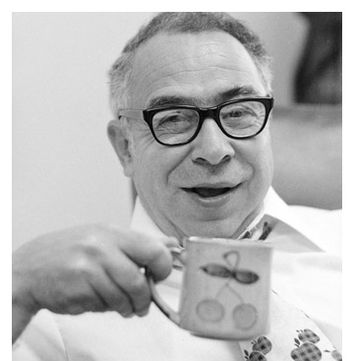
“Smooth as old satin”

Jay Leno, Della Reese, Mike Douglas, Miles Davis, Betty White and others on their impressions of Merv Griffin, the late talk show host, game show producer and mogul.

  • more
    • All Share Services

Mike Douglas, talk show host: “Brother”

The first time I heard of a young fellow named Merv Griffin, I was singing with Kay Kyser’s band. I heard a song called “Lovely Bunch of Coconuts” with Merv featured as a vocalist. He was of Irish descent, about my age, some say he even looked a bit like me, and he was singing with a big band. Like me…

I think the world of Merv Griffin. He’s about as likable as people get, his show was a class act, and I like to think we were brothers in the Exalted Order of Pioneer Daytime TV Hosts… (Chicago, early 1950s)

From “I’ll Be Right Back: Memories of TV’s Greatest Talk Show,” by Mike Douglas with Thomas Kelly and Michael Heaton (Simon & Schuster, 2000)

Charles Templeton, evangelist and broadcaster: “Expanding his opportunities”

I did the show ["Look Up and Live" on CBS] for three years. In my last season I was joined by Merv Griffin as co-host. Merv was at the time a band singer who wanted to expand his opportunities and add to his versatility. He was easy to work with, amiable, no camera hog, and quickly became a witty and skillful interviewer. My most vivid memory is of the two of us perched on high stools bantering until we broke up in laughter — neither of us able to remember the name of the guest we were supposed to introduce. (New York, 1956)

From “An Anecdotal Memoir,” by Charles Templeton (McClelland and Stewart, 1983)

Della Reese, gospel and jazz singer: “On his couch”

I had done his radio show where we formed a warm, professional bond. One of Merv’s regular bits was to do the weather report to music. So the night I was on the show he did the weather to “And That Reminds Me.” He started playing and spoofing. Fearing not, I jumped in with both feet. We had a ball making each other laugh. Merv was so smooth, starting up a song like “Tea for Two,” for instance, singing: “On Friday, in Washington, it’s true … it’s going to be forty-two.” And I would sing a quick ad lib along the lines of “Yes, and in Milwaukee… they say it will be forty-three.” The listeners loved it.

The next time I saw him was on his television show, which was broadcast from New York. That night, when my number was finished, Merv invited me to sit on the couch and talk to him. Completely unheard of at that time. In those days black artists with hit records were hired to sing on TV shows but were never invited to sit on the couch and be interviewed by the host. So that night when Merv beckoned me over to the couch and not only congratulated me on my song but also began to talk to me, I was almost incredulous. That gesture was most certainly an angel’s. He invited me back whenever I was in New York and later, when his show moved to Los Angeles, I practically became a regular. (Late 1950s)

From “Angels Along the Way: My Life With Help From Above,” by Della Reese with Franklin Lett and Mim Eichler (Berkley Boulevard Books, 1997)

Betty White, actor: “Down-to-earth mogul”

Merv Griffin first entered the game-show scene back in 1958, as host for a show called Play Your Hunch … Merv was a popular singer at the time, and Mark Goodson spotted this personable young man as good emcee material. I am sure even Mark, in his wisdom, could have had no inkling that Merv would eventually become the giant one-man conglomerate that he is today. As for Merv, the game bug must have burrowed deep in the Griffin until it ultimately surfaced in a big way with Wheel of Fortune and Jeopardy!

…I got to know Merv when he brought his nighttime talk show on the air. It was one of the more enjoyable to do, because Merv kept everyone engaged in interesting conversation, even as each new guest was introduced. I was also understandably partial to the show because he let me bring on all sorts of animals from time to time. On two occasions he invited me to host the show when he was away.

Merv Griffin has grown into a veritable mogul before our eyes. For the record, that mogul has remained the same down-to-earth, funny, warm Merv that I first met. (Early 1960s)

From “Here We Go Again: My Life in Television,” by Betty White (Scribner, 1995)

Jackie Mason, comedian: “Loved me”

I used to go on Merv Griffin and I did something nobody else did. I took questions from the audience. I would just go up in front of the audience and say, “I’ll answer questions about anything…”

They’d ask, “Why don’t you play football?”

“I would, but how would it look, a Jew catching a pig.”

Merv always loved me. He saw me in Las Vegas and all during the late ’60s and early ’70s, he tried to get me on every show. Every day I would get a call from his booking agent to try to get me on the show because these segments were so popular. They acted like they couldn’t live without me.

From “Jackie, Oy!: Jackie Mason From Birth to Rebirth,” by Jackie Mason with Ken Gross (Little, Brown and Company, 1988)

Robin Morgan, child actor, poet and feminist: “Feminist basics”

While still pregnant [with son Blake], I’ve had to do Merv Griffin’s show, when another activist cancels from stage fright. This entails smiling grit-teethed while explaining the ‘Basics’ (“No, women don’t want to be drafted. Actually, we’d like to end the draft for men, too. No, rape survivors don’t ‘ask for it’…”), only to have Griffin fixate on my belly, asking, “How can you be a genuine feminist if you’ve got a bun in the oven?” (New York, 1969)

From “Saturday’s Child: A Memoir,” by Robin Morgan (New York: W.W. Norton, 2001)

Abbie Hoffman, political activist: “Handling shirt-shock”

The flag shirt played a central role in my most heralded television appearance … I was a guest on the Merv Griffin Show…

After introductions all around I said it was hot under the lights and would anybody mind if I took off my jacket?

“Go ahead,” said mild-mannered Merv. Then I removed my jacket … Merv tried to pretend he didn’t notice I had just unfurled Old Glory.

Merv Griffin has these beautiful clear blue eyes, and as I talked to him I had the impression I could see right through his skull to an imaginary sky beyond. He decided to handle the shirt-shock with a little small talk. But eventually the topic turned from men’s fashion to more serious matters. We had a little thrust and parry over the mandatory tough question, “How can you claim there’s so much repression in America if you’re allowed on my show?” I told him how I had just been given a thirty-day jail sentence, not for wearing the star-spangled shirt, but for the thoughts in my head… (New York, 1969)

“Soon to Be a Major Motion Picture,” by Abbie Hoffman (G.P. Putnam’s, 1980)

Miles Davis, jazz musician: “Stupid bullshit”

In 1970 I was asked to play on the televised Grammy Awards show. After I played, Merv Griffin, the host, ran up and grabbed me by the wrist and started talking all this stupid bullshit. Man, it was embarrassing. I started to knock the jive motherfucker out right there on television, live. He ran up talking this nonsense that most television talk show hosts say because they ain’t got nothing else to say and don’t know — or care — about what you’re really doing. They just talk to take up space. I don’t like that kind of bullshit and so after that I didn’t go on too many of them talk shows… (Hollywood, 1970)

From “Miles: The Autobiography,” by Miles Davis with Quincy Troupe (Simon & Schuster, 1989)

Jay Leno, talk show host: “Supportive”

Merv Griffin started having me on his show in the late seventies and was always very supportive. In fact, he was the first show I ever guest-hosted, just before I started guest-hosting for Johnny [Carson] in 1986… (Los Angeles)

From “Leading With My Chin,” by Jay Leno with Bill Zehme (HarperCollins, 1996)

Judith Krantz, novelist: “Smooth as old satin”

The Merv Griffin Show booked me…

I’d never done a television interview before, but I decided not to wait in the green room and watch the first part of the show, since I was on last, but stay in the dressing room I’d been assigned … When I got out on stage I was startled to hear the well-organized applause from the audience.

I just looked right into Merv’s eyes for twelve minutes, never dropping or raising my gaze, so I wouldn’t see a camera, and kept answering questions, feeling no nerves at all. None. Merv was a marvelously attentive listener and so easy to talk to, as smooth as old satin. He did TM [transcendental meditation] every day before the show started, which might well have explained his calm and openness. I was to do his show nineteen more times before, sadly, he decided he’d had enough of it and called it off after twenty-three years.

Merv held up the book ["Scruples"] himself — every author adored Merv for that — and told people to go out and buy it right away. Most interviewers will, at the best, allow a five-second shot of the book jacket lying on a table… (1978)

From “Sex and Shopping: The Confessions of a Nice Jewish Girl,” by Judith Krantz (St. Martin’s Press, 2000)

Cyndy Garvey, baseball wife and television talk show host: “Liked my talk”

That year, all the Los Angeles-based talk shows had us appear. It started with Merv Griffin; his show had invited Steve to be a guest. I went with him to the studio and watched in the wings as he was interviewed. For a few minutes, they talked baseball. The usual questions, Steve’s usual answers. Griffin’s smile seemed a little forced. He looked bored.

Then, craning his neck, he looked past Steve and right at me. “Say, Steve! Isn’t that your pretty wife standing over there?”

What? “Sure is,” said Steve, a bit startled by the sudden change in direction.

Griffin pointed at me and crooked a finger. “C’mon out. Cyndy! Let’s take a look at you…”

During the commercial break, Merv patted my hand. “Hey, you know something?” he said, “You can talk.” (1978)

From “The Secret Life of Cyndy Garvey,” by Cynthia Garvey with Andy Meisler (Doubleday, 1989)

Continue Reading Close

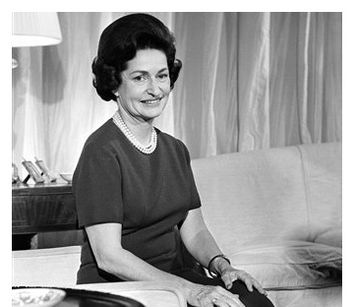
Looking back at Lady Bird

Hillary Clinton, Helen Thomas, Mike Douglas and others remember the integrity, warmth and kindness of the former first lady.

  • more
    • All Share Services

Looking back at Lady Bird

Helen Thomas, journalist: “Cut her own path”

I remember running into her in a Los Angeles hotel in 1960 when LBJ was one of the many contenders for the Democratic nomination. With all the hubbub and mad dashing going on around her, she had decided to take her daughter to an afternoon movie…

After Kennedy won the nomination, negotiations began to get LBJ to take second place on the ticket. Speaker Sam Rayburn acted as go-between and eventually gave up his opposition to LBJ taking the second spot. Not Lady Bird. As pols ran in and out of their suite through the long night, she repeatedly told Lyndon he would be letting his Texas friends down if he accepted the number two spot…

Covering Lady Bird [as first lady 1963-68] had its own exhaustion threshold: While we had exhausted ourselves just trying to eke out news of Jackie [Kennedy] and her secretive comings and goings, we exhausted ourselves just trying to keep up with Lady Bird.

We had more access, and not only at the Texas ranch. When Lady Bird launched her historic “beautify America” project, we all got to go along for the ride. And what a wild ride it was.

Let me say for the record that my idea of a “nature hike” is a ten-minute walk, maybe, through some carefully landscaped gardens. Lady Bird had other ideas. I probably never was in better physical shape than when Lady Bird was around. We logged over 100,000 miles on those beautification trips with this “secretary of the exterior.”

Lady Bird was one of the most remarkable women ever to grace the White House. Her integrity and understanding, along with tolerance and compassion have been constants in her life. Although her experiences seem inextricably entwined with her husband’s, she cut her own path. Her beautification efforts continue today, helped with her creation of the National Wildflower Center near Austin.

From “Front Row at the White House: My Life and Times,” by Helen Thomas (Lisa Drew Book/Scribner, 1991)

Carol Channing, actor: “Sensitive aristocracy”

Hello, Dolly! The Wednesday matinee is always mostly women.

You know, whenever a First Lady is in the audience, all heads are turned toward her. For instance, when Lady Bird came, she must have known this because she wore long white gloves and, after the first song, both of her arms shot straight up, clapping as high as she could. To us onstage it looked like a grand gesture of “I approve of this show.” She threw the attention off her and onto the stage. We treasured her for it. It worked! She let them know where they should be looking…

Lady Bird has always been my role model. You’d think it would show more on me, wouldn’t you? I try, but I’ll never make it. I can only appreciate her sensitive aristocracy. Before the final Dolly performance in Austin, she came in with her own hand-picked wildflowers to give me and to chat because we do that from time to time, I’m proud to tell you. This time she said, “May I ask, do you have grandchildren?”

“No, dear Lady Bird, I don’t want to push and aggravate either of them.”

She said, “Push! I would say poo oosh! Do that, please.” She said it so intimately, slowly, and sweetly that I knew she simply wanted me to be happy and have a full life. (mid-1960s)

From “Just Lucky I Guess: A Memoir of Sorts,” by Carol Channing (Simon & Schuster, 2002)

Ned Rorem, composer: “Prettier than her pictures”

Against the better judgment of my mother who wished that I, like Robert Lowell, had taken an open stand against Vietnam, I accepted the gold engraved invitation to Washington.

Of the four hundred guests at the Festival of Arts — a first gesture of this kind by our current administration — I was, quaintly enough, the only long-haired composer…

Mrs. Johnson, the First Lady (this nomenclature was the sole bow to formality), greeted us individually in Southern tones beneath a barrage of flashbulbs. Faithfully she smiled all day, disappearing only at five to change from dark blue print into pale blue sequins. She’s younger, prettier than her pictures.

In the East Room she first introduced the writers who read for an hour, and only [John] Hersey caused a stir, handsomely, in a no-nonsense reference to “wars have a way of getting out of hand,” quoted by noon in Washington headlines. (1965)

From “The Later Diaries: 1961-1972,” by Ned Rorem (North Point Press, 1983)

Lotta Dempsey, journalist: “Executive approach”

Mrs. Lyndon, when I interviewed her [for the Toronto Star], was of a distinctly different breed from either [Pat Nixon or Nancy Reagan]. Ladybird, which has to be the most incredible nickname for any American president’s wife, was shrewd, affable, but never friendly to the point of gush, as Mrs. Nixon sometimes seemed to be…

Ladybird knew exactly where she was going and what she was doing. Her experience as a radio-station owner and in other business ventures had given her an executive approach to her job as wife of the president of the United States. She was competently organized, down to the last touch of lipstick and faultless hairdo. I suspect she is one of those rare women who carry uncluttered and well-ordered handbags. (Washington, D.C., mid-1960s)

From “No Life for a Lady,” by Lotta Dempsey (Musson Book Company, 1976)

Mike Douglas, television show host: “A familiar face”

[I went] to dinner at the White House, a formal dinner for the Irish ambassador, with music and dancing afterward in the Gold Room…

For me, the highlight of the evening was the receiving line. President Johnson greeted us with Texas congeniality and Lady Bird endeared herself to us forever with her warmth and kindness. As we approached, she opened her arms in welcome. “Ah, at last, a familiar face,” she said. We had never met, but she felt she knew me well enough from the show ["The Mike Douglas Show"] to embrace me as a friend. I’ll never forget her brief words or sincere hug. (Washington, D.C., mid-1960s)

From “I’ll Be Right Back: Memories of TV’s Greatest Talk Show,” by Mike Douglas with Thomas Kelly and Michael Heaton (Simon & Schuster, 2000)

Rosalynn Carter, first lady (1976-1980): “Wildflowers for Georgia”

With the help of Lady Bird Johnson and the Texas Highway Department, we started our own Georgia Highway Wildflower Program. The Texas program is famous, and I wanted to know more about it. With an offer of funds from an anonymous donor toward a highway beautification project, I joined other members from our state Garden Club on a trip to see Mrs. Johnson at the LBJ Ranch. We flew to Texas in a small state plane and landed on the strip just behind her house, where she welcomed us in her friendly, charming way… (1970)

From “First Lady From Plains,” by Rosalynn Carter (Houghton Mifflin, 1984)

Hillary Rodham Clinton, first lady (1992-2000) and U.S. senator: “Quiet strength and grace”

I joined five former First Ladies at the National Garden Gala. I was the honorary Chair of the event at the U.S. Botanic Garden to help raise funds to construct a new garden that would be a living landmark on the Mall dedicated to eight contemporary First Ladies and honoring our contributions to the nation.

I was delighted that Lady Bird Johnson was able to attend. She and I wrote each other during my years in the White House, and she was a comforting and affirming correspondent. I admired the quiet strength and grace she had brought to her position as First Lady. She began a beautification program that spread wildflowers along thousands of miles of U.S. highways and enhanced our appreciation of the natural landscape. Through Lady Bird’s advocacy, a generation of Americans learned new respect for the environment and were inspired to preserve it. She also championed Head Start, the early learning program for disadvantaged children. (Washington, D.C., 1994)

From “Living History,” by Hillary Rodham Clinton (Simon & Schuster, 2003)

Continue Reading Close

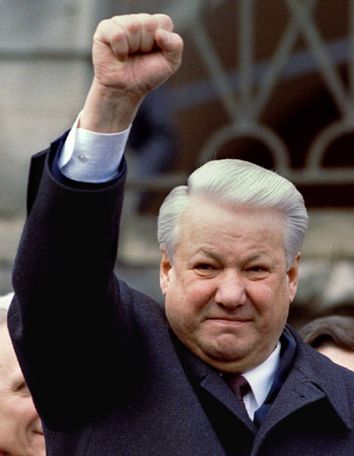
Boisterous Boris

Bill Clinton, Billy Graham, Helen Thomas and others recall Russian President Yeltsin's confidence, rough charm and liberal ways with drink.

  • more
    • All Share Services

Boisterous Boris

Helen Thomas, journalist. “Relishing the attention”

The disapproving look I got from Barbara Bush at a state dinner in honor of Russian President Boris Yeltsin. He was seated at the table next to mine and, thinking of my nieces and nephews and wanting to come up with some historic memento of the occasion, I asked Yeltsin to sign my menu card. Sitting next to me was the wife of James Billington, head of the Library of Congress and a renowned Russia scholar. When she saw what I did, she asked me to get an autograph for her husband. So I again defied the gods of protocol and approached Yeltsin. He graciously obliged. He was having a great time, and enjoying being the center of attention. When I caught Mrs. Bush’s look, I felt a bit uncomfortable. But I was not sorry I had gotten the autograph, especially for the nation’s top librarian. (Washington, D.C., 1990)

From “Front Row at the White House: My Life and Times,” by Helen Thomas (Lisa Drew Book/Scribner, 1991)

Billy Graham, evangelist. “Interest in religion”

On July 13, the day before I left for America, I was unexpectedly invited to meet with Boris Yeltsin at his office in the Kremlin. We talked together for an hour. I got the impression that he was even more interested in the religious side of things than Mr. Gorbachev. He did not hesitate to tell me that he no longer was a Communist. I thought he sounded pleased when he volunteered that his three granddaughters all wore crosses now. (Moscow, 1991)

From “Just as I Am,” by Billy Graham (HarperCollins, 1997)

Dan Quayle, U.S. vice president, 1988-1992. “Image problems”

I first met Boris Yeltsin in [presidential advisor] Brent Scowcroft’s office back in 1990. At this point the administration was walking a fine line, trying to build friendly relations with the Moscow deputy without looking as if it were beginning to favor him over [Mikhail] Gorbachev. For that reason the President [George Bush the elder] wouldn’t receive Yeltsin in the Oval Office itself. I had to go down to Scowcroft’s office to get my first glimpse of this burly man with the thatch of white hair.

People in the White House, and especially those over at State, were skeptical of him. He had terrible image problems: there were plenty of reports that he was a drunk and incompetent, a great uncouth bear in the Khrushchev manner. “Very Russian” was Brent Scowcroft’s assessment of him, and it wasn’t meant as a compliment. But I liked Yeltsin from the start. He may not have had Gorbachev’s polish, but I could immediately see how confident he was. During that short encounter in Scowcroft’s office, he joked about the bad press we shared, and I was impressed at how briefed he must have been in order to know this. (Actually, my feeling was mixed with a bit of annoyance: was my press so bad that it made its way to everyone’s attention?) (Washington, D.C.)

From “Standing Firm,” by Dan Quayle (HarperCollins, 1994)

Max Hastings, editor of the Daily Telegraph. “Replacing himself”

One of the privileges of editorship is access … the one-to-one lunches and dinners, the confidences from politicians, which give editors a thrilling window into power … I attended one splendid affair with Boris Yeltsin, who came downstairs visibly drunk, and took an immediate dislike to his placement. He picked up his own table card, next door to that of Princess Alexandra, and deposited both the card and himself next to John Major, with whom he chattered amiably, if incoherently, all evening. (London, early 1990s)

From “Editor: An Inside Look at Newspapers,” by Max Hastings (Macmillan, 2002)

George Stephanopoulos, communications director for Bill Clinton. “Losing his face”

The setting was an estate overlooking Vancouver’s harbor, and the photo op was [Bill] Clinton and Yeltsin strolling through the forest … The cold war was over, and this summit was about trade, investment, setting up a stock market, fighting crime …

The person who was really losing his face that day was Yeltsin. He opened strong in his tête-à-tête with Clinton. “I liked him a lot, full of piss and vinegar, a real fighter,” Clinton told me after the meeting, the first of several authorized clichés I would pass to reporters on background …

But Yeltsin’s form faded as the day wore on. That afternoon, I bumped into Martin Walker, the Washington bureau chief for Britain’s Guardian newspaper. He said that Yeltsin had had three scotches on the boat ride to Vancouver Island — on top of wine at lunch. At dinner, Yeltsin ignored his food and downed wine in single-gulp shots. [Secretary of State Warren] Christopher slid me a note during the second course: “No food, bad sign. Boat ride was liquid.” By the end of the evening Yeltsin was extending his arms across the table toward “my friend Beeel,” and I finally understood what people meant when they described a drunk as “tight.” Yeltsin’s skin was stretched across his cheeks in a way that nearly obliterated his features. With his slicked-back white hair, he looked like a boiled potato slathered in sour cream. (1993)

From “All Too Human: A Political Education,” by George Stephanopoulos (Little, Brown, 1999)

Bill Clinton, U.S. president, 1992-2000. “Mad at the world, full of fun”

In early March, Yeltsin and I agreed to meet on April 3 and 4 in Vancouver, Canada …

I left Vancouver with more confidence in Yeltsin and a better understanding of the magnitude of his challenges and his visceral determination to overcome them. And I liked him. He was a big bear of a man, full of apparent contradictions. He had grown up in primitive conditions that made my childhood look like a Rockefeller’s, and he could be crude, but he had a fine mind capable of grasping the subtleties of a situation. He would attack one minute and embrace the next. He seemed by turns coldly calculating and genuinely emotional, petty and generous, mad at the world and full of fun. (1993)

From “My Life,” by Bill Clinton (Alfred A. Knopf, 2004)

Hillary Rodham Clinton, first lady, 1992-2000, and U.S. senator. “The wonders of red wine”

This first visit to Russia was intended to strengthen relations between Bill [Clinton] and President Yeltsin so that they could constructively address issues such as the dismantling of the former Soviet Union’s nuclear arsenal and the expansion eastward of NATO …

The Yeltsins hosted a state dinner … I sat next to President Yeltsin, with whom I’d never had an extended visit, and he kept up a running commentary about the food and wine, informing me in all seriousness that red wine protected Russian sailors on nuclear-powered submarines from the ill effects of Strontium 90. I always did like red wine. (Moscow, 1993)

From “Living History,” by Hillary Rodham Clinton (Simon & Schuster, 2003)

Strobe Talbott, U.S. deputy secretary of state and journalist. “Pizza! Pizza!”

The White House protocol office asked … me to greet Yeltsin when he arrived at Andrews Air Force Base … I was then to accompany Yeltsin in his limousine to Blair House …

As Yeltsin emerged from the plane and made his way down the mobile stairs, he was gripping the railing and concentrating on each step. His handlers did their best to block the view of the cameras recording his descent. He slipped on the last step and had to grab [wife] Naina’s arm. That night at Blair House, Yeltsin was roaring drunk, lurching from room to room in his undershorts. At one point, he stumbled downstairs and accosted a Secret Service agent, who managed to persuade him to go back upstairs and return to the care of his own bodyguard. Yeltsin reappeared briefly on the landing, demanding, “Pizza! Pizza!” Finally, his security agents took him firmly by the arms and marched him briskly around in an effort to calm him down. (Washington, D.C., 1994)

From “The Russia Hand: A Memoir of Presidential Diplomacy,” by Strobe Talbott (Random House, 2002)

Continue Reading Close

Page 1 of 3 in Dana Cook