Dana Vachon

Email from Cairo: So now what?

The poor hope, the rich move on, and Tahrir Square is like the Bronx after a big Yankee win only safer, friendlier

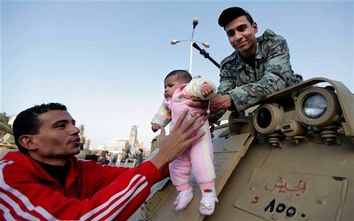
An Egyptian man hands his child to an army soldier in order to take a picture of him on top of an army personal carrier during Friday demonstration at Tahrir square in Cairo, Egypt Friday, March 4, 2011. Egypt's new prime minister designate Essam Sharaf has vowed before thousands of mostly young demonstrators at a central Cairo square that he'll do everything he can to meet their demands, pleading they turn their attention to "rebuilding" the country. (AP Photo/Nasser Nasser)(Credit: AP)

It’s basically ancient Rome out here, with the plebs gathering in Tahrir to demand reforms once a week, patricians coasting around in Mercedes and BMWS, trying to keep as many privileges as possible, the military holding all the real power (which they’ve had since Nasser) and everyone aware of it. All the main intersections are guarded by Abrams tanks and armored personnel carriers. But a lot of the soldiers don’t even shave, often can be seen texting girlfriends from the tank cockpits, accepting another baby from some family excited for a photo-opportunity.

They seem more instruments of branding than anything else; “The army and the people are one,” they chanted during the revolution, an idea reinforced with every GI-cuddling-infant Nokia snapshot. There’s been only one exception to this: A group of commandos in balaclavas rushed Tahrir Square last weekend, beating the protestors with cattle prods, Kalashnikov butts, threatening live ammunition. They arrested a photographer friend of ours and accused him of being an Israeli spy. A Canadian, he had maple leaves tattooed on both arms — which of course only confirmed their suspicions, the Israelis being masters of deception.

But the next day the army apologized, the people seemed to accept it, the revolution, such as it is, continued towards whatever it will be.

Last week someone firebombed the Ministry of the Interior, no one seemed to mind or miss it.

Tonight protestors stormed Mubarak’s Secret Service headquarters, finding the postmodern Bastille filled with sex tapes, history married (once again) to pornography.

Tahrir Square is like the Bronx after a big Yankee win, only safer and friendlier. I got in for the Day of Celebration, was hoisted onto one of the lion-bearing pediments on Kasr El Nil Bridge, handed a drum to beat, cheered, had the Egyptian flag painted on my cheek. Yesterday they had another huge manifestation celebrating the ouster of Prime Minister Shafeek, dismissed by the military after a Tucker Carlson/Jon Stewart moment on Egyptian TV. The angry arab mob mistook me for a Hollywood movie star, made me pose for arm-linked group portraits, one man kissed me on the cheek.

The only life I feared for was the one I live back home.

The wealthy remain so. Zamalek is an island in the Nile developed by Europeans into one of Cairo’s nicest neighborhoods during the Suez Canal era. A Swiss, Baehler, built a belle epoque mansion there where now is La Bodega, Cairo’s best restaurant. You go in for dinner and see fauxhawked Egyptian playboys drinking whiskey as hijabless women sip Red Bull. One soft-cheeked Sharifa seems to have convinced more than a few of her love. Russians and Europeans plot business. Bob Marley plays. The only reminder of the Revolution is the bandage beneath your waiter’s eye.

Journalists are frustrated that the big story has gone elsewhere, leaving them to skulk through military checkpoints to garden district parties in derelict mansions built under the British, on rooftop terraces enshadowed by ancient trees, towering and shaggy. The revolution has made old men of twenty-six year old Ivy Leaguers. They drink duty free whiskey and recount the glory days of…last month, lamenting that things will have to turn ugly again if Egypt is to regain the narrative of Middle Eastern strife and bloodshed from Libya, Oman and, perhaps, Saudi Arabia, whose Day of Rage is still in planning phase.

Shaun White: Mythic victory

Vonn glides above her demons, while the man once known as the "Flying Tomato" soars closer toward ... immortality?

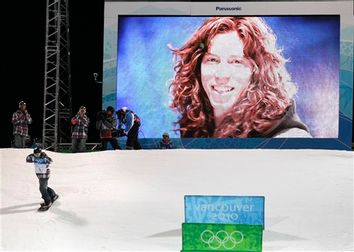
Shaun White of the USA during his first heat run in the final in the men's snowboard halfpipe competition at the Vancouver 2010 Olympics in Vancouver, British Columbia, Wednesday, Feb. 17, 2010. (AP Photo/Gerry Broome)(Credit: AP)

Earlier in the evening a Swedish woman skiing the downhill tumbled grotesquely down an icy mountain slope over and again in extended slow motion, NBC’s commentator analyzing the angles of her body to the ground, estimating the speed with which she hit the ice at 70 miles an hour. She had huge legs, twisted around, and when she hit a gate it seemed to tear her apart. An animated arrow showed the exact place where her skull whipped onto the ice; “She simply got way more air than she bargained for,” the commentator said, as the Swede, Anja Paerson, lay vaguely writhing in excruciating contemplation of God’s vast silence and her own fragile skeleton. “She was launched into orbit here,” the commentator said. “We’ve seen a couple a big crashes today, this the biggest of them.” The commentator had the voice of a Country Club woman who cares way too much about tennis. A few other Scandinavians fell, though not nearly so dramatically.

Lindsey Vonn looks like the young Christie Brinkley’s less attractive older sister Pam, and her history of physical suffering was earlier explored in high production value injury retrospective where doctors likened one Vonn trauma to “being struck with a sledgehammer.” She was never safe, this girl, she had been born under dark stars. Once she thought the curse lifted, the coast clear, she dared celebrate, but then she nearly sliced off her thumb on the metal foil of a champagne bottle. Imagine? She skied uneventfully down the Whistler slope to the downhill gold medal that escaped her four years ago, when I was loved by cheap women and her skin was like morning cream in a rosewood bucket. The earlier video segment was so affecting that you had no choice but to root for her, to see your own stubborn thumb injuries and dashed dreams in hers. “Estranged dad of Vonn watches win on Internet,” wrote the Washington Post, and the athlete’s triumph as prelude to obscurity was complete.

Amid all this, some sort of speed skating event occurred wherein a number of Korean men with huge quadriceps chased an African-American man with equally huge quadriceps around a track evoking the Large Hadron Collider minus the promise and mystery. If there were falls they were not interesting enough to recall. If the Koreans existed as clichés of nuke-mongering, Japanese starlet-abducting North Koreans, as they did briefly in my mind, and not as clichés of generally pleasant, fast-assimilating, Momofuku-creating South Koreans, as they did mainly in my mind, it might have been an exciting thing to behold, at least in the terms of the theater of national enmity and cataclysm. The American, Shani Davis, eventually won, and likely later received a gold medal. That Apolo Anton Ohno and his soul patch appeared amid all this seems hardly worth noting. Named for a serial rapist many millennia out of fashion, he remains unrelated to John Lennon or Wilmer Valderrama. Speed skating might once have been interesting to watch, or listen to, in the days before jet flight, hip-hop and Playstation.

In the days before Shaun White.

Shaun White looks vaguely like Danny Bonaduce might had Danny Bonaduce lived a happier, healthier life, and so makes deep amends for all the awful things done by our ravenous culture in its devouring of Danny Partridge and therefore, in a roundabout way, he can only be a redemptive figure of the Christlyish sort: As an infant he had open-heart surgery, and on TV, or at least HDTV, you can still see the Roman spear scar running down his chest. As a teenage skateboarder he once collided with another teenage skateboarder, fracturing his skull, hovering between life and death for, by his estimation, 10 to 15 minutes. Sports offer the promise of communion between God and man, and snowboarding, as wild tribute to the gods of lifestyle and technology, may be the only real sport left in these Olympics and, it follows, the event where we most clearly glimpse the future and, if we keep following, the most perfect arena for the savoring of death and displays of death defiance. Which is all to say that Shaun White was magnificent in a manner so truly Olympian it can only be explored in the realm of myth:

This past November White’s one unvanquished rival, Dag Torgborn Johansdottir of Monaco and Iceland, broke his spinal column, destroyed his spleen and lost half his teeth trying to learn the Quadruple McTwist, also known as the Barbarossa, a jump created by White while on Ritalin-laced peyote, which sealed his dominance of the snowboarding world; Johansdottir is sitting out these games, learning to talk again. So there was never any real challenge to the American, who after a long weekend at a Nepalese ashram changed his nickname from the Flying Tomato to Big Vishnu and earlier that day astonished the agora by gaining 50 feet of air in warmups, 60 in qualifiers, and then, by some (conservative) estimates, rushing 117 feet skyward in a rotating Buddhist-prayer position during early medal competition. For the finals his only credible competition was the frail-hearted Hiroshi Yamamoto, a recovering Hikikimori who sat out the Turin games in his childhood bedroom drawing exquisite pictures of dragons and writing lovelorn e-mails to spam personages while listening to Radiohead’s “Kid A” on repeat; Yamamoto possesses an ease of motion and awe of space suggesting broad acceptance of impending human doom and this has made him beloved in nursing homes across the world. After his strong first run NBC cut to the recreation area of Our Holy Lady Home in Warwick, R.I., where oxygen-masked residents squinted through sad eyeglasses at a midsize Sony Trinitron in the company of a death-sniffing cat. But Yamamoto fell flat on his ass in the second run, and then nothing in the world could stop Big Vishnu.

So it was math and not hubris that saw him celebrating victory before even taking his final run, guaranteed gold before even leaving his starting perch, where NBC found him breaking from iPhone SimCity to accept a congratulatory conference call from David Rockefeller, Ashton Kutcher and the full partnership of Creative Artists Agency. “Let’s get into the head of Shaun White,” said snowboarding analyst Chuck Massengill as, out of respect for the privacy of CAA, NBC editors cut to footage of White’s earlier run. “He has so much static. He has to do jumps where he almost kills himself, huge air, amazing, twist, double-cork, twist, double cork, another, amazing, he is amazing.”

“A global phenomenon, leading the way,” said the second analyst, Cornelius St. Hilaire, who sounded like he feared the return of blood work. “The pioneering and progression of sport. He’s so far ahead of the next guy. The chants of USA are going up here. I feel transported to another era. Even the colors are different, changing, simpler but more vibrant, like the pictures you keep always with you of yourself as a child. Innocence. Wonder. Flight dreams. It’s hard not to feel the adrenalin rush, you want to weep. I’m very lonely.”

Then the Chinese robot camera zoomed in with Swiss optics and German precision on the American Shaun White, now in conference with his head of security, the private detective Mitch Havemeyer-Dubois, his choreographer, Sino-Prussian movementologist Otto Wang, his rhythmatician, retired Basque electrocrunk rapper Young Manchego, his iPhone caddy, a brain-unwashed Congolese child soldier once known as Sanjo Sanjo Obwango, lately adopted and rechristened Gary Sternbergh. Also an olive-skinned documentarian named Wendy Dubrowski who a Gawker commenter, OliveGardenTaco, would suggest to be pregnant with White’s fifth love-child for no greater reason than to break the doldrums of a February afternoon:

“I can’t ride right now, man,” White said to Wendy.

“Do whatever you want, man.”

“What do you think?”

“Do whatever you want, have some fun, what do you want to do?”

“I don’t know, man, fly down the middle?”

“Nah.”

“Drop a Quad Mick?”

“Yeah, drop a Quad Mickey on ‘em. Just make sure you stomp the shit out of that,” said Wendy, kissing White in a manner so soulfully tongueful it would prompt the contemplation of innumerable affairs in Manhattan, the envisioning of 18 film treatments across Laurel Canyon, a dozen letter-writing campaigns to NBC affiliates across the Great Plains. “Shaun White said if he won here today he would get a section of the Baghavad Gita tattooed across his back,” said Cornelius St. Hilaire, giving into tears as White pushed off from his promontory into the first moments of his can’t-lose glory run. “I think we can safely say that the Vancouver ink scene is about to get a new customer.”

The crowd held signs that said “USA” and “Go Big Vishnu!” while a group of New School truants unfurled a homemade banner that, for just a second, read, “Long Live American Myth.” The people lived in frenzied unison as White coasted down the pipe, gaining speed against glittering flashes, angry lights, a dance beat materialized from nowhere. They took a single breath as he hit the lip, soaring high, 60 feet up, 90 feet up, cutting fast through the thinness of awe in the night, sailing higher still, incredibly high, so that Chuck Masengill made a joke about him crashing into a geosynchronous satellite, and Cornelius St. Hilaire said no, it would be a geostationary satellite he’d crash into, and the censorial beep came late as he said it wouldn’t matter, Big Vishnu would send that fucker into graveyard orbit. And as the curse beamed out from satellites of all kinds, White continued up higher still, and the Chinese German Swiss camera made a doleful, grinding sound as it strained to follow him, and as he turned to the camera Shaun White broke not just laws of gravity but the fourth wall itself, wondering aloud in his own offhanded way, “Just what the fuck does Google do with all the e-mails of the dead?”

Continue Reading Close

“I’m so tired of America”

Rufus Wainwright on his new record, its sometimes apocalyptic vision, and the lyric that's causing a commotion.

At 33, Rufus Wainwright is the man that became of the young Orpheus who stunned and amazed with his 1998 eponymous debut and 2001 masterwork, “Poses.” Since then, he has released two critically acclaimed albums, fallen in love, survived addiction, had an opera commissioned by the Met, and even written its first act. Just a day after its release, his fifth album, "Release the Stars," did something that none of its predecessors had managed: “I’m No. 2 in England today!” he said with mock pride during our phone interview. “I’m right behind Linkin Park!”

Wainwright left his home in New York for Germany to write his new work, which has attracted attention for its grim view of America. “It is a sad situation,” he says. “I still love this country, but I do feel like we have lost a big chunk of our soul. That’s why I went to Berlin, in a lot of ways. Places that have experienced great defeat experience a kind of rebirth, which I think America has to do — unless we want to get more decrepit. I don’t think we have to destroy the place totally.”

Cataclysms pervade the Wainwright catalog. In the beginning the disasters were personal — in the loneliness of “Vibrate,” the emptiness of “Want,” the ecstatic self-erasure of “Poses” — but his new album treats larger disasters: “Why does it always have to be water? Why does it always have to be holy wine? Destruction of all mankind?” Wainwright asks on “Do I Disappoint You,” the album’s opening track. The second song, “Going to a Town,” finds its narrator leaving for a place “that has already been burned down,” lamenting as he goes: “I’m so tired of America.”

“I feel somewhat disconnected from this song,” he says, aware of both the Geffen Records publicist listening in on our call and the realities of George W. Bush’s America as he attempts to embrace this most powerful — and for some, scandalous — lyric. “I literally sat down before dinner one day and five minutes later the whole thing was there. So I just consider myself more of the messenger of a general pathos, really: what’s happened to the democracy and with this war. I’m just stating the obvious at this point. It’s more kind of a healing gesture, really. It’s more getting through the stages of mourning.”

“Going to a Town” has been hailed as among Wainwright’s finest songs, on this album or any other. It also sets up perhaps the strongest of this album’s thematic fugues in an exploration of the idea of flight before disaster, that great and unspoken post-millennial American fantasy. Wainwright reprises “Leaving for Paris,” but not before offering some of the most disturbing lines he has yet sung, in tones so uplifting that you will find yourself bouncing along if you don’t really pay attention:

When the rocket ships all fall/ And the bridges they all buckle/ Quietly we’ll exit as it all is happening/ Cause there’s a river running underground/ Underneath the town towards the sea/ That only I know all about/ On which from this city we can flee

The trumpets of angels blast as he works his way up the scales, gay Messiah ascending. An equally stark dissonance between melody and message might be found in “Poses’” “Cigarettes and Chocolate Milk,” whose childhood nursery rhymes come so beautifully at odds with its meth-addled voice and story. That was a personal darkness, though, and a different time. It wasn’t long after “Poses” broke that Wainwright entered a dark phase of crystal meth addiction that led to tales of debauchery, hallucinations and a Hail Mary call to Elton John that eventually helped get him into rehab. On “Release the Stars” Wainwright seems to have moved past personal apocalypses to dance about with the biblical one. But who could have imagined that the end of the world would sound baroque? Or that Wainwright and his boyfriend would be the only ones to make it out alive? Or that the two of them would play “Phantom of the Opera” as they went?

“I’m definitely a fan of juxtaposition,” he explains. “Using the most beautiful line to say the most horrific thing — I think one of the main things in songwriting is definitely friction between the words and the melody. It’s got to be done very delicately because both elements are somewhat explosive, and all of a sudden the song becomes like a crystal meth lab. You know, you don’t want to blow up your family.”

Though free from family-slaying meth-lab explosions, “Release the Stars” has a good collection of Wainwright’s slaves, impartial creations that tantalize with hints of more fully realized selves. And it’s mostly the love songs. “Slideshow’s” weak refrain — “I better be prominently featured in your slideshow …” — keeps its melody from orgasmic wonder. “Tiergarten” reflects the hyper-manicured, German garden it’s based on; it’s pretty, simple and without any evident purpose. “Sanssouci” starts out sounding like a less inspired version of “Movies of Myself,” and it ends that way too.

“I don’t believe that people really change,” says Wainwright, when asked how the years have changed attitudes and writing on love. “I think you just develop other personalities — a whole set of people who you’ve been in terms of love. Whether it’s kind of a sex fiend, or a romance addict, or in a devoted relationship — which this album deals more with — I’ve kind of lived a wide variety of them. With boys, that is.”

As it happens Wainwright is no longer a foolish lover, but a jealous one who demands inclusion in slide shows. So where within him is the young Catullus who wrote “Foolish Love”? Or the Tin Pan Alley Daedalus who gave us “14th Street”? What about the denizen of the Chelsea Hotel who set down “Poses,” which lets us all know what the night must have sounded like to Jay Gatsby as he stood on his dock, transfixed by green light?

“I definitely consider ‘Poses’ — the whole album in fact — to be kind of a miracle,” he says. “Like the last breath of that moment when decadence is healthy, ‘Poses’ encapsulates that feeling. It’s a kind of song and a kind of album that I’ll never be able to repeat.” Everyone knows that Orpheus doesn’t get to look back. And yet, the near brilliance of “Release the Stars” makes one hope that Wainwright is able to find that place of pure magic again, and that perhaps this time he won’t have to suffer so terribly in his own underworld to get there.

Continue Reading Close

Iceboy cometh

Call him talented, call him Tinkerbell, just don't call him Esther: Skater Johnny Weir talks about training, Kabbala and Michelle Kwan's dowdy look.

At age 20, two-time U.S. National Figure Skating Champion Johnny Weir is America’s best hope for a medal at this week’s World Championships in Moscow (he is currently in 7th place, entering Thursday night’s free skate), and a real threat to break Russia’s domination of the event at the 2006 Winter Olympics in Torino, Italy. We met over coffee during his recent stay in New York to talk about the road to the Olympics, Russia’s Evgeni Plushenko, and the challenge of drawing attention to the men’s side of a sport historically dominated by women. Our conversation touched upon Weir’s practice of Kabbalah, his love of fur, and his reverence for Paris Hilton.

As we talked, I began to sense that I was in the presence of something entirely new in the world of men’s figure skating: a man who has never asked himself the age-old puzzler, What would Brian Boitano do? Indeed, Johnny Weir is an original. From his new love to his new Balenciaga bag to his old nickname “Tinkerbell,” almost nothing was off the table in a wide-ranging talk with America’s next great gold medal contender.

What is it like to be so exalted at such a young age?

It’s really interesting because a few years ago I had a lot of problems with my skating and with how things were going in my competitions and things, so a lot of people started to write me off and say, “Oh, he’s not going to really culminate and become what we think he can be.” So to kind of shove it in everyone’s face, and show everyone that I can do this, and that I was really born to skate and that sort of thing, it’s really the icing on the cake.

What was your point of inflection?

I had trouble in the nationals in Dallas, which is 2003, and I hit the, the wall, when I was competing.

Literally or figuratively?

Really, I hit the wall. Like, I was stuck in between the ice and the wall, and I fell down and I kind of popped my back out of place, and I got up and I was so stunned, like I just went, “Oh my God!” And, um, people thought I was faking it and then I tried to keep going with the program and I fell again. My kneecap, like, moved out place. So I was really injured, and I stopped … I decided, you know, I’m not going to hurt myself anymore. I’m done.

And I took a lot of criticism for that.

And that was, at the same time, what allowed you to come back and become a champion?

Because without something bad happening I don’t think you can really appreciate the good times in things, and that’s in anything, your career, your personal life, or anything like that.

Your style has been original, but at the same time you are in a sport historically dominated by women. How do you think that the way that you see the sport differently could affect its place in the American sports psyche?

Well I’m kind of hoping that with all of the young skaters right now, since most of us are 20 or younger, um, that it kind of brings a new generation into the sport … But my style, personally, is just me being free and trying to express myself, and figure skating is different from other sports because you have the opportunity to be athletic but at the same time you can make it an art form and really present yourself in a different light, and not do things the same way that everyone else does. And that’s just always been my philosophy on my skating, and I love being a little bit different than my competitors and it’s nice. And I’m hopefully going to inspire younger skaters to be their own skater, and kind of march to their beat.

You have a real interest in fashion. Who are some of your favorite designers? Did you watch “Project Runway”?

I don’t watch TV. I just tune in for “The Simple Life.” Have you seen it yet, with Paris Hilton and Nicole Richie?

I saw Season 1. Not Season 2.

Season 2′s done now, and they’re on Season 3. So that’s the only TV I watch.

Are you a Paris Hilton fan?

Yeah, I think she’s hilarious.

What do you like about her?

I like that she’s famous for really not doing anything. And I like her because she rolls with it and she is a huge celebrity now, and she’s famous for being famous, as someone quoted at one point, and she definitely goes to her own tune, and I think that’s admirable … But as far as design and stuff, I like the people that are a little bit different. As far as women’s clothing, I really like Heatherette. I think they’re crazy with everything they do with the rhinestones and the paint, and I think it’s very cool. But as far as stuff I wear, I just like things that are different and things that are well made. And it doesn’t necessarily have to be a Roberto Cavalli jacket or, um, like a Balenciaga bag. Which I bought yesterday.

Do you see yourself segueing into fashion?

I’d love to be a fashion designer. I think it would be an amazing experience and, um, I have so many ideas and just creative juices running all the time, and even if it’s a flop, it’s still something that I would like to try and pursue and just see what happens.

One of the materials that you like is fur …

Yeah.

When is PETA just going to realize that fur is fabulous and drop this whole charade?

You know, animals wear fur coats, so I don’t see any reason why I can’t. It’s discrimination, I think.

Do you take furs with you on the road?

Yes, I have one that I take when I go to Russia or somewhere that’s really cold.

What is it?

It’s just, it’s coyote fur. It’s somehow like a coyote shearling of sorts, and it’s really nice, and it’s long, and it’s beautiful … I love beautiful things, and if it means having a fur coat or diamonds — or even if I want to wear a tiara someday — then that’s just the way it’s going to be. You know, I really, I don’t seek approval or anything.

So I don’t think PETA will ever realize that fur is fabulous. But for now I think it is.

You practice Kabbala.

Yes. My string actually fell off while I was up here, so I’m purged of all my negative energy …

While you were where?

My string, my red string that I wear?

OK.

It fell off while I was in New York, so it means that I’m purged of my negative energy.

So, while the string is on it collects negative energy and when it falls off you’re free?

Yeah. And the red string kind of saves you from other people dissing you. It kind of saves you from the evil eye, is what the story says. It sort of collects your evil energy, and then when it falls off you’re done. But then I put another one on just to be safe after. So it’s a cycle, but when it comes off it’s a nice feeling, like a weight’s off your shoulder or something. It’s weird …

So it’s like a karmic muffler?

Yes.

That falls off when it’s full?

Really.

So, what do you get from Kabbala, and do you plan on changing your name to Esther in the near future? [Madonna changed her name to Esther after she began studying the Kabbalah.]

No, I don’t plan on changing my name to Esther! But, um, I’ve always had a big interest in the Jewish faith, and I was raised in a Catholic family, and my mother would like it if I stayed Catholic and that sort of thing … Judaism is just something that stuck out to me, and a friend introduced me to Kabbala actually before Esther started doing it … It’s about living your life as a good person and trying to be the best person possible and not worrying about what criticisms might come your way, and at the same time not criticizing other people for their shortcomings. For a while I was getting a big head about how good I was becoming and what was going on with me, and it just sort of helped me stay centered and that sort of thing. You know how you tie a string around your finger so you can remember something? It’s like that. You have a string tied around your wrist and when you look down you see it and you think, “Oh, well that was really mean what I just said.” It makes you kind of realize what you’re saying and how you’re acting.

A lot of people in your position have this sort of paradox where, you’re so famous and beloved, yet, when you look at their personal lives they don’t have time to have anybody. How have you dealt with that?

Well, I’m seeing someone and it’s been almost 13 months now, so that’s the longest relationship I’ve had, and it’s difficult at times because I don’t get a lot of time away from skating when I can work on my relationship, and, um, it is tough. But I think if you really love somebody, it’s not going to just fade away because you’re gone for a little while. It’s just something that will always be there, and always you can feel the love coming to you, and you can always give love back.

When you win the gold medal in Torino, and you’re on the podium, the DJ looks down, he’s like: “Dude, we don’t have the ‘Star-Spangled Banner.’ Tell me what to play.” What would you have him play?

“Beautiful” by Christina Aguilera.

Why do you like Christina Aguilera?

Well, she’s so talented and I feel that I’m very talented at what I do. And she’s been criticized and sort of knocked down and I feel like that’s happened to me, and it’s just a feeling that I get that a lot of people don’t want me to succeed because people are jealous of talent and people that are just naturally good at something … She’s just my biggest role model. She’s my idol, I guess I could say.

So you’ve got two nicknames: Tinkerbell and Simba. Right?

Yes.

Can you explain them?

Simba is just a name a friend has given me because for a while I had really long hair, and when I was skating, like, the pictures in the magazines and the newspapers would always be like, my hair sticking straight up the sides and straight up and I looked like a lion. So, it was like I was Simba, the Lion King. Because I’m small, I’m tiny, so I can be a lion cub. And then, Tinkerbell [skater] Nicole Bobek actually gave me on tour last year just because she says I kind of float around, like even when I’m on the ice and off the ice. I kind of float around and am very quick, and doing everything all at once and, I don’t know. I guess she kind of thinks I’m like Tinkerbell.

What do you think are some of Michelle Kwan’s greatest strengths and her greatest weaknesses?

Her greatest strength is she is an amazing competitor. She can go into any competition, maybe not as trained as she was when she was younger and maybe not, ah, maybe not as strong … um, technically as some of the other people. But she still, she goes out and she rocks it and she does her program with flair and elegance. I mean, she’s very admirable in that way because she can just pull it out of her anywhere. She can pull a performance out of her nether regions … As far as weaknesses go, it’s only like nitpicky skating things that are her weaknesses. She doesn’t have as strong jumps as some of the other athletes, and some people are saying, “That’s gonna kill her,” and that sort of thing. But, you really can’t deny someone that talented, and that has had as much longevity.

Isn’t her look a little dowdy?

A little bit. She’s working with Vera Wang now.

Ah.

Yeah. So, uh …

Nancy Kerrigan was the one who started working with Vera Wang, right?

Yeah, but Michelle’s sister Karen actually was an assistant or an intern for Vera Wang, so they kind of got in the door that way. And, they make beautiful dresses. But I say she could jazz it up a little bit more.

So what does the next year hold for you?

Of course I’ll progress as a skater, and hopefully as a person as well, and just this is crunch time now. It’s like doing an all-night cram session before a big exam. This year is just going to be all about working up to the Olympics, I think, and making sure that I’m ready and that I have the right look and the right programs, and just being strong. Because I’m just now starting to become more noticed and more in the limelight. So, I mean, going to the Olympics as a medal contender will be a big deal for me, so I want to capitalize on it and make it the best I can, and not really second-guess anything and just go all out and go for the Olympics and whatever happens, happens.

What do you think of Plushenko’s style?

It’s more dynamic than me. He’s more, if I’m doing dances he’s more like salsa and I’m more ballet, I think.

What do you think of his look?

I think he looks good. I think his costumes are interesting, and his programs are always interesting and I like his hair. Because my hair is really curly so it’s hard to get it to, like, do anything. And he has nice blond, straight hair. And he looks different. He has a really big nose. And some people might say, “Oh, that’s hideous and it’s ugly,” but I think it just makes him different and I think that’s cool. So, I’m in extreme admiration for him and what he’s done for our sport, and for men’s figure skating. And, ah, he’s definitely my favorite men’s skater. Besides myself.

Continue Reading Close

Thong warfare and the kidnapped beauty queen

A tour of socialist Venezuela, where 98 percent of the people are poor and the other 2 percent ogle metrosexual Tarzans and silicone-perfect blonds at a well-lubed fashion show.

The New York Times doesn’t know it yet, but it has a chief Venezuelan fashion correspondent. And I’m it. Models strut down the runway under an enormous white tent and wave to their sugar daddies. I’m not anyone’s sugar daddy, but I wave back anyway. Through the sashaying legs I intermittently see a man who bears an uncanny resemblance to Ricardo Montalban. He has a blond on each side of him — rib-removed, collagen-boosted silicone beauties. They wrap their pneumatic lips around fluorescent straws for hits of Bellini between jealous stares at the newer flesh up on the runway. The models come out one at a time in pink thongs, leopard-print thongs, jeweled thongs. Each thong draws a big cheer from the crowd until a bigger cheer is drawn by the next. Thong warfare.

This is the best assignment in the world, and I suppose I have Alex Deep to thank. His family owns the Casablanca Fashion Group, a chain of high-end fashion boutiques where affluent Venezuelans can get the latest from Dolce & Gabbana, Armani and Versace all under one roof. They produce this show annually to publicize the spring lines.

Deep wears a retro-tailored Armani suit, steel chains around his neck and at least two tones of red streaked through his hair, swept up in the style of a David Beckham mohawk. The final accessory is an admiring coterie of Venezuelan princesses. Alex Deep wants to be a music producer. He has a recording studio in Miami and spins at Boston nightclubs. A drunken Mexican introduced us to each other at the Manhattan nightspot Hiro, where Deep appeared to have fallen into a vat of Dolce & Gabbana. A week later, he offered to fly me to Venezuela if I would write a piece about this show. He mentioned that his family was looking to expand their fashion business to the United States, and I imagine that they wanted publicity.

Of course, I don’t know anything about fashion and did not pretend to. But I had followed Hugo Chavez’s socialist coup of this country and even found amusement in his more colorful rhetoric. If Paris was well worth a mass, post-capitalist Caracas is certainly worth a fashion show.

I picked up a few back issues of Vogue and flew down.

Soon we are driving around the city in Deep’s armored Jeep Grand Cherokee. The Deep Jeep is a unique automobile. It has a panic button to kill the engine and signal a satellite in the event of a kidnapping, inch-thick windows to stop bullets in the event of a shooting, and a hefty driver trained to speed like a madman if necessary.

We are headed into the mountains for a birthday party. In Latin America the upper classes say that bodyguards are like testicles — big, hairy and always outside when the party happens. Alas, it’s funny because it’s true. Outside the house is a black-suited phalanx of armed men, big and grisly with indigenous features. The SUVs form a row of bulletproof chrome beneath a 10,000-volt wire of death suspended above the 9-foot fence surrounding the estate. Outside is the city, and outside it will stay.

Caracas is a city built into the jungle, but everyone I meet here looks perfectly European. Silken hair, porcelain skin, small nose. The young women spend a great deal of time, and surely money, achieving what is often described as an impossible body standard. One wears a lavender sweater so commensurately tight with her own body that you can see the outline of every abdominal muscle in her six-pack. The young men could have walked out of the Upper East Side or a European capital.

Alex Deep hands me another bottle of Polar beer, which the birthday girl’s family has made several billion dollars manufacturing, and explains: “This is the top 2 percent of the country, what you are seeing. We have no middle class.”

But they have a lower class. Squalid adobe towns flicker across the mountains on the other sides of the city. Each house does its best with a single light bulb while the teakwood pillbox shines, bright and cheery, an electrocution-prone pleasure dome.

Early on, Chavez sacked the entrenched management of Petroleos de Venezuela, the state-owned oil corporation, replacing it with his own supporters. Last year he redirected oil revenues to social programs to the tune of $1.7 billion.This sounds entirely humanitarian, especially when you consider that Venezuela is the world’s fifth-largest producer of oil. It makes even more sense when you account for the persistent global energy panic; the cost of oil skyrocketed past $50 a barrel last year because of China’s insatiable appetite for crude and threats to oil fields in the Middle East (namely, Iraq). To a socialist leader in an oil-rich country the arithmetic is easy. Why not share the wealth?

Critics, though, charge that Chavez implemented his programs to buy quick support from the masses — at the cost of the large-scale capital reinvestment, which experts say the state oil industry needs if it is to continue producing the low-quality jungle oil that is this state’s lifeblood. Analysts estimate that Petroleos de Venezuela requires $6 billion of reinvestment each year to remain competitive, and under Chavez in 2004, it received less than half that amount. The fear is that Chavez is acting recklessly to bolster his own power and that oil prices may fall, triggering an economic crisis. For the time being, Chavez’s educational programs and subsidies have improved the quality of life for some poor Venezuelans, though the basic fabric of society remains unchanged.

In this crowd, the very mention of his name brings sour looks and rumors: Chavez has a private collection of Rolex watches and Armani suits that he wears to the same types of debauched parties that he once railed against. More: His sons have trust funds filled with the people’s money and spend their days as bourgeois wastrels in Florida. Still more: His lieutenants fill entire sections of Miami with million-dollar mansions similarly paid for by the single-light-bulb adobes off in the distance. With power firmly consolidated, Chavez holds all the cards.

One man insists to me that a little over 10 percent of the country’s leading families are represented on this single lawn. It is at first difficult to believe, but it seems more plausible after one girl invites me to her birthday party without ever learning my name.

“We are flying to Margarita on Sunday!” she says. “Three hundred of us!”

Lightning flickers over the Bantustan built into the side of a less fortunate mountain. Mud slides killed 25,000 and left 100,000 homeless in towns like this across the country in 1999, but no one outside Venezuela took much notice. No one takes much notice now.

The next morning the phone rings. It is Alex Deep. The fashion show is tomorrow and there is a press conference in the hotel lobby. I feel sorry for the press and wonder what sorts of questions they could possibly ask on the day before a fashion show. I then recall that I am the press.

I enter the lobby and soon meet Veruska Ramirez, who was Miss Venezuela in 1997. Her ochre skin is Amazonian, her pointed features European, and her unmoving breasts silicone. She is lost world, Old World, and New World. Before becoming Miss Venezuela she cleaned houses for $80 a week. Venezuelans take their beauty pageants seriously, and beauty is the only element of meritocracy that remains fully operative in this country, come junta or high water. Life is good for Ramirez, and she also recently experienced the ultimate Latin American status symbol: a kidnapping.

There is an awkward silence as I realize that she expects to be interviewed. As a fashion reporter it is my professional duty to inquire about her clothes.

“What are you wearing?” I ask.

It comes off sounding a bit pervy, but apparently this is how it’s done.

“Max Mara,” she says.

Right, then. “So … tell me about your kidnapping.” And away she goes.

“They left me in a very dangerous zone of the city, and when I got out of the car I said, ‘Oh my God!’ Because I had my high heels on! They wanted autographs!” she says. “When they got in the car, they said, ‘Don’t worry, cutie! We’re not gonna hurt you!’ — ’cause they recognized me!”

We are now playing Latin American abduction survivor. Deep, again wearing head-to-toe Armani, one-ups Ms. Venezuela.

“My brother, he had a gun in his head! They were pointing at his girlfriend! They were saying, ‘Let’s spread this little girl! You’ll feel bad this entire life if I rape your girl!’”

Ms. Venezuela defends her honor: “Well, I told them from the beginning, ‘I prefer that you kill me than touch me.’”

She then joins Mr. Venezuela and several other models on the press panel with Carlos Dorado, a tan businessman in a navy-blue suit with gold pinstripes. Dorado is Deep’s stepfather and many other things: bestselling author, firebrand journalist, currency-exchange magnate and, most recently, owner of the Casablanca Fashion Group.

I am initially inclined to sit in the back row nursing my Polar beer hangover until it is all over. But I am a fashion reporter, and in less than 24 hours will be the highest-ranking such reporter in this entire nation. I must ask questions about fashion; it is what I do. Soon Deep elbows me in the side. “Come on, man. Ask a question.”

New media laws have made criminal any statement that “promotes, condones or incites disrespect for the legitimate authorities and institutions.” This means that you can find yourself in jail for speaking ill of Chavez and his cohorts. The week before my arrival a decorated general was given five years for discussing the workings of flamethrowers on national television, in connection with their alleged use by the government as a torture device on soldiers. This is especially remarkable when one considers that flamethrowers are by and large self-explanatory. They throw flames.

Soon I have a question.

I ask Dorado how he plans to continue to retail European luxury goods as the most populist regime in Venezuela’s history wages a war against elites. Pairs of $200 jeans don’t exactly call out “Viva la huelga!” The room grumbles as the question is translated. Dorado launches into his reply:

“You have the liberty of asking that question, but I don’t have the liberty of answering it. You can go back to New York and rest there tranquilly, but I have to stay here and face this president as the cameras are filming me … I always have written with my heart in my pen, without considering the consequences. Today I made the decision to stop writing entirely. In this country we can no longer write with our heart in our pen; one must write now with his wallet in his pen. We’re one of the richest countries in the world in resources and also the most poorly administrated country on the planet. Until we Venezuelans — rich, poor, businessmen, workers — understand that we will find the solutions to our problems through our intellect and hard work, and that we have to put aside the demagoguery and radicalism, all these resources … will end up being used against us and turn us into one of the poorest countries in the world.”

As a fashion journalist I don’t really keep up on political theory. Still, there is no mistaking that this is a poignant defense of individualist capitalism offered in the face of totalitarian collectivism and the draconian media laws passed to protect it. Dorado may be a member of the oligarchy, but he is the only person in the room who feels entitled to exercise anything resembling a First Amendment right.

Everyone, that is, except for Mr. Venezuela, who has a song to sing.

Francisco Leon was selected as the country’s most beautiful man in 2004. He has a metrosexual Tarzan look, with espresso hair dangling about his latte face and a Thrilleresque red leather jacket with black racing stripes down the arms. Around his neck is a set of dog tags from the army of Narcissus. These bear no marks of identity but serve as ever-ready mirrors for the chronic checking-out of self. He stares into the barrel of a live camera, twists his face with a longing scowl, and croons a ballad from the Julio Iglesias School of Angst and Longing.

There is no way they air this, I tell myself. But the very next morning I will turn on the news to see the entire painful episode replayed in its entirety. Following the serenade is a laudatory news item about Hugo Chavez receiving a humanitarian award from that great civil libertarian Moammar Gadhafi. Dorado’s reflections on the flagging state of modern Venezuela are not shown.

More Deep Jeeps arrive at the hotel to take us to lunch at the Caracas Country Club, a retrofitted Spanish mission. As Dorado orders wine for the table, I notice a crucifix set above a small altar in a garden off the colonnade. This is not the Vatican II Jesus that I was brought up to know and love (and to know loved me); this is bleeding Christ, suffering Christ, wailing Christ. In Latin America, the hope of Christ’s resurrection allows the poor to endure poverty without despair while the visceral and universal pain of his suffering allows the wealthy to endure comfort without guilt.

The Deep Jeeps are there after lunch to take us back to the hotel. Soon we pass what could be the campus of a small university, surrounded by tapered barricades and barbed wire. This is the home of Gustavo Cisneros, one of the wealthiest men in the world, with a personal fortune estimated by Forbes at $4 billion, personal holdings that include AOL Latin America, and personal friends that include George H.W. Bush and Jimmy Carter. Most accounts put him at the center of the April 2002 coup d’état that briefly deposed Chavez, replacing him with an interim government friendly to U.S. oil interests, which is to say, the oil interests of Bush supporters. The coup was briefly successful, but Chavez found support among the military and the masses. Forty-eight hours later, Cisnero’s new president, businessman Pedro Carmona, was quite literally history. All fingers pointed at the United States, which by varying accounts blessed and assisted the entire ordeal.

The next day we meet Dorado, his wife and the usual entourage for lunch atop Avila, the highest peak outside Caracas. The only addition to the party is the niece of Frida Kahlo, who is working with Dorado to license her aunt’s name on products across Latin America. We go up through the clouds, and the city recedes until it is just a great pile of Legos left spilled and unattended in the jungle. Deep is particularly hip today, in a pair of wraparound sunglasses and an Armani T-shirt/belt ensemble inspired by the color yellow and the number 91. He points out the Venezuelan Twin Towers, one of which burned in a recent fire. The higher floors, which allegedly used to store election records that Chavez wanted torched, are black and sooty. American tourists ride in the other gondola cars, surveying the great vista of city below, not even pausing at the towers. Making things disappear isn’t so hard after all.

At lunch Deep asks how the article is coming. I tell him that I think I have gotten some good material. He is encouraged.

“The New York Times is going to want this article!”

I have written exactly one article for the Times, and the Mexican must have mentioned this during my introduction to Deep. The mention of the Times draws approving looks and chatter from across the table. I think that this may have been the moment I was anointed Venezuelan fashion czar, but I cannot be sure; Spanish and Italian were the linguistic fare of the meal, and I don’t speak a bit of either.

I find this fashion reportage to be quite taxing on my higher mental faculties. Political intrigue, class warfare, the constant threat of kidnapping, the future of socialism in Latin America — these things can cloud the mind and make it difficult to focus on the issues that drew me to this field in the first place some 48 hours ago. Hemlines, fabrics, shoes. I’m talking about the real human drama. I take a nap back at the hotel and oversleep, rushing down to the lobby a bit after 8 p.m. to find an annoyed entourage waiting for me beside the armored Grand Cherokee. The man from Dolce & Gabbana, his Speedo-favoring lover, Frida Kahlo’s niece; I have made them late, and they resent me for it.

And that is what brought me finally to the enormous white tent that Casablanca has erected in the center of the city. A spotless white runway cuts through the middle with perhaps a thousand of Caracas’ most well-to-do sitting on either side. The press corps has had time to rest from its rigorous workout at yesterday’s press conference and is in full form. I don’t quite know where I fit into all of this, or even where I am supposed to sit, but soon all is clear. There is a seat in the very first row at the center of the runway. Upon this seat is a placard:

Reservado
New York Times

I don’t possess the language skills to protest or correct, so the matter is settled; I am chief Venezuelan fashion correspondent for the New York Times. And although I am a fashion reporter of the highest caliber, I have to admit that it is remarkable to have risen so far so fast. Like a rocket. As I take my seat I notice a 30-something businessman and an elderly couple looking at me with great respect. Even Frida Kahlo’s niece is impressed. I put the placard away, but it is no use. They are welcoming me on the P.A.

“Bienvenido, Signor Dana Bodkin Vachon…”

There is no going back now. I give a nod to the crowd and the show starts. A grating industrial beat takes over as a group of break-dancers comes out on the runway. They go from worms to backflips to frontflips to head spins to armstands, and the room bursts into applause as the models start to strut. The women have giraffe legs and surgery perfect breasts. The men march top heavy, with pumped chests and arms atop little stick legs. I take out my notebook.

The steady thump of Deep’s house beats pulse from the ground. Computerized lights change with the music and fill the white tent with purples, reds and blues. A million-watt spotlight blasts down the runway, and a thousand flashbulbs explode each time a model hits the end.

Then it stops. The lights die. The sound cuts. Montalban’s blonds look about anxiously. The models bop in place. Venezuela is a country whose vast natural wealth allows the tank of a Jeep Grand Cherokee to be filled with gasoline for a little under $2, but somehow the power has gone out. Ms. Venezuela comes out to calm the crowd with beauty. Dorado goes outside to see what has gone wrong. And the wealthiest residents of the capital of one of the world’s most energy-rich countries can only remain seated, completely in the dark.

Continue Reading Close
www.salon.com/writer/dana_vachon/index.html