Daniel Harris

Reproduction of the rich and famous

Forget golden statuettes. In the new, family-friendly Hollywood, the real status symbols are sonograms and diamond solitaires.

  • more
    • All Share Services

Reproduction of the rich and famous

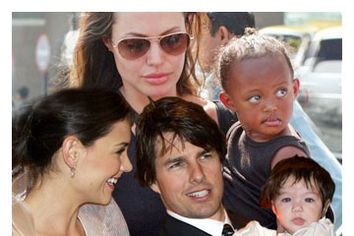
Had Angelina Jolie and Katie Holmes given birth out of wedlock even 50 years ago, they may very well have been pilloried, not only in gossip columns and Sunday sermons, but on the floor of the U.S. Senate. When, in 1949, Ingrid Bergman became pregnant during her notorious affair with the Italian director Roberto Rossellini, Edwin Johnson, a senator from Colorado, rallied to the defense of motherhood and denounced her as “a horrible example … and a powerful influence of evil,” “an apostle of degradation” “whose unconventional free-love conduct must be regarded … as an assault upon the institution of marriage.” He then led a successful vote declaring her persona non grata, thus preventing her from appearing in American films for the next seven years.

By integrating her own pregnancy into the plot of her sitcom, Lucille Ball broke the taboo against media representations of expecting celebrities, but despite her unprecedented candor during the nine months preceding the birth of “Little Ricky” on the “I Love Lucy” show, cast members never once uttered the forbidden word “pregnant,” even when episodes revolved around Lucy getting stuck in chairs and experiencing uncontrollable cravings for ice cream and sardines. Compare such prudery to the openness of the present when photographs of celebrities’ newborn children, illegitimate or not, are splashed across the pages of People and Vanity Fair, and bloggers speculate if Katie Holmes has “preggo boobs” and if it is premature to put Maggie Gyllenhaal on a “bump watch.”

Hollywood actresses have always presented an image of smoldering female sensuality incompatible with the dull domestic routines of child rearing, a sexual hedonism freed of the unwanted consequences that our cinematic fantasies were once in flight from. Now, by contrast, public displays of the pedestrian responsibilities of family life are as vital to the star’s media profile as appearances on the red carpet. The recent obsession with maternity is changing the face of Hollywood promiscuity, which has given way to a new conservative ethic, one in which fertility is a crucial component of a star’s sexual magnetism.

The candor with which we address celebrity pregnancies, which many speculate originated with the famous 1991 Vanity Fair cover of a hugely pregnant and naked Demi Moore, would seem to mark a step forward in public attitudes toward sex. But, in fact, it may signal the rise of a new prudery on the part of the mass audience, which refuses to sanction the proverbial bed-hopping of the stars. Instead, it looks on approvingly — almost certainly with a large measure of schadenfreude — at their enthusiastic acceptance of the burdens of reproduction. Despite the salacious images celebrities project on the stage and in the movies, they have seldom been more wholesome. Far from being Jezebels and gigolos, they are dutiful moms and dads who, no sooner do they remove their costumes, than they dash off to their son’s soccer match or throw birthday parties for their toddlers — gala events that offer not only magic tricks and Mylar balloons, but, according to industry insiders, valet parking.

The recent obsession with high-profile pregnancies would never have occurred without significant advances in maternity fashions that have allowed celebrities to remain in the limelight well into their third trimester, all the while retaining a modicum of glamour. The messy physicality of fallen arches and protruding navels has been supplanted, or at least camouflaged, by an improbable new chic, the unanticipated consequence of the aggressive merchandising of procreation. In 1997, Liz Lange, a designer whose mission is to reinvent the whole look of maternity, began vigorously courting pregnant stars to wear her line of dresses. Other high-fashion collections for expanding waistlines followed, enabling celebrities to remain in the public eye all the way from their first sonogram to the onset of labor. Not only are pregnant stars better dressed than they have ever been before but their offspring are no longer puke-stained slobs in hand-knitted rompers and crocheted sun bonnets. Instead they’re infantile fashionistas decked out in angora booties, bibs that cost $113, and two-ply cashmere chenille sweaters that start at $165.

Pregnancy has long rid itself of the stigma of shame, but recently a higher level of candor has been achieved, a lack of reserve that has effectively ended the state of retirement mothers were once forced to endure out of ladylike bashfulness. This deliverance from restrictive propriety has been accelerated by the career needs of a group of professionals who retreat into voluntary seclusion only at the peril of their most precious asset, their fame, which cannot withstand even a few months’ neglect. Because of the requirements of exposure — and because this media attention makes them the perfect manikins for product placement — celebrities are in the vanguard of the new commerce of pregnancy, which has transformed nine months of nausea, sore breasts and frequent urination into a 40-week photo op.

It is not just the radical intervention of high fashion into maternity that is fueling the current obsession with celebrity pregnancies. A more powerful stimulus is what lies beneath the clothing, the body itself, which has never been so vulnerable to public scrutiny now that celebrities starve themselves into skeletal wraiths whose emaciation reveals even the slightest swelling. Stars are constantly fighting to protect their privacy in a game that is as much a tease as it is an expression of genuine reticence, a never-ending round of hide-and-seek that generates a staggering amount of litigation, much of which is a mere pretense, a transparent gambit for publicity. The cult of the pregnant star represents a deeper penetration of this privacy, which has now escalated from mere surveillance to a psychotic episode of stalking.

As their progesterone levels soar, their very cravings become matters of public record, as in the case of Toni Braxton, who for nine months pined for Doritos and Kellogg’s Frosted Mini-Wheats; Victoria Beckham, who battened on smoked salmon; and Angelina Jolie, who stuffed herself with Reese’s Pieces, which she had flown into Namibia from the Hershey factory in Pennsylvania. What’s more, we download their pirated sonograms from the Web and even submit our favorite personalities to probing gynecological exams. Consider the National Enquirer, which travels like a scope through Jennifer Lopez’s allegedly barren womb, taking us on a tour of her entire reproductive tract: “Doctors injected a dye into Jennifer’s fallopian tubes, where a blockage was discovered. The pressure of the dye injection opened the blockage. She was also put on the fertility drug Clomid to boost her production of eggs.” So deep is the spell of Hollywood on the mass audience that it has turned us into amateur internists and obstetricians, crazed anatomists who seek a perverse intimacy with our divinities, attempting to narrow the physical distance that divides us, reaching out through photographs and gossip columns to touch their bodies, measuring the motility of their sperm and the thickness of their uterine walls.

Hollywood moms and dads are, at least according to legend, monsters. They provide us with deliciously wicked examples of parenting run amok — the hapless Britney Spears, for instance, who, carrying a drink that most mistakenly assumed was alcoholic, nearly dropped her baby on the sidewalk. They also abandon their infants to a retinue of strangers, hired hands with dubious credentials and ample bosoms, while they themselves selfishly pursue their own careers, a situation remarkably similar, indeed, identical, to another instance of neglect: our own.

Virtually all parenting, that of the rich as well as that of the poor, is now delegated to a special class of professionals, whether it be nannies or day-care workers. The delectation with which we relish the culpable negligence of self-serving egotists who care more about their Cessnas and swimming pools than they do about their kids originates in the fears all parents share about juggling their work and family lives.

A dilemma endemic to the two-career household is stoking the fires of gossip about celebrity pregnancies, which afford insecure moms and dads, as tethered to their jobs as any movie star, an irresistible opportunity for back-seat parenting. Electronic bulletin boards are rife with postings that speak disparagingly of “Shitney” Spears, a “hoochie mama” and a “sex freak” who “has a very low selfasteam of herself” and who needs to “take court ordered parenting classes.” That “psychotic flaming queen from hell,” Tom Cruise, by the same token, is widely rumored to have defied doctors’ warnings and, through gratuitous exposure to ultrasound, disfigured his daughter, who, according to various bulletin boards, has a fiery red birthmark on her forehead, a cleft palate, or scoliosis. His adherence to the Scientologists’ practice of silent birth led many to request that he mind his own business, suggesting to hospital staff that, while Katie Holmes writhes speechlessly in the delivery room, “they should shove a watermelon up Tom’s A** and tell him to stay quiet.” The guiltier we become about the dereliction of our own duties as mothers and fathers, the more irresistible it is to take potshots at the child-rearing styles of the stars.

They are the worst of parents but now, according to recent media coverage, they are also the best. Many have successfully shrugged off their sinister reputations as infanticidal careerists and emerged as exemplary parents, who effortlessly coordinate their work and family lives, setting up cribs in their dressing rooms and trailers, extolling the virtues of Snuglis and Baby Bjorns, and recommending in Good Housekeeping and McCall’s ways to “multitask” and eliminate rashes with bleach-free diapers. As they assume an unprecedented role as parental paragons, we are being deprived of the satisfaction of watching avarice and megalomania destroy their humanity, rendering them unfit to accomplish what we view as mankind’s highest mission, its biological destiny, the propagation of the species.

This new image of the celebrity super-parent is uniquely damaging to the self-esteem of the average mom and dad, particularly in light of people’s receptiveness during pregnancy to the often unsolicited advice of family and friends. Radical changes in a woman’s body inspire tremendous fear and insecurity, which can be assuaged only through the reassurances of others who have undergone the same experience. Information about everything from breast pumps to epidurals was once transmitted locally, from generation to generation, mother to daughter, or friend to friend, but in the 20th century, the source of authority began to shift to popular culture, specifically, to the self-help guru, who offered more than just standard advice on clean towels and hot water. Now an entirely new mentoring system is emerging, one in which the expert is increasingly the star, who is not only charismatic and glamorous but spectacularly well-informed, a fount of wisdom about the arcana of teething, morning sickness, doulas and post-natal Pilates classes. Christy Turlington insists on the importance of using only organic or environmentally friendly shampoos and lotions on one’s infant, while Felicity Huffman kneads the tired muscles of her two young daughters with Burt’s Bee apricot massage oil. Information is no longer available exclusively through local channels. National, indeed, global ones — popular culture itself — are becoming the new surrogate |ber mom cum friend.

We mimic them and they, in turn, mimic us. Celebrity parents are constantly minimizing the importance of their fame and fortune for what they refer to time and again as “the role of a lifetime” and “[my] most exciting job to date,” as if wiping dirty behinds and sniveling noses were as challenging and remunerative as $10,000,000 picture deals. They denigrate their careers as actors and musicians as little more than fortuitously lucrative hobbies, professing to be parents first and foremost and assuring us that “[my] priorities are very clear — family comes first” and “if you took away all the money, I would rather have happy kids.”

Such ritualized self-humanizing is the penance the mass audience exacts from them for their affluence, which we condone, albeit begrudgingly, only if they throw themselves wholeheartedly into the dirty business of “diaper duty” and hector us with passionate avowals that they are just like us, humble parents struggling to do their best for their kids with the resources available to them, namely, two nannies, a cook, a limo driver and a live-in housekeeper. Children have become a necessary accessory of fame in a democracy that worships archaic hierarchies of rank and power as much as it despises them. Infants throwing up on Armani suits and peeing on Chanel jackets help quell the feelings of resentment we experience at seeing these cynosures amass fortunes entirely incommensurate with their talent and intelligence.

But even as they protest that they are just like us, that their fame is meaningless to them, that they would abandon everything for the sake of their children, they prove that they are not at all like us, that they couldn’t care less about the vexed question of coordinating their work and family lives. Most people do not have the luxury of jettisoning their careers or even of speaking lightly of such a grim possibility, which, in all but the most exceptional cases, would result in almost certain bankruptcy. Only the fabulously rich can entertain such a desperate eventuality, even in a frivolously rhetorical way. Average hourly workers know that if they did indeed put their families before their jobs their children would starve or end up in a shelter, a public housing project or the foster care system.

Celebrities, by contrast, have the luxury of really and truly sacrificing their professions for the sake of their kids, even if virtually none of them avail themselves of this heroic option but, their protestations of uxoriousness notwithstanding, blithely cast aside half a dozen husbands and wives who end up issuing restraining orders and garnishing their wages. They assert their privilege in the very act of apologizing for it, indulging in exquisite daydreams about the noble forfeiture of their wealth and their romantic banishment to the poorhouse, the mortgages to their Bel-Air mansions foreclosed, their Oscars auctioned on eBay.

The kitschification of Sept. 11

America hid from the harsh realities of the attack behind a maudlin curtain of heavenly firemen and weeping angels.

  • more
    • All Share Services

The kitschification of Sept. 11

Within minutes after the collapse of the World Trade Center, inspirational songs, propagandistic images designed to feed the fires of patriotic fury, and poetry commemorating the victims began to proliferate on radio, television and the Internet. The Dixie Chicks performed an a cappella rendition of “The Star Spangled Banner”; car-window decals appeared featuring a lugubrious poodle with a glistening tear as large as a gum drop rolling mournfully down its cheek; refrigerator magnets of Old Glory flooded the market (“buy two and get a third one FREE!”); and the unofficial laureates of the World Wide Web brought the Internet to a crawl by posting thousands of elegies with such lyrics as “May America’s flag forever fly unfurled,/May Heaven be our perished souls’ ‘Windows on the World’!” Gigabytes of odes to the lost firemen and celebrations of American resolve turned the information superhighway into a parking lot:

My Daddy’s Flag

Arriving home from work and a trip to the store,
My 5 year old daughter greeted me at the door.
‘Hi daddy!’ she smiled, ‘what’s in the bag?’
‘Well, daddy has brought home the American flag.’

With a puzzled look she asked ‘What does it do?’
I answered, ‘it’s our country’s colors, red, white and blue.
This flag on our house will protect you my dear,
It has magical powers to keep away fear.’

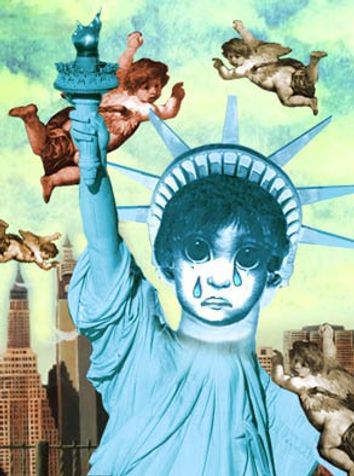
Does an event as catastrophic as this one require the rhetoric of kitsch to make it less horrendous? Do we need the overkill of ribbons and commemorative quilts, haloed seraphim perched on top of the burning towers and teddy bears in firefighter helmets waving flags, in order to forget the final minutes of bond traders, restaurant workers and secretaries screaming in elevators filling with smoke, standing in the frames of broken windows on the 90th floor waiting for help, and staggering down the stairwells covered in third-degree burns? Perhaps saccharine images of sobbing Statues of Liberty and posters that announce “we will never forget when the Eagle cried” make the incident more palatable, more “aesthetic” in a sense, decorated with the mortician’s reassuringly familiar stock in trade. Through kitsch, we avert our eyes from tragedy, transforming the unspeakable ugliness of diseases, accidents and wars into something poetic and noble, into pat stories whose happy endings offer enduring lessons in courage and resilience.

And yet while kitsch may serve to anesthetize us to the macabre spectacle of perfectly manicured severed hands embedded in the mud and charred bodies dropping out of windows, it may conceal another agenda. The strident sentimentality of kitsch makes the unsaid impermissible and silences dissenting opinions, which cannot withstand the emotional vehemence of its rhetoric. It not only beautifies ghoulish images, it whitewashes the political context of the attack which, when portrayed as a pure instance of gratuitous sadism, of inexpiable wickedness, appears to have had no cause, no ultimate goal. Four months to Bush’s “crusade,” despite clear successes, we remain far from certain about what, in the long run, we hope to achieve.

Ignoring geopolitics, we sealed the incident off in an ideologically sterile vacuum, the perfect incubator for kitsch, which thrives on irrational simplifications of moral complexities. Rather than making sincere efforts to understand the historical origins of the event in a protracted international conflict, we erect a schematic narrative that pitted absolute evil against absolute good, our own unwavering rationality against the delirium of crazed fanatics. On the electronic bulletin boards on the Internet, the terrorists became cartoon villains whose “insane and beastly acts” were both unmotivated and unaccountable, the result of nothing more explicable than “malevolence,” of the “dastardly cowardice” of “an inhuman … group that has no place in the universe.” These “depraved minions of a hate-filled maniac” who subscribed to “the toxic theology [of] suicidal barbarism,” “watched from a distance/And laughed in a hauty [sic] tone” at this “ungodly intrusional [sic] violation of human life,” this “psychotic” prank ostensibly staged out of sheer spite.

If the perpetrators are monsters, the victims are not just innocent but angelic, diaphanous seraphs with harps who, after being crushed in the collapse, “rose again,/Through the smoke, and dust and pain./To fly. To play above again/In the blue American sky./The perfect, blue American sky.” R&B vocalist Kristy Jackson has hit the charts with a commemorative single entitled “Little Did She Know” about a woman who, on the morning of Sept. 11, sent her fireman husband off to work with a peck on his cheek, heedless of the fact that he would never return:

Little did she know she’d kissed a hero
Though he’d always been one in her eyes
But when faced with certain death
He’d said a prayer and took a breath
And led an army of true angels in the sky

Little did she know she’d kissed a hero
Though he’d always been an angel in her eyes
Putting others first, it’s true
That’s what heroes always do
Now he doesn’t need a pair of wings to fly

The kitsch of extreme innocence also emerges in the selectivity of the roll call of the martyrs. We found the deaths of the emergency personnel far more riveting than the deaths of the office workers, even though the latter outnumbered the former by a ratio of approximately 12 to 1. It is difficult to make a martyr out of someone who is run down in the street by a bus, as the casualties in the two buildings essentially were, dying, not while manning gun turrets or lobbing grenades, but while filing expense reports and faxing spreadsheets. Such an unglamorous, clerical fate is not suited to instant martyrdom and hence our attention shifted away from secretaries and CEOs, who did nothing more intrepid than attempt to save their own lives, and gravitated toward a group that more adequately satisfies our folkloric requirements for heroism. The whole story was reshaped so that the narrative focus fell squarely on those whose bravery in the face of death allowed us to superimpose on the chaos and panic of that incomprehensible hour a reassuring bedtime story of valiant knights charging into the breach, laying down their lives for their countrymen as they fought against “the forces of darkness.”

Much as the skies above New York were immediately “sterilized” to prevent further attacks, so debate was sterilized to prevent further discussion of the disaster. Many patriotic stalwarts seemed to believe that dissent amounted to a disavowal of one’s American citizenship, a McCarthyite accusation that created an atmosphere of fear and paranoia, a self-consciousness hardly conducive to the effective discussion of an emergency. Moreover, uncritical defenders of our foreign policy made liberal use of such words as “tasteless,” “inappropriate” and “untimely” to describe the statements of anyone who questioned the wisdom of carpet-bombing Afghanistan, including the unfortunate host of the television program “Politically Incorrect,” who was forced to retract remarks deemed offensive to the Pentagon after his outraged sponsors, Sears and Fed-Ex, summarily yanked their advertisements. Because other more despotic forms of repression have been outlawed in democracies, we now rely heavily on a lawful form of censorship, social pressure, a subtle method of coercion that legislates conformity by stigmatizing marginal opinions as the indiscretions of ill-mannered boobs who, while they may not literally break the law, trample on the more elusive statutes of “decency.” It is ironic that, during a time in which we seem so preoccupied with the “tastefulness” of people’s remarks, we exhibit an appalling insensitivity to the tastelessness of kitsch, which repeatedly and unapologetically rides roughshod over all aesthetic standards.

Instead of conducting open and uninhibited discussions, we state our opinions through symbols, through saber-rattling images of American eagles sitting on stools sharpening their claws; screen savers of rippling flags captioned “these colors don’t run”; computer-manipulated photographs of the tear-streaked face of the Man of Sorrows superimposed on the Statue of Liberty; and votive candles that morph into the burning buildings themselves. It is appropriate that President Bush, a man known for the endlessly inventive infelicities of his speech, should communicate to the American public largely by means of symbols, by displaying the badges of dead policemen and staging photo-ops in which, bull horn in hand, he hugs firemen on piles of rubble and leads squirming first-graders in the Pledge of Allegiance after admiring a bulletin board of their drawings titled “The Day We Were Very Sad.”

Symbols are the language spoken by those who are uncomfortable with words. Our leaders use them when they seek to stimulate, not thought, but adrenaline. They are the weapons of emotional obscurantism, paralyzing dialogue before we are plunged into war where doubts and hesitations have potentially disastrous consequences and where our actions must be swift, decisive and unthinking. So much of the “discussion” of the World Trade Center is based on button-pushing, on a barrage of symbols designed to trigger reflexive, Pavlovian reactions, bringing us to our feet against our wills to salute the flag and burst as one into song, our intellectual independence shot down by salvos of patriotic kitsch.

In the course of the imagistic orgies that flared up after Sept. 11, a brand new American symbol was invented: the towers themselves. Poets and commentators anthropomorphized the skyscrapers as, on the one hand, “pillars of strength,” which, like Atlas, seemed to support the weight of the entire United States; and, on the other, as wavering ghosts, which, like Hamlet’s murdered father, seemed to call out for revenge, especially when they were superimposed on top of sympathy card images of disconsolate angels. The buildings quickly lost their material reality as architecture and became living beings, “two brothers” endowed with the capacity to move, to “reach,” “stretch,” and “stand tall.” We even cast this prime piece of Manhattan real estate as Christ in a resurrection scene: No sooner do the buildings collapse than, like phoenixes, they rise again from their ashes, often in the form of the American eagle, soaring skyward out of the smoking rubble: “As the Eagle lay on the ground In awe I witnessed a miracle, a rebirth! The eagle rose triumphant.”

The transformation of the Word Trade Center from a physical location into a turn of phrase, a “vibrant symbol of the bounty and pride of democracy,” gave both terrorism and dissent a new dimension, that of heresy, of the desecration of holy idols, of buildings that quickly acquired the mystique of temples and, in many images, of New Age crystals, which, like gigantic prisms, emanated a throbbing aura of iridescent energy. As a result, those who advocated restraint became more than just opposing voices but iconoclasts and flag-burners, blasphemers who inflicted physical harm on objects that our high-flown rhetoric treated as sacred relics. We left the realm of reason, of bricks and mortar, and entered the realm of faith, of sacraments and graven images, of flags that have “magical powers to keep away fear.” We scoff at the extremism of terrorists who are willing to die in the name of Allah, but we ignore the religious dimension of our own behavior which we justify not by carefully reasoned defenses but by animistic symbols as hallowed as the Koran or the Kaaba. Both the Islamic fundamentalist and the American patriot may share more than they care to admit.

Economic as well as political factors contributed to the proliferation of kitsch after Sept. 11. Kitsch is frequently associated with fundraising, especially fundraising for diseases that afflict children, whether it be the doe-eyed poster children of the first muscular dystrophy campaign, or Ryan White, the heroic young AIDS victim who, after being railroaded out of his bigoted hometown, was canonized as the patron saint of AIDS charities, largely by means of the attention lavished on him by People magazine. And yet, appearances notwithstanding, AIDS affects far fewer children than it does adults. Similarly, on Sept. 11, only three victims were below the age of 13 (all passengers on the hijacked planes). That’s a surprising statistic, given the disproportionate number of relief agencies that, after the attacks, were launched specifically to help children, the cash cows of the tragedy’s nonprofits, which have primed the pumps of American generosity with ad campaigns featuring images of bereft toddlers superimposed on apocalyptic photographs of the ruins. Even during an event in which children are only indirect casualties, they are the ones brought in to shake the tin cans. They, and not adults, are easiest on the eyes, the most photogenic of panhandlers, issuing importunate entreaties with a mere kiss on the cheek or squeeze of the hand. Children are the unpaid workmen of kitsch, its drudges and slave laborers. Many did, of course, lose a parent, but many parents lost something equally important: their lives. Once again, the primary victims of the tragedy were shuffled off to the sidelines to make room for a cast of more narratively appealing objects of compassion, much as the rescue workers were elevated into the starring roles of this “Towering Inferno,” since their deaths were more dramatic than the banal denouements of file clerks collapsing at the water cooler and stock brokers suffocating in bathroom stalls.

What distinguishes the professional fundraiser from any other sort of commercial advertiser is that he has nothing to sell other than his complimentary toasters and his tote bags, his “Never Forget” T-shirts and his American flag car window clings. Because the altruist receives nothing commensurate with the money he gives, nonprofit organizations must ensure that they provide an adequate emotional boon to their benefactors, an intangible feeling of pride, a “warm glow,” the sole “product” that the fundraiser really “sells.” Charities must induce the consumer to do something that goes against his capitalistic instincts, to give something for nothing, a dilemma that leads them to employ the full rhetorical arsenal of kitsch, providing a particularly rich and satisfying spiritual reward in the complete absence of a material one. Charities are so kitschy precisely because they are an industry that packages the warm glow, the well-earned satisfaction we experience after limping to the finish line of an the AIDS walkathon sponsored by AmFAR or adopting a wide-eyed Central American waif through the Save-the-Children Fund.

But in the midst of epidemics and natural disasters, many Fortune-500 companies try to pass themselves off as charities, to slip into wallets already lubricated by the grease of legitimate, fundraising kitsch, such as Burger King, which is helping to “rebuild the American way of life” by selling $1 flag decals with their shakes and fries. After Sept. 11, the airwaves were flooded with corporate condolences from firms that should perhaps have donated to the FDNY’s Widows and Orphans Fund the millions they squandered on prime-time television spots advertising their good Samaritanship, expressing their “horror,” and dispensing their “thoughts and heartfelt prayers.” Charity impersonators infiltrated the ranks of the Red Cross and the Twin Towers Fund, camouflaging their commercials as public service announcements, while hordes of unscrupulous entrepreneurs set up shop by promising to donate to the orphans of dead firemen 20 percent, a full one-fifth, of the proceeds they collected from the sale of their WTC coffee mugs and their “United We Stand” posters of the towers wrapped like an enormous Christo work in 110-story flags (“please support our country, every purchase helps. God Bless America”). Even a pornographic Web site that offers paying clients images of big-busted Asian women promised to donate 10 percent of its proceeds to relief agencies.

If there was something duplicitous about Wendy’s asserting its intentions of selling hamburgers to make “our beloved nation stronger than ever,” Coca-Cola blowing its own horn about the fruit juices it supplied the rescue workers, and Chase Manhattan Bank hanging a four-story American flag on the facade of its Midtown offices, there was something equally duplicitous about the consumers who responded to these blandishments and shopped up a storm under the thin pretense that, given a company’s outpouring of concern, they were “giving” rather than “buying,” donating their hard-earned dollars to a caring, compassionate organization that offered something a little more enticing than a thank-you note, a toaster, and a tax break. We discovered that we could have our cake and eat it too, enjoy that laptop or that surround-sound stereo system and simultaneously bask in the warm glow. If corporations engaged in charity impersonation, consumers engaged in a similar fraud: benefactor impersonation, with both parties participating in a mutually beneficial game of self-flattery.

The marketing of self-congratulation finds a particularly susceptible consumer niche in a culture permeated with pop psychology, with its ever-more clamorous calls for emotional candor and its dire warnings about the dangers of bottling up potentially explosive feelings of anger, pain and grief. Soon after the attack, Oprah’s Oxygen Media posted on its Web site a video of Cheryl Richardson, a self-styled “life coach,” who advised viewers to “get your feelings up and out of your body in order to assist in the healing process,” as if our emotions were toxic substances or medieval “humours,” which exert damaging pressure on our internal organs, poisoning our systems if they are not purged or drawn out by professional blood-letters. Throughout the crisis, the constant refrain of politicians, celebrities, and even housewives was the necessity of beginning the process of “healing,” which, in the current context, has nothing to do with recuperation, but precisely the opposite: with wallowing, indulging in the unnecessary prolongation of our misery, in the drama of living in a state of high alert.

What’s more, the word “healing” promiscuously extends the status of victim to the general public and hence the privilege of being coddled, consoled and pitied, as if we were all casualties and had all narrowly escaped being crushed in the collapsing towers, rather than merely sat safely in our living rooms glued to our television sets.

The mandate to “allow yourself to cry the wounded animal sounds and write in your grief journal,” to quote one of several mourning “rituals” Oprah offered her audience after Sept. 11, shows how the contemporary notion of mental health has weakened the inhibitions that once held our sentimentality in check, our sense of shame about self-disclosure, about losing control in public. We have reached unprecedented levels of mawkishness, levels that exceed even those attained by such lachrymose Victorians as Dickens and his devoted readers who wept copiously over the untimely death of Little Nell, a tragedy that would appear to bear some resemblance to the Sept. 11 attack, which, according to one commentator, was so moving that it “burst the clogged, stereotypical male tear duct wide open.”

Our belief in the putative healthiness of creating external embodiments of internal states through “art” and “play” therapies, activities that lead to a proliferation of folk ceremonies and homemade tchotchkes: commemorative quilts, the largest hug ever staged in human history (thousands linked arms in a field after the tragedy), and the work of the so-called “Crayola Coalition,” a group of school children nationwide who commit their hopes and fears to paper and send them to the rescue workers (often with the help of McDonald’s, which includes original artwork — surely an indication of how highly such drawings are prized — in each bag of Big Macs and French fries it distributes at ground zero).

We are now taught that it is detrimental to our peace of mind, indeed, to our sanity, to experience emotion apart from its communication, its “release,” and must therefore never remain alone with our feelings but seek out an audience to receive our discharges, our cathartic unburdenings, the messy, unhygienic ruptures of our blockages. What we are witnessing in the kitschification of the World Trade Center is how the pressure to externalize, to emote, “to get your feelings up and out of your body” results in emotional exhibitionism, emotional pornography, a need to play to the galleries and ham up our shock and horror as histrionic spectacles that we relish in and of themselves. Internal states retain their authenticity only if they retain some of the solitude in which they are originally experienced, only if there is no audience that needs to be entertained by the trembling of our chins, only if our real responses remain inaccessible to others in the privacy of our consciousness.

The Internet bulletin boards provide one of the most unrestrained examples of the emotional exhibitionism that pop psychology sanctions. The anonymity of the Web eliminated any need for a censoring mechanism to contain the exuberance of our grief and the result was a crying contest to see who could utter the loudest lamentations, the most piercing keens:

“I felt … disbelief, horror, sadness, and the relentless shedding of tears … Would I ever be able to enjoy a sunrise again? … Would food ever taste good to me again?”

“I flipped the tv to the news early Tuesday while putting a workout video in the vcr … needless to say, i never did work out that day … Every time i hear or see the news, i cry … the flags flying all over my city make me cry … hearing our national anthem through various media makes me cry … hearing people going around trying to find their loved ones makes me cry … knowing how many lives were directly affected … makes me cry … i’ve been crying since Tuesday.”

When the crying subsided, bulletin board contributors offered each other a profusion of papal blessings (“may God bless each & every one of you,” “may the Lord cause His Countenance to shine upon you”) and engaged in one of the most complex and disingenuous acts of mourning seen in the aftermath of the World Trade Center tragedy: They posted condolences to the victims’ families, electronic sympathy cards in which they told the orphaned children of firemen that “I just wanted you all to know I cared” and wrote poetry to the bereaved husbands and wives and despairing mothers and fathers:

“We care that you are lonely and blue,
So we are sending this hug especially for you.”

One unnerving thing is missing from this soothing murmur of comforting words: the people being comforted. It is doubtful that the survivors of the tragedy spent the hours after Sept. 11 poring over the thousands if not millions of notes that appeared on the Web and one must therefore conclude that we posted them for our own benefit, that we were both the senders and receivers of these love letters, and that we took turns playing for each other an audience of devastated widows and orphans. We were acting as aesthetes of grief, competing to see who could utter the windiest sighs, who could beat their breasts and gnash their teeth most piteously. Kitsch was created as the ante was steadily upped and the emotional pornography of an exhibitionistic culture reached its climax, its money shot. Just as Puritans once vied with each other in demonstrations of their piety, so we competed to prove who could feel the most, who could “express” the most intensely, showing off a new type of secular piety as unctuous as the zealotry of 17th century religious purists.

The Internet samizdat offered not only a talent contest for the self-appointed pallbearers of the tragedy but an art gallery in which grass-roots designers displayed their click-and-drag doodles and daubs. The images in this electronic museum are based on what might be called the aesthetic of jumble, the haphazard look that results when preexisting images available in such computer programs as Clip Art are carelessly juxtaposed or even rendered transparent and placed on top of each other, forming an arty if often illegible mess. With a click of the mouse, files can be copied and pasted so that the same American eagle can be endlessly recycled and combined in countless permutations with the same angel, the same candle, the same red-white-and-blue ribbon, and the same dove carrying the same olive branch. The deadening unoriginality of Internet kitsch is largely the result of the computer’s capacity to clone pictures and photographs, thereby minimizing the user’s need to invent his own graphics and reducing his role to that of a collector, the rag picker of the World Wide Web who scavenges through various databases in order to assemble a collage of ready-made imagery.

The aesthetic of jumble and the prefab look that it creates become a metaphor of the intellectual vacuity of the Internet samizdat where opinions are replicated and then pasted in like Clip Art, the same denunciations of the terrorists’ “evil” appearing cheek-by-jowl with the same panegyrics of the firemen’s selfless heroism, the same expression of American indomitability with the same torrential spate of tears. As an experiment in democracy, the Internet has failed, for while it is true that the voiceless may have found their voices in a forum in which it is always open-mike and people are free to say virtually anything they’d like, in fact they do little more than repeat the clichis of their leaders, mouthing slogans that are the literary equivalent of the graphics created in the wake of the attacks. The photo-ops of President Bush and the inflammatory symbol-mongering that has dominated the discussion of the attack become the editorial Clip Art of the bulletin boards, the source of the generic patriotism and jingoistic hawkishness that the contributors right-click and copy, presenting them to the public as revelations. Much is made of the radical potential of the Web, which has restored to common people the means of being heard above the deafening corporate voices of the media, but when we really listen to these quieter, uncensored voices, what we hear is smiley faces and little red cabooses, Santa Clauses and carved pumpkins. The Internet is the grave of free speech, a monument to our lack of thought and autonomy. Freedom to speak amounts to freedom to repeat, to select a pictograph from an archive of icons, here a whimper of stereotyped anguish, there a defiant cry of militaristic fury.

The same voice echoes from server to shining server. The response to the World Trade Center attack was a celebration of consensus, of the exhilarating unanimity of what one bulletin-board contributor aptly characterized as “Americans banning [sic] together, soaring [sic] flags, showing pride.” People from every corner of the globe weighed in with their expression of sorrow and solidarity, from the residents of “the little inupiaq Eskimo village on the shores of the Bering Sea in Deering, Alaska” to the Australian chapter of the Jackie Chan Fan Club: “on behalf of the member of the Australian Jackie Chan Fan Club, our thoughts, prayers, and hearts are with all of our brothers and sisters in the United States.”

Within a matter of days, memories of the tragedy seemed to fade as horror gave way to the unadulterated joy of togetherness, which lent the bulletin boards an air of morbid conviviality, the stately funeral procession quickly lapsing into a riotous Irish wake. “How I wish I could embrace you all!” one contributor bursts forth, while another shouts “we love you all!!!” and still another recommends hugging as a palliative to grief, for “a hug heals more pain than the eye alone can see.” One contributor was so overwhelmed by the spirit of good will created by the tragedy that she wrote a poem in which she imagined the victims of the attack “choosing” to die in the World Trade Center well before their birth, volunteering in heaven for a divine mission, that of rallying all nations together in a common cause against evil:

“In the halls of Heaven an offer
was made to thousands
of angels one day:

‘You can go to the earth and help unite the world
But you won’t be able to stay.’
The angels stepped forward.”

Behind the kitsch of our grief is a horrible, seemingly inhuman fact: We are not as dejected as we profess but in fact excited, a repulsive notion that we hide from ourselves, burying our euphoria deeper and deeper in sentimentality, becoming all the more long-faced the more gleeful we are at having come together as one.

Why do we experience pleasure during such crises? Surely not because we are sadists at heart, prurient, unfeeling ghouls who gloat over the sufferings of others. Instead, such an inappropriate reaction is the natural outcome of the fact that we no longer consciously experience on a daily basis a very acute sense of belonging to any community, even though the infrastructure of a highly complex society lies behind our most insignificant actions, from opening a tap and raising the thermostat, to flushing a toilet and flipping on a light. And yet, the communities we live in have become invisible, despite their omnipresence; the thousands who work in our water departments are never seen, we have no contact with those who keep our furnaces running, and the electric company appears only when the meter reader rings our bell. What’s more, our government operates so efficiently that it has all but disappeared from our lives, leaving us with an eerie sense of being free agents acting alone in an unpopulated wilderness full of automated amenities. A society that seems to run by itself, that does not require us to perform any civic duties, is plagued by feelings of isolation and is particularly prone to bouts of pathological collectivity in which we hold old-fashioned neighborhood socials around a centerpiece of mangled corpses, a hideous incongruity that we hide behind a tearful mask of kitsch. In an atomized society, any crisis becomes a catalyst for instant togetherness in which the pleasure of companionship far exceeds the depths of sorrow and our fierce tribal instincts reemerge with a vengeance, having been thwarted by the curse of autonomy that afflicts advanced Western cultures.

Continue Reading Close

America's greatest sexologist

A new biography of Alfred C. Kinsey shows he not only studied many forms of sexual behavior but experimented with them as well.

  • more
    • All Share Services

America's greatest sexologist

Long before Dr. Ruth began televangelizing about the wholesomeness of doing it in the shower, playing doctor and “being sensitive to our partners’ needs,” Alfred Kinsey was observing, recording and, last but not least, having sex — a lot of sex. In 1948 he shocked the world with his international bestseller “Sexual Behavior in the Human Male,” the so-called Kinsey Report, in which he questioned the basic distinction between heterosexuality and homosexuality, proposing instead his “scale,” a continuum of erotic responses that defied easy categorization.

Five years later, he published the companion volume “Sexual Behavior in the Human Female,” an equally outrageous exposi of American Womanhood in which he moved the typical happy homemaker of the 1950s out of her kitchen and into the barn and the monkey house, side by side with her counterparts in the wild kingdom. His pioneering work on the nature of female orgasm, the masturbatory habits of adolescents and the prevalence of extramarital intercourse is so basic to the modern understanding of sex that at times it is difficult to appreciate his originality, so thoroughly have his trailblazing observations become the stock and trade of well-meaning sex columnists the world over.

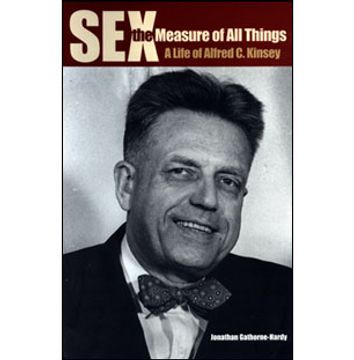
The dance card of the greatest American sexologist of all time was empty for his high school prom, even though he was devilishly handsome, smart as a whip and, as Jonathan Gathorne-Hardy’s excellent new biography, “Sex the Measure of All Things,” so shamelessly discloses, hung like a horse. The son of a religious fanatic, he wore his Boy Scout uniform at all times well into college and even prayed to God with the younger cubs he counseled to help them avoid the errors of “self-pollution” — an unanswered prayer, it would seem, given that he continued to masturbate all his life and even engaged in more esoteric perversions, including “tea-room trade” in public johns, genital mutilation, self-circumcision and his favorite sexual pastime, urethral insertion, a practice that involved sticking into his penis pens, pencils and even, as he honed his craft, toothbrushes — bristles first.

As a budding herpetologist, he housed dozens of snakes in his dorm room and, after he graduated from Bowdoin College in Maine, quickly became one of the greatest collectors of all time. He began first as an entomologist, gathering millions of specimens of wasps (many species still bear his name), and then as a sexologist, amassing thousands of sexual histories of pedophiles, prostitutes, businessmen and housewives. He also collected the measurements of more than 5,200 penises and 400 African-American clitorises, to say nothing of 2,000 films of male orgasms and hundreds of documentaries recording the mating habits of rats, pigeons, horses and even porcupines.

He was a born scientist and a compulsive statistician, as monomaniacal about bugs in killing jars as he was about dicks in vaginas. He stunned America by stripping sex of the trappings of romantic love, liberating it from the moral judgments of Judeo-Christian prudery and reducing it to a pure biological act in which men and women behaved like any other rutting animals. (An unflattering vision is still enshrined on the bathroom doors of the Kinsey Institute, which bear not the dainty expressions Ladies and Gentlemen but the starkly taxonomical terms Male and Female.)

He also practiced what he preached and hence, in the eyes of his ostensibly more detached colleagues, unscrupulously violated the high standards of objectivity that are the prerequisite of effective science. He encouraged wife-swapping among the staff of his institute, pimped off his own beloved spouse, a comely den mother, to other horny men and insisted that acquaintances keep detailed sex calendars describing the origin and intensity of their orgasms. He even, in the case of a mildly homophobic interviewer he employed, summoned the man to his hotel room in order to provide him with a firsthand demonstration of gay sex with another colleague.

Far from undercutting Kinsey’s credibility as a researcher, his willingness to have and not just observe all kinds of prohibited sex, from sodomy to sadomasochism, enhanced his qualifications as a pioneering sociologist and helped him cut through the prim euphemisms and barriers of prejudice that afflicted his more censorious predecessors.

What’s more, he was a crusading humanitarian, and a kind of proto-Ann Landers, who demolished the myth of the vaginal orgasm, exposed — indeed condoned — the epidemic levels of extramarital intercourse among seemingly wholesome, happily wedded couples and personally answered a constant flurry of anxious queries from around the globe: “Does sex while pregnant lead to polio?” “Are tampons stimulants?” “Does suppressing sex cause stuttering?” “Can one avoid insemination by keeping on one’s socks or high heels during intercourse?”

But perhaps his most enduring legacy as a sexologist was his campaign on behalf of homosexuals. He almost single-handedly laid the foundations for gay liberation, decrying anti-sodomy laws as early as the 1940s and advocating tolerance at a time when most people saw little distinction between pederasts and psycho killers.

And he blew the lid off American hypocrisy by revealing that 40 percent of all adult males had engaged in homosexual sex to the point of orgasm, 10 percent had been sexually involved with another male for periods as long as three years and 4 percent were exclusively homosexual.

Throughout his life, he slowly advanced up his own infamous scale from 0 to 6, beginning as a 1 — an undeviating heterosexual — and ending as a full-blown homosexual, a fact that the institute kept closely under wraps, worried that the practices of its relatively fearless leader would jeopardize the funding of an organization that, under the circumstances, was somewhat disingenuously promoting sexual freedom.

In another recent biography, James Jones launched a much-publicized revisionist attack of Kinsey in which he questioned the value of his work on the grounds that he was a sexually manipulative administrator and that his bisexuality and monstrous libido led him to doctor his results, skewing his statistics and placing too sensational an emphasis on the incidence in the public at large of homosexuality.

Gathorne-Hardy’s entertaining and engagingly written biography revises this revisionism and presents Kinsey in an altogether more favorable light — admittedly, as a compulsive workaholic and an exacting boss who pushed his employees to the brink of collapse and drove himself to an early grave from exhaustion at the age of 62 in 1956 — but also as a humane and indefatigable sex educator, as well as an unfairly maligned martyr of American priggishness and the promiscuous grandfather of the sexual revolution who inspired movements such as feminism and gay rights.

Jones would seem to have preferred Kinsey to be exclusively heterosexual, but how would this fact in itself have contributed to his objectivity, if it would not indeed have undercut it? Would Kinsey’s sex surveys have been less skewed if they had been orchestrated by a straight man rather than by a bisexual? Would a heterosexual not have been revolted by and, therefore, have ignored, if not swept under the carpet, much of the data that Kinsey courageously brought to light and that remain to this day unchallenged?

Would a practicing heterosexual have been able to face the fact that women do not have vaginal orgasms from what their lovers vaingloriously assume are the unmitigated delights of penetration? Would they have been able to admit that the missionary position is an almost complete aberration among existing species? Or that infidelity seems in the long run to be far healthier than monogamy, if not crucial to our evolutionary development, in that it ensures contact with the best sperm and the widest gene pool?

Far from hampering his objectivity, Kinsey’s bisexuality, his ability to slide up and down his own scale like a musical keyboard, was a distinct advantage to his work. Also helpful was his intimate, personal experience with behavior he studied, not as a curious sightseer and somewhat meddling tourist, but as a participant and fellow traveler.

It is only the lingering prejudices of a homophobic society that can say that Kinsey’s rather fluid sexuality compromised his research, whereas a conservative straight man in a monogamous relationship with a wife and 2.5 kids is uniquely qualified to tell the whole truth and nothing but the truth. Did Newton’s homosexuality mean that he lied when he said that the stars behave according to the principles of gravity? Did mathematician and cryptographer Alan Turing’s homosexuality interfere with his invention of the computer or his successful efforts to break the Nazis’ code, a heroic feat that won him not a bronze star or an Order of the Purple Heart but a vicious campaign of persecution that led to his suicide, a death that the radical changes that Kinsey effected in Western culture would undoubtedly have prevented?

Gathorne-Hardy’s superb biography demolishes the skeptical new myths of Kinsey as a date-raping autocrat whose libraries of statistics functioned as his own self-flattering mirror.

Continue Reading Close