Daniel Mendelsohn
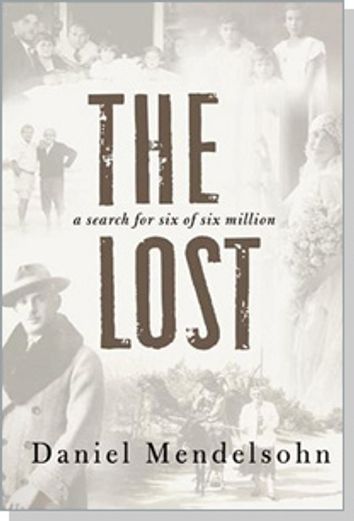
“The Lost”
Daniel Mendelsohn remembers the strange effect he had as a boy on his kin in this excerpt.
Excerpt from “The Lost” Chapter One: The Formless Void
Some time ago, when I was six or seven or eight years old, it would occasionally happen that I’d walk into a room and certain people would begin to cry. The rooms in which this happened were located, more often than not, in Miami Beach, Florida, and the people on whom I had this strange effect were, like nearly everyone in Miami Beach in the mid-nineteen-sixties, old. Like nearly everyone else in Miami Beach at that time (or so it seemed to me then), these old people were Jews — Jews of the sort who were likely to lapse, when sharing prized bits of gossip or coming to the long-delayed endings of stories or to the punch lines of jokes, into Yiddish; which of course had the effect of rendering the climaxes, the points, of these stories and jokes incomprehensible to those of us who were young.
Like many elderly residents of Miami Beach in those days, these people lived in apartments or small houses that seemed, to those who didn’t live in them, slightly stale; and which were on the whole quiet, except on those evenings when the sound of the Red Skelton or Milton Berle or Lawrence Welk shows blared from the black-and-white television sets. At certain intervals, however, their stale, quiet apartments would grow noisy with the voices of young children who had flown down for a few weeks in the winter or spring from Long Island or the New Jersey suburbs to see these old Jews, and who would be presented to them, squirming with awkwardness and embarrassment, and forced to kiss their papery, cool cheeks.
Kissing the cheeks of old Jewish relatives! We writhed, we groaned, we wanted to race down to the kidney-shaped heated swimming pool in back of the apartment complex, but first we had to kiss all those cheeks; which, on the men, smelled like basements and hair tonic and Tiparillos, and were scratchy with whiskers so white you’d often mistake them for lint (as my younger brother once did, who attempted to pluck off the offending fluff only to be smacked, ungently, on the side of the head); and, on the old women, gave off the vague aroma of face powder and cooking oil, and were as soft as the “emergency” tissues crammed into the bottom of their purses, crushed there like petals next to the violet smelling salts, wrinkled cough-drop wrappers, and crumpled bills. . . . The crumpled bills. Take this and hold it for Marlene until I come out, my mother’s mother, whom we called Nana, instructed my other grandmother, as she handed her a small red leather purse containing a crinkled twenty-dollar bill one February day in 1965, just before they wheeled her into an operating room for some exploratory surgery. She had just turned fifty-nine, and wasn’t feeling well. My grandmother Kay obeyed and took the purse with the crumpled bill, and true to her word she delivered it to my mother, who was still holding it a number of days later when Nana, laid in a plain pine box, as is the custom, was buried in the Mount Judah Cemetery in Queens, in the section owned (as an inscription on a granite gateway informs you) by the First Bolechower Sick Benevolent Association. To be buried here you had to belong to this association, which meant in turn that you had to have come from a small town of a few thousand people, located halfway around the world in a landscape that had once belonged to Austria and then to Poland and then to many others, called Bolechow.
Now it is true that my mother’s mother — whose soft earlobes, with their chunky blue or yellow crystal earrings, I would play with as I sat on her lap in the webbed garden chair on my parents’ front porch, and whom at one point I loved more than anyone else, which is no doubt why her death was the first event of which I have any distinct memories, although it’s true that those memories are, at best, fragments (the undulating fish pattern of the tiles on the walls of the hospital waiting room; my mother saying something to me urgently, something important, although it would be another forty years before I was finally reminded of what it was; a complex emotion of yearning and fear and shame; the sound of water running in a sink) — my mother’s mother was not born in Bolechow, and indeed was the only one of my four grandparents who was born in the United States: a fact that, among a certain group of people that is now extinct, once gave her a certain cachet. But her handsome and domineering husband, my grandfather, Grandpa, had been born and grew to young manhood in Bolechow, he and his six siblings, the three brothers and three sisters; and for this reason he was permitted to own a plot in that particular section of Mount Judah Cemetery. There he, too, lies buried now, along with his mother, two of his three sisters, and one of his three brothers. The other sister, the fiercely possessive mother of an only son, followed her boy to another state, and lies buried there. Of the other two brothers, one (so we were always told) had had the good sense and foresight to emigrate with his wife and small children from Poland to Palestine in the 1930s, and as a result of that sage decision was buried, in due time, in Israel. The oldest brother, who was also the handsomest of the seven siblings, the most adored and adulated, the prince of the family, had come as a young man to New York, in 1913; but after a scant year living with an aunt and uncle there he decided that he preferred Bolechow. And so, after a year in the States, he went back — a choice that, because he ended up happy and prosperous there, he knew to be the right one. He has no grave at all.
Excerpted from “The Lost” by Daniel Mendelsohn. Copyright ) by Daniel Mendelsohn. Published by HarperCollins Publishers.
Brain-dead
HBO's "Mind of the Married Man" is about as edgy as "The Mary Tyler Moore Show."
It would be hard to determine how often the verb “jerk off” crops up in normal conversation among urban heterosexuals, but it can’t be as often as it does in the HBO sex sitcom “The Mind of the Married Man,” which just concluded its first season. The series, the brainchild of the comedian Mike Binder, is about a Chicago newspaper columnist in his 30s named Mickey Barnes (Binder), whose basically happy marriage to a beautiful English journalist named Donna doesn’t prevent him from having stray thoughts about other women. (That’s what’s going on inside his mind.) In the pilot episode, Donna discovers some porn that Mickey has downloaded onto his laptop, and she flips out. This leads to a lot of wry jokes (“You may as well have cheated!”) between Mickey and his two best buddies — the henpecked, anxious Doug, and the compulsively womanizing Jake — and, of course, to those many jokes about onanism.
Continue Reading CloseClassical HMO
When the heroes of Ancient Greece apply for healthcare reimbursement, the results can be tragic.
Dear (Ms.) Thetis:
We are writing to you in reply to your application for death benefits following the untimely passing of your son. We have carefully reviewed the case of ACHILLES (NO SURNAME GIVEN), and regret to inform you that we are unable to pay any benefit at this time.
According to the records you provided, your son died of an arrow wound to the heel while covered by The Plan. However, the medical records you provided indicate that his heel condition was, if not congenital, then present almost from birth — the result, moreover, of a non-covered home treatment of your own devising. The underlying cause of your son’s death is, therefore, deemed to be a pre-existing condition, and hence not covered.
Continue Reading CloseScarlet letters
Al Gore's favorite novel, Stendhal's classic "The Red and the Black," is just the kind of art his wife and running mate want to squelch.
Al Gore’s recent announcement on “The Oprah Winfrey Show” that his favorite novel is Stendhal’s 1830 classic “The Red and the Black” comes as a gratifying vindication for aficionados of high literature and for amoral sociopaths everywhere. The former, after all, have had little cause to find the present campaign of interest: Although George W. Bush’s spoken English continues to improve at an impressive rate, so far his literary ambitions seem limited to stylistic tours de force that rarely exceed two syllables — “rats,” say, or “asshole.” And yet if Gore’s enthusiasm for one of the great classics of Western lit seems of a piece with his and his wife’s much-touted cultural high-mindedness, a quick look at the book — a sex- and violence-filled potboiler about an affectless social climber who schemes and sleeps his way to the top of Parisian society — suggests that it would never pass the presidential candidate’s “not till after prime time” criterion for clean art.
Continue Reading CloseThe boy in the graveyard
A young man finds that the path to seduction winds through some treacherous territory.
The first time I ever had the experience of desiring another man who I knew also desired me was when I was in college, and I walked aimlessly for many hours one day a long time ago, following him. We were both 19, and I never knew his name. He was waiting at the farthest edge of the university cemetery, a spot where the graves become indistinguishable from the woods.
This was at a college in the South; these woods were thick, choked with creepers and dense with trees you won’t find in the suburbs of Long Island. It was a strange place for someone like me to have ended up. I’d come here, to the university nested in the foothills of the Blue Ridge, because in high school I’d loved a boy who’d come from this state, a boy who shunned me when he realized I wanted him; I thought that by going here, to the place where he was from, I could recuperate him somehow, have a part of him. I thought that being in this place, with its hills and horse farms and the smoky blue spine that was the mountain range in the distance, would let me experience him, finally. My choice of universities had struck people I grew up with as strange; no one else in my graduating high school class of 500 had even applied here; the South, it was felt, was hostile to Jews. On Long Island, the South required some explanation. Of course I would not tell them that I was going there because of a boy with shiny yellow hair, and so I would observe that the university I’d chosen had a renowned English department. It was always assumed that I would be an English major, and this seemed to satisfy people.
Continue Reading CloseThe Best of Friends
Daniel Mendelsohn looks at how Hollywood movies depict friendships between gay men and straight women
Can men and women have relationships without also having sex? It’s a
question we’ve been pondering ever since courtly love went the way of the
dodo, and the answer, at least in 20th century popular culture, has been a
resounding “No.” In movies, it’s been pretty clear that guy + girl =
romance ever since Clark Gable and Claudette Colbert — unlikely roommates
on a madcap road trip in Frank Capra’s 1934 classic “It Happened One
Night” — started out chastely separated by a partition made of sheets, only
to end up in each others’ arms. (More recently, there was “When Harry Met
Sally …” in which not only Meg Ryan’s orgasm but also the film’s
commitment to exploring the uncharted waters of nonsexual relationships
between guys and girls turned out to be faked: Of course they ended up
together.)