Dante Ramos

Rough waters

Preacher and professor Michael Eric Dyson attacks America's reaction to Katrina as racist, ignorant and inept. But his rushed book is little more than a soggy rehash.

When the apocalypse comes, Americans will have to sit though a lot of tedious commentary about it, if the aftermath of Hurricane Katrina is any indication.

On the ground here in the days just after the storm, one could hardly imagine how anything worse could ever happen. As the city filled with water, desperate people waded to higher ground, trudged along the city’s elevated expressways, gathered at the Louisiana Superdome and the Ernest N. Morial Convention Center because they had nowhere else to go. Stores were being looted, and some police officers and firefighters were taking part in the action. In much of the city, law enforcement and emergency medical services were nowhere in evidence. For those of us who live in New Orleans and love the city, it was hard to find words to describe how shocking all of this was.

Of course, plenty of one-note opinion-mongers must have known what they thought of the disaster before it even happened. As Michael Eric Dyson notes in “Come Hell or High Water,” Louis Farrakhan predictably declared that Katrina was divine punishment for American racism and military aggression. Others said the hurricane was God’s way of smiting gay people. Bill O’Reilly argued that the suffering in New Orleans was a cautionary tale about laziness and drug addiction — an apparent dig at the poor black evacuees whose plight filled the nation’s TV screens. New Orleanians were dying in their attics and drowning in the street, but even then some commentators couldn’t be bothered to change their shtick.

The apparent purpose of Dyson’s new book is to offer a counterweight to uninformed statements like O’Reilly’s. Dyson is a University of Pennsylvania humanities professor, a Baptist minister and a prolific author; he has written books about Malcolm X, Martin Luther King Jr., Marvin Gaye and Tupac Shakur. “Come Hell or High Water” is the first book-length analysis of how racial and class dynamics shaped the Katrina crisis. Unfortunately, the book is too rushed and unfocused to add much to our collective understanding of the disaster.

In the first chapter alone, Dyson rambles through statistics on poverty and automobile ownership in New Orleans, a history of the flood-ravaged Lower 9th Ward, a criticism of George W. Bush’s education policies, a call for better health care for black Americans, and a discussion of writer Michael Ignatieff’s claim that the U.S. government has failed to hold up its end of the “contract of American citizenship.” The second chapter examines musician Kanye West’s assertion that “George Bush doesn’t care about black people.” Dyson then moves on to a lengthy survey of the history of the federal role in emergency management and a chronology of the days just before and just after Katrina struck. He weaves from one subject to another with dizzying speed.

To the extent that Dyson has any overarching argument, it’s a familiar one: That the racial and economic profile of Katrina’s most conspicuous victims affected how the media covered the disaster and how the federal government reacted to it. News organizations, Dyson says, were quick to reinforce stereotypes about African-Americans as violent and criminal. Early reports of an epidemic of rapes, murders and other atrocities at the Superdome and Convention Center, he notes, soon turned out to be unfounded. Would news organizations have been more skeptical if thousands of wealthy white suburbanites had gathered in makeshift shelters? Almost certainly. Likewise, if a natural disaster had overwhelmed local authorities in Falls Church, Va., or Coral Gables, Fla., and if well-heeled residents were begging for help on camera, would the Bush administration have let them fend for themselves for days on end? Surely not.

Still, the demographics of Katrina are more complicated than Dyson and many other people realize. To the east of New Orleans, beyond the easy reach of cable news channels, St. Bernard Parish, a predominantly white suburban community, was flooded from the Gulf of Mexico to the Mississippi River levees, and the death rate per capita was similar to that in the city. More than 120 people perished there, including 34 patients at a single nursing home. Indeed, the most striking pattern in the death statistics for the entire metropolitan area isn’t the victims’ race but their advanced age. And while Dyson presumes that the only people who would fail to heed an evacuation order were those who couldn’t afford cars, it now appears that most of those who were killed by Katrina stayed willingly. Evacuating for a hurricane is a major undertaking, even for people of means; moving people who are in fragile health can endanger their lives; because hurricanes menace the Gulf region every year, residents pick and choose which ones to fear.

These nuances have become clearer in the months since the storm, and they do not inform “Come Hell or High Water.” Instead, much of the book is a rehash of, or a rejoinder to, various pronouncements that filled the nation’s airwaves, Op-Ed pages and computer screens in early September.

Dyson is miffed, for instance, about the sudden discovery by comfortable Americans of the grinding poverty that afflicted so many Katrina evacuees — a discovery that he views as a form of vanity and willful ignorance. “Our being surprised, and disgusted, by the poverty that Katrina revealed is a way of remaining deliberately naive about the poor,” Dyson writes, “while dodging the responsibility that knowledge of their lives would entail. We remain blissfully ignorant of their circumstances to avoid the brutal indictment of our consciences.” Fine, but Dyson doesn’t seem to know where to take the argument from there. And some of the conclusions he comes to don’t make much sense. Drawing on a sheaf of news articles (including, for what it’s worth, articles published in the newspaper I work for) he details a variety of missteps by the Federal Emergency Management Agency and other government bodies, and he shows that former FEMA honcho Michael Brown was a bungler and a boob. Yet Dyson goes on to declare, “Had Brown been a cabinet member, his stature may have won him the president’s ear and confidence.”

At this point, the sins of FEMA have been amply catalogued, and the focus of news coverage has moved on to mining disasters and Samuel Alito. Yet much of New Orleans is still without power and without residents, and the city is struggling with a host of racially charged questions that Dyson never begins to engage. Should New Orleans rebuild hard-hit neighborhoods — many of which are predominantly black — or encourage residents to move to higher ground within the city? If some poor black evacuees find better homes and jobs in Houston or elsewhere, to what lengths should the city go to bring them back? At what point, if ever, should evacuees who don’t return stop voting in New Orleans elections? These issues were already simmering in the early days of the Katrina crisis, when Dyson presumably began writing “Come Hell or High Water.” But nothing in his book furthers those discussions or gets New Orleans closer to any answers.

Instead, the book is a frustrating tangle of dropped threads. Though Dyson interviewed a number of Katrina survivors, those discussions barely register in his text. The book is peppered with bits of wordplay — “FEMA-nizing disaster,” “theolateral damage” — that are more clever than meaningful. And Dyson refights old battles. In his last book, he took issue with Bill Cosby for suggesting that poor African-Americans were holding themselves back through their language and choice of clothing. In “Come Hell or High Water,” he goes after pundits, such as columnist Cynthia Tucker of the Atlanta Journal-Constitution, who agreed with Cosby but later expressed sympathy for Katrina’s victims. To his credit, Dyson is willing to debate the religious implications of the deadly storm — something that many other commentators, particularly those of a leftish bent, are hesitant or unwilling to do. But in his final chapter, he dwells on other writers’ attempts to explain how a just God could permit such suffering. Rather than bring a preacher’s passion to academics or a scholar’s rigor to religion, he brings LexisNexis to both.

Public health vs. private medicine

Laurie Garrett, author of "Betrayal of Trust," talks about the policy battle in America that allows disease to spread and people to die.

The world looks like a scary place through Laurie Garrett’s eyes. In her 1994 book “The Coming Plague,” she described the threat that a host of deadly microbes poses to human lives. And for the past five years, she has been working on another book about how governments allow diseases to spread.

In the new book, “Betrayal of Trust: The Collapse of Global Public Health,” Garrett suggests that better public health measures — as opposed to better individual medical care (though the two aren’t mutually exclusive) — can keep infectious diseases in check and prevent legitimate concern from turning into panic. She draws on a few extreme examples of poor public health systems: India, Russia and the former Zaire. But Garrett thinks America’s priorities are also out of whack. Changes in the political climate have led to drastic cuts in the health budgets of New York and Los Angeles and to the near dismantling of a model public health system in Minnesota. So far, that hasn’t led to disease outbreaks on the garish scale seen in the developing world, but Garrett suggests that our lack of interest in community health hurts us in subtler ways. While Americans are spending more money on individual healthcare than anyone else, life expectancy is growing more slowly here than in any other industrialized nation.

Garrett has been tracking threats of disease for years. A native of Los Angeles, she did graduate work at UC-Berkeley in bacteriology and immunology before leaving academia for journalism. She worked as a freelance reporter and as a National Public Radio science correspondent before joining Newsday as a science writer in 1988. She won the 1996 Pulitzer Prize for explanatory journalism for her reporting on the Ebola virus. Over the years, Garrett has gained a reputation as a dogged reporter who backs up her arguments with an avalanche of data. That’s certainly true of her new book. “Betrayal of Trust” is thorough, detailed and meticulously documented, and its author clearly knows her subject backward and forward.

Salon caught up with Garrett by phone at her home in Brooklyn, N.Y.

What was your motivation for writing this book at this particular moment in history?

After I finished “The Coming Plague,” people were asking me, What’s the solution? How can we avoid having these massive epidemics overwhelm us? And the obvious answer is, you need a tough public health infrastructure that can spot the incursion of infectious diseases in the early stages and take appropriate steps to stop it before it becomes the next AIDS pandemic.

Here in the United States, I realized that for the last, say, 10 years of my career, without consciously focusing on it, I had been chronicling the collapse of our public health system. And that one thing after another that had been occurring in our country was a direct result of the fact that we had severely eroded … the very concept and the political power of public health.

What kind of events are we talking about?

In many states in the last decade, public health officials have tried to create such things as birth defect registries to track whether in some neighborhoods there’s a higher rate of birth defects. And if so, might there be something responsible for it? This has been refused by one legislature after another as if it were some Big Brother intrusion.

Another example is attempts to create a notification system for immunization … Many states were seeing that they were beginning to have resurgences of measles, resurgences of pertussis and other epidemics in children and thought, well, let’s just make it easy on families. Let’s create an immunization registration system. And then we can notify parents — your kid’s now 2, and it’s time for these shots. Virtually every time it’s been brought up in any state, the legislature has said no way. They see it as some kind of government intrusion in private life.

That’s one of the age-old questions of public health: How do you balance the individual’s rights with the health of the community?

We didn’t have any problem making those choices back when we had huge public health catastrophes all around us. In 1900, when waves of catastrophic epidemics would sweep through every city in this country, people didn’t have a whole lot of problems with the idea that the government had a job, and that the job, among others, was to prevent epidemics and to stop these catastrophes from occurring.

When I travel around the world I rarely encounter this notion of individual rights vs. public health as a serious impediment to the ability of public health to do its job. It’s a very American problem … It’s easy to be smug about it and to ignore the needs. The danger in a wealthy society is not as obvious as it was in your grandparents’ day or as when as you get in an airplane and travel overseas.

What about some of the places where the danger is more obvious?

India is this enormous sprawling nation of a billion people of virtually every religion on the planet and highly contested and occasionally volatile political forces … Several years ago, when the Congress Party was running India, the decision was made to relinquish virtually all responsibility for the public health of the people of India to the state level, but there was no increase in revenue streams to the states to cover that. As a result, public health virtually died overnight. When plague first broke out, it broke out in the state of Maharashtra. It went virtually unnoticed until some villages had bubonic plague rates exceeding 10 percent of the population.

When you arrive in Surat, you’re the only one getting off the train, because everyone else is leaving.

They all thought I was out of my mind … India has one of the highest illiteracy rates in the world … It’s very easy in such circumstances to have rumors take on a kind of life that exceeds anything we saw with the Monica Lewinsky episode in Washington.

The overreaction was stupendous. When [the disease] actually did appear in pneumonic airborne form, it was cause for a slight ratcheting up of concern, but certainly not to the degree that panic ensued. Instead of having government officials issuing proclamations that very clearly spelled out what was going on — this is what bacteria are, this is the antibiotic one should use, etc. — the state and federal governments freaked out and left everything to the wits of a handful of very dedicated civil servants in the town of Surat.

The global community totally overreacted. The World Health Organization totally failed to respond. And the result was that the Indian economy lost what was conservatively estimated to be about $2 billion in revenues and [experienced] a stock market collapse. [Indians] were placed under international boycotts for the most absurd possible reasons. Do you understand that the Gulf states banned Indian postage stamps? They banned food. They banned everything. Every country reacted absurdly.

Turning to the Ebola outbreak in the former Zaire: You were in Kikwit soon after the first cases were reported. At what point did you arrive on the scene, and what was going on?

Once I arrived I immediately discovered that there was such a sour taste in the mouth of these scientists from the previous gang of journalists. Some scientists, even the ones who knew me well and whom I had worked with in the past, were very hostile. The scientists themselves were sleep-deprived and strung out. They had witnessed a massive amount of death and real fear.

The community was gripped with a kind of terror that I’ve seen in civil wars, but it’s different … This is a terror that strikes when you really don’t understand; you don’t know how you can protect yourself; you don’t know whether the person you just hugged is a carrier.

One of the themes of the chapter on Kikwit is the connection between the spread of disease and poverty and corruption in government. How do those conditions amplify an outbreak?

People always talk about corrupt societies and bemoan the money that’s lost and the inability to get a school built or to get your business on track because of corruption. They forget that corruption actually kills people, that corruption is actually murder when it strikes your public health system.

In the case of Zaire, there’s no doubt whatsoever that that country experienced wave after wave of infectious diseases because of rampant corruption. Hospital systems and public health systems had been looted of everything. Doctors were performing surgery with instruments that were non-sterile — not because they were stupid but because they had no more fuel to run the generators and therefore to run the autoclave and therefore to sterilize the instruments. This epidemic never would have happened if an index case hadn’t shown up in one of these completely looted-to-the-bones hospitals, and the individual hadn’t gone in for surgery.

Once it got into the hospital, the explosion really claimed healthcare workers. The bulk of all that first wave of deaths was doctors and nurses and lab technicians and orderlies. They didn’t know what was killing them. It hadn’t been identified as Ebola. They didn’t know therefore how to protect themselves.

They had been coming to work every day. The vast majority never left their posts, even though most of them had gone unpaid for years. I’m not sure most American doctors would do that under similar circumstances.

When you’re talking about the American health system, you make more of a distinction between public health and individual medical care than you do when you talk about other countries.

Because it’s a clearer distinction in the U.S. We don’t have a national healthcare system. In Sweden, medical care and public health are all government functions and usually through the same agencies, so the lines get more blurred. But in the United States, public health is really a government function, usually at a fairly local level, and medicine is … an almost entirely private function, with some parts of it heavily government subsidized but in largely private facilities.

How is that bad for the health system?

We have given the bulk of health power to physicians and to organized medicine and most recently to the health management corporate structure, and we have allotted very little prestige and power to the practitioners of public health. They are paid far less; they are given dingy, lousy offices; and they’re treated like lesser beings. They rarely succeed in beating the AMA [American Medical Association] or any organized medicine on any issue.

Several times we have come very close in this country to voting for some form of national healthcare. Each time, public health has been completely left out of the discussion. What are the things that increase life expectancy in America? What are the things that can make sure children do not die in America? That’s never what we talk about … We always start the debate from the wrong place, which is an assumption that everything that anybody wants that’s called “medicine” should be paid for by government or not paid for by government.

You talk about the difference in what people spend on healthcare from age zero to 65 and age 65 and older, and the latter number is four times more than the former.

At least.

How do you shift some of those dollars from the end stages of life to the beginning stages of life, when the immediate benefits aren’t quite as clear, without looking like Dr. Kevorkian?

There are several answers to this. First of all, most of what determines how long one is going to live are events that occur in the first 12 years of life: how well you eat, how much you exercise, how well you brush your teeth. If you’re going to put a heavy investment, it makes a lot more sense to put it in childhood … I’m of the age group that when John F. Kennedy issued the president’s physical fitness exams, we all had to go out and prove we could do so many pushups and so many sit-ups. I can’t even imagine kids today managing to do it, with about half of the children in America physically obese.

The other part of that is, and I’ll put this to you in very personal terms: While I was hitting the finish line on this book, my father went into terminal illness and he was very ill. He had a strange form of autoimmunity that surfaced when he reached his 80s, in which his immune system was attacking his bone marrow and destroying his red blood cells … With constant transfusions of blood and injections of cortisones he could keep this vaguely in check and have some good days, some quality days, in between rounds of transfusion.

I was sent overseas on assignment to Africa for Newsday, and while I was in Africa my father made a decision. He decided that he never wanted to be in an ICU; he knew where this disease was going. And he decided that this transfusion was his last, this round of cortisones was his last and that he was going to die. I rushed back from Africa, and he died a few days later … I think he went with great courage. The whole family, we all feel so proud of him. I realize that some families would make a different choice. They would feel that any amount of money — any amount of hospitalization that could keep him alive another day, another two days — was warranted. But I don’t understand why. I can’t see it.

To me, one of the things we’ve done by putting such emphasis on individualized medicine and ICU and disease treatment is that we’ve stripped all dignity from the individual. And I’m not sure that it’s the individual who wants $4 million spent on their care in two weeks to keep them alive, hooked up to machines, gasping in between pain-alleviating shots. I think it’s the family that cannot bear to see them go and a system that’s structured to keep spending money.

Do you see any political will or emotional will on the part of Americans to change that system?

Yeah. When you ask the right questions, the surveys show that Americans are thinking with wisdom about this. It’s simply that we’ve not had the debate start at the right point. If you start the debate from the point of who should pay for us to have absolutely everything we want done to us medically, you’re going to lose.

We’ve ended up with a terrible system full of injustice that leaves no one satisfied except the very, very rich … How can we pursue the sort of brave new world of medicine the Human Genome Project promises us and do so in a way that doesn’t result in, say, 2 or 3 percent of the global population having access to this grand scheme? And 94 to 97 percent not only don’t have access to this expensive medicine but actually lose access to older drugs that are no longer patentable but that used to protect them.

In a couple of places, you quote Paul de Kruif, who was a science writer in the 1930s. At one point, he says, “I don’t know why it took me so long to see that the strength and life-giving results of the toil of those searchers were for sale; that life was something you could have if you bought and paid for it.” How much of that reflects your own feelings, or are you more optimistic than that?

Certainly it reflects my opinion of the state of public health on a global level. I think we have made a decision for quite some time that if you’re in a poor country, your health is going to be worse, and if you’re in a rich country, your health is going to be better. And somehow that’s OK. We have no apparent moral or ethical problem with that. Which I personally find very troubling.

Continue Reading Close

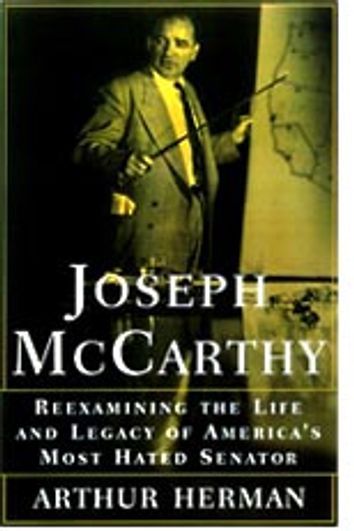
“Joseph McCarthy: Reexamining the Life and Legacy of America's Most Hated Senator” by Arthur Herman

A revisionist biography argues that the red-hunting senator got a bum rap.

In common usage, Joseph McCarthy’s name has become
synonymous with making groundless accusations, seeing enemies
everywhere and chasing at phantoms. Even writers relatively
sympathetic to the goals of the anti-communist crusade of the
1950s depict the Wisconsin senator who led it as a bully, a
demagogue and a drunk. Arthur Herman, an adjunct professor of
history at George Mason University in Virginia and the
coordinator of the Western Civilization Program at the
Smithsonian Institution, observes in his “Joseph McCarthy” that
for today’s commentators there’s no risk in deriding McCarthy and
little percentage in defending him: “McCarthy remains what the
Germans would call vogelfrei — the ‘free bird’ everyone
and anyone is free to take a shot at, even 40 years after his
death. Today he exists in most people’s imagination almost solely
as an established icon of evil.”

Herman believes that’s an unfair picture. If nothing else, it’s
an incomplete one because Americans had legitimate reasons to
fear Soviet infiltration in the immediate postwar years. The
United States and the Soviet Union were just about the only major
powers left standing, their interests were bound to clash and
there were nuclear weapons to worry about. Before and during the
war, a substantial number of leftist intellectuals and
institutions in the West were broadly supportive of the Soviet
Union; lured in by the dreamy, “let’s all share things” theory of
communism, they ended up countenancing purges, show trials,
political murders and intentional famines.


Herman certainly isn’t the first to point that failure out — or
to argue that the apparatus of the Communist Party of the United
States was basically under Stalin’s control. Simply put, there
was plenty of spying going on, and it seems that some of the
people offering foreign-policy advice to U.S. leaders were
willing to let parts of Europe and Asia fall under communist
control. That might come as a surprise to those who learned
everything they know about anti-communism from Arthur Miller,
Hollywood and the Nation, but scholars who have studied
declassified Soviet-bloc documents and other historical materials
have been saying it for years.

Obviously, that doesn’t mean that all or even most American
communists were spies or in any position to influence American
foreign policy, or that it was right to hound people because of
their political beliefs. Even among hardcore anti-communists, the
rap against McCarthy has always been that he was more interested
in grandstanding than in identifying actual infiltrators and
building strong, factual cases against them. Herman’s book
doesn’t do a whole lot to counter the charge. “Those who knew
McCarthy were constantly discovering to their astonishment how
little McCarthy knew about the theory or practice of communism
itself,” Herman says, and in so saying he makes the senator’s
supposedly principled anti-communist stance look more like a
free-floating xenophobia that just happened to home in on the
right target.

Make no mistake: Herman has exhaustively researched McCarthy’s
life and work, and he dutifully cites the countless mistakes and
outrages McCarthy committed. What’s bizarre is that none of them
seems to have provoked a flicker of indignation in the author.
For example, when Herman considers McCarthy’s vicious attack on
Gen. George Marshall in 1951, he refuses to take the senator’s
words at anything other than face value. “If Marshall were merely
stupid,” McCarthy lashed out, “the laws of probability would have
dictated that at least some of his decisions would have served
this country’s interest. … We have declined so precipitously in
relation to the Soviet Union in the last six years, how much
swifter may be our fall into disaster with Marshall’s policies
continuing to guide us?”

Ignoring the obvious implications of McCarthy’s statement, Herman
complains, “Critics bandied it about that McCarthy had called
Marshall a traitor (he had not), a secret Communist (he had not),
and even a coward.” Is Herman incredibly literal or just naive?
It’s certainly useful to try to understand, from the senator’s
point of view, why McCarthy did what he did. But at times Herman
simply takes leave of his own judgment. And some of the excuses
he offers for McCarthy’s conduct are astounding. McCarthy
“decided to lump where others took care to split,” Herman shrugs.
Oh, was that it?

Despite its flaws, Herman’s book is fascinating, and it visits a
lot of interesting territory: McCarthy’s friendship with the
Kennedys, his strong political support among Catholic voters, the
tactical mistakes that led to his eventual downfall. And Herman
makes a strong argument that the grounds on which the Senate
censured McCarthy were tenuous at best. But even then, Herman
takes his own argument one step too far. He compares McCarthy to
the victims of Stalin’s show trials, who, after their convictions
for nonexistent crimes, were hauled off and executed. For all of
Herman’s efforts to explain McCarthy’s excesses, the resulting
book is not at all flattering — to its author or to its subject.

Continue Reading Close

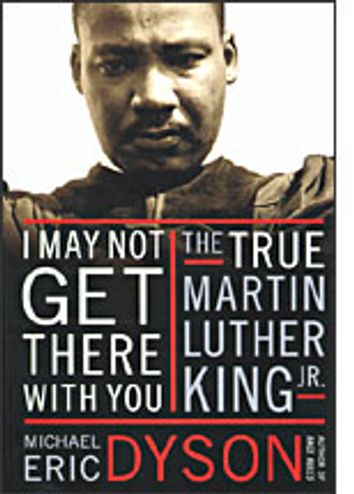
“I May Not Get There With You: The True Martin Luther King, Jr.” by Michael Eric Dyson

What would the civil rights leader think if he were alive today?

If Michael Eric Dyson had his way, Americans would put away the most famous speech Martin Luther King Jr. ever delivered and leave it there for 10 years. “I have a dream,” King proclaimed in 1963, “my four little children will one day live in a nation where they will not be judged by the color of their skin but by the content of their character.” Those words, interpreted then as a call to end discrimination against black Americans, have been more prominent lately in the campaign against affirmative action. And so the moratorium idea is convenient for Dyson’s own political purposes. The Columbia professor and Baptist preacher supports race-conscious remedies to the hardships black people face, and in laying aside “I Have a Dream” he would deprive his foes of the best sound bite they’ve got.

Dyson is right about one thing: Few Americans these days know much more about King’s thinking than what they remember of that speech. In Dyson’s view, King has been transformed into a “safe Negro,” a romantic dreamer who doesn’t make white people uncomfortable. So in “I May Not Get There With You,” he sets out to describe a King far more radical than the one trotted out for mainstream consumption on the third Monday of every January. “We must rebel,” he writes, “against the varieties of amnesia that compete to reduce King to an icon for the status quo or a puppet of civil and social order … King as he truly was is enough for us now, perhaps even too much — a fact that drives us to sanitize his image with soapy tales of how he wanted us to like each other very much.”

For most of his adult life, King did try to appeal to white people’s consciences and to basic American ideals. That strategy worked brilliantly when he and his followers braved attack dogs, fire hoses and Southern sheriffs who were benighted to the point of caricature. But King’s views changed in the mid-1960s, when he took his crusade against racism to Chicago. To hear Dyson tell it, the civil rights leader was bewildered by what he found: intense hostility among whites, demoralization among blacks and indifference all around to the “huge morality plays” like the ones he staged in the South.

Afterward, King showed much more reluctance to stake black people’s future on white goodwill. Rather than demanding reforms in existing institutions, he talked about “restructuring the whole of society.” By 1968, he was questioning whether black Americans could rightly celebrate the Bicentennial. He talked, at least privately, about the need for a democratic form of socialism. While his whole career reflected a desire for what Dyson calls “substantive, not just procedural, justice,” that theme became more pronounced in the last three years of his life.

Painting a truer picture of that life takes more than just rereading the speeches, though, and Dyson feels obligated to address King’s less honorable behavior. Critics have accused King of plagiarizing much of his academic writing, cheating on his wife and succumbing to sexism. Dyson concludes that King is guilty as charged; he thinks, though, that the man’s achievements outweigh his sins.

That’s a perfectly sensible judgment, but Dyson can’t leave well enough alone. He tries to place King’s plagiarism within a supposed black tradition of borrowing and expanding upon other people’s ideas — the same tradition, he suggests, that led to sampling on hip-hop records. He also hypothesizes that “King’s plagiarism at school is perhaps a sad symptom of his response to the racial times in which he matured.” Dyson tries to make a larger point out of King’s infidelity as well, declaring that his “relationship with Coretta symbolizes the difficulty faced by black leaders who attempted to forge a healthy life with their loved ones while the government aimed its huge resources at destroying their families, a sure metaphor for how the state has often abandoned or abused the black family with cruel social policies.” It’s awfully presumptuous to speculate on what lay inside a long-dead person’s heart. And it’s intellectually sloppy to extrapolate a whole critique of society from it.

Unlike critics who bemoan the shift in King’s tone from major key to minor, Dyson wants to revive and extend the work of the civil rights leader’s later years. Yet he blurs the difference between his own views and what King might have thought if he were still alive now. When Dyson urges the black church to work for class solidarity, stronger labor unions and other goals familiar to readers of the Nation, he describes it all as what “King might say.” When Dyson disagrees with King’s opinions — e.g., King “took too readily to the language of pathology to describe black ghetto families” — he dismisses those opinions as “serious mistakes.” That’s too bad. Dyson’s passion is evident, his writing is powerful and he’s right to fret about people who use King to suit their own purposes. If only the writer could practice what he preaches.

Continue Reading Close

“The Crisis of Desire: AIDS and the Fate of Gay Brotherhood”

A gay activist turns the revolutionary lens of the '70s on the sleepy politics of the '90s.

Like plenty of other gay men, writer Robin Hardy lived it up in the 1970s and early ’80s. He had lovers across North America and Europe, made friends with gay intellectuals and once hung out in a Toronto bar with a leather-clad Michel Foucault. He reveled in sex clubs and communal sex, to judge from his passionate writings on those subjects. By Hardy’s account, it was more than a good time. “It seems naive to say this now, but the men I saw around me in those days were at once not just potential lovers but brothers,” he recalls in “The Crisis of Desire.” And then the walls closed in. AIDS killed hundreds of thousands of gay men, and it also destroyed a sense of brotherhood that had grown out of sexual attraction. By Hardy’s account, it made gay men seek shelter in a dull monogamy and turn into supplicants at the feet of doctors, their own families, the government and the media.

Actually, “The Crisis of Desire” is only half of the book Hardy intended to write, according to the lengthy introduction by his friend David Groff. Hardy died in a hiking accident in 1995 but left behind a lengthy book proposal, drafts of a few chapters and extensive notes. Groff, a freelance writer and former editor for Crown, tried to stitch them together. And in the book that emerged, Hardy urges gay men to take control of their health, their sex lives and their fates.

In a few places, Hardy’s book is downright heart-rending. He writes achingly of his Dutch friend Hans, who chose to “quit” rather than keep struggling against HIV. Physician-assisted suicide is legal in the Netherlands, and Hardy was in Amsterdam when Hans was tidying up his affairs. “The pages of his daily agenda for the year 1991 were filled with notes of what he had yet to do up to a certain day — and then abruptly blank for the rest of the year,” Hardy reports. Hans died comfortably at home among friends after drinking a poison under a doctor’s supervision. Hardy can’t help but compare him with other terminally ill friends whose lives ended in madness or with guns or handfuls of pills. “Beyond sorrow and my loss, I saw a victory against a virus that knows no love,” Hardy writes. “In the final stages of his illness, Hans wrested control back from the disease, refusing to give it any more of the suffering and trials that it demanded. Of all the deaths I have seen — and I have seen too many — only his had dignity.”

Yet while Hardy is adept at sifting through the intricacies of loss and bereavement, his attempts at activist sociology often miss the mark. Consider his argument that gay men need to bring friendship and eroticism back into their lives: “Bound through our sex together and our histories, suffused with anger and ever-transforming desire, planted in different landscapes but fed by the same underground streams, we could find in fraternal love a paradigm we might healthily embrace.” It’s an odd point to dwell on, not because there’s anything wrong with friendship or eroticism but because modern gay America has plenty of both. (Ever been to a gay bar on a weekend night?) Yet Hardy is wistful — even nostalgic — for the political activism and easy sexual intimacy of the 1970s, and only by the standards of that era does gay life today seem sterile and tame.

Before the epidemic, Hardy was part of a revolution that was going to create alternatives to monogamy and heterosexual marriage. Gay politics in the 1990s is nowhere near as momentous. The gays-in-the-military debate, his book argues, is merely a distraction from the plague; same-sex marriage, when justified on the grounds that it would domesticate gay men, is “anathema to the historic truths of gay liberation.” And because gay men tried before AIDS to create a “new ideology of relationships,” Hardy even gets worked up over men who succumb to “unconsidered notions of love and marriage.” His bitterness is sad, and it’s also ironic. What’s the use of a liberation movement if people can’t make choices that the liberators dislike?

Continue Reading Close

Compassion Fatigue

Dante Ramos reviews 'Compassion Fatigue: How The Media Sell Disease, Famine, War And Death' by Susan D. Moeller

Forget the misleading subtitle of Susan D. Moeller’s book, for if American news outlets are trying to “sell” international crises, they are doing a terrible job. The cameras rolled as people starved to death in Somalia. Reporters sent back passionate dispatches from Bosnia. Yet sensing little public interest, the network news shows have drastically scaled back their coverage of world news. When the cover of Time or Newsweek features the foreign tragedy du jour, the magazines gather dust on newsstand shelves.

Can the American public really be so callous? “Why, despite the haunting nature of many of these images, do we seem to care less and less about the world around us?” asks Moeller, a professor at Brandeis University. The premise of “Compassion Fatigue” is that it isn’t the public’s fault. Moeller suggests that Americans are plumb worn out from lousy coverage of world events and are tuning it out entirely — and that some news organizations are responding by reporting only the most salacious foreign news.

As evidence, Moeller lists crises during which news outlets disserved their audiences with reductive or overly graphic coverage. For instance, the Ebola virus and flesh-eating bacteria captivated reporters; meningitis and sleeping sickness kill far more people but aren’t shocking enough to get much ink, Moeller says. She has a point. It can’t be healthy when dozens of newspapers and three 24-hour cable news channels reduce complex international crises to melodrama again and again. But Moeller’s long catalogue of overheated quotes and desperate situations is likely, on its own, to drive most readers to compassion fatigue (and also to “Compassion Fatigue” fatigue, since the book is often as repetitive as the news reports it criticizes).

Moeller views Americans’ disengagement from foreign affairs as a new problem, and she finds a new culprit: profit-minded media giants and the substitution of readership surveys for news judgment. It’s a reasonable hypothesis. In Hollywood, marketing techniques produced “Batman Forever”; in Washington, they produced Dick Morris and the Contract With America.

Though Moeller notices that the media have put less emphasis on world news since the collapse of the Soviet Union, she refuses to entertain the idea that Americans actually are less interested in world affairs. She overlooks one of our most ancient traditions: Except during wartime, Americans have unfortunately heeded George Washington’s warning against foreign entanglements. It’s no coincidence that, like the new isolationism of Pat Buchanan and Ross Perot, compassion fatigue became rampant when the Cold War ended.

Take another look at Somalia: People there had been starving to death for a year — and living in political anarchy for longer — by the time American cameras arrived in 1992. Media pictures convinced George Bush to send the Marines to Mogadishu with humanitarian aid, but most Americans were surprised when a warlord’s forces started killing U.S. soldiers. Suddenly, images of a Somali mob jeering at a dead serviceman flooded American TV. “And so was born the ‘Somali doctrine,’” Moeller writes, “the inheritor to the ‘Vietnam syndrome’ that argued that the United States should not get involved in faraway crises when its own security is not in danger.” But that doctrine has nothing to do with tuning out news coverage and everything to do with bad old American isolationism.

Continue Reading Close

Page 1 of 2 in Dante Ramos

www.salon.com/writer/dante_ramos/index.html