Daphne Eviatar

Attorney General Holder: Look at the torture photos

If he wants to know who to prosecute for torture, the photos the administration won't release might contain clues

Editor’s note: Glenn Greenwald is on vacation this week. Daphne Eviatar of The Washington Independent is guest-blogging today.

If, as the latest reports indicate, Eric Holder is serious about prosecuting the worst torture and abuse of “war on terror” prisoners that occurred during the Bush administration, then there’s some key evidence he’s going to want to take a look at: photographs. Although Bush Justice Department prosecutors claimed they didn’t have the facts to support prosecuting anyone for the mysterious deaths and disappearances of detainees hauled out of Bagram and Abu Ghraib in body bags, the photographs — which two courts have now ordered the Obama administration to turn over — would seem likely to provide some of the missing evidence.

The photos I’m talking about are the same ones that President Obama back in April promised to release to the public by May. Then, after consulting with Defense Department and CIA leaders, he changed his mind. The ACLU, which sued under the Freedom of Information Act to obtain them, won orders from a federal district court in New York in 2005 and then the court of appeals in 2008; both courts agreed that the photos are critical to the public debate over torture and the U.S. government’s counter-terrorism tactics, and don’t fall under any exemption to the freedom of information law. Still, the Obama administration isn’t budging.

Interestingly, while the case was on appeal, lawyers from the same Washington law firm that Eric Holder was then working at, Covington & Burling, wrote a powerful brief on behalf of 22 legal experts on the laws of war arguing for the photos’ release. These sorts of images are in part responsible for the regime of international humanitarian law that we have today, they argued.

The cornerstone of modern international humanitarian law — the Geneva Conventions of 1949 — was adopted after the release of vivid images of Nazi concentration camp survivors. And it was the United States and General Dwight D. Eisenhower himself who insisted on distributing huge volumes of these photos to the media. The images of corpses, prisoner remains and emaciated survivors helped persuade nations around the world to develop and adopt new universal humanitarian norms.

It’s because images can be so powerful and can motivate action that the Obama administration now wants to suppress them.

On Friday, the Justice Department filed a petition with the U.S. Supreme Court, arguing that releasing the photos of detainee abuse would so inflame public opinion against the United States abroad that it would endanger the lives of U.S. soldiers stationed in Iraq and Afghanistan.

(Initially, the government refused to turn them over on the grounds that they would violate the privacy rights of the detainees. After the ACLU and the court agreed to have the photos redacted to conceal identifying information and protect personal privacy, the government came up with this second reason to object.)

On its face, the argument sounds pretty reasonable. I have to admit that when the administration first announced its change of heart, although Glenn, Andrew Sullivan and many others were immediately outraged, I was somewhat sympathetic. After all, the Freedom of Information Act does include an exception to releasing information if it would reasonably be expected to “endanger the life or physical safety of any individual.” The photos of abuse at Abu Ghraib were certainly alarming. And who would want to endanger the lives of U.S. troops?

Meanwhile, the Justice department had collected sworn statements from top military generals — including General Richard Myers, then the Chairman of the Joint Chiefs of Staff and the Nation’s highest ranking military officer — saying that releasing the photos would do just that. Who are we to question the top brass?

Amrit Singh, an ACLU lawyer handling the case, answered that for me yesterday. “The argument the government has put forward is unacceptable because it would afford the greatest protection from disclosure to records that depict the worst kind of government misconduct. That is fundamentally inconsistent with FOIA. And it’s fundamentally inconsistent with democracy.”

It’s a good point. Though I want to protect our troops as much as anybody, it turns out the law wasn’t drafted to protect Americans from retaliation that might result because their country did something illegal, or even just really embarrassing. If it were, then evidence of any illegal or upsetting U.S. government conduct would be exempt from disclosure. And that would defeat the entire purpose of the Freedom of Information law.

According to the U.S. Supreme Court, the purpose of FOIA is “to ensure an informed citizenry, vital to the functioning of a democratic society, needed to check against corruption and to hold the governors accountable to the governed.” So you can see how that would be seriously compromised by the government’s interpretation of the law here.

It turns out that when you look at the language of the FOIA itself, the government’s interpretation doesn’t make much sense either.

Exemption 7(f) allows an agency to withhold “records or information compiled for law enforcement purposes, but only to the extent that the production of such law enforcement records or information … could reasonably be expected to endanger the life or physical safety of any individual.”

But does “any individual” mean any conceivable individual out there, or some specific individual that the government can identify?

The Court of Appeals ruled that because Congress said the release must endanger “any individual” rather than just “endanger life or physical safety” generally to be considered exempt, Congress must have meant some identifiable individual — a particular witness to a crime or subject of a law enforcement investigation, for example. If Congress had meant to include anyone who’s a member of a group of people who could possibly become the target of someone’s anger, it would have used the more general phrase, the court reasoned. So the court ruled the exemption doesn’t apply, and the Obama administration has to turn over the photographs.

Now, the administration faces a dilemma. When it released the Office of Legal Counsel memos written by the now-infamous John Yoo authorizing the administration to torture prisoners abroad, it wasn’t prepared for the media firestorm that erupted — and the growing public pressure to prosecute. Reluctant to face that again, Obama and senior officials in his administration are trying hard now not to stoke the fires. (Even if they can go along with a limited prosecution along the lines of what Eric Holder has described, they certainly don’t want to face calls for prosecuting senior Bush officials.)

But it looks like they can’t legally stop this release.

Still, they can delay it. Supreme Court review could delay the case months or even years, depending on what the court decides to do. In the meantime, other reports will be released about the Bush era anti-terror tactics. Those include the Senate Intelligence committee’s investigation led by Senator Dianne Feinstein, the report from the ethics division of the Justice Department, the Office of Professional Responsibility, on the work of the DOJ lawyers who crafted the memos, and, of course, the 2004 CIA Inspector General report I wrote about earlier that’s supposed to be released by the 24th of this month.

Which raises the question whether the government will invoke Exemption 7(f) of FOIA to try to withhold that report. After all, couldn’t the government make the exact same argument about the CIA report that it’s making about the photos? You see the slippery slope we’re on.

The CIA report apparently describes cases of abuse and deaths in custody so horrific that Attorney General Eric Holder was moved to consider initiating prosecutions. And that’s despite the fact that the Justice Department under Bush investigated those cases, but decided not to prosecute them. That report must be pretty upsetting.

So don’t be surprised if we start hearing that we shouldn’t be allowed to see that one either, because someone somewhere might get hurt.

The administration could, of course, try to distinguish the report from the photographs, arguing that, essentially, a picture is worth a thousand words. The photos may be just too powerful.

When faced with the atrocities of the Nazi concentration camps at the close of World War II, Eisenhower found that words failed him:

I have never felt able to describe my emotional reactions when I first came face to face with indisputable evidence of Nazi brutality and ruthless disregard of every shred of decency. Up to that time I had known about it only generally or through secondary sources. I am certain, however that I have never at any other time experienced an equal sense of shock . . . as soon as I returned to Patton’s headquarters that evening I sent communications to both Washington and London, urging the two governments to send instantly to Germany a random group of newspaper editors and representative groups from the national legislatures. I felt that the evidence should be immediately placed before the American and British publics in a fashion that would leave no room for cynical doubt. — “Crusade in Europe,” Dwight Eisenhower, pp. 408-9

One can only conclude that the Obama administration is taking refuge in that doubt, or is not prepared to face the consequences in this country once the current veil of doubt is lifted.

The opposite of the Nuremberg defense

If the Attorney General investigates torture, he will be forced to focus on those giving orders, not following them

Editor’s note: Glenn Greenwald is on vacation this week. Daphne Eviatar of The Washington Independent is guest-blogging today.

Ever since the Los Angeles Times reported last weekend that Attorney General Eric Holder is inching closer to investigating detainee torture that occurred during the “war on terror”, the debate over whether the Holder probe is a good thing has intensified — and distracted a few of us from the spectacle of the town hall brawls.

Andrew Sullivan at The Atlantic called it “the worst of both worlds” because Holder is reportedly considering prosecuting the actual interrogators who exceeded the interrogation limits set out by John Yoo & Co. in Justice Department memos, rather than the authors of the memos and the torture policy themselves. That “risks essentially legitimizing the torture it does not prosecute,” Sullivan argues.

And in this space on Monday, digby wrote that the purported impending investigation uses “inverted pretzel logic” to go after only “those who failed to follow John Yoo’s directives.”

Digby continues: “I think we can all see the problem here, can’t we? By prosecuting waterboarding “abuses” we are essentially declaring waterboarding under John Yoo’s only slightly less sadistic guidelines to be legal. Evidently, the new standard will be that if you’re going to torture, you’d better do it right.”

Well, sort of. These arguments urge the attorney general to do the right thing, but they don’t take politics into account. And the attorney general is, above all, a political animal.

Eric Holder knows that his boss (the president) and his boss’s chief of staff (Rahm Emanuel) don’t want prosecutions of the last White House to distract from the Obama agenda. So a criminal investigation of John Yoo, David Addington or Dick Cheney was just not on the table.

But I don’t think there’s any real way for an independent prosecutor to ethically investigate the torture and sadistic abuses inflicted on detainees at Abu Ghraib, Bagram and elsewhere without that ultimately leading up the chain of command — to who ordered what to happen and how. And that’s inevitably going to raise the much broader question of whether the legal memos actually represented a policy that was communicated to interrogators when they were beating prisoners and leaving them in the cold to die (more on that in a bit) or whether the “policy” was just created after the fact to make the whole interrogation process in the early lawless days of the “war on terror” look legitimate.

I realize this doesn’t address whether what those memos themselves describe was illegal, and why that bothers people who think that tactics like waterboarding and systematic sleep deprivation and confining people in tiny boxes with insects ought to be condemned and punished. But it’s a beginning of finally starting to hold someone accountable. And I’m convinced that if it’s done seriously by a truly independent prosecutor, it will be a key step toward exposing the whole truth about what really happened during those dark Bush years. And, one way or another, the truth will come out. (Don’t forget there’s still that Justice Department ethics report on the development of the torture memos that’s supposed to be issued any day now.)

Holder is likely to investigate some of the cases that were discussed in the highly anticipated still-classified 2004 CIA Inspector General Report, which is supposedly the thing that got Holder upset enough to consider taking action. (The fact that the declassified report is set to be released on August 24, and is likely to include some really gruesome details, probably helps motivate Holder, who as the nation’s top law enforcement officer surely doesn’t want to look like he’s deliberately ignoring heinous crimes.)

News reports and a series of letters between the Justice Department and Judiciary Committee member Dick Durbin that I’ve written about highlight some of the cases likely to get special attention. They include the death of an Afghan man who was stripped naked, dragged across a concrete floor and chained there by CIA operatives in a secret prison north of Kabul known as the “Salt Pit”; he was left on the floor overnight and froze to death.

Then there’s the death of Manadel al-Jamadi, an Iraqi insurgent who died just hours after he was captured and beaten by Navy SEALS, who hung him from his wrists, which were tied behind his back, until he was dead.

And there’s the killing of Iraqi Maj. Gen. Abed Hamed Mowhoush, a 56-year-old who, reportedly uncooperative with interrogators, was stuffed into a sleeping bag and clubbed to death.

Whether it’s a good idea to focus on these sorts of cases, which clearly went beyond the bounds laid out by the Bush Justice Department’s legal memos, or whether Holder ought to be prosecuting the authors of the memos themselves is kind of beside the point. Because the CIA agent who clubbed a man to death or hung him from his wrists on the ceiling or left someone in sub-zero temperatures chained to the floor naked is going to have to explain how he came to think that was acceptable interrogation conduct. And that’s likely to reveal that the bounds we’ve all seen in John Yoo’s torture memos — many of which were drafted years after these murders occurred — were never articulated to the interrogators on the front lines.

In fact, as the Los Angeles Times story notes (and as Digby pointed out), it’s not clear that CIA interrogators were ever even told about any legal memos.

” ‘A number of people could say honestly, correctly, ‘I didn’t know what was in [the memos]‘ ” a former senior U.S. intelligence official familiar with the operation of the interrogation program told the L.A. Times.

The Times’ reporters present that as if it’s a defense to the crime that will likely foil Holder’s prosecutions. Actually, it’s strong evidence that it’s the commanders and policymakers, rather than the front-line interrogators, who are most responsible. After all, particularly if they didn’t tell their subordinates what the rules were, then they have what lawyers call “command responsibility” for their subordinates’ actions. Think of it as the opposite of the Nuremberg defense — “just following orders” — that Bush staffers joked about in the e-mails released yesterday about the U.S. Attorney firings. They just “followed orders.” This is accountability for giving orders.

And isn’t it the higher-ups who knew this stuff was illegal and ordered people to do it anyway that we most want to hold responsible?

I made this point yesterday on Warren Olney’s radio show, “To the Point,” produced by KCRW and Public Radio International. Greg Miller, one of the L.A. Times reporters who wrote the story, was making the case on the air that Holder is going to have a really hard time prosecuting the CIA interrogators. Miller cited the claims of former Justice Department employees who investigated these cases during the Bush administration and did NOT refer them for prosecution because the facts to support a prosecution “just weren’t there.”

At no point during the show, though — nor in his LA Times piece — did Miller acknowledge that those former DOJ officials had a really strong incentive to say that the evidence just wasn’t there. After all, out of 24 cases of extreme brutality referred to the Justice Department for prosecution, 22 were “declined” by the Justice Department.

Last year, Brian Benczkowski, then principal deputy assistant attorney general, explained to Sen. Durbin in a letter that “All of the declinations [to prosecute] resulted from insufficient evidence to warrant criminal prosecution for one or more of the following reasons: insufficient evidence of criminal conduct, insufficient evidence of the subject’s involvement, insufficient evidence of criminal intent, and low probability of conviction.”

Justice Department employees told Miller of the L.A. Times, meanwhile, that they had “difficulty locating witnesses and identifying documents — such as clinical examinations or autopsies — that could withstand scrutiny in federal court.”

That just doesn’t add up. These were murders and cases of abuse so serious that even Bush officials – who’d been told that waterboarding and the rest of the so-called “extreme interrogation tactics” were legal — referred them to the Department of Justice for prosecution. And they all took place in U.S.-run prisons, with surely more than one lone interrogator present. (If you imagine the logistics of getting hanging a grown man by his wrists, while they’re tied behind his back, it would seem you’d need at least two people there to do it.) But there were no witnesses? No CIA agents or U.S. soldiers or anyone around to see a guy get clubbed to death, or dragged around a floor naked and left in the cold to die?

(This is, by the way, another reason why those photos of torture that the ACLU is still fighting the Justice Department to see, the release of which the Obama administration is asking the Supreme Court to block, are so important — because they’d show some of the witnesses to these crimes. But I’ll have more on that case later.)

“We wanted to make these cases,” a former Justice official familiar reportedly told the L.A. Times. “We looked at them as hard as we could, and they just weren’t there.”

Eric Holder, to his credit, is apparently not buying that.

Ultimately, any thorough presentation will have to follow the chain of command, and it will be awfully difficult to skirt the issue of waterboarding.

Bruce Fein, a former Deputy Attorney General under President Ronald Reagan made some really good points about that yesterday on Olney’s show. First, the constitution says that the president “shall take care that the laws be faithfully executed.” So he doesn’t get to just pick and choose what to prosecute, and not to prosecute obviously illegal conduct. (Fein knows what he’s talking about; as a lawyer in the Office of Legal Counsel in 1972, he participated in drafting impeachment charges against Richard Nixon.) Given that both President Obama and Eric Holder have publicly testified that waterboarding is torture and illegal, and given that Dick Cheney has boasted about authorizing it, it would seem pretty clear that something should be done about that.

Fein added that if the president or attorney general don’t want to punish people who may have believed they were following the law, even though they weren’t, then the answer is to pardon them — not to ignore that crimes occurred.

“The reason a Pardon is so much more important than no prosecution is that in a pardon situation the recipient confesses that what was done was wrong,” said Fein. “The country doesn’t acknowledge that what was done was legal, but that there are circumstances that justify leniency.”

Clearly President Obama and his attorney general aren’t yet willing to go there. But prosecuting at least the unquestionably illegal activity is a good start.

Continue Reading Close

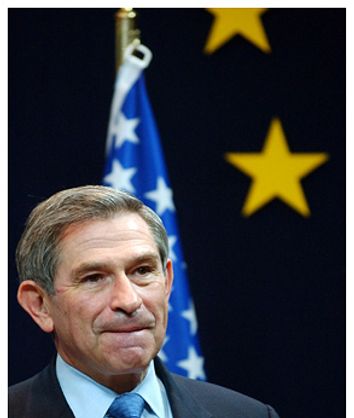
Wolfowitz’s new agenda

Experts say the war hawk's fealty to the oil industry could derail the World Bank's mission to reduce poverty.

On the same day that Goldman Sachs predicted world oil shortages could spike the price of oil to $105 a barrel, Paul Wolfowitz was confirmed as the World Bank’s next president. The confirmation of Wolfowitz on March 31 turned around what might otherwise have been a bad-news day for the White House. Now, a leading architect of U.S. foreign policy would be in a position to pressure the world’s largest public financial institution to help pay for the exploration, drilling and transport of America’s most coveted natural resource.

Of course, it’s too early to know for sure what Wolfowitz will do. But experts who’ve followed the bank’s troubled history in financing the oil, gas and mining industries around the world have real concerns about how the soon to be ex-deputy secretary of defense will balance his long-touted commitments to a “new American century” with the very different ones he’ll assume on June 1 at the World Bank. Although Wolfowitz has assured his critics that he believes deeply in the bank’s aim of reducing poverty, calling it “a noble mission and a matter of enlightened self-interest,” U.S. foreign policy, forged under Wolfowitz’s strong hand, has been dedicated to American hegemony, energy security and the opening of foreign markets to U.S. business — goals that are often in conflict with the bank’s mission.

Whether the bank’s next leader can reconcile his old beliefs with his new position is a burning question among longtime critics of the World Bank’s financial support for companies like Halliburton, ChevronTexaco and ExxonMobil (among the bank’s biggest private beneficiaries), supposedly in the interest of alleviating poverty. Decades’ worth of studies, often performed by the bank’s own experts, have shown that oil, gas and other so-called extractive-industry projects have done little to promote growth in poor countries. On the contrary, countries that depend economically on oil exports tend to have slow growth, deep-seated corruption, repressive governments and frequent conflict. The phenomenon is so widely known it has a name — the resource curse. And it has led experts across the political spectrum to claim that the bank has been derelict in its duty to the world’s poor, employing policies that make poor countries even more dependent on selling their finite natural resources to the highest foreign bidder.

In response to mounting pressure, the bank commissioned an independent study in July 2001, which after two years of exhaustive research worldwide concluded that the bank should impose stringent standards and stronger safeguards on oil and gas projects and, by 2008, stop supporting oil production altogether. Ultimately, the bank’s top brass would not agree to stop financing oil industry projects, but they did promise future reforms aimed at curbing corruption and ensuring that oil profits reach countries’ poor.

It will now be up to Wolfowitz to carry out those reforms. But some are skeptical that he’ll be able to shed his Pentagon perspective enough to genuinely pursue the bank’s antipoverty mission. Indeed, some believe he was placed in his new post precisely to pursue U.S. policy objectives. Wolfowitz’s appointment “strongly suggests that President Bush has something specific in mind for the bank — to be an instrument of U.S. power,” says William Easterly, a former World Bank economist who now teaches at New York University.

Easterly is not alone in that view, and over the years, Wolfowitz himself has made it clear how he believes U.S. power should be exercised. “In the Middle East and Southwest Asia,” Wolfowitz wrote in a draft Defense Planning Guidance document in February 1992, leaked to the New York Times, “our overall objective is to remain the predominant outside power in the region and preserve U.S. and Western access to the region’s oil.”

Those sorts of statements are now causing serious concern. “I worry that Wolfowitz will be more concerned about increasing global fuel production, and less concerned about whether or not such projects actually contribute to economic development and poverty alleviation in oil-producing countries,” says Michael Ross, a UCLA politics professor who advised the World Bank’s extractive-industries review chairman.

Manish Bapna, director of the Bank Information Center, a watchdog group, warns that Wolfowitz’s past concern with U.S. oil security is in direct conflict with his more recent statements about promoting democracy. “The focus on strengthening democracy would seem to support requiring strong governance standards before providing financial support to countries to develop their oil resources. But much of the oil development in the world today is in countries which are not democratic and whose governments are not accountable to international norms. How will those objectives be reconciled?”

Not everybody lacks faith in Wolfowitz’s ability to shift focus. David Victor, a senior fellow at the Council on Foreign Relations and director of the Program on Energy and Sustainable Development at Stanford University, a project funded substantially by BP and the Electric Power Research Institute (created and supported by the major utility companies), says the appointment of Wolfowitz “offers the opportunity for the administration to extend to the bank a philosophy of development that focuses on underlying fundamentals — good fiscal management, rule of law, openness to trade — that have been shown to drive whether countries actually make good use of development dollars. I would be pretty confident this will be a big part of the philosophy at the bank: setting the conditions for sustainable development rather than just putting money into projects.”

Perhaps, but many industry experts note that supporting large oil and gas projects almost always comes into conflict with fighting corruption and promoting sustainable development. As UCLA’s Ross and others have shown, oil production often distorts the economy, exacerbates corruption and inhibits the development of true democracy. And the bank can easily become part of the problem, because large multinational corporations that borrow from the bank to invest in developing countries usually contract with national governments, which are typically in charge of the countries’ oil and gas industries. As a result, huge amounts of money often are funneled to corrupt, antidemocratic or repressive governments. With little incentive to insist on transparency or democratic reform, a corporation financed by the bank essentially ends up propping up a corrupt government and becoming a critical part of the corruption.

Allan Meltzer, professor of political economy at Carnegie Mellon University and a visiting scholar at the American Enterprise Institute, doesn’t think the problem of corruption is the fault of the oil industry per se but the result of years’ worth of financial support provided to corrupt governments. “The obvious thing is to say we’re not going to give money to countries that are corrupt,” he says. And he predicts that Wolfowitz — coming from the same administration that created the Millennium Challenge Account, a foreign-aid program designed to target aid toward well-functioning governments — may well try to institute such a reform.

Wolfowitz has certainly promised to crack down on corruption at the World Bank. And he touts his experience in Indonesia as an example of his interest in third-world development. But to many, his past actions don’t inspire confidence. After leaving his ambassador’s post, Wolfowitz used his Indonesian contacts to help found the U.S.-Indonesia Society, a private organization funded by oil and mining companies to press U.S. business interests in Indonesia, even though those companies knowingly financed the notoriously corrupt and abusive military-backed regime of President Suharto. The society’s most active members included New Orleans-based mining giant Freeport-McMoRan, one of the largest American investors in Indonesia, which generated billions of dollars for the Suharto government while so brutalizing the environment and endangering local residents that it lost its U.S.-backed political risk insurance in 1995.

And Wolfowitz was strangely silent on the Suharto government’s cronyism, even reporting to Congress in 1997 that Suharto provided “strong and remarkable leadership,” notwithstanding vast human rights abuses in East Timor. “He didn’t seem to look at who was really benefiting most from gross corruption in Indonesia,” says Ian Gary, an advisor on extractive industries for Catholic Relief Services. “For me, the question is whether Wolfowitz will make the intellectual connection between the role that natural resources and particularly oil have played in fueling corruption — by concentrating power in the hands of the elite few — and what he says is his interest in good government.”

Until now, Wolfowitz has expressed great faith in the capacity of oil to bail out developing nations. In fact, he said it would be the key to postwar development in Iraq. Iraq’s oil revenues “could bring between $50 [billion] and $100 billion over the course of the next two or three years,” Wolfowitz told the House Budget Committee in February 2003. “We are dealing with a country that can really finance its own reconstruction and relatively soon.”

But experts were already warning that the Pentagon’s faith in oil was folly. “His miscalculation on Iraq was appalling,” says Youssef Ibrahim, managing director of the Dubai-based Strategic Energy Investment Group and former energy editor for the Wall Street Journal. “Before the invasion, Iraq exported to the outside world 3.5 million barrels of oil a day. Today, on a lucky day, Iraq exports maybe 1.4 million barrels. Not only did he completely miscalculate what Iraqi production would be after the war, but in fact the world has lost nearly 2 million barrels a day of Iraqi oil.”

What’s more, even if oil does provide vast revenues to a government, many believe a public multilateral institution dedicated to fighting poverty ought not be financing the projects of private oil companies, which would be likely to invest in oil-rich developing countries anyway. “Oil is not an industry that is in need of any capital,” says Ibrahim, a consultant to major oil companies. “I’m concerned that he would divert funds from worthwhile projects to things like looking for oil, which are pretty much within the hands of major multinational oil companies (which have very deep pockets). This would be squandering the World Bank’s funds, and a misallocation of public resources.”

Wolfowitz’s long-standing support for privatization raises more concerns. He was one of the leading proponents of early privatization of state-owned enterprises in Iraq, including the oil industry, which likely would have been a violation of international law. Some watching the World Bank worry that as head of the world’s largest public lending institution, he’ll press governments to privatize their industries to make them available for U.S. investment, regardless of whether that’s in their best interests. They also worry that he’ll emphasize foreign corporate investment over government-run antipoverty programs, channeling more money toward the arm of the bank that lends to corporations and less toward poor countries’ governments. “Many of us fear that Wolfowitz will yank the World Bank away from a growing emphasis on programs that reach the poor and cast it back onto these giant infrastructure projects which primarily help big companies,” says John Cavanagh, president of the Institute for Policy Studies in Washington, which has tracked a recent significant shift by the bank away from financing governments and toward financing corporations in the oil and gas sector. (Altogether, the World Bank has put up more than $11 billion for oil, gas and coal projects since 1992.)

It was the last World Bank president to come from the Pentagon — Robert McNamara — who originally concentrated bank lending on huge infrastructure projects such as highways, ports and dams. Many of these projects, which some critics believe were chosen for supporting U.S. foreign policy interests rather than because of their suitability as development projects, in retrospect are viewed as environmental, social and economic disasters.

Wolfowitz will face another controversial policy debate at the bank — whether it should provide grants rather than loans to the poorest countries, a reform the Bush administration has pushed. While grants have the virtue of not encumbering poor governments with more debt, they make the bank more dependent on its member countries for replenishment of the unpaid money, and some of those countries face serious political obstacles to providing additional funds. The result, some fear, could be an overall shrinking of the bank’s investments in poor governments and an increasing dependence on multinational corporations, rather than democratic governments, to drive third-world development.

Now, some of the standards those companies must follow are at risk of being jettisoned. The International Finance Corporation, part of the World Bank, is currently reevaluating the environmental and social safeguards it requires of all World Bank-sponsored projects. These minimum standards ensure that companies borrowing from the bank employ modern environmental protections and consult with communities adversely affected — forced to move, for example — by bank projects. The bank’s requirements have been adopted by many major commercial banks and now set the standard for about 80 percent of the major infrastructure projects financed worldwide. Early drafts of the IFC’s proposed changes suggest the bank may water down those standards significantly.

“I worry that Wolfowitz will take advantage of lax safeguards at the IFC being created to promote a business agenda, as he did in Indonesia and has been done in Iraq, in a way that someone less oriented toward big business might not,” says Steve Kretzmann, founder of Oil Change, a new nonprofit focusing on petro-politics. As oil prices rise, shortages loom and the United States faces growing competition for oil supplies from emerging superpowers like China, the pressure to put American business interests first will only grow.

In the end, how Wolfowitz conducts his World Bank presidency will come down to whether he carries the resource curse into his new job. Can he shift his focus from the United States’ unilateral foreign policy objectives to the very different antipoverty mission of the most economically powerful multilateral institution in the world?

“Wolfowitz has instincts that are a sort of coercive utopian idealism, where American power, and now maybe World Bank financial muscle, are used to force the American version of utopian ideals like democracy and free-market opportunity on the rest of the world,” says Easterly, the former World Bank economist. “I actually believe in those ideals myself, but I don’t think they can be forced on anybody from the outside, and I don’t think that their current American incarnation represents some perfect model that everybody else should follow.”

Since all indications are that Wolfowitz wants the rest of the world to follow where America leads, his biggest challenge may be adapting his unqualified American utopianism to the murky realities of the developing world.

Continue Reading Close
www.salon.com/writer/daphne_eviatar/index.html