Dave Cullen

John Kerry’s lesbian moment

Dick and Lynne Cheney screamed foul when the Democratic candidate mentioned their gay daughter. But for gays and lesbians, what is most outrageous is the Cheneys' outrage.

America’s most notorious lesbian is back.

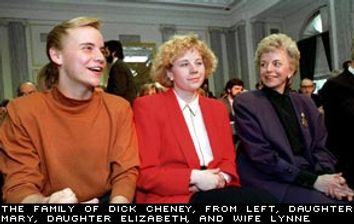
In the final presidential debate, John Kerry responded to a gay-rights question with a reference to Vice President Dick Cheney’s gay daughter. The vice president’s wife, Lynne Cheney, immediately went ballistic, condemning Kerry in her most moralistic tones as “not a good man” for the “cheap and tawdry political trick.” By Thursday morning, it was all over the news networks, with the vice president also impugning Kerry’s character and describing himself as “a pretty angry father.” CNN’s Wolf Blitzer gravely speculated that the controversy could dominate the entire post-debate landscape. Well, yeah, if the Cheneys — supposedly outraged by the violation of their daughter’s privacy — get their way and keep the issue burning brightly in the public eye.

How incredibly sad for Mary Cheney, the lesbian in question. And not for the reasons that her parents and the pundits have been screaming about.

First, let’s dispense with the comic aspects of the parental indignation:

  • Mary Cheney has been happily out of the closet for at least a decade, so John Kerry was hardly dragging her out against her will.
  • She spent the late ’90s working as a veritable professional lesbian, as gay and lesbian corporate relations manager for Coors Brewing Co.
  • Dick Cheney himself has been using her sexuality on the campaign trail. Click here to watch a Human Rights Campaign ad with him on the stump on Aug. 24, 2004: “Lynne and I have a gay daughter … ”
  • The Bush-Cheney administration has shamelessly used homosexuality as a wedge issue, never hesitating to play the sodomite card when it serves their political ends.
  • John Edwards brought up Mary Cheney in response to a similar gay-rights question just eight days earlier in the veep debate. Dick Cheney responded by thanking him for his kind remarks.

    Maybe Dick’s indignation began later that night watching “The Daily Show.” Jon Stewart poked fun at Edwards for opportunistically screaming GAY DAUGHTER! GAY DAUGHTER! to any homophobe out there who still hadn’t heard about it.

    It didn’t go much further, but twice in one week was apparently too much — for the Cheneys and for the media. The conservative cable clones began piling on. Even some liberals have been squeamish about the Democrats invoking Mary’s lesbianism so shamelessly.

    But they just don’t get it. Much of the gay population is incensed. At the media.

    Let’s get one thing straight. It is not an insult to call a proudly public lesbian a lesbian. It’s an insult to gasp when someone calls her a lesbian. That’s how all the gays I have spoken to the past 24 hours perceived the press response. You’re embarrassed for us. And it’s infuriating.

    Consider the way a paraplegic or a blind person feels when you act just a little too sympathetic about their “plight.” We don’t want your pity! Can you see how insulting it is?

    The only thing offensive about Kerry’s statement to us gay people was that he had to pause mid-sentence and gulp and sputter the terrifying word out: “Dick Cheney’s daughter, who is … a lesbian …”

    It’s not a dirty word, John. And why is the press reacting like he exposed a breast?

    The most outlandish exchange I’ve seen came in a scholarly Fox News debate Thursday — seriously, it happens — over the candidates’ linguistic styles, of all things. The conservative guy, Eric Dezenhall, charged that “the invocation of Vice President Cheney’s daughter’s lesbianism was sort of a radioactive concept. The words lesbian in a presidential debate — even if you don’t mean it to be mean — came across as off the grid, and very, very shrill.”

    Is he serious? If it’s innocent little gay people you think you’re protecting here, listen up! Gay people do not consider the invocation of our existence radioactive. It’s the comparisons to plutonium that drive us nuts. We are not toxic.

    A gay reader e-mailed to lament that, “I’ve heard my own mom say that she wished there was a ‘nicer’ word” than “lesbian.”

    At least he didn’t have Lynne Cheney for a mom.

    Her response was truly deplorable. If Mary Cheney is distraught this morning, it’s likely her mother is the cause. And it’s perplexing to millions of gay Americans today why the press has not grasped how horrible she acted toward Mary Wednesday night.

    Maybe it’s understandable. Most of you out there have never been a homo. Let me share a personal story to illustrate how this works for a gay person. I came out to my parents when I was in my 30s — they were shocked, then understanding, but also a little queasy about it. The queasiness was much less about them accepting me as it was their friends accepting them.

    That’s the part that stings. No matter how old you get.

    Once you’re happily out of the closet a few years, you don’t bat an eye at someone hearing you’re gay. Even on national television. Even if your father’s the vice president. (Especially if your father’s the vice president — don’t you think she’s used to it by now?)

    What rips your heart out is when someone close to you denies your sexuality in public. Or shudders at the mention of it, so you can see how desperately they want to.

    It may sound like a subtle implication to a straight person — clearly it does; even the most liberal straight pundits appear oblivious to it — but a gay person hears it scream out loud and clear. You people still feel there’s something to be ashamed of here.

    One of the happiest days of my life came when one of the old ladies at my mom’s Catholic bridge club mentioned what a nice young husband I’d make. My mother, in her 60s by then, laughed it off. “I don’t think that’s going to happen,” she said. “He’s gay.”

    I was stunned when I heard the story. It had taken her years to get to that point. And it meant everything to me. She didn’t care what the bridge ladies thought. She cared more about me.

    I doubt very much that Mary Cheney gives a rat’s ass if some church lady in Idaho knows she’s gay. But her mother cringing at the church lady knowing — that’s gotta hurt like hell.

  • Sexual turbulence in Colorado Springs

    The Air Force Academy's new hard-line policies will curb rape and harassment -- but they don't do enough to protect the victims.

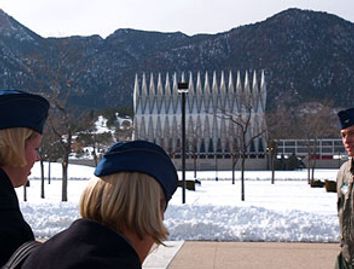
    With one Pentagon investigation complete, two more underway, and a fourth still pending, an Air Force “implementation team” arrived here this week to initiate changes designed to end a sordid history of cadet rapes and leadership indifference that broke in the media several months ago. The team has orders to literally transform campus culture, leaving intact the tools necessary to “cultivate a warrior spirit,” while purging elements that helped create a climate of sexual harassment and assault that goes back at least a decade.

    The blueprint for the operation, called the Agenda for Change, takes on half a century of entrenched military tradition, and toppled two key symbols of the old regime right away. In a surprise move, the Pentagon sacked the senior leadership of the academy — both generals and two top colonels — and then removed the enormous sign that commanded “BRING ME MEN …” from the center of campus, leaving a naked granite wall in its place.

    Both steps stunned the inhabitants of this sequestered compound, who were still reeling from months of media coverage about cadet rapes and the botched investigations that followed. But faculty members, cadets and military scholars, impressed as they were by the scope and breadth of the proposed changes, are not convinced that the academy’s culture can be cracked — even by 49 bullet points of reform and new leadership. And rape counselors have no doubt: The agenda overlooks key aspects of victim psychology — above all, the need for confidentiality — necessary to make the academy safe for its students.

    “The first or second question from the victim is nearly always ‘Is this confidential? Will you call the [military leadership]?’” says Christine Hansen, founder of the Miles Foundation, a national nonprofit dedicated to victims of domestic abuse in the military. “If they don’t establish confidentiality immediately, the victim is out the door.”

    For its part, the Air Force chose a response — swift and hard-hitting — that tackled the basic charges: that crimes had occurred in the ranks and the perpetrators escaped prosecution and discipline. With military precision, the Agenda for Change addresses the issue of finding and neutralizing the enemy, leaving more ephemeral and emotional issues to work themselves out. While well-intended, say critics of the reforms, they are too official and too narrowly focused for the intimate and emotionally complex crime of rape.

    And yet the change that victims’ advocates are seeking — for the Air Force to relinquish primary control over cases of sexual assault — is regarded as equally unrealistic in a community where control and loyalty must be total for complete success.

    - – - – - – - – - – - -

    Since the first public report of sexual attacks at the academy appeared in January in Westword, a scrappy Denver-based weekly, Pentagon investigators have learned of 56 cases of sexual assault, and acknowledged that academy leadership mishandled some of them. Congress has presided over weeks of hearings on the scandal, and early this month, Sens. Wayne Allard, R-Colo., and John McCain, R-Ariz., tore into Air Force Secretary James Roche for defending academy leaders that he reassigned as the crisis exploded in the media. The Senate has since authorized a fourth, independent team, to be appointed by Defense Secretary Donald Rumsfeld, to assign blame for the crisis, even as the implementation team begins its mission to bring specific reforms to campus.

    Those reforms go to the essence of academy doctrine — loyalty and its expression within the corps — to stress personal responsibility, eliminate opportunities for intimidation and humiliation, and promote open communication, despite longstanding codes of silence. In specific, the changes propose beefing up adult oversight and weakening the student chain of command — stripping sophomores of authority over freshmen, for instance. Taken together, the reforms suggest an ambitious and thoroughgoing overhaul of academy structure that took professors, cadets and military scholars by surprise.

    “If this had been a one-page document saying ‘zero tolerance’ that a commander could read one morning in front of formation, then I would have been disappointed,” said professor Melissa Embser-Herbert, a sociologist specializing in women in the military and author of “Camouflage Isn’t Only for Combat: Gender, Sexuality, and Women in the Military.” “The fact that it’s fairly detailed and conveys that someone put a lot of thought into this thing should convey that, ‘We’re not just doing something to please Congress.’”

    A sign of the Air Force’s seriousness was its willingness to suggest changes that affect the guiding principle of the academy model — the same principle employed at West Point, the Naval Academy, and the services’ officer candidate training schools. That approach has been to overwhelm the cadet with so much stress, from so many different angles, that he or she cannot possibly overcome them individually. “They artificially create crises to make people work together,” says professor Lance Janda, a military historian specializing in women in the military. He spent five years researching the book “Stronger than Custom: West Point and the Admission of Women.”

    Because military doctrine since World War II holds that men and women in battle do not fight to stay alive — they fight to keep their comrades alive — the concepts of “unit cohesion” and “esprit de corps” take on religious significance to combat commanders. In an effort to produce model soldiers, the academies drive these concepts to the extreme. They have been successful at instilling group cohesion; but, as demonstrated by the rape crisis, they eventually suffered from their own success.

    “Once the group pulls together, when an individual does the wrong thing” — rapes a junior cadet for instance — “the instinct is to say ‘My loyalty to the group means I have to cover for this individual,’” Janda says. Faced with crisis, the group circles the wagons, and anyone threatening a group member becomes the enemy — including a member of the group.

    In this climate, a rape accusation threatens not only a group member, it also tarnishes the integrity of the unit. This plays right into another core concept at the academies: the constant indoctrination that cadets are elite, special, superior to civilians. The prospect of a rapist in their ranks threatens to shatter the group’s reputation. “We are members of the profession of arms, the noblest of professions” wrote incoming Commandant General John Weida to cadets last week in an introductory e-mail titled “Getting Started.”

    The phenomenon is similar to the code of silence in police units, but with troubling complications. Age and power provide the most striking differences: Imagine the thin blue line manned by adolescents. Imagine a rogue cop with not just power over a subordinate’s career, but over his ability to eat, sleep or go to the bathroom.

    “When a freshman wants to leave his room just to go to the bathroom, he puts himself at risk,” an academy professor said. Lurking around any corner lies a potential upperclassman with the power to stop him, haze him, berate him, drop him for pushups and issue demerits. “It’s a high-anxiety situation,” the professor said.

    Compounding that anxiety is the official power that upperclassmen have wielded in academy hierarchy. A cadet’s entire chain of command, through five levels of superior officers, is composed exclusively of fellow students. The first officer to appear with command authority is the commandant of the entire academy, the general serving a role akin to dean of students.

    The system is designed to thrust responsibility upon the young cadet until it becomes second nature. But when an angry, vindictive adolescent gets hold of that much power, the combination can be unnecessarily destructive.

    “Any sophomore who’s pissed off for any reason can just shit on a doolie just because he can,” said a high-ranking military professor at the academy. And sophomores, fresh and bitter from their own relentless year of hazing, tend to be anxious to dish it back out to the next class most viciously.

    “It’s a tremendous amount of power for a 19-year-old to hold over an 18-year-old,” the professor said. Even cadets are daunted by the power they wield. “Last summer I was a colonel in the academy,” said senior Andy Allen. “I had power over 2,000 people. Despite that, I was 21 years old.”

    While they don’t dismantle the chain of command at the academy, the proposed reforms take a hefty bite out its most dangerous elements — sufficient, the Pentagon hopes, to rein in wayward cadets playing dictator in their own private fiefdoms. Instead of a single general commanding 4,200 cadets, one major will now command each squadron of about 120. Those officers are in place already, but only in an administrative role. They will now assume command, a drastic change in military governance.

    New rules require most of these officers to be one rank and several years older than the current crop — with significant other military perks certain to a attract a higher caliber of officer. Sophomores, currently vested with primary responsibility for training the freshmen in military knowledge, will transfer that duty to seniors. The changes “should prevent most opportunities for abuse of power relationships,” said Pentagon spokesman and academy graduate Capt. Peter Kerr.

    A new law-and-order system is designed to “enhance officer supervision of the cadet wing,” said Pentagon spokesman Lt. Col. Dewey Ford. A round-the-clock dorm security and monitoring system will be implemented. An officer will be placed on duty at all times in the dorms. He or she will manage a roving patrol nights and weekends. Upperclassmen will no longer be permitted to burst into the room of opposite-sex subordinates to force them carry out orders. Cadets will now be required to knock and wait for the occupant to open the door. Doors must now remain fully open whenever visitors are present.

    Perhaps the most significant change is a mandatory and blanket amnesty that absolves nearly all cadets from offenses discovered during a sexual-assault investigation. (Drinking is the most common.) The Air Force included a few exceptions to the rule meant to crack the cadet code of silence: Anyone covering up a sexual assault or impeding the investigation loses amnesty for their own infractions, hopefully tilting the scales in a battle of divided loyalties. The senior ranking cadet present is also excluded, and will now be held accountable for all infractions committed by subordinates. This puts one person at tremendous risk for underage or dormitory drinking — intended to reduce situations that later descend into rape.

    - – - – - – - – - – - -

    While outsiders focused on concrete changes to academy rules, military scholars said subtler themes in the agenda could prove more influential. They advised critics against viewing academy culture through a civilian lens. In a world that revolves around the idea of honor, they say, “disloyalty” and “dishonor” are fighting words, making the language in the agenda a huge institutional leap. The agenda acknowledged “misguided loyalty” and abuse of the honor code, and put cadets on notice against hiding behind the letter of the code. Those passages could have enormous impact, said Embser-Herbert. “That’s how so much of this operates.”

    Nonetheless, rape counselors and other victim advocates quietly fumed about the proposal’s inadequacies. By focusing so intently on its own culture, they say, the military lost sight of a second, and perhaps more dominant imperative: the necessity to acknowledge and incorporate the psychology of victims in rules proposed to deal with sexual assault.

    The proposed changes go to great lengths to create a climate in which blame might be easier to place on the perpetrator, acknowledge critics of the reforms, but they don’t do enough to make victims feel safe enough to report the crime. It is a dilemma common to civilian courts as well — victims need protection, but it cannot come at the expense of the rights of the accused. Unfortunately, the Air Force, say these critics, tends to sacrifice the victim in order to quickly catch and prosecute the offender.

    Evidence of this oversight is clear, say victims’ advocates: By demanding that rapes be reported by anyone with knowledge of the attack, regardless of a victim’s wish for anonymity, the military fails to give assaulted cadets a grace period in which to get counseling and relief from their trauma — a period during which they might decide not to initiate formal proceedings against their attackers.

    “It’s still the same mantra of, ‘You’ve got to report,’” says said Cari Davis, executive director of Tessa, the Colorado Springs domestic violence agency that counseled many of the academy assault victims. “And anyone who doesn’t report is a criminal.”

    Anyone seeking help from the academy’s counseling center or peer counseling program will effectively have gone public about the crime, ceding full control to the commander. Even medical attention will close out a victim’s options. Victims’ advocates were thrilled that medical facilities on the academy campus will now stock rape kits and be staffed with personnel trained to use them (though they wondered what took so long). But they blanched at the prospect of medical staff as informants.

    Even more troubling, say the advocates, is the fact that a close friend or roommate in whom a victim confides is legally bound to report on her behalf. Davis said most rape victims suffer some level of post-traumatic stress disorder (PTSD), making it essential that they talk to someone about the attack. Isolating her at this pivotal moment — or adding the stress and guilt of putting her best friend at risk — can seriously exacerbate the psychological trauma, she says. Said Jennifer Bier, director of Tessa’s clinical services, “Victims have to have a right to talk to somebody and have that held in confidence.”

    By giving control of complaints to commanding officers, who routinely function as cop, judge and jury in assault cases, the military builds dangerous subjectivity into what is a serious criminal matter, say the advocates. Air Force officials have failed to grasp that many victims will never trust academy commanders as impartial since, with a investment of more than $300,000 per cadet, the academy, and its commanders, start with a bias, say critics.

    Commanders often bond with cadets, commonly viewing them like sons, say victim advocates. Rapists can be solid performers in other areas, and commanders may find it difficult to conceive of a young man they admire attacking a woman. The situation is rife with conflicts of interest, Davis said. She paraphrased her victims’ take on their commanders this way: “I’m going to throw out my best guy, who could be one of my best pilots, because some girl who was drunk says she was sexually assaulted?”

    And finally, by failing to make a provision to keep such events out of a cadet’s permanent record, the academy, say rape counselors, discourages victims from reporting sexual assault for fear of ruining their chances for advancement in their careers. “These medical records and mental health records must be kept separate and sealed,” Davis said. The officer corps is a very small community, and “the higher up you go, the tighter the circle.” The “inappropriate sharing” of information has to stop if they expect anyone to come forward, Tessa says.

    Medical records are a particular concern, especially since PTSD is such a common effect of sexual attack. Many cadets expect to fly fighter jets one day, and shudder at anything that could hinder doctor’s clearance years down the road. “Your record shows PTSD from a sexual assault and you might be grounded,” Davis says. While she has no direct knowledge of a pilot being grounded that way, Davis says she has repeated firsthand knowledge of academy victims fearing those long-term consequences. The perception runs strongly that reporting a rape represents a risky career move.

    The Air Force did make significant moves in its proposal to improve commander responsiveness — once an assault is reported. The reforms decree that new majors, to whom a cadet would report an assault, must receive a year of full-time graduate school in order to acquire a master’s degree in counseling before reporting to the academy. The process is supposed to be repeated with each new round of commanders.

    It is a huge step, but the Air Force still fails a crucial test, says Hansen of the Miles Foundation, which has dealt with more than 10,000 cases of military domestic violence since 1996. Victims of assault are still afraid to come forward, she says, even to the most understanding commander, because those commanders are required to report to Air Force leadership.

    Bier and her colleagues acknowledged positive measures in the plan and say they have no doubt Air Force leaders are sincere in their desire to root out all sex offenders under their command. But without confidentiality, and a place outside the military to find comfort and help, victims of assault will stay quiet, they say.

    “The military has to realize it is in their best interest to collaborate with civilian authorities in this area,” says Hansen. She points to fairly simple solutions. Put up Tessa posters with hotline numbers around campus. The system is already in place; the group already runs four centers in Colorado Springs that serve 800 abuse cases a year. Or bring in another civilian agency. Davis says Tessa is prepared to respond immediately, “But if it’s not us, it should be somebody.”

    In a best-case scenario, Tessa would open an additional outreach center on campus, in a discreet location, she said. Worst case, the academy would introduce its own professional, confidential counseling service, though it’s unlikely victims would trust the same system that just let them down.

    - – - – - – - – - – - -

    Many observers — current faculty, military scholars and victims’ advocates — argue that sexual abuse of women at the academy, and commanders making light of their charges, are both symptoms of a deeper problem that cannot necessarily be changed by new rules: the failure of male cadets to fully accept women. A new Veterans Affairs study published in the March American Journal of Industrial Medicine justifies the concern. “Officer leadership played an important role in the military environment and safety of women,” it concluded. It found that officers who permitted sexual harassment saw four times the level of rapes in their units.

    Women may now play an integral role in the military, but some men still only accept them grudgingly, particularly in elite areas like the Air Force Academy. Embser-Herbert describes the attitude as “We know we need you, but we still don’t really want you here.”

    The removal of the “BRING ME MEN” sign, long a focus of bitter debate at the academy, promises to ease some of the conflict at the school, or, at the very least, relieve female cadets of a daily reminder of their shaky status there. At the same time, however, the divide between the sexes is in danger of being reinforced by one of the most controversial elements in proposed changes for the academy. The Pentagon, after having a tentative proposal to segregate women in the barracks shot down, outlined a plan to segregate dorms during the initial six-week basic training. During the academic year, women will be housed within their squadron, but “clustered” near the women’s bathrooms.

    Academy scholars say the military is playing with fire in contemplating any change that could look like special rules or special handling for women. The more visible the distinction, the more likely to inflame those men already opposed to female presence. Angry males will say, “We’ve got to have women here, but we need all these special rules to protect them,” Embser-Herbert said.

    It is one thing to confer victim status — and a measure of confidentiality — on cadets who have been sexually assaulted, say critics of the changes. It is another to suggest that female cadets need protection simply because they are women. “It sends the wrong message to the women there,” professor Hillman said. “It’s as if we’re saying, ‘You need to be protected.’ These are women who are going to be officers in the Air Force. They are going to do the protecting. When you’re perceived as a victim, it makes it difficult to assert power and authority.”

    Resistance to the proposal is fierce inside the academy, among women as well as men. “I think integration is very important,” said junior Daneta Jablonsky. “Once we graduate we will be in charge of leading both men and women and we need to learn how to live together first. [The change] can be a hindrance.”

    Adds junior Alexis Fear, “To separate them even more could be a big problem unless they’re careful about it.”

    Ironically, opposition to segregation of any kind at the academy may have the effect of eliminating some of the hostility between male and female cadets. According to professors and cadets, the intense scrutiny and steady drumbeat of criticism created by the sexual assault charges have caused cadets to pull together — much as they have been taught to do in battle. The suggestion that they be separated pushed them together even more.

    Said a long-time academy professor, “Even the men think it’s ridiculous that the women be segregated. They’re all united against that policy.”

    Male and female cadets also tend to feel that the media has blown the story out of proportion, and they are angry at their leadership for blaming its own failings on them.

    “The tension here has been huge,” says Fear. “Especially the male cadets feel attacked — that they’re aggressive, horrible rapists.”

    Added a faculty member, “[Cadets] were outraged when Roche claimed in a speech to the whole cadet corps that it was a ‘cadet problem,’ not a leadership issue. And the vast majority of female cadets feel demeaned by being overprotected by the leadership’s tin-eared, paternalistic responses.”

    But anger at what Cadet Ryan Argenta describes as “the swarm that hit us” doesn’t mean they’re wallowing in denial. Cadets found the charges hard to believe at first, but most came around as the shock wore off and evidence mounted. “It’s no longer a matter of this can’t be true,” Argenta said. “Changes are definitely needed.”

    A week after their return from spring break, some cadets were feeling guardedly optimistic. Retrenchment on women’s segregation was unpopular, and removal of the campus sign was still the subject of hot debate, but most of the changes were quite popular. No cadet would go on the record with glee about the personnel changes, but faculty described them as “ecstatic” about the removal of Brig. Gen. S. Taco Gilbert III and Col. Laurie Slavec.

    But a common theme in nearly every cadet interview was how much the crisis — not the reforms — had drawn men and women together. Each sex felt attacked in different ways, but the outside pressure had united them against a common foe.

    “We’ve been through so much together,” senior Andy Allen said. “We’re going to stick together and we’re going to make it on into the Air Force.”

    Continue Reading Close

    New clues in Columbine killings

    Thousands of new documents released in the case debunk persistent myths about the motives of Eric Harris and Dylan Klebold.

    Nineteen months after Columbine, investigators finally released compelling testimony to refute some of the high school massacre’s most enduring myths Tuesday. Jefferson County District Judge Brooke Jackson ordered the release of 11,000 pages of material, mostly eyewitness accounts recorded by investigating officers.

    Victims’ families and their attorneys cheered the release as a major victory. “I am expecting to gain a lot of information from this report,” says Brian Rohrbough, whose son Dan was killed in the attack. “Part of what I’m expecting to learn … is what’s missing from this report.”

    The material released Tuesday filled four large storage boxes. County spokesman John Masson says it amounts to a “substantial” portion of the data available. But it omits a great deal of crucial evidence — including autopsy reports, thousands of photos and medical reports of the victims — that could be useful in lawsuits that have been brought on by families of Columbine victims.

    Among the most compelling documents are 16 pages of testimony from Patty Nielson — the teacher famous for making 911 calls from the library as the killers rampaged through the building — that effectively refute the most misleading myth of all: that the entire tragedy was intended as a horrible attack on jocks, blacks and Christians.

    The testimony substantiates an argument investigators have been trying to make since September 1999: The massacre at Columbine was random and indiscriminate — it wasn’t based on targeted groups or a hit list. (Though several so-called hit lists did exist, they don’t appear to have played any role in the final killings.) Material leaked from Eric Harris’ diary and the so-called “Suicide Videos” supported that conclusion, but it arrived months after the conception of the attack was firmly planted in the public perception. And for several days after the massacre, the media drove home the message that it was directed against jocks and blacks, with relentless attention to the now infamous line “All jocks stand up.” Until now, investigators have refused to release significant testimony from the attack to effectively dislodge that misperception.

    Nielson repeatedly describes killers Harris and Klebold moving methodically through the library, pausing to torment their victims before shooting them, seemingly indiscriminately.

    “It was her belief that the suspects were going around and shooting every student who was hiding underneath the tables,” the interview report states.

    At one point in the testimony, Nielson recalls one of the killers yelling “Kill all the jocks.” At one another, she hears one say: “What do we have here, a nigger?” — presumably before the murder of Isaiah Shoels.

    “Patty Nielson stated it was clear in her mind the suspects were attempting to humiliate the victims prior to shooting them,” the document says.

    She says the killers repeated their demand that everyone “get up” several times, and describes them heckling any number of students, for the most trivial reasons. She says one killer asked, “Whatta we got her, a fat boy?” His partner responded that he could “do whatever you want with that one, I don’t care.” Another student was taunted for his glasses: “You think those glasses look cool[?]”

    Because Nielson remained hidden beneath the library’s front counter as most of the shootings occurred, she was often unable to ascertain which killer said what.

    Tuesday’s release included more than 500 detailed pages about killers Harris and Klebold — offering a far richer portrait than anything else yet released about the pair.

    A graphically violent English-class essay by Klebold portrays a protagonist in a black trench coat with a duffel bag brutally executing “college preps.” His creative writing teacher, Judy Kelly, described it as “the most vicious story I have ever read.” Kelly met with a guidance counselor and Klebold’s parents to discuss it. She was recently added to a lawsuit charging that various officials were warned of the coming attack.

    The release provides the first direct windows into the responses of the killers’ parents. Several investigators, including lead investigator Kate Battan, decried the widespread blaming of the parents, particularly the Klebolds, in September 1999. “It really does begin with the family,” Battan told Salon News at the time. “But I’m here to tell you, I sat down and I’ve spent a lot of time with the Klebolds, and they’re nice people. It’s not like they’re these monsters that raised a monster. I mean, they truly are clueless about any warning signs that this was going to happen.” However, the parents remained in seclusion, and investigators remained mum on discussions with the families. The new documents detail the interviews conducted during that time with the families. They present a portrait of the Klebolds as immediately cooperative, and the Harrises as far more wary.

    The documents also reveal a whole new level of detail as to how the case was investigated, and the way witnesses were questioned. Many of the reports are short and unenlightening, but others, like Nielson’s, chart how information was revealed gradually over the course of a lengthy interview.

    “As Patty Nielson continued to reflect on the incident in the library she began to recall additional details,” the report states, “…at one point during the incident she remembered hearing a boy being confrontational with [the killers].” Nielson stated that the confrontation was strictly verbal, but remembered hearing the unidentified male student state words to the effect of “that’s enough, he’s dead.”

    While the release may help dispel some of the major Columbine myths, the victims’ families will concentrate on lingering questions about the law enforcement response that they have made the focus of litigation:

    Could authorities have prevented the attack in advance? Were the SWAT teams negligent in responding? Was student Daniel Rohrbough killed by a law enforcement officer as the lawsuit filed by his family alleges? Did authorities know whether it was safe to save teacher Dave Sanders, who bled to death in the three hours it took police to get to him.

    Those were the key charges brought by more than a dozen families last April, in a flurry of lawsuits against the sheriff’s department. Several other families later signed on to these cases as plaintiffs and named other county officials as defendants — most notably Columbine Principal Frank DeAngelis. The sherriff’s department has adamantly, and sometimes angrily, denied all counts.

    But doubts have persisted. Skepticism over the investigators’ vindication of the way in which law enforcement officers handled the attack lingers. And the department’s steadfast refusal to release the majority of the documents, testimony and evidence collected in the investigation — has also raised suspicions.

    The department’s major report was delayed at least six months, and finally released only by court order, a full 13 months after the massacre. The Columbine Report ran several hundred pages and was dominated by a detailed timeline of the attack on the afternoon of April 20, 1999. It provided only scattered witness testimony and sketchy information on most of the hotly-contested issues.

    Brian Rohrbough believes the department has engaged in a full-scale cover-up, a charge that was also leveled last spring by attorneys for the Sanders family.

    “There’s no question about it that they’re covering up,” he says. “They’ve been doing that since day one. This report will be the best opportunity to look through some of the facts as they happened.”

    Observers have widely assumed that much of information on the Columbine attack will never come out until the discovery phases of the various lawsuits mandate the release. “We know we’re not going to get discovery for what looks like years now,” Rohrbough says. “They’re hoping everyone will forget. They’re hoping everyone will lose interest. That’s why this report is so very important. I’m absolutely certain things are missing from the report, but I still expect it will shed some light on some things.”

    Rohrbough and the family of victim Kelly Fleming set the release in motion last April, when they filed suit demanding the release of nearly every category of information they could identify. The one-year statute of limitations was about to expire on filing suits against the sheriff’s department, and the families were still trying to build their case.

    Judge Jackson granted the families almost immediate access to the draft report, and ordered its public release by May 15. Over the following months, Jackson continued to release additional information as he reviewed it, including several hours of 911 tapes, ballistics reports, cafeteria surveillance tapes and other information. Jackson ruled on Sept. 5 that the latest material be released. Several rounds of editing were performed in the interim, to remove certain sensitive data — such as bomb assembly instructions, names of students on the so-called “hit lists” and names of certain witnesses and suspects.

    While this release dwarfed all others in sheer volume, several crucial items remain under seal — most notably Eric Harris’ infamous journal. Harris had written about the attack for more than a year, documenting apparent plans and motives in great detail. But Tuesday’s documents only included requested material, and attorneys amended their request to delete information seized from the killers’ homes. Rohrbough explains that the families involved in the suits were cooperating, and others asked for the deletion, partly because of the pain it would cause. He says it may be requested at a later date, but that it may be unnecessary.

    Between the witness testimony, written documents and especially the so-called “Suicide Videos,” we know a great deal about the killers’ intentions, Rohrbough says.

    What the Rohrboughs would most like to get hold of is the clothing their son died wearing, which they believe will prove unequivocally that Daniel was shot by a law enforcement officer and not Klebold or Harris. “We know what happened to Dan,” Rohrbough says. “We want his clothes back because they will tell the absolute truth about what happened to him.” The family has been trying to obtain the clothes since September 1999.

    The sheriff’s department is making copies of the newly released documents available to the press and the public for $602, plus shipping charges. Contact the Jefferson County Public Information office at (303) 271-8512, or 100 Jefferson County Parkway, Suite 5530, Golden, Colo. 80419.

    Continue Reading Close

    Unexpected healing at Columbine High

    The school unveils its new atrium, built to replace the library where so many died, and the victims' families find some peace.

    The best news about Columbine High School anyone has gotten since the tragedy was no news: When school resumed a week ago Monday, nobody came to cover it. Students and staff were relieved, and the reporters chained to this story the past 16 months were pretty happy, too.

    But last weekend Columbine officials held a press event showing off the new school atrium, phase one of a $3.1 million project to raze the old library — where most of the students were killed April 20, 1999 — and add on a new one, adjoined to the school by a hallway.

    A year ago, the school had unveiled its post-massacre renovation project to reporters, on the eve of its “Take Back the School” reopening event, and the half-baked solution to the library problem was its most disturbing feature. The goal was laudable: to keep the structure of the school intact — so students didn’t feel they’d lost it — while making superficial changes to provoke subtle differences in perception that would be hard for students to put their finger on. There were softer colors, a different pattern on the ceiling, new texture on the floor, different clatter in the hallway.

    The glaring problem, though, was that dreaded hallway past the library. They’d erected a wall to cover the internal library windows, and installed a long bank of dark blue lockers to camouflage the empty space. It evoked way too many associations with childhood horror fables: dead bodies walled off by crazy grandpa in the cellar, the telltale heart lurking under the floorboards. I found myself thinking: We know what’s back there, we know what you’re hiding.

    A year later, Brian Rohrbough remembers that temporary solution as a metaphor for the massacre’s aftermath. “Everything about what happened here has been hidden,” he says. His son Daniel was one of the first killed, on the steps just outside the building. He spent the next 16 months leading some of the families on a relentless investigation, which culminated this April in a series of lawsuits against the sheriff’s department.

    The atrium, by contrast, was the victims’ parents’ own solution. The district initially hoped to simply redesign and reopen the library, but the families had been adamant that no one should ever set foot in there again. They raised $3.1 million to tear it down and build a new one.

    One of our nastier local columnists had written this spring that the families should stop whining and sucking up money for their problems. I thought he was a jerk to complain, but I did think the families were misguided. It was hard to see how ripping out a floor and ceiling was going to provide the kind of relief they were looking for.

    How could obliterating the library wipe out their bad memories? They’d thrown their hearts into this campaign for a year now, they were heavily invested emotionally and they seemed to be headed for sure disappointment.

    But I was wrong.

    The cafeteria was wide open and airy with the extra vertical space from the atrium and an eye-catching mural on the ceiling. The plate-glass windows that had been blocked by lockers were clear again, looking down into the cafeteria, across to green outer tinted windows, and all the way to the Rocky Mountains if you scrunched down and peered.

    But the change wasn’t about the view, the painting or anything outwardly architectural; it was what was missing. The library had vanished. It didn’t feel hidden, it didn’t feel missing, it looked and felt like it had just never existed.

    I wasn’t going to talk to the families, but they actually encouraged our questions. In fact, one of the objectives of the atrium press conference was to thank the media. “What did you say?” I asked the communications manager when she told me. “I thought you just said, ‘Thank the media,’” We hadn’t exactly endeared ourselves to these families, after all, and our overall likability ratio was rock-bottom across the school population.

    But they wanted to thank us for publicizing their fund to raise the money, and they had baked us M&M cookies and delicious banana bread to show their appreciation.

    Most seemed visibly relieved by the atrium project. It was hard to keep my eyes off Sue Petrone. She was Danny Rohrbough’s mother and I’d seen her countless times before. She was usually upset, which was understandable in light of whatever latest unpleasantness had brought us all together again. On the occasions I saw her smile, she seemed like a deep-down joyful person being crushed under all that grief.

    On Saturday she was positively beaming. You couldn’t miss her in the crowd: a cluster of happy families, with one woman among them who looked like she’d just won the lottery. When I ran into her upstairs in the hallway, looking down into the cafeteria, she hadn’t lost a hint of the glow, and I just had to blurt out my reaction: “Sue, I have just never seen you so happy!”

    She beamed a little harder, gushed about how good it felt, how oppressive the crime scene felt hidden behind that wall. “When you came in the school, it just felt like a heaviness, like you’re under water and can’t breathe. And then when we came in — once the floor was gone, it was like all that was lifted away.”

    It wasn’t all peace and tranquility: too many lawsuits and questions and maybe even coverups in progress. Brian Rohrbough clearly has a way to go in his grief process. The fight to raze the library is over for most of the families, but he’s still in a pitched battle to discover how and why his son died. And he’s still upset at the school’s reaction to the tragedy. He feels the school culture played a part in what happened, and the administration hasn’t made any progress toward changing it.

    And then there was principal Frank DeAngelis. He’s a long way from reaching the relative tranquility of the families. He was mostly smiling, but definitely still carrying a huge weight: It’s unmistakable. It got a little worse last month, when several of the families extended their lawsuit to include him and other school officials. District lawyers warned him it would happen, that it was a standard practice to name all possible defendants in the chain of command.

    ‘They tell me not to take it personally,” he said Saturday. “But there’s my name at the top of the lawsuit.”

    Rohrbough and DeAngelis kept their distance for over an hour, but they had to greet each other eventually. It was all very friendly on the surface: They spoke in code, but everyone knew what Brian was referring to when he said the physical changes were completed, and now he was looking forward to “other kinds of changes.”

    It was painful to watch, but it was a brief moment at an event that was amazingly uplifting.

    Petrone said she felt completely different since she first walked into the building; all the families had come in for a preview together, everyone had been taken aback by the change. “It’s like getting past one stage, and now we can kind of move on to more personal things,” she said.

    I couldn’t resist asking her what other stages lie ahead.

    “For me — I really don’t know. I guess we’re still trying to find what our family is. Because it’s so changed. We tried to make it what it was before, but you can’t, because there’s this gaping hole. So we’re just kind of working on that right now, to kind of take a break from all the public thing.”

    It might sound a little sad when repeated, but Petrone’s smile never dimmed as she said it.

    Continue Reading Close

    Nothing about Mary

    While gay America watches, the GOP's second family closets its lesbian daughter.

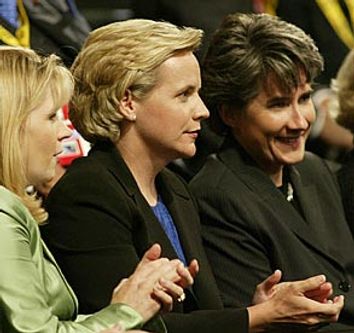
    All across gay America Wednesday night, activists were playing an impromptu kind of parlor game, watching the Republican Convention to see if vice presidential nominee Dick Cheney’s lesbian daughter, Mary, would attend with her partner.

    Television cameras captured Mary Cheney, her sister, Elizabeth, and brother-in-law, Phil Perry, laughing and applauding during Cheney’s acceptance speech. But the tight camera angle shut out others in their box. For a while, an unidentified woman in a red dress playing with the Cheney grandchildren, sitting to the left of Perry, raised hopes that Cheney’s girlfriend had attended the convention, as rumored.

    “You see the woman holding the baby?” Human Rights Campaign spokesman David Smith asked. Phone calls were buzzing in from around the country wondering if that could possibly be her. Activists had one photo of the couple to work from, and the woman’s hair seemed way too light, but it was hard to rule her out categorically.

    So Smith borrowed a seating chart from a reporter, to make sure. And everyone in the box was accounted for; the woman was clearly identified as another member of the family delegation.

    Smith was sorely disappointed at the absence of Cheney’s life partner from the event.

    “It’s a shame that Mary’s relationship is politically inconvenient, and obviously in the eyes of the Bush campaign, not ready for prime time,” Smith said. “It completely unmasks the veil of inclusion put forth by the Bush campaign that everyone is included and welcome. Obviously Mary Cheney’s family is not welcome in the box. Elizabeth’s family is on display for everyone to see.”

    Smith noted that in years past, the vice presidential nominee’s whole family joined him on stage at the end of the speech, but after Cheney’s speech, only his wife, Lynne, came up.

    “Every convention I can remember, Democrat or Republican, the vice presidential nominee has had their entire family on stage: You see cousins and aunts and uncles — the only explanation is because of Mary.

    “Isn’t this an obvious exclusion? They’re going through tremendous contortions to hide it. Because this family is not palatable to the conservative right. That’s a huge departure.”

    Bush defenders denied the campaign had objections to Mary Cheney’s sexual orientation. “Governor Bush wouldn’t have selected Dick Cheney as his running mate if he had a problem with it,” Pat Harrison, co-chair of the Republican National Committee, told Salon.

    But even as Mary Cheney’s life partner was being kept off stage at the Republican Convention, USA Today posted her name on its Web site Wednesday night. At least a few other news organizations, including Salon, have withheld the widely available name as well as a photo of the couple, because it could not be ascertained how open Cheney’s girlfriend is about her sexual orientation and her relationship with the vice presidential nominee’s daughter. Friends say the woman is out at work, but no one could confirm she is out to her family.

    The Mary Cheney story may be the most overreported yet undercovered story in political history. Friends of Cheney say they’ve been contacted by numerous reporters, and some have even stopped giving interviews. Yet only a handful of publications have written about the issue of the former defense secretary’s lesbian daughter.

    Writing in the New Republic, Andrew Sullivan blasted the double standard that has kept the media, and the Republican Party, quiet on the story.

    “How does Cheney square [his anti-gay voting record] with his belief that his gay daughter, Mary, is ‘wonderful,’ ‘decent,’ and ‘hard-working’? I don’t know, because the media, which evidently still doesn’t regard gay rights as central to our politics, has barely asked … The New York Times, for all its pretensions to have left homophobia behind, has barely touched the subject. The Washington Post buried it.”

    Smith also questioned the media’s reluctance to delve into the Mary Cheney story. “They have to my knowledge been out and open and part of the Denver gay/lesbian community. This is not a family that has pulled back behind the veil of privacy until Secretary Cheney was nominated as vice president. This is privacy based on convenience. It’s politically inconvenient for Mary Cheney to be in a relationship with a woman.”

    On the convention floor, every Republican interviewed in the delegations for Texas and Colorado — where Cheney lives with her girlfriend, in Conifer, 25 miles from Denver — tried to express their tolerance for Cheney’s daughter’s “lifestyle,” even if they didn’t approve.

    Even delegates from Texas — which drew attention Tuesday when delegation members bowed their heads in prayer as openly gay Rep. Jim Kolbe, R-Ariz., gave a speech on trade — were reluctant to criticize Mary Cheney or the selection of Dick Cheney as Bush’s running mate.

    Dianne Edmondson of Denton, Texas, says she, too, prayed during Kolbe’s speech Tuesday, though she was “not necessarily protesting. I asked that God show him the straight and narrow way.”

    On the subject of Dick Cheney’s lesbian daughter, Edmondson said: “There’s a big difference between an elected official being gay and someone’s child — we don’t even know if she wanted to go public with it. I believe you love the sinner and hate the sin.

    “There are lots of people within the party who I don’t agree with,” Edmondson continued. “In the end, we all want the same thing — the election of George W. Bush.”

    “If she were speaking about these matters on stage, I’d be highly offended,” said Bobby Eberle of Houston. “The GOP doesn’t support that kind of activity. But Bush picked Dick Cheney because of his long history of public service.” Eberle said he sat “silently and respectfully” through Kolbe’s speech.

    Sharon Johnson, a Colorado delegate from Denver, said “I admire the Cheneys. I had no idea they had a lesbian daughter. I would hate to have homosexuals come into the schools and teach homosexuality, but if she chooses to be a lesbian, that’s her business. If she would go into schools and try to tell my grandchildren or sanction it,” that wouldn’t be acceptable.

    But Nancy Beddingfield of Jewett, Texas, who owns a 2,500 acre farm with over 600 cows and calves and describes herself as being “as Texan as anyone on this delegation,” believes the revelation that Cheney’s daughter is gay will “show the diversity of the party. If that had been a problem for Bush, he never would have considered it. They may have discussed it, they may not have. If they [gays] contribute to the country, then it’s fine.”

    Continue Reading Close

    Mary Cheney to take a leading role in dad’s campaign

    But will her life partner join her on the podium Wednesday night? Stay tuned.

    Friends of Mary Cheney say she’s poised to take a key, daily role in her father Dick’s vice presidential bid, even as questions about her sexual orientation continue to stir the placid waters of this week’s Republican convention.

    Cheney’s life partner is also said to be on her way to Philadelphia or already there. “She is going to become part of the media frenzy,” says one friend. It is unclear whether the girlfriend will join Mary Cheney on the platform when her father formally accepts the Republican nomination Wednesday night, or when he joins George W. Bush for final convention photo opportunities on Thursday.

    A colleague confirmed that Mary Cheney has formally postponed graduate school and will take a leading role in her father’s campaign. “She is going to work as his personal aide — be the body man, so to speak — the person who stays with the candidate all the time,” the source said.

    The Bush campaign has mostly ducked questions about the role of Cheney and her girlfriend at the convention, deferring to the Cheney family’s desire for “privacy.” Although the Drudge Report has repeatedly quoted unnamed Bush sources as saying Cheney would be “embraced,” and welcomed at the convention with her partner, no Bush source has yet confirmed that on the record.

    The issue got dicier Sunday, when Mary Cheney’s mother Lynne scolded ABC’s Cokie Roberts for raising the question of her daughter’s sexuality, and denied that Mary — an open lesbian who worked as the gay relations manager for Coors Brewing — had ever declared she was openly gay. Many friends have stepped forward to confirm that Cheney is in fact openly gay.

    A college classmate of Cheney’s said she was out of the closet as far back as that time. “In personal conversation, she would never hide her sexuality, but she was not politically active around lesbian and gay issues,” the classmate said.

    Cheney never broadcast her sexuality, the classmate added, but word traveled fast. “She was a celebrity in the sense that she was the defense secretary’s daughter. She’s always been in the spotlight. It was widely known.”

    Many gay advocates saw Lynne Cheney’s call for privacy Sunday as a variation on the military’s “don’t ask, don’t tell” policy, forcing Mary Cheney back into the closet.

    “Lynne Cheney has no problem talking about her daughter who’s married and has children, and that’s not private, but Mary’s relationship is,” complained David Smith of the Human Rights Campaign. “There’s a double standard.” Mary Cheney’s sister, Elizabeth, is expected to join the family on the podium Wednesday night.

    On the other hand, some gays defend Lynne Cheney. “She said she loves her daughter, she was very supportive of her daughter,” Rep. Jim Kolbe (R-Ariz.), a Tuesday night convention speaker, told Salon.

    “I’m sure she views it as a private matter and would prefer that it not be public,” he added. “But obviously it’s reality and something that they’re going to have to deal with and acknowledge it.”

    On the far right, the issue is being defined in terms of privacy and decorum, not homophobia. A fairly typical post on the Web site Free Republic read: “What these Gay Terrorists fail to understand is that Lynne Cheney is a LADY. Ladies don’t talk about ANYONES sex life to the news media, especially their childrens… DUH! These idiots will never figure out that most of us don’t care what they do in the PRIVACY of their homes. We do care when they get in our face about it and wish they would shut the hell up and mind their own business!!!”

    Meanwhile, many gay activists say the media’s handling of the Mary Cheney story has become as interesting as the story itself. “The agony that every news organization has been going through in terms of how to report this story is unbelievable,” says David Smith.

    “For the most part, I think they don’t know how to cover an openly gay person. They expect a gay person has to make some sort of pronouncement somewhere.”

    Some gays have asked how Mary Cheney could stump for a ticket antagonistic to gay rights. But others say Cheney herself is fairly conservative.

    “There’s nothing that Mary has ever said that seems incongruous with the ideology of her family,” says Katherine Pease, executive director of the Gill Foundation, who has worked with Cheney professionally.

    “In fact, everything that she did say to me seemed generally in line with her family’s policies. And I think that really just emphasizes and stresses the fact that ideological backgrounds vary within the lesbian and gay community.”

    Continue Reading Close

    Page 1 of 9 in Dave Cullen

    www.salon.com/writer/dave_cullen/index.html