There is no Nobel Prize for mathematicians, the story goes, because of a love affair.
Alfred Nobel, the inventor of dynamite who established the prizes to spruce up his image, refused to endow a prize in mathematics because his wife was having an affair with the Swedish mathematician Gosta Magnus Mittag-Leffler. Nobel was afraid a math prize would be awarded to the mathematician-cum-Romeo, and so the mathematics community has forever been excluded from the most recognized award in all of science.
Alas, the story is not true. Nobel never married and by all accounts was quite a lonely man. But his oversight may perhaps be why mathematicians get so little press. That, and the fact that non-mathematicians have no clue what they’re up to.
“Most people are so frightened of the name of mathematics that they are quite ready, quite unaffectedly, to exaggerate their own mathematical stupidity,” said the English number theorist G.H. Hardy. But admit it: Whether you left math after a humiliating D in high school trigonometry or crawled away, exhausted and defeated, from a year of college calculus, you’ve always suspected that, deep down, mathematics rules the world.
As you read this, ex-physicists are probably devising ever more sophisticated ways to wager your pension fund on Wall Street, and no doubt five geniuses in a government agency that does not officially exist are developing data-mining algorithms that will calculate the likelihood your baby sister is a terrorist.
But there was little to no popular media coverage of the Aug. 20 announcement of the Fields Medals, the highest honor in mathematics. Given every four years to the best mathematicians under the age of 40, this year’s prizes were awarded at the International Congress of Mathematicians in Beijing. No doubt you didn’t even know they were getting together.
The medals went to Laurent Lafforgue of the Institut des Hautes Etudes Scientifiques, in Bures-sur-Yvette, France, and to Vladimir Voevodsky of the Institute for Advanced Study at Princeton. The 2002 Nevanlinna Prize, one of the highest honors in computer science, went to Madhu Sudan of the Massachusetts Institute of Technology.
Speaking by e-mail, Lafforgue said: “When non-mathematicians ask me what I work on, I don’t try to explain it to them because I believe that this is nearly impossible. The same with mathematicians who work in other fields.” Voevodsky is traveling and could not be reached. But Sudan has been successful, he said, in explaining his work to his 3-year old daughter. If she can get it, so can we.
Let us recognize that mathematicians are not like you or me. We the many can detect some beauty in the paintings of Titian, feel a certain sad hope in a Chopin sonata, recognize the grace in Frank Lloyd Wright’s Fallingwater. But, most likely, the isomorphism between a modified motivic cohomology of an algebraic variety and the modified singular cohomology of its natural topological space does little for us.
Which is, really, a shame. For there is a beauty in mathematics, which you may have glimpsed that day in first grade when it struck you how peculiar zero was: that you could add it to any other number — any number at all! — and the number would stay the same. Or maybe you’ve encountered a slick little thing called the square root of -1. There are men who have this number engraved on their tombstones.
This wonder, of course, gets beaten out of us by dull teachers, media stereotypes, the massacre of our attention span, and the manufacturers of standardized college entrance exams. But it hasn’t been beaten out of these guys. “There exist in mathematics things extremely beautiful,” said Lafforgue. “One thing that’s always astonishing is that, occasionally, one realizes that in mathematics the truth is beautiful.”
Over the millennia the tree of mathematics has branched in dozens of different directions, arching out from a base that looks like a high school transcript: geometry, algebra, analytic geometry, calculus. In some ways mathematicians have been working there ever since, extending those basic concepts to more and more sophisticated ideas, building mathematical objects (like the set of all positive integers, 1, 2, 3, …), and constructing ever more complicated beasts (like the set of all fractions, to give a trivial example,). Mathematicians often find this beauty, this truth, in their efforts to unite previously disparate areas of their field, to tame the unruly beasts they have unleashed.
Lafforgue made his mark in such unification. Decades ago a young Princeton mathematician named Robert Langlands conjectured that two very different animals are intimately connected. Roughly speaking, as Charles Seife described in Science magazine, these animals are mathematical objects that can be distorted in certain ways and still retain their original shape [such as the fundamental equivalence between a rubber coffee cup and a doughnut -- one can be stretched into the other, as long as you respect the hole] and objects that reveal the relations between solutions of equations.”
Langlands’ conjecture, described as a “Rosetta stone” of mathematics, was formalized into the Langlands Program, a quest that has happily occupied scores of mathematicians for more than 30 years. Andrew Wiles, the Princeton mathematician who a few years ago announced a heralded proof of Fermat’s Last Theorem, established a important ingredient of the conjecture in his own work.
In general, mathematicians believed that Langlands’ conjecture was true, but proving it was extremely difficult. Parts of the proof had already garnered two Fields Medals, and in 1999 Lafforgue made his mark with a 300-page handwritten proof of the conjecture in the case of what are called “function fields.”
This is where the writer, fearing that he is losing the reader, must bring the discussion back to earth. He’ll begin by pointing out that, the foregoing remarks notwithstanding, mathematicians are as human as you or me, even if they often have funny-looking hair or peculiar habits. The genius Paul Erdos called little children “epsilon,” which is humorous if you’re a mathematician (the Greek letter epsilon is often used as a symbol to express the concept of something approaching zero) but probably irritating if you are not.
Sometimes mathematicians make mistakes. After his proof of Fermat’s Last Theorem was announced in the New York Times (“At Last, Shout of ‘Eureka!’ in Age-Old Math Mystery”) Wiles discovered a mistake in his work and presumably just about had a bird. It took him a year to fix the problem, and Fermat was put to bed at last.
In 2000 Lafforgue was awarded the Clay Research Award by the Clay Mathematical Institute in Massachusetts. Just five days later he found a mistake in his own work. Lafforgue contacted Arthur Jaffe, the Clay Institute’s president and a mathematics professor at Harvard, and offered to return his prize.
“Andrew Wiles and I convinced him that the award would be, under the circumstances, even more valuable to him,” said Jaffe. “He could travel or collaborate however he liked in order to repair his proof.”
Lafforgue said he worked day and night and fixed the flaw a few months later, proving that two very different-looking things are the same. At the same time it gave mathematicians confidence that the Langlands Program would succeed in other areas where work proceeds on the conjecture.
Why does Lafforgue’s proof matter to me or to you? For a moment let’s set aside the part about beauty.
In 1960 the physicist Eugene Wigner spoke of “the unreasonable effectiveness of mathematics.” Mathematics is useful, and not just in the spreadsheet that is going to be part of the report you have due in three hours. Scientists and engineers have constructed our world on it, from Newton’s calculus — which he invented to describe the laws of motion — to the quantum mechanics that describe the workings of the chip inside your personal computer.
Mathematics, amazingly enough, works; that is why it has been called the queen of the sciences. It works in the real world, and not just in the airy heights of the mathematician’s imagination. It’s an ugly kind of thing, in a way, in the minds of some pure mathematicians. “Real mathematics has no effect on war,” wrote Hardy in “A Mathematician’s Apology,” a book intended to justify his existence as a pure mathematician. “No one has yet discovered any warlike purpose to be served by the theory of numbers or relativity.”
Hardy wrote this in 1940, five years before the nuclear bomb was built on Einstein’s fundamental ideas in relativity and well before today’s cryptography built on prime numbers. These days no one is clean. That is one thing of which we can all be sure.
Voevodsky also solved a major mathematical problem, called the Milnor conjecture. Milnor, one of the best mathematicians of the past half century and a close friend of John Nash, the mathematician portrayed in the movie “A Beautiful Mind,” believed there was an equivalence between different ways of describing the properties of different kinds of surfaces. (This is a vast oversimplification, but I’m worried again that I’m losing you.) Voevodsky created new mathematical tools that, in 1996, enabled him to solve the problem.
Voevodsky is also a Clay Institute Prize fellow, and the institute sponsors his visits to Russia to lecture and inspire the current generation of young students there. Russia has a proud tradition of mathematicians and mathematical physicists (built in part, it has been speculated, because the country was unable to mount major efforts in the experimental sciences), which like other areas has suffered with the collapse of the Soviet Union.
How do mathematicians like Voevodsky work? This is, in the end, difficult to say. Hardy spent most days at the side of a cricket field, drinking tea. The great Grothendieck, who as much as anyone else is responsible for a vision of the unity of all mathematics, spent 18 hours a day creating mathematics that has astonished and inspired mathematicians ever since. (Grothendieck won his own Fields Medal in 1966, Milnor in 1962.) “There was far more imagination in the head of Archimedes than in that of Homer,” Voltaire said, which English majors might doubt. But they would be wrong.
Your tax dollars pay for about $300 million dollars of mathematical research each year, and we are finally going to get to something you can understand.
As you read this article, you trust that the words your computer retrieved from Salon’s Web servers are faithful to their original. But how do you know?
You know because mathematicians and engineers have thoughtfully included error-correcting codes in the computers that talk to one another across the Internet, because sometimes bits get scrambled, dropped, or mutilated. Madhu Sudan, winner of the 2002 Nevanlinna Prize, explained it to his daughter as follows: “When my 3-year-old daughter, Roshni, asked me what I do, I told her I correct errors. She asked me what is an error and what does it mean to correct them. So I wrote ‘Rothni’ on a piece of paper and asked her to circle any mistakes (without explaining what I intended to write). She circled the ‘t.’ I told her that’s what I do for a living. She understood what I did, but not why it was a big deal.”
It’s a big deal because Sudan has shown that certain codes can correct many more errors than was previously thought possible.
Sudan is a theoretical computer scientist. He does not, he said, use a computer in his work. He was recognized for his breakthroughs in error-correcting codes, probabilistically checkable proofs, and the non-approximability of optimization problems.
Given a proposed proof of a mathematical statement — say, the statement that there is an infinite number of prime numbers (numbers, such as 7 or 17, evenly divisible only by 1 and themselves) — the theory of probabilistically checkable proofs recasts the proof so that its fundamental logic is encoded as a sequence of bits that can be stored in a computer. Checking only some of these bits, Sudan and others have shown, can determine with high probability whether the proof is correct. Amazingly, the number of bits one must examine can be made extremely small.
How small? Let’s just leave it as “small,” because this article must soon come to an end, and because … well, you know.
Consider two sets: all towns in your state, and all states whose names end in the letter “A.” Given a finite collection of finite sets such as this, what is the largest size of a subcollection such that every two sets in the subcollection have no overlap? I forgot to ask Sudan about this particular problem, but he probably doesn’t know anyway — hey, it’s a tough problem. You might propose a solution, which could be easily checked, but in general there may be no known algorithm that will easily produce a solution from scratch.
What Sudan and others showed is that, for many such problems, approximating an optimal solution is just as hard as finding an optimal solution. Now, this could obviously be useful to scientists and engineers. It also has implications for a fundamental mathematical problem called P=NP (if you solve it, the Clay Institute will give you a million dollars).
Why, in the end, does all of this mathematics matter? Why have Lafforgue, Voevodsky, and Sudan been culled from the set of all mathematicians for the highest honors?
Yes, mathematics is wonderfully useful for calculating the properties of superstrings and the path of the next comet that will collide with earth. Yada yada.
But, really, does a poem matter only because it can be read at a memorial? Isn’t a busker’s real worth the gleam in his eye when he performs? Is whatever art you may have created more important than the way you felt when you created it, or the way others felt when it was received?
“The case for my life, then,” Hardy wrote in his “Apology,” “or for that of any one else who has been a mathematician in the same sense in which I have been one, is this: that I have added something to knowledge, and helped others to add more; and that these somethings have a value which differs in degree only, and not in kind, from that of the creations of the great mathematicians, or of any other artists, great or small, who have left some kind of memorial behind them.”
This story has been corrected.
Stephen Wolfram wants to bring science into the age of the computer. A boy genius turned multimillionaire scientist, Wolfram has been a veritable recluse for the last decade while developing his new approach to fundamental physics. He runs his software company, Wolfram Research, largely by videoconference calls from his home, allowing himself the latitude to pursue his research on the subject of complexity. He views the future of science as one dominated by the computer, one where scientists run experiments via the keyboard, unraveling the vast complexities of the natural world through relatively simple rules of programming.
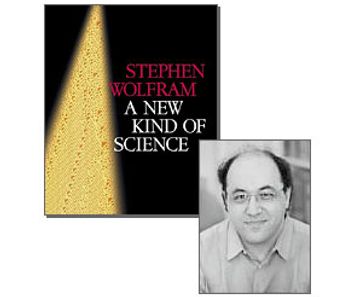
Wolfram is a maestro of this new world, a Moby of a scientist who has looked deep into the standard way of doing science and who sees the sparkling of a new dawn. His just-published magnum opus, “A New Kind of Science,” is his Principia, a response to the deterministic mathematics that Isaac Newton used to render science into a tidy picture of elliptical orbits and parabolic arcs, predictable to as many decimal points as you please.
If Einstein was the long-haired rocker whose theory of relativity overturned the staid, boring establishment, and Heisenberg a jazz fusionist who composed new tunes from discordant notes, Wolfram is a techno-pop artist who programs his machine to the new sounds he hears in his head. With this book he is inviting the rest of the world to move along to the beat.
Twenty years ago, Wolfram writes, the unexpected output of a computer program made him realize he had seen “the beginning of a crack in the very foundations of existing science, and a first clue towards a whole new kind of science.” Although barely out of his teens at the time, he was already recognized as a genius — he had published his first scientific paper at the age of 15, a study in particle physics titled “Hadronic Electrons?” He received his Ph.D. in theoretical physics from Caltech at the age of 20, and a year later became the youngest person ever to receive a fellowship from the MacArthur Foundation (these are informally called “genius” grants).
“He’s extremely smart, impressively smart,” says Andrew Odlyzko, a friend of Wolfram’s who worked with him 20 years ago on cellular automata. And Wolfram knew it. “He was certainly in his early days more than a little arrogant, which rubbed people the wrong way,” Odlyzko says.
Marriage and children have smoothed Wolfram’s rough spots over the years, and a big pile of money probably didn’t hurt: He made millions off his development of the Mathematica software program, a versatile program that is used by millions, most of them scientists and engineers who use it to do symbolic and numerical mathematics.
With continued development, Wolfram expanded Mathematica into a programming language in its own right. “It’s one of the most complete packages I’ve ever seen,” says Flip Phillips, a professor of cognitive psychology at Skidmore College and editor of the Mathematica Journal. Wolfram initially developed Mathematica to evaluate complex equations in particle physics called Feynman diagrams, then turned the usual academic tables by founding a corporation to sell the product to his fellow academics.
His program and his company’s success afforded him the opportunity to pursue his scientific interests unbeholden to the usual demands of academia — the need for grants and the publish-or-perish treadmill. Wolfram writes that he resolved “just to keep working quietly until I had finished and was ready to present everything in a single coherent way.”
But computer technology allows more than programming languages; to Wolfram, it makes a fundamentally new kind of science possible, just as the development of telescope technology made astronomy possible and microscope technology took biology beyond mere taxonomy. “Computers are not just limited to working out the consequences of mathematical equations,” he says, whether they be Feynman diagrams or your checking account statements. Rather, studying the behavior of even the simplest programs reveals extremely complex behavior, as anyone who’s tried to debug a piece of software knows.
Wolfram began his work, and begins his book, by analyzing cellular automata, a conceptual device invented by the Hungarian physicist John von Neumann for representing a complex system using an array of simple elements, such as squares on graph paper that can be colored either black or white. Starting with one initial black square, decide on a rule for how each of its neighbors will be colored in each step forward in time. Repeat the process indefinitely, moving forward one time frame after another. (John Conway’s “Game of Life” is a famous example of a cellular automaton.)
Wolfram spent several years analyzing the results of such cellular automata setups, computer work that involved more than a million billion logical operations and the equivalent of tens of thousands of pages of output. Most of the output is relatively simple, repetitive patterns that remind one of a distinctive braid, or sometimes a snowflake, or occasionally a fractal pattern. But a few of the pictures seemed to demonstrate arbitrarily complicated patterns, long, random chains that seemed to take on a life of their own, reminiscent of the turbulence of a fluid or the curl of rising smoke.
You or I might have seen a pretty pattern and moved on, but Wolfram says using them he has seen into the clear blue depth of a new paradigm of thought. For such pictures can be seen even in cellular automata whose rules are extremely complex — those in multiple dimensions, or based on number systems, or in a Turing machine, a very simple machine that has, logically speaking, all the power of any digital computer.
No matter how elaborate the rule, the behavior that emerges is remarkably similar to that of the simplest cellular automata, according to Wolfram. And what that means is “there are general principles that govern the behavior of a wide range of systems,” Wolfram writes. “Even if we do not know all the details of what is inside some specific system in nature, we can still potentially make fundamental statements about its overall behavior.”
All well and good, but Wolfram’s conclusions have taken him to far greater heights of thought. The problem with traditional mathematics and physics is that it has of necessity restricted itself to simple cases that are “computationally reducible,” systems such as a planet orbiting a star where mathematical analysis provides a simple equation describing the motion. But in other domains, such as predicting the weather, it has failed miserably.
Wolfram’s new science — a science largely devoid of equations — demonstrates, he says, that there are many common systems whose behavior cannot be described except by explicit simulation on a computer. Most of the world, he asserts, is in fact computationally irreducible. The mathematical emperor does have clothes, but not much more than cotton skivvies and an undershirt with an unseemly spaghetti stain on the front.
Wolfram proceeds to attack the bulwarks of science head-on. The famous Second Law of Thermodynamics, stating that any energy associated with organized motions of microscopic particles tends to degrade inevitably into heat — that order tends to disorder — is “is an important and quite general principle,” he writes, but his simple programs show that “it is not universally valid.”
How can humans have apparent free will in a universe governed by deterministic rules? Because, Wolfram says, though our brain works by definite rules of chemistry, “our overall behavior corresponds to an irreducible computation whose outcome can never in effect be found by reasonable laws.” Darwinian evolution? Wolfram believes that his methods can generate essentially any degree of complexity exhibited by life, and they have nothing to do with natural selection.
In fact, Wolfram sees no end to the possibilities of his ideas — or his own place in scientific history. “In time,” he writes in his preface, “I expect that the ideas of this book will come to pervade not only science and technology but also many areas of general thinking. And with this its methods will eventually become a standard part of education — much as mathematics is today.”
It remains to be seen how the scientific community at-large will react to Wolfram’s work. (IBM computer scientist Gregory Chaikincalls Wolfram’s work “a monument to experimental mathematics and the convergence of theoretical physics with computer science.”) Wolfram has purposely declined to publish in the usual scientific journals, and his book is surprisingly devoid of footnoted references to the work of those who came before him (though a full third of the two-volume set consists of an appendix chock-full of general notes).
Wolfram has sought to control all aspects of the work, from establishing his own publishing house to hiring a publicist and placing an embargo on discussion of the book until its exact release date. The book has been anticipated for years, and the hype has apparently paid off: It was already ranked No. 1 on the Amazon.com bestseller list several days before its release. “Never lose a holy curiosity,” said Einstein. Whether or not Wolfram’s ideas launch science in a new direction — and the great success of traditional science in explaining and shaping nearly every aspect of our world sets a very high bar indeed — like other great scientists he has followed his instincts and blazed a new trail. One’s impression is that Stephen Wolfram has never expected any less of himself.
Continue Reading
Close
Journalists are the whipping boys of the information age, and lord knows they deserve it. Operating in a world far too subtle and complex to be reduced to their paltry formulas, they misinterpret statistics, misunderstand research and mishandle the truth, usually in service of their own political and social objectives. They choose topics that advance their liberal agenda and ignore any truths that defy it. They decide which angle to cover and which perspectives to suppress, who’s on the side of good and who’s sold their soul to the devil. You can trust them about as far as you can throw them, and given how slippery they are, that sure isn’t very far.
But have no fear, for experts have arrived to set us straight, in the form of the Statistical Assessment Service — STATS for short. As part of its noble service, STATS offers us the new book “It Ain’t Necessarily So: How Media Make and Unmake the Scientific Picture of Reality” by David Murray, Joel Schwartz and S. Robert Lichter, a trio of social scientists. The book gets to the scientific heart of the journalistic matter, unraveling dozens of science stories that have appeared in print over the last 10 years to reveal “the means by which savvy news consumers can defend themselves.”
For example, are trick-or-treaters being sliced to pieces by razors in apples and poisoned with tainted licorice? “Halloween candy-tampering is a myth,” the authors write. Since 1958, all 76 reports of candy-tampering have been mistaken or fraudulent. The three reported deaths attributed to sabotaged Halloween treats were ultimately traced back to a lie to cover up an uncle’s drug stash, an intentional poisoning of a child by his father and sensational reports of a girl’s fatal seizure resulting from a congenital heart condition.
But “It Ain’t Necessarily So” doesn’t limit itself to disproving popular urban legends. Are you worried about species dying out as a result of global warming? Don’t. Those scare stories are the doing of green scribblers who cherry-pick the scientific journals for alarming factoids and who work in cahoots with Volvo-driving scientists who skew their results in an effort to oppose progress and capitalism. Alarming increases in infectious diseases? Relax, those numbers can be written off to gays getting AIDS and the aging of the population. Magazine and newspaper articles saying anything to the contrary are just the media’s way of pushing for yet more government money to be thrown after bad. Breast cancer skyrocketing, sperm counts plummeting, racial discrimination against mortgage applicants running rampant — just watch the media spin.
The experts debunking these reports go by names designed to reassure, names like The Greening Earth Society (we’re all in favor of verdancy) and The Harvard Center for Risk Analysis (Harvard, of course, knows everything). The last decade has seen the rise of many such groups, here to dice and slice the news and point out its many shortcomings. Staffed with people holding doctorates (in at least some discipline), expressing patent objectivity and publishing newsletters to promote their side of the latest stories, such groups are ever ready to take calls from journalists looking for help in understanding a scientific paper or in search of a ready quote from someone on the other side of an issue’s fence.
The trouble is, many of these groups are industry fronts, pushing industry agendas. The Greening Earth Society, for example, which promotes the benefits of carbon dioxide, was created by the Western Fuels Association, according to the Integrity in Science database created by The Center for Science in the Public Interest. The Harvard Center for Risk Analysis has received funding from numerous corporate sources, including unrestricted grants from Amoco, Dow Chemical Company, General Motors, Monsanto, Procter & Gamble and many others.
The authors of “It Ain’t Necessarily So” come from STATS (Murray); the Hudson Institute, a conservative think tank (Schwartz); and the Center for Media and Public Affairs, STATS’s parent organization (Lichter). STATS was created four years ago, and according to investigative journalist Sheldon Rampton, coauthor of “Trust Us, We’re Experts: How Industry Manipulates Science and Gambles With Your Future,” the organization “derives most of its funding from conservative sources such as the John M. Olin Foundation, the Sarah Scaife Foundation and the William H. Donner Foundation.” Murray, once an assistant professor of anthropology at Brandeis University, has also worked for the Heritage Foundation.
Science journalists certainly don’t always get the facts right. Eighty-nine percent of scientists surveyed expressed “only some” or “hardly any” confidence in the press, according to a 1997 study by the First Amendment Center. “It Ain’t Necessarily So” makes a few valid points. Too often, journalists opt for covering sensationalistic stories — like the one about the asteroid that, at least until more complete calculations were revealed the following day, was headed straight for Earth — instead of the really important, hard-edged ones that readers find less interesting. Every newspaper has its editorial slant, and that does indeed determine its choice of which stories to cover and which to leave behind. The authors of “It Ain’t Necessarily So” take particular delight, of course, in lashing at the New York Times and the Washington Post.
But the hypocrisy of “It Ain’t Necessarily So” is that it employs the very same tactics that it finds so objectionable when used by journalists and publishers. Consider their criticism of coverage of Camille Parmesan’s study of the extinction rates of local populations of a western butterfly, the Edith’s checkerspot, due to global warming. Parmesan’s work, one of the first solid pieces of evidence of the biological effects of global warming, was published in the journal Nature in 1996.
As is the case with so many examples in this book, the authors’ criticism of how journalists covered the story quickly becomes criticism of the original study itself. One of their techniques is to omit mention of any findings that do not support their agenda. Complaining that Parmesan “took it for granted that the climate had warmed in locales in which the checkerspot was now extinct,” they quote a 1996 communication in the Bulletin of the American Meteorological Society (BAMS) saying that the “apparent ‘global warming’” in the western U.S. “is in reality urban waste heat affecting only urban areas.”
But this analysis doesn’t hold up under closer scrutiny. Not only is the BAMS paper that the authors of “It Ain’t Necessarily So” cite a simplistic statistical view of the measurement of urban heating — tallying county-by-county information regardless of the vagaries of individual temperature measuring stations — but they also overlook a major BAMS paper published earlier that same year by Thomas Karl and colleagues of the National Climatic Data Center. This study found a 1 to 3 degree Celsius warming in the western United States from 1910 to 1995 — after explicitly correcting for urban heat island effects.
Likewise the authors grouse that Parmesan did not take into consideration that the thinning of the butterflies’ population may have result from the loss of their host plants due to factors such as changes in air quality or the impact of agricultural chemicals. But Parmesan, as expected, does state — in a figure caption — that she did not count checkerspots in sites that “were degraded by loss of usable host plants,” regardless of the reasons for that loss. She also writers that she had eliminated over three-quarters of the sites potentially available to her for, in part, just such reasons of degradation.
Other criticisms in “It Ain’t Necessarily So” are just wrong. The authors complain that Parmesan did not include “anything like a baseline for the number of extinctions that would be expected in the absence of any warming.” But what they apparently fail to understand is that Parmesan designed her study to reveal patterns of net extinction with respect to latitude, rather than the absolute number of extinctions. It is these patterns that were the signal that population changes were due to climate change. Furthermore, the authors misread a reference to “2 degrees” as one of temperature (“Celsius”), and not of latitude — which is just the kind of error you might expect from social scientists dissecting a study in the natural sciences.
Finally, other criticisms in “It Ain’t Necessarily So” are simply petty. They denigrate Parmesan’s study because it made claims about a single species of butterfly, ignoring follow-up studies by Parmesan, David R. Easterling and others, some of which found similar shifts in 57 species of butterflies in Europe. They sneer that the New York Times article on Parmesan’s work was “lengthier, in fact, than [Parmesan's] study itself,” as if properly explaining a piece of complex work to nonscientific readers should be more dense than the specialized language of the scientists. And they refer to Parmesan’s work as “preliminary,” as if Nature weren’t one of the most prestigious peer-reviewed scientific journals in the world.
Such disingenuous maneuvers fill “It Ain’t Necessarily So.” It’s clear that while the authors are good at looking up articles in Lexis-Nexis, they aren’t playing straight with their readers. Even when Murray and his colleagues hit the occasional right note, it’s always from the same tune. Their analyses and conclusions inevitably stack up in favor of the view that there are few environmental problems that less government spending won’t fix and that social dilemmas like racial discrimination are figments of overactive imagination. A fair review of the state of science journalism is always welcome, but this cleverly disguised example of corporate propaganda isn’t it.
Continue Reading
Close