David Greenberg

Calvin Coolidge: Right-wing rock star?

Sarah Palin praises the 30th president throughout her new book. She's hardly Silent Cal's only fan on the right

  • more
    • All Share Services

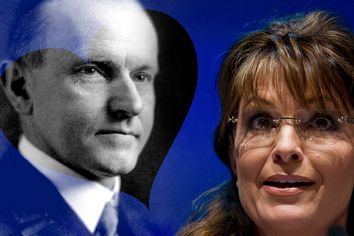
Calvin Coolidge: Right-wing rock star?Former Alaska Governor and 2008 Republican vice presidential candidate Sarah Palin speaks during the National Rifle Association's 139th annual meeting in Charlotte, North Carolina May 14, 2010. REUTERS/Chris Keane (UNITED STATES - Tags: POLITICS)(Credit: © Chris Keane / Reuters)

A reader who knew only the author and title of Sarah Palin’s new book, “America by Heart,” would in all likelihood be able to predict many of the delights contained within: self-justifying accounts of her behavior on the 2008 campaign, snarky jabs at President Obama, paeans to the Alaska grizzly. Rapturous words for Calvin Coolidge, however, would probably not be among the expected finds. And yet peppered through Palin’s new volume of ruminations lies a handful of admiring references to our 30th president. The oddity is worth pondering.

To most people today, Coolidge is little more than a cartoon. If he’s remembered at all, he’s the grim-faced “Silent Cal,” the man said by Theodore Roosevelt’s daughter Alice to have looked as though he had been weaned on a pickle. His taciturn style provoked no end of jokes and anecdotes. One hostess, aware of the president’s laconic reputation, was said to beseech him at an event, “I made a bet today that I could get more than two words out of you.” Not missing a beat, Coolidge replied, “You lose.”

There’s no evidence in “America by Heart” to suggest that Palin has dug much beyond this familiar lore about Coolidge. It’s hard to believe that she’s well-versed in the achievements of his presidency, whether the Dawes Plan to aid a debt-ridden Europe or the unprecedented mobilization of federal resources to deliver relief to victims of the 1927 Mississippi flood. She may not know the finer points of his economic policies. Coolidge seems to appeal to her, rather, because of his talent for evoking the values of a small-town America that was disappearing even during his presidency. Three times she cites his speech on the 150th anniversary of the Declaration of Independence (“I highly recommend it,” she burbles) in which he swears by the timelessness of the ideals of equality and popular sovereignty that it uncontroversially avows.

Yet Palin’s name-checking of our 30th president is less corny than it seems. For decades, since the arrival in power with Ronald Reagan of so-called movement conservatives, Coolidge has been a patron saint to the right — a symbol of patriotism and piety, of hard work and thrift, and not least of low taxes and minimal government. When Reagan moved into the White House in 1981, he removed the portraits of Thomas Jefferson and Harry Truman in the Cabinet Room and put up those of Dwight Eisenhower and Coolidge instead.

For Reagan, who was a boy during Coolidge’s presidency, Silent Cal was “one of our most underrated presidents.” Throughout his two terms in office, including the convalescence after his 1985 cancer surgery, Reagan perused Coolidge speeches and biographies. His staff brought to the White House the conservative writer Thomas Silver, whose 1982 book “Coolidge and the Historians” argued that liberal scholars had given Coolidge a bum rap. Reagan agreed. “I happen to be an admirer of Silent Cal and believe he has been badly treated by history,” he wrote to a correspondent. “I’ve done considerable reading and researching of his presidency. He served his country well and accomplished much.” Like Palin, Reagan drew on Coolidge’s homilies for his own statements.

The president was hardly the only Republican in Washington to find a model in the neglected Coolidge. Wall Street Journal editorialist Jude Wanniski, the apostle of supply-side economics, viewed Coolidge as an unsung prophet for his relentless efforts to cut taxes on the rich. The columnist Robert Novak ranked Coolidge as his second-favorite American leader — after Reagan, of course. GOP consultant Roger Stone hosted annual celebrations of the former president on July 4, which happened also to be Silent Cal’s birthday. The cult of Coolidge remained alive, if largely undetected, for many years thereafter. In September 2006, I was invited to an evening titled “Coolidge: A Life for Our Time,” hosted by the Heritage Foundation, featuring a premiere screening of what was touted as “the first film ever made of the personal and political life of Calvin Coolidge.”

Coolidge retains this mystique because he reconciled two different strains of conservatism and two different factions of the Republican Party. His approval of the decade’s kinetic capitalism pleased Chamber of Commerce types. But economic growth also has a way of unleashing cultural change, and Coolidge’s flinty New England virtue reassured traditionalists worried about moral decay during a time of the “new woman” and the “new Negro,” of the Scopes trial and jazz. “We were smack in the middle of the Roaring Twenties, with hip flasks, joy rides, and bathtub gin parties setting the social standards,” wrote Edmund Starling, Coolidge’s Secret Service agent and daily walking companion. “The president was the antithesis of all this and he despised it.” Despite his reputation for silence, moreover, Coolidge was a skilled speechmaker — a prizewinning orator as a student and the last president to write most of his own remarks — and he excelled especially at the patriotic homilies that Sarah Palin seems to admire.

But Coolidge’s vogue on the right goes beyond the conservative principles he extolled; it lies in his conception of the presidency. He took office at a time when Theodore Roosevelt and Woodrow Wilson had transformed the executive branch, actively using their powers to restrain big business and secure a measure of fairness in economic life. Coolidge, in contrast, believed in a small federal government, a passive executive and light regulation of business. “If the federal government were to go out of existence,” he said, “the common run of people would not detect the difference.” The main legislative battles of his presidency were to implement the tax cuts favored by his plutocratic Treasury Secretary Andrew W. Mellon. He even balanced the budget.

There is another reason, of course, that Coolidge — and not Warren Harding or Herbert Hoover, the other conservative Republicans of the interwar years — has become a hero to the contemporary right. Harding, who was probably more conservative than Coolidge, was discredited by the Teapot Dome affair — a wide-ranging scandal that tainted several of his closest aides. Hoover, who put the small-government philosophy into effect at an hour of crisis, saw it fail utterly. They do not appear in Sarah Palin’s new book.

Coolidge, in contrast, presided over six and a half years of economic growth, which was even called the “Coolidge Prosperity.” He left office in March 1929, seven months before the crash. If he left no towering achievements as president, neither was he tarred by corrupt cronies or by a callous indifference to the plight of the destitute. And if historians note that Coolidge’s hands-off presidential style contributed, in its own way, to the miseries of the Great Depression — well, who today really knows the finer points of his economic policies?

David Greenberg is a professor of history at Rutgers University and the author of “Nixon’s Shadow” and “Calvin Coolidge.” In 2010-11, he is a fellow at the Woodrow Wilson International Center for Scholars in Washington.
What’s the rush?

Florida shouldn't worry about blowing its electoral vote deadline; Hawaii did it as recently as 1960.

  • more
    • All Share Services

The Great Florida Election Dispute of 2000 — finally nearing a close — has offered few bright spots. One might be the inevitable history lessons, discovery of new relevance in the “Corrupt Bargain” of 1824 and the Hayes-Tilden dispute of 1876. Yet even as we’ve wallowed in history lately, we’ve also overlooked a fascinating story from our recent past: the Great Hawaii Election Dispute of 1960. In that saga — pieced together here from newspapers and long-neglected judicial records — a state’s certified election outcome was not only contested in court, but was ultimately, and decisively, overturned.

That story makes clear that there’s only one significant deadline in a contested presidential race: Jan. 6, when Congress meets to choose the next president.

Rewind to 1960. On Election Night, Nov. 8, in the closest presidential race of the 20th century, Sen. John F. Kennedy appears to defeat Vice President Richard M. Nixon. In Hawaii — the newest state in the union, admitted just 14 months earlier — an initial tally of the votes produces a 102-vote Kennedy victory.

The next day, however, an administrator in the lieutenant governor’s office announces that a routine review of the various precinct tally sheets shows a 200-vote error. Rather than losing the state, Nixon now actually leads by 98 votes.

Because of the error, Lt. Gov. James Kealoha calls for an audit (not a recount) of all the tally sheets throughout the state. By Nov. 16, Nixon leads by 141 votes: 92,505 to 92,364. Three days later, a front-page photo in the Christian Science Monitor shows Kealoha holding up the results, which he has certified on behalf of the state of Hawaii.

Immediately, Democrats demand a recount. After all, they know that the Republicans, led by their national chairman, Thruston B. Morton, are battling to overturn Kennedy’s victories in 11 other states. In the off-chance that Republicans should eke out upsets in Illinois and Texas (where they are fighting most avidly), Hawaii’s seemingly trivial three electors could prove decisive.

Besides, they have a compelling case: In many precincts, the number of ballots (including blanks, which today might be called “undervotes”) and the number of people who voted don’t match. Clearly, someone counted wrong.

After some legal wrangling, state Circuit Judge Ronald B. Jamieson, a Democrat, on Dec. 13 orders a recount of the 34 precincts in which the totals failed to match up. On the first day, 12 precincts are recounted, netting a single additional vote for Kennedy. Nixon’s lead stands at 140.

At that point, Republicans call attention to the “Safe Harbor” provision in federal law requiring states to choose their electors six days before the Electoral College meets. Hawaii’s attorney general calls on Jamieson to halt the recount. Jamieson denies the request.

By the time the 34 precincts are recounted on Dec. 15, Nixon’s lead stands at 50 votes. Now persuaded of the unreliability of the original counts, Jamieson orders new tallies in still more precincts — after which Kennedy regains the lead, by 21 votes, on Dec. 17.

On Dec. 19, with the court case ongoing, state electors meet in their respective capitals around the nation. Three hundred vote for Kennedy, 219 for Nixon and 15 for Dixiecrat Sen. Harry Byrd of Virginia. In Honolulu, the three Republican electors enter voting booths in the throne room of the Iolani Palace and vote for Nixon; then the three Democratic electors do the same for Kennedy. In news articles the next day, neither candidate is credited with receiving Hawaii’s three votes.

Back in the courtroom, Jamieson orders the rest of Hawaii’s 240 precincts to be double-checked, and — three days after Christmas — Kennedy is finally proclaimed the official winner by a margin of 115 votes. Oliver P. Soares, the Republican lawyer on the case and a Nixon elector, moves to declare the election invalid because of fraud, since a sample ballot had turned up among the state’s official ballots. (Jamieson, the New York Times notes, has the power to nullify the entire election and order a new vote.) But the judge rules that the appearance of the stray ballot was an innocent accident and that Kennedy’s victory should stand.

The next day, Kennedy’s press secretary, Pierre Salinger, tweaks the GOP for what the Times describes as “their many and unsuccessful demands for recounts since the election.” The Republicans, Salinger notes, “announced that they were going to seek recounts in 11 states. We sought a recount in one state. The recount in the one state … turned from Republican to Democrat. And nothing happened at all in the 11 states the Republicans asked for recounts in.”

On Jan. 6, 1961, a joint session of Congress meets to confirm the electoral vote count. When Hawaii’s turn comes in the alphabetical roll call, the congressional tellers note that they have conflicting documents, since the initial certified document for Nixon remains in their possession, along with the newer certification for Kennedy. But Hawaii’s Gov. William F. Quinn, a Republican, has furnished an affidavit endorsing the judge’s ruling that the most recent document should count, and the final decision to award Hawaii’s three electors to Kennedy is made by the man presiding over the joint session, outgoing Vice President Richard M. Nixon.

And the rest, as they say, is history.

Continue Reading Close